• Skip to primary navigation
  • Skip to main content
  • Skip to primary sidebar
  • Skip to secondary sidebar
  • Skip to footer

M.D. CREEKMORE

  • Blog
  • Books
  • Newsletter
  • Gear I Use
  • About
  • Contact
  • Facebook
  • YouTube
You are here: Home / Archives for Bugging Out

Bugging Out

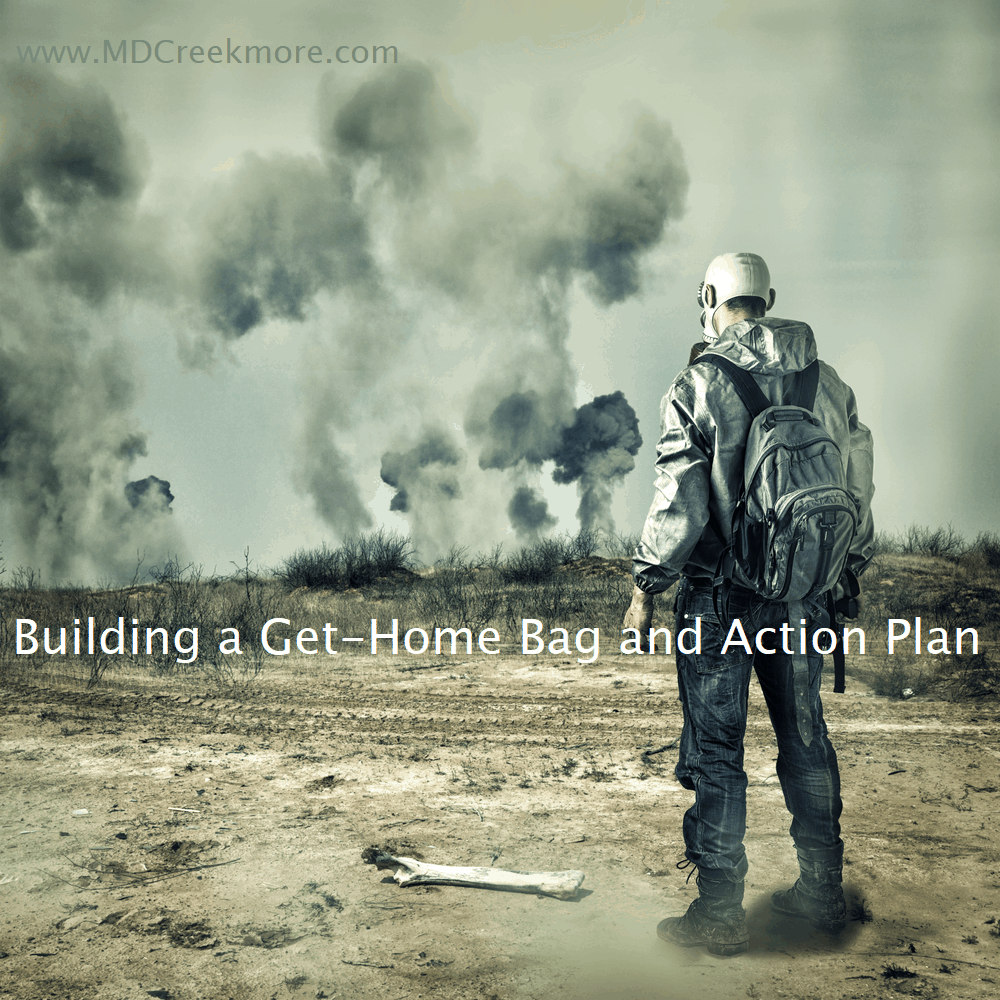
Building a Get-Home Bag and Action Plan

January 22, 2019 M.D. Creekmore

Building a Get-Home Bag and Action Plan

by John R (AKA SickSkilz)

There have been multiple discussions on getting home during a disaster and the contents of a GHB (get home bag).  In the 11/18 weekly preps, I mentioned that I decided to test out my get home plan with the assumption that I would not have my truck available and would have to travel on foot.   Here is how it went and what I found:

I work downtown in a medium to large city.  I drive a bit over 25 miles to work each day and part in a parking lot. In January, I developed my plans to get home from work which included stocking my truck box with the things I thought I would need and keeping other things in my office.

If traveling by vehicle is possible and realistic, I am not too concerned about getting home.  I have a path mapped out that avoids highways at least until I can get to one with a grass medium and shoulder so I could not get stuck.  I also made a rough path to travel on foot.

I suspected that being in really good shape, I could get home in a max of 5 hours.    However, I had never really tested a plan like that.   So, with a day off work that my wife was going to be busy, I decided to test it out.

The route I would take during an actual event involves going near the highway in a north-south direction.  I would not want to do this as a test because the path is more dangerous (and stupid) so I mapped out an east-west path that goes through similarly mixed terrain but not near highways.

I had my wife drop me off a similar 25 miles from home at about 10 am with the things that I carried in my truck and would have on me at work.  I took my phone, but intentionally did not use the GPS on it as something like a solar flare or EMP that would stop me from being able to use my truck could also take out GPS.

The experience was a real eye-opener.   What I thought would be under 5 hours turned out to be 9.5 hours despite the fact that I am in my early 30s and in the best shape of my life.

Significant Learnings

  • The constant changes in terrain and rarely stopping was really hard on my feet. I was on concrete and grass and went up and down hills.   The old tennis shoes I had were only barely better than my work shoes.
  • My work route is 25 miles by car which is 90% straight highway. My test route was a similar distance on the main roads.  I didn’t track it, but I presume that my actual travel distance was a bit longer.   I know how to tell which direction is which, but multiple times I either got sidetracked or got to a place where I had to turn around.  Note: for the purpose of this experiment, I didn’t do a lot of trespassing and stayed near a road most of the time.
  • While I did have some food and did not get excessively hungry, I got very dehydrated because I only had two 12 ounce bottles of water
  • Given that it took much longer than expected, my wife now knows not to freak out if I don’t get there quickly.

I also found that there were a lot of things in my GHB that I no longer think I would EVER need in a GHB or are things I could have with me at work or in my truck and only carry with me as needed depending on the specifics of an event.  I figure I could have saved at least another hour traveling lighter.  Below I have listed the contents and some changes I made.

* – would leave in my truck

** – would only take with me as the situation warrants

*** – removed from GHB


Get Home Bag

  • Glock 19 with 2 clips and 100 rounds
  • Mace ** – as needed unless I buy a smaller can.
  • Lighter
  • Fire starters *** – I decided this was not useful to carry. 1 lighter could last me weeks
  • Minimal food/water for 1 day – Changed to 2 boxes of granola bars, a 24 count case of water and a few cans of Mountain Dew (my preferred method of caffeine intake. If I leave my truck, I’ll only take 6 bottles of water or so.   Great for bartering as I have extra.
  • First aid kit – It was way too big. I took out a respirator mask and 1 large bandage that I would take with me.  The rest would stay at the truck.  I would not be putting on band-aids and ointment in the interest of time
  • Crank radio/flashlight ** – it’s a bit bulky and weighs almost 2 lbs. Nice to have in the truck but not that necessary to carry on me.
  • Blanket and jacket ** – I wore the Jacket and ended up putting it in my backpack within 15 minutes. Though it was quite chilly, the pace I was moving more than kept me warm.
  • Multi-tool and screwdriver *** – I will probably get some flak for this but I never conceived of a use for it that warranted their weight.
  • Gerber machete – I debated bringing this but I loved loved loved having it. Multiple times I found myself wanting to cut through the woods and it was really nice. For those of you who have never done yard work with a machete, its way better than using pruning shears for clearing thin brush.   The Gerber one has a saw on the back for trimming anything bigger.   Really convenient
  • Pen and Paper *** – Dear diary, I feel stupid that I even thought I needed this at all
  • Rope *** – I only carried this because Boondock Saints told me too. However, not encountering any mobsters, I figure I am safe without it.  Again, the usefulness does not justify the weight
  • Hat and Gloves ** – I could see myself not needing a coat while moving but a hat and gloves would help a lot. Just not if it’s warm out.
  • Medicine – Stress can give me a headache. A few ibuprofen are more than worth their weight
  • Vitamins *** – more for long term well-being than immediate needs
  • Backpack – while this was necessary, it was big enough that things jostled too much inside it. Needed a smaller one

More on Water

Riverrider aptly suggested I use a water purification bottle.  I sort of go back and forth on this but decided to keep the water because the weight of 6 bottles of water would not slow me down as much the time and energy spent looking for water and filtering it.  I could also use the water for bartering or to get out of a bad situation. Another option might be to go with 3 bottles and a water purification bottle.  Water could also likely be obtained on the way home depending on the circumstance. I still debate this but for now, sticking with bringing the water.

Action Plan

  • I got a smaller backpack packed with the bare essentials from above that I can grab quickly.
  • If the plan is needed, the first step is to add anything extra from my stash at work to my backpack
  • I had been keeping old backup shoes in my GHB (since I wear dress shoes to work) but I needed a better pair. So now I keep a much newer pair in the truck.
  • Keep a change of clothes at work. Especially in the summer I will be way overdressed in my work clothes.  Changing will make me faster.
  • I had always kept a coat in my truck but now also keeping a light jacket in the office. I’m pretty warm and it rarely ever gets cold enough that I won’t keep warm constantly moving.

Finally, now that I’ve made changes, I hope to try it again in February.  While I am not very concerned with the cold, traversing snow will definitely make a big difference.

Filed Under: Bugging Out

What Is EDC?: The Beginner’s Guide to Everyday Carry

January 14, 2019 M.D. Creekmore

What Is EDC The Beginner's Guide to Everyday Carryby S. Loch Pennsylvania

For some odd years, I have found myself going deeper and deeper down the rabbit hole of Every Day Carry (EDC) and, as many of you have modified or improved my EDC and most likely will continue to do so as the years go by. As a kid, I couldn’t wait to get home from school, the weekend or the summers when I could grab my gear and hit the woods.

This was long before the survivalist TV shows and the only hint of “wilderness living” TV was Grizzly Adams. I never went into the woods or for a hike with one of my friends without at least the following; knife, BB gun, first aid kit, water, and a snack.

But now I’m older, 45 to be exact and I have a job at a respectable company so I can’t just show up in surplus army gear without causing alarm and making my coworkers uneasy. So what do I do?

Well for starters I’ve been frequenting many of the EDC sites on the internet and making minor changes to what comes with me every day and doing my best to make it fit in my pockets, on my belt or on my keychain. One of the things that surprise me when looking at peoples “pocket dumps” is how both unique and sometimes (in my humble opinion) lacking many of the selections for EDC there are.

I think even at the basic level of prepping, which is what EDC or pocket dumps are, many are taking too much for granted. Assuming all will be fine without putting just a little more effort into what they carry.

Now I know I am not right in the eyes and opinions of many, and yes we all must tailor our daily carry to what not only suites us best but also the environment in which we work and or travel. Granted, if you work at a Post Office you can most certainly not carry a gun.

If you work at a school there is no way you can get away with a tactical knife, in fact, many workplaces frown upon any knife, (and these are the places where the sheeple cower when someone uses a plastic butter knife when attempting to peal fruit.)

So, on to my basic EDC and why I feel it is important to me.

Belt Carry EDC:

what is an EDC KITMultitool: Like so many out there, the Multitool has become a way of life, that extra hand and in many cases a part of us. Myself, I prefer the Leatherman brand and like any gear addict, I have several of them (8 at last count I think). But among them all, I rotate between the latest version of the Wave and Rebar.

Pocket Carry EDC:

Small pocket knife: For years I have loved the Victorinox Rambler as a small be efficient pocket knife. This small Swiss Army Knife has all one would need on an everyday basis; knife, scissors, small flat-head screwdriver, nail file, Philips screwdriver, bottle opener, wire stripper, toothpick, and tweezers. Honestly, I carry it mostly for the toothpick.

what is an EDC KITBic Mini Lighter: I don’t smoke and don’t plan to, however, I do believe in having a device that can always give me a sure way of making fire. These little lighter are compact, durable and have even made it through the laundry and still work after being submerged.

Wallet: Now how does a wallet fit into the “always ready” EDC kit? Simply put, I always carry at least 2 fabric band-aids in mine. I have 4 boys and sooner or later my wife, my kids or I will cut some part of us. I also have a RAT Knives survival card in there as well.

It always amazes me how many parents don’t even carry a band-aid or two and have to go begging for one at parks, stores and so on. Seriously? Not even a single band-aid and you have kids?! This is, in my opinion, the simplest, easiest and least EDC like thing to carry around with you.

Tactical Pen: Sure there are REALLY good ones out there that you’ll drop close to $100 for, but why? What is the basic purpose of this item? Something to write with and something that is sturdy enough to defend yourself with. Why should I spend a lot of money on something that could be confiscated by the TSA should I forget about it when traveling?

You can get a free tactical pen here – the only catch is that you may have to pay a couple of dollars to have it shipped to you but it’s still a great deal.

I have purchased 3 different models made by Schrade. They make a quality product, I can purchase refills at any big box office supply store and they work perfectly for the two standards I expect them to meet. They also don’t say something on them that might draw the attention of someone looking at my gear and make them paranoid like Smith & Wesson or Uzi.

EVERYDAY CARRY KIT WHAT IS ITFlashlight: A pocket-sized flashlight is another key component to my EDC. I rotate between two different models, one that is powered by a single AA and one that is powered by a single CR123 battery. Both are compact, bright, have multiple settings for brightness and flashing.

I have really started to prefer the AA battery model simply because I know I can always find AA batteries no matter where my travels take me. Whatever one you choose make sure it will seriously put some light “down range” from you so you can see what might be coming long before it gets to you.

Tactical Blade: My tactical blade is for just that a tool for my protection. If I want to cut something that is what my Leatherman is for and if someone wants to borrow my knife that is what my Leatherman is for. But my Tactical Blade doesn’t leave me, in fact, the only person I’ve let use it is my wife solely because she knows how to and knows how I am about it.

No one else will treat it with the same respect as I do. I have several “tactical blades” and I rotate through them every so often, but my favorite, my “go to blade” is my Zero Tolerance 0562 Hinderer Design with a 3.5-inch blade (click here to see it at Amazon.com). I shopped for a really good tactical knife for some time and decided on this one as for me the best quality, design, and reviews.

EVERYDAY CARRY EDC KnivesAlso, as a smaller, beatable, and smaller Tactical Blade I’ve decided to carry the Kershaw Shuffle II in black (click here to see it at Amazon.com). The blade is only 2.25 inches, which makes it great for carrying at work and other places where I don’t want to have a “huge” knife on my (so as not to scare the sheeple.)

Wearable EDC:

everyday carry beltBelt: My favorite belt is the 5.11 1.5” Black TDU Belt (click here to check the current price at Amazon.com). This is a great belt, lightweight and has no metal buckle so in many instances there is no need to remove when going through metal detectors.

Watch: Casio’s Pathfinder PAG240-1CR Triple Sensor watch has been a long time desire for me and I finally got one recently online. This is a great watch some of its features include; solar power, sunrise/sunset, compass, thermometer, barometer, altimeter, stopwatch, and timer.

everyday EDC watchIt is lightweight, comfortable to wear and is just a great all around watch. I feel prepared for anything with it and it is very easy to read (click here to find out more about this watch at Amazon.com).

Hat: The standard baseball cap is my go-to choice for a head cover, it shields my eyes from the glare of the sun, protects my head should I bump into something and provides just a little bit of extra warmth that I might need when the temperatures drop a bit.

However, during the winter months, I carry a Smart Wool Beanie. This is a great hat, very warm in the winter and long enough to cover my ears and part of the back of my neck from the cold.

Miscellaneous Items:

Some other items that I keep on me would be of course my car keys which have a Victorinox Spartan on them (this model has a place for a pin and mini screwdriver for fixing glasses). Also, I have a ham radio license, so I usually have a hand-held (HT = Handy Talky) radio with me.

Lately, I’ve preferred the Kenwood TH-F6A which is a tri-band radio with exceptional receive capabilities. Not only can I receive AM & FM radio but also short wave and all Ham Radio frequencies (with the ability to fine tune as well).

I’m not big on wanting to talk on the radio, but I do enjoy being able to listen to what is going on. I rigged up a way to connect an alligator clip wire to the radio’s antenna jack then to any piece of metal, fencing or what have you to act as a giant antenna for exceptional receive capabilities. I also always have an AA battery pack with me for the radio for emergency power.

To sum up my choices, I feel it is important to be ready for as much as I can without having a backpack, pack mule or service van to carry all of my “must have” EDC items. Yes, there is some redundancy but for the most part not a lot.

I believe in the military idea of, “One is none, Two is one” and by having the Tactical Knife, Leatherman and Victorinox knife I fulfill that; as well with carrying at least two band-aids in my wallet. Everyone’s EDC is unique to them and their environment, my way may not be yours and that is fine. I often look at pics of peoples EDC online and think, “Well, if that guy and that guy meet up together they’re set!”

And well, that very well may be to a solution, you plus someone else may have all you need; it may be your mate, partner, traveling companion, relative, co-worker or just a stranger. Just as we are stronger in numbers, so is our EDC, a well thought out EDC will support itself and if added to someone else’s in a time of need, well your “Multitool will work better in the dark with that guy’s flashlight.”

Also, read:

  • What Is The Best Swiss Army Knife For EDC?
  • What’s The Best Multi-Tool to Buy For EDC

Good luck to you all, stay safe, stay prepared, stay alert and talk to one another and please leave your thoughts and comments below… Also, please share this article with your friends on social media… thank you.

Filed Under: Bugging Out

Everyday Carry Checklist – What Are The EDC Essentials?

December 21, 2018 M.D. Creekmore

Everyday Carry Checklist What are your EDC essentials

By Lee Forbes

My wife and I are new to prepping and have been at it for only seven months. I have been very pleasantly surprised by the things I’ve been getting out of this pursuit which I did not expect when I started. Among these things are; closer bonding with my family, less time in front of the TV, a growing sense of purpose and control over my financial affairs and life, but most of all I’ve come to appreciate the wealth of ideas and inspiration provided by my fellow preppers, and prep sites like this one.

By circumstance, we are suburban preppers and at this point, we’ve improved our ability to sustain ourselves significantly by securing an off-grid permanent water supply, and heat sources for one year. Additionally, we have gone from the “3 days of food in the cupboards” category to having a rich variety of foodstuffs for six people for six months.

With only four of us actually in the household, this is another great idea taken from our fellow preppers…”expect company when TSHTF”. We are continuing to increase our food supply toward the next benchmark of one year.  Along the way we have had a ton of fun as a family, experimenting with canning, Dutch Oven cooking, building dedicated shelving in the garage for our supplies, our first vegetable garden, and most of all…creating and adjusting our vehicle-based bug-out bags.

Another aspect of prepping  I’ve come to enjoy is how preparing for what may come includes the need to parallel plan for “bugging in” and “bugging out”. The crux of this planning it seems to me, for most of us, is to expect an “event” to occur when we are away from the house.

My best guess is the chances are about 50/50 for the average prepper that they will be away at work, doing errands, visiting, or some such when then need to put their plan into action occurs. This brings us to the topic of the first and arguably most important preparation element for Doomsday…the everyday carry bag (EDC).

I have spent a fair amount of time researching many sources on this and experimenting with my own EDC. After much thought toward the actual and practical rationale for an EDC, I humbly offer my opinion that most folks carry around too much stuff in their EDCs.

Carrying a bag of any kind everywhere you go is not as natural in our culture for men as it is for women, and this is perhaps why I found doing so to be so bothersome and hard to get used to.

I carried a book bag all through college, but it has been a number of years and I found carrying and EDC to be mildly annoying …this got me to thinking…man or woman, you should balance being prepared with being overloaded with stuff which in reality you most likely will never actually need instantly at your fingertips…

Cool and necessary stuff to be sure, but much of it is even cooler when it is handy in my vehicle. Less is more they say, especially if carrying a bag everywhere you go is still something you’re getting used to.

The process for me worked out nicely in the end though, and went something like this…The current trend in EDCs seems to be being prepared for multiple contingencies with on the spot solutions for any emergency…

I submit you should trim your EDC to only those items needed to get you the four or five hundred yards between you and your vehicle which, more than 99% of the time, is one minute or less from wherever you may be. Fewer items in your EDC doesn’t mean giving them up, it means only keeping them in your vehicle Bug Out Bag (BOB) instead…still available when needed.

The question becomes how many times in the last year have you been more than a minutes’ walk away from your vehicle? Here, one might argue the possibility that something could happen to your vehicle, or prevent you from getting to it…a Tornado slings your car into the next county, or more likely someone breaks into it, or steals it…or what if you’re trapped in a building?…but how likely is it really that you would ever need some of these items and you wouldn’t have a few minutes to get to your vehicle to get them?

Sometimes you just have to make an assumption and go with it…I’ve concluded the odds of such a scenario are so small that I am comfortable with the risk, and the benefit is I have to have less in my EDC. This makes for a smaller, less bothersome bag.

The idea here is to think in terms of packing your EDC for two things only, 1.) Tools for overcoming whatever could stand between you and your vehicle, and 2.) Items so necessary if you couldn’t reach your vehicle, you’d be screwed without them. At your vehicle-based BOB you can have everything you need for the three days on the road it may take to cover the miles back to your home or your bug-out location…in the meantime, you don’t have to carry anything non-essential with you everywhere you go.

If you are in an office, at a movie, or shopping somewhere, will you really need to change your socks and underwear right then and there? Or could it wait until you get to the parking lot to your car? Will a sudden and immediate need ever arise where you must build a fire in the lobby of a Denny’s using waterproof matches and a magnesium stick? or could it wait until you’ve cleared that location in your vehicle, and are settling in for the night hours later and down the road?

When I first started carrying my EDC about five months ago it was a full-size nap sack and while I liked having all the gear with me, but it wasn’t quite worth the hassle of juggling it every time I was on the move. After embracing the two assumptions above, I settled on the Maxpedition Jumbo Versa Pack (click here to check current price and availability on Amazin.com).

I now use this smaller satchel type bag for a combined purpose of essential EDC items, and everyday items. Even with the essential items, I have identified, this bag is still just big enough for me to also include my I-Pad and my 5×9 folio with some work papers I routinely need.

Now I know I’ve been talking about streamlining this whole time, so why am I adding different non-essential items? For one good reason…by combining the two I still have less of a load than I did before, and the bag now serves two purposes (EDC, and stuff I actually need every day at multiple locations). I hate to say it but…A man purse…It is practical for me on two levels now and it makes it even more worth the hassle of carrying it around.

I would also mention you could look at the similar bag offered by 5.11 which swaps the open top bottle side pocket for a second zipper pocket (You can still fit a bottle of water inside the main compartment and it makes the bag even lower profile). My bag is black and this makes it appear to be an ordinary briefcase type bag, suitable for business, and it calls no attention to itself when I’m walking around in the community. It is so nondescript in fact that after five months of carrying it with me everywhere; I’ve yet to have one person ask me anything about it…think about that!

So then, an empty (And smaller) EDC bag sits before you…what should go in it?

Based on our two assumptions above, is physical danger a possible barrier between you and your vehicle? Absolutely…In goes the handgun! (Assuming you are not already wearing it on your person).

Could darkness be an impediment? Very possible…in goes the mini LED flashlight.

Stuck in an elevator somewhere? Building collapsed and you’re trapped? A bottle of water and a bag of trail-mix would be handy, as would a whistle, a pocket knife, and a glow stick.

Need news, weather, and sports while riding out a hurricane? A charging cable for your smartphone is at hand. No power to charge your Smartphone? A 4-cell AA battery auxiliary charger is the size of an Altoids tin and will keep you tied to the airwaves for days.

On an unrelated note, if you don’t have a Smartphone yet, get one! The downloadable apps are far too valuable a tool for a prepper to not have. (Not all “events” result in the immediate disabling of cellular and satellite networks). To have the internet at your fingertips, files with libraries of everything from knots to raising rabbits, maps, GPS, built-in compasses, and on and on…

I especially like the Tune-In radio station app giving access to virtually every radio station on the planet, and you should also look at downloading the 5-0 Radio Police Scanner App with tens of thousands of police and fire frequencies (including those from your immediate vicinity) for you to listen in on 24/7.

So what else should go into the bag? What might occur in your presence that wouldn’t allow time to run to your vehicle, grab what is needed out of your BOB, and return? A medical emergency? Very possible…Here I can go on a final, and short tangent and offer advice to my fellow peppers on first aid.

I spent seven years as a Paramedic in some of the meanest streets of America, and I have two pieces of very practical advice which will make you highly effective during medical emergencies if followed. Have the right supplies, and the right training…that’s it. What are the right supplies for your EDC? This will blow your mind…one 4″ roll of Kerlix, and one 4″ roll of Coban…That’s it…

These two items are sufficient for all but the most massive traumas, traumas which by definition are more than certain to be fatal in any case. Kerlix is an absorbent gauze roll which can be wrapped around wounds, or shoved whole into larger wounds, where direct pressure is needed to staunch severe bleeding.

Coban resembles the commonly known Ace bandage, but it has the unique quality of being a self-adhesive (but not sticky to the touch). This allows the roll to be used loosely as a wrap that sticks to itself or wrapped tightly to maintain any desired level of direct pressure to a wound beneath. I recall on a number of occasions using Coban even as a tourniquet. It can also be easily torn into sections and/or strips for multiple wounds or smaller wraps of small cuts on the extremities.

These two items require no scissors, pins, clips, or gloves to use, and they both will fit in the palm of your hand at the same time…They are in fact the Swiss army knife of first aid. I should clarify here I am not saying a roll of Kerlix and Coban are all the first aid supplies you will ever need, but they are just enough, just in time from an EDC to allow you to get to your car and back with a larger kit if needed. From the EDC perspective, it is a most effective balance.

What about first aid training? Like many things in prepping, knowledge seems to be the key to everything. I think all serious peppers do the right things in practice with weapons, drilling on bug out plans, researching and doing sustainability skill set building like gardening, animal husbandry, learning knots, etc, and medical skills should be no exception. As a minimum, I recommend a course through the American Red Cross for first aid training. They have chapters everywhere and offer an inexpensive and effective introduction to the practice.

For serious preppers I further recommend a trip to your local community college for enrollment into a Level 1 Emergency Medical Technician course (EMT-1). The beauty of the community college system in America is, without so much as a G.E.D. to one’s name, any adult can go down and pay a reasonable fee to enroll in a one semester-long course (about 80 hours, or 4-5 hours per week, of mixed lecture and hands-on training, spread over 16 weeks). You will learn skills that will serve you and others for life…not a bad deal!

So, back then to our now half full EDC…That’s about it for the essentials…a weapon, food, and light…signaling and information gathering…There are some other items I carry which can’t be justified as tools to remove obstacles between my vehicle and myself, but much like you I imagine, I will carry them anyway, just because they come in handy…and because I have the room now!

These items include; 2 Kleenex tissue pocket packs, Carmex lip balm, earbuds for the music files on my phone, a small Bic lighter (I know, but they are so small, why not?) a couple of crystal light drink mixes, a small digital camera in an equally small padded case, a 3×5 notepad and pen, an extra clip for the gun (because I watch too many movies), a flat of aspirin, a flat of gum picks (I’m starting to get why women carry purses…), two heavy-duty 24” zip ties, and an expired gift card half wrapped with 6 feet of duct tape and the other half with 2’ of Paracord (Very compact) and I still have room to spare.

I continue to experiment and I’d be interested in what others have to say on the subject for sure. I’m feeling pretty good about this plank in our strategy and we are focusing now on our Bug-Out Vehicle and Bug-Out Location. We still have a ton of work in front of us but are enjoying the process itself, and we are learning from our fellow Prepper’s every day. Thanks to you all!

Filed Under: Bugging Out

How to Protect Yourself from Natural Disasters (science-backed)

December 14, 2018 M.D. Creekmore

key-west-FLOOD

by Roger Gallager

Have you been seeing tsunamis, earthquakes, volcanic eruptions, devastating hurricanes and other natural disasters in the news more often? Have natural calamities become more frequent? According to a report released by the Centre for Research on the Epidemiology of Disasters (CRED), there had been 385 disasters recorded during the 2000 – 2009 period. This figure marks an increase of 233% from 1980 to 1989 and a 67% increase from 1990 to 1999.

This means that the increase in the frequency of natural disasters you see on the television and the internet is no coincidence. There has been a steady increase in natural disasters since 1980. Earthquakes made up 60% of natural disasters from 2000 to 2009 while climate-related events, such as droughts, storms, and floods, had made up the majority of disasters overall, increasing tenfold since data was first collected in 1950.  The resulting economic losses from these disasters were estimated at $446 billion.

Now, the question is, are you and your family prepared to face a natural calamity? According to a study conducted by the University of Iowa, College of Public Health which was published online in the American Journal of Public Health, older Americans are not adequately prepared to face natural calamities likes tornadoes, floods, hurricanes, and earthquakes.

Only one-third of the 1,304 adults interviewed said they had read information or participated in a disaster-preparedness program while fewer than twenty-five percent reported having emergency or contingency plans. A disturbing fifty percent of the respondents said they would not know where to seek shelter if they were forced to evacuate their home and about a quarter said they did not have access to transportation during emergencies.

Are you one of these people who are not prepared to face natural calamities? If the world’s worst disasters were to hit your city next week, would you know what to do for survival? If you are not sure, you better take a look at our seven ways to survive environmental disasters.

Surviving a Flood:

Flooding can be caused by different phenomenon. It can be natural, like excessive rain or a tsunami or man-made like the opening of a dam. A flood can develop slowly, over time or rapidly, as in the case of flash floods which can develop in just a few minutes and without visible signs of rain. A flood can be limited to a neighborhood or a community or very large and span the entire river basins or multiple states.

  1. Be aware if your area of residence is at risk of a flood. This is the first thing that a prepper should do. It is unwise to rely solely on history to determine whether your area is at risk of flooding. A number of factors which include, but are not limited to, rainfall, topography, flood-control measures, river-flow and tidal-surge data, and changes due to new construction and development can affect your area’s risk of flooding.
  2. Elevate electric panels, water heaters, and other electrical appliances in your home to reduce the chance of short-circuiting and accidental electrocution during a flood.
  3. Create an evacuation plan and route in case you have to evacuate your home. Be aware of the designated safe areas you can go to. Prepare food kits for natural disasters that you can easily take with you if you have to leave your house. It would help to stock up on your food storage through food preservations for emergency situations.
  4. If there is a possibility of a flash flood, leave your home and move immediately to higher ground. Do not wait for instructions to move. Evacuating may also cause a shortage in available food supply. During these cases, hunger becomes a very real threat. To survive, one must rely on food storage.
  5. While evacuating, avoid walking through moving water. Six inches of moving water can make you fall. If you have to walk in water, walk where the water is not moving. Use a stick to check the firmness of the ground in front of you.
  6. Do not drive into flooded areas. If floodwaters rise around your car, abandon the car and move to higher ground, when water is not moving or not more than a few inches deep. You and the vehicle can be swept away quickly. If your vehicle is trapped in rapidly moving water, stay in the vehicle. If the water is rising inside the vehicle, seek refuge on the roof.
  7. Stay on higher ground even if the floodwaters seem to be receding. There is no telling when another flash flood may occur.

Surviving an earthquake:

A calamitous earthquake is a violent shaking of the ground that can cause massive destruction to people and property. The most common cause of earthquakes is the moving of subterranean rocks to release tension that has accumulated over time.

  1. As with every natural disaster, try as much as you can to assess how much you are at risk of an earthquake. It is much harder to predict an earthquake-prone area compared to other natural disasters. The best one can do is to avoid building in areas which have soft rock foundations as these areas are prone to take more damage in the event of an earthquake.
  2. Most injuries caused by earthquakes are from falling objects hitting people. You can avoid this by fastening shelves securely to walls, placing  large or heavy objects on lower shelves, storing breakable items such as bottled foods, glass, and china in low, closed cabinets with latches and fastening heavy items such as pictures and mirrors securely to walls and away from beds, couches and anywhere people sit. You can also brace overhead light fixtures and top heavy objects.
  3. Earthquakes also usually cause fires as every household is filled with flammable items that can ignite easily when dropped or mixed together. That is why it is important to store flammable materials such as weed killers, pesticides, and flammable products securely in closed cabinets with latches and on bottom shelves.
  4. Always remember three things when it comes to an actual earthquake: drop, cover, and hold. Drop to the ground; take cover under tables or other solid pieces of furniture, and hold on. Remain stationary until the earthquake ends.
  5. If you are outdoors, stay away from buildings, streetlights, and overhead wires. Try to stay where you are unless there is imminent danger.
  6. After the earthquake, it is best to leave your house or building even if it seems to have taken no damage. Beams and foundations may have been broken which might cause collapses that might gravely injure you. In case of earthquakes with strong magnitudes, do not attempt to enter your house unless ensured safe by an expert.
  7. Even if your house and your family manage to take no damage from the earthquake, your surroundings and community could be extremely damaged.  In cases such as these, there might not be a steady stream of a dependable food supply. It would be best to be prepared for these cases by having emergency food ready and having the best survival kits for the situation.

These are just two of the natural disasters that you must be ready to face. Always remember that when it comes to natural disasters, always be aware, prepared, and alert. You never know when disaster might strike.

Filed Under: Bugging Out, Prepping

Must Have Items for Your Car Emergency Kit (A Checklist)

November 11, 2018 M.D. Creekmore

Must Have Items for Your Car Emergency Kit (A Checklist)

Most of us spend a lot of time in our cars, and I feel that it’s necessary to have an emergency auto kit aka auto survival kit in every automobile we drive in addition to our every day carry kits (EDC) and concealed carry handguns.

A handgun won’t be of much use when you need to change a tire, get you unstuck, or change a burnt-out fuse for a new one so that you can get your lights or wipers working and get back on the road and to your intended location.

One of the worst on the road breakdowns that I can remember is having a flat tire in winter with the temperature setting right a freezing with a mixture of freezing rain and sleet pouring down as I changed the tire.

By the time I had finished loosening the lugnuts, jacking up the car, finishing taking off the lug nuts, and then removing the flat tire, and putting the inflated spare tire on and snugging the lug nuts, unjacking and then finished tightening the lug nuts. I was soaked through and miserably cold.

It was, an awful (and dangerous with all the ice and uneven footing) experience… mainly because that happened years ago and I wasn’t properly prepared and didn’t have anything but a jack and spare tire.

Granted even now I’d not want to have to change a flat tire again in those weather conditions but even so, it would be a better experience if I do because now I’m more prepared and would at least stay dry because I have a poncho in my auto emergency kit and a change of clothes.

Below are lists of items for two different kits: the deluxe and basic. Choose the one that best fits your needs and budget also feel free to modify the contents list below to match your location and personal driving habits.

Basic Auto Preparedness KIT

❏ Duct tape
❏ EDC kit (your phone, knife, handgun, lighter etc.)
❏ Fire extinguisher
❏ First aid kit
❏ Fix-a-Flat
❏ Folding shovel (I love this one that’s on Amazon.com)
❏ Hand cleaner, waterless (e.g., GoJo)
❏ Jack and lug wrench
❏ Jumper cables
❏ Spare tire
❏ Toilet paper
❏ Water (drinking), 1 gallon

Deluxe Auto Preparedness KIT

❏ Change of clothes, depending on the season
❏ Rain Poncho
❏ Duct tape
❏ EDC kit (your phone, knife, handgun, lighter etc.)
❏ Energy bars or similar food
❏ Fire extinguisher
❏ First aid kit
❏ Fix-a-Flat can
❏ Flashlight and extra batteries
❏ Folding shovel (I love this one that’s on Amazon.com)
❏ Fuses for your vehicle
❏ Hand cleaner, waterless (e.g., GoJo)
❏ Hose clamps
❏ Ice scraper
❏ Jack and lug wrench
❏ Jumper cables
❏ Light sticks, two or three are enough
❏ Matches
❏ Motor oil, windshield washer fluid, engine coolant; 1 gallon each
❏ Road flares
❏ Sleeping bag or wool blanket (weight appropriate for the season)
❏ Socket set
❏ Spare tire
❏ 12-volt portable air compressor
❏ Special needs items: prescription medications, eyeglasses, hearing aid batteries, and items for infants if applicable (e.g., formula, diapers, bottles, pacifiers)
❏ Tire chains for snowy climates
❏ Tire plug kit (this one on Amazon.com is nice)
❏ Toilet paper
❏ Tools: flat-head and Phillip’s head screwdrivers, pliers, vise grips, and adjustable wrench
❏ Tow chain or rope
❏ Water (for drinking), 1 gallon
❏ Whistle
❏ Wire

Finding a place to store all of this gear inside your vehicle yet out-of-the-way can be a bit tricky depending on the type of automobile. My truck is a double cab with several different storage compartments including storage areas under and behind the seats, so it’s just a matter of placing items where they will fit (and remembering where each item is so I can get to it quickly if needed).

If you drive a car with a trunk then it’s easy… just organize everything neatly in a plastic tote (get one with a tight-fitting lid and preferably one that locks down) and secure it in the trunk of your car.

Vehicle Safety Tips (from ready.gov)

  • Keep your gas tank full in case of evacuation or power outages. A full tank will also keep the fuel line from freezing
  • Install good winter tires and ensure they have adequate tread or any jurisdiction-required chains or studs
  • Do not drive through flooded areas. Six inches of water can cause a vehicle to lose control or possibly stall. A foot of water will float many cars.
  • Be aware of areas where floodwaters have receded. Roads may have weakened and could collapse under the weight of a car.
  • If a power line falls on your car you are at risk of electrical shock, stay inside until a trained person removes the wire.
  • If there is an explosion or other factors that make it difficult to control the vehicle, pull over, stop the car and set the parking brake.
  • If the emergency could impact the physical stability of the roadway avoid overpasses, bridges, power lines, signs, and other hazards

Also Read:

  • The Ultimate Bug Out Bag Checklist
  • Best Survival Guns for Preppers: Handguns, Shotguns, and Rifles

Well, folks, that’s it. If you have any questions, comments, and or suggestions then please post those in the comments section below…

Filed Under: Bugging Out

Bug Out Vehicle Tips And Gear Checklist

September 15, 2018 M.D. Creekmore

bug out vehicle setupBy Brian D.

The world we live in today is unstable.  We face the possibility of terrorist attacks, natural disasters, viral outbreaks, power outages, water shortages, the list goes on and on.  Hurricane Katrina showed proved that the government cannot protect everyone in the aftermath of a large-scale disaster.

This was a wake-up call for many that in order to survive you must take your fate into your own hands.  Regardless of personal feelings about what may be coming or ending, it is growing more and more important to maintain a basic level of readiness for whatever may disrupt life and interrupt the ability to acquire a supply of water, food, and shelter.

Whether you are a hard-core, end of the world “prepper” or just take the Boy Scout motto seriously, there is no shortage of good information on prepping for disaster.

If you plan to “bug out” or “bug in” or just learn what items are best to carry every day, you can find numerous resources and opinions on what gear to buy and what skills are necessary, but one area that often fails to get enough attention in preparedness discussions is preparing and maintaining your vehicle for emergencies.

When disaster strikes, whatever the disaster may be, you might be lucky enough to already be in your safe zone, your “bug-in” site.  But what if you’re not?

What if you’re caught out and need to get home?  Many people focus on what makes up a good EDC or a bug out bag, but your vehicle is capable of handling so much more!

By all means, maintain a solid bug out bag and keep your EDC updated so you have the best tools for whatever you encounter every day, but take a good look at the vehicle that may be your best hope of getting where you need to be to survive.

Some of what is suggested here may be redundant with what you already have in your bag or on your person, but redundancy is a good thing in a survival situation.  You can recreate most of what you’d normally have in a bug out bag or a “get home bag” in your vehicle.

Every vehicle should have some basic safety/maintenance items on board.

These include, but are not limited to:

  • Spare Tire/lug wrench/bottle jack
  • Toolkit
  • Can of Fix-a-Flat
  • Tire pressure gauge
  • Jumper cables
  • Flashlight w/ extra batteries

Now we take this list a step further and add items that will aid in various situations.  For example, inclement/winter weather, treating an injury, or just stuck for an extended period of time.  A few basic items can increase survivability and comfort in most situations.

Here are some suggested items to store in your vehicle:

  • Umbrella
  • First Aid kit
  • Tarp
  • Knife
  • Length of paracord/rope
  • Hat (ball cap and wool watch cap/beanie)
  • Glow sticks
  • Duct tape
  • Cell phone charger
  • Hand warmers
  • Ice scraper
  • Gloves (winter, work &surgical)
  • Leatherman type multi-tool
  • Bottled water
  • Lighter/fire starter
  • Granola bars/snacks
  • MRE/dehydrated meals
  • Blanket/Mylar emergency blankets
  • Rain poncho
  • Heavy duty trash bags
  • Sunscreen
  • Hand sanitizer
  • Fishing rod & small fishing kit
  • Firearm and ammo
  • Extra jacket
  • Daypack/small backpack
  • Maps of the area

This is by no means an exhaustive list, but rather some basics to work from.  You will want to tailor your list not just to your environment/climate, but to any specific needs you may have.  Most of these items you probably already have laying around in duplicate or can pick up fairly cheap.

Several of these items are seasonal in their usefulness and can be rotated in/out according to the weather, but it’s easier to keep them all in the vehicle so you don’t forget to add them back as needed.  A few of these items are worth paying a bit more attention to.

I won’t go into great detail on many of these because there are plenty of reviews and resources out there already. Instead, I’ll touch briefly on items worth a little more thought than just something to toss into your glove box.

Your first aid kit should be stocked according to your level of first aid training and knowledge.  For example, don’t invest in a field surgery kit if you have no idea how to perform any of the functions the kit was designed for.  Rather stick to what you know how to use.

You can start with a store-bought first aid kit, but you’re likely to end up with tons of band-aids and little of the other items you may need.  Stock useful items like ibuprofen, anti-diarrhea meds, allergy meds, anti-bacterial ointment, and cold/flu meds.

Be sure to have a selection of band-aids, gauze, tape, with scissors and tweezers.  Add a small mirror and a magnifying glass for those hard to get splinters. The magnifying glass can even double as an emergency fire starter. Some instant cold paks are a good idea, as well as Quick Clot for larger wounds.

Include a snake bite kit as well. Sawyer makes a good venom extractor kit for around $15.  Obviously, it’s always a good idea to expand your knowledge, so sign up for a first responder class or a rescue first aid class with your local Red Cross and add items to your kit accordingly.

When it comes to firearms obviously you’re going to spend some cash and quality items will set you back some, but this is not the kind of thing you can afford to have fail if you really need it, so select carefully.  This weapon should be in addition to your normal conceal carry weapon, so you aren’t as limited by size.

This is totally a personal choice and you can find endless discussions and arguments over what’s the best weapon to have in any given situation.  The important thing is to choose a weapon you are familiar with, practice with, and can rely on.  Of course, when it comes to carrying any weapon, be sure to check your state’s laws and act accordingly.

In addition to the basics, some other items worth investing in are a portable jump starter and a portable air compressor.  You can buy units that have both in one, like the Stanley J5C09 that is a best seller on Amazon. It has 500 Amp/1000 Peak Amp capability, a 120 psi compressor, and the ability to charge USB devices.

The unit is heavy, weighing in at around 18 pounds, but should be enough to jump-start even a V8.

Another good option is the Clore Automotive Jump-N-Carry JNC660, also an Amazon bestseller.  This unit is a professional grade jump starter and while missing the bells and whistles of the Stanley model, it boasts 1700 peak amps.  It also weighs in around 18 pounds.

This is a no-frills model, but might be your best bet if you’re in an area with long-term freezing temps that typically wreak havoc on vehicle batteries.  Both of these items come in between $80 and $130.  You can find a cheaper, lower amp model but if you have anything bigger than a 4 cylinder in warm weather, you may find that your unit doesn’t have enough “umph” to get you started.

As for emergency tire inflators, there are several good ones on the market.  Stick with something in the mid-priced range, somewhere between $40 and $60.  Viair, Kensun, and Q Industries are some names to look for.  Just be aware that much like the jump starters, you often get what you pay for.

If you have a big truck with big tires, you may not get much use out of a bargain mini compressor other than pumping up pool toys for the kids.

Now we’ve talked about the items to have in your vehicle, what about maintaining the vehicle itself?  After all, the real goal of the vehicle is to get from point A to point B in as efficient a manner as possible.  If the vehicle won’t go, it’s just an expensive shelter.

You know to get an oil change when the little sticker from the lube place says so, or the “Maintenance Required” light comes on.  You replace tires when someone points out the steel showing, but beyond that put little thought into vehicle maintenance until something goes wrong.  This could prove deadly in a survival situation.

You may not be a mechanic and may know little about the magic happening under the hood that makes your cargo, but here are a few tips for keeping the vehicle on the road and available for use during an emergency.

At least once a month take the time to do a detailed inspection.   Start out by just cleaning up.  Get rid of the fast food wrappers, old drink cups, and bits of paper.  Go through your console and toss out anything you don’t need and reorganize the things you use the most frequently so they’re closer to hand.

In the warmer months items like ice scrapers, wool hats, hand warmers, etc., could be placed in a bag in the trunk and vice versa when the weather gets cold.  Rotate your unused snacks, MRE’s, and bottled water for fresher items.  Check to be sure you have copies of your current insurance card and vehicle registration.

Check your license plate to be sure it hasn’t expired.  These aren’t survival items, but a couple of minutes could save you a traffic stop.

Now check the head, tail, break, and reverse lights.  Check the turn signals.  Take a look at your tires and use a tire gauge to check air pressure.  Air pressure can vary with the temperature, so even if you don’t have a leak you could be a little low.

Remember that you can find the manufacturer’s recommended tire pressure in your owner’s manual or on the tire placard on the vehicle door’s edge.  Check the tread wear of your tires.  A good way to test this is with a penny.

Insert the penny into your tread with Lincoln’s head facing you and upside down.  If you can see all of Lincoln’s head then you are below the recommended tread depth and should prepare to replace the tire as soon as possible.

Look under your car where you normally park.  Are there any signs of leaked fluid?  Pop the hood.  Check your oil, power steering fluid, brake fluid, and antifreeze with the vehicle off and on a flat surface.  Look over your hoses and belts for any thin places, bulges, or other signs of wear that may need to be addressed.

If you’re unsure how to do this, take a few minutes to read through your owner’s manual, check out some YouTube videos, or maybe look into a basic auto repair class at your local community college. You’ll never regret having those basic skills.

If you have your car maintained periodically at a lube place or dealership, odds are they will check these items and more, but verify that with your particular servicer and don’t count on a periodic oil change service as your only problem detection.

Check things out with your own eyes.  In addition, be aware of changes in the way your vehicle handles.  Listen for different sounds.  For example, squealing when you stop is a good indicator that it’s time for new brake pads.

If you aren’t a mechanic yourself, find someone you trust to handle any repairs and remember that typically the earlier you discover and address a problem, the easier (and cheaper) it may be to repair.

Your vehicle may be your lifeline in an emergency situation.  Whether it gets you out of town when the world falls apart, or just gets you home from work, you never know what you might encounter along the way.

It pays to be confident in your ability to safely get to your destination, wherever that may be, so prep your vehicle just like you would your other gear and multiply your odds of survival!

Filed Under: Bugging Out

Is The Lever Action A Good Bug Out Rifle?

September 9, 2018 M.D. Creekmore

Lever action rifle ready to bug out By Jim Ballou

For a lot of potential wilderness survival emergencies, a lever-action carbine of one variation or another chambered for a versatile hunting/defense cartridge seems especially practical in my view. With such a weapon you’d have rifle-like accuracy and power in a comparatively compact, portable platform, and for this reason, I believe the carbine lends itself well as the basis for an emergency survival or bug out kit.

I chose to make my own such survival kit out of a Winchester Model 94 “Trapper” carbine with a legally minimum 16-inch barrel, chambered for 44 Remington Magnum (an earlier glimpse of this same project is featured in my book, Arming for the Apocalypse.

I like this gun for this particular purpose because it’s a fast-handing repeating lever-action of a conveniently short and handy size, and its cartridge is not only interchangeable with my favorite revolver but is also quite versatile.

The 44 Magnum has been used since its introduction in the mid-1950’s to successfully hunt every species of North American big game if my information is correct. My little carbine holds nine loaded rounds in its magazine tube, plus one in the chamber.

For me, this is the perfect sit-around-the-campfire kind of gun. If some beast were to suddenly burst into my camp in the middle of the night and threaten my being or the safety of anyone else in the camp, I believe I would feel fairly secure having nine or ten fast rounds of 44 Magnum at my disposal to answer the threat with.

I am aware that this particular variation of the Model 94 is no longer manufactured by Winchester, but I still frequently see plenty of used ones offered for sale. I purchased mine new in 2002 when they were still in production, and I paid around $300.00 for it at that time.

butt sock survival kit
Plate removed, showing small cavity in butt of stock for housing small survival gear.

The used ones I’ve seen lately have been priced considerably higher. By the way, this same model was also offered in .357 Magnum, and I believe one in that chambering would also be an excellent choice for this purpose. Additionally, there are at least a few other lever-action rifles and carbines chambered for 44 Magnum currently available from other gun makers.

No doubt readers will think of other viable or possibly even more suitable carbine designs for their purposes, but whether we opt for a lever-action, semi-auto, pump-action, single-shot, or bolt-action, I think the general idea of a survival carbine would be basically the same.

I began my project by removing the butt plate and drilling a 5/8” diameter hole into the wooden stock, just deep enough to hold a few wooden matches, a hobby knife blade, some sewing needles with a length of thread, a cotton ball (for emergency fire starting tinder), and some fish hooks.

I avoided the temptation to drill a larger hole that would house more gear, being careful to avoid compromising the stock’s structural integrity. After screwing the plate back on, I decided to sew a tiny pocket to the gun’s sling for stowing a short key-shaped screwdriver with the gun that fits the screws used to hold butt plate to the stock.

sling swivel on lever action rifle
A tiny pocket made from leather scrap was stitched to the sling to house the key-shaped screwdriver for the butt plate.

Next, I wrapped the entire buttstock of the carbine with several sizes of utility/survival cord. If there is one type of product more generally utilitarian to a wilderness survivor than cordage, I am not aware of it. When I visit the woods I invariably end up using the cord in shelter building or tent raising, tying down the gear, repairing items, hanging supplies from tree branches, replacing boot laces, etc.

The task of wrapping a rifle stock with cord can be tricky, but I’ve learned a few little tricks that make this process easier and more successful.

First, it is much easier when attempting to tightly wrap any tapered object with cord to start the process from the smaller diameter end of the thing and progress toward the larger portion, because the windings of cord have a tendency to slide apart while wrapping them on a body tapering downward. You will want to keep your wraps even and tight together.

A second trick involves using a wrapping technique commonly employed in whipping the ends of rope with small cord, and this is how you can avoid entirely the use of bulky knots that eventually unravel, while also maintaining a more permanent and tighter wrap.

cordage wrapped around rifle stock
Close up view of the wrist area. Note also that the lever itself has some cord wrapped onto it.

This can be done simply by forming a bight in the standing end of your cord and laying this bight stretched out along the length of the item you want to wrap, and wrap your windings of cord over it together with the (gun stock, in this case) until your windings approach the remaining eye in the end of the bight.

At that point, you feed the running end through the eye and pull on the standing end of your cord to draw the bight and running end under the tight wraps. I sometimes use two pairs of pliers to firmly grip and keep both ends of the cord taut during this finishing stage.

Finally, I discovered that by adding a furniture tack at the comb of the stock I was able to provide a much-needed ledge to hold back the wraps of cord at that point. Without something like this, there is nothing to prevent the windings of cord from merely slipping over the edge of the comb.

Wrapping the wrist area of a Model 94 Winchester requires some care because there is a safety button in the lower tang that must be depressed by the closed lever before the gun will fire. So, any wraps of cord around that area must not be too thick or interfere with that little button, because if they do the weapon won’t work.

lock bladed knife attached to rifle stock
A lock blade knife with a belt clip fits conveniently onto the stock’s shell holder.

After I had wrapped several layers of small cord on the carbine’s stock, I decided that a cloth shell holder that goes over the buttstock could be a handy thing. After adding that, I found that a lock-blade knife with a belt clip that would firmly slide under the back end of the shell holder could also be very handy to have in the woods. I eventually secured this knife into position more permanently by tying it on using several lengths of small diameter cord.

At some point, it occurred to me that the gun’s sling would lend itself quite well as a shell holder as well as a pouch for more small survival gear. The sling I had purchased for the carbine came with a few cartridge loops already, but I wanted a few more.

bug out survival kit
Examples of lightweight survival gear that can be carried on a rifle sling: 1) small knife, 2) sparking tool, 3) wire saw, 4) button compass, 5) #6 barbed fish hooks, 6) needles & thread for emergency repairs, 7) birthday candle, will sustain small flame for 35 minutes, and 8) band-aids and butterfly sutures.

I discovered that a belt slider with six cartridge loops could be positioned in a convenient section of the sling and stitched into place to prevent it from sliding around. I also discovered that this created a sort of convenient pocket between the belt slider and the sling, inside which I managed to fit a small bag of some basic survival items like a ferrocerium sparking tool, a small knife, a wire saw, bandages, more small-diameter cord and fishing tackle, a button compass, etc.

To make all these goodies thus mounted on the sling (including those spare rounds stowed in the cartridge loops) more secure, I ended up wrapping a handkerchief around the whole works and binding it up with a few lengths of small cord. While the sling may now be a tad bulkier and heavy with all of these things on it, it is still nevertheless usable as a carry sling.

Sling on lever action rifle and ready to bug out
A handkerchief tied on helps to protect the ammo in cartridge loops and all the survival gear on the sling.

Ultimately I ended up with not only a handy little 44 Magnum carbine to take along camping and scouting around in the woods, with its spare ammunition stowed “on board”, but in fact a survival kit system of its own. So, will this resulting mess of outdoor gear form part of my emergency Bug-Out Bag arsenal? You bet it will. With a set-up like this, a survivor would have plenty of possibilities available to him in an emergency.

Bio:  Jim Ballou has worked as a self-employed, independent insurance agent and a freelance writer for over sixteen years. More than sixty of his magazine articles on a variety of topics ranging from primitive and early American crafts and tools to wilderness survival skills have appeared in five periodicals since 2000, including Backwoods Home Magazine, The Backwoodsman, Wilderness Way Magazine, Primitive Archer Magazine, and Modern Survival Magazine.

Mr. Ballou’s first non-fiction book titled: Long-Term Survival in the Coming Dark Age was published by Paladin Press in 2007, and it quickly became a Paladin best seller. This was followed by four other popular non-fiction titles with Paladin Press, including Makeshift Workshop Skills for Survival and Self-Reliance, MORE Makeshift Workshop Skills,Arming For The Apocalypse, and the most recent title, The Poor Man’s Wilderness Survival Kit.

Ballou’s interests are too varied to list here but include blacksmithing, gun collecting, target shooting, reading and learning about history, writing, camping, hunting, fishing, treasure hunting, exploring, experimenting with tools and creative processes, survival and self-reliance related topics, plus all of the primitive skills, among numerous other interests and hobbies. He lives with his wife and two kids in Idaho.

Filed Under: Bugging Out

  • « Go to Previous Page
  • Page 1
  • Page 2

Primary Sidebar

About the author

I’m M.D. Creekmore, and I’m all about simple living, financial freedom, and life here in Appalachia. I grew up poor in these mountains and built a life around doing more with less. Read more→

  • Amazon
  • Facebook
  • Substack
  • Twitter
  • YouTube

Subscribe to my newsletter

Join the thousands of readers who get it delivered free to their inboxes every week

“Do more with less.”

– Minimalist proverb

Secondary Sidebar

Read My Books

Paperback and Kindle

Footer

Recent Posts

  • A quick note about The View From Appalachia Channel
  • Weather Update for My Corner of Appalachia
  • Why I’m Ordering Ivermectin + Mebendazole Every Year
  • The Website’s Shutting Down (But Here’s the Plan)
  • You Are Hated! Start Training Like It!

More about me

Books I’ve written

Books I’ve read

Follow Me on YouTube

Follow Me on Facebook

Gear I Use and Recommend

Newsletter

Search this site

Follow me elsewhere

  • Amazon
  • Facebook
  • Substack
  • Twitter
  • YouTube

© 2008–2025 M.D. Creekmore · As an Amazon Associate, I earn from qualifying purchases.

  • Blog
  • Books
  • Newsletter
  • Gear I Use
  • About
  • Contact
  • Privacy Policy