• Skip to primary navigation
  • Skip to main content
  • Skip to primary sidebar
  • Skip to secondary sidebar
  • Skip to footer

M.D. CREEKMORE

  • Blog
  • Books
  • Newsletter
  • Gear I Use
  • About
  • Contact
  • Facebook
  • YouTube
You are here: Home / Archives for Knives and Blades

Knives and Blades

Here you will find articles on knives, and other bladed tools and techniques for their use and well as state knife laws that all knife owners need to know.

Fixed Blade and Folding Survival Knives (Selection and Care)

December 31, 2019 M.D. Creekmore

fixed blade survival knivesGuest post by Josh C  

Any Prepper, Survivalist, Hunter, Camper or Outdoor Enthusiast should have a good knife and know how to use it.  A good survival knife is the single most important piece of equipment you will ever have or use.  With it, you can procure fire and food, and create shelter and other structures. Just as there’s a tool for every job, a wrench for tightening bolts, a hammer for pounding nails, there’s a knife for every task.  

If you’re blazing trails or clearing brush you would want a Machete (check out this awesome CRKT Machete out on Amazon). If you’re splitting kindling or dressing game the obvious choice would be a Fixed Blade. Cutting rope and carving tent stakes then falls to the Folding Knife (this is one of the best folding knives priced at under $20).  

Let’s take a look at the parts of a knife. The blade is made up of the edge, the tip, the point, and the coil. The tang is the part of the blade that runs through the handle.  

When choosing a knife there’s a simple guideline to follow:  

Hold the knife, how does it feel in your hand? Does it fit your hand comfortably? Is it too heavy for you to use effectively? Is it too big?  Look it over, what is it made of? Are you going to be comfortable carrying it around with you on outings?  

Use the knife, is the blade-shaped correctly for the jobs you may need to use it for? Will you be able to comfortably use it for an extended period of time? Go over all the cuts and slices you may need to make.  

Research it; ask people who have it how it handles. Read reviews on it, many times have I bought a knife on impulse to have it break the first time I use it.  

Price It, I have never spent more than twenty-five dollars on a knife. That said you should not skimp on quality, the knife you purchase has to be perfectly suited to you for you to survive.  

Now, let’s take a look at the types of Cutting Edges there are available.  

Machetes:

In a survival situation, a good chopper can make a world of difference. While an ax or hatchet would be equally useful for chopping, they lack the finesse of the machete.  

There are several different styles of machetes ranging from the Gurka Kukri to the South American Bola. The only good way to find the style that suits you is to get out there and use it.  

Fixed blades:

A good fixed blade is essential to your survival. When choosing a fixed blade one thing to keep in mind is whether or not it has a full tang.  

The tang is the portion of the metal that runs through the handle. A full tang provides extra support for chopping and slicing or anything that requires putting any stress on the blade.  

Also, try to stay away from hollow handled “survival” knives. These are accidents waiting to happen.  

If it has a hollow handle than it has no support from the tang and is therefore probably the worst tool you can take into the woods.  

A blade length of between 4 and 7 inches is probably best for survival and bushcraft purposes, any larger and it becomes too cumbersome to use effectively, any smaller and you might as well use a folding knife.  

Folding Knives:

The Folding Knife provides amazing control when carving and doing fine work. There are to types of folders, Pocket Knives, and Multi Tools.  

Pocket Knives can be divided into two further categories, Jack Knives, and Pen Knives. Jack Knives are hinged on only one end but may have more than one blade.  Multi-Tools are divided between Multi-blade Knives and Multi-pliers.

Multi-blade Knives are hinged on both ends like Pen Knives but in addition to multiple blades, they have tools such as scissors, bottle openers, corkscrews, and screwdrivers.  They are traditionally the only type of knife with a blade that locks in place, although it does not have to. Pen Knives are hinged on both ends and have multiple non-locking blades.  

This style of knife was made popular by the Victorinox knife company. Multi-pliers are basically Multi-blade Knives that fold up inside folding needle-nose pliers. The Leatherman Knife Company made this tool popular. Sometimes generic multipliers are referred to as Leatherman tools.  

survival knives fixed blade

There are two common types of steel used in making knives. The first being stainless steel, stainless steel has the advantage that it is virtually indestructible and in theory, won’t rust.  

That said, it will tarnish over time, and will not keep a good edge for very long. The other type of steel is ‘carbon steel’. Carbon steel will take and hold an edge better than stainless but will rust if exposed to the elements.  

There are several things that you can do to extend the life of your knives or any tool for that matter.  

First, keep it dry. ‘Dry knives live long lives’. The process of rusting is scientifically known as rapid oxidization. If you leave an apple out in the open air for any period of time you will notice that it will start to turn brown.  

That is called oxidization, which basically means that the fruit is losing moisture. Rusting occurs when metal gains moisture (whether it’s through being left out in the rain or other), and then rapidly losing it.  

Keep it clean. If you ever have to cut a piece of food with your knife, and it’s still all sticky from that piece of pine you cut through the other day, then what are you going to do.  

Sap and other sticky substances and residues can easily be removed by rubbing at the sap with rubbing alcohol and using a dish scrubby or rough sandpaper.  

Finally, keep it sharp. A dull knife is much more dangerous than a sharp one. When carving with a dull knife you have to force the knife more than is necessary, making it harder to control. It is also a lot easier to work with a sharp knife.  

There are many methods of knife sharpening, included are:  

The Sharpening Steel (honing rod). The honing rod is a long round file used for quickly sharpening longer blades. Sharpening (wet) Stone. The sharpening stone is the most reliable knife sharpener out there. It has been used since before our forefathers came to America.  

Precision Sharpening Systems. There are many different types of manual sharpeners and kits on the market. Okay, now I have a question… What’s your favorite survival knife? 
Filed Under: Knives and Blades

What’s The Best Pocket Knife for Every Day Carry?

November 11, 2019 M.D. Creekmore

What is The Best Pocket Knife

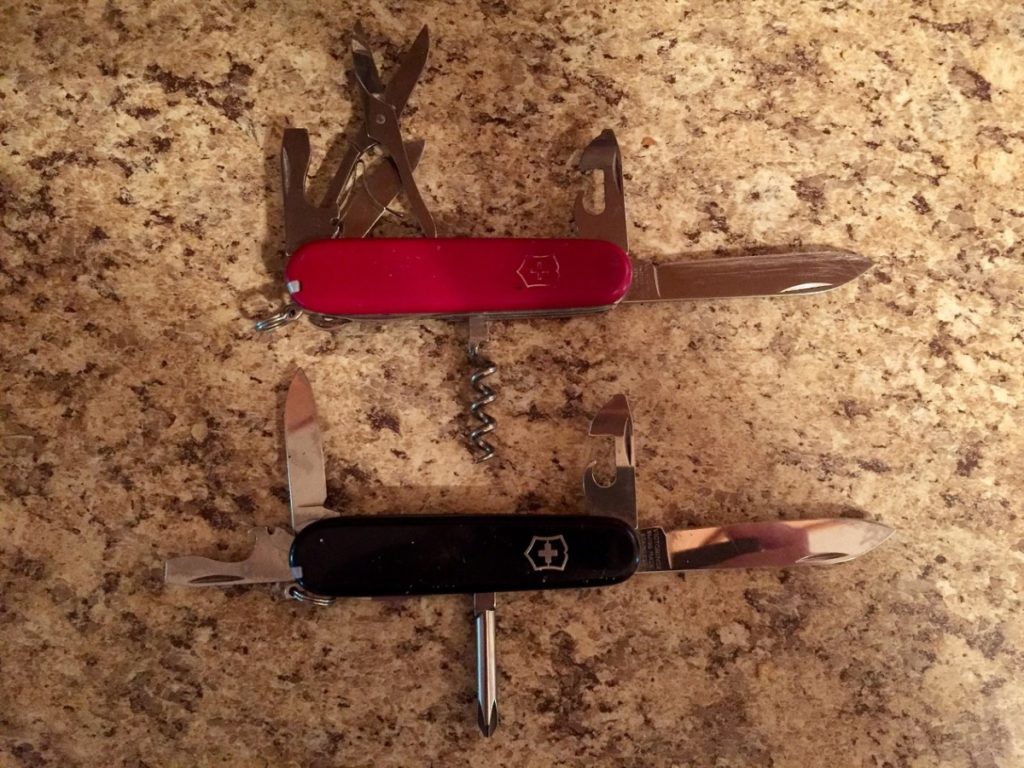
Swiss Army Knives are arguably one of the most underrated and overlooked knives there is. They are great for everyday carry (EDC), camping, and wilderness survival but which is the best pocket knife for 2019.

One of the most important pieces of advice you can follow when putting together your everyday carry, or EDC is to not just get the right equipment but to get high-quality equipment.

One of the handiest items you can have as part of your EDC is the Swiss Army Knife, such as the kind made by Victorinox.

Victorinox has been producing knives since 1897, so it’s safe to say that they know what they are doing. In other words, they know how to deliver quality.

But first of all, why is a Swiss Army Knife even a necessary or wise item to have in your EDC?

Why Carry A Swiss Army Knife?

There are many reasons that you should carry a Swiss Army Knife as part of your EDC, and we’ll outline and discuss the primary reasons here:

It’s Convenient

It may not be one hundred percent necessary to carry a Swiss Army knife as part of your EDC, but there’s no question that it would be a very convenient item for the sole purpose that it combines multiple tools into one.

In fact, Swiss Army Knives are arguably one of the most underrated and overlooked tools there is. This is because a Swiss Army Knife essentially takes several items out of a toolbox, sizes them down, and then stuffs them into the body of the tool:

– Knife Blade
– Magnifying Glass
– Key Ring
– Fish Scaler
– Can Opener
– Bottle Opener
– Screwdriver
– Measuring Tape
– Scissors
– LED Flashlight
– Toothpick
– Tweezers
– Saw

That’s just a small list of the above items that are often packed into a little Swiss Army Knife. With those kinds of tools, you can perform tasks such as:

– Opening Boxes
– Slicing or Cutting food
– Tightening Screws
– Cutting Wires
– Seeing In Darkness
– Sawing Through Small Wood Pieces
– Opening Cans and Bottles
– Peeling Fruit
– Measuring A Certain Height
– Opening A Wine Bottle

You get the idea. A Swiss Army Knife can be a highly convenient item to have with you in your everyday life.

In fact, the most complex Swiss Army Knives have over thirty different tools in them (yes, thirty). The fact that you’re carrying multiple tools together is what makes Swiss Army knives so unique and such a wise item to have with you. It’s multi-functional, and it will be there when you need it.

You Can Carry It With You Everywhere

Or at least you can bring it with you almost anywhere. Because of how small it is. The largest Swiss Army Knives measure approximately five inches in length and the smallest Swiss Army Knives around two inches in length.

It’s really easy to bring your Swiss Army Knife with you around in your pocket wherever you go, and you won’t even remember that it’s with you (at least not until you need it).

In short, Swiss Army Knives are among the most portable tools in existence, and this alone proves their worth in gold.

It will Last For Years

Swiss Army Knives

So long as you buy a Swiss Army Knife from a highly reliable manufacturer, such as Victorinox, it is going to last you for many years, and this is not an exaggeration.

The primary reason for this durability and quality is because Swiss Army Knives are built out of stainless steel, and have been for years. Furthermore, they are also often further coated in rust and corrosion-resistant materials as well, such as the Victorinox Spartan PS Swiss Army Knife that we will discuss later in this article.

It’s Cost-Effective

Last but certainly not least, did anyone mention that Swiss Army Knives are hardly expensive? They are highly affordable despite their multi-purpose design and stainless steel build construction. It’s a relatively cheap investment that you’ll have to make for a tool that is going to give you many years of dependable service.

In short, you should never underestimate the Swiss Army Knife for how it can serve you in your everyday life.

That being said, don’t overestimate it either. You should never treat the Swiss Army Knife like a defensive, fighting, or combat tool, so you’ll need another tactical knife in your EDC that can fulfill those purposes for you instead.

Next, let’s talk about five of the best models of Swiss Army Knives for EDC use.

The 5 Best Swiss Army Knives For EDC

Here are the five best Swiss Army Knives for EDC and the unique features of each model, listed in alphabetical order:

BEST BEGINNER SWISS ARMY KNIFE – VICTORINOX BANTAM

The Victorinox Bantam is easily the best entry-level Swiss Army Knife, as it consists of only the following components:

– Knife Blade
– Wire Stripper
– Can Opener
– Screwdriver (5mm)
– Key Ring
– Toothpick
– Tweezers

Still, there’s a lot that you can do with just those items. But what really makes this a good entry-level Swiss Army Knife is the price, as it’s offered at a much lower price point in contrast to the other Swiss Army Knives on this list.

BEST LOW PROFILE SWISS ARMY KNIFE – VICTORINOX CADET ALOX

If you’re looking for a Swiss Army Knife that can handle basic and yet consistent everyday tasks, while also being very small and low profile, then the Victorinox Cadet Alox may be exactly what you’re looking for. The scales on the body of this Swiss Army Knife are built out of aluminum oxide. You may be disappointed to find out that this Swiss Army Knife does not have a tweezer or toothpick, simply because it does not have the storage room for either of them, but the tradeoff is you are getting a knife with a much lower profile and size, in combination with the superior grip texting.

In other words, this Swiss Army Knife is about as flat and small of a pocket knife as you could ask for. The entire body of the knife is just 3.3 inches long, while the blade measures just under two and a half inches.

Additional tools that the Cadet Alox comes with, in addition to the knife blade, are:

– Can Opener
– Bottle Opener
– Screwdriver

BEST SPECIALIZED SWISS ARMY KNIFE – VICTORINOX CLIMBER

If you’re in the market for a Swiss Army Knife that’s a little more specialized, then you’ll want to pay close attention to the Victorinox Climber Swiss Army Knife. This is a knife that comes with a few tools you may not have anticipated, including a corkscrew for opening bottles of wine (and is also surprisingly useful for untying knots in your shoelaces as well).

This knife earns its name because it was designed for rock climbers in mind. Still, it’s a very small sized Swiss Army Knife that is a great choice for anyone looking for a practical and conveniently sized tool that they can carry with them every day.

BEST SWISS ARMY KNIFE FOR HUNTING – VICTORINOX HUNTSMAN

There’s also a reason why this Swiss Army Knife is called the Huntsman: it really was designed for use with hunters. To this end, it contains tools such as a saw to slice through branches, a hook for hanging fish, a can opener to open your camping provisions, and even an awl that you can use to drill holes into the side of a tree in order to set up snares.

Besides hunting use, this is really just a heavy-duty Swiss Army Knife that can also be used for EDC use in your daily life, then this will also be good for that.

SWISS ARMY KNIFE WITH THE BEST BLADE – VICTORINOX SPARTAN PS

The final Swiss Army Knife that we will talk about for EDC use is the Victorinox Spartan PS, and this knife is worthy of note because it easily comes with one of the best knife blades of any of the Swiss Army Knives.

First and foremost, you’ll notice that this knife is colored all black, including each of the components such as the blade, which is coated in a material called Polispectral for added durability and rust resistance. This coating is also what gives the blade, body, and the rest of the components the unique black coating that can appear to be different shades when viewed under sunlight.

The total length of this blade when closed is three and a half inches, so like any other Swiss Army Knife, it can easily be carried with you even noticing it.

Conclusion

In conclusion, Swiss Army Knives are a very good tool to have for your everyday carry purposes for the reasons that we covered earlier in this article: they are multi-purpose, practical, easy to carry around, and dirt cheap too. With all of these reasons in mind, it naturally begs the question: why would you not carry around a Swiss Army Knife in your EDC?

If you agree that it would be a good idea to have a Swiss Army Knife to serve in your EDC, any one of the five models that we have covered here today will be a good option for you.

Filed Under: Knives and Blades

Best Throwing Tomahawks [SOG Tactical Review]

June 27, 2019 M.D. Creekmore

tomahawk reviewby Mike

I’m always on the lookout for new and better gear.  We should all be doing that, and for most of the readers of MDCreekmore.com, I think that statement holds true. Today I’d like to talk about the SOG Tactical + Throwing Tomahawk. I saw it for sale on Amazon and decided to snap it up for the following reasons:

  • The cheap hardware store hatchet I bring backpacking with me is heavy, dull and clumsy. The SOG Tactical Tomahawk is listed as much lighter and I wanted to see if it could cut branches and wood as well or better than the average cheapo hatchet.
  • I wanted something that could also be used for self-defense if need be. I reasoned that if the tomahawk was used successfully by both the Native Americans AND later the American military, there had to be something to that.   This holds especially true because as a Canadian, I cannot bring firearms into provincial parks and conservation areas where I typically backpack, and as of late the bears, coyotes, and wolves have been getting more aggressive as they get hungrier.
  • I’ve read good reviews of it elsewhere and:
  • It was very reasonably priced.

Before I go on any further, let’s get a look at this thing.  It looks pretty mean, and it also looks pretty functional in my opinion:

Let’s look at some cold facts about this device.  The overall length is 15.75”, and it weighs in at less than 2 lbs (24 ounces).  The blade length is 2.75” and 0.26” in width and it’s made of 420 stainless steel with a black finish (except for the end of the blade). It has a fiberglass reinforced nylon handle and comes with a nylon sheath with a belt loop in it.

SOG-Tactical-Tomahawk

The uses of this device listed on the website include “… breaching operations, excavation, obstacle removal, extraction, and other utility applications.”.

So, my first impressions were good. Anybody with any kid left in them will look at this thing and exclaim “COOL!” I’m pretty sure that’s exactly what I did. It does have a mean look too it, something that when you pull out in the company of friends, they want one, and in the company of enemies, they might think twice about messing with you.

Aside from the aesthetics, this is a fairly light axe but it does have heft.  SOG claims its well balanced and I agree. Gripping it at the end of the shaft it has a natural swing to it. I feel that it follows the proper path with my stroke. It seems well designed for the mechanics of the human swing.

There’s quite a bit of meat to the blade. As you can see from the picture above, it’s quite thick and should stand up to quite a bit of abuse.  Just like the shaft.  The fiberglass reinforced nylon is very light, provides excellent grip and it seems to be very strong.

There are videos on the SOG website showing them propping the shaft on a piece of wood and driving over the shaft with a truck. The shaft flexes but does not break. Sorry folks, but we’ll just have to take SOG’s word on that one unless you want to buy one of these and do it for yourself.

Still, I tried bending it in my hands and beating the shaft against some concrete and it held up with no breaking and no marking up.  That should give us some clue on to the longevity.

The blade is attached to the shaft with what seems to be a tang of fair length. It’s hard to tell but I’d say it’s about 3”.  The blade is held onto the shaft by what looks like two screws as well as a tight metal band that is about 1.5” in length.  It is attached with a lot of strength and I feel zero give or wiggle to it.

I really just got this Tomahawk so I haven’t had a chance to use it much. However, I wanted to try it out as best I could before actually taking it into the field (my next backpacking trip isn’t until August 12th, sorry).  I did beat up a big stump pretty good and I did bury the end of the blade into a tree with minimal effort.

But to show you how it works, I put together a video showing what it does to both a 2×4 and a pineapple.

The 2×4 is pretty self-explanatory.  How well does it split wood?  The pineapple, well, I wanted to show how well it would work in a self-defense application. The example I use in the video is for protection from animals and nothing else just for the sake of the YouTube moderators.

Be that as it may, I selected a pineapple while feeling both my head and different fruits in a grocery store and it seemed to me that the pineapple best felt like my Neanderthal skull.  For your viewing pleasure:

The SOG Tactical + Throwing Tomahawk retails for about $65. I bought it on sale from Amazon.  I’m sure there are better axe devices out there, but how much money are you going to spend? This thing seems solid, VERY solid and well worth the price if you’re in the market for one.

Also, the pineapple was delicious. Just thought I’d let you know… please share your thoughts in the comments section below. Thank you!

Filed Under: Knives and Blades

What Are The Best Survival Knives For The Money [2019 Hands-On]

June 26, 2019 Jesse Mathewson

what is the best survival knife for the moneyWritten by – Jesse Mathewson

One of the most underrated and over marketed essential components of a bug out, survival, bushcrafters kit are the knife, or in my case knives. Since the rollover in 2000 and failure to collapse of anything at that time, the prepper, survival world has blossomed as an entirely new industry.

This has led to knife builders getting into designing knives for large production companies versus the plethora of smaller individual builders that used to exist. There are now machine shops producing show-stopping advanced design knives, however, are any of these modern art pieces really worth the money you pay for them?

And do they have a purpose outside of looking pretty when you post an Instagram of your never used daily carry?

As a lifetime prepper/bush crafter who has lived for over two decades in the High Deserts of North America having a useful knife on hand is not only essential, it is a life or death decision. There have been numerous times in my life where a simple Opinel #8 kept me from going hungry, allowed me to start a fire and set up camp.

Knives are tools, essential tools. If you live where you are not allowed to carry a knife, move; honestly it is the height of political arrogance, that people not be allowed to carry even a simple folding or sheath knife.

This being said, time for the basic reviews of three manufacturers I recommend to people wanting to start their kits on the cheap, or even for experienced individuals looking at expanding their tool chest.

Mora of Sweden – manufactures the famous Morakniv line of knives. There are dozens of models available though I have found that for most tasks the simple Companion in either stainless or high carbon works just fine and at an average of $13 apiece on Amazon, they are worth buying in bulk.

1.  These are fixed blade, sheath knives and come with a standard working plastic sheath. Modern polymers have proven time and again to be as strong as many steels so don’t let that deter you. The stainless version most commonly seen is made of Sandvik 12C27 a Swedish steel that is almost naturally occurring and well known for its longevity.

The HC or high carbon version is made of laminated high carbon and softer external steel.

2.  The edge bevel or grind is called the Mora grind, and is a very shallow, thin grind that allows easy cutting and shaving of kindling. It is NOT a good knife to use for chopping, though you can do so, as the bevel of the blade itself lends itself to edge rolling and it will need a quick strop before continuing on.

3. Stainless steel models do not hold an edge as well as compared to the high carbon models; however, they are far more rust resistant than the latter. So it is a toss-up as both easily work for the same tasks when called upon. One simply needs more touch up than the other.

4. The grip is a rubberized plastic and they are a ¾ tang, which is quite strong. Initially, upon testing I hammered two into a tree about 5 feet off the ground, I then hung from the handles and put my full weight on them for as long as I could hold it several times. I have also pried with them, putting them in a vice and bending the blades almost double without any harm occurring in the handles themselves.

5. Speaking of the blades, they are relatively thin running .078” to .098” of an inch wide, however, this is a good thing as it means they will work very well for cooking, camping, picnicking, cleaning game, filleting fish and much more. And yes I have done this with them.

6. Over time they will get a patina from use, this is a benefit, of course, if you want to prevent rust upfront and add a little personal touch, there are hundreds of videos about using mustard through vinegar. My preferred method is heating apple cider vinegar up to boiling and placing the blade in this for 5-10 minutes, rinsing with cold water, repeating until quite dark. Than using mineral oil or really any gun or knife lubricant/ cleaner you wipe the blades down well and store them away. It works and they look very tactical after you are finished.

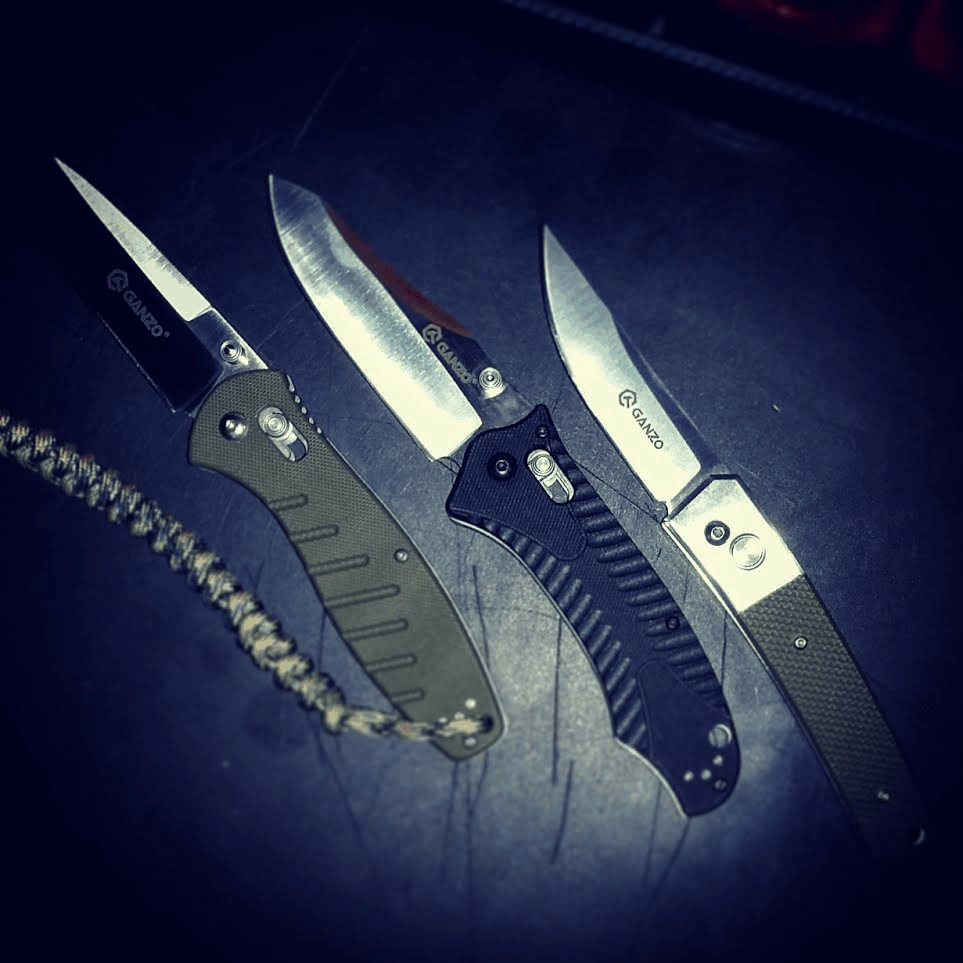
knives-budget-Ganzo

7. Lastly the spine, these blades do not have a 90-degree spine, however, with a hand file you can quickly put one on and even the stainless model with throw sparks from a Ferro rod!
Ganzo Folding Knives – A Chinese manufacturer of folding knives that has grown in popularity and is very well made using solid steel and well fit parts for a low price.

1.  Again there are several models; they have automatic folders, flippers, frame locks and the much talked about the Chinese version of Benchmade’s famous Axis Lock. For the purists, I have several Benchmade knives and love them all.

The axis lock that is being used on the Ganzo is nothing like the lock Benchmade originated. The design is similar, however, it is not as smooth or easy to use.

2. The blade material is 440C stainless steel, with the plethora of modern super steels and machinist designed blades in existence this steel has lost ground. However, for those of us who understand the purpose of a folding knife and tend to use it for that, buying one or more of these for $13-$31 apiece versus a Spyderco, Benchmade or high-end Kershaw at $100-$1200 apiece is the intelligent approach.

3. I tested several models including one auto version, my favorites are the G738 and G724 and lastly the G7212 (auto) model. They come quite sharp, hold an edge as well as most of the other high-end comparable size, styles available and easily take an edge or retouching if needed.

4. I have destruction tested these as well, nearly cutting my thumb off with one test (it was the Spyderco that failed) where I was testing lock strength. I carry one of the above three as my daily user in my left pocket; my right pocket has a defensive styled folder (Fox Karambit, Benchmade Emerson CQC7, Spyderco Paramilitary) and carry this way every day.

5. They are worth the money and easily among my favorite carry knives these days.
Lastly the large bush crafting blade – my first choice (non-khukri style or blade) is Ontario Knives of the USA. You can get a well-made machete, large butcher knife or the Ka-Bar made by Ontario and all of the above will fit well in the large blade category.

1. I highly recommend any of their machete styles though I am personally a fan of the Parang style for its cutting ability.

2.  The butcher knife is a 7” blade length, inexpensive handle, and no sheath though the ka-bar styled sheath will fit it easily and can be found for under $10 on Amazon. The knife itself runs $10-$12 on Amazon and is worth every penny. You can chop with it and do all sorts of things with it, it is inexpensive enough that even if it breaks (the handle is not attached well) you lose nothing and can try your skills at re-handling.

3.  The Ka-Bar well, it has proven itself as a fighter and for many, myself included as a large bush crafting blade as well.

4.  The steel most commonly used by Ontario Knives is 1095 high carbon which is treated properly, takes and holds an edge well, though I do have my blades chip regularly. (Easily fixed, but still something to consider)

So there is three of my favorite low budget bush crafting knives for your consumption. What say you? Which do you like and why? And remember, this is low budget, not bad knives simply under $100 bucks for the three types of knives every bush crafter should have (to begin with).

Filed Under: Knives and Blades

Wisconsin Knife Laws: A Simple Cheat Sheet With All You Need To Know

January 24, 2019 M.D. Creekmore

wisconsin flag - knife lawsEven for a legal expert trained in understanding weapon laws, Wisconsin knife laws are often difficult to understand. The primary reason for the confusion stems from the ambiguous wording of statutes that lead to protracted legal battles inside civil and criminal courts.

Legislative leaders in Wisconsin have made an effort to clear up the ambiguous language by passing laws defining the meaning of a number of knives, as well as clarify the intent of unclear knife statutes.

[ Note: Out of all of the pocket knives available on Amazon.com this one is my favorite everyday carry knife – click here to see what it is on Amazon.com. I love this knife! It’s built like a tank and holds an edge better than any other knife that I’ve owned…]

A thorough review of Wisconsin knife laws leads to the conclusion the state does not consider knives to be labeled as “dangerous weapons” as defined by state law. Let’s review the important components of Wisconsin knife laws to determine where residents and visitors stand.

Recent Changes in Wisconsin Knife Laws

On April 14, 2015, the Badger State passed a law that provides visitors and residents with more legal freedom to own and carry knives. Senator Terry Moulton and representative Kathleen Bernier sponsored the landmark knife law, with Governor Scott Walker a persuasive supporter of the new law.

Governor Walker played an instrumental role in lobbying legislators that sat on the fence during the extended debate that at times turned confrontational.

The governor made a statement that tied the new law to the fundamental meaning of the Second Amendment to the United States Constitution. “Wisconsin citizens have the fundamental right to defend themselves and feel safe and secure in their homes and we remain committed to protecting those rights,’ remarked Governor Walker during an emotional speech.

AB 142 removed every restriction placed on switchblade knives, which the state categorizes as a type of automatic knife. The lifting of restrictions includes the concealed carrying of a switchblade.

State lawmakers made an exception to the new switchblade rules by stating “person who is prohibited under state law from possessing a firearm may also not go armed with a concealed knife that is a “dangerous weapon.”

In February of 2016, legislators removed additional restrictions when it comes knives, concealed carry, and how the state views municipalities that pass more onerous knife laws that what is mandated by the State of Wisconsin.

With myriad lakes and plenty of wilderness to provide homes for wildlife, the reform of Wisconsin knife laws came about primarily because of the strong support demonstrated by the anglers and hunters living in or visiting the state.

Here are the types of knives that are legal to own in Wisconsin:

  • Dirk
  • Bowie
  • Ballistic
  • Dagger
  • Disguised
  • Switchblade

Wisconsin Defines the Meaning of Concealed

In a monumental 1993 Wisconsin Court of Appeals case, State v. Keith ruled there are three criteria for defining what is a concealed weapon. First, the weapon must be completely hidden, Second, the defendant in a criminal case must be aware of the presence of the hidden weapon.

Finally, the weapon is within the defendant’s reach, attached to a part of the body, or stored in a clothing pocket.

Another case litigated by the Wisconsin court of appeals ruled a person was guilty of carrying a dangerous concealed weapon in situations where all the three of the following criteria are met:

  • Defendant was aware of the presence of the weapon
  • The weapon was located inside a car and within the defendant’s reach
  • The weapon was hidden from ordinary view

Subsequent court rulings defined the ambiguous term “ordinary view” to mean a person could not see the weapon standing outside a vehicle or within a vehicle.

Concealed Carry Knife Law in Wisconsin

Knife laws in the Badger State allow residents and visitors to conceal carry a legal to own knife.

“Unless other facts and circumstances that indicate a criminal or malicious intent on the part of the person apply, a person is not in violation of, and may not be charged with a violation of, this section for loading, a firearm, or for carrying, or going armed with a firearm or a knife, without regard to whether the firearm is loaded or the firearm or the knife is concealed or openly carried.”

AB 142, Act 149, Section 11 prohibits a person from possessing a firearm, if the person is also prohibited from conceal carrying a legal to own knife.

Additional Wisconsin Knife Laws Information

State preemption language for Wisconsin knife laws is highly ambiguous.

“With regard to state preemption of local regulations, political subdivisions are prohibited from enacting or enforcing an ordinance regulating the sale, purchase, purchase delay, transfer, ownership, use, keeping, possession, bearing, transportation, licensing, permitting, registration, or taxation of any knife, unless the ordinance or resolution is the same as or similar to, and no more stringent than, a state statute.”

AB 142, Act 149, Section 2 also prevents local regulations from prohibiting a person’s right to open or conceal carry a legal to own knife.

Here is where the state preemption statute for Wisconsin gets muddied.

Although there is a state preemption provision written in AB 142, local governments can forbid the possession of knives carried into a building that is owned, occupied, or controlled by the local political entity. Note the Wisconsin legislature uses the word “building” instead of the term “real estate” to create a narrower restriction for knife prohibition. Knives remain outside the definition of a “dangerous weapon.” However, Wisconsin law has not changed the law that forbids dangerous weapons on school property.

Other Important Provisions of Wisconsin Knife Laws

In the Badger State, minors are not allowed to own a weapon or receive a weapon that was transferred to a minor by an adult. Wisconsin does not place a restriction on the length size of a knife blade. The lack of a blade size restriction is relatively rare among American states. Most states place blade restrictions that range from three to five inches.

Where Do Wisconsin Knife Laws Go from Here?

In a show of unity, both prominent Democrats and Republicans in the Wisconsin statehouse have publicly stated the importance of further clarifying state weapons statutes. State preemption language especially needs more work to unify state and municipal knife laws. Expect some type of law to pass in 2019 that merges state and local knife ownership interests.

Please note: None of the material in this article should be interpreted as legal advice.  I am not a lawyer.  Never take any action with legal consequences without first consulting with a lawyer licensed in your jurisdiction.  This article should not be relied upon for making legal decisions.  This information is provided for scholarship and general information only.

You can read my other knife law articles for other states here…

And check out these related articles:

  • What’s The Best Multi-Tool to Buy For EDC
  • Best Survival Knife of for Under $100
  • Best Folding Knives For Self-Defense
  • Work Sharp Pocket Knife Sharpener Review
  • SOG Tactical Tomahawk Review

Filed Under: Knives and Blades

Missouri Knife Laws: A Simple Cheat Sheet With All You Need To Know

January 24, 2019 M.D. Creekmore

missouri-flag-knife-laws

As one of the leaders in preserving constitutionally guaranteed rights, the Show-Me State not only recognizes the right of residents and visitors to bear arms, but the state also preserves the rights of residents and citizens to own and bear all types of knives. The Missouri Constitution closely resembles the language written into the Second Amendment of the United States Constitution.

  • 23.
    Right to keep and bear arms-exception

“That the right of every citizen to keep and bear arms,  ammunition, and accessories typical to the normal function of such arms, in defense of his home, person, family, and property, or when lawfully summoned in aid of the civil power, shall not be questioned.

The rights guaranteed by this section shall be unalienable. Any restriction on these rights shall be subject to strict scrutiny and the state of Missouri shall be obligated to uphold these rights and shall under no circumstances decline to protect against their infringement.

[ Note: Out of all of the pocket knives available on Amazon.com this one is my favorite everyday carry knife – click here to see what it is on Amazon.com. I love this knife! It’s built like a tank and holds an edge better than any other knife that I’ve owned…]

Nothing in this section shall be construed to prevent the general assembly from enacting general laws which limit the rights of convicted violent felons or those duly adjudged mentally infirm by a court of competent jurisdiction.”

Are Any Knives Prohibited in Missouri?

Since 2012, state law § 571.010 does not include a switchblade on the list of prohibited knives. However, anyone that uses a switchblade to commit a crime is in violation of a long-standing federal law. The United States Congress passed the Federal Switchblade Act in 1958 to regulate interstate commerce. Confusion as to which switchblade law applies to each case has bogged down court proceeding involving the ownership of switchblade knives.

Concealed Carry of Knives in Missouri

Missouri knife laws forbid the concealed carrying of any type of knife, except for “an ordinary pocketknife” that does not measure more than four inches in length. As with many legal definitions, the meaning of “an ordinary pocketknife” has undergone intense judicial scrutiny in several highly publicized civil and criminal cases.

The state law applying to concealed carry reads like the following:

  • Carries concealed upon or about his or her person a knife, a firearm, a blackjack or any other weapon readily capable of lethal use.

In summary:

  • You are not allowed to conceal carry a pocketknife that is more than four inches in length
  • You are allowed to open carry any type of knife that state law mandates as legal to won
  • You cannot conceal carry any other type of knife outside of a pocketknife measuring fewer than four inches in length

As one of the legal pillars of Missouri precedent law, the case of State v. Dowdy rules that a paring knife Dowdy had concealed qualified as a banned conceal carry knife as written into state knife laws.

Concealed Carry Further Defined in Missouri

Missouri law considers the meaning of concealed to be a knife that “is not readily and practically visible to approaching persons under ordinary circumstances.” As another case that set Missouri knife laws in stone, State v. Rowe declared a six-inch bladed knife hidden in the driver’s side door of Mr. Rowe’s vehicle met the legal definition of concealed.

Although Mr. Rowe’s knife handle was easy to see, state court ruled the knife was concealed and thus, a banned knife under Missouri knife laws. Moreover, the court’s decision in State v. Rowe states that in order to convict a defendant for the concealed carrying of a knife, the person owning the knife must have easy access to controlling the knife.

A Few Exceptions to Missouri’s Concealed Carry Provision

Missouri knife laws when it comes to concealed carry do not apply to government employees, as well as professionals that serve legal papers to Missouri residents. Hunters that legally carry an exposed bow and/or firearm also are allowed to conceal carry a knife in the Show Me State.

Anyone “peaceably” traveling through the state are allowed to carry a concealed knife. Numerous defendants have submitted legal challenges in court to request definitions for the terms “peaceably traveling” and “continuous journey.”

Here are a few of the cases:

State v. Mason ruled in 1978 that you do not have to travel entirely through the state of Missouri to be considered on a “continuous journey.” The ruling opened the door for residents that concealed carry certain knives from let’s say Rolla to St. Joseph.

Not surprising, a court ruled in 1990 that transporting a “considerable quantity” of narcotics violated the “peaceable traveling” clause of Missouri knife laws.

Eleven years later, a Missouri Appellate Court rules in State v. White that possession of a small quantity of marijuana does not exempt a defendant from the meaning of “peaceably traveling.”

Missouri Statutory Definition of a Knife

 (12) ‘Knife’, any dagger, dirk, stiletto, or bladed hand instrument that is readily capable of inflicting serious physical injury or death by cutting or stabbing a person. For purposes of this chapter, ‘knife’ does not include any ordinary pocketknife with no blade more than four inches in length;

Remember the term “ordinary pocketknife remains a contentious topic among both defense and prosecuting attorneys.

Miscellaneous Missouri Knife Statutes

Missouri represents one of the few states that does not place any restrictions on the minor age ownership of knives. There is not a statewide preemption allowed for Missouri knife laws. The lack of statewide preemption has given major cities such as St. Lois and Kansas City more legal wriggle room to enact stricter knife laws. The critical dimension mandated by Missouri knife laws is four inches. No blade on any type of knife can exceed four inches.

Missouri Knife Laws Moving Forward

In 2019, Missouri appears to be a state that will address legally ambiguous language written into the state’s knife laws. Lawmakers are also poised to address the legal conflict between allowing minors to own knives and the tough knife laws passed by a few cities that prohibit the carrying of any type of knife on school property. Nonetheless, Missouri should remain one of the most knife-friendly states in the country.

Please note: None of the material in this article should be interpreted as legal advice.  I am not a lawyer.  Never take any action with legal consequences without first consulting with a lawyer licensed in your jurisdiction.  This article should not be relied upon for making legal decisions.  This information is provided for scholarship and general information only.

You can read my other knife law articles for other states here…

And check out these related articles:

  • What’s The Best Multi-Tool to Buy For EDC
  • Best Survival Knife of for Under $100
  • Best Folding Knives For Self-Defense
  • Work Sharp Pocket Knife Sharpener Review
  • SOG Tactical Tomahawk Review

Filed Under: Knives and Blades

Illinois Knife Laws: A Simple Cheat Sheet With All You Need To Know

January 21, 2019 M.D. Creekmore

Illinois knife lawsYou probably have heard about the ratcheting up of violence on the streets of Chicago. The nightly news has covered the stories of street violence (mostly gang related) extensively, as well as nationally recognized publications such as USA Today and the Wall Street Journal. Has the publicity coincided with a push for more weapon control legislation by the Illinois legislature?

The answer is no, which is good news for outdoor recreational enthusiasts that use a wide variety of knives to cut fishing lines and set up duck blinds.

[ Note: Out of all of the pocket knives available on Amazon.com this one is my favorite everyday carry knife – click here to see what it is on Amazon.com. I love this knife! It’s built like a tank and holds an edge better than any other knife that I’ve owned…]

Overview of Illinois Knife Laws

Illinois represents one of several states that refer to intent when it comes to determining the legality of possessing a knife. State law defines intent as attempting to injure another person by using a knife.

However, intent is not the only criterion for determining how to write Illinois knife laws. The state has decreed specific types of knives to be illegal: ballistic, throwing and automatic. Residents of and visitors to the State of Illinois are prohibited from owning and/or selling the banned knives.

(720 ILCS 5/24-1)  Sec. 24-1 defines the unlawful use of weapons:

(a) A person commits the offense of unlawful use of weapons when he knowingly:

(1) Sells, manufactures, purchases, possesses or carries any bludgeon, black-jack, slung-shot, sand-club, sand-bag, metal knuckles or other knuckle weapon regardless of its composition, throwing star, or any knife, commonly referred to as a switchblade knife, which has a blade that opens automatically by hand pressure applied to a button, spring or other device in the handle of the knife, or a ballistic knife, which is a device that propels a knifelike blade as a projectile by means of a coil spring, elastic material or compressed gas; or

(2) Carries or possesses with intent to use the same unlawfully against another, a dagger, dirk, billy, dangerous knife, razor, stiletto, broken bottle or other piece of glass, stun gun or taser or any other dangerous or deadly weapon or instrument of like character;

Illinois law emphasizes the intent to use a legal knife can change the legality of owning the knife. For example, accidentally hurting another person by handing a dagger over is not typically considered bad intent. However, using the same dagger to threaten someone is cause for seeking a warrant for the violation of Illinois knife laws.

A Word about Automatic Knives in Illinois

Like many states, Illinois has banned automatic knives. You cannot create, own, sell, and/or trade an automatic knife. Legal restrictions placed on automatic knives have gotten tougher over the past few years in response to the violence epidemic plaguing the streets of South Chicago. Nonetheless, several Illinois legislatures that represent rural districts have formed a coalition to loosen the restrictions placed on automatic knives, which are popular among anglers and hunters. Avid anglers and hunters should pay close attention to any legislation introduced in Illinois that makes it legal to own an automatic knife.

Knives that are Considered Legal by Illinois Law

  • Pocket
  • Folding
  • Bowie
  • Butterfly
  • Sword
  • Machete
  • Dirk
  • Dagger
  • Stiletto
  • Hidden
  • Misleading

At one time deemed illegal according to Illinois knife laws, switchblades moved into the legal column in 2017 thanks to a coordinated push by legislators representing districts outside of Chicago. On August 11, 2017, Governor Bruce Rauner signed into law SB 607, which repeals a ban on switchblades in Illinois.

Open Carry Knife Laws in Illinois

Despite the media attention paid to the violence in Chicago, Illinois has remained a knife ownership friendly state. Only a few styles of knives are outright banned and in some areas of the state, you are not allowed to open carry a knife that exceeds three inches in length. Areas of concern that regulate open carry knives include public property, such as a state landmark and a federal courthouse. All other types of legal knives are eligible to be open carried anywhere in the State of Illinois.

Concealed Carry Knife Laws in Illinois

As opposed to open carry laws, Illinois does not place restrictions on the concealed carrying of a knife, as long as the knife is legal to own. However, like open carry knife laws in Illinois, concealed carry statutes ban the carrying of any kind of knife in the following public places:

  • Public schools
  • Public housing
  • Courthouses
  • School buses
  • School sanction activities held off-premise
  • Public transportation
  • Prisons
  • All types of athletic venues

Illinois Laws and Knife Length

Illinois law places few legal restrictions on the length of knives carried by residents and visitors. Yet, a couple of laws exist that prohibit the carrying of knives that are more than three inches long.  The length restriction is in place on properties partly or entirely owned by state, federal, and municipal governments. There does not have to be bad intent to ban knives measuring more than three inches in length.

Illinois Knife Laws and Minors

In an attempt to prevent the onset of illegal behavior by minors, Illinois legislators have focused on crafting knife laws that target minors. Under Illinois statute 105 ILCS 5/10 22.6, any student in possession of a knife while on school grounds is legal cause for expulsion of the student between one year and two years.

A group of legislators have proposed Illinois knife laws that increase the penalty for minor ownership of any type of knife off school grounds, but each bill has fallen short of receiving enough votes in the Illinois legislature.

Illinois Knife Laws 2019

Perhaps no other state has such a wide disparity in political perspective than what you find in the State of Illinois. Representatives of Chicago districts-especially districts located on the south side-want stricter knife possession laws, as well as harsher penalties for violating the laws. Rural legislators prefer a much more lenient approach to Illinois knife laws. Nonetheless, neither urban nor rural Illinois legislators have placed any bills on the 2019 legislative docket that address knife issues. Stay up to date to legislative activity by joining the email list created by your state representative.

Please note: None of the material in this article should be interpreted as legal advice.  I am not a lawyer.  Never take any action with legal consequences without first consulting with a lawyer licensed in your jurisdiction.  This article should not be relied upon for making legal decisions.  This information is provided for scholarship and general information only.

You can read my other knife law articles for other states here…

And check out these related articles:

  • What’s The Best Multi-Tool to Buy For EDC
  • Best Survival Knife of for Under $100
  • Best Folding Knives For Self-Defense
  • Work Sharp Pocket Knife Sharpener Review
  • SOG Tactical Tomahawk Review

Filed Under: Knives and Blades

Les Stroud SK Mountain Ultimate Survival Knife Review

October 13, 2018 M.D. Creekmore

survival knifeby Randw

My recent gift/purchase of a Les Stroud SK Mountain, Ultimate Survival Knife by Camillus, gave me an opportunity to do a review on a product that at first glance seems rather contrived and panders to the “Survival/Prepper community” by its very design and nature.  These types of fluff/specialty items usually leave me feeling exploited and preyed upon by the “Sax Fifth Ave” types who come up with various marketing tools to separate us from our hard-earned money through slick marketing and gimmickry that seldom leaves us feeling good about a potential purchase.

Check Latest Prices: Amazon.com | BladeHQ

Since I had been given a gift coupon to a big box hardware store during the recent Christmas Holiday I was feeling rather adventurous and wanted to see what was available in their knife selection.  I was somewhat in need as a few years back my favorite survival knife and I had said “good-bye” as someone was in need of the knife a whole lot more than me, but I digress.

Can you really have too many good knives?  After all, they are always “loaded”, and fit nicely in the palm of your hand.

I had intended to go with a Gerber, Buck, or other easily recognized quality American made knife or hatchet but was compelled to see what was available in the “survival expert Arena” (Bear Gilas, Less Stroud, Dual Survival, Cody Lundeen, etc.).

Since I am a strong advocate of “two is one and one is None” when it comes to bugout or survival gear, I knew I needed a back-up to my 8-inch “Dive knife” perched atop my BOB in the storage area of our home.  I was not certain what I was searching for but had not bought a good mid length, fixed blade knife in a long time and was certainly in the market for a backup, survival tools, and am always searching out other items to augment my outdoor gear when shopping in outdoor or sporting goods section at any retail market.

While browsing in the knife section I was first attracted to Gerber and Bear Grylls knives as well as Buck and Camillus.  As I was looking at the fixed blade knives, I noticed there was a survival knife in my price range ($40-$60.00) with a large plastic sheath and tons of advertising that Camillus put on their packaging of this Les Stroud SK style knife.  I was kind of mildly impressed by its versatility and the sheath’s “survival tool” integration, as well as the bladed weapon, they offered in this obviously contrived yet cleverly engineered product.

At first glance it is quite obvious that the knife is effective in design although not as robust as many Hunting/bush-craft or other survival knives I have looked at (blade is too thin on the front inch of the shank and needs additional spline reinforcing as well as spin thickness, in this area, as Buck and other premium Knife builders use)”.  This cutting tool would certainly offer many utilitarian as well as self- defense options for the end user.

The cutting edge of the knife itself includes a rather wide 1.5 inch by 5 inch blade with a Titanium coating that is proprietary to Camillus but has a similar coated appearance to the black (anodized) coatings put on the Buck, first generation, Knight hawk 6.5” black, anodized stainless steel blade, tactical  knife I owned and carried for years.  In addition, the sheath-knife has as its core, a super sharp, black tungsten treated, stainless steel blade, a  with a 1-inch serration for cutting bone or wire, and an integrated striking notch for starting fires using the flint, cut into the knife spine/back.

I knew in my heart that it would be very hard to replace the Buck, Night Hawk tactical knife I carried for years that I generously gave away as a token of appreciation.  The Buck and is now residing in the hands of an amazing man of God in the Himalayan Mountains of NE India, but that is another story, (I sort of still miss that knife but I know it was the right thing to do in giving it away).

In addition to this rather utilitarian, SK knife, I really was drawn to the innovation/redundancy that was offered in the sheath of this “survival” tool.  The assortment of survival trinkets incorporated in the sheath, include:  integrated signal whistle, LED flashlight, signal mirror, blade sharpener, flint striker and para-cord, like, cordage found on the knife’s sheath.  This combination of survival gear fit nicely into my duplication principle mentioned earlier (two is one…).

I currently and have for the last 3 years, incorporated all of the sheath mounted items (signal mirror, whistle, fire steel, flashlight, and para-cord) in my BOB but was intrigued by the fact that I was able to double dip on my preps in one single purchase, of a knife I would be carrying anyway.

One minor detail about the use of materials on the handle and the sheath that could be a potential drawback is the plastic construction of the sheath housing and accessories, as they are made of plastic and should not be kept too close to a campfire or heat source of any kind for fear of a melting event, but if you have most any modern knife or sheath with plastic components, being left too close to a fire there would probably result in adverse consequences.

As an additional plus for those living in a nanny state like I do anything over 6 inches in a fixed blade and 3.5 inches in a folding knife is illegal.  The blade of this SN knife is about five inches long and is therefore legal to carry openly.

In a grid down situation, to me, this would not be an issue (WROL SITUATION) but if I am pulled over tomorrow and the knife is laying on the seat beside me I would not be face scrutiny or worse for carrying a “scary” if not illegal, weapon.

While I have not had time to fields test every aspect of the props integrated into the knife sheath, I can tell you the whistle works with some practice and would be better that yelling for help for an extended period of time (intended purpose of any whistle),

The mirror is tiny; about 1.25 x 2.25 inches with a burnished rather than truly reflective surface like a mirror, but it might work in a pinch to check on a facial wound or to shave by.  It would certainly be able to reflect light to signal an aerial spotter and there is an incidental hole at the blade sharpening port found below the mirror that would allow a person to align the mirror with the sun in order to achieve the correct angles for optimal, signaling using the sun reflection.

The flashlight would work for up-close, detail work or reading a map in a low/no light situation, but would not offer a lot of illumination or security if you would need lighting for walking a trail on a cloudy night since it is a single LED bulb.

The flint/striker is only about 1.5 inches long but once the black paint/coating is scraped off, will create ample spark to ignite dry tinder or a prepared “fire wick” of some kind.

The integrated edge/blade sharpener is underpowered at best but in a wooded setting with no other stones to use as a blade, sharpener, it is good to know you have it available as a failsafe.

The so-called “Paracord” is about ½ the diameter of normal para cord but looks to be of similar construction to the real thing.  This 10 ft. cord would be a good place to start if all you had was shoelaces and not much more for cordage but would not be enough to hang a large shelter, tarp from.

There is also a small flip-up compartment housed in the sheath under the mirror that could store a small fishing line or some strike anywhere or waterproof matches but it is not truly water prof so additional packaging with a baggie/plastic wrap would be in order if used for a match safe.

The sheath has a good retention system for the knife, using a plastic clip that engages the knife at the hilt (there is a corresponding indention on the handle where the latch engages) and a Velcro strap is integrated in the top of the sheath to secure the upper portion of the handle when sheathed.  In addition to the black rubber grip materials on the knifes handle there is a knuckle contour for the index finger (this increases purchase and control when the blade is forced away from the user in skinning or whittling of shavings or tinder making).

This black rubber overlay embedded in the handle may not bear up to excessive use or abuse but should hold up for light to medium abuse as a back-up “zombie poker”. The head of the handle of this sheath knife contains an anvil/metal cap that would lend itself to cracking hard nut shells, tapping small tent stakes into the ground or in a pinch could be used as a club to fight off the occasional squirrel if the need should arise.

On the back of the plastic sheath, a portion of nylon webbing covers the case and extends along the length of the entire blade for a length of around 10 inches.  At the back of the nylon webbing is 3-inch webbing, belt loop about ¾ inch wide so a person can run a belt through the sheath and carry the knife on the waistband or their pants.

The relatively thin spine of the knife would probably hold up to moderate use such as splitting pine or less dense wood, if using a mallet or baton to help drive the blade, and is certainly sharp enough to skin small or even large game if need be, and to filet a fish.

In the configuration of the blade, this knife would certainly act as a deterrent to a marauder or two, but, is at best a compromise or backup Bush-craft tool when stack against a Bouie knife machete, or hatchet.  But then again most medium sheath knives would have the same or similar drawbacks for heavy outdoor use.

The Camillus (Les Stroud) SK knife would meet most camp outing needs, most of the time and has a lot going for it with the added trinkets found on the sheath.  While a compass is very sensitive to metallic objects in close proximity, an integrated compass might have been a welcome addition to the arsenal already included in the sheath.

The small net pouch on the back of the sheath is more of a gimmick and is rather smallish for a topo map (advertised use) but could carry a book of matches or handkerchief or ½ bandana section in a pinch, in order to retain usefulness.

One additional option that has been included on the sheath that might prove useful is the two eyelets/grommets, one at each corner of the flared top, nylon portion of the knife sheath.  These could be used to secure a thigh lanyard for extra securing or even be used as a neck lanyard to carry this tool over the shoulder or at the chest should one feel so inclined.

The Les Strand SK knife can be purchased separately with only a nylon sheath, from Camillus for around $50.00, but for the additional $10.00 or so for the survival equipped sheath (whistle, flashlight, cordage, mirror etc.) makes an affordable American knife an even greater barging, as a companion tool for those who are venturing out in the wilds for recreation or possible survival.

Would I recommend this purchase to a friend?  Yes if they were going to use it as an addition to a fully equipped (Bug out bag) BOB,    since I believe the sheath, integrated items are not robust enough for a total long-term, grid down, situation I would recommend this as a standalone tool.

For the money, I believe anyone purchasing this item, as intended, for bugging out bag, would be well served in a short-term survival situation.  Would I rely on the small integral tools in the sheath for my sole preps in a long-term, Grid down, Mad Max situation?  Probably not but would this knife and sheath come in handy in an emergent, evacuation, “you bet” and for the Money (around $60.00) one would have to look long and hard to come up with a better compromise package that meets most of the basic requirements of a BOB, survival knife than this product.

Pound for Pound strapped to your waist or fastened to your BOB I do believe this tool would be worth its weight in usefulness.  I do not regret the initial purchase of this tool and feel confident that even with the contrived design and miniaturized versions incorporated in the sheath, this tool would make life more bearable in a “Lost and Alone In the woods situation” that hikers, outdoorsmen and weekend survivors might find themselves in during a recreational outing or heaven forbid a SHTF event.

Filed Under: Knives and Blades

What’s The Best Multi-Tool to Buy For EDC

October 9, 2018 Jesse Mathewson


When it comes to multi-tools there are dozens, hundreds of available choices. The best part is, they can all be very useful for a variety of reasons and in a variety of situations. However, for survival, prepping and or simply having, is there one that can work as the go-to, all-around best approach?

Rome had pocket multi-tools, however, modern times the trend really started with the Victorinox and Wenger tools as far back as 1884 and 1893. However the folding pliers included version was introduced by Tim Leatherman in 1983, the Leatherman Company called it a PST, Pocket Survival Tool.

Since this time, they have come up with dozens of iterations, amazing tools all of them. However, they are not generally inexpensive. In fact, most of the better Leatherman’s run $70 plus dollars, at least for the good ones.

The Leatherman Wingman is an amazing tool, small enough and light enough to keep in a go-bag without being too much. After all, ounces are lbs. An alternative to the Wingman is the Gerber Suspension. Head to head there is not much difference. Here are the specifics.

Leatherman Wingman – Handle: stainless steel

Blade: 420 stainless steel
Blade Edge
Blade Finish
Blade Length: 2.6-inch
Open Length:
Closed Length 3.8-inch
Screwdrivers: small screwdriver, medium screwdriver, Philips screwdriver
Pliers: yes, needle nose
File: yes
Scissors: no
Wire Cutter: yes
Wood Saw
Bottle Opener: yes
Can Opener: yes
Other Tools: wire stripper, ruler
Weight: 7 oz
Recommended Use: being prepared for anything
[Click here to check current price and availability at Amazon.com]

Gerber Suspension – Handle and tools are stainless steel

Bottle opener
Can opener
Scissors
Small flathead screwdriver
Large flathead screwdriver
Phillips screwdriver
Serrated knife blade
Fine edge knife blade
Saw blade
Wire cutter
Needle nose and standard pliers
Closed length 4 inches
Weight: 9 oz
[Click here to check availability and current price at Amazon.com]

Recommended use, preparedness

The Leatherman version is $40 and worth every penny, the Gerber version is $27 and also worth every penny. Dollar for dollar, I have and will continue to put the Suspension to the test and come out even or ahead. The grind that the screwdrivers have allows for easier work on firearms and larger items as well. Both are amazing tools, however, which one do you prefer?

In all fairness I have bags that have the Leatherman and bags with the Gerber version, this being said, I am really not a friend of Gerber, after all, most of their knives are made out of country these days. However, here is the thing, recent years have shown that China has learned that by outproducing us with QUALITY and quantity they can, in fact, bankrupt us as a nation.

So they do, if I was a fan of our government (which I am not) I may be apart of the crowd that refuses to buy anything not made in the United States, however, since I want the best equipment I can get for the least expense (I am not rich, taxed to death by the very government so many still support), I buy Chinese at times.

I love my country, I love the land I live on, but let’s face it, folks, our government, is way, way out of control. Anyhow, so what’s the best one?

I will leave that up too you, I have tested and used both and love them both. They work well when needed and I have never once regretted purchasing either. Here is my recommendation for the fiscally strapped as I am. Haunt your local pawn shops, you will find them, Leatherman / Gerber multitools, and Victorinox folders as well, and you can talk them down to a much less expensive approach.

I go in with $100 bucks and will line up a selection I know is worth more, but will lay that $100 bill on the counter or five $20 bills, this is more effective…and than start dealing. KNOW what you are going after, and what the prices generally are.

Then remember they offer less than a quarter of what these tools are worth, almost always they are well used, handle them, make sure they function, dirty is fine, after all, you can clean them up. I almost always walk out with around $300 retail for $100 cash. It’s called horse-trading and it works!

Free the mind and the body will follow…

Filed Under: Knives and Blades

Maine Knife Laws: A Guide for Knife Carriers!

September 22, 2018 M.D. Creekmore

maine-knife laws
Maine Knife Laws

Maine has some of the most picturesque landscapes in the United States. It only makes sense that the state most known for lobster would allow permit possession of most types of knives.

It is legal to own all types of knives in the Pine Tree State including switchblades and automatic knives. However, the laws around concealed carry and the display of knives are less concrete. Recent changes in the law and cases that have tried to illuminate distinctions in what makes a weapon “dangerous” have led to confusion.

However, a brief history of knife laws in Maine will assist in clarifying what one can and cannot do. In summary, Maine, like many other states, relies on an expansive definition of intended use.

History of Maine Knife Laws

Like many states, the year 2015 was a turning point year for residents of Maine. Before 2015, anyone who wanted to carry a concealed weapon needed a police-issued permit.

The permit requirements were extensive and included a background check, fingerprints, criminal history information, domestic violence investigation(s), a screen for drug use and mental health disorders, and proof that the permit applicant passed a gun safety course.

The current law allows legal firearm owners to carry concealed handguns without a permit. The new law also repealed a 1959 ban on switchblades, butterfly knives and other blades that open automatically.

Permitted Knives in Maine

The following are legal to own in Maine:

  • Pocket knives
  • Bowie knives
  • Daggers
  • Single-edged and double-edged fixed blades
  • KA-BAR knives
  • Sword Canes
  • Stilettos
  • Throwing knives
  • Belt knives and other disguised knives
  • Hunting knives
  • Utility blades

Restrictions on Concealed Carry

A person is not allowed to carry certain concealed weapons which include dirks, bowie knives, stilettos, and other dangerous or deadly weapons. With the exception of knives used to hunt, fish or trap, a person may not “display in a threatening manner a firearm, slungshot, knuckles, bowie knife, dirk, stiletto or other dangerous or deadly weapon usually employed in the attack on or defense of a person; or wear under the person’s clothes or conceal about the person’s person a firearm, slungshot, knuckles, bowie knife, dirk, stiletto or other dangerous or deadly weapon usually employed in the attack on or defense of a person.”[i] (emphasis added)

There are two elements that are important to the interpretation of this law. First, the statute clearly states that a person cannot “display in a threatening manner” which is not clearly defined. Of course, holding a knife to someone’s throat would be a display in a threatening manner.

However, given that the statue is not clear what constitutes such a display it is easy for one to conclude that a determination one has broken the law will come down to a fact-based scenario. Second, the law does not define the type of weapon that would be usually employed in the attack or defense of another person.

However, it seems that the intended use of the knife, rather than simply the classification of the knife itself, is paramount in determining if it is a dangerous or deadly weapon. As an example, if one can conclude that if a knife was not designed for use against humans it can be carried concealed.[ii] Put another way, if a knife was designed solely to harm other humans it cannot be carried concealed.

It does appear that the Courts are moving away from a strict reading of the statute. In 2012, the Maine Supreme Court overturned the conviction of a man who was found in possession of two ordinary folding knives. The Court stated in State v. Jones, that:

“The [trial] court, in its written findings of fact and conclusions of law, noted ‘the size, the heft, and the sharp and serrated edges of the [blades]’ and that ‘these knives would easily do significant damage to human tissue, human organs, and major arteries.’ Such a description, however, could be given of any knife and renders Jones’s knives indistinguishable from those that the Legislature has expressly exempted from the prohibition against concealment.

Thus, there is no factual basis in the record to support a conclusion that Jones’s knives fall within the class of knives that the Legislature has prohibited individuals from concealing.”[iii] (emphasis added)

This decision is important for a number of reasons, among them, being that the decision came down from the state’s highest court. It is also important to note that the Court discussed legislative intent in its decision. The Court also noted: “It is the intrinsic qualities of the knife, not the circumstances in which it is found, that informs the determination whether it is the type of knife that the Legislature has prohibited from being concealed.

Any other approach would produce inconsistent results, leave the public to guess as to how to conform its conduct to the law, and judicially engraft a culpable state of mind requirement into a statutory provision that is silent as to intent.”

Limit of Blade Length & Other Exceptions

There is no maximum blade length is established by Maine’s knife laws. One-armed people are permitted to own and transport gravity knives, switchblades, or balisong knives if the blade of the knife is shorter than three inches long. The only knife length limit is the 3” limit for exempted switchblades and gravity knives carried by one-armed individuals.

Knife Laws Moving Forward

Cases will further clarify Maine’s knife laws by adding to the canon of intended use. Additionally, cases will help clarify which knives (and perhaps which situations) will permit concealed carry. Remember that knives are still prohibited on school grounds under school district rules – state preemption does not apply in Maine.

Knife owners should be cognizant of the jurisdictions they are traveling in at all times. Given that a sweeping overhaul of the law has already occurred in Maine, it is unlikely we will see any changes in the near future. Travelers to Maine should rest assured that residents can own switchblades – a welcome lift of a generations-old restriction.

[i]  25 M.R.S. §2001-A (2012)

[ii] http://www.mainelegislature.org/legis/statutes/25/title25sec2001-A.html

[iii] https://docs.google.com/viewer?url=http%3A%2F%2Fwww.courts.state.me.us%2Fopinions_orders%2Fopinions%2F2012_documents%2F12me88jo.pdf

None of the material in this article should be interpreted as legal advice.  I am not a lawyer.  Never take any action with legal consequences without first consulting with a lawyer licensed in your jurisdiction.  This article should not be relied upon for making legal decisions.  This information is provided for scholarship and general information only.

[ Note: Out of all of the pocket knives available on Amazon.com this one is my favorite everyday carry knife – click here to see what it is on Amazon.com. I love this knife! It’s built like a tank and holds an edge better than any other knife that I’ve owned…]

Check out these related articles:

  • What’s The Best Multi-Tool to Buy For EDC
  • Best Survival Knife of for Under $100
  • Best Folding Knives For Self-Defense
  • Work Sharp Pocket Knife Sharpener Review
  • SOG Tactical Tomahawk Review

Filed Under: Knives and Blades

Best Camping and Survival Knives for Under $100

September 17, 2018 Jesse Mathewson

the best survival knife in the world

Best, this word always brings to mind the 80’s ninjitsu and various karate/TKD/dance kick-boxing martial arts superstars. Best is at subjective and a useless measurement of anything. This said, I and many others, have done enough recorded testing to be able to give you a short list of good survival knives.

In fact, I believe quite strongly that as long as you do not want a knife that can be an axe, pry bar, fighting knife, butcher knife and a camp knife all in one the following short list will include knives that do exactly what you need!

There is a simple reality within our modern society, nothing is made in the United States or any single nation without raw materials or parts being made in other countries. This is a reality of a highly industrialized global commercial marketplace.

I am a huge fan of Palmetto State Armory products, and while they are almost entirely alone in their approach to making everything themselves and in the United States the raw materials used are sourced from outside the United States.

Likewise, I enjoy and promote Benchmade knives as well as Spyderco, both of these are quality well known American brand names. Both use steel formulated in other countries and other raw materials can be put in that bucket as well.

This is why when it comes to my families well being and safety, I shop for the best overall product and not what has “made in the USA” stamped on it alone. Facts matter, I enjoy shopping locally, except when the only local store is Walmart or another big box retailer.

I met Sam Walton (he gave me a few bucks and said I should get some ice cream – I was 10?) and worked for Walmart back in the 90s, these days Walmart is nothing like what it was meant to be.

Here is the knife/knife line I firmly believe is best currently for pure survival needs. While I am certain many will talk about their combat blades, those are not necessarily good for bushcraft work. Survival is more than the extremely romanticized fight for your life against hordes of humans who are all far less prepared than you.

Survival is not bugging out or bugging in. Survival is not endless ammunition and guns that never break to shoot that endless ammunition. Survival is quite simply the ability to adapt to any situation and live through it.

My choices of “best survival knife” is based entirely on the reality that is true survival. It should be noted I use my real name, my real picture and have not intentionally sold anyone a lie. Rather, I write these articles because I believe in the need to remain prepared and aware of everything.

The knife I have chosen is the Morakniv Bushcraft Black. It is a very well made, high carbon steel blade that has been designed using the Mora pattern blade with modern steel. This combination allows it to be both lightweight and extremely durable.

The blade is 3.2mm (1/8th inch approximately) and 232mm or 9.25 inches long overall. The blade is 109mm or 4.25 inches long, my conversions may be off a bit, for the record an inch is equal to 25.4mm. It has a true 90-degree spine already for easy fire steel or flint use and a very grippy rubber/plastic composite handle.

Combine the well-designed sheath and you have a very serious package for well under $100 US. During my testing with this blade, I used it to chop, carve, feather stick and even batoned with it. Now, batoning is really a silly use for a knife.

You can carve wooden pegs and use those to split larger pieces of wood. Why risk your blade or sacrifice all else to get a heavy chopping blade when a knife was never really meant to chop wood? Do what I do, get a hatchet, axe or tomahawk and even a Khukri will suffice in many cases.

the best survival knife in the world

Next, we have the Morakniv Craftline Robust or the Companion HD in stainless or high carbon steel. If you prefer a guard on your fixed blade knives, get the Craftline Robust. This approach incorporates a small guard into the injection molded grip.

Like every Morakniv blade, I have owned or currently own these grips are honestly one of the best features and I really like their steel as well! I have used these blades for skinning large game/animals and many camp tasks in heavy rain and have never had my grip slip on one.

Edge retention of the carbon steel version of Morakniv knives is quite good, with a small stropping you can skin large game rather easily. The stainless version will require a bit more edge work as you go, however, it does have more corrosion resistance.

My personal approach is to force a patina using 120-140 degree apple cider vinegar, cold water, and isopropyl alcohol to clean the blade and a good bath of Ballistol after I am done forcing the patina. There are a few ways to do this, the easiest is to simply soak the well-cleaned blade until it reaches a level of patina you prefer.

This may take a few times and you need to rinse and clean the blade each time!

Now for some people who enjoy the over-engineered more robust modern “full-tang” approach, the modified rat tail tang can seem disappointing. It should be noted that with very few exceptions full-length swords, machetes, kukhris, and many other incredibly strong blades have utilized rat tail tangs.

I am one of the old breed of knife enthusiast who understands that it is not as simple as full versus rat tail, it really is all about the strength of the steel and what you plan on doing with your blades.

Morakniv Bushcraft Black can be found for $40 on Amazon, it is easily worth twice to three times that price in my opinion.

I have only had one rat tail knife break on me, I have had several “full tang” knives break on me. What it comes down too is steel type and temper (regardless approach taken with tempering a blade if it is not done properly it will fail!) Morakniv has proven to be a very well made brand, I do suggest getting the HD versions when possible, however, the standard work very well also!

You can easily buy 2 or more of these amazing blades for under $100 and have twice the support should you need it. I personally own several dozen Mora blades. I have custom mora type blades and I have original Frost Mora blades, I also have and use Kephart style and more.

I can honestly say that between the Kephart style and Mora style you are well taken care of regardless which you choose to purchase. Morakniv blades are made exceedingly well, I have personally only broken one of them in the many years I have owned and used them.

Skinning animals, filleting fish, prep work in a kitchen, camp work and building fires these blades have always performed above and beyond what I needed. Certainly, I can say that there are many blades designed for specific chores that work better alone.

However, if you are looking for a lightweight, strong, durable and exceedingly sharp blade look npo further than the Morakniv line of knives. All things break, this is a simple fact of life. Some things are made better than others, and these blades, fit that bill well!

Local laws and rules for blades always apply and this is another area where these blades shine well. I am unaware of any specific location outside of some major cities where you cannot legally carry a Morakniv knife.

They are working blades, they are not designed for fighting though with practice you could easily use them in this way. Because they are designed for working with, most places that may be strict on knives will allow these blades. If you live where you cannot have a working knife on you, move.

Seriously, if you are okay with not having any way to defend yourself or even just work on projects, you are at best indentured at worse a slave to a system that doesn’t care about you. And no, I will never agree that laws against natural rights should exist, using facts alone we see that any time this is allowed or promoted, lots of people die.

If you enjoyed this article let me know in the comments, I try to get back to most people and will do my best to respond to all queries and comments. Thank you for reading and feel free to drop me a line via email or in the comment box.

Please understand that I can not ever test every single item ever made by any company. I can and have tested dozens of Morakniv blades and am very much a fan of their products!

Free the mind and the body will follow…

Filed Under: Knives and Blades

  • Page 1
  • Page 2
  • Go to Next Page »

Primary Sidebar

About the author

I’m M.D. Creekmore, and I’m all about simple living, financial freedom, and life here in Appalachia. I grew up poor in these mountains and built a life around doing more with less. Read more→

  • Amazon
  • Facebook
  • Substack
  • Twitter
  • YouTube

Subscribe to my newsletter

Join the thousands of readers who get it delivered free to their inboxes every week

“Do more with less.”

– Minimalist proverb

Secondary Sidebar

Read My Books

Paperback and Kindle

Footer

Recent Posts

  • Weather Update for My Corner of Appalachia
  • Why I’m Ordering Ivermectin + Mebendazole Every Year
  • The Website’s Shutting Down (But Here’s the Plan)
  • You Are Hated! Start Training Like It!
  • I don’t really give a damn anymore.

More about me

Books I’ve written

Books I’ve read

Follow Me on YouTube

Follow Me on Facebook

Gear I Use and Recommend

Newsletter

Search this site

Follow me elsewhere

  • Amazon
  • Facebook
  • Substack
  • Twitter
  • YouTube

© 2008–2025 M.D. Creekmore · As an Amazon Associate, I earn from qualifying purchases.

  • Blog
  • Books
  • Newsletter
  • Gear I Use
  • About
  • Contact
  • Privacy Policy