• Skip to main content
  • Skip to secondary navigation
  • Skip to primary sidebar
  • Skip to footer

M.D. CREEKMORE

  • Blog
  • Books
  • Newsletter
  • Gear I Use
  • About
  • Contact
  • Facebook
  • YouTube
  • Blog
  • Books
  • Newsletter
  • Gear I Use
  • About
  • Contact
  • Privacy Policy
You are here: Home / Archives for Power Generation

Power Generation

Here you will find information on living off the grid including solar power and detailed information on other alternative and off-the-grid power alternatives.

Alternative Energy Sources For The Homestead Part One – Solar Power

May 16, 2018 M.D. Creekmore

Moving off the grid doesn’t mean that you have to give up every modern convenience you enjoy today. If you don’t want to. And you don’t need to rely on having gas for your generator.

Solar power has become a popular option for many people in cities and suburbs hoping to save money. But it can also be a great option for those who don’t want to be connected to a traditional source of power.

Those who truly want a life of self-sufficiency away from the power grid can enjoy it with solar power in many locations.

This is off-grid living

And while solar power can be a great option and prices have generally been going down, it is still pretty expensive for most families. Depending on the size of the system, it will cost between $15,000 and $20,000 before any state or federal tax credits or rebates.

If you want to live off-grid and save money, you can get started with do it yourself solar power. Is that really possible? You might be thinking solar power sounds pretty complicated. But with the right planning in place, you can create a DIY off-grid solar system that will give you the self-sufficient off-the-grid lifestyle you want.

However, if you want a smaller system for backup and emergency power or if your power needs are relatively small then you can set up a system for under $5,000, which is what I did.

You can even buy a portable system like the Genex Nature’s Generator or a Humless for portable power which is what I have. These portable solar systems are great for extended fishing, hunting, and camping trips and are also an option if you have a remote bug out location but can’t set up a larger system at the site because of the possibility of theft or vandalism.

Ready to begin? Here are seven steps to getting started with do it yourself solar power for your home, homestead, or survival retreat…

Your needs are unique

The first step is more of a warning. When it comes to the solar power that your house will need, there is no one size fits all solution that will work for every house. You can’t just go to Amazon and buy a solar power kit and expect that it will work for you before doing any other research.

The system that you will need will vary depending on your location, the size of your house and how much energy you will be using. So as you begin this process, make sure you know that you will need to customize your projeMDCreekmore.comct to your individual needs.

Power

The first part of that process is the calculation of how much power you will use. What does that mean? Think of every item that will be powered by solar power in your house. And know that any little change or anything you forgot can make a big difference.

You can utilize a load evaluation calculator to help you get started. There you will enter your appliance, quantity, watts and hours on per day. To make sure you have the right data an electricity usage monitor will be a valuable tool. You can find more general data on individual appliances here.

If you’ve had electricity in the past, you can refer to past bills to find the kilowatt-hours (kWh) used. I suggest going with the highest usage seasons depending on the climate in your area. That will be easier, but it’s not going to be an option for everyone.

Either way, just remember it is very important that your numbers are right.

Batteries

Once you know how much power you need, you can then figure out how many batteries are needed to store it. You don’t want to run out of battery capacity and be forced to use a backup generator. But you don’t need to waste your money on batteries you aren’t using that will just require maintenance.

To make this determination, there are a couple questions to ask. How many days worth of energy do you want to store in your battery bank?  Is it a day or two or more like four or five? Are you storing the batteries in a cold location? Generally, the colder the room the bigger battery bank you will need. Do you have a power source for days you go without sunshine? This will certainly be impacted by where you live. What voltage battery bank do you need? Your battery will be 12V, 24V or 48V and a large system usually requires a higher voltage.

You can use this battery bank calculator to get started.

One other consideration is cost and maintenance. The two batteries most commonly used for off-grid solar power are Lead Acid and Lithium. Lithium will be the most efficient, have the longest lifespan and will not require maintenance or venting. However, it will come at a cost. Lead Acid batteries, on the other hand, will cost less. But they may also require maintenance and have a shorter lifespan.

Sunshine

By knowing how many hours of sunshine you receive each day, you will be able to determine the number of solar panels you need.

Your sun hours will tell you how much sunshine you will be able to harvest. Now, all sun is not created equal. Sun will hit your panels at different angles and will be brighter at certain times of the day. Since you don’t want to be overly optimistic on this calculation, use the season that will give you the least amount of sunshine so you don’t run out of solar energy.

This calculator will help you find the average hours of sun in the city closest to you.

Once you’ve determined the number of sun hours your panels will receive, you will be able to calculate how many panels you need to purchase using this calculator.

Solar charge controller

Your solar charge controller will properly charge your batteries so they will enjoy a long life. Therefore, you will need to make sure you have chosen the right controller. You can do this by taking the wattage of your solar panels and dividing it by the battery bank’s voltage. This will give you a calculation of your needs.

One other important point to note is that controllers come in two types of technologies: PVM and MPPT. If the voltage of the solar panel matches the voltage of the battery bank, you can use PVM. If they are different, you need to go with MPPT.

Inverter

An inverter is basically the “brains” of your solar panel system. It will direct current from the batteries into alternating current for your appliances.

To select the right inverter, you need to start by knowing what type of AC power you have. Once you do that, you need to know how many watts you will be powering (which you’ve already done). And then pay attention to your voltage battery bank as the inverter is designed for a specific voltage.

Tax Credits

Now that you’ve invested in your solar power system, there is some good news. A federal tax credit is available for solar power.

You can talk with your tax pro or find more details here, but this is a quick rundown. You can qualify for a credit equal to 30 percent of your total cost. This credit is currently available through the end of 2019. Then, the percentage will decrease each year and stop after 2021.

Because this is a credit, and not a deduction, you take the amount directly off your tax payment.

And yes, this credit is available for a DIY system.

By following these steps, you will be able to build the off-grid solar power system that is right for your specific needs. And you will finally be able to enjoy life where you would like without a reliance on the power grid.

It’s a great feeling.

Filed Under: Power Generation

DIY Solar Projects Made Simple – Even Forrest Gump Could Do This

May 9, 2018 M.D. Creekmore

by Michael C

DIY Solar ProjectsMost folks have the “idea” that solar costs lots of big bucks. But the truth of the matter is – solar energy is an investment. Like big power company’s that buy a nuclear power plant. There is a big (one time) upfront investment for the company that will usually pay off later.

You would do the same thing – invest in a pile of components that will become your personal utility. The cost of taking care of your utility is minimal – after the initial purchase. You don’t have any monthly bills – it is YOUR utility. Why is solar worth having? Because it gives you power. The power comes from the sun and goes into your pocket – if you got it. Solar power is nice and quiet – use a night-light to go to the bathroom.

A few people can tell you how to build a solar energy system. But, going into wire sizes, battery sizes, panel sizes and everything else is sure to confuse you to the point of “puttin’ it off”. So, I am going to just describe systems that I made. I am going to describe 3 different sized systems – that you can copy – for your own use. You should copy – but, keep in mind that you can adapt your system to the materials you have. If you have a 100 Watt panel lying around – use it – instead of the 80W panel I used in my medium system.

Small system

A small system for me is just some thin-film panels, taped to a piece of stretch proof plastic sheet (from the post office plastic mailer) with wires soldered on. Most productive for recharging batteries or powering a small device. A common connector is style “M” which can be found at Radio Shack.

solar projects diy

I added diodes (…N1001) to each solar panel (since they are all in parallel) to block all reverse current – I did not want any panel to “leak” power backward. At this size of alternate energy system – most of your connections would be soldered. The cost for each thin-film sheet was about $17 (USD) and the wire was cheap speaker wire (24 gage).

The solar panels can be soldered together in parallel, series or both for the voltage/amperage needed. (The thin-film panels can be bought in various sizes too.) At about 12 volts you might consider a 12V solar panel to avoid all the soldering. Thin film panels work great in this case because they are very lightweight and portable. You could have these in your BOB, GHB or with your GPS.

Medium System

This alternate energy system is larger, uses regular components like a framed solar panel. This system is still portable – if you have an electric chainsaw, you can roll into the woods and use it. I use a $30 (USD) hand truck from Harbor Freight to “mount” the parts.

The parts consist of an 80W solar panel, Xantrex C30 charge controller, 2 – 6 Volt 225 Amp hour batteries, 2 – inverters (400 & 1200 Watt), desulphator and a 12V car outlet. The batteries are inside the wood box, the inverters, desulphator, and outlet are on top.

solar projects diy

The components of this system can be separated – the battery box is strapped to the hand truck and the solar panel is mounted on the handle with 2 U-clamps. Mounting the panel this way allows me to “swing” the panel up into the sun, I use a stick to keep it there. I used a short extension cord (cut in two) to connect the panel to the battery so I can “unplug” the panel.

Connections from the battery to charge controller (and from the solar panel to charge controller) are fused using common automotive blade style fuses. The inverters and power outlet have their own (blade style) fusing. The battery and solar panel are the biggest cost in this system. The cost for the panel was $400 (at the time) and the batteries were $150 each.

This system does have 120V AC output but, if you’ll notice – you’re not going to touch it, at all. All components that you handle are only 12 volts, the inverter will be connected to the battery with the cables that they give you.

This system has an 80 Watt solar panel so the output is 80 Watts per hour or 80 Whrs. In a 10 hour sunny day, you would get 800 Whrs – enough for 5 – 24W CFL’s for over 6 hours. (This system is bigger then MD’ Creekmore’s system that’s in his book Dirt Cheap Survival Retreat.)

Large System

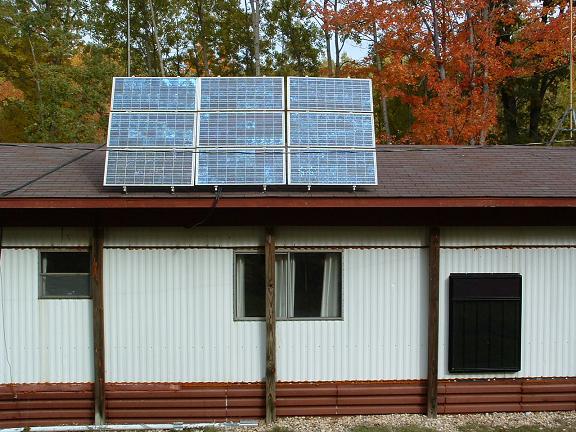
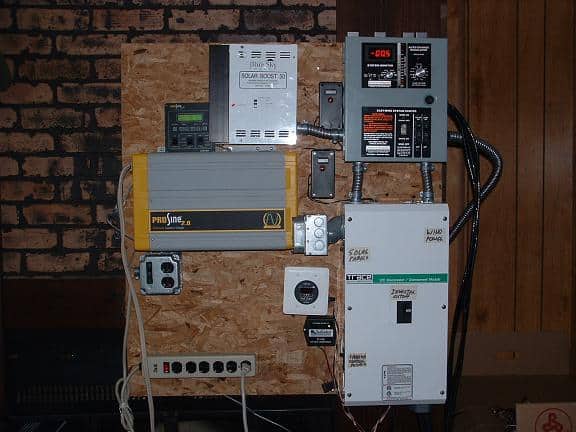
The large solar power setup is just like you see in magazines with solar panels on the roof, a wall full of components and kids playing in the yard. I have 3 – 90W and 6 – 80W (total 750W) solar panels on top and a Solar Boost 50 (charge control), Prosine 2 (2 kW inverter), Xantrex breaker box, Link 10 battery meter (fuel gauge), 8 – Trojan L16 batteries (20 kW storage). All components except batteries and panels are mounted on 3/4″ plywood. This means that I have 3 major connections: solar panels, batteries and AC output from the board.

solar projects diy

This type of system is best bought as a kit – I bought the first 3 panels with an inverter and added the other solar panels and charge controller later. You get almost all the pieces – including roof mounting hardware for the solar panels and the right size wires.

The trick with building this system is to put most of the stuff on a plywood board. I set the parts on plywood and arranged it to my liking. The breaker box should be located close to all the other stuff to minimize wire length. I had my panels mounted on the ground for good snow removal but, after thinking about theft (nice shiny blue panels) I mounted them on the roof. I use a snow rake and angle the panels steep (70 degrees).

The best feature of this kit was the inverter. The inverter has an automatic transfer switch (the thing that goes click in a UPS when the power goes out) and 3 stage battery charger built-in. It is true sine wave (yes, had it hooked up to my scope meter). I added the breaker box because you just can’t get 300 amp DC rated fuses from the electric store.

solar projects diy

I normally use cheap grid power for running everything but, when the power goes out – its solar time. If you have heard neighbors say something like “I have 100 amp service” then this inverter gives you 15 amp service. You can run up to 15 amps at 100% duty, it will surge to 30 amps (4 kW). This inverter is not grid tie but, UPS (Uninterruptable Power Supply) tied. I have my fridge on this inverter in case of power outage.

Here is my little lead in on efficiency. My fridge (19 cf. Kenmore side by side) uses 1.12 kW a day, in 2 hours of sun – my panels will generate 1.5 kW – enough to cover my fridge power (and inverter overhead) use for a day. This fridge is 20% more efficient than every other fridge in its class (19-21 cubic foot). It cost $700 (USD) when I bought it. In the years that I have had it (about 8) it paid for itself in lower electric costs. It will always “pay you” to buy a new fridge.

Final Notes

Try to place the panels where they get sunlight, I should say “where they get the most sunlight”. If you have a tree that shades your panels at 2 pm – move the panels so that the tree shades them at 6 pm. I know that my roof space is limited but, I plan on getting the “best” light (10 am-3 pm) that I can. Losing energy in the winter because the tree shades at 2 pm is very costly (especially after all the money you paid for solar!)

SAFETY for the small system consists of not burning yourself with the soldering iron. The medium system has batteries that could weld your tools to the posts, wrap electrical tape around “good” tools used near the battery, have a tap for the post threads.

The batteries in my medium and large systems are flooded lead acid which means that I have to fill them with pure (distilled) water, I wear rubber gloves for this task and goggles. I also keep the family sized baking soda bucket nearby in case a mouse chews the corner (for water) – a lot of solution (more than a gallon) in a 120-pound battery. Lead acid batteries generate hydrogen gas which is explosive, a vented battery box is recommended.

The medium system uses a (cheaper, easier to find) flooded lead-acid battery, not the best type (AGM Absorbed Glass Mat or Gel Cell) for this application. Since it could tilt past 40 degrees (max fluid to cap angle) the solution can leak. I installed plastic inside the box to contain any fluid and am aware of this limitation in my system. The box is strapped to the hand truck for quick release to move into a truck bed.

The lead acid batteries that I used were bought before I found out about Edison batteries. Admittedly, the lead-acid battery has more power per pound than the Edison (Alkaline based Nickel-Iron) battery but, have become the “throw away” part of every solar power system. Edison batteries will (have) last for a hundred years, don’t sulfate, don’t break down (lead plate flaking) and if they run dry – simply refill. In fact, replacing the alkaline solution would only take Berky water and wood ash (lye is alkaline) solution. Last but not least – no chance for an explosion, does not generate hydrogen.

If you have read “31 Days to Survival” then you know that there is a chapter on alternate energy. I think that any of these systems will count for that day. Please share your comments and thoughts in the comments below.

You might also like:

K-Tor hand crank generator (pocket socket 1 amp usb) : Weekly Product Review

Filed Under: Power Generation

  • « Go to Previous Page
  • Page 1
  • Page 2
  • Page 3
  • Page 4

Primary Sidebar

Subscribe to Blog via Email

Enter your email address to subscribe to this blog and receive notifications of new posts by email.

Join 7,197 other subscribers
  • Amazon
  • Facebook
  • Substack
  • Twitter
  • YouTube

“Do more with less.”

– Minimalist proverb

Recent Posts

  • Just so you know
  • Weather Update for My Corner of Appalachia
  • Why I’m Ordering Ivermectin + Mebendazole Every Year
  • The Website’s Shutting Down (But Here’s the Plan)
  • You Are Hated! Start Training Like It!

Footer

Recent Posts

  • Just so you know
  • Weather Update for My Corner of Appalachia
  • Why I’m Ordering Ivermectin + Mebendazole Every Year
  • The Website’s Shutting Down (But Here’s the Plan)
  • You Are Hated! Start Training Like It!

More about me

Books I’ve written

Books I’ve read

Follow Me on YouTube

Follow Me on Facebook

Gear I Use and Recommend

Newsletter

Search this site

Follow me elsewhere

  • Amazon
  • Facebook
  • Substack
  • Twitter
  • YouTube

© 2008–2025 M.D. Creekmore · As an Amazon Associate, I earn from qualifying purchases.