• Skip to main content
  • Skip to secondary navigation
  • Skip to primary sidebar
  • Skip to footer

M.D. CREEKMORE

  • Blog
  • Books
  • Newsletter
  • Gear I Use
  • About
  • Contact
  • Facebook
  • YouTube
  • Blog
  • Books
  • Newsletter
  • Gear I Use
  • About
  • Contact
  • Privacy Policy
You are here: Home / 2018 / Archives for October 2018

Archives for October 2018

How To Survive A Zombie Apocalypse

October 13, 2018 M.D. Creekmore

zombie apocalypse survival guideby Marc White

All hell has broken loose. Society has crumbled. Your front lawn is filled with zombies. You might be wondering how this happened. That’s not the point. The zombie apocalypse is here and unless you plan on getting eaten alive, you are going to need to know how to survive. Don’t panic.  I’m going to teach you everything that you need to know.

I’m Marc White, the founder of Zombie Gear Dude where I teach people how to survive the zombie apocalypse and what zombie weapons and gear work best.

Zombie Outbreak Survival Tips For The Unprepared

To survive a zombie apocalypse, you need to be in great shape. If you get winded running a mile, you’re probably going to be eaten. Build up your cardio since the majority of your day will be spent running from zombies. Train in parkour, which can help you navigate a hazardous or obstacle-ridden environment.

Have an escape route for your home when the zombies inevitably break in. You will need two separate meeting locations for your family if you get separated in the chaos. You should also have an emergency contact who is out of state to keep your family updated on your status, assuming all technology hasn’t been destroyed.

Stick together. You’ll find strength in numbers and a good team can help you gather supplies and fight off zombies. If everyone goes back to back, you’re going to have 360 degrees of vision. Never let the zombies get out of sight.

You shouldn’t trust strangers. People who are unprepared to deal with the zombie apocalypse are prone to freak out and act irrationally. You want your team to be all die-hard survivalists. No cheerleaders.

You’re also going to need a survival kit: clean drinking water, 1 gallon per day; food, either canned or non-perishable; a first-aid kit with bandages, rubbing alcohol and any prescription medication that you might need; and utility items like a knife, duct tape, a flashlight with extra batteries, and a radio.

But even the most extensive survival kit will run out eventually. How do you find new supplies? In an urban environment, the best places to look are abandoned homes, gas stations, military surplus outlets, and outdoor stores. After you have confirmed that the room is clear of zombies, bring a large backpack or duffle bag and raid the place.

You can also find supplies in a forest. You might stumble upon an abandoned campsite with plenty of supplies. But before you wander too far into the woods, mark the trail with spray paint or duct tape. Be careful with any berries or vegetation that you find. Unless you know for sure they’re not poisonous, don’t eat anything.

The human body can only go a few days without water. The easiest way to get water in a zombie apocalypse is from sealed water bottles. But if you can’t find those, catch rainwater in an empty bottle. You don’t even need to purify it before you drink it. In a cold climate, note that snow or ice works great too. Are you somewhere that doesn’t get any rain? Raid hot water tanks and water from toilet basins. And please remember that it’s the top part of the toilet, not the bottom part.

But before you drink that water, you’re going to need to purify it. Bring the water to a boil for a minute and it should be safe to drink. If you don’t have access to fire, find some clean chlorine bleach and mix in 8 drops per gallon of water. Stir, and let it sit for 30 minutes. You’ve got yourself clean drinkable water, yum!

With zombies everywhere, you’re going to need to secure a base camp. The ideal shelter is made of a sturdy material like a brick with few windows that can potentially serve as entry points.

Dams, power plants, water treatment facilities, or any government buildings serve nicely. But don’t venture too far or spend too much time looking for the perfect spot. The more you’re out in the open, the more vulnerable you’re to a zombie attack.

You might think you should hold up in a mall or a big box retail store to be near supplies. But according to Zombie Research Society founder, Matt Mogk, that’s a terrible idea. Stores are the first place most people will go, and the more people there are in a contained area, the quicker and easier it is to spread the virus or disease that caused the zombie outbreak in the first place.

If you are in a pinch, can’t find any secure buildings, you can always try a boat. While the topic is hotly debated by Zombie fans, science says that zombies would lack the motor functions necessary to swim. This means that a boat would keep you safe from an attack unless you are in shallow water.
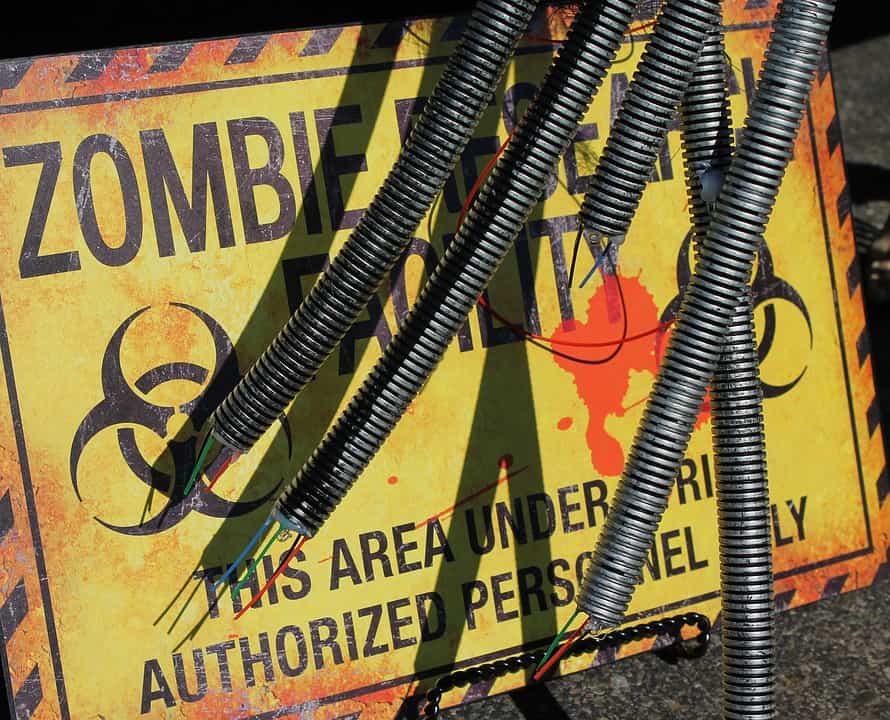
zombie-research-facility

Get some protective gear! A strong leather jacket or Kevlar motorcycle gear is ideal. Zombies are going to have a tough time biting through something that thick. Ditch your car! You are not going to fuel your gas tank in the middle of a zombie apocalypse.

Not to mention the fact that a loud engine would tip any nearby zombies off to your location. Find a bike instead. It’s a much more versatile and effective means of transportation in the new zombie infested world. Plus it’s better for the environment. In case we ever manage to rebuild society.

No matter how prepared you are, eventually, you are going to come face to face with zombies.

So, what’s the best way to deal with these murder machines?

Don’t fight, just run, fast! You have all heard the saying that it’s a marathon, not a sprint. Well, this is a sprint. So do your best and get the hell out of there!

If you can’t outrun the zombies, though, you still have a couple more options. Neuroscientist Bradley Voytek created a model of what a zombie’s brain would look like and found that damage to the zombie’s central corpus would give them terrible short term memory. This means that you can easily hide. Loss of the posterior parietal cortices means that zombies have trouble visually focusing on more than one object at a time, meaning that they are easily distracted.

Another option is to act like a zombie. Voytek speculates that zombies suffer from a form of illusion which means that they have trouble knowing whether a person is a human or a zombie. Don’t feel bad for them, just take advantage of it.

But if all else fails, you’re going to need to fight the zombies. This is the last resort as the only way to kill a zombie is to destroy its brain.

But what’s the best weapon to do that?

The answer is simple. Take a blunt or sharp object and hit them in the head. The best part is, these weapons are basically silent and won’t attract attention from any other nearby dead-ites or zombies.

Here is another thing to consider: don’t think that you’re used to playing video games, and it will help you score headshots when it comes to killing zombies. Studies have shown that in life situations, trained police officers have a shooting accuracy of just 25%.

Alright, you’re now in good shape to stay alive in a zombie apocalypse. Now just follow my advice for the rest of your life and you’ll be good to go.

Send me more suggestions in the comments down below. And until the next time, I am Marc White, wishing you a safe zombie killing adventure.

Top 10 Zombie Apocalypse Survival Tips

And don’t forget to check out the CDC’s Zombie Apocalypse Survival Tips

M.D. Creekmore adds: No we don’t believe that there is going to be an actual walking dead zombie outbreak – this article is written in a “fun way” and published here to make it more interesting for readers.
Filed Under: Prepping

How to Prepare Your Dog for Survival

October 13, 2018 M.D. Creekmore

by Millie in K

In the rush of prepping for your family, don’t forget the canine members (and other pets) of your family! I will be writing about dogs, much of this same information will apply to cats and other pets. I have owned and cared for dogs all my life, owned a boarding kennel, taught obedience classes and trained service dogs, I was a retail sales clerk in a pet department and was a groomer. I will try to cover things in a practical manner for you.

The first thing to consider is food. There are a couple of ways to approach this. You can buy and save commercial dog food for your dog. Or they can eat what you eat, in which case you want to make sure you buy for “another person”.

Dog food is processed and packaged to last 18-24 months. There is a date, somewhere on the bag that will indicate when the food expires. The little secret the dog food companies don’t tell you is that it will be good for at least a year afterward if the packaging is intact and you have not gotten bugs in it or mice.

So buy the food with the furthest expiration date you can and rotate, rotate, rotate! When SHTF you should not worry that Fido has the super-premium, all organic, all meat formula. Buy what you can NOW to meet his needs. If the super-premium food costs $60 a bag or the average food costs $40 a bag, save yourself some money and get extra food from the $20 you will save.

Most of the mid-priced foods are very nutritious, especially if you can find a brand that is not so nationally advertised. For example, you can buy Blue Buffalo which is a good food in so many ways but costs $50-60 for a 28 lb. bag.

Or you can buy Premium Edge (manufactured by Diamond) for about $40 a 35 lb bag. There isn’t really a whole lot of difference, nutritionally, the difference in the price is the heavy advertising that Blue Buffalo does.

If you buy your food, check the expiration date. If it is getting within about 6 months of expiring, find someone and ask for a big discount for you to take that food off their hands. You know it will last longer and you can use that food now, setting back food with a longer date for later use. They don’t want this food around because if it expires, they will have to throw it out.

This gets more complicated if your pet has a medical problem or allergies. In that case, you may want to think about feeding them what the family eats. Family dogs have eaten scraps for years, so long as you don’t overdo it on the fat, they will be fine. You can experiment now with two sources of nutrition.

One will be a protein source, one will be a carbohydrate source. Most of the allergens that dogs react to are the grains, second is the meat source. If they are on a trout and sweet potato based food, you can start with that. Find a fish that the dog can tolerate. You can stock a pond, if you have it, for fresh fish for everyone.

You can buy cans of fish for them for storage until you can figure out something else to do. You can fish for the dog every few days. Sweet potatoes can be grown in the garden and stored easily. Try and find other things your dog can eat in this case. Experiment by adding a singular kind of food to the regular diet for two weeks.

If no reaction, you probably have found something else they can have. This needs to be done NOW so you can be ready for the future and know what they can have.

How much to buy? My dogs on average, eat about a cup of food a day. Sometimes the bag will indicate how many cups are in the bag. Sometimes you have to weigh a cup of food, divide the pounds in the bag by that weight to get the number of cups.

Or you can take the kilocalories in the entire bag (don’t ask me why they put this on the bag) and divide that by the kilocalories found in a cup which will also be on the side of the bag. This will give you the number of cups in a bag.

One thing to keep in mind is that most dogs are somewhat overweight. Dog food takes up room. So figure out how much food every day that Fido can have and then buy appropriately. Go ahead and get him slimmed down to what he needs to be. Then you won’t be wasting prep room for an overweight dog that is certainly going to be developing some kinds of health problems over time.

I have bought enough food for my pack for a year. I figure by that time, I may be sharing the food we have with them, or we will have figured out what will work for us. I worked out how much oatmeal I would need for each dog and it was an enormous amount.

Oatmeal is a great thing to feed because it is one of the most nutrient dense grains there is. Corn, wheat or soy which often causes food sensitivities in dogs over time are not good choices, but rice is a good choice for most dogs, as is bread or macaroni. You can also explore other grains such as amaranth or milo.

When storing the food, it doesn’t matter so much if it gets cold. But it should not get hot. Most dog food is “extruded” meaning it is cooked, then made into a gooey mass and then extruded into nice little kibbles, which are then heated to “bake” them and sprayed with flavored oils to make them more appetizing for your pet. That oil can go rancid if the food is in a place where it is warm. Your dog will not eat it and nothing will make your pet eat that food if it smells bad to him.

Canned food should be kept from freezing, as any canned goods should, as well as not getting hot. If you have it in a pile with your supplies, be sure you have some sort of rodent protection around it. Mousetraps or poison (make sure Fido does not go in that area!) or mothballs work.

dog survival prepping

Dogs will eat mothballs and they are poisonous. They taste sweet to them. A better alternative is cedar oil or peppermint oil or dried leaves. Put the oil on cotton balls and refresh them every month, tuck them around the bags.

Plant a package of mint somewhere on your land. It can be very invasive so keep it away from your gardens or it will take over. It will reseed itself every year in that same patch; while you are about it, throw down a package of catnip for Kitty. She will appreciate the fun she can have with a fresh branch every day and you can dry it for winter fun or even tea for yourself if you desire.

When you run out of commercial food, Fido will have to rely on scraps, crows and other birds I can shoot, road kill and/or predator meat. If I shoot a coyote, I will put it to use. I probably won’t want to eat it but the dogs could. Any varmints, such as possums, groundhogs, foxes, feral cats, all could be useful for this. I am also working on a better chicken house so that my chickens are not being picked off by hawks, a cup of oatmeal and a fresh egg or two would make a fine meal for most dogs.

When hunting after SHTF don’t forget to save the bones for the dogs. Raw, uncooked bones will keep their teeth cleaner and provide some nutrition as there will be meat on the bones. If you still have electricity and can freeze them, they can be kept that way for a while, they can also be smoked.

Be aware that all bones can splinter and cause awful problems, especially the cooked ones, so look for the sturdier leg bones for them. Take them away after most of the meat has been removed, throw them on the roof to dry out better, pulverize them in the spring to put calcium in your garden. Bones of smaller animals should not be given.

However, if you decide to cook a whole rabbit or a chicken (or birds that have been shot for this purpose) in a pot of water, cook it covered on low (a la crockpot style of cooking) for 24 hours.

Take a potato masher and mash it all up. The bones will be fragile and disintegrate. I cook chicken this way all the time for my dogs in the crockpot. Remove the skin on the chicken and the rabbit. Dogs can also have tongues, brains, liver, heart, etc. of whatever you hunt. You can also teach your dog to help hunt. Right now my barns are filled with mice and I’m going to be taking one down every day and letting them learn the joy of catching and eating a mouse.

Make sure you have a water bowl and a food bowl in your BOB, with food, a sturdy leash, and collar for your pet. The water bowl can double as a food bowl if necessary and to save on weight. Kitties should always have a small crate; they get frightened and take off if you let them out. Some kind of litter box would be helpful and you can use just plain dirt for litter if necessary.

Water: A dog will need about 8 oz. of water (one cup) for every 5 lbs. of body weight. They will need a little more in hot weather. Dogs can and do drink some really scummy water and don’t seem to mind but some can be more particular. Mine really like the algae water that is in their swimming pool on a hot day, warm, green, very yummy apparently.

They do have a shorter digestion system, so many of the things that would affect us can pass through their guts quickly and without problems. But you cannot count on that; giardia comes to mind and coccidia. Those will cause digestive upsets and especially diarrhea. Make sure your water filter can make enough water for your pets, too.

Medicine, wormers and flea control: Please verify what I am telling you. I am not a vet nor do I play one on TV. Double check the dosages of anything you might need to give to your dog. Also be aware that many things that work well in humans and dogs will kill a cat, such as aspirin. Never give a dog Ibuprophen. Do some research on what you put in the kit for use in animals.

Also, NOW is a good time to be sure your pets are up to date on vaccinations and wormings. Get this on your to-do list now and keep an eye on the timing for this. There won’t be vaccinations for animals when SHTF. Rabies is particularly important, no one wants to see a redux of Old Yeller with their beloved family pet.

Make sure there are things in your medical kit that will help Fido, should he need it. Benadryl for insect bites, particularly bees and wasps, is helpful. 1 mg. per pound is the dosage. A couple of different antibiotics for fish is a good idea, tetracycline is not as effective for most things but amoxicillin and cephalexin are a good choice and easily obtained as fish medicine. Make sure you look up the right dosage for your pet’s weight.

You can buy tapeworm medicine made for fish, too, check the dosage and make sure it is written down. They will get tapeworms from fleas, they nibble the fleas and the fleas are ingested and then you have tapeworms. People can get tapeworms so it’s a good idea to keep on top of this.

You can keep flea preventative on hand, I’ve not seen expiration dates on the spot on type. You can also make a tea out of mint and spray that on your dog, it will repel the fleas at least. Diatomaceous earth can be rubbed into the coat and put in the dog’s bedding, it supposedly cuts the flea larva up and dries out the adult fleas. Pennyroyal is also good for repelling fleas but should not be used on pregnant dogs.

If you are in an area with heartworms (carried by mosquitoes) you will want to be sure you have preventative on hand. You can buy cattle Ivermectin, the 1% injectable kind. The recommended dosage of cattle Ivermectin for dogs to prevent heartworm is .0015 milligrams to .003 milligrams per pound of body weight once a month. Figure the dosage very carefully and measure out with an insulin syringe, be sure you know what you are doing.

This will be given ORALLY, not injected, once per month. Put it in something tasty to get it down your dog. You use the insulin syringe to get a more exact reading. Cattle Ivermectin is good for longer than the expiration date on the bottle. Never give Ivermectin to dogs that are of “collie” origin, collies, border collies, Australian shepherds, or mixes thereof. The measurements on an insulin syringe are in units.

There are 100 units to 1 cc or 1 milligram. The 40 unit syringes are easiest to work with and you can reuse them for this purpose only. Do not think you can make a mistake on this; Ivermectin poisoning can kill your dog. Do some research to be sure you know what you are doing.

Training: You may need to train your dog for various duties when SHTF. One may be that you want the dog to raise Cain and bark its head off any time it sees a stranger or something unusual. Barking vigorously gives the impression that the dog means business, even if it is a small dog.

Most people cannot read a dog’s body language and assume the dog means to bite if the dog can get to them and will give a wide clearance. Conversely, you may wish the dog to be silent. It may be best not to draw attention to what appears to be an abandoned house where you may be.

Training to bark is easier than training not to bark. You may need to have some help bringing in cattle or sheep. Be sure your dog has some instinct in this area, you aren’t going to be able to bring in cattle with a Maltese, but you can train a poodle to retrieve ducks, it’s what they were bred for.

Toys: At some time, there will be worn out toys and we all like our dogs to have some fun. Old socks, knotted together make a fine tug toy as does an old rope. The lid from a 5-gallon bucket makes a pretty fair Frisbee. Bones are always amusing. And it’s probably not a bad idea to lay in a small supply of tennis balls for the dogs who love those to play with, we never know when we may run across another tennis ball!

Filed Under: Prepping

Wildfire Survival Tips To Keep Your Homestead Safe

October 13, 2018 M.D. Creekmore

forest-fire-survival-tipsby Ron Melchiore

I had another post in mind to submit to you folks but forest fires are a subject that is near and dear to my heart. I’ve recently become aware of the fires burning in various areas particularly in the Southeastern United States. In fact, it finally made the National news tonight. I thru-hiked the Appalachian Trail many years ago and I can’t imagine the number of fires or amount of territory now burning through those areas.

As some of you know, we’ve had our share of forest fires out here. They’ve literally had us running for our lives. I can’t think of too many things that demand immediate attention more than walking out the door and seeing a billowing curtain of gray/black smoke rising skyward in the nearby forest.

The following paragraph is an excerpt from my book Off-Grid and Free: My Path to the Wilderness.

“It was like being in a movie theater, the big screen showing a large-as-life fire burning right in front of us, with black smoke billowing upward and a dense veil of white-gray smoke hugging the ground so thickly that the bright orange flames were visible only when they leaped skyward above the fracas.

A slight diminution in the smoke allowed just enough visibility to see an orange-red glow, much like opening the door to a furnace allows a view of the orange-red coals. And, like the furnace hungrily consuming its fuel, the intensity of the forest fire’s heat incinerated everything in its path. “

wildfire survival tipsI have a full chapter devoted to our fire experiences. I am not a fire expert. Rather I’m a guy who has dealt with at least 4 different fires in our 17 years of wilderness living in northern Canada. Two of those fires have gotten to within 90 feet of our homestead. All totaled those fires burned at least ¾ million acres around us.
Here are some general tips anyone can do to prepare well ahead of time. They are not things to contemplate when the fire is ¼ mile away and working towards you. Have an escape plan having multiple paths of egress. If this road is blocked, where to now? Is there a lake to head to as a last resort? Is the vehicle fueled up? Is it pointed in the right direction?

The last thing you want to be doing is packing in a panic! Consider what items are of greatest importance. Purse/wallet, identification, important documents, medications, backup laptop computer, hard drive or USB with essential financial or other data? What is deemed essential will vary from person to person.

In our case, in spring, since we are only one lightning strike away from disaster, we have a survival bag by the door as well as our survival suits. We have smoke masks and goggles. We pack some food and water in the boat and have the water pump and boat fully fueled and ready to roll. Remember, we have the added factor we are alone out here so we plan accordingly.

Rake all combustibles such as leaves and debris far from buildings. Be aware fires will create their own winds so those leaves you raked to the perimeter will be blown around again. If I had a chipper, tiller or some device to reduce and shred and /or bury leaves, I would use it.

If you are in an evergreen forest, I would consider removing trees near buildings. At the very least, remove all lower branches in nearby trees which act as ladder fuels. (fuels that allow a ground fire to start climbing the trees)

The above are routine things we do every year to be prepared. Since we live on a lake, we have a sprinkler system set up preemptively. Forget trying to put the fire out. That’s not going to happen. All you can do is try to get combustibles away from any structures and take measures to bounce the fire around your property.

When we moved out here, we bought a water pump, fire hoses, garden sprinklers and garden hoses (which serve as sprinkler supply lines). Higher quality sprinklers and supply hoses are available and if I had to do it over again I would opt for those. Our spring ritual is to set up all our equipment long before the first thunder and lightning appear. By doing so, at the first sign of trouble, we’re ready.

wildfire survival tips
Sprinklers on the roof

The first step is to set up the fire pump on our beach. By means of a quick coupler, a 2.5 inch PVC suction line is connected to the pump and extends about 12 feet out into the lake. On the end of the pipe that is in the water, I have a foot valve which allows water to flow one way to the pump but prevents water from draining back into the lake.

That’s important because you don’t want the water pump to drain of water and thereby lose its prime. The foot valve rests on a rock about 8 inches off the lake bottom so that sand and other debris isn’t sucked into the system.

On the output side of the water pump, there is a threaded coupler which ultimately connects to a standard 1.5-inch fire hose. Several 100-foot sections of hose are connected together to make the run up the hill to the house.

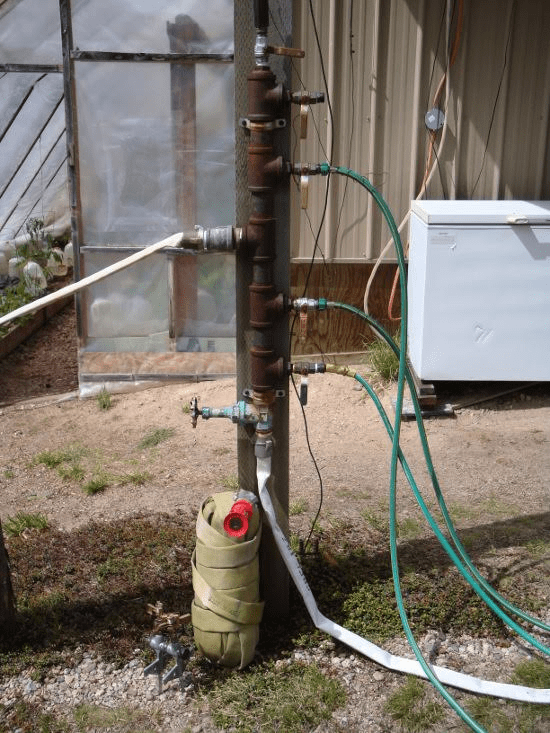
Mounted on a porch post is a manifold which takes the high-pressure water from the pump and redirects it out to smaller feed lines, the garden hoses I mentioned earlier. We have 5 outlets on this manifold which we can control via individual valves.

We can shut off or engage each sprinkler with the turn of a valve. Sprinklers can be mounted singly or in series, so there are some instances where one valve may control two sprinkler heads.

Our manifold also has an adapter and valve that allows us to continue a run of standard firehose out to our homestead’s perimeter to tackle any smoldering areas and hot spots. We have two nozzles that can be attached to the end of this fire hose.

The first is an adjustable spray nozzle capable of spraying water in a short, wide pattern or a jet of water that can shoot out one hundred feet if need be. Our second nozzle has a narrow opening that delivers a high-pressure jet of water capable of pulverizing the ground to reach fire that is smoldering in roots and moss.

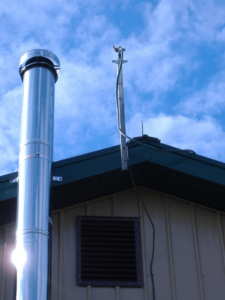
Our home and outbuildings are top priority to protect so I head up to the roof of our two-story home and mount a sprinkler on a short pole at each end of the roof. A short hose connects them in series and then the feed line drops from the roof to the nearby manifold. Our house and outbuildings are now protected.

Forgive me for the cuts from the book but time is of the essence and I want to get this information out. The following is another excerpt from my book Off-Grid and Free: My Path to the Wilderness and has more specific information.

What has saved our home twice?

Sprinklers! Both our own system and those of the provincial fire crews. Part of my spring ritual is to head to the house roof and install two sprinklers, one at each end. I also have full-length trees cut, approximately 20- to 25 feet long, and have a sprinkler head attached to the top of each of those trees.

We pick locations around our house site where we can stand these trees back up, like big flag poles, and either wire each one to another smaller tree or attach a set of tripod legs to the pole, so that it can be free-standing. The higher these “flag poles,” the more coverage and the better the protection.

The Honda water pump with a 1 1⁄2 ” firehose delivers pressurized water from our lake to the input side of a manifold and all the sprinkler feed hoses come off the output of the manifold.

Once a fire gets into the crown of the trees, it’s hard to stop. So how do sprinklers prevent the property from being incinerated?

Manifold Setup
Manifold Setup

The basic premise of sprinklers is to bring up the humidity in the protected area as high as possible before a fire arrives. The dome of humidity has a tendency to bounce the fire around it, allowing the fire to bypass the protected areas. They most certainly will not extinguish a wildfire!

For anyone living in fire-prone areas, this concept will work for you as long as you have a reliable water source. A swimming pool, pond, stream, or even household tap gives you a chance at saving your home. At a minimum, a couple of sprinklers, proper water lines, and a water pump are all that is needed for some cheap insurance.”

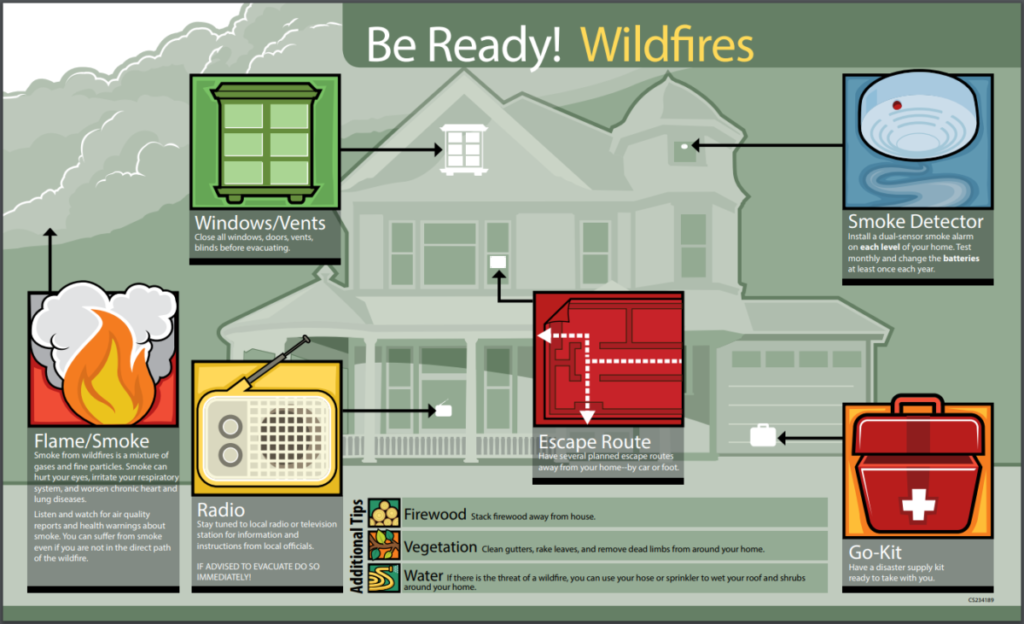
Be Ready: Wildfires Infographic from CDC

When we first moved out here to build our homestead, we knew we would eventually have to deal with a forest fire. But we had no idea the scope and intensity a conflagration could possess. During construction, we flew in metal siding and roofing for our home’s exterior. It gives a great deal of fire resistance.

For anybody doing new construction, especially in fire-prone areas, consider metal or masonry exterior. And finally, never underestimate a fire. I have personally seen forest fires run 5 to 10 miles in a day! They will lob embers far in advance of themselves to start new fires. Good luck!

Bio: Ron and his wife currently live 100 miles in the Canadian wilderness on a remote lake. As part of the back to the land movement that originated in the 70’s, they have spent their adult years living the homestead dream. You can follow and contact Ron at https://www.facebook.com/offgridandfree.mypathtothewilderness or http://www.inthewilderness.net/

Filed Under: Homesteading

Flood Survival Tips | How To Survive Before, During, And After A Flood

October 12, 2018 M.D. Creekmore

Flood Survival Tips | How To Survive Before, During, And After A Flood

by Joe Alton, MD of www.doomandbloom.net, co-author of The Survival Medicine Handbook

There’s a lot of information on the risks associated with storms, hurricanes, and tornadoes, but not as much about their consequences. Just about any storm can cause flooding, and many communities are not prepared to deal with it. As a result, water supplies are contaminated, emergency services are crippled, and important infrastructure can fail.

In Texas and Oklahoma, heavy rains caused major damage and a number of deaths, with more precipitation expected. Floods are not a rare occurrence, with a number of major disasters over the past few years: In 2013, Boulder, Colorado experienced 6 months of rainfall over the span of a week. Flooding in the wake of Hurricane Katrina (2005) was severe enough to cause a humanitarian crisis.

To respond appropriately to a flood, we should understand the various types of flooding and the steps we can take to stay safe.

What is a Flood?

A flood is defined as an overflow of water that submerges land which is normally dry. Flooding may occur from water bodies, such as a seacoast, river, or lake. The water overcomes levees, resulting in the inundation of populated areas. It may also occur due to an accumulation of rainwater on saturated ground.

Some floods develop slowly, while others (called flash floods), can develop in a very short time and rush into areas where it wasn’t even raining. As a result, flash floods often catch the population downriver by surprise, causing severe damage and loss of life.

Types of Floods

There are several types of floods:

Areal Floods

Floods can happen on flat or low-lying areas when the ground is saturated and water cannot run off quickly enough to prevent accumulation. Floods related to rainfall can also occur if waterfalls on an impenetrable surface, such as concrete, asphalt paving or frozen ground, and cannot rapidly be absorbed. In urban areas, it usually takes at least 1 inch (25 mm) of rainfall per hour to create significant ponding of water on hard surfaces.

Riverine Floods

Floods happen in rivers when the flow rate exceeds the capacity of the river channel. This happens particularly at bends in the waterway. The faster the flow rate, the more dangerous it is; people traditionally live and work by rivers due to access to fertile soil and trade routes.

Coastal Floods

Flooding on the coast is commonly caused by a combination of tidal surges caused by winds and low barometric pressure. Coastal areas may be flooded by storm events, such as hurricanes, resulting in waves over-topping seawalls and levees.

Failures of vital infrastructures, such as the collapse of a dam, may cause catastrophic flooding,. This exact event occurred in Johnstown, Pennsylvania in 1889, costing 2,200 lives. Major flooding may also be caused by the effects of an earthquake or volcanic eruption. These events often occur at sea hundreds of miles from the area affected, but result in tidal wave floods called Tsunamis.

Warning Types

Most people have heard of hurricane or tornado watches and warnings, but the U.S. weather service also tries to warn the populace of flooding. In order of imminent danger, they are:

• Flood Advisory: Flood advisories are issued when an expected weather event may cause some flooding, but not enough to be a major issue. Significant inconvenience may be possible and lead to dangerous situations if caution isn’t exercised.

• Flood Watch: Flood watches are issued when weather conditions become favorable to cause significant flooding. Although flood conditions are not imminent, steps should be taken to prepare for such an event.

• Flood or Flash Flood Warning: Flash flood or flood warnings are issued when hazardous flooding is imminent or has already begun. Action should be taken to avoid life-threatening situations.

Many people ignore these warnings at their own peril. If you live in a low-lying area, especially near a dam or river, then you should closely monitor and heed warnings when they are given and be prepared to evacuate quickly. Rising flood waters could easily trap you in your home.

Preparing for Floods

If you live in a floodplain, you should:

• Build an emergency kit with food, water (yes, water), and medical supplies.
• Have a way to communicate with family members.
• Elevate the furnace, water heater and electric panel
• Install special “check valves” to prevent water from backing up into the drains of your home.
• Consider having materials to make waterproof barriers to stop floodwater from coming into the building
• Seal walls in basements

When It Happens

You can’t stop the rain from falling and you can’t stop the tide from coming in, but you can weather the effects of flooding with some sound strategy and a little preparation. Here are some flood safety tips:

Get Out Early

Make the decision to leave for higher ground before extensive flooding occurs. Closely monitor public service announcements for warnings and advice from experts.

Be Careful Walking Through Flowing Water

Drowning is the most common cause of death during a flood, especially a flash flood. Rapidly-moving water can knock you off your feet even if less than a foot deep.

Don’t Drive Through a Flooded Area

As many people drown in their cars as anywhere else. Cars stall and roads/bridges could easily be washed out. Try to figure out now if there is a “high road” to safety before a flood occurs.

Beware Of Downed Power Lines

Electrical current is easily conducted through water. Watch for downed power lines; you don’t have to touch them to be electrocuted; just stepping in the water they’re in could kill you.

Turn Off The Power

If you have reason to believe that water will get into your home, turn off the electricity. Don’t use appliances or motors that have gotten wet unless they have completely dried. You might have to take some apart to clean debris out of them.

Watch Out For Intruders

Critters that have been flooded out of their homes may seek shelter in yours. Snakes, raccoons, and other unfriendly creatures may decide your home is now their territory. Human intruders may be interested in your property, as well.

Look Before You Step

After a flood, watch where you step; there is debris everywhere. The floors of your home may be covered in mud, causing a slip-and-fall hazard. There may be damage to foundations of flooded buildings, even if the water has subsided.

Check for Gas Leaks

Don’t use candles, lanterns, stoves, or lighters unless you are sure that the gas has been turned off and the area has been well-ventilated.

Exhaust Fumes Can Kill

Only use generators, camping stoves or charcoal grills outside. You can easily be overcome by the fumes they emit.

Clean Out Saturated Items Completely

Floodwaters are not clean! Don’t use floodwater as drinking water or to cook food unless you have thoroughly sterilized and filtered it. Make sure you have food storage in waterproof containers.

More Flood Preparedness Tips

by Paul North

flooding public domain imageAlthough it may not be the apocalypse, flooding is a serious threat to many areas of the world. Floods can come unexpectedly and wreak havoc quickly so it is important to be as well prepared as possible for them.

They can just as easily be caused by adverse weather conditions, such as the floods in the UK over the last couple of years, or unexpected accidents such as a burst dam. But how do you prepare for the unexpected?

Research your area

Whether it is somewhere you already live, and especially if it is somewhere you are potentially considering moving to, researching the potential flood conditions of an area are essential to determine how at risk you could be.

In the UK you can obtain the flood history of any property from the Environment Agency for free (unless the report takes over 18 hours to put together when there is a small fee associated with it). In the US you can check if your home is near a floodplain by accessing FEMA’s Flood Map Service Centre.

This is particularly useful if you are researching land to build a property on, and you can check as many different areas as you need to.

Have a plan

This may sound obvious but a lot of people who live in high flood risk areas accept this, and yet have no plan in place should the worst happen. Having a carefully considered plan can save you time and money in the event of a flood if you implement it quickly enough to alleviate any damage, or at least of the worst of it.

Sandbags are often used to block doors and create a barrier against floodwater. The best time to get your sandbags is, of course, before a flood has hit so make sure you have a supply of these ready to be used.

You will be able to respond quicker, resulting in less damage, if you have these at hand straight away. If you do not have any sandbags they can be made from old clothes and bed sheets and filled with gravel or even dirt if that is all that is available.

If preventing the flood damage is not possible you should also have prepared to leave your property as quickly as you can, taking important possessions with you. This means having a bag of essentials prepared so you can leave quickly, as well as knowing where anything is that you may want to take with you on short notice and ensuring it is somewhere that can be easily reached as you leave. Remember that you may need to be away from home for days, or even week depending on how bad the damage is.

It is also important to plan and prepare for staying in your home in certain conditions. A flood may wipe out your water and electricity supply, even if the water itself doesn’t reach you. Having a well thought out stock of candles, lamps, drinking water and other supplies could make all the difference between continuing to live comfortably or having to leave your home.

It is also important to have a supply of food in case you are stuck for any period of time. Tinned food is the best as it is not susceptible to flood damage like fresh food and can be kept and stored for long periods of time.

Essential items

As well as the obvious such as food and drinking water, there are several items that will make your life much easier if trapped in a flood. These include waterproof clothes, which will keep you comfortable and dry and waterproof containers for electrical items such as your mobile phones and torches. Torches are of course another essential item, as well as a small kit of medical supplies.

Most homes will have a basic first aid kit but it worth keeping on top of this and making sure this is always well stocked and ready to be used. If anyone in the house takes regular medication that they cannot do without then you should also ensure there is always a good supply of this in the house.

All items, where possible, should be stored on the upper floor of the house as high as possible, in order to keep them away from any potential flood damage.

Insurance

Whilst most people tend to be sensible enough to take out insurance for their home and contents, a lot of insurance policies do not cover floods. Instead of getting caught out, take the time to research your policy and if flood damage is not covered invest in a separate flood insurance policy too.

Although you may not want to spend the extra money if a flood does affect you then you could end up spending far more if you are not covered by a suitable policy. Having insurance in place will make your life easier during what is bound to be a stressful time.

Cleanup

As well as preparing for all eventualities of a flood you should prepare for the cleanup afterward. Cleaning after a flood can be complicated. To begin with, you may need to remove any loose dirt, rocks and other debris from your home.

It can be muddy where the water has been and anything touched by the mud is contaminated and should be cleaned thoroughly or disposed of if this is not possible. Anything that can be salvaged should be cleaned and dried, making sure no trace of the floodwater remains.

You will need to disinfect all surfaces so a good supply of bleach for this is essential, and any rugs, carpets or soft furnishings that have been damaged will probably need to be thrown out. No electricity should be used until it has been checked by a professional, and the foundations should be thoroughly checked for cracks and signs of any long-term damage that may cause problems further down the line.

Filed Under: Prepping

How to Prepare for a Power Outage [The Definitive Guide]

October 12, 2018 M.D. Creekmore

Shining lantern in complete darknessby Lorenzo Poe

Survival seems to be the current hot topic. Everywhere you look self-proclaimed experts are willing to tell you all you need to survive the upcoming apocalypse of whatever scenario they can imagine. Most of their tips are tied to more and better equipment.

I do think that it is important to prepare for the future, but knowing what to prepare for and how to start are always tricky. I am no fortune-teller just an old country boy who has been around several blocks in my day. I grew up in an area often hit by hurricanes and lived through one of the most active periods on record. While serving in the US Army I lived in the northeast through several winters. I have slept out in tents in 10-degree weather, in tents in 110-degree weather, sandstorms, lightning storms and some disasters of a man-made nature.

I grew up in a rural area as the son of parents who lived through the Great Depression. As such we already lived to maximize the things that we had but whenever a storm approached we had certain things that we had to do in case of power loss. Hopefully, you will find this plan an easy way to prepare.

Most survival guides try to talk you through surviving major apocalyptic events from financial system meltdown to electromagnetic pulse. This guide will attempt to help you make a plan for any disaster you may face.

The most common scenario most of us will face is a 3-day local power disruption.

Whenever there is an indication that something could disrupt power don’t just run out to buy milk and bread. There are several things that you can do at home to help you prepare and make your life better.

I tend to use ‘Hurricane’ as the general cause of short-term power outages but this can be adapted to any anticipated event of short-term duration.

Secure an adequate water supply

You will need a gallon of water per person per day. This is as easy as buying a case of water per person sheltering with you. This is drinking water only for people who are not performing manual labor. Persons performing manual labor will need 1-2 quarts of water per hour in the heat and 1 quart per hour in the cold. This is just water for drinking only; it does not take into account water for cooking or personal hygiene.

Fill your bathtub with water. This water will be used to flush the toilet. Conserve water by flushing only when necessary. Remember “yellow let it mellow, brown flush it down”.

Toilets in America are flushed by siphon. The goose-neck in the toilet keeps gas and odor from coming into the house. Pouring water into the toilet bowl raises the level of the water above the goose-neck and will cause a siphon action to drain the bowl.

You can understand how the siphon works by trying two experiments with your toilet. First, take a cup of water and pour it into the bowl. You will find that almost nothing happens. What’s even more interesting is that you can pour multiple cups of water into a toilet bowl, one at a time, and still, nothing will happen.

That is, no matter how many cups of water you pour in, the level of the water in the bowl never rises. When you pour the cup of water in, the water level in the bowl rises, but the extra water immediately spills over the edge of the siphon tube and drains away.

Now, take a bucket of water and pour it into the bowl. You will find that pouring in a certain amount of water at the precise speed causes the bowl to flush. That is, almost all of the water is sucked out of the bowl, and the bowl makes the recognizable “flush” sound and all of the water goes down the pipe.

What’s happened is this: You’ve poured enough water into the bowl fast enough to fill the siphon tube. And once the tube was filled, the rest was automatic. The siphon sucked the water out of the bowl and down the pipe. As soon as the bowl emptied, air entered the siphon tube, producing that distinctive flushing sound and stopping the siphoning action.

You can see that even with water service cut off you could still flush your toilet. All you need is a bucket containing a couple of gallons of water. It is not an exact science and you should practice prior to any event so you can do it with a minimum of water and maximum of achievement.

Use care because a spill from the toilet onto the floor will waste more water for a necessary clean-up. (Father Fenton, our priest in Afghanistan, lived through Hurricane Katrina just north of Biloxi, Mississippi and told us how several retired priests moved in with him because his house was still habitable.

As luck would have it, his small inflatable pool survived and was available to furnish water for toilet flushing. He said that his home suffered more water damage from errant flushing than from the storm.)

And yes you could simply remove the cover of the tank and pour the water into the tank so that you can use the toilet like normal. There are two reasons I recommend not doing that. First, the cover of your toilet is fragile and can be broken very easily and second, water conservation. Everyone’s instinct will be to automatically flush when finished.

Worse than a ‘slop’ over’ from an over-enthusiastic flush, will be a drain clog. Paper products should not be put in the toilet but into a plastic garbage bag for disposal.

Hand cleansing should be accomplished with hand sanitizer.

Fill plastic bottles with tap water and cram them into your freezer. The more full your freezer is the longer it will stay cold. Block ice will also last longer than cubed ice in an ice chest. A stand alone freezer will keep food frozen for up to 3 days if you leave the door closed. A freezer compartment above your refrigerator will not last that long. Avoid opening the door as long as you can.

After thawing, these bottles of water will be available for drinking.

Gather your food supplies

Once a Hurricane Warning has been issued, its time to prepare your food. Any food items in your refrigerator needing cooking should be cooked now and returned to the refrigerator or placed in an ice chest. Boil your eggs, bake your potatoes, fry your steak.

Leftovers that are in your refrigerator can be placed in an ice chest with ice so that you can keep your refrigerator closed.

The ideal food for short duration power outages are foods that take little or no preparation. Peanut butter sandwiches, spam, deviled ham, and other canned items that are tasty cold straight from the can. And that is how they should be eaten, straight from the can without a plate or bowl.

Water conservation is still the key so avoid dirtying anything that needs washing. Spoons and forks can be licked clean and wiped off then washed later. You could use paper plates and bowls with disposable utensils but chances are that your garbage service will be off schedule so try to minimize your waste.

Providing three meals a day for even short durations will not give you a large variety to choose from when picking foods that can be eaten cold, straight from the can but by adding seasoning and small snacks such as trail mixes and cans of fruit they don’t have to be unpleasant.

As an alternative, military-style meals, MREs, have a device that heats the meals by simply adding water to a heater pack. These meals can be expensive, have a shelf life that is limited to a few years and in my personal opinion, the main meal portions taste terrible cold.

Proper clothing

When you know in advance that a storm/event will likely put you out of power, wash all your dirty underwear. Clothes can and should be worn more than once in these situations but for health and well being change your underwear daily when possible.

The proper clothing for a short duration power outage will simply be your normal seasonal clothing. Keep in mind that in any season you may be spending more time outside so add a season-appropriate hat and sunscreen to your normal wear. Winter or summer you will need Chapstick, Blistex, something. (see Poo Poo Broussard on youtube)

Make sure that you have good quality rain gear including boots for all members of the family.

There are gloves for all purposes and all purpose gloves. My personal choice is leather working gloves for general work, welder’s gloves for work around a fire and good quality wool inserts for my leather gloves for winter work.

A shelter is key to survival

In most cases during power disruptions of short duration, the best choice is to shelter in place. This can be comfortably accomplished in any season with a little planning.

If your power-out event occurs in the summer opening all the windows and doors of your home that have screens will get you by in the same comfort our ancestors had. An alternative would be to set up a screen tent or canopy in the backyard. I also keep several different sprays that kill mosquitoes as well as the Deet types that repel them.

Winter events can likewise be handled by moving everyone into a single room, sealing it from all drafts, and setting up a tent. Insulate the tent floor with blankets and additional blankets can cover the top and sides of the tent. Good quality sleeping bags and comforters can keep you warm to zero degrees. Sharing a sleeping bag or comforter can increase the body heat available to warm the sleeping bag/comforter.

Do not use open flames in or near a tent. A good quality lantern/ oil lamp kept lit while everyone is awake can help warm a small, draft-free room but warm foods, high in calories can warm you from the inside. If you do use a lantern/oil lamp be sure to have a battery-powered carbon monoxide detector.

The trick to sleeping warm in winter is to use the bathroom prior to climbing in your sleeping bag, eating a small, high-calorie snack and dressing correctly.

The correct way to dress for sleeping in a sleeping bag is to strip down to shorts and a t-shirt. Sleeping bags are warmed by body heat. Clothes such as sweats or pajamas trap your body heat close to your body and don’t allow your sleeping bag to function as designed.

Additional things to help are, pick a temperature appropriate bag, wear a knit cap, cover your face with a towel or t-shirt and do not exhale into your sleeping bag. If your feet do not reach the bottom of your sleeping bag, fold the bottom under so you don’t heat that portion of the bag.

Wear warm socks if you suffer from cold feet. I have a pair of shorts, a t-shirt and a clean pair of socks that I keep in my bag. I put them on just before getting into my bag at nights.

Clean clothes and a clean sleeping bag are warmer than dirty ones. A sleeping bag liner can add up to 15* of warmth to your bag. Simply adding a sheet or insulating the bag from the ground can add another 10*. For additional warmth, place a wool blanket or comforter on top of your sleeping bag.

Three to five-day disruptions of power are not insurmountable challenges. With a little planning and almost no skill, anyone can do it. Plan and prepare so that you can do it with as much comfort as possible.

Also Read:

How To Prepare Your Family For Power Grid Failure [The Definitive Guide]

Filed Under: Prepping

Tennessee Knife Laws: A Guide for Knife Carriers!

October 12, 2018 M.D. Creekmore

Tennessee preppers
Tennessee Knife Laws

If you are an outdoor enthusiast and/or works in a trade requiring the cutting of hard objects, you should learn about the laws governing knife ownership in the State of Tennessee.

Like many other states, knife statutes in The Volunteer State remain vague enough to require interpretation by state courts.

Unfortunately, the Tennessee court system has dragged its legal feet ruling on knife ownership statutes. However, state legislators cleared up several debated statutes in July of 2014.

Tennessee Knife Laws: An Historical Perspective

Tennessee has historically enacted restrictive knife laws, that is, until 2103 when SB 1771 legalized the ownership of switchblades and butterfly knives. Moreover, HB 581 extended the same rights of knife ownership granted to adults for minors.

This means it is no longer unlawful to own and or carry switchblades. Section 7 of HB 581 includes a rule of preemption, which prevents any county or municipal government from passing any knife ownership statute that imposes stricter ownership conditions or establishes more punitive fines and prison sentences.

Overview of Tennessee Knife Laws

Legislation passed by the Tennessee House and Senate in 2014 makes it legal to own any type of knife, which includes knives such as dirks and throwing stars many other states have banished.

The only exception mandated by Tennessee law concerns the clause “any other implement for the infliction of serious bodily injury or death, which has no common lawful purpose.” The ambiguity of the clause has prompted the Tennessee judicial branch to weigh in on its meaning.

Here are the types of knives the state allows for ownership:

  • Pocket Knife
  • Folding Knife
  • Butterfly Knife
  • Bowie Knife
  • Machete
  • Stiletto
  • Switchblade
  • Sword
  • Ballistic Knife

How Tennessee Regulates Blade Length

Since the 2014 change in Tennessee knife laws, there are now no restrictions on knife length or knife-blade length. Before 2014, the law prohibited open or concealed carry of knives with blades longer than four inches, but that has since been superseded, making knife length generally unrestricted.

Tennessee Knife Open Carry Laws

Since 2014, open carry of all types of knives of any length has been lawful under Tennessee law. Basically, knife-carry laws are unrestricted when it comes to open carry. The only exceptions are the restrictions concerning carrying on school property and the (often appealed) intent to go armed.

Tennessee Concealed Knife Laws

Tennessee law makes no distinction between open and concealed carry of knives. Any knife that can be legally carried openly can also be legally carried concealed. The same exceptions obtain here as well: on school property and with the intent to go armed.

Tennessee Pocket Knife Laws

Under Tennessee law, pocket knives of any length may be legally owned and carried, whether openly or concealed. Tennessee treats all knives the same with respect to both ownership and carry regulations, with the only exceptions the same as those above: carrying on school grounds and with intent to go armed..

Tennessee Fixed Blade Knife Laws

Tennessee law does not distinguish between a folding blade and fixed blade knives with respect to ownership and carry. So just as with pocket knives, fixed blade knives of any type and length may be legally owned and carried openly or concealed.

Since the clarity and uniformity brought to Tennessee knife laws in 2014, there is no longer a restriction or prohibition on carrying knives with blades longer than four inches, which would have included many fixed blade knives such as Bowie knives.

How Tennessee Knife Statutes Apply to Schools

So, carrying a knife in Tennessee is generally unrestricted – except, of course, on school property. The maximum fine, however, for using a knife in the commission of a felony doubled, from $3,000 to $6,000. While, in general, it an offense to carry a knife on school property, the law possible allows carry of very small knives.

But “very small knives” is terribly inexact and open to interpretation. So the best conclusion to draw is that carrying a knife, whether openly or concealed, is unlawful in schools and on school property.

What Does “Intent to Go Armed” Mean?

If for some reason, a person is charged with unlawful possession or carry under Tennessee’s sometimes ambiguous statutes – especially the hazy “intent to go armed” heading – there are several defenses/exceptions that person has recourse to.

These include use in a person’s home or place of business or on the person’s property, as well as the special dispensations for certain government employees. Others include those “incident to”: 1) a lawful activity such as hunting, fishing, camping, or sport shooting, 2) using the knife in a manner that is “reasonably related” to a lawful dramatic performance or the conducting of scientific research, and 3) display of the knife in a public exhibition or museum.

For an overview of Tennessee, Concealed Carry Handgun laws go…

Carrying A Long Gun In Tennessee And The Snap Rack
A Guide To Concealed Carry Reciprocity In Tennessee
Where is it Legal to Carry a Concealed Handgun in TN?

None of the material in this article should be interpreted as legal advice.  I am not a lawyer.  Never take any action with legal consequences without first consulting with a lawyer licensed in your jurisdiction.  This article should not be relied upon for making legal decisions.  This information is provided for scholarship and general information only.

[ Note: Out of all of the pocket knives available on Amazon.com this one is my favorite everyday carry knife – click here to see what it is on Amazon.com. I love this knife! It’s built like a tank and holds an edge better than any other knife that I’ve owned…]

Check out these related articles:

What’s The Best Multi-Tool to Buy For EDC
Best Survival Knife of for Under $100
Best Folding Knives For Self-Defense
Work Sharp Pocket Knife Sharpener Review
SOG Tactical Tomahawk Review<

Filed Under: Knife Laws by State

  • « Go to Previous Page
  • Page 1
  • Page 2
  • Page 3
  • Page 4
  • Interim pages omitted …
  • Page 6
  • Go to Next Page »

Primary Sidebar

Subscribe to Blog via Email

Enter your email address to subscribe to this blog and receive notifications of new posts by email.

Join 7,202 other subscribers
  • Amazon
  • Facebook
  • Substack
  • Twitter
  • YouTube

“Do more with less.”

– Minimalist proverb

Recent Posts

  • Just so you know
  • Weather Update for My Corner of Appalachia
  • Why I’m Ordering Ivermectin + Mebendazole Every Year
  • The Website’s Shutting Down (But Here’s the Plan)
  • You Are Hated! Start Training Like It!

Footer

Recent Posts

  • Just so you know
  • Weather Update for My Corner of Appalachia
  • Why I’m Ordering Ivermectin + Mebendazole Every Year
  • The Website’s Shutting Down (But Here’s the Plan)
  • You Are Hated! Start Training Like It!

More about me

Books I’ve written

Books I’ve read

Follow Me on YouTube

Follow Me on Facebook

Gear I Use and Recommend

Newsletter

Search this site

Follow me elsewhere

  • Amazon
  • Facebook
  • Substack
  • Twitter
  • YouTube

© 2008–2025 M.D. Creekmore · As an Amazon Associate, I earn from qualifying purchases.