• Skip to primary navigation
  • Skip to main content
  • Skip to primary sidebar
  • Skip to secondary sidebar
  • Skip to footer

M.D. CREEKMORE

  • Blog
  • Books
  • Newsletter
  • Gear I Use
  • About
  • Contact
  • Facebook
  • YouTube
You are here: Home / Archives for Bugging Out

Bugging Out

Is it Time to Leave the U.S. for a Safer Country?

September 13, 2024 M.D. Creekmore

The United States is no longer the place it once was. With the border wide open and millions pouring in from over 170 countries, it’s not just about illegal immigration anymore—it’s about the erosion of safety and security. Violent gangs are forming, crime rates are skyrocketing, and you don’t feel as secure in your own home as you once did. Add to that the looming threat of war with Russia and the ongoing economic instability fueled by inflation and BRICS nations ditching the dollar, and it starts to make sense why many Americans are considering relocating to a safer, more stable country.

Relocating isn’t a decision anyone should take lightly. If you’ve invested in prepping and homesteading, moving across borders might seem like starting from scratch. But in these times, safeguarding your family’s future might mean finding a country where individual freedoms, financial stability, and personal security aren’t at constant risk.

If you’re thinking about making the move, here are five countries that check off some of the key boxes for Americans looking for a better life abroad.

1. Costa Rica

Costa Rica has long been a popular destination for expats, and for good reason. This Central American gem offers a relatively low cost of living, friendly locals, and a stable government. They’ve abolished their military, which might seem concerning at first glance, but their focus on peace and neutrality has kept them out of major conflicts.

What makes Costa Rica appealing is its freedom-friendly atmosphere. While firearms ownership isn’t as liberal as in the U.S., it is possible to own firearms with proper licensing. To me this is the main downside to the location, however, the U.S. is heading the same way, and working to ban and limit firearms ownership so…

The government is stable, crime is low (especially in rural areas), and you get to live surrounded by nature. Plus, their healthcare system is top-notch for expats.

Costa Rica does not require proof of vaccination for entry. While the country did have vaccine requirements for certain activities in the past, these have been dropped, and no vaccine certificate is needed for tourism or residence.

2. Panama

Another Central American option, Panama is growing in popularity for its welcoming attitude toward foreign residents. The cost of living is affordable, and they use the U.S. dollar as currency, which makes for an easier transition financially. Plus, Panama offers permanent residency through their “Friendly Nations Visa” program.

The individual freedom factor in Panama is strong. While gun ownership isn’t as permissive as in some parts of the U.S., it’s possible to own firearms for self-defense after obtaining the necessary permits. The country is politically stable, and there’s no risk of being dragged into a global conflict. They’re also big on personal property rights, and taxes are low for expats.

3. Uruguay

If South America is more appealing to you, Uruguay is a solid option. It’s one of the most politically stable countries in the region and has a good balance between modern comforts and traditional values. The cost of living is reasonable, especially outside of the capital, and the country has a laid-back, stress-free vibe.

Uruguay is one of the few countries in Latin America where private gun ownership is allowed, and they have a relatively easy process for obtaining firearms legally. The government respects individual freedoms, and the healthcare system is excellent for expats. Uruguay also avoids getting involved in international conflicts, making it a safer long-term bet.

Uruguay also has no restrictions on foreign ownership of property, and the process is straightforward. The country has a stable political and legal environment, which makes property ownership very secure. Additionally, Uruguay is known for its respect for private property rights, and you don’t have to be a resident to own property.

4. Portugal

Portugal is part of the European Union, but it’s one of the more laid-back countries in Western Europe. It’s affordable, with a cost of living much lower than the U.S., especially if you stay away from Lisbon. Portugal has excellent healthcare, a stable economy, and a culture that values freedom and quality of life.

For gun enthusiasts, Portugal allows legal firearm ownership, though with strict regulations. That said, crime is relatively low, and most people don’t feel the need to carry. Portugal offers the right balance of safety, individual rights, and low taxes for expats, along with easy visa options like the D7 for retirees or passive income earners.

5. Czech Republic

For those looking to relocate to Europe but wanting to maintain some of the freedoms we cherish in the U.S., the Czech Republic is a strong contender. One of the best aspects of the country is its approach to gun ownership. Unlike most of Europe, the Czech Republic allows private citizens to own and carry firearms legally with a license, and their laws are fairly liberal on this matter.

The cost of living is reasonable, especially outside the major cities like Prague. The government is stable, and the country doesn’t get involved in the kinds of geopolitical conflicts that are threatening other nations. Czech culture is also built around personal freedom, and expats are generally welcomed with open arms.

Conclusion

It’s becoming harder to ignore the signs that the U.S. is on a dangerous path. Whether it’s the open borders allowing unchecked migration, the rise in crime, or the economic issues stemming from international tension and the weakening dollar, now might be the time to seriously consider relocating. These five countries offer more safety, freedom, and a chance to start fresh in an environment that values the same principles you do.

If you’re ready to pack up and seek a better, safer life elsewhere, don’t wait until it’s too late. Time is short, and the world is changing fast. Prepare now, make the right connections, and be ready to move when the time comes.

Personally, I’m starting to learn Spanish and looking more and more into… Costa Rica… but always, do your own research and do what is best for you… I’m not leaving yet, however, I am making plans and retaining leaving as an option when needed.
Filed Under: Bugging Out

How to Prepare Your Home Prior to a Bug-Out

September 4, 2024 M.D. Creekmore

setting up a bug out camp shelter

by Randy W

One topic that I have not seen a lot of coverage on in recent years is the topic of getting one’s home prepared just prior to running out the door due to a forced evacuation or a “Bug Out” scenario.

If you live in an area susceptible to Hurricanes, tropical storms tidal waves, Wild fires and the like there will certainly be public service announcements, and News programs contain many of the things I am discussing here but in a situation where you do not have a large “time budget”, due to impending disaster, there are several things that should be addressed (if there is time to do so) prior to evacuating your home. (Please note all of these procedures should be followed if sufficient warning allows for the time to do so).

Personal property and belongings can always be replaced, take care of your loved ones and their safety as the first priority, then if there is time address these measure to prevent your home from sustaining additional non-storm related damaged caused by a compromised utility or system in your home.

First of all, I believe it is essential to leave you home as secure as possible being certain to remove, or secure any pets, cash, jewelry, valuable papers, documents firearms and ammunition. If possible, rare antiques, and valuable should be wrapped, boxed or protected, where they will be out of harm’s way. In case of potential flooding any and all household items that can be moved, should be placed on upper floors of the home rather than left in the basement or on the first floor if applicable. Valuable Items that cannot be moved or taken away should be left out of sight. If valuable electronics or furniture can be seen from an open window then cover all windows and doors with the blinds, or curtains so no one has the ability to see the contents of your home.

If you live in areas where storm evacuations occur such as along the east coast, it is a good Idea to have functional storm shutters installed on windows that face the prevailing direction a storm will usually come from and have plywood (at least ½ inch thick) pre-cut to size to fit all other doors or windows not so equipped. Having plywood precut to size, and properly labeled in advance, can save valuable time and ensure protection is afforded if sufficient warning for such measures is given. If you are forced to leave your home for long periods of time, this practice that will not only protect your windows from windblown objects, wind compression damage, and hail, it will also offer some additional security, protection should the area be overrun by vandals, looters or marauders.

Another good Idea to protect your home prior to evacuation is to learn where the main water shut off is in order to prevent non storm related, water damage. Once the water main has been shut off, it is a good practice to test a low lying faucet to see if the water is off prior to departure (if the is sufficient time to do so). More than one home owner has returned from vacation or a short evacuation to find the exterior of their home in good condition but flooded from a damaged washing machine hose, ice maker water line or other non-storm related, water damage that could have been prevented if water to the home had been shut off.

In rare instances if you should be forced to evacuate your home in winter conditions or for extended periods of time, the water meter should be disconnected and capped, the supply lines should be drained, pressured cleared, and all drains filled with a few cups of RV anti-freeze. This will prevent pipes from bursting in colder climates. While this would be rare in most evacuation scenarios weather related steps should be taken. In most cases of short term evacuations the possibility of frozen water lines would be small, but it is of course weather dependent.

In an event of a possible Forced evacuation there may not be time to drain and winterize the lines but be aware there are conditions where this could be warranted.

One of the scariest cases of having to evacuate your home would be due to a possible wild fire looming in your area. The Local Fire Marshal may ask to have home owners leave their water on with garden hoses at the ready (should the home owner be forced to leave, at least the fire department would be able to douse the roof or siding should here be a save opportunity to do so). Each forced evacuation may be different and the Local authorities will announce their methodology for such an evacuation. This is by no means a comprehensive guide and is just mentioned for educational purposes.

In addition to shutting off water flow to the home in case of a Bug-out, the natural or LP gas supply to the home should be shut off at the meter or the LP tank dome.

There are certain appliances that rely on pilot lights to start the flame when they are placed in use (water heater, gas log, etc.). These appliances will need to be re-lit once the home can be re-occupied. Most modern stoves/ovens, furnaces, and fire places have electronic ignition or igniters and do not need to be relit prior to use. Learn were the shut offs to you gas supply is located (Meter or tank) and educate yourself and others in your family how to shut them off. For most homes the gray colored gas meter will have a pipe coming from the curb (buried at least 2 ft.) carrying the gas to the meter and a pipe running to the ground that will enter the home on one of the exterior walls. Once located, the gas line shut off will generally be on the pipe line coming to the meter from the curb.

This valve will look like a brass spool valve with a tab standing out from the spool. This should be turned 90 degrees from vertical or in the horizontal position to shut off gas to the home. In situation where the home is fueled by an LP tank the shut off valve will be in the tank dome and may be a ¼ turn ball valve or a screw valve similar to an outdoor hose bib (water faucet). Each valve application may be different so familiarize yourself with safe and proper procedures prior to performing these precautions. A trained professional, utility employee or contractor may need to be contacted in order to familiarize you with your own home system and how it functions, but do not wait until an emergency to find someone to show you the ropes.

In the event of a storm surge, flood, or even earth quake such precautions could prevent further damage to your home caused by a gas leak and resultant fire. It might even prevent being overcome by gas fumes as you reenter your home. Advanced training in systems functionality may prevent additional non-related storm damage to your home.

One additional potential for non-storm related damage to your home would be your electrical system. It might be possible for it to sustain damage from severe weather. While it takes a Utility employee to shut current off to the home at the Mast head (Location where the lines come into the home). Most new homes do have the ability to shut off the circuit panel using the main shutoff, located in the circuit panel (many times this is the first breaker at the top or bottom of the panel, this will appear at least twice the size other circuit breakers in many cases). In some regions, building codes may also call for an exterior, electrical, main, shutoff, breakers, between the circuit board and the meter.

This is very convenient for the Local fire department in case of a home fire, but unless secured by a seal or padlock can also allow a thief to shut off power to the home in order to bypass security. While contriversial, cutting power to the home at the circuit panel, during extended evacuations, may be a viable option. It is probably lower in priority that the other utilities, but if there is a large windblown objects that strikes the exterior wall or you home an electrical line can be damaged in the wall, causing an ark and resultant fire at this location, especially if the object happens to be metal. In most cases of flood, the utility company will shut electricity off as a main distribution switch to prevent emergency workers from coming in contact with live lines. But do not assume this is the case without first contacting the utility prior to entering your home, after a natural or manmade disaster

Extreme caution should be used when reenergizing the main circuit to your home after a natural disaster due to potential damage to your wiring. Never stand in front of the main circuit panel when activating the main shut-off to the on position. Use a protected stance, off to one side of the panel with as much of your body away from any potential electrical fire ball that may form if a large ark occurs due to a power surge in the panel.

Please consult your utility or a professional electrician if you have any questions about shutting your power off to your entire home and prior to re-energizing the home if you have any concerns, this article is for educational purposes and is by no means an all-encompassing manual.

Many people have returned home to a natural disaster to see their home in ruins due to damage that occurred from non-related storm damage that could have been prevented by following a few simple steps to insure that damage to the systems of their home that we take for granted in normal times. Please do your homework so this.

We have taken time today to explore 3 of the systems in your home that may fail or cause potential damage to your home due to a natural or manmade disaster but this is not all inclusive as there may be other sources that I may have over looked that may be unique to our own situation such as solar array and batteries, Exterior wood furnaces, water or steam heat to your home just to mention a few. Making all of the systems of your home as inert as possible prior to bugging out may prevent additional non-storm related damage occurring to your home in your absence.

In summary, it is prudent to be knowledgeable about the main utility systems of your home and how they can be de-energized or shut off in case of an emergency. The main systems we have discussed today all allow us to live in relative ease and comfort compared to our ancestors of less than 100 years ago, but they also have the potential to cause harm to our property or loved ones if they are not properly shut down in times of emergency evacuations.

Electricity, Gas, and water when properly controlled are truly a blessing but when they are not contained or controlled in their proper infrastructure, can lead to additional damage to our home should they be left unchecked during a disaster. With proper knowledge these modern conveniences can be shut off or disconnected in such a way that they will remain in a contained and controlled manner that will allow our homes escape unintended damage that can easily be contained with proper education.

Filed Under: Bugging Out

Quick Tips For Planning an Effective Family Bug Out

January 2, 2020 M.D. Creekmore

What Should I Put In My Child's Bug Out Bag?by Anonymous
 
If you are a family leader, you must plan for the entire family also.
 
I recommend a grab bag for each person who is old enough to carry and hang onto one…and a separate medical pack for the entire group (here is a great kit on Amazon.com). Besides a separate well-stocked medical kit, each pack should have a small first aid kit (this kit at Amazon.com is perfect for individual bug out kits).
 
Each person, even children who are old enough to carry a small book bag type pack, should carry a pack of some sort. Each pack should have some food, extra underwear and clothing and rain protection, and toilet paper and soap and a washcloth.
 
MD Creekmore has gear article on bug out bag contents here – The First 23 Things I Put In My Survival “Go Bag” and you can see his bug out bag video below for his most recent bug out bag recommendations. 

Bug Out Bag Checklist | Survival Prepper Gear Recommendations

 
Each person should have at minimum a bar of soap, dry or dehydrated energy food, etc. Remember to take salt along also. A bottle of saccharine tablets (available at Amazon.com) and some kool-aid packets and instant coffee will make life a lot more pleasant for everyone, especially children in a harsh environment. Remember, keeping spirits up is essential, especially for the young.
 
Each adult pack should have two rolls of toilet paper. Pull half-used rolls out of your bathroom and squeeze them flat so they don’t take up much space.
 
Sheets of toilet paper can also be used for marking trails if you want someone to follow you, or for marking the blood trail of a wounded animal or person…just leave a sheet at the last drop of blood, and cast forward until you find another drop, and so on until you find the wounded animal or person.
 
A wounded animal or person will seek shelter and a place to rest and hide.
 
Mouth-blown game calls can be used as signaling devices. Where crows are, you can outfit your crew with crow calls, and set up natural-sounding signals. A crow will caw three times in a row if danger is near, and this is a good way to warn your team if you spot danger…or a crow might warn you also.
 
All packs should have some tough plastic ground cover sheets in them. Remember, you must separate yourself from the cold ground with some kind of insulation in the winter. Pine boughs covered with plastic will do, or else, the cold earth will absorb your body heat and cause hypothermia. In summer, the plastic keeps chiggers and ticks and other creepy crawlers away from your skin.
 
Meaning no disrespect for women, but mature females need extra consideration for the cleaning of their vaginal area in a wilderness environment since their urethra is shorter than males making them much more susceptible to bladder infections. A bladder infection can literally drain the energy from a person.
 
Just ask anyone who has ever had one. So, soap and two washcloths and tampons for female menstrual periods should be in their packs. These essential considerations make all of the difference in the world in a harsh environment, and these extras keep spirits up.
 
Also, sulfa drugs to treat female bladder infections should be packed in the medical grab bag…and condoms should be packed for all females who are sexually active, if the wilderness stay might be an extended one.
 
For weapons, except for young children, I recommend the above-suggested choices of a .22 and one or more team members with a …….308 or .223 semi-auto or other weapons.
 
For other members, especially female family members I suggest a very small palm-sized .22Lr revolver or other small reliable derringer or small pocket pistol which can be hid in a pack or shoe or pocket of each adult, especially each woman and girl who might be susceptible to rape from roving males who might try to overpower them when other team members are away from camp and they are venerable.
 

The goal is to have a weapon of last resort handy if the person is overcome by someone who gets the drop on them and then wants to do them extreme harm. Just some ideas from my tour in Vietnam and from my years of deer stalking.

If you have other ideas and or advice, please add in the comments section below…

Filed Under: Bugging Out

How To Survive Being Homeless and Broke

November 11, 2019 M.D. Creekmore

by Urban Nomad

These days, “survivalism” has come to mean preparing for great events like nuclear holocaust or total government collapse. But disaster may come on a much more personal level. Individuals can suffer catastrophe as surely as nations can.

When they do, it can be even more distressing because individuals feel alone in their suffering. I am talking about personal financial ruin and homelessness. Thousands of people across North America, indeed the world, have already experienced it following bankruptcies and foreclosures.

Whole families have been evicted from their homes, some quite forcibly. We see dozens of tent cities appearing across America, and more people ordering storage containers to live in. What we don’t see are the “hidden homeless” – those forced to survive by couch-surfing or moving back in with family.

If 47 + million Americans now live below the poverty line, that means 47 + million who are either homeless or in imminent danger of becoming so. And the number is still growing.

When I lost my own job a while ago, I was not overly concerned. I had enough savings to live on for over a year. Then the economy self-destructed. It became exceedingly difficult to score a job interview, let alone an actual job.

As the months of unemployment dragged on, my savings dwindled until I was forced for the very first time to consider homelessness as a real possibility.

What would I do if worse came to worst? How would I live? Not being a “rugged” or “street-smart” person at all, I knew from the outset that I could not follow the prevailing wisdom of living as the homeless do and trying to blend in with them.

Sleeping in bus shelters, eating from dumpsters, and staying in homeless shelters was not for me. I feel that joining the homeless population, as many recommend, severely limits your options, especially if you hold out any hope of ever rejoining society.

My only survival experience comes from camping and backpacking. I’ve survived for days or weeks with just the supplies on my back. So I tried to adopt that same knowledge to an urban environment, envisioning a new kind of “home-free” lifestyle.

I prefer to call it “distributed living” or being an “urban nomad” because it lets you have most of life’s necessities, just not all in one place. It’s based on the backpacking model of carrying everything you need with you and being self-sufficient.

It does require some resources and preparation. A plan like this must be undertaken before you actually become homeless when you still have some money and credit to draw on.

Fortunately, homelessness is more easily anticipated than some other disasters. You often can see it coming months in advance. But even those who do may prefer to live in denial. You may think it cannot happen to you.

But it has already happened to thousands who thought it could never happen to them either.

Nobody plans to end up in a homeless encampment. But lately, this is where more and more of the former middle-class are landing. Even many famous celebrities have had periods of homelessness.

If you’re one of the lucky few who has nothing to worry about financially, remember that poverty is not the only cause of homelessness. Things like chemical spills, radiation leaks, brush fires, mudslides, arson, water main breaking, and civil unrest could all force you from your home as surely as mounting debt can.

Natural disasters can strike anyone at any time. Hurricane Katrina rendered an entire city’s population homeless within hours. So have tornadoes in America’s heartland and nuclear meltdown in Japan. In such situations, people with vehicles and bug out bags ready will be survivors.

Everyone else will be refugees. With that in mind, the following suggestions should be helpful to many, whether facing imminent homelessness or not. They can also be used in partial disaster scenarios where much of society still functions, with only some residents being displaced.

WHERE TO FIND SHELTER

homeless-shelter

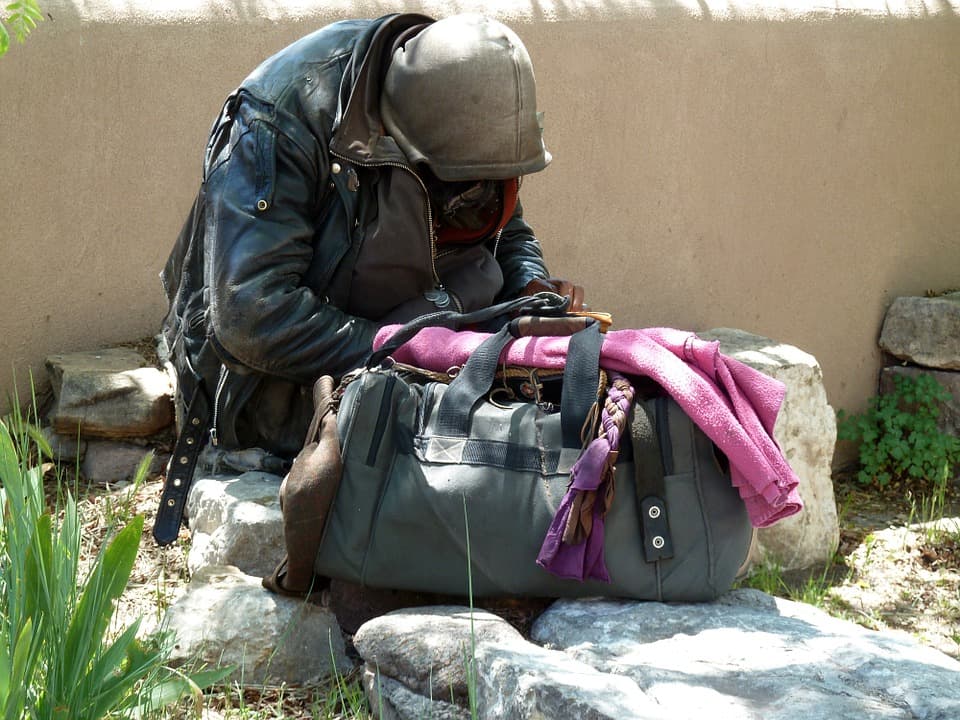
Obviously, this is the main problem faced by the homeless. Those who stay in the city are restricted by laws against putting up any kind of temporary shelter. This is why the homeless are so often seen huddling in doorways, alcoves, tunnels, etc.

Many cities have outlawed sleeping outdoors, which gives police the power to harass anyone they see lying down with their eyes closed. In fact, as long as you can be seen by anyone at night, your safety is at risk.

Homeless shelters may be no better. Filled with drugs and mental illness, they can be more dangerous than the streets, and many transients know enough to avoid them. Similar problems exist in tent cities. Diseases and parasites can easily spread when many people, all with poor hygiene, live close together.

Wooded areas appear safer and can be found throughout cities in the form of ravines, forests, valleys, and parks. Some homeless build shelters there using tarps, plywood, cardboard boxes, or whatever else they can find. This may work for a while.

But authorities keep tabs on these encampments and sooner or later come to take them down. Also, any shelter can be a target for thieves and squatters when you’re not there. Its mere presence during the day tells everyone that a homeless person is living there.

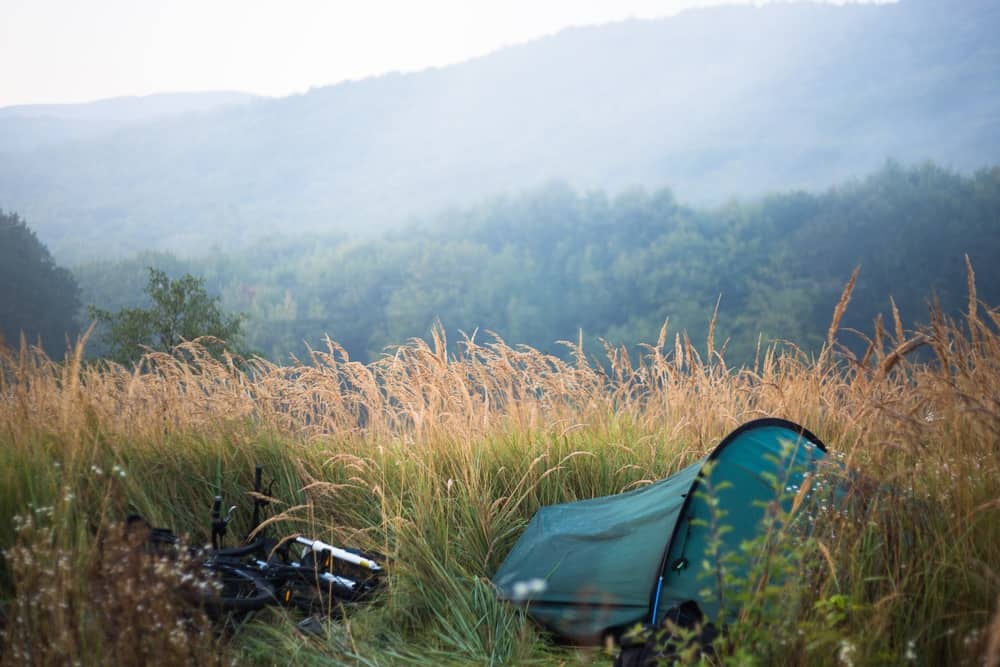
I get around these problems by using a relatively inexpensive “pop-up “camouflage dome tent found online. A pop-up tent can be set up and taken down extremely fast, with very little effort. The idea is to find a secluded area in the woods or a local park, put up the tent at sunset, and then take it down again at or before sunrise the next morning.

There is no campsite for anyone to find because it does not exist during the day. This is also known as stealth camping and many long-distance cyclists use it to avoid staying in motels. They camp on public or private land and take off before anyone knows they were there.

Your safety will come from being totally hidden. For anyone to see you sleeping at night, they would have to enter the forest after dark, leave the path at the right spot, and see through your camouflage. Even in broad daylight, a camo tent amid foliage is hard to spot.

I have spent several nights in city parks using this method and haven’t yet been detected. A tent is one of the best possible temporary shelters you can use and gives a sense of security, even if it is mostly psychological. It does need a relatively flat, clear area of ground to be set up, so scout locations before you need them and clear them of debris before nightfall.

An even smaller shelter that fits practically anywhere is the bivy sack– essentially a zippered bag just large enough for your body, made of waterproof, breathable material. Some fold down to the size of a water bottle. A bivy will keep you dry and sheltered but won’t have room for anything else, like changing clothes. Some come with a framework that holds the fabric away from your face for some breathing room.

Satellite images on Google Maps are great for finding dense woods in your area. You want areas that are more “wild” and overgrown, not those which are obviously mowed and well maintained by the parks department(though if you are very diligent about always taking your tent down at sunrise, you should have no problems either way).

Find spots that are totally hidden from both the trail and the street. At the same time, they should not be too far from places you want to go during the day. Eventually, you will have memorized a few ideal spots around the city and can rotate between them so that you never camp in the same place too long.

I use a heavy camouflage tarp as a groundsheet, protecting the tent floor from sharp debris. This can double as a cover for your gear, keeping it dry and hidden in the forest while you go about your daily business.

Do not try to weather a serious storm in a tent. At such times, train stations, bus stations, and airports are better choices. They are open24 hours a day and are designed for people to wait in, with ample seating, bathrooms, snack bars, and sometimes wi-fi.

In bad weather, some people will be sleeping in their seats or on the floor due to transit delays, and you can blend in with them. Keep a travel book from the library across your chest or some old boarding passes sticking out of your pocket.

If you are in an airport with multiple terminals, change terminals every so often. Lingering in one place too long may attract the attention of security(though I have heard of one woman living for months at the airport before anyone caught on). Hospital waiting rooms may be almost as good.

PRACTICAL CLOTHING

As an urban nomad, pick your outfit very carefully. It must not only protect you from the elements and carry what you need it to carry but also fit into an urban setting without looking odd. In my opinion, black should be the color of all your items, including bags.

Black looks right at home in the city, can go longer between washings without looking dirty, makes your bags and pockets look smaller despite being packed with stuff, and will render you practically invisible at night.

My all-black outfit consists of:

  • waterproof hiking shoes
  • paratrooper or cargo pants (lots of pockets)
  • alternate pair of waterproof pants
  • turtleneck
  • hoodie sweater
  • expedition vest filled with pockets
  • waterproof coat with hood
  • baseball cap with built-in LEDs (like the Panther Vision power cap, for hands-free lighting at night)

Add to this a week’s worth of clean socks and underwear, as well as duplicate pants and hoodie so you’ll still have something to wear when doing laundry. In cold weather, I add wool socks, thermal insoles, wool turtleneck, wool long underwear, waterproof mitts, and a balaclava.

BAGS AND BACKPACKS

homeless-survival-tips-for-city

Huge packs made for backpacking may look odd in the city. I use a large size army surplus ALICE pack to carry bulky items such as sleeping bag and sleeping pad, with a tent strapped to the outside.

Choose a backpack that places the weight on your hips, not your shoulders, as the ALICE does.

Urban commuter bags and messenger bags also work well for the city. You should be able to carry everything yourself when you need to. At other times, leave some of it stored or hidden and carry only what you need for that day.

As backpackers know, the level of fitness required to carry everything you need on your back is not inconsiderable. So get in shape.

A compression sack may help fit everything in. Used by the army, this is a sack meant to be carried inside your pack.

Fill it with compressible items (usually sleeping bag and clothes), then squeeze everything down, usually by sitting on it. At the same time, tighten all the straps around the sack. It will retain its smaller size until opened again.

HOW TO KEEP CLEAN

Besides clothing, this is the other area that gives homeless people away. Though cities are filled with public bathrooms, it is hard to find one private enough to do anything more than use the toilet and wash your hands.

So I recommend carrying a collapsible pail (found at camping stores) and a magnetic mirror (from a school supply store or dollar store).

Collapsible pails fold down flat to take up very little space in your pack. Fill one with warm water from the sink and bring it into one of the stalls. Set the pail atop the toilet tank or hang it from something if possible. Stick your magnetic mirror to the stall wall and use the pail as your sink. Now you can shave, brush teeth, and scrub your armpits in relative privacy.

Avoid bathrooms frequented by the homeless which tend to be the filthiest and most dangerous (eg. those in subways, public squares, certain restaurants, etc.). Clean, even elegant restrooms can be found in upscale shopping centers, colleges, theatres, airports, office buildings… places the homeless generally avoid. In hot weather, it may be possible to bathe in the same lakes and rivers where people go swimming.

When only a hot shower will do, visit a gym, YMCA, or university athletic center for the day, all of which have well-appointed locker rooms. Fitness centers on college campuses may just be the cheapest, cleanest and safest, and are usually open to the public.

A year’s membership will likely cost less than one month of rent and may include perks like free wi-fi, towel service, and a locker. It also provides a place to work out, rest, and socialize. Keeping suit clothes in your locker will allow you to go for job interviews. Beaches and campgrounds are other places to look for showers.

The travel section of dollar stores is a good place to pick up lightweight hygiene products like mini shampoo, mouthwash, and toothpaste. Don’t forget plastic containers for your soap and toothbrush, and pillboxes to carry Aspirin, vitamins, and any medication you need.

I keep all toiletries in a mesh bag which lets them air out after use. Replace your regular towel with a small, super-absorbent one from a backpacking store. A battery-powered travel razor will let you shave just about anywhere, any time.

Get one that runs on AA batteries as opposed to a plug-in rechargeable. Look for any way to save space, for instance using a bottle of camping soap also as dishwashing liquid and shampoo.

Facial cleansing cloths, wet naps, and hand sanitizer can keep you clean without water. If given any at a restaurant, save them until needed. Use those wet naps on your armpits and groin if necessary, where bacteria flourish. Use a high SPF sunscreen to avoid the telltale sunburn that many homeless people have.

And if the look suits you, shave your head and forget about all the maintenance that comes with having hair.

Always practice good hygiene and grooming, not just for your own health but to keep blending in with civilized society. If you look and smell like a bum, you will find many doors closed to you.

FINDING FOOD

The homeless survivalist does not have the option of storing food long-term or buying in bulk. You can only stockpile what you can carry – which amounts to maybe a week’s worth of sustenance at most. Peanut butter is an excellent choice, being easy to carry and eat, high in calories and protein, and needing no refrigeration.

Trail mix is another. There’s a lot of energy in nuts and seeds, and most of these mixes now come in resealable bags. Think like a backpacker, keeping heavy items like canned goods to a minimum and removing any unnecessary packaging from foods to make them lighter.

Dried (dehydrated) foods are the lightest. Foods that are simple, won’t spoil quickly, and require little to no cooking are well suited for the urban nomad: think beef jerky, granola bars, raisins and other dried fruits, corn chips, banana chips, buns, bagels, raisin bread, peanuts, instant soups, etc.

Again, dollar stores are good places to procure these items cheaply. Because your diet is sure to drop in quality, take a multivitamin daily as well.

Carry your food in a reusable cloth shopping bag and you will simply look as though you’ve just been grocery shopping. Also, keep a length of rope in this bag for hanging it from a tree when in the forest. Never keep food in your tent or your pockets at night, especially in city parks teeming with raccoons.

You should still have some means of cooking food. Needless to say, a big open fire in the woods would give away your presence. My personal choice was a Jet boil propane stove, with an Emberlit stove as a backup.

The Jet boil may be the fastest, most efficient means of boiling water outside, making it good for preparing instant foods and purifying water.

The Emberlit stove is a wood stove. It folds flat, taking up almost no space in a pack, and its fuel is essentially free. It lets you cook with a very small fire well suited to stealth camping.

Look into the ultra-light, compact kitchen utensils that backpackers use. Such products are designed to fit inside each other and take up minimum space. I fit my two stoves, fuel canisters, two bowls, pot, mug, cutlery, can opener, and even a Steripen water purifier into a bag less than 9” wide by 11” tall.

Cities usually have places to fish. Take advantage of this free food source by carrying a compact fishing rod. The smallest rods fold down almost to the size of a pen. For tackle, all you really need are a couple of floats, some hooks, sinkers, and a lure or two, all of which will fit in the palm of your hand.

Add a package of scented Power bait, or some similar product, to always have bait on hand. Look for live bait beneath fallen and rotting logs, or use pieces of food like bread or corn.

I’ve heard you can cook and eat practically anything that walks on land or flies. But be very careful with plants and eat only those you can positively identify as safe. (The color illustrations of plants in the pocket version of The SAS Survival Guide can help with this.)

FINDING WATER

This should be the least of your worries. Drinking water is readily found throughout cities. You should carry at least one 1L water bottle and get in the habit of topping it up every time you come to a tap or drinking fountain. Once you get used to water, you need never pay money for drinks again.

In the woods, large rivers are the preferred water source and you’ll want to camp near one if possible. A fast-moving stream will be cleaner than a pool of standing water. Of course, any water drawn from such a source must first be purified, just like in the wilderness. That means boiled, filtered, or treated with tablets or UV light.

Water purification tablets (easily found at camping stores) are the easiest way to treat water without additional apparatus. River water should never be your first choice for drinking but is good to have nearby when you run out of water collected from the city. Remember that almost all purification methods will remove the biological pathogens but not the chemical pollutants.

If rain is forecast, leave your collapsible pail outside to collect it. This water will not have to be purified.

INTERNET

Internet access is essential even when homeless. It is how you will look for jobs, send resumes, learn survival tips, and keep in contact with the wider world. You may even use it to earn money directly, using something like Amazon Mechanical Turk, or to offer your goods and services on eBay or Craigslist (the “gigs” section of Craigslist contains short-term odd jobs that pay cash).

Under normal circumstances, this would hardly be enough to live on. But without rent or utilities to pay, the economics of a nomadic lifestyle is somewhat different.

Fortunately, there are more and more places to use the Internet for free, especially if you can provide your own laptop, iPad or netbook. Find out all the free wi-fi zones in your vicinity. There will be some in places you never knew or expected.

Large district libraries and reference libraries can be ideal. There you can find computers, cubicles, outlets to plug into, and some portable chairs to sit in all day. (Note: When using public wi-fi, always use a Virtual Private Network or VPN, like the free service Hotspot Shield, when entering passwords.)

The online environment looks the same whether you are homeless or not, and so can be a source of comfort and consistency as your living conditions change. When immersed in online activities, it almost doesn’t matter where you are.

Even a homeless person can spend the day playing online games, watching shows, listening to music, writing a blog, and reading the news, much like a normal person would.

If you have the need and the money, consider a rugged computer like the Panasonic Toughbook. Able to withstand drops and freezing temperatures, with a waterproof keyboard that glows in the dark, this laptop line is practically built for homelessness.

RADIO

You should have a radio, like any survivalist. The lightest might be something like an armband radio for joggers, with readout showing the time and an alarm. Use it to check weather reports daily, and choose your attire and shelter areas accordingly.

TELEPHONE

Cellphones make having your own phone number as an urban nomad very easy. Remember to charge it and your other wireless devices whenever you come across an available outlet.

MAIL

If you need to receive mail, one choice is renting a PO Box. There are also services that can provide you with a real street address if you want people to think you have one. You will get an address like “99 Paladin Street #1” where the number actually refers to your box.

This is useful when you have to give your home address to obtain services.

This is the essence of “distributed living” – your shelter in one area, your shower in another, your mailbox in yet another. All are components of your “home”, you just need to travel a bit to get to each one.

TRANSPORTATION

Your own two feet may serve as your primary mode of transport. For this reason, don’t skimp on your footwear and make sure it fits perfectly.

If you can still afford gas, auto repairs, parking, and insurance, then, by all means, keep your vehicle as both transportation and shelter. If not, consider a bicycle as a substitute. Having a bike makes everything seem much closer than if you were walking, and will expand your range considerably.

I already cycle everywhere and now prefer it to the often poor and overcrowded public transit system.

Add a Bob Yak trailer, or almost any child bicycle trailer, and you can bring all your survival supplies with you. Some child trailers turn into strollers when detached from the bike. You can then push your belongings along the sidewalk in something a little more stylish than a shopping cart.

WINTER

Not everyone will have concerns about winter, depending on where they live. For me, the problem of surviving a Canadian winter without a heated shelter must be treated with deadly seriousness. Many homeless people die on the streets of cold countries every year.

Throughout Europe, we have just seen how extreme cold can strike even in unlikely places and kill hundreds without warning. Without going into all the details of winter survival, here are some tips:

You must test out your cold-weather gear before trusting your life to it. For example, camp out in the backyard during a deep freeze. Winterized sleeping bags have temperature ratings but their effectiveness varies depending on the user’s own body heat, metabolism, and clothing.

Sit in the park for several hours in your full winter outfit to see if it’s enough. The amount of insulation needed for sitting still in the cold is greater than what people typically wear for dashing from one heated structure to another. Dress in layers and always cover your head, even when sleeping. Wool is arguably the best material as it insulates so well, even when wet.

A sleeping pad is just as essential as a sleeping bag. This item is easy to overlook, but without it you will get cold no matter how great your sleeping bag is.

The ground has a way of conducting the heat right out of a warm body. (For the same reason, never sit directly on the ground without a thermal cushion like hunters use or some such insulating barrier.) The warmest sleeping pads are also the bulkiest and cannot be carried inconspicuously.

I chose to focus on the smaller self-inflating pads and get the one with the highest ‘R-value (insulation rating) I could find. Without a sleeping pad, you will have to sleep on cardboard or newspapers just like the homeless do, or use pine boughs when in the wilderness.

From what I’ve seen, gadgets like electric sleeping bags and propane space heaters are not practical or effective. And building a fire is usually out of the question. So you will be relying on your own body heat for warmth. Don’t lose it by leaving your shelter at night. If you have to relieve yourself, use a bottle instead. Study the survival tactics of winter campers and arctic explorers.

Anything that does not take well to freezing – laptops, cell phones, water bottles – should share the sleeping bag with you, down near your feet. Some winter sleeping bags have extra room at the bottom for this purpose.

If you fill your water bottle with hot water before retiring, it will help warm you. Use extra layers of shelter if you have them. For example, using a bivy sack inside a tent may seem redundant but it will increase your bag’s effectiveness against the cold. So will using a tent inside a larger structure.

FURTHER READING

The U.S. Army Survival Handbook adequately covers the wilderness side of homeless survival. It takes into account the soldier’s need for stealth and concealment when stuck in enemy territory.

Where other survival books tell how to remain visible and attract the attention of search parties, this one shows how to conceal your presence, move stealthily over terrain, and to build fires and shelters so that they cannot be spotted by the enemy.

(For our purposes, “enemy” can refer to anyone – police, park rangers, security guards, neighborhood watch, etc. – who tend to make life extra difficult for the homeless.) This no-nonsense guide also has surprising and innovative ways to treat your own injuries and illnesses in the field using common materials.

CONCLUSION

Thanks to odd jobs, credit cards and help from relatives, I remain housed for now. But the threat of homelessness still looms large. My debts are such that I do not know exactly where I will be living three months from now.

But even if homelessness never strikes, I won’t regret the time and money spent preparing for it. The increased confidence and peace of mind have been worth it. I know that, whether housed or not, life will go on.

Even the idea of spending winter without a permanent shelter is no longer unthinkable, and that is an amazing thing. Preparing for homelessness has incidentally prepared me for other scenarios, like the furnace breaking down or a sudden evacuation. And I can go camping or backpacking at a moment’s notice.

Homelessness has to be one of the gloomiest things to think about, let alone prepare for. But realize that not thinking or preparing will make the reality of it worse. If you do find yourself out on the street, having a plan of where to go, what to do, and what to take with you can make all the difference.

If it helps, don’t think of yourself as homeless but as a nomad practicing an alternative lifestyle. Without such an attitude or plan, you will start to resemble the typical bums who wander without direction or purpose. Who have nowhere to go, nothing to do, and nothing to hope for. Homelessness does not have to look like that.

Develop the skills of the urban nomad and practice distributed living. Keep your basic needs met and your mind clear, and you can always live a dignified existence whatever your situation may be.

Stealth Camping Tips

This video has some great tips on stealth camping that also apply to homeless survival…

homeless survival guide

Please share your thoughts, comments and homeless survival kit ideas in the comments below… thanks.

Filed Under: Bugging Out

Think on your FEET! A Prepper’s Guide To Shoes and Feet…

August 31, 2019 M.D. Creekmore

prepper shoes

by Arthur X

“Keep your eyes on the stars, and your feet on the ground.” – Theodore Roosevelt

As preppers, we have to prepare ahead. We have to look ahead and notice any potential problems and deal with those problems. Foot problems are one such area. That is my goal today, to have you merely recognize your feet for the next few minutes. This is about taking care of your FEET now, not later, and some downright simple solutions that will keep you walking for the long haul. Read along and learn how to save your feet for only $20.

First, two questions:

Have you ever had a pair of shoes that really hurt your feet but you wore them anyway?

Have you ever worn a pair of shoes until they have literally fallen apart?

I’m definitely guilty here

Do I have feet problems?

No, I do not. I think mainly because I have been proactive with my feet. If my shoes wore out, I would immediately buy a new pair of shoes. Wearing insoles is a way of life for me and I don’t own a pair of shoes without them.

When I was younger I wasn’t so lucky and developed some calluses from not wearing good shoes. Nothing too serious or needing any type of surgery. However, I learned from my mistakes and I am sharing my own personal experience. Let’s talk about some solutions!

Been there done that!

Have you ever been to your local store and visited the foot section? Most of us probably have. And it has grown over the years to very big business. That is good news because preppers have options that make our life easier. What’s the best product, field-tested? 

Gel or Foam?

Personally I do not like gel insoles, for example, Dr. Scholls. I have tried many brands. But the ones I have tried, I didn’t like. They do seem to be durable and have quality standards; however, I could not find a comfortable pair of gel insoles.

I really like foam insoles, such as Sof Sole or New Balance. Personally I use Sof Sole Arch Insoles. Mainly due to my high arch, I also love the cushion and support.

Sof Soles are a type of latex or composite foam material. They hold up extremely well, are worth the money, and offer outstanding protection. The foam tends to hold heat a little, and I have noticed this with foam insoles. This can be a benefit or a weakness. If you live in a cold climate they will generally offer a little more warmth.

In a hot climate that can make your feet sweat a little more. This usually is not a problem considering the manufactures usually make sport or athletic insoles that will help in this area, only something to consider. In my years of use, heat from Sof Sole insoles has never been a problem. I live in a very hot part of the country.

Very few pairs of shoes that I have bought were comfortable “without” insoles. Very few. Shoes like Air Jordans, New Balance, and higher quality running shoes are the exceptions here. Shoe technology is much better than say, 20 years ago, I can testify to that.

Let’s make it easy

I recommend Sof Sole insoles. Part of the reason is ‘accessibility’. Sof Soles are in every major department store and shoe store. At only, $20 they will not break the bank. I know you are thinking, those insoles are expensive, “I can buy a pair of shoes for $20”! Yes, you can, however what about buying a pair of shoes for $20, AND some quality insoles for $20.

Then, for $40 you have a really comfortable pair of shoes. This isn’t only about comfort. These types of insoles really do lessen the impact of your joints.

Over a period of years, the damage could be significant, especially if you wear really hard sole shoes. You may not feel the pain now, but down the road, you could develop some serious feet problems. And like back problems, feet problems can’t be ignored, they can get much worse.

Orthotics

Custom orthotics are not usually an option for preppers. Mostly because of a cost issue, not anyone can afford a custom pair of orthotics. I’m sure there are some benefits here, however, with new, over-the-shelf products offering such high quality I don’t feel custom orthotics are needed unless you have a foot problem. Then this article is not for you! I’m not a foot doctor only sharing my experience.

There are also heel supports and other store-bought orthotics. I never really liked these because I like more cushioning on my feet. For example, if you work on concrete floors for 8 hours a day, you are going to need a lot of support and a really good pair of shoes. If not, your feet will be hurting.

Tips for Happy Feet

Don’t remove the insoles that come with your shoes

Merely put the Sof Soles on top of the insoles already in your shoes. This will give you more support. It may make your shoes wear a little tighter, adjust your shoes, or shoe size accordingly.

Buy new shoes

If you have no tread or your shoes are torn etc., go buy a new pair of shoes. Shoes are so cheap nowadays there is no reason not to buy a new pair of shoes. Even if they are not the highest quality, buy a new pair. Insoles can help those shoes feel and perform much better.

Quality not quantity

In essence, this is what I’m saying. Not everyone can purchase a $120 pair of New Balance running shoes, or Air Jordan’s. As a solution, find shoes on clearance for $40, then purchase a pair of insoles for $20. For $60 you have a really comfortable pair of shoes. And your insoles should outlast your shoes, so you’re only helping yourself here. If you can afford those high-quality shoes, by all means, wear them!

Shop on the cheap

Big stores like Kohls, Kmart, Walmart, Big 5, eBay, offer shoes at great prices. Many times I will walk into big-box retailers and find shoes for $10.00 on clearance. Shop around, and if you find a good pair of shoes you like, buy two pairs. Why not?

Waterproof your shoes

I can recommend Sof Sole Water Proofer. In most shoe stores you can find leather conditioner and Water Proofer. This stuff isn’t usually cheap, but I do believe it is worth the price. Let me explain.

High-quality boots, Gore-tex or waterproof shoes are usually expensive. Water will kill shoes pretty quickly, especially if you live where it rains a lot. If it rains a lot where you live, you might need boots or a water-proof pair of shoes.

However, if you are like me and wear shoes most of the time, I can save some money and water-proof my own shoes. It will help them last longer and keep your feet drier. If your shoes are wet a lot, you might NOT notice the wear on your shoes on a daily basis; however, over time water is a real threat to your shoes. It breaks apart the glue in shoes and wears them down. It basically ages shoes faster than normal.

If you have leather boots or shoes, a leather conditioner is also recommended as it will help your shoes last longer. You can even use olive oil on your leather shoes or boots.

Be a lightweight, not a heavyweight

Shoe weight is important to me. For example, have you ever worn a pair of steel toe boots? They are heavy! Alternatively, you could buy a pair of steel toes shoes and cut the weight in half. Your feet will thank you later. For example, Nike Men’s Manoa Leather Boots are extremely lightweight for a boot. I own a pair and they are very comfortable for a boot. I do wear them with Sof Sole insoles because they didn’t come with any good support.

Reflexology

Reflexology might be an option if you have feet problems. Very therapeutic and you might be able to find a local Groupon deal and save some money

Future Technology

D30

D30 is a company that created a unique shock-absorbing material. They have been in business for a number of years. They became well known by their snowboarding gear, where you can literally get smacked in the head with a shovel!

Products made with their material in them are starting to become more widely available, helmets, jackets, gloves, etc. I have not had the opportunity to try out their new line of insoles at this time. I could only find their comfort insoles for sale on the internet. I’m really looking forward to trying out this new technology. Look for them possibly next year with more insoles on the market.

Filed Under: Bugging Out, Prepping

The Top Water Filters For Your Bug Out Bag

July 31, 2019 M.D. Creekmore

by David

There is no shortage of products or systems to choose from, but which one’s are the best investments? I’ve been doing a lot of research into the packable water filtration systems currently on the market and I’d like to share my findings and opinions.

In this post, I’d like to try to cover which products successfully filter/purify water of toxic industrial chemicals, viruses, bacteria’s, protozoa, cysts, algae, spores, and sediments, and which do not. Also, some of the pros and cons of each variety.

So, here we go…

Product Group 1A: Katadyn Hiker / Hiker Pro / Vario

These pump style filters have found their way into many bug out bags, and for good reason. They’re simple and effective. There are very few differences between the models listed above, but I’ll highlight the differences here.

Hiker and Hiker Pro $50 – $75 – Fact Sheet / Pro Fact Sheet

The Hiker and Hiker Pro are both decent backpacking filters and they are both fairly reasonably priced if you shop around. In fact, I own the Katadyn Hiker and I’ve successfully used it to pump my canteens and hydration pack full of pond water with no ill effects.

The products are compact, lightweight, easy to use, and relatively effective, but you assume some risk because the filter media is only capable of capturing particles of 0.3 microns average size or larger. They do leave a slight tinge to the water and if the water is particularly nasty there can be some mild odors or taste left in the water.

It probably won’t kill you, but there are better options out there so that in the event you do have to drink water that is potentially contaminated with a virus you won’t contract it, especially post SHTF when treatment will be harder to come by.

  • •Filtration Quality: 0.3 Microns (bacteria, protozoa, cysts, algae, spores, sediments)
    •Filtration Volume: 200gal / 750L (Pro 300gal / 1150L) 1-3 people
    •Filtration Media: replaceable glass fiber media with an activated carbon core
    •Filtration Flow: +/- 1 quart / liter per minute
    •Filtered Turbidity: Mildly Tinged / Mostly Clear
    •Filtered Aroma: Very Mild
    •Filtered Taste: Mostly Pure

Vario $75-100 – Fact Sheet

  • •Filtration Quality: 0.3 Microns (bacteria, protozoa, cysts, algae, spores, sediments)
    •Filtration Volume: 528gal / 2000L 1-4 people
    •Filtration Media: replaceable glass fiber media with an activated carbon core
    •Filtration Flow: +/- 2 quart / liter per minute (1q/lpm in long-life mode)
    •Filtered Turbidity: Slightly Tinged / Almost Clear
    •Filtered Aroma: Slight or None
    •Filtered Taste: Mostly Pure

With the exception of volume, these filters are almost all identical. If you are going to purchase one of these, purchase the most inexpensive version because no improvement in particle size is gained by purchasing the upgrades.

The replacement filters (Hiker / Vario) are reasonably priced to stock up on and easily replaceable simply by unscrewing the top discharge lid, disposing of it, and installing a new one (don’t throw it away though because you can drill a hole in the bottom, clean out the charcoal, and reinstall to use the filter system as an unfiltered pump unit as I’ll discuss later).

In the end, these are decent products, but make sure you stock up on the filter cartridges if you intend to use it for an extended period of time or buy a Sawyer (if you’re sold on Katadyn’s brand name then upgrade to one of their endurance series products for greater filtration volume).

Product Group 1B: Katadyn Pocket / Combi / Expedition

These pump style filters are designed to support multiple people (anywhere from 1 – 20 depending on variety) or for a longer period of time. They range from on the expensive side to outrageous, but if you have the money they’re awesome. There are some variations to discuss though.

Pocket +/- $270 – Fact Sheet

  • •Filtration Quality: 0.2 Microns (bacteria, protozoa, cysts, algae, spores, sediments, and some viruses)
    •Filtration Volume: 13,200gal / 50,000L
    •Filtration Media: Replaceable Ceramic
    •Filtration Flow: +/- 1 quart / liter per minute
    •Filtered Turbidity: None
    •Filtered Aroma: None
    •Filtered Taste: Pure

Combi +/- $225 – Fact Sheet

  • •Filtration Quality: 0.2 Microns (bacteria, protozoa, cysts, algae, spores, sediments, and some viruses)
    •Filtration Volume: Ceramic 13,200gal / 50,000L, Charcoal 105gal / 400L
    •Filtration Media: Replaceable Ceramic / Replaceable Activated Charcoal
    •Filtration Flow: +/- 1 quart / liter per minute
    •Filtered Turbidity: None
    •Filtered Aroma: None
    •Filtered Taste: Pure

Expedition +/- $1200 – Fact Sheet

  • •Filtration Quality: 0.2 Microns (bacteria, protozoa, cysts, algae, spores, sediments, and some viruses)
    •Filtration Volume: 26,400gal / 100,000L
    •Filtration Media: Replaceable Ceramic
    •Filtration Flow: +/- 4 quarts / 4 liters per minute
    •Filtered Turbidity: None
    •Filtered Aroma: None
    •Filtered Taste: Pure

There are some variations here, but with the exception of volume and flow, the pocket and Combi filters are almost identical, the expedition is more of a camp filter, but I suppose you could pack it.

The replacement filters (Pocket / Combi Cer – Car / Expedition) are fairly expensive, but the volume they’re capable of makes up for the cost if you plan to use the filter this much. These are really great products, but the initial cost will be prohibitive to people on tighter budgets.

Product Group 2A: Sawyer Point One Biological Filter Variations – Print Brochure

These filters are sold as a squeeze, gravity, and pump style with different adapters and configurations. The filters are Non-replaceable sealed element hollow fiber membrane (kidney dialysis machine technology).

But they’re guaranteed for 1 million gallons (I’m not sure that the guarantee will work for you post-collapse though) and are touted as an indefinite use filter by the use of periodic backflushing and maintenance. If the filter ever does happen to break on you though, they’re very affordable and stocking up on them won’t be too difficult. Let’s delve in.

Point Zero Series $20 – $220 (average $50) – flow rate report – microbiological test report

  • •Filtration Quality: 0.1 Microns (absolute) (bacteria, protozoa, cysts, algae, spores, sediments, and some viruses)
    •Filtration Volume: Indefinite (yes indefinite with maintenance back flush and care)
    •Filtration Media: Non-Replaceable Hollow Fiber Membrane
    •Filtration Flow: 4 quarts / 4 liters per minute Squeezed or up to 5 gallons per minute at max inlet 40psi
    •Filtered Turbidity: None
    •Filtered Aroma: None
    •Filtered Taste: Pure

These filters are excellent. They’re lightweight, easy to use, filter down to extremely small micron size, and are extremely inexpensive and reliable. They do not have replaceable media, but they are considered indefinite use as long as you regularly backflush the filter with the included backflush syringe and prevent it from freezing with water inside.

If you do happen to break it, they’re so affordable you can buy backups. These filters really only have 1 drawback in my opinion, and that is due to their hollow membrane pore construction they do not filter out and dissolved solids or solutions. That is to say that they cannot filter out anything that is completely dissolved into the water.

Product Group 2B: Sawyer Point Zero Two Biological Purifier Variations

These purifiers are sold as a squeeze, gravity, and pump style with different adapters and configurations. The purifiers are Non-replaceable sealed element hollow fiber membrane (kidney dialysis machine tech).

But they guaranteed for 1 million gallons and are touted as an indefinite use filter by the use of periodic backflushing and maintenance. If the filter ever does happen to break on you though, they are fairly affordable and stocking up on a small supply is doable.

Point Zero Two Series $140 – flow rate report – microbiological test report

  • •Purification Quality: 0.02 Microns (bacteria, protozoa, cysts, algae, spores, sediments, and all of the most common viruses CDC: Scroll all the way down)
    •Purification Volume: Indefinite (yes indefinite with maintenance back flush and care)
    •Purification Media: Non-Replaceable Hollow Fiber Membrane
    •Purification Flow: 4 quarts / 4 liters per minute Squeezed or up to 5 gallons per minute at max inlet 40psi
    •Purification Turbidity: None
    •Purification Aroma: None
    •Purification Taste: Pure

If you haven’t noticed the above facts, these are actually not considered filters anymore, but purifiers. These purifiers are capable of removing every harmful thing (that is not in dissolution) from the water.

Again, the only drawback is that due to the hollow fiber technology, these purifiers do NOT remove anything that is completely dissolved into the water. They pass everything that is smaller than .02 Microns in size without absorption.

Product Group 2A & 2B both function in exactly the same manner, but the Point Zero Two variation has smaller pore sizes. Both of them utilize an ABSOLUTE micron measurement which is much more stringent than the AVERAGE micron measurement. This basically means that absolutely NO particles, biology, or vectors of the specified micron size or larger will be found in the processed water.

The different variations of these products are the same core filter or purifier with different peripherals included in the package. For example, the SP129 package contains one Point One filter, one 1L collection pouch, and a mouthpiece valve for $45 while the SP131 contains one Point One filter, 3 collection pouches, a backflush syringe, and a mouthpiece valve for $45, and the SP181 All In One package contains 1 Point One filter, 2 mouthpiece valves, 1 faucet adapter hose, 1 backflush syringe, 1 1L collection pouch, and a bucket adapter kit for $60. Here’s a view of their water products.

At the end of the day, in my opinion, the best investment would be to purchase both a Sawyer Zero Point Two purifier and the Katadyn Hiker Pro along with some extra filters for the Katy.

The reasoning is that while some chemicals can slip by all but the most advanced filtration and purification techniques, a glass fiber / activated charcoal filter pump unit used as a post-filter would help to capture some chemicals by absorption while the Sawyer purifier will function to eliminate all of the smaller non dissolute “badies” such as HEV/HAV/SARS.

The sawyer will benefit and accommodate the pressurization that the pump filter will add to the line and this will speed your collection up as the drop tube can be easily dropped into the water source, the pump outlet can be connected to the Sawyer very easily, and the Sawyer can be adapted to a hydration pack drink tube so you never really have to drop your kit to refill your bladder if you’re traveling with a buddy.

If you are trying to collect water in an environment that is potentially hostile you can just use the sawyer collection pouches to grab the water and take it with you to purify it in a safer environment. Just bear in mind that the Katy media would need replacement after about 200 gallons (you could probably get more since it’s used as a post filter).

Most filters cannot remove toxic chemicals due to the dwell time required to absorb them onto the charcoal media. In fact, even distillation does not remove all chemicals because some exhibit the same properties of evaporation and boiling/condensation points.

Choose your water source more wisely, and/or use the old fashioned method of digging a hole a few feet from your source water and collect from the water that has flowed into the hole. The Katy is mainly used as a pump, but the filter can help to improve taste that the Sawyer may not. You can refer to the CDC for further information on filtration properties and effectiveness here.

My personal configuration currently is a combination Katadyn Hiker Basic / Sawyer Point One filter connected in series so that the Sinker/Screen and Bobber are connected to the inlet of the Sawyer Point One filter, the Sawyer outlet is connected to the Hiker inlet, the Hiker outlet is connected to a quick disconnect Camelbak adapter and the QD connects to my Camelbak drinking tube after removing the bite valve.

Connected in this manner I am using the Katadyn prescreen and bobber to screen the water out going into the Sawyer. Since the Sawyer is back-flushable I use it to capture all sediment, bacteria, and protozoa prior to the Katadyn Glass Fiber / Charcoal unit to extend the life of the filter. I am using the Glass Fiber / Charcoal filter to absorb any dissolved contaminants that the Sawyer passes through which can help to improve any taste issues that the Sawyer may miss, and I’m using the pump unit to speed the process by pressurizing the line.

An added benefit to using this system is that by slightly pressurizing my Camelbak’s bladder I can allow the filtered water to backflush the Sawyer filter automatically and lose only 1 liter of water from my 3-liter reservoir providing me with a freshly backflushed Sawyer filter and 2.5 liters of very clean water.

Bear in mind that while this system is excellent for most water sources in the US, it does not filter our viral contaminations. I plan to upgrade the Sawyer Point One to a Point Zero Two purifier in the not too distant future.

If viral contamination is a concern you can add 4 drops of unscented bleach per liter/quart or 12 drops to a full bladder directly into the drinking tube prior to connecting the filtration system and allow the bleach 10-15 minutes of contact time in the bladder before drinking.

Now, if you remember, I recommended saving your used Katadyn filter cartridges because they can be reused in away. Allow your filter to thoroughly dry out by leaving it in the sun for a day or two. Take your used filter cartridge and turn it upside down to see a plastic circle in the center of the bottom plate. Using a 1/4″ or similar sized drill bit you can drill a hole through it.

Now, just dump out any charcoal media that you may find inside. Now find a drill bit that just fits into the outlet hole in the top of the filter cartridge and drill down through the top to clear the silt barrier that holds the charcoal in. Now, run some tap water through the inlet hole of the filter to wash out any residual charcoal or drill shavings that may still be inside.

Now reinstall the filter into your pump and cycle about a quart of fresh tap water through the filter to remove any more filtration media or shavings that may have survived your first two attempts. You now have a cartridge that can turn your Katadyn filter into a basic hand pump to use on your Sawyer indefinitely.

Warning: This is only recommended for filtration cartridges that have only ever been used as a post filter behind a Sawyer or other similar smaller micron filtration system.

If you’ve ever used a filter cartridge to directly filter contaminated water this is not recommended because bacteria and or cysts could be present on the dirty filtration media and could potentially make their way through the filter in the future.

If you want to convert a used filter of this type be sure to allow the filter to soak in a water/bleach solution of at least 1% for 24 hours, then allow the filter to thoroughly dry out in direct sunlight.

Filed Under: Bugging Out

How to Pack a Bug Out Bag

June 16, 2019 M.D. Creekmore

packing a bug out bag

by Everyday Prepper

Bug Out Bags (BOBs) have been hotly debated on the internet for some time and while I don’t expect my post on how to pack a bug out bag to put an end to the discussion I thought I would throw in my two cents for those readers out there that are just getting started.

Why do we need a BOB?

Let me start of by saying that if you’re searching for information on survivalist or preppers then chances are you already realize the need to get ready for situations that may be out of your control.  These situations can include anything from a problem with your house to a world crisis.

As preppers, we generally say you need to get ready for what you consider to be the most devastating realistic event you can think of.  If you honestly believe that the worst thing that can happen is a tornado touches down and blows away your house then you should start preparing for that.

When you prepare for the worst you can think of you generally cover a whole broad spectrum of smaller things that you can’t think about or don’t want to think about.

When prepping for any event whether great or small one thing that is most likely needed across all situations is a way to leave wherever you are quickly and without too much thought about what you will need.  This is where the BOB comes in handy.

If prepared before an emergency then when an emergency comes you don’t have to think about what to grab.   Now you may ask “What about the situations where I don’t need to leave and I need to stay instead?”

Well, you see, having the BOB didn’t hurt you and the supplies in the BOB can still be put to use where you’re at and you don’t have to scrounge around to find them.  Having one just makes sense and by creating one early in your prepping adventure you will find this to be one baby step toward your ultimate goal.

The .gov folks have stated that in any national emergency you should be prepared to get by for at least 72 hours by yourself without any assistance.  For a horribly real example of this look at what happened after hurricane Katrina.

As far as I can tell the .gov had been telling people about the 72 hour waiting period for some time and still, people didn’t believe or they chose not to listen.  We can look back and see what crazy things happen in the aftermath of the storm and while not every location lost control (although the media didn’t talk about the calm and reasonable people) some did.  I went to Mississippi shortly after Katrina to help in the relief effort on the coast and got to see what shelter life was like.

I can promise you that you don’t want to be in that situation, especially with a family.  Where we were staying was a campground about 30 minutes outside of the national guard lines that blocked the coast and there were tarp houses set up in the “primitive living” campsites.

We didn’t understand what that was about when we were there but looking back after visiting the shelters and hearing stories about what was going on at some of the shelters I can see how sleeping in a tarp house would be better than sleeping in a shelter.

I say all of this to make you understand that if you buy gear now for a BOB and prepare for a 72 hour period extending that period becomes an easier and easier job.  You simply get more gear and also (more importantly) you get more knowledge about what it will take to survive an emergency.  The more prepared you are the less freaked out or panicky you will be in the time of emergency.

Who needs a BOB?

In my opinion, every member of your family should have a BOB just for them.  Yes, there will be duplicate supplies but as the saying goes “two is better than one” or as the survivalist saying goes “two is one and one is none”.  Having a BOB for each member of your family will ensure that you have the supplies you need to make it through a short-term emergency.

Where do we get a BOB?

There are several prebuilt solutions available but in general, I would stay away from them.  I personally believe your BOB should be tailored to you or your family members and the generic solutions just can’t promise that.  Also with a generic version you are paying for someone to assemble a group of cheap supplies.

You can build a good BOB suited for you with good gear for around the same price or less most of the time.  Not only will you possibly save money but you will know the gear that is in your BOB instead of just reading about it in the printed 8.5×11 piece of paper that comes with your prebuilt BOB.

When to use your BOB?

One of the most difficult questions to answer is “When do I use my BOB”.  There are many theories and many arguments but it really all comes down to what you and your family plan to do during the emergency at hand.  With many emergencies staying at home and sheltering in place might be a necessity.

With other situations, you may be forced to leave your home.  Having plans for what you will do beforehand makes the decision of when to use your BOB much easier because all the information doesn’t need to be weighed while you are stressed and going through the situation.

If you already know that in the event of a blizzard you will stay home, ride it out and contact some out of state relatives to let them know what you are doing then the decision to not use the BOB has already been made for you.

The same is true for the situation where you know you will use your BOB if someone knocks on your door at 3 am and tells you that you must be ready to leave your house in 5 minutes because you are being evacuated to a “safe” location because a wildfire threatens your house.

Planning is what will help you determine when to use your BOB.  Planning for every possible event that might happen is very important and can make your life much easier and a little less stressful during very stressful circumstances.

With that said however you can’t plan for all situations so you need to be ready to make a split second decision under stress at any given moment.

 Here are some things you may want to consider when deciding to use your BOB.  (These are in no particular order)

  1. Is your family safer at home or elsewhere
  2. Are you worried this event could lead to lawlessness or vandalism
  3. Is this a personal, community, state, national or world level crisis
  4. How long will this emergency last
  5. Is your family healthy enough to travel or be moved currently
  6. Is the weather good enough to change locations
  7. When you get to the other location will you be able to survive with only what you are bringing
  8. Is there a way to not only survive but to thrive and prosper when you get to site b (not meaning get rich but meaning live and continue living once your BOB supplies run out)

Packing a bug out bag:

There are a lot of list on the internet about what items you should pack in your BOB.  I don’t offer any individual items most of the time because it really all depends on your comfort level with the locations you will be bugging out to and through.

For instance, if you are a seasoned backpacker and your plan is to escape 60 miles through the woods to a cabin that you own then your supply list may be very small.  The more you know the less you have to carry on your back.  This is especially true with bushcraft related skills but also applies to urban environments.

Here is a basic overview of what type of items you should have for most scenarios.

  • Shelter
  • Clothes
  • Water
  • Fire
  • Food
  • Hygiene

Conclusion:

While you may be feeling overwhelmed or intimidated by building your first BOB it’s really not as bad as you think.  Going to the library to find books on backpacking or even going to a store and talking to the “experts” there will help you quite a bit.  Just remember the people at stores are there to sell you lots of stuff.  Most of it you won’t need and much of it will just be dead weight that you have to carry on your back.

Overall you should really be looking to carry only about 25%-30% of your total body weight.  At first, you will probably buy cheaper heavier equipment and that OK.  Don’t put off building a BOB just because you’re on a budget.

My first BOB weight almost 50% my total body weight and nearly killed me my first 10-mile hike.  Slowly but surely you’ll find lighter gear and you’ll learn what you don’t really need to carry.  All this will add up to a lighter and better BOB.

Get started today and you’ll be hooked, just don’t forget to actually practice some hiking and overnight stays with your BOB every once and awhile.

Filed Under: Bugging Out

The First 23 Things I Put In My Survival “Go Bag”

June 16, 2019 M.D. Creekmore

Some people might consider a bug-out bag and a 72-hour kit as essentially the same thing. For the purposes of this article, we will consider them as two separate kits. The 72-hour kit is more of a “stay at home and ride out the short-term disaster” kit, while the bug-out bag described below is more of a “grab and go” kit.

The very idea of leaving the security of your home to “bug out” to the woods has never set well with me.

In nearly every instance, it is better to hunker down or “bug in” than to bug out. Why leave the safety and familiar surroundings of your home for the open and unforgiving wilderness? For many people, fleeing is their first line of preparation against disaster.

Unfortunately, most will end up joining the multitude of other refugees freezing in a cave; dying from exposure, starvation, or violence at the hands of the mob; or becoming wards of whatever government entity is still functioning.

I live in a fairly safe area and have prepared to survive at home. I can conceive of only a few scenarios that would force me to leave. Even then, I would go to the house of an out-of-state relative with whom I have an agreement: if need be, he can come to my place or I can go to his after a disaster.

I know what you’re thinking: what about an “end of the world as we know it” type of event? Well, if such an event does take place, there will be no 100 percent safe place for most of us anyway, and do you really think you would be better off trying to hide in the open wilderness than hunkering down at home?

Don’t get me wrong—I’m not saying you should never bug out; you should keep all options open because you never know what you’re going to have to do to survive until the time comes to make that decision.

What I am saying is that there are better ways to survive most disasters than heading into the bush. You need to weigh the risks of bugging out vs. hunkering down and make your final decision based on logic and type of threat.

That’s the way decisions should be made. Unfortunately, when making survival decisions, many people rely on emotion (to run and hide) rather than more tried-and-true logic. Relying on emotion instead of logic can make for some interesting adventures.

However, without sound planning, those adventures are likely to be short-lived. For example, I recently asked a fellow in his late 30s what he would do if disaster struck his area. He thought for a moment and said he would gather his family and all the food, guns, and ammunition he could find and head for the mountains that lie some 75 miles north of his home.

Depending on the type of disaster, his “plan” might work short-term for a lone survivor or a small group of individuals in good physical condition and equipped with proper gear and mindset. But he is the father of a newborn, and his wife thinks missing an appointment at the nail salon is the end of the world as she knows it.


Making matters worse, the young father has no outdoor survival training or skills other than watching reruns of Les Stroud’s Survivorman television show and camping at a national park campground with all the utilities and hookups provided.

Why he thinks he can survive in the wilderness while dragging his young family along, I don’t know. He isn’t thinking logically, and if he ever has to put his plan to the test during a real emergency, his family will likely suffer or possibly even die.

Unfortunately, this “Batman in the boondocks” mentality will continue to be the chosen survival plan for many who haven’t thought survival through logically and come up with a realistic plan.

When making survival plans for your family, you have to honestly weigh the risks of your decision based on logic. In almost every disaster scenario, it is better to stay put (bugging in) or head to a prearranged safe place at an out-of-town relative’s or friend’s house than it is to head to the woods to eat twigs and pine bark.

Therefore, for most people, an evacuation bag is a better choice than a bug-out bag. An evacuation bag should contain the gear necessary to get you from point A to point B, whereas a bug-out bag (in most cases) is geared more toward wilderness survival. I have both, but admittedly my bug-out bag is an option of last resort. Knowing when to go is much more important than the contents of your survival pack or even where you will go.

You don’t want to jump and run before you need to, but if you wait too long you may never reach your destination. If you wait for the authorities to give the order to evacuate, it may already be too late.

The roads leading to safety could be blocked or impassable by motor vehicle, and walking to your destination may be impossible or too dangerous to attempt. On the other hand, if you jump and run in response to every potential disaster, you’ll soon deplete your resources and the patience of your family, school, and employers.

For example, say you live in an area prone to tornadoes, like Texas, and you evacuate to Arkansas (which has also suffered its share of killer tornados over the years) every time the clouds turn dark or the wind shakes the leaves.

You would be on the road nonstop during tornado season—which seems to be most of the time in Texas. But waiting until the twister is at your door will also put you at unnecessary risk. There are no easy answers.

All you can do is weigh the dangers of bugging out vs. hunkering down logically based on the situation at hand. You have to consider the nature of the threat and ask yourself which option gives you the better chance of surviving the type of disaster you are facing.

Of course, there are times when evacuation is a no-brainer. Say, for example, you live on the Florida coast and a category 5 hurricane has been predicted to hit your area within 72 hours.

In that case, you would be foolish not to go as soon as possible, even if you have no prearranged bug-out location. On the other hand, let’s say there is a snowstorm heading your way and you have food, water, heat, and a way to cook even if the power goes out for an extended time.

Then you are probably better off to hunker down where you are. In my opinion, the bugging out vs. hunkering down debate is moot because it all comes down to the type of threat you face, your personal situation, and your preparedness level. In the end, you’ll have to decide what to do on a case-by-case basis.

Survival Go Bag Checklist

Please note that the following list is intended only as a suggestion. Your bug-out bag should be customized to suit your
individual needs, plans, and location.

  • ❏ Antibacterial hand wipes
  • ❏ Cash—$100 in ones, fives, and tens
  • ❏ Cell phone and charger
  • ❏ Change of clothes
  • ❏ First aid tactical trauma kit
  • ❏ Fishing kit
  • ❏ Fixed-blade knife (the linked to knife is the best survival knife available in my opinion)
  • ❏ GPS navigator (handheld)
  • ❏ Handgun and 200+ rounds of ammunition
  • ❏ LED flashlight (small) with extra batteries, as well as a crank-type flashlight that doesn’t require batteries
  • ❏ Lighters – two
  • ❏ Map of area and compass
  • ❏ Multitool (the one linked to is the best multi-tool available in my opinion)
  • ❏ OC spray
  • ❏ Paracord, 25 feet
  • ❏ Prepaid calling card
  • ❏ Prescription medications, as needed
  • ❏ Sewing kit (small)
  • ❏ Space blanket
    ❏ Sterno folding stove (less than $15 on Amazon)
  • ❏ Trail mix, a box of energy bars (15), and electrolyte packets
  • ❏ Wooden matches in a waterproof container
  • ❏ Water filter or bottle

Note: If forced to bug out by car, load both your 72-hour kit and bug-out bags…

Special Considerations For Children

In stressful situations, it is important for you to appear relaxed, confident, and in control—even if you are a trembling bag of nerves on the inside. The last thing children need is extra stress brought on by a panicked parent. Another consideration concerning children is familiarity.

During a bug-out situation, you will be away from home, and this can be extremely stressful for children. It is important to eliminate as much of the stress as possible. One way to do this is by bringing along items that are familiar to them. If they have a favorite blanket, pillow, stuffed toy, or other objects that comfort them, be sure to pack it before heading out the door.

This is very important. Children tend to bore easily, so adding items to forestall or extinguish their boredom will make the time away from home much easier for all of you. You may want to put together a bug out pack just for them consisting of toys, books, cards, writing/drawing materials, and games.

Don’t forget extra batteries for those games and toys that need them. Of course, children aren’t the only ones who get bored; include things that will keep your boredom in check as well.

Filed Under: Bugging Out

Bug-Out Bag Guide and Checklist

June 16, 2019 M.D. Creekmore

bug out bag checklist
The Ultimate DIY Bug-Out Bag Kit and Checklist

by Mike

If you are like me, you may find prepping for everything to be a little overwhelming. It can seem that no matter how much you have, there just is never enough. I have read hundreds of articles and watched endless videos on what to carry for EDC and how to make a BOB/INCH bag.

I also seemed to focus on one aspect at a time and way overdo it while letting the rest slip by. So to keep me from having the most awesome arsenal in town and dying of thirst, or keeping me from caring an 80 lb. backpack everywhere I made a graph of what I might need in a survival situation vs. how long I need to survive.

My first concern in any emergency is can I breathe, see, or am I bleeding? Next question is am I in immediate danger and what can I do to remove the threat?

After that, I need to ascertain what threats are likely to come from this situation and prepare my surroundings to deal with them. Once the threat is no longer my focus, it should turn to how can I sustain myself in this situation?

Now many of the answers may change depending on what type of emergency you are facing. I am bleeding but an EMT is currently coming through my door would be handled a lot different than I am bleeding and marauders are currently coming through my door.

The two situations require both different responses from me as well as needing different gear.

To know what I need, I need to know how long the emergency will last. Here is where the problem comes in, I don’t know when what, or how long. Many Preppers feel the best way to combat this is to always be prepared for everything, and that is where the sense of overwhelming comes from. It’s almost impossible to be prepared for everything all the time.

So here is the solution I find works best for me.

I broke it down into 10 categories.

  1. How to transport my kit (Carry).
  2. How to deal with injury (Care).
  3. How to stay warm and dry (Cover).
  4. How to make what I need (Cutting).
  5. How to make light and fire (Combustion)
  6. How to transport/prepare food and water (Container).
  7. How to secure and repair (Cordage).
  8. How to replenish/get food (Collecting)
  9. How to stay in touch (Communications)
  10. How to obtain/replace gear (Currency)

I borrowed heavily from Dave Canterbury’s 5 C’s on this.

First I listed what I need to survive, then based on how long it might take I made my different kits. If the situation is over in an hour or so I should have everything I need in my pockets to survive. If it were to take the rest of the day then I would need my sling pack/handbag.

Overnight to a week then I would need my large pack. A week to a month I would need a cache, and a month to a year I would need to make it to my retreat. There will be some redundancy but the five should build on each other.

I am going to use level one through five for my emergencies. This is in no way an official scale, just me sorting what I might go through. Level one examples could be a power line down, flat tire, a fire, first date, minor accident, a confrontation, etc.

Can I breathe, am I bleeding?

For both of these, a couple handkerchiefs can help. To both cover the face to keep smoke, dust, and other stuff from being drawn into your lungs and as a makeshift bandage.

These are temporary measures until you can make it to help or help can find you. (Note, if you can’t breathe because of a windpipe, lung, or chemical issue that is not a level one emergency.) I also keep some gauze, alcohol wipes, anti-bacterial cream, and a few band-aids wrapped up in the handkerchiefs. For seeing I keep a small single battery flashlight.

Am I in immediate danger and what can I do to remove the threat? Here you have to make a decision, get out or stay. In level one cases removing yourself from the situation is usually the preferred method. If you don’t then you will focus on the threat.

For cold/rain I keep a paracord bracelet, space blanket, lighter, and a pocketknife. Seasonal, sturdy clothing and dressing in layers is a huge help in this. For danger from physical attack (dog, snake, biker, ex-wife) I have my knife and my CCW pistol, but in a level, one escape is still the best option if available to you.

Preparing your surroundings to deal with threats and sustaining yourself usually are not a worry as the emergency will have passed before you need either of those in a level one.

However, if I were to need to collect water or food I have my pistol and I keep the handkerchiefs in a ziplock baggie with a water filtering straw.

I can use the baggie to collect the water and drink through the straw. Communication during a level one can usually be accomplished with a cell phone, but I carry a sharpie as well just in case. For levels 1-3 Currency I carry cash.

Level two emergencies are ones that last several hours to all day. They might include breaking down, getting lost, flooded streets, bad break up, freezing rains, terror attack, second dates, all day power outage, riots, etc.

For this, I carry my kit in a sling pack or messengers bag, whichever looks less conspicuous. I have a small first aid kit, with tape, gauze, painkillers, antihistamines, anti-diuretic, and more options in band-aids and would cleaners.

For cover, I have a self-folding Rain Jacket/Wind Breaker, gloves, and watch cap, if you are already dressed appropriately these will make a great difference.

My cutting tool is a strong belt knife. I highly recommend you get a full tang, high-quality one as this knife seems to take the most abuse. I also carry a multi-tool, small pry bar, and lockpicks.

For combustion, I have another lighter and a 2 cell flashlight as well as spare batteries and a magnesium fire starter.

My container is a metal water bottle already full. For cordage, I have 50’ of paracord and zip ties. For collecting, I have my full sized pistol as well as extra ammo.

At this point, a few Cliff bars are going to get you a lot further then trying to set snares, fish, or hunt, and the pistol is more for protection but can still be used to collect game if needed.

Finally, in communication, I have my iPad mini, a notebook, and pens.

While in the first two levels of threat it is possible and even likely you would live through without preparations, a level three there can be a considerable danger.

A Three can be a tornado, hurricane, blizzard, coordinated act of terror, nuclear meltdown, helplessly lost, mother-in-law visit, martial law, etc.

In a level three, you are likely going to be spending several days away from your normal comforts and routine. In a situation like this staying put is not always a bad idea, and in most cases preferred. If you are home, don’t head for the hills.

If you are somewhere safe, going home could be more risky then staying put. If you are not safe, this pack should help you get to a place that is.

For carry, I use a full sized backpack. A good sized duffle or gym bag could also be used, but I find them to be less comfortable if you do end up heading out.

For care, I have a full first aid kit, including quick clot, bandages, scissors, irrigation syringes, Epi-pens, wound closers, etc.

Cover can change a lot depending on the time of year, but I like to always have at least a bivy roll (t-shirt, underwear, and socks), Sweat shirt, long underwear/base layer, extra socks, hammock, tarp, ground cloth, and blanket/sleeping bag.

Tent and change of clothes are nice if you have the room or don’t have to pack them far. For my cutting tools, I carry an entry tool, a tomahawk, and a large knife.

Combustion at this point can be one of the things that can make or break you. You will need it to cook food, make water safe, warm you up, and see at night. There is also a great psychological aspect to having a fire that can bring up your spirits.

For this, I have a wood burning camping stove that also accepts an alcohol burner for fast fires and to cook without smoke. I carry several fire starters for wet conditions, a head lamp to keep my hands free, flares for signaling and really wet conditions and rechargeable batteries for my lights.

For containers, I carry a water bag that can be used as a hydration pouch, metal cup, and hiking water filter. I also add light wire and tape to more paracord and zip ties for my cordage. For collecting, I now have snares, fishing gear, and a carbine as well as more ammo.

Finally, for communications, I have a solar panel that can charge the iPad, cell phone, or batteries for lights, and walkie-talkies.

While Level 3 are possible to die in, Level 4 emergencies are those you are likely to die in without proper gear/experience/help. They can last up to a month long and could include things like Katrina/Sandy, Nuclear accidents, large scale Terror Attacks, ending/becoming Engaged, run on the banks, or as in the only Level 4 I have ever been, a blizzard that lasted a month.

The first night power went out and we were stuck for weeks until the National Guard arrived.

A level four Carry for me is a stash. Now I know most people think of stash as something buried in a hole in the woods, and while it can be that, a Stash can be many other things as well. Supplies left in the attic, basement, closet, or spare room can be your stash.

Things you leave at a friend’s place, storage center, locker, hunting blind, or favorite campsite. Stashes are only limited by your imagination and can very well mean the difference between like and death.

For care, I recommend a full EMT kit. You can find them on Amazon pre-built, or buy a good bag and make your own. If you are on prescriptions meds it is a very good idea to have a supply of them in your bag, but remember they do expire so have a plan to rotate them. Cover should be something you can live in for some time.

One of my stashes is the RV I lived in while attending college, another is a shipping container several of us use.

RV for bugging out

Our stuff is already there along with the tools to make it a livable structure with minimal work, and still, another just has a tent buried along with the gear, and not to be discounted the homes of everyone in our group.

I also recommend at lease complete changes of clothes and 3-4 extra changes of undergarments never hurts to have. Whatever you choose just make sure you can live in it for 7-30 days. The last place you want to be is the superdome with everyone else.

Cutting at level 4 includes things like Axes, Bow saws, hammers, nails, shovels, etc. I have several places where we stashed enough tools to build a dugout cabin if necessary. Combustion includes things like a rocket stove, the Solo Stove Campfire, and whatever you start a fire with while camping.

I also like to keep a decent number of tinder/fire starters, you never know when you will get there and getting a fire going quickly could be vital. As for Containers, all the camping pots, plates, kettles, water bags, collapsible buckets, regular buckets, and bottles that were too heavy or just didn’t make it for the BOB’s can be used.

As for cordage you really want rope, straps, and even nails or screws to help make a secure and comfortable shelter. For collecting, I feel shotguns and high powered rifles work well here. Also steel traps, nets, and even cage traps.

For Communication, I like to have a wind up/solar radio and several drop points that are known to me and the rest of the group. For Currency, I like extra food, alcohol, batteries, candles, blankets, or pretty much anything that you would want to stay comfortable on the run.

When it comes to Level 5 I am really talking about something I know nothing about. These could include an invading army on our soil, nationwide EMP, stock market/total economic collapse, a divorce, Zombie Apocalypse, or cutting off welfare and food stamps.

Since nothing like that has happened in my life time I can only speak third hand what I have heard from those who have gone through it. The one thing I gather from those who have gone through it is decide ahead of time what you will and won’t do. I will leave that up to you to decide what that means to you.

For carry, I recommend it already be at your retreat, if it’s not, then plan on only bringing what you have in a level 3. For Care, I recommend learning as much as you can about alternative treatments and care.

We are lucky to have a Surgeon, a trauma nurse, and an EMT in our group and most of the care items has been left up to them.

If you do not have these you will have to decide how far you are willing to go and stock accordingly. Cover is the house at our retreat. It has wood stoves, beds, blankets, and most of the clothes that we no longer wear but still fit.

For cutting we have all the implements you would find on a farm, since it is on a small scale being used as such, we just have extra of everything we use (while we do have gas powered equipment, we have a section that is only farmed with hand tools to keep our skills and knowledge of needs up to date).

Combustion is the wood stoves, rocket stoves, wood grills, solar stoves, wood smokers and a fire pit, as well as lanterns, candles, candle making equipment, solar panels, rechargeable batteries, and spare part for all of the above.

For containers, we have pretty much what you will find in our homes, as well as larger ones to accommodate larger groups, canners, jars, lids, and bins in the cellar. Cordage goes from fishing line to logging ropes. Collecting we have raised beds, an orchard, a pond, two creeks, barns, pens, fenced fields, and the land we can and do hunt.

For communication, we have a Ham radio both at the farm and at our homes as well as the smaller hand held units. Currency is pretty much anything we have extra, as well as tools that can make both replacement and barter gear.

I could go on forever about the retreat and what we have done, but the truth is, if you aren’t living on one now (at least part-time), a lot of it will just be a waste. For the long term, it is my opinion that skills are what will bring you through and while I could tell you the best thing for me, it may not be the best thing for you.

A lot of full time farmers argue forever about how things should be done, and for you to know what works for you, you really need to be doing it. But then again I am only guessing, I have never been through a Level 5, and if you haven’t prepared for the lower level ones, maybe that’s where you should start. Anyways hope this helps.

Some thoughts on bug out bag firearms selection…

bug-out-bag-gunAdded by M.D. Creekmore

Most people will suggest a .22 caliber rifle, such as the Ruger 10/22 and this is a great choice. A .22 caliber rifle can take small game as well as larger game such as deer with proper shot placement.

Another advantage for having a .22 Long rifle is the relatively low-report especially when using CB caps and the ability to be effectively silenced with a commercial or homemade sound suppressor aka “silencer”.

Just remembered that such a device is illegal without proper government approval and will land you behind bars if you’re caught, and is suggested here for a worst case scenario only or after you have gone through all of the legal hoops.

The downside of the .22 Long rifle round is the limited range, penetration and stopping power all of which limit the rounds effectiveness when used for self-defense.

I suggest a backup handgun chambered for a cartridge suitable for self-defense. I would not go below a 9mm or 38 special and then us good expanding ammo.

Even with a 9mm and 38 special, you should seriously consider using only the +P rounds such as the 115 or 124-grain JHP +P in the 9 mm or 158-grain lead semi-wadcutter hollow point .38 Special +P for defensive purposes.

Your location would also determine weapons choice. For example, those bugging-out in grizzly country should definitely consider something more powerful than the aforementioned 9 mm or 38 special.

My first choice for protection against such large game would be a center-fire rifle chambered for 308 or larger. My second choice would be a magnum revolver with a 5.5″ to 7.5″ barrel chambered for .44 magnum or larger.

It is wise to avoid any armed confrontation if possible. Trust me you are not a coward if you avoid the possibility of being shot or having to shoot someone else. You are not expendable – neither are the lives of your family or those in your bug out group. Those with the macho kill ‘em all attitudes will not last very long after the poop hit’s the fan.

With that being said, a semi-auto military style rifle should be considered especially if you are trying to get from an urban area to the country, where facing organized gangs or other threats attempting to block your exit could be a possibility.

An AR-15 with collapsible buttstock or folding stocked AK-47 (for compactness and concealability) could help get you out of a dangerous situation if you’re forced into one while taking up little space and not adding significant weight to your overall survival gear.

The $10 Fire Kit For Your Bug Out Bag

Added by P. Mueller

FIRE-KIT-for bug out bagIt all began this past winter while watching the national news. Apparently, an older couple decided to try an untested shortcut home from a nearby casino. This shortcut happened to be through a lightly traveled mountain pass. Did I mention there was a blizzard going on at the time?

Well, there was. You know what happens next. The folks got lost and their car became stuck in the snow and they weren’t going anywhere. They must not have believed in being prepared for situations like this because they had no useful supplies with them, not even a bit of food, water or matches.

After hearing this story, I decided that I would build an inexpensive fire kit for each of my vehicles, and while at it, another for a prepper friend whose birthday was coming up.

Since there are typically higher priorities for my cash, I thought I’d challenge myself to build a waterproof fire kit for under $10. And the challenge was on.

The first step was to comb the internet websites, blogs and YouTube for ideas. To say there are a lot of great ideas is an understatement by far. There are tons of styles and types of containers alone, from mint tins to plastic zipper bags, along with content suggestions too numerous to name.

As stated earlier, the container had to be waterproof, so mint tins and the like were out. I browsed an online retailer for containers and found dozens, so once I refined the search by cost, I stumbled upon a 14 cm x 10 cm x 4 cm, a waterproof plastic container for $5 with free shipping.

There went half the budget and I hadn’t even started on the contents. But that was okay because I knew that I had many of the contents already in the house. I bet you do as well. This hard plastic container is watertight and closes securely against a rubber gasket with a locking latch; a prolonged submersion test was performed on each to verify that fact.

The completed kits were placed into freezer zip bags as the first line of defense anyway.

Since I was already at the online retail site, I ordered small, but stout, 2” ferrocerium flint rods with red plastic handles and an attached striker. These cost about $3 each and also had free shipping.

While waiting for these items to arrive, I set about pulling together the rest of the contents of the kit. In an empty coffee can, I’d drop items as I found them, not knowing if they would actually be used.

FIRE-KIT for bug out bag containerFinally, the day came when the items were delivered; the assembly process could now begin. The first step was to pull out the 550 paracord that’s kept on hand for miscellaneous tasks and projects. The container had a cheapie cord which definitely needed replacement.

After watching various online videos, I decided on an attractive braid called the Cobra Weave. According to the video, there was approximately one foot of cord for each inch of braid; three feet of cord would be sufficient.

That should also be enough for a bow drill cord if needed. I attached a medium sized split key ring on one end and connected the other end to the box. Now the kit could be hung in a tent, a car or from a go bag,

By this time, the rest of the needed materials had been gathered so it was time to get to work. Below is the kit inventory is broken into three categories: ignition sources, tinder and miscellaneous.

IGNITION SOURCES

Disposable butane lighter – This is your standard, full-sized Bic lighter, not the mini or the cheapie. I guess the mini would work, but in an emergency situation, I would want as much fuel as possible. The lighter does have a leash clip cover with a split key ring to protect against the fuel being inadvertently released. The leash clip and lighter cost approximately $2 each.

Ferrocerium flint rod – There are many options to choose from when you order these. I needed something that would fit in the container, but would not be so small that it would be tricky to grip and strike with cold hands.

The two-inch rod I found fit the bill. This particular model had a red plastic “winged” grip that made holding the rod very easy. The rod itself is also quite stout so there are lots of strikes before it is worn out. The metal striker was attached with a small bit of elastic cord and I knew I could do better.

Out came the paracord as a replacement. It is important that the rod and striker are not separated because one without the other is useless. I know you could use a knife edge, but that assumes you have a knife.

Lifeboat matches – Here I cheated a bit. I already had the matches so I didn’t need to buy them. I wrapped six matches in plastic cling wrap along with the striker pad cut from a matchbook. For those who don’t know, lifeboat matches are waterproof and can be ignited even when wet. Make sure that the matches can’t rub against the striker or each other while in storage to avoid accidental ignition.

Matches – Again, these I had from a previous camping trip. I took a small matchbox and replaced half of the stick matches with waterproof camp matches. My thinking was that having different types gives options.

Just make sure the striker on the box works with all of the matches in the kit. On one of the Alaska reality shows I watch, one gentleman said that he prefers paper matches in the freezing cold, so I included a book of plain, old paper matches.

TINDER

Cattail – Last Fall while out golfing, I came across some dried cattail at the end of the season. I broke a couple off and stuffed them in the golf bag; now I had a use for them. I cut a section long enough that it would fit snuggly in the lid of the container and stay there. Once I wrapped it in plastic wrap, it stayed in place nicely.

Char cloth – This type of tinder intrigued me. I’d seen it work in videos, but had never made any or started a fire personally utilizing char cloth. Now was a great time to acquire a new skill. Using an old, clean t-shirt, I made enough for three patches, each 2”x 3”. Once completed, the cloth was placed into a small brown paper envelope to minimize the mess.

Due to space restrictions, I can’t go into the actual process here. That could be a whole post on its own. It is simple to do though.

Cotton balls with petroleum jelly – This was a bit of a project. I cut large drinking straws into 1.5” sections and stuffed it with half a cotton ball slathered in petroleum jelly. The ends are then sealed using a lighter and needle nose pliers. This eliminates the mess and keeps the jelly from drying out or getting all over the rest of the contents.

Jute twine – This I use around the house to tie up plants or wrap packages. I cut an 18” piece and wound it tightly around two ten penny finish nails driven into a piece of scrap lumber. It snuggled next to the cattail in the lid.

There is just enough friction to keep both firmly in place. I realize that 18” is not a very long piece, but it should be enough for a fire or two in an emergency situation. More twine could be stuffed into the voids of the container when done.

Wet Fire – Individual tabs are sold at a big box hardware store nearby for $1 each. These things are great; they burn while wet. Better living through chemistry indeed.

MISCELLANEOUS

Aluminum foil – 18”x 24”piece folded neatly so that it could be slipped on the side of the container taking up virtually no room. The foil is very handy if you need to start a fire on a wet surface. Spread this on the ground and build up from there.

Candle – This is a 4” long cylindrical candle with the diameter slightly smaller than a dime. The family got these at a church function and it was a perfect fit. The candle can be used for multiple purposes including light, heat and melting snow to make water.

550 paracord – The usefulness of this item in any emergency kit goes without saying. Altogether the kit consumed about five feet of cord. I used what I had on hand, but there are fifty plus sheath cover colors including a really cool reflective variety. By the way, don’t buy the cheap stuff, you’ll regret it later.

All in, I spent $11. Drat, I missed by $1.00. That’s okay though because I had a blast putting this kit together. I combined many things I already had into a potentially lifesaving kit. There are many items that you could substitute in your kit. Maybe you can get birch bark in your area or prefer fatwood or dryer lint and a magnifying glass. Customize the kit to fit your needs.

Take the $10 Fire Kit Challenge, I dare you! Make mods to this kit like wrapping it in duct tape (itself a nice fire tinder) or connect items to the key ring.

Oh, I almost forgot, the stranded folks finally made it out a week later. Hungry and cold I would imagine, but wiser for the experience.

Cheap, Light Shelter Ideas for Your Bug Out Bag

setting up a bug out camp shelterAdded by Mike

I have the same mindset as M.D. – bugging out is your absolute last resort. You’ll never be able to carry as much as you can store in your house, and your house is (or very well should be) water tight.

That being said, there are going to be situations where you have to get out. If your city is under water. If Ebola is going around (stay away from people with blood coming out of all of their orifices, eh?), if martial law is called, if the power is out and you live in a big city – all these things are good cues for you to leave.

Everyone should have a bug out bag. Everyone. Disasters and situations can come very quickly where you need to leave and NOW – you won’t have time to pack a bag in all cases, so you must have one ready to go.  But if you’re like me, you don’t have all sorts of excess money to throw at high-end products for something you may (and hopefully never)  have to use.

Also if you’re like me, you’re healthy and in not too bad shape, but you’re also no Olympic athlete. There’s a saying when it comes to bags for camping, hiking, and especially bug out bags where you have to be mobile – “Ounces mean pounds and pounds mean pain”.

Your bug out bag should overall be small, light and portable. But that’s a whole topic for an entire another article of a type that’s already saturating the internet.  I’m here today to talk about cheap, light ideas for shelter to bring with you on your bug out.

What Is Shelter?

Shelter is the idea of keeping the elements at bay so you can stay warm and dry.  This is why you live in a house or apartment, and not out in the open. Humans, with our slow crappy metabolisms and our hairless skin, are probably one of the most susceptible creatures on the planet to the elements.

We need to stay out of the wind, we need to keep our temperatures at a decent level, and an excess of water tends to make our skin shrivel, then get infected, then rot and fall off.

No one wants their skin to fall off, I’m almost 100% sure of that.

Seeing that we can die of exposure almost as fast as we can die of thirst, a shelter is an absolute must in your bug out bag. I’m sure you’d all like to bring a 3,000 square foot holiday house with granite counter tops, but that’s not going to fit in your 45-liter bug out bag.

Your shelter will not be comfortable, but it will keep you alive, that’s the idea. It will not be heavy, and it will not be expensive, and here are some ideas for you.

Contractor Grade Garbage Bags.

They are thick, they are big, they are cheap, they are durable, they are light, they can fold up into a teeny space, and they have a million uses.

I have one in my bug out bag specifically to use as a ground sheet.  The ground can conduct cold and wet very quickly.  Using a big garbage bag will stop moisture from getting through the ground to you.

If you are in an area with some dry vegetation, stuff the garbage bag full of dry leaves, or soft pine branches or grass or straw or whatever is around. This will give you both some insulation from the grounds cold, as well as some padding for comfort.

You can also use a garbage bag as a makeshift bivvy sack (see below) or a makeshift rain poncho or tarp. Put a few in your bug out bag, you won’t regret it.

Bivvy Sacks

A bivvy sack, or bivouac sack, is a small, light and 100% waterproof sack that’s designed to slip over a sleeping bag. It’s an alternative to a tent and basically wraps you in a cocoon of waterproofing.

It’s incredibly small and light and very, very portable.  You can pick one up online very cheaply and store it in your bug out bag.  I have a bivvy in my bug out bag made by a company called SOL. They are thermal bivvy’s made from a mylar material that reflects your body heat back to you and they are completely waterproof.

You can get the original product for less than $20, and it’s actually about the same price for a two-person version if you’re bugging out with someone you don’t mind spooning within a giant plastic bag.

I actually have the SOL product with the breathable fabric that is still 100% waterproof but will not build up any condensation in. It’s a bit more expensive but at $40 it’s totally worth it to not be damp, in my opinion.

Tarps

Again, a small tarp is cheap, light and waterproof. It can be folded up to take no space in your bug out bag. If you have some rope, you can tie a tarp in such a way that it will keep most of the rain off of you. Even if your bivvy sack is waterproof, I’d still like not to get rained on if at all possible.  Tarps can also be used to help conceal you if you decide to buy say a green or brown tarp and not one of those bright orange ones.

Single Man Tent

I have a single man tent I purchased a couple of years ago. I absolutely hate it. Sure, it was cheap, and light, and small (rolled up its smaller around and shorter than my forearm). Sure it’s waterproof.  But the top of the stupid thing is inches away from my face and if it’s warm and even a bit humid out you get some serious condensation in the thing.  That’s why the bivvy is in my bug out bag and not the single man tent. That being said, to each their own, and I would a million times rather be claustrophobic and slightly damp than soaked and exposed.

Multi-Man Tent

Multi-Person tents are larger, harder to set up and heavy.  However, if you know for sure that you’re bugging out with several people and you don’t think you’ll get separated, having the stronger person carry this on their pack might work.  You’ll certainly get more space in your shelter but for the reasons I listed above, I don’t like or recommend this.

A Folding Shovel

You heard that right. A folding shovel. This can absolutely help with shelter.  If you live in a cold climate, and if you’re in the horrible situation of having to bug out in the winter, that totally completely sucks and should only be done if you have absolutely no other choice, a shovel makes sense.

That’s because if there’s snow on the ground, snow can be used as a shelter material. Take your shovel and make the snow into a wind block. If you’re really good, you can build an underground snow shelter, because snow actually is a good insulator. Only do this if you know what you’re doing though. No one wants a snow collapse to deal with.

Putting it all together

So, in my bug out bag, I have a tarp, a couple of contractor garbage bags, and a watertight, heat reflective bivvy sack.  I find some high ground in between a couple of trees. I tie my tarp up on an angle to form a sort of tarp lean-to.  I stuff my contractor garbage back full of dry grass and leaves and put it under the tarp lean-to.

I put my bivvy sack out on top of the stuffed garbage bag. All these items together weigh less than two pounds, cost a little over $40 ($20 if you get the cheaper bivvy) and if put together right, form a weather resistant, dry and (relatively) comfortable place to sleep.

There it is. If I’m very lucky, I’ll never have to use it…

A Combat Vet’s Perspective on Bug Out Bag Water Filtration

Added by David

hiking clean drinking water filters

There is no shortage of products or systems to choose from, but which ones are the best investments? I’ve been doing a lot of research into the packable water filtration systems currently on the market and I’d like to share my findings and opinions.

In this section, I’d like to try to cover which products successfully filter/purify water of toxic industrial chemicals, viruses, bacteria’s, protozoa, cysts, algae, spores, and sediments, and which do not. Also, some of the pro and cons of each variety. So, here we go.

Product Group 1A: Katadyn Hiker / Hiker Pro / Vario

These pump style filters have found their way into many bug out bags, and for good reason. They’re simple and effective. There are very few differences between the models listed above, but I’ll highlight the differences here.

Hiker and Hiker Pro $50 – $75 – Fact Sheet / Pro Fact Sheet

The Hiker and Hiker Pro are both decent backpacking filters and they are both fairly reasonably priced if you shop around. In fact, I own the Katadyn Hiker and I’ve successfully used it to pump my canteens and hydration pack full of pond water with no ill effects.

The products are compact, light weight, easy to use, and relatively effective, but you assume some risk because the filter media is only capable of capturing particles of 0.3 microns average size or larger. They do leave a slight tinge to the water and if the water is particularly nasty there can be some mild odors or taste left in the water.

It probably won’t kill you, but there are better options out there so that in the event you do have to drink water that is potentially contaminated with a virus you won’t contract it, especially post SHTF when treatment will be harder to come by.

  • •Filtration Quality: 0.3 Microns (bacteria, protozoa, cysts, algae, spores, sediments)
    •Filtration Volume: 200gal / 750L (Pro 300gal / 1150L) 1-3 people
    •Filtration Media: replaceable glass fiber media with activated carbon core
    •Filtration Flow: +/- 1 quart / liter per minute
    •Filtered Turbidity: Mildly Tinged / Mostly Clear
    •Filtered Aroma: Very Mild
    •Filtered Taste: Mostly Pure

Vario $75-100 – Fact Sheet

  • •Filtration Quality: 0.3 Microns (bacteria, protozoa, cysts, algae, spores, sediments)
    •Filtration Volume: 528gal / 2000L 1-4 people
    •Filtration Media: replaceable glass fiber media with activated carbon core
    •Filtration Flow: +/- 2 quart / liter per minute (1q/lpm in long life mode)
    •Filtered Turbidity: Slightly Tinged / Almost Clear
    •Filtered Aroma: Slight or None
    •Filtered Taste: Mostly Pure

With the exception of volume, these filters are almost all identical. If you are going to purchase one of these, purchase the most inexpensive version because no improvement in particle size is gained by purchasing the upgrades.

The replacement filters (Hiker / Vario) are reasonably priced to stock up on and easily replaceable simply by unscrewing the top discharge lid, disposing of it, and installing a new one (don’t throw it away though because you can drill a hole in the bottom, clean out the charcoal, and reinstall to use the filter system as an unfiltered pump unit as I’ll discuss later).

In the end, these are decent products, but make sure you stock up on the filter cartridges if you intend to use it for any extended period of time or buy a Sawyer (if you’re sold on Katadyn’s brand name then upgrade to one of their endurance series products for greater filtration volume).

Product Group 1B: Katadyn Pocket / Combi / Expedition

These pump style filters are designed to support multiple people (anywhere from 1 – 20 depending on variety) or for a longer period of time. They range from on the expensive side to outrageous, but if you have the money they’re awesome. There are some variations to discuss though.

Pocket +/- $270 – Fact Sheet

  • •Filtration Quality: 0.2 Microns (bacteria, protozoa, cysts, algae, spores, sediments, and some viruses)
    •Filtration Volume: 13,200gal / 50,000L
    •Filtration Media: Replaceable Ceramic
    •Filtration Flow: +/- 1 quart / liter per minute
    •Filtered Turbidity: None
    •Filtered Aroma: None
    •Filtered Taste: Pure

Combi +/- $225 – Fact Sheet

  • •Filtration Quality: 0.2 Microns (bacteria, protozoa, cysts, algae, spores, sediments, and some viruses)
    •Filtration Volume: Ceramic 13,200gal / 50,000L, Charcoal 105gal / 400L
    •Filtration Media: Replaceable Ceramic / Replaceable Activated Charcoal
    •Filtration Flow: +/- 1 quart / liter per minute
    •Filtered Turbidity: None
    •Filtered Aroma: None
    •Filtered Taste: Pure

Expedition +/- $1200 – Fact Sheet

  • •Filtration Quality: 0.2 Microns (bacteria, protozoa, cysts, algae, spores, sediments, and some viruses)
    •Filtration Volume: 26,400gal / 100,000L
    •Filtration Media: Replaceable Ceramic
    •Filtration Flow: +/- 4 quarts / 4 liters per minute
    •Filtered Turbidity: None
    •Filtered Aroma: None
    •Filtered Taste: Pure

There are some variations here, but with the exception of volume and flow, the pocket and Combi filters are almost identical, the expedition is more of a camp filter, but I suppose you could pack it.

The replacement filters (Pocket / Combi Cer – Car / Expedition) are fairly expensive, but the volume they’re capable of makes up for the cost if you plan to use the filter this much. These are really great products, but the initial cost will be prohibitive to people on tighter budgets.

Product Group 2A: Sawyer Point One Biological Filter Variations – Print Brochure

These filters are sold as a squeeze, gravity, and pump style with different adapters and configurations. The filters are Non replaceable sealed element hollow fiber membrane (kidney dialysis machine technology).

But they’re guaranteed for 1 million gallons (I’m not sure that the guarantee will work for you post collapse though) and are touted as an indefinite use filter by the use of periodic back flushing and maintenance. If the filter ever does happen to break on you though, they’re very affordable and stocking up on them won’t be too difficult. Let’s delve in.

Point Zero Series $20 – $220 (average $50) – flow rate report – microbiological test report

  • •Filtration Quality: 0.1 Microns (absolute) (bacteria, protozoa, cysts, algae, spores, sediments, and some viruses)
    •Filtration Volume: Indefinite (yes indefinite with maintenance back flush and care)
    •Filtration Media: Non Replaceable Hollow Fiber Membrane
    •Filtration Flow: 4 quarts / 4 liters per minute Squeezed or up to 5 gallons per minute at max inlet 40psi
    •Filtered Turbidity: None
    •Filtered Aroma: None
    •Filtered Taste: Pure

These filters are excellent. They’re lightweight, easy to use, filter down to an extremely small micron size, and are extremely inexpensive and reliable. They do not have replaceable media, but they are considered indefinite use as long as you regularly back flush the filter with the included back flush syringe and prevent it from freezing with water inside.

If you do happen to break it, they’re so affordable you can buy backups. These filters really only have 1 draw back in my opinion, and that is due to their hollow membrane pore construction they do not filter out and dissolved solids or solutions. That is to say that they cannot filter out anything that is completely dissolved into the water.

Product Group 2B: Sawyer Point Zero Two Biological Purifier Variations

These purifiers are sold as a squeeze, gravity, and pump style with different adapters and configurations. The purifiers are Non replaceable sealed element hollow fiber membrane (kidney dialysis machine tech).

But they guaranteed for 1 million gallons and are touted as an indefinite use filter by the use of periodic back flushing and maintenance. If the filter ever does happen to break on you though, they are fairly affordable and stocking up on a small supply is doable.

Point Zero Two Series $140 – flow rate report – microbiological test report

  • •Purification Quality: 0.02 Microns (bacteria, protozoa, cysts, algae, spores, sediments, and all of the most common viruses CDC: Scroll all the way down)
    •Purification Volume: Indefinite (yes indefinite with maintenance back flush and care)
    •Purification Media: Non Replaceable Hollow Fiber Membrane
    •Purification Flow: 4 quarts / 4 liters per minute Squeezed or up to 5 gallons per minute at max inlet 40psi
    •Purification Turbidity: None
    •Purification Aroma: None
    •Purification Taste: Pure

If you haven’t noticed the above facts, these are actually not considered filters anymore, but purifiers. These purifiers are capable of removing every harmful thing (that is not in dissolution) from the water.

Again, the only drawback is that due to the hollow fiber technology, these purifiers do NOT remove anything that is completely dissolved into the water. They pass everything that is smaller than .02 Microns in size without absorption.

Product Group 2A & 2B both function in exactly the same manner, but the Point Zero Two variation has smaller pore sizes. Both of them utilize an ABSOLUTE micron measurement which is much more stringent than the AVERAGE micron measurement. This basically means that absolutely NO particles, biology, or vectors of the specified micron size or larger will be found in the processed water.

The different variations of these products are the same core filter or purifier with different peripherals included in the package. For example, the SP129 package contains one Point One filter, one 1L collection pouch, and a mouthpiece valve for $45 while the SP131 contains one Point One filter, 3 collection pouches, a back flush syringe, and a mouthpiece valve for $45, and the SP181 All In

One packages contains 1 Point One filter, 2 mouth piece valves, 1 faucet adapter hose, 1 back flush syringe, 1 1L collection pouch, and a bucket adapter kit for $60. Here’s a view of their water products.

At the end of the day, in my opinion, the best investment would be to purchase both a Sawyer Zero Point Two purifier and the Katadyn Hiker Pro along with some extra filters for the Katy.

The reasoning is that while some chemicals can slip by all but the most advanced filtration and purification techniques, a glass fiber / activated charcoal filter pump unit used as a post-filter would help to capture some chemicals by absorption while the Sawyer purifier will function to eliminate all of the smaller non dissolute “badies” such as HEV/HAV/SARS.

The sawyer will benefit and accommodate the pressurization that the pump filter will add to the line and this will speed your collection up as the drop tube can be easily dropped into the water source, the pump outlet can be connected to the Sawyer very easily, and the Sawyer can be adapted to a hydration pack drink tube so you never really have to drop your kit to refill your bladder if you’re traveling with a buddy.

If you are trying to collect water in an environment that is potentially hostile you can just use the sawyer collection pouches to grab the water and take it with you to purify it in a safer environment. Just bear in mind that the Katy media would need replacement after about 200 gallons (you could probably get more since it’s used as a post filter).

Most filters cannot remove toxic chemicals due to the dwell time required to absorb them onto the charcoal media. In fact, even distillation does not remove all chemicals because of some exhibit the same properties of evaporation and boiling/condensation points.

Choose your water source more wisely, and/or use the old-fashioned method of digging a hole a few feet from your source water and collect from the water that has flowed into the hole. The Katy is mainly used as a pump, but the filter can help to improve taste that the Sawyer may not. You can refer to the CDC for further information on filtration properties and effectiveness here.

My personal configuration currently is a combination Katadyn Hiker Basic / Sawyer Point One filter connected in series so that the Sinker/Screen and Bobber are connected to the inlet of the Sawyer Point One filter, the Sawyer outlet is connected to the Hiker inlet, the Hiker outlet is connected to a quick disconnect Camelbak adapter and the QD connects to my Camelbak drinking tube after removing the bite valve.

Connected in this manner I am using the Katadyn prescreen and bobber to screen the water out going into the Sawyer. Since the Sawyer is back-flushable I use it to capture all sediment, bacteria, and protozoa prior to the Katadyn Glass Fiber / Charcoal unit to extend the life of the filter.

I am using the Glass Fiber / Charcoal filter to absorb any dissolved contaminants that the Sawyer passes through which can help to improve any taste issues that the Sawyer may miss, and I’m using the pump unit to speed the process by pressurizing the line.

An added benefit to using this system is that by slightly pressurizing my Camelbak’s bladder I can allow the filtered water to back flush the Sawyer filter automatically and lose only 1 liter of water from my 3 liter reservoir providing me with a freshly back flushed Sawyer filter and 2.5 liters of very clean water.

Bear in mind that while this system is excellent for most water sources in the US, it does not filter our viral contaminations. I plan to upgrade the Sawyer Point One to a Point Zero Two purifier in the not too distant future.

If viral contamination is a concern you can add 4 drops of unscented bleach per liter/quart or 12 drops to a full bladder directly into the drinking tube prior to connecting the filtration system and allow the bleach 10-15 minutes of contact time in the bladder before drinking.

Now, if you remember, I recommended saving your used Katadyn filter cartridges because they can be reused in a way. Allow your filter to thoroughly dry out by leaving it in the sun for a day or two. Take your used filter cartridge and turn it upside down to see a plastic circle in the center of the bottom plate.

Using a 1/4″ or similarly sized drill bit you can drill a hole through it. Now, just dump out any charcoal media that you may find inside. Now find a drill bit that just fits into the outlet hole in the top of the filter cartridge and drill down through the top to clear the silt barrier that holds the charcoal in.

Now, run some tap water through the inlet hole of the filter to wash out any residual charcoal or drill shavings that may still be inside.

Now reinstall the filter into your pump and cycle about a quart of fresh tap water through the filter to remove any more filtration media or shavings that may have survived your first two attempts. You now have a cartridge that can turn your Katadyn filter into a basic hand pump to use on your Sawyer indefinitely.

Warning: This is only recommended for filtration cartridges that have only ever been used as a post filter behind a Sawyer or other similar smaller micron filtration system.

If you’ve ever used a filter cartridge to directly filter contaminated water this is not recommended because bacteria and or cysts could be present on the dirty filtration media and could potentially make their way through the filter in the future.

If you want to convert a used filter of this type be sure to allow the filter to soak in a water/bleach solution of at least 1% for 24 hours, then allow the filter to thoroughly dry out in direct sunlight.

Take your bug out bag for a walk

test your bug out bagAdded by Georgia Boy

For any of you with a BOB or GHB, congratulations – it’s a big important step to being prepared. But…have you ever taken it for a walk? If not, I urge you to do so. A long walk. It’s the only way to know whether it’s heavier than it ought to be and to know how fast you can travel with it.

I’m in my 50s and have done a lot of backpacking. I’ve carried some heavy loads on some long trips, and one thing I can tell you is that it is no fun humping a heavy pack. In looking over many posts on what people include in their BOBs, I often think that people tend to way overload them, trying to be able to meet any contingency.

Taking your BOB out will give you an idea of just how heavy it will feel in a bug out situation.

I’d recommend at least a day’s hike, which will give you an idea of just how much ground you can cover. That should give you a much better sense of how long it will take you to reach your BOL than just guessing.

If your bag is too heavy, you’ll need to think hard about what to cut, but one thing I’d cut out of a lot of the loads I see is cooking gear – it may not be as pleasant, but you can certainly live on cold food (protein bars, energy bars) until you reach your BOL.

Even in a very cold environment, having enough calories and adequate clothing and sleeping bag are more important than eating hot food (I know, I know, I’m from Georgia, what do I know about cold weather?, but I have done a fair amount of cold weather camping). I have no cooking gear, not even a cup or bowl or fork or spoon in my BOB.

I’d keep some way to start a fire for a cold weather bugout, but keep in mind that a fire may compromise your security, as may cooking over a stove to a lesser degree. I love starting a fire with a magnesium fire starter, but with the weather here and a relatively short distance to my BOL I could forego it.

A lot of BOB gear lists include hunting/fishing / snaring equipment. While I’m a big believer in all these for the long term, they all take time to use – I’d forego them for a BOB unless your trip is so long you cannot pack enough food to make the trip. I want to get to my BOL as soon as possible rather than spend time along the way hunting or fishing.

Clothing choice is obviously dependent on where you will be traveling, but I would recommend wool and fleece garments. while you want to avoid overdressing while on the move, wool and synthetic fleece have the great advantage over cotton of remaining warm when wet, something cotton fails miserably at.

Again, try out your clothes on your walk-you don’t want to spend hours walking in pants that chafe or bind. A practice walk is also the time to find out if you have the right shoes, not after TSHTF.

For a warm weather or dry country bugout, water is critically important, but damn if it isn’t heavy. Unless you’re going to be in a desert, I’d take no more than 2 or 3-quart bottles and instead rely on a Lifestraw or something similar if you’ll be crossing streams or creeks. I do carry Gatorade powder. While I am both frugal (cheap?) and old school, if you’re doing a long walk in the heat,

Gatorade definitely beats water.

A tent is another thing to consider leaving out, in favor of a small lightweight tarp or shelter half or bevy sack (like a form-fitting tent for your sleeping bag), or just a sleeping bag alone. A down bag is worthless when wet, but a synthetic fiber bag will keep you warm even when wet. I don’t carry a tent but I darn sure carry bug spray to keep from being eaten up at night.

One thing I would absolutely, positively include in any BOB is Dr. Scholl’s moleskin. Blisters can be debilitating and completely screw up your timeline for reaching your BOL, and moleskin is incredibly effective at preventing and protecting blisters.

Take care of your feet-stop if you feel a hotspot developing and take care of it. One benefit of a lighter BOB is that depending on the terrain you’ll be crossing, it may allow you to hike in much lighter shoes than heavy hiking boots, which reduces the chance of blisters.

I have gotten to where I hike and backpack in sneakers on even the roughest terrain, and much prefer them to my heavy boots. Unless you’re used to walking, the practice hike should leave you sore. In a real bug out, expect to be quite sore the second and third days. Usually, by the fourth day, the soreness will begin fading and you’ll be getting into shape, and the hiking will get easier and maybe faster as well.

If after your practice hike you are still worried that your bag may be overloaded, you may want to add a plastic lawn bag to the BOB, so that you can cache non-essential items during your bug out.

Filed Under: Bugging Out

What Should I Put In My Child’s Bug Out Bag?

June 16, 2019 M.D. Creekmore

What Should I Put In My Child's Bug Out Bag?

by Beckie B

As many of us are working on our bug out location, stocking food and water, which we all know takes both time and money.  You might be working on living off the grid, solar, wind and water which again is time-consuming and costly, securing guns in case martial law goes into effect, and it seems the list of things grow each time you think about what you will need.

In our home, the food and water storage is the work of both of us, the off-grid falls on my husband as well as working on securing our safety with guns, gas, and wood.  My job is securing the future of our grandchildren.

So much has been posted on the above, but I have not read much on the children who will be impacted the most in the worst case scenario.   Our grandchildren range from the ages of entering the world in October 2012 to eleven and it is very important to me that life keeps some normalcy for them in changing times.  Since nobody knows how long life will be effective, preparing for them is my top priority.

Preparing both our local bug out location and our second, where we will end up and hopefully live out the major portion of our time, takes planning.  As some of our grandchildren are not of the age to walk far (a consideration that truly needs to be addressed by all) if the need arises, and ground needs to be covered to reach your location, have you considered how to move them if needed.  A bike with a cart in tow is one option if you have the means to get them or build them.

Wagons, sturdy big wheels to handle all terrain is a second option, as I figured it is easier to pull than push a child,  and both carts and wagons have the capacity to carry more than a child.  Remember weight also plays a big role in the walking scenario, and too much will wear a person out.

A child, two bug out bags, and blankets, and two adults per one child, as to have the ability to rotate this chore is how I am setting up our departure.  I do hope that the truck works and all of this prepping will not be needed, but I’d rather be prepared in case it is needed.

So now you are in your bug out location, is it child ready?  Have you considered how to occupy a child for long durations of time?  Some will be lucky enough to still have the ability to go outside and play, others will be homebound.  Games and toys are part of a child’s life, and while it is impossible to furnish them with all that most children have nowadays, I decided to stick to the basics of life.  Coloring books, and puzzle books.

Both locations have all of these as well as crayons and markers, which you can get rather cheaply at the locate dollar store.  Games like Yatzhee, Uno, Sorry, Life and Monopoly as well as decks of cards (which can provide endless hours of many games) are on hand.

These again can be picked up new or used but will provide hours of entertainment for children.  I have also stocked matchbox cars (gender friendly), small building sets, and have been raiding our grandchildren’s old toys each November and moving them to our bug out locations to provide them both normalcy (it was theirs and it is still here) and allowing them to be a child still.

Books to read and you need to remember expanding knowledge requires new books, workbooks to teach young ones the basics, reading, writing, and arithmetic are essential to both their development and a sense of normalcy, and again the dollar store is a great place to achieve this goal.  These items can be passed on if you use them as tools and provide paper and pencils instead of having them write in the book itself, which will save you in the long run.  Learning is part of being a child, as well as schooling, and this set time daily will again bring some secure back into their lives.

Now to the most important part of being prepared for children, clothing!  While most adults do not have to worry much about clothing, as belts will always work on pants that might become too big, or a couple of quick stitches work on darting them, children do have a tendency to grow and the need to have clothes to grow into is a must.  Pants and shirts can become short, and children will survive, but at one point it just will not fit them.

Stores and shopping will not be an option, and while some will be lucky enough to have the ability to sew, others will not.  Another consideration is the weather.  Will your weather be affected in your area?  Stockpiling clothing is something I began two years ago, and I am keeping it to the basics.

Underwear, socks, sweatpants, and sweatshirts, as well as shorts and t-shirts.  I decided that basically, I need 4 of each in sizes ranging from 2T to 16/18 (as at 18 they most likely will be wearing adult clothing).  Underwear and socks were a main stay for each group as these are essential to everyday living.  In our location, I have also added winter coats and snow pants to my stockpile list (and for those up North, now is the time to pick these items up at great savings) as well as hats and gloves.

PJ’s were not an option, as children are very happy to sleep in sweatpants in winter.  With this knowledge and the fact that children can be rough on clothing, and the need to be able to pass down to the next child, I have also stocked patches and material to mend the clothing if needed as well as buttons and snaps.

With the clothing covered I also had to consider the need for growing feet, so I have stockpiled both snow boots (again a Northern issue) as well as sneakers in each size.  In all the above I did not go gender specific, what works for boys usually works for girls, so I keep colors basic.

All of these items I bargained shop for and do not spend more than a dollar to three dollars on with the exception of winter clothing, but most of those I have picked up for under ten dollars each.

The last normalcy I wanted to provide for the younger children, was their belief in Christmas, so we have a bin at our bug out location that Santa can still come and leave a toy behind on Christmas, Again dollar stores and shopping right after the holidays allowed this to be accomplished and the bin filled for under $50.00 and Christmas will come for many years.

Since our children and grandchildren will hopefully be the ones to reestablish our world, giving them the fighting chance is very important, and allowing them the ability to be children thru the changes helps to ensure this.

Filed Under: Bugging Out

How to Escape New York During a Catastrophe

January 22, 2019 M.D. Creekmore

How to Escape New York During a Catastrophe

by K.C.

About two years ago, we moved our family to New Jersey so that my wife and I could pursue jobs based in New York City. Our commute is about 23-25 miles each way and as a result, we use public transportation to bring us back and forth from work.

Since our move, we have experienced an earthquake, a “snowpocalypse” and two hurricanes; the most recent being superstorm Sandy, which wiped out key transportation and electrical grid infrastructure; some of which is still being repaired like Hoboken station.

Additionally, New York is the unfortunate target of terrorists, even as recent as this past October, a Bangladeshi man was charged with trying to blow up the Federal Reserve building in New York.

About a year ago, my wife and I took a long overdue “couples getaway” and as we were driving along the California coast, we were listing to the radio and one of the stories was about 9/11. Our conversation turned to that fateful day and how would we have managed to get home if we were working in the city, remembering the pictures of thousands of New Yorkers walking out of the city across the myriad of bridges.

It’s easy to forget that Manhattan is an island with restricted access dependent entirely on a system of tunnels, bridges and water taxis to access the city. Couple this with the fact that there are about 66,000 people per square mile and you find yourself in a potentially difficult and dangerous situation should a disaster occur.

With this realization, we decided that we needed to assess the situation and determine an emergency plan with the objective of getting us off the island and to our home 23 miles away without access to personal vehicles. Like any large, complex problem, we decided to break it down and create a critical path to make a plan. We netted out 6 key questions to explore:

  1. How will we find each other?
  2. How will we communicate with one another and/or family?
  3.  What modes of transportation can we plan for?
  4. What are the best exit point(s) off the island to get us to our home in North NJ?
  5. How long will it take us to get home; the best and worst scenarios and how will we navigate home?
  6. What should our get home bags (GHB) contain and what are the legal restrictions we need to be mindful of?

Below, I will outline our conclusions, but I will be leaving out certain details for obvious reasons. However, I hope that the questions and conclusions might help other folks that are in similar situations. Also, it will be great to get your collective perspectives on the plan that might help us refine/upgrade, etc.

How will we find each other?

My wife and I work in different parts of the city. I work in the Flat Iron district and my wife is up past Grand Central Terminal. The total distance between us is around 1.5 miles so not too far. However, a lot of times, either one of us are out and about meeting with clients all over the city and neither of us would know that we were out of the office should an emergency ensue.

As a result, we realized that we should predetermine meeting a meeting spot should a situation arise where we needed to evacuate the island. As we started to evaluate a meeting spot, we realized that we needed more than one due to the fact that the spot needed to be predicated on when and where an event occurs. For example, what if we picked Times Square and that is exactly where an incident or emergency occurred?

As a result, we segmented Manhattan into two zones, North and South, with the rule that if an issue or event happens in one zone, we would meet in the “safe zone.” If no actual event occurs in either of the zones, and we are facing a general evacuation, then we would meet in the north zone, assuming our exit points are still operational (more on that later). Within these two zones, we have picked a spot to meet.

At first, our inclination was to meet at some popular tourist attraction. After thinking about it, we realized that this was a bad idea and that we should identify two places close to the river but away from popular tourist attractions. From this spot, we would assess our exit options off the island.

There is the reality that one of us might not be able to make the meeting point for a myriad of reasons. The cold truth is that it could be a reality and that our highest priority is getting back to the kids. With that in mind, we established a “waiting window” that if one of us didn’t show up within that window of time, the other would start navigating towards home alone with the hope that the other would make contact later and rendezvous along the route home, assuming we are able to.

How will we communicate with one another and/or family?

When the earthquake hit in August of 2011, it was impossible to make calls with your cell phone. Texts had a 50/50 chance of getting through. The landlines seemed to work fine but if you were calling a cellphone from a landline, odds are you would get a busy signal.

Also, if there was a more dubious situation, a common tactic for police are to shut down cell service as a means of crippling signals that might be used for coordination and/or other outcomes. Walkie-talkies are an option but with all the tall buildings, success for long-range contact will most likely be slim.

Our first objective is to establish contact with each other before obtaining contact with our family at home. With communication being impaired on the island, we realized that we need to start heading to our predetermined meeting place, with an objective of initially cutting straight west over to the Hudson riverbank as soon as possible, regardless of which meeting zone we pick, so that we would maximize the ability of either grabbing a cell phone signal from the NJ side of the river or getting a better signal for the walkie-talkie.

In terms of contacting our family, it is our assumption that we wouldn’t be able to get a line of communication until we got off the island and into New Jersey. We determined that my wife’s sister, who lives between our home and Manhattan would make a great relay and would be our back up plan should we not be able to call home. We do have a set of walkie-talkies at home but we highly doubt that they will be useful 23 miles out.

We have instructed our children’s caretaker to monitor the walkie-talkie but set the expectation that it was possible that they wouldn’t hear from us until we got close enough for a clear signal. The most conservative expectation we decided to set was that odds are that if the situation is really bad, you probably aren’t going to hear from us and that our care taker’s main objective is to contact the children’s grandparents (live just a few miles away) and bring them to our home ASAP so that she can get to her own family.

Also, we can’t expect a non-family person to prioritize our kid’s welfare so we wanted to make it crystal clear that she should get our kids taken care of ASAP. We also set expectations about how long it could possibly take for us to make contact given a worst-case scenario, both to help the family calm and to enable the grandparents with timelines should they need to make critical decisions. More on timelines later.

What modes of transportation can we plan for?

There are three segments to the journey home we needed to plan transportation for:

  1. Getting to the meeting spot
  2. Traveling from the meeting spot to exit point off of Manhattan
  3. Travel from Exit point back to home

Next, we discussed what modes of transportation we might have access to (or could acquire in advance or at time of need) during our journey home, keeping in mind that we take public transportation back and forth to work (e.g. no car):

  1. Feet
  2. Folding Bikes
  3. Good Samaritan with car/Hitch Hike
  4. Limited Public Transportation
  5. Paying off a taxi driver
  6. Paying off a boater to ferry us across the river

Each one of these options is going to be dependent on the severity of the emergency. For example, if the emergency is minor, the odds of leveraging taxis, boats and public transportation are high. If the emergency is major, we will be stuck with feet, folding bike or possibly a Good Samaritan.

A Good Sam is very unlikely if you have spent any time in NYC. Pregnant women and older folks are constantly knocked around on the subway just to take a seat from them. It’s not very often you see a gentleman here in NYC! Anyway, like most folks, we hope for the best but plan for the worst. With this in mind, we came to the following conclusions:

  1. Feet: We will be doing a LOT of walking and we need to take this into consideration with our GHB
  2. Folding Bikes: These mini folding bikes are very popular here in Manhattan. Very common to see in someone’s office by or under their desk. I found 3 folding bikes in Manhattan with small cargo racks for under $175.
  3. We had three major concerns when it came to the folding bikes:
  4. Would the bikes make us a target in a major emergency?
  5. What if one of us didn’t have access to our bike (attending a meeting out of office) and had to proceed on foot? Could two of us fit on a tiny mini bike and would the benefit in speed make up for any gear we would have to leave behind (assuming both GHB’s couldn’t fit on a mini bike with two riders)
  6. My wife is a complete klutz and has no coordination…..

In the end, $300 spent on used folding bikes seemed like cheap insurance to us and provided alternate transportation for normal situations where maybe taxis or subways were undesirable.

You might be asking yourself why I am not more bullish on the subway option. I was at first but that was before the post-Sandy transit experience. People are losing their tempers, yelling, etc and this is over silly things like making room for a passenger to sit.

The thought of being stuck underground, packed like sardines with super aggressive New Yorkers in an emergency situation didn’t seem to be a smart move. So regardless if there is a minor or major emergency, I am avoiding the subways. Plus, for some reason, I prefer the options available above ground vs. below ground.

What are the best exit point(s) off the island to get us to our home in North NJ?

Manhattan is 13.4 miles long and 2.3 miles wide. There are 14 bridges and 5 tunnels accessible by car and in some cases foot (I don’t believe the tunnels allow for pedestrians under normal circumstances). There are another 11 train tunnels and one train bridge. For access directly to NJ, here are our options:

  1. George Washington Bridge (GWB)
  2. Lincoln Tunnel
  3. Holland Tunnel
  4. NY Water Taxi to Hoboken

The best option is the GWB followed by the Water Taxi. The tunnels possess a unique danger; carbon monoxide poisoning. Even though the underwater tunnels are vented, the fumes build up very quickly.

One day, I rode my motorcycle into the city and instead of taking the GWB, I took the Lincoln Tunnel. What a mistake. When I got to the other side, I felt like I had a hangover that would rival a 3-day bachelor party binge in Vegas.

Although these are options, they aren’t the best options in my opinion. You would have to have a pretty good respirator to make it across without getting sick IMO.

If for some reasons our direct routes are inaccessible, we will be facing a very long and circuitous journey home. If we head north, we will be on the wrong side of the Hudson River and the next bridge is very far away, being the Tappan Zee bridge.

If we go south, our options are to go through Brooklyn and find our way back from there. My bias is to go north as populations are smaller and the chances of finding a cab and/or working public transportation will go up. Also, outside of the direct routes, going north is the next most efficient route even though it takes us several miles north of our home.

How long will it take us to get home; the best and worst scenarios and how will we navigate home?

Assuming we have to walk, there are three likely scenarios where we assume the water taxis will be over capacity:

  1. We have to walk north up the island and then across to the GWB where we will have access to cabs and/or public transportation in Fort Lee, NJ. This is about 10 miles and will take between 3.5-5 hours to make it across assuming minor issues or delays. Assuming traffic back home once we catch a ride, other 1-2 hours making it a conservative total of 7 hours
  2. We have to walk north up the island, across the GWB and then all the way home. Assuming only minor issues or delays, this could take anywhere from 10-20 hours conservatively.
  3. We have to take an alternate northern or southern route through New York to alternative entry points into NJ where we had to walk home. These routes could end up doubling our distance to 40 miles which would most likely take 1.5-2 days assuming we have to stop and sleep for a bit. If we are able to get a ride or other transportation after leaving NYC, we estimate this would probably be anywhere from 10-20 hours but that is a wild guess as there are too many variables with this option.

The net/net here is that we believe that we could possibly not be heard from for 2 whole days or as little 7 hours. Obviously, the time of day we evacuate will also have impacts into timing and also how we prepare our GHB (get-home-bag).

You will probably notice that I didn’t account for the time it would take if we had our folding bikes. We figured if we used walking as our primary transportation option, we would set a more realistic/conservative estimation for friends and family.

This way, if we are gone for one day after a very serious emergency, friends and family won’t necessarily give up hope. But if day two goes by and we aren’t home, it is probably time to start making some assumptions and making decisions.

What should our get home bags (GHB) contain and what are the legal restrictions we need to be mindful of?

The topic of GHB’s have been discussed ad nauseam and we used these resources to build our bags. We have built our bags around a 2-3 day walk, assuming 1-2 overnights with limited access to food and water. Good shoes, medical, etc are all accounted for in our bags. What we ran into as an issue was in regards to options for protection. New Jersey and New York have some of the strictest rules around defensive weapons.

Forget guns; you can’t carry them anywhere; concealed or not. In NJ, if you have a fire arm in your car and you can’t prove you are heading to a gunsmith or shooting range, you will be arrested. Even BB guns, extendable batons and pepper sprays are illegal or require permits and would/could cause issues with authorities if found in the GHB. There is also no reciprocity. I may have a permit for my pepper spray in NY but it wouldn’t hold in NJ.

I also can’t license the same can of pepper spray in NJ and NY and transport it between states (click here to read MD Creekmore’s article on pepper spray). You also have to assume that your bag can and most likely will be searched by transit police, NYC police or military depending on the location (e.g. Penn Station has military, police, etc).

When I brought my GHB into the city, I put it inside my favorite suitcase just so I didn’t have to go through an inconvenience of a search, even though my bag has no items that would violate any law. So what options do I have? Here is what I have put together:

  1. Big Flashlight: Heavy and useful for light. Would zip tie on the bike for a head light, although we have head lamps in our GHB
  2. Ax: You can buy them at the home depot. This is a gray area that I will explain below. Also allows me to chop wood, etc.
  3. Tactical Gloves: These will help my hands a little bit if I have to use physical force to defend myself and also serve to protect my hands for climbing, riding, etc.
  4. Boots with steel toes: These are very well worn and have many hiking miles on them. Good kick to the head, knee or groin will give me an option to run away or defend my wife.
  5. Tactical pen (you can get a free tactical pen by clicking this link).

As you will see, each item is a multi-tasker which keeps the weight down in my GHB and/or gives me more space for other items. Obviously, I have a pocket swiss army knife but you need to be careful what you carry. Here is an excerpt of NYC law:

A person is guilty of criminal possession of a weapon in the fourth degree when:

(1) He possesses any firearm, electronic dart gun, electronic stun gun, gravity knife, switchblade knife, pilum ballistic knife, metal knuckle knife, cane sword, billy, blackjack, bludgeon, metal knuckles, chuka stick, sandbag, sandclub, wrist-brace type slingshot or slungshot, shirken or “Kung Fu star”; or

(2) He possesses any dagger, dangerous knife, dirk, razor, stiletto, imitation pistol, or any other dangerous or deadly instrument or weapon with intent to use the same unlawfully against another.

Whether a “knife” is a “dangerous” knife may be determined on the basis of three alternative considerations: one, its own characteristics which show that it is primarily intended for use as a weapon; second, a modification, which converts what would otherwise be a utensil into a weapon; and third, the circumstances of the possession which may reveal that the possessor considers it a weapon and not a utilitarian tool.

Read MD Creekmore’s article on Knife Laws in New York City here…

I guess my ax could fall into the camp of weapon if I consider it a weapon. Maybe I will be removing that from my GHB….might be too risky.

Summary

Working in NYC can be a lot of fun and very rewarding. But as I outlined above, it poses some unique challenges should an emergency arise that requires you to get home without transportation. Hopefully, my wife and I have planned sufficiently enough to get us home to our kids.

Our next topic for consideration is evaluating our situation should a bigger storm or something awful like an attack hits the island that requires people to flee NYC for long periods of time. Being less than 30 miles from NYC with limited resources in the area (farms, etc) presents scenarios where we might want to get out of dodge…..

Filed Under: Bugging Out

  • Page 1
  • Page 2
  • Go to Next Page »

Primary Sidebar

About the author

I’m M.D. Creekmore, and I’m all about simple living, financial freedom, and life here in Appalachia. I grew up poor in these mountains and built a life around doing more with less. Read more→

  • Amazon
  • Facebook
  • Substack
  • Twitter
  • YouTube

Subscribe to my newsletter

Join the thousands of readers who get it delivered free to their inboxes every week

“Do more with less.”

– Minimalist proverb

Secondary Sidebar

Read My Books

Paperback and Kindle

Footer

Recent Posts

  • A quick note about The View From Appalachia Channel
  • Weather Update for My Corner of Appalachia
  • Why I’m Ordering Ivermectin + Mebendazole Every Year
  • The Website’s Shutting Down (But Here’s the Plan)
  • You Are Hated! Start Training Like It!

More about me

Books I’ve written

Books I’ve read

Follow Me on YouTube

Follow Me on Facebook

Gear I Use and Recommend

Newsletter

Search this site

Follow me elsewhere

  • Amazon
  • Facebook
  • Substack
  • Twitter
  • YouTube

© 2008–2025 M.D. Creekmore · As an Amazon Associate, I earn from qualifying purchases.

  • Blog
  • Books
  • Newsletter
  • Gear I Use
  • About
  • Contact
  • Privacy Policy