• Skip to main content
  • Skip to secondary navigation
  • Skip to primary sidebar
  • Skip to footer

M.D. CREEKMORE

  • Blog
  • Books
  • Newsletter
  • Gear I Use
  • About
  • Contact
  • Facebook
  • YouTube
  • Blog
  • Books
  • Newsletter
  • Gear I Use
  • About
  • Contact
  • Privacy Policy
You are here: Home / Archives for Prepping

Prepping

Here you will find articles about emergency preparedness and prepping including articles on prepper food, prepping checklists, home defense, bugging out, bugging in, and the best prepper gear ideas.

Methods of Purifying Water That Are Simple, Effective, and Inexpensive

December 14, 2018 M.D. Creekmore

Methods of Purifying Water That Are simple, Effective, and Inexpensive

by Donald Thompson – Emergency Management Specialist

What I would like to touch on here today is Water Treatment. I know that for some, it would be hard for me to teach you something new on this subject. But this particular aspect I have not seen addressed anywhere else.

First, let’s just say it’s been a bad day in Muddville, and whatever nasty situation you are planning for has unfortunately happened. Now you find yourself and your family in the position of bugging out. There may or may not be some others with you.

You may or may not link up with others for that safety in numbers thing. At this time your most pressing problem will be, how will you provide enough drinkable water for your journey? Your journey will have you on the road long enough that it is not possible for you to even attempt to try and carry an adequate amount. Stop and think a moment, how will you approach this problem?

To set the stage here are a few key points so that we are all on the same sheet of music.

A widely accepted way to purify water is to use unscented household Bleach, such as Clorox. Just be sure that it has no scents or additives. Here is the simple formula to use the Bleach.

Water purification – 8 drops (1/8tsp) per gallon/4 liters.  Let stand for 20 minutes, retreat if water does not smell of Chlorine.  Only do this twice (a total of 16 drops). Now, this part is important to remember. Bleach does have some problems – it has a limited shelf life (6 months to 2 years depending on who you ask).  It’s also messy and nasty to clean up if spilled.

We understand that the short shelf life of bleach poses a problem when packing a GOOD bag. So that being said another more economical solution is to use “Pool Shock” a common ingredient to make pools safe to swim in. It is available from any pool care store online or in your town depending on your environment.  Make sure that Calcium Hypochlorite is the only active ingredient in the product and at 65% or greater, (Note: You will not be able to find this concentration at Wally-World, you will need to go to a pool supply store) with no added anti-fungal’s, or clarifiers, if not you can seriously endanger you and your family.

You mix 1 heaping Teaspoon, about ¼ ounce into two gallons of water. The mixture will produce a Stock Chlorine Solution of approximately 500 mg/L, since the Calcium Hypochlorite has an available chlorine equal to 65 percent of its weight. You just made a form of Bleach, and with that you can use this bleach solution to treat water at 1 part per 100 parts water, roughly 2.5 tablespoons per gallon of water.

This Stock Solution will also have a shelf life so don’t mix it up until you need it. As for the dry C-H I do not know what the shelf life of this is. All I can say is that in all of my research I have not seen or heard of a limited lifespan. For me the basic rules apply here, Keep it sealed tight, Keep it in the dark, and Don’t play with temperature fluctuations. This should at the least, last many years. If someone knows the actual lifespan, please let me know. I would appreciate it greatly.

But then you all knew this, so let’s see if I can walk you down a bit of a different path.

We know that the basic formula of 1 teaspoon of Calcium Hypochlorite will make 2 gallons of a stock solution, which then treats 200 gallons of water. This is a 1:100 ratio. But then my DW asked the show-stopping question. “Do you have a 2 gallon and a 200-gallon container”? With a dumbfounded look and a rather sheepish “I’ll get back to you on that” I realized I had a problem to solve. How will I measure out a 1:100 batch of safe water?

Who really, does have these kinds of containers to use this treatment option? And how would we do this if we were out on foot. My best guess is not too many. I set about figuring out how to break down the containers of solution into manageable amounts.

But even using a small readily available container meant that I had to accurately measure out 1 unit of the stock solution and then 100 units of water to accurately make the 1:100 ratios. There had to be a better way!

And then I had my AHA moment. Now follow me on this, and you will see the method to my madness.

If 1tsp. to 2 gallons of water makes a 1:100 stock solution, (this treats 200 gallons of water)

Then that same 1tsp. to only 1 gallon of water makes a 1:200 stock solution, (this still treats 200 gallons of water) only the concentration is doubled.

With me so far?  Good.

  • Then 1tsp. to ½ gallon of water makes a 1:400 stock solution, (this also treats 200 gallons of water)
  • Then 1tsp to 1qt. of water makes a 1:800 stock solution, (this treats 200 gallons of water)
  • And finally 1tsp, to 16oz. (a pop bottle) of water makes a 1:1600 stock solution (this still treats 200 gallons of water).

Remember:

The 1tsp of Calcium Hypochlorite treats 200 gallons of water no matter what concentration you decide to make.

OK, that was a bit much. I hope you are still with me because I am going to add in another factor.

This is the second part you need to know. Copy this down it is important. “1oz. of water is made up of 596 drops”.

That 1 oz. of water equaling 596 drops is a key element of this concept. So let’s carry this out a few steps. By the power of deduction (all that Sherlock Holmes holds dear), we also know that 2oz of water = 1,192 drops of water, and 3oz. of water = 1,788 drops. I’m gonna stop here as 3oz. makes my point.

Did you notice that 1 drop of the 1:1600 stock solution (1 drop treats 1600 drops) will treat just less than 3oz.? Good. Now let’s move along and jump to16 oz. 16oz. x 596 = 9,536 drops, divide this by 1600 and you can see that it will take 5.96 (go ahead and round it up to 6) drops to treat a 16oz bottle of water.

So if 6 drops treat 16oz., then 12 drops must treat 1qt., and 24 drops will treat 2qts. and 48 drops will treat 1 gallon of water. It took a few minutes for the full impact of this to register on me. 48 Drops treat a gallon. I can count to 48 in my sleep. (Do I get an AHA?)

Now if you are as intuitive as I believe you are, you would have seen all of these little golden gems?

  1. All of these size bottles will be laying everywhere.
  2. Anyone can easily carry 16 oz. of Stock Solution.
  3. You can now mix up a batch of treated water to fill the size of container you have.
  4. If you are on the move you can make enough water for your daily needs. And be able to carry it.
  5. You can carry only the amount you will need for the day. If water is plentiful.
  6. You can afford to share with your fellow travelers. (This will earn you near God Like status.)
  7. You could even mix up and hand out 16oz bottles of stock solution to others.

That one bottle can make many, many more, on an as-needed basis. Yes, that 16oz bottle of stock solution means you are carrying 200 potential gallons of safe drinking water.

This revelation sure did take a burden off of my shoulders, both physically and mentally. And it works in both bug out and or hunker down scenarios. I see this as a fairly easy way to address all of my water needs, especially when I have to be on the move.

Find yourself a way to package up a few individual Teaspoons of this, and you will be able to carry potentially thousands of gallons of drinkable water when you needed it.  And all you will need in addition to a few pop bottles is an Eye Dropper.

I have been working on this for a while so it took me a while to come up with this (OK, I got it from someone else). Here is where I need to add in an afterthought. It has to do with fixing up additional packages of 1 tsp. (heaping) of the Calcium Hypochlorite.

Pinch the end of a common plastic straw leaving about an 1/8” (I find that a needle nose pliers works best). With a lighter melt that 1/8” so that it seals up the end. 1 tsp. of the Calcium Hypochlorite will nearly fill the body of the straw. For me using a powder funnel for reloading seems to work pretty good.

Now with the pliers just snug up to the C-H, trim off the excess straw leaving 1/8” and melt this end also. WAL-LA.  200 Gallons to go. Ten of these straws can easily fit into a standard 16oz. COKE bottle.

They will just sit there waiting for their moment to shine. Ten straws, that’s 2,000 gallons in your pack. This is not just a good way to store and carry the Calcium Hypochlorite. It also makes it an easy way to dispense a life-saving commodity. Just think of the good you can do with a handful of these straws.

Oh and one last point. I like to use the regular Coke bottle with the RED cap to hold my stock solution. The red of course signifies Danger. Diet Coke bottles (or any other without a red cap) will hold the water that I can drink.

Additional good information-CDC recommends a fresh 1:10 to 1:100 solution for cleaning up blood spills.
FEMA recommends 8oz of bleach to 5 gallons of water for killing mold and 4 oz. to 5 gallons for disinfecting flood-contaminated articles:
(That’s 125ml / 20liters and 250ml / 20 liters for you metric folks).

Here is the mixing chart again in case you want to print out labels for instruction.

  • 1Tsp. to 2 Gal. of water makes a stock solution that treats 200 Gal., at a 1:100 ratio.
  • 1Tsp. to 1 Gal. of water makes a stock solution that treats 200 Gal., at a 1:200 ratio.
  • 1Tsp. to 1/2 Gal. of water makes a stock solution that treats 200 Gal., at a 1:400 ratio.
  • 1Tsp. to 1 Qt. of water makes a stock solution that treats 200 Gal., at a 1:800 ratio.

1Tsp. to 16 oz. of water makes a stock solution that treats 200 Gal., at a 1:1600 ratio.  1 oz. = 596 Drops.  If 1 drop of stock solution (1:1600 ratio) treats 1600 drops and 1 oz. = 596 drops, then 1 drop of solution treats just under 3 oz. (1788 drops) or 2.68 oz.  If 16 oz. = 9,536 drops divide by 1600, then 5.96 (go ahead and round it up to 6) drops will treat a 16oz. pop bottle of water, then 12 drops will treat a Qt., and 24 drops will treat 2 liter’s., and 48 drops will treat a Gal..

For me, this is a doable solution to a problem that has been eating at me.

I hope in a small way this helps to add a bit to the collective knowledge. I also hope it starts to pay back some of what I have received from all of you.

Thanks for your time, and as Red Skelton would say “MAY GOD BLESS”.

THE OXY-MORON

Filed Under: Prepping

Prepper Food Storage Ideas… Wheat and Gluten Sensitivity

December 13, 2018 M.D. Creekmore

by Michele O

Wheat is the backbone of most long-term storage and bread made from wheat the “staff of life”.  After all, 3000 – 4000-year-old wheat found in pyramids was able to sprout, and it’s not exactly frigid in Egypt.  Now that is some long-term storage.

But what happens to you or a family member who discovers they have either a wheat or gluten allergy, or intolerance?  Most people think that an allergic reaction is the typical hives, runny nose, all the way to life-threatening anaphylactic shock, but there are many others.

Other lesser known symptoms of wheat and or gluten sensitivity include stomach upset, bloating, abdominal discomfort, pain or diarrhea; or it may present with a variety of extra-intestinal symptoms including eczema, allergic rhinitis, bronchospasm (asthma-like symptoms) headaches, and migraines, lethargy and tiredness, attention-deficit disorder and hyperactivity, schizophrenia, muscular disturbances as well as bone and joint pain.

I personally get fibromyalgia from accidentally ingesting even tiny amounts of wheat.  Sometimes, allergies SUDDENLY manifest after eating something without any difficulties your whole life.

Doctors and scientists now believe that 10% of the general population is has a gluten sensitivity, and that does not include strictly wheat allergy/intolerance.

For me personally, sprouting the wheat takes care of my problem – but I have to make sure EVERY SINGLE grain is sprouted.  Even one or two now sprouted causes me several days in incredible pain.  However, for someone with an undiagnosed celiac sprue (gluten allergy) or gluten intolerance, sprouting will probably not help.  Sprouting may make wheat more tolerable for some, but does NOT get rid of the gluten.

Sprouted glutinous grains (wheat, rye, barley, and contaminated oats) still have the protein gluten present. Sprouting begins some enzymatic breakdown of the protein and for those who are not gluten intolerant but merely have difficulty digesting certain grains, sprouting can make that process of digestion easier.  For these people eating sprouted grains/bread may alleviate some of the symptoms, they get from eating non-sprouted regular bread.

Again, in NO WAY does sprouting eliminate gluten from the grain and these sprouted grains are NOT SAFE for anyone with gluten intolerance – celiac nor gluten sensitivity.

For those people who are, or become allergic/intolerant to gluten, eating wheat as a daily staple will cause life to be unbearable and may result in death.  So, what can you do?  Well, I personally store many other grains, such as Milo (sorghum), rice, tapioca, teff, corn, amaranth, quinoa (both amaranth and quinoa are complete proteins), buckwheat (which is not related to wheat at all) – AND YOU SHOULD TOO.

I buy Milo at the feed store in 50 lb bags, just as I do wheat (I’m prepping for 30 people, and none of the rest of them have a wheat allergy that I’m aware of).   Also, consider using some of your non-gluten food grains as seed (although NEVER eat grain that is specifically seed grain – it sometimes has additives that might not be good for you).

Milo/grain sorghum is an easy to grow grain, and both wet and drought resistant.  You will get slightly better yields watering it occasionally, but for drought areas, this is a good crop to grow to sustain your family if a SHTF scenario goes on longer than a year or two (and at that point in time, probably 80% of the population will be dead, so you’ll have a bit more room to grow grain in).  The leaves and stalks can be fed to your animals too – no waste.

Buckwheat is both a grain (strong flavored) and green manure.  If growing it for green manure, early spring or summer is fine, but it doesn’t set grain well in high heat so for grain production, it should be planted in the late summer/early fall so that the grain has time to mature – maybe 11-12 weeks before the first frost.

THE BENEFITS OF SPROUTING GRAINS

As the grain germinates, enzyme inhibitors are disabled, and water-soluble vitamins such as B complex and vitamin C are created, fats and carbohydrates are converted into simple sugars. When examining the nutrient density of sprouted wheat to un-sprouted wheat on a calorie-per-calorie basis, you’ll find that sprouted wheat contains four times the amount of niacin and nearly twice the amount of vitamin B6 and folate.  Folate (folic acid) is VERY IMPORTANT for women of childbearing age, as folic acid in the diet (even before pregnancy) prevents spina bifida.

Moreover, sprouted grains generally contain more protein and fewer starches than non-sprouted grain. Another plus is that it is lower on the glycemic index making it more suitable for those suffering from blood sugar issues and diabetes. Sprouted grains, seeds and nuts also encourage the growth of good bacteria, known as pro-biotics, which help to keep the colon clean, and are high in protective antioxidants.

Flourless bread (and cakes!) are made with grains and legumes that are sprouted before grinding. The sprouted grains used most often for these flourless breads include wheat, millet, and spelt.  Sprouted grains take on a very sweet taste because sprouting changes some starches in grains to sugars.

Sprouting barley, then drying it increases its sweetness and makes malt (note to you makers of beer).  The bread can also be made with no yeast (traditional), or you can add your sourdough starter if you like sourdough, no or low salt, and you can flavor it with raisin and cinnamon, grated carrot or small pieces of fruit to make the bread almost dessert-like. Sprouted breads are generally denser, allowing the fruits to evenly spread throughout instead of sinking to the bottom.

HOW TO MAKE SPROUTED WHEAT (ESSENE) FLATBREAD

Note:  This is a very dense bread – not even remotely related to Wonder Bread.

Soak 3 cups of whole wheat berries (not flour) in water for at least 8 hours. You can also sprout other grains, legumes, and beans to make your bread.  This will add variety, flavor and more complete nutrition but you’ll have to experiment with their sprouting times. Soak them in a large stainless steel or ceramic bowl overnight. In the morning, drain and discard the soak water. Rinse the soaked berries a couple of times again and drain well.

Spread the berries out as best you can in the bowl, cover with a clean cloth and let it sit in a warm place for about 10 hours in warm conditions, 24 hours in winter/cooler conditions, maybe 48 hours in Canada and Alaska, I don’t know. Rinse with clean water a couple of times a day. When it is sprouted, you will see the tiny root poking out of the seed.

As soon as it is about 1/16″ or 1/8″ long, it is ready.  If you don’t catch it at the right time you will soon discover what living food is. Instead of sprouted wheat, you’ll have baby grass and it won’t make sweet tasty bread.

As soon as it is ready you have to dry them or bake it right then.

If we still have electricity, place them in a strong food processor like the Cuisinart, and process well. Scrape the sides of the food processor if you have to, but blend the mixture well until it forms a sticky dough ball.

If no electricity, it might be easier to dry the grain in the sun (or solar oven), grind into flour then add just enough water to make a sticky dough.

Traditionally, Essene Flat Bread contained only sprouted wheat and nothing else. During the sprouting process, the starch is converted into simple sugars which make a sweet tasting dough. If you want to make sweeter bread, (especially the first time, or for kids) add 1/4 cup of raw honey and 1 teaspoon of salt. You can also add cinnamon and raisins, or other small pieces of fruit for variety.  This kind of bread metabolizes slowly and helps you feel satisfied with less; it also improves digestion and elimination.

Squeeze and knead the grain for about 10 minutes, and then form into 2 small flattened round loaves with your hands.  Sprinkle an insulated cookie sheet with a little bran or cornmeal, and put the loaves on it.

Traditionally, the loaves were baked in the sun and/or on hot rocks.  You can bake it in a solar oven, wood-fired brick oven (I’ll be posting an article on the building of one in a month or two, once we are done making mine) or if we still have electricity, a regular oven.

In a solar oven, bake for an hour or two, then flip the loaves and bake on the other side if you like.

In a regular oven, preheating the oven is not necessary. Bake at 350 degrees F (175 degrees C) for 30 minutes – 40 – 45 if the oven was not preheated. Then turn the oven down to 325 degrees F (165 degrees C), and bake for approximately 2 hours and 15 minutes more. Allow the bread to cool thoroughly on cooling racks for several hours (if you can wait that long).

Filed Under: Prepping

Can I Use My FoodSaver® to Vacuum-Seal Mylar Bags?

December 13, 2018 M.D. Creekmore

Drawing a vacuum with Mylar / plastic collar sandwich.

by KW

Some time ago, I was having a problem vac-sealing grains such as oat groats and hulled barley in plastic bags. It seems they have sharp points that puncture even heavy duty bags. So I posed the question in the comments: “Can I use my Food Saver to vac-seal in Mylar bags?” The fine folks in here provided answers, suggestions, links to YouTube videos and the like.

Thank you for all your help!

I was discussing this with Dear Significant Other and told him it couldn’t be done. I even showed him a YouTube video where a man used a vacuum cleaner, electrical tape and the hose that comes with the Food Saver to seal canisters. Well, with him being the super techno-geek that he is, he took it as a personal challenge to find a way to use these two tools together to create a new process.

In our experiment, we used 3.5 mil, and later 5 mil, Mylar bags, and the Italian made Tilia vac sealer. First, we simply sealed a bag with the sealer to see if it would work. It did, beautifully. Then we tried to draw a vacuum and seal the bag. This was met with failure. The Mylar is too smooth to allow the machine to pull the air out of the bag.

I could hear the gears turning as the light bulbs in Dear SigO’s brain started popping.  What if we used the plastic from regular vac seal bags inside the Mylar so that the machine could pull the air out? Would the plastic melt to the Mylar? If it did, would it still seal?

We cut a strip off of a pre-made plastic Food Saver bag and tried to fit it inside the Mylar bag. It didn’t work because even though the bags were the same size on the outside, there was not enough room inside the Mylar bag to slip the plastic inside.

Take 2: we cut the strip off the textured side from a bag, and cut it to fit inside the Mylar bag. When lined it up in the machine, it began to draw the vacuum. The machine pulled the vacuum just as it normally would.

Then came the seal part. We knew we could seal Mylar to Mylar, but would a Mylar/plastic sandwich seal. Yes! But only to one side. The smooth side of the texture piece of plastic was sealed to the Mylar, but the entire sandwich would not seal together. So it was back to the drawing board for us.

We decided to try both sides of the plastic bag. We cut a collar of the roll and trimmed it to fit inside the Mylar bag. It worked. (insert a recording of angels singing and the sweet smell of success here J ).

In fact, it worked so well, we reduced the size of the piece of the plastic collar and tried again. Success again.

VAC SEAL
Second sealed bag with a smaller piece of plastic collar sandwiched between the Mylar.

It seems that the vac sealer machine needs the texture in order to pull the air out of the bag, but the sealer needs both sides of the bag to make a complete seal.  After a bit of research, we . . . Ahem  . . . Dear SigO found a product that will do the job beautifully without having to cut open the all those plastic Food Saver bags.

It is called VacStrip by VacMaster (Disclaimer:  I am not affiliated with this company in any way; just a happy user). VacMaster has supplied professional kitchens with suction machines for quite a while.  They carry a line of bags that can be used just like the regular vac sealer bags, and the VacStrip bags. You can use them alone OR . . . you can remove the mesh, cut it into strips and use it with Mylar.

The VacStrip worked with both 3.5 mil and 5 mil Mylar; we tested with what we had on hand. I have a 4 lb package of hulled barley, sharp edges and all, sealed in 3.5 mil and in 5 mil. It’s been sealed for 2 weeks now with no sign of leakage. I now have a new tool in my food storage arsenal.

Filed Under: Prepping

Two Way Radio Communication Training (The Basics)

December 13, 2018 M.D. Creekmore

Two Way Radio Communication Training

by Hunter_Prepper

There are no handheld radios that will ever cover any kind of range (beyond LOS (Line of Sight)) without some kind of special circumstances or a repeater. The laws of physics, solid matter and the curvature of the Earth simply get in the way. So, here are your realistic options for achieving long (er) range.

Amateur Radio (Ham) can offer coverage from a few miles to thousands of miles, depending on the band and equipment used. Portable VHF/UHF (Very High Frequency/Ultra High Frequency) radios will have a range by themselves of a few miles, usually less than 10, but can increase that range dramatically through the use of a repeater. HF (High Frequency) radios with good antennas can offer ranges of hundreds or thousands of miles depending on the band, time of day and atmospheric conditions. Repeater sites can fail and atmospheric conditions can be severely disrupted by solar activity, so depending on this is still a gamble, but it is by far the best option for reliable communications range.

General Mobile Radio Service (GMRS) High-end GMRS radios operate similarly to UHF Ham radio equipment. GMRS users can use up to 50 watts, high-gain antennas and they can even use and own repeater sites. This is not going to happen using the common bubble pack available as a 22 channel pair of radios. You need real radios, such as the Motorola or Vertex variety. Handheld radios are not going to get more than a few miles range without some unusual circumstances or a repeater.

All other radio services are simplex or point-to-point and don’t offer repeaters, therefore limiting the radios range to no further than the horizon. Radio waves do not follow the contour of the terrain, they operate in straight lines, and any object of sufficient size will block them. What this means is, that they will not go through mountains, nor will they go over the mountain and back down the other side. They will not penetrate buildings very well, travel through dense vegetation such as a forest very well or follow the curvature of the Earth. Radio waves of sufficient power and that are below a certain frequency can be reflected off the upper layers of the atmosphere, but this is dependent on things such as time of day and solar activity.

The only reliable way to get communications range more than a few miles is to install antennas on tall masts or towers (you can hang them in trees) and with sufficient power and provided the terrain isn’t too mountainous and in the way, then you can begin to get some reliable and consistent range out of your radio system, but expecting a handheld radio to offer coverage of more than a few miles is asking too much. Hand-held Ham, GMRS and MURS (Multi-Use Radio Service) radios on VHF and UHF frequencies will offer a standalone range of a few miles over average terrain. The FRS (Family Radio Service) bubble pack radios, that you can buy at a Wal-Mart or Academy Sports, for example, can only be expected to be reliable at distances measured in yards rather than miles.

Here a few major things that limit your ability to talk to your buddy. This may be oversimplified, but I hope it will help you start to understand the big picture.

Propagation: This is the pathway of the radio waves you send to your buddy. If they are in LOS (line of sight)–which means you could actually see him if you could see 30miles–then you simply need the right antenna and power level to talk to him.

Most of us don’t have line-of-sight to the people we want to talk to. Usually, trees, buildings, mountains or other barriers block the signal. They turn the “36-mile” radios into the 1-mile radius you have! There are a few ways to combat these problems, and this brings us to the next point.

Antenna design: There are antennas out there designed to “focus” your transmitting or receiving into one direction. Kind of like a flashlight you can point in any direction you choose. They are called “directional” antennas and have design names like “yagi”, “quad” or “log periodic”.  Old analog TV antennas are commonly a yagi or log periodic design–that’s why you rotate them to get the best signal.

Anyway, if you and your buddy point these directional antennas at each other you will stand a better chance of hearing each other. Because they are physically large they almost always used at fixed locations like a home.

Other antennas are designed to broadcast in all directions. They are called “omnidirectional”. Much like a light bulb, they send their energy out in all directions. It’s the type of antenna used by police cars and walkie-talkies. However, they aren’t good for talking over long distance unless you feed them some serious power. But sometimes you can use a radio with a directional antenna pointing at someone with an Omni… and still have a good result.

Antennas do best when they are used at the highest geographical point. It gets you closer to the LOS mentioned earlier; you can better your position by transmitting from the top of a hill, from the highest floor of a building, or from an antenna on top of roof, mast or tower.

One more note. Your antenna needs to be tuned to the frequency you are using. This makes your antenna as efficient as possible. This efficiency is a huge concern–and it brings us to the next topic.  (Tuning your antenna is too much info to put into this article, do your research and learn)

Power: You have to use enough power to create a signal that reaches your buddy. The best antenna in the world won’t work if you don’t feed it enough juice. And the most juice in the world won’t make your antenna work of it’s not tuned.

The general rule of communication is to use only as much power as you need. This is courtesy to others who use the same or nearby frequencies. You don’t want to overpower them. Also, it helps save money on your electric bill!

Summary: To achieve constant and reliable 30-mile range,  You need to use enough power WITH a tuned antenna AT the best height you can manage.

The inexpensive FRS or GMRS radios (like the Motorola Talkabout radios) won’t do it. They put out a maximum 0.5 watts of power (half a watt!) Their antennas are very inefficient.  However, they would be good for communications on your property.

Other public radio frequencies such as MURS band have very limited power output–2 watts.

CB radio can legally put out 4 watts. There’s also a mode feature that allows 12 watts in “single sideband” mode. It’s also referred to as “SSB”. Your voices will sound funny due to the mode, but it is a much more efficient use of your radio’s power. CB antennas tend to be long or very big. It will take some experimenting to find the best antenna position to use.  You will also need to “tune” the antenna for optimal performance.

The only way you’re going to legally talk to your buddy with a relatively compact antenna and good audio quality is to get into Amateur Radio. It will enable you to use higher power (some mobile radios can put out 75 watts), and there are many antenna options for home and mobile use.  I know not everyone wants to register with the Government, but sometimes it has its advantages.  Besides just because you have a license does not mean you have a radio if you understand.  There is also no law against buying the radio “just” to listen.

If you choose amateur radio, you will likely need a mobile car radio that puts out 50 watts or more into a tuned mobile antenna that is not too short. You can use the same radio in your house… with a better performing antenna on the roof, inside the attic, or on an antenna mast.  By having a radio of this type you will be able to have a mobile station and a base station using one radio and two antennas.

There are many, many other more involved options and details such as grounding, repeaters, etc. It is hard to cover everything in a single post, it is best to get a good book; I started with “HAM radio for Dummies” and one from the ARRL (Amateur Radio Relay League). But hopefully, this will help you ask more questions.

Abbreviations and Explanations:

VHF – Very High Frequency; is the ITU-designated range of radio frequency electromagnetic waves from 30 MHz to 300 MHz.  Frequencies immediately below VHF are denoted high frequency (HF), and the next higher frequencies are known as ultra high frequency (UHF).  VHF propagation characteristics are ideal for short-distance terrestrial communication, with a range generally somewhat farther than line-of-sight from the transmitter (see formula below). Unlike high frequencies (HF), the ionosphere does not usually reflect VHF waves (called skywave propagation) so transmissions are restricted to the local radio horizon less than 100 miles. VHF is also less affected by atmospheric noise and interference from electrical equipment than lower frequencies. Whilst it is blocked by land features such as hills and mountains, it is less affected by buildings and other less substantial objects than UHF frequencies.

UHF – Ultra High Frequency; designates the ITU radio frequency range of electromagnetic waves between 300 MHz and 3 GHz (3,000 MHz), also known as the decimeter band or decimeter wave as the wavelengths range from one to ten decimetres; that is 10 centimeters to 1 meter. Radio waves with frequencies above the UHF band fall into the SHF (super-high frequency) or microwave frequency range. Lower frequency signals fall into the VHF (very high frequency) or lower bands. UHF radio waves propagate mainly by line of sight; they are blocked by hills and large buildings although the transmission through building walls is high enough for indoor reception. They are used for television broadcasting, cordless phones, walkie-talkies, satellite communication, and numerous other applications.

I hope this has helped you or at least guided you in making an informed decision on what to purchase and what you can expect for your purchase.

Filed Under: Prepping

Helping Those In Need After SHTF

December 12, 2018 M.D. Creekmore

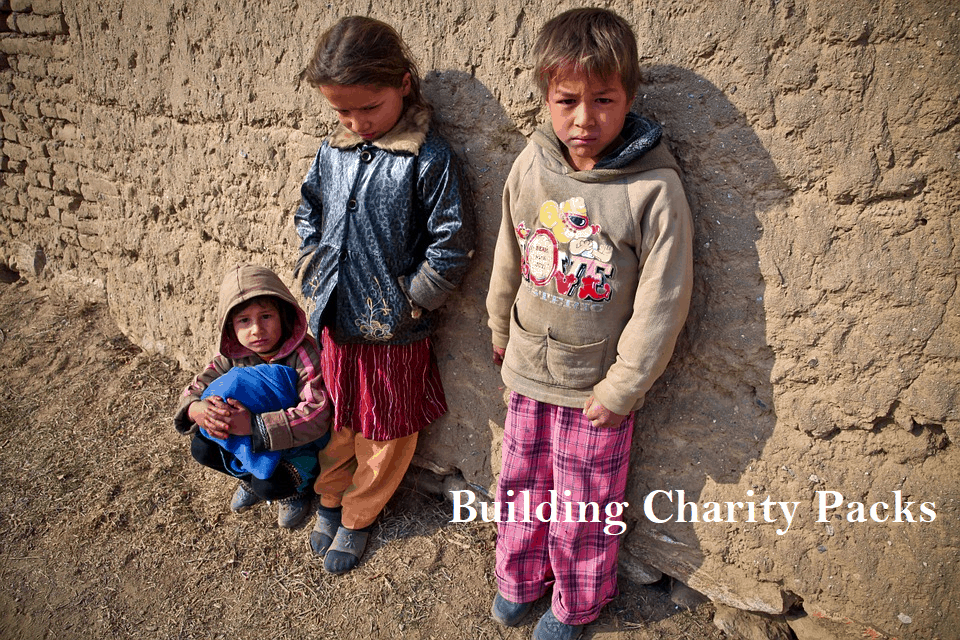
Building Charity Packs

by Mama J

This is one of the hardest parts of prepping for me. I do not have many neighbors that would be dependant on us, though there are a few. Our rural neighborhood will come together to help them. Not just one family.

I don’t believe I would be able to turn away homeless hungry children. Not without great emotional cost. Actually, my family plans on keeping me away from stray children. We have adopted several.

If I have enough for my family and we have the means, I want to have some way to help as many people as I can, even if it is for a short time. One gift of a hot meal, a clean body, a kind gesture. To ease the suffering of a child is the greatest gift I can imagine. These packs are designed as a starter kit or a temporary kit for short-term assistance.

In a large disaster and all infrastructure collapses, I can imagine a lot of displaced folks wandering down the road with their children. Looking for sanctuary, or a meal. I feel I must do something. If this comes to pass and I run out, at least I know I did everything I could for as many as possible.

One of my favorite things to do is “Treasure Hunt”. Yard sales. Thrift stores, Salvation Army, Craigslist, Freecycle. On my journey, I have seen so many items that can be put to good use, so I started building Charity Packs.

Before I say anything else, I must stress that you MUST prep for yourselves first! We have been prepping for over a decade. When you feel like you have sufficient stores for yourself and have extra items, put them to use here. Even with a limited income, we all tend to have extra items laying about. Even one or two packs would be helpful.

I have $20.00-$30.00 budget per week to Treasure Hunt. Mostly I buy items for my family list on this budget. Some weeks I don’t find anything. Some weeks I hit the Mother Lode. Once in awhile, I find something so incredible I dip into the savings. If I have funds left I buy items at the Dollar Store.

Ask your friends to save items for you. Keep an eye out for you when they are shopping. I see the same people at yard sales every week. We talk and tell each other what we are looking for. We have exchanged numbers in our phones. I have purchased hundreds of canning jars and equipment by text messages from other salers. Not to mention the camping gear, pack supplies, med supplies, the list goes on and on.

One woman I see often is all over the place. Almost every day. The only thing she does is cruise around looking for sales. I think she may be a hoarder, but she has helped me find some amazing deals! She never asks silly questions either. Bless her heart!

Check store clearance items. managers specials. Using coupons on clearance items make them almost free or deeply discounted. I make a clearance circuit in a each store. Every store in my area has specific spots for clearance items. Especially if a store is remodeling. They will have crazy amounts of cheap stuff. Add a coupon and BAM! Happy Dance.

Talk to the store managers, they will let you know the best times to pick up on good sales. Tell them what you are doing. People generally want to help you to help people. The manager of the Salvation Army and one of the local supermarkets have been very generous with items for these packs.

The basic Hygiene Kit is something I put in all of the packs. Everything is hotel/travel size. Thrift stores often sell some these items 5 or 6 for a dollar. I have had a lot of these items donated.

  • Shampoo/conditioner
  • Soaps
  • Lotion
  • Deodorant
  • Q-tips
  • Cotton balls
  • Small emery board~ I found a case of these at a thrift store for 50 cents. Must be five hundred in the box.
  • Toothbrush/toothpaste
  • Comb
  • Tissue
  • Mouthwash
  • OTC pain relievers
  • Cough drops
  • Band-aids
  • Antibiotic ointment
  • Hand sanitizer
  • Wet Ones
  • A small container of laundry soap.
  • Dryer sheets~ Help with bugs.
  • One quart size ziplock bag to put it in.

A towel and washcloth. I often these in perfect condition used. This is enough to give someone a few showers or even creek baths. Being clean can make someone feel human again. We are not setting up a household.

Sometimes I find and add…

  • Nail clippers
  • Disposable razors
  • Sunscreen
  • Bug spray
  • Food/Water Packs~ These vary depending on what I have
  • Water bottles
  • Chlorine bleach in a small bottle~ Water purification. This has to be changed out yearly.
  • Cup~ Metal camping cups when I can find them.
  • Fork, butter knife, spoon. Super cheap at a thrift store.
  • Homemade dehydrated soup mixes. Dehydrated foods with gravy mix or bouillon. Or….
  • Cans of soup, beans, veggies, whatever I can find.
  • Crackers
  • Granola bars
  • Ramen
  • Small packs of condiments~ Salt, pepper, ketchup, sugar, sweetener, soy sauce. Friends save these for me, we rarely eat out.
  • Dried or canned fruit
  • Hard candy
  • Tea bags
  • Hotel coffee
  • Drink Mixes
  • Instant cocoa

If I can find mess kits I include them. Or a small lightweight pan to heat water.
Grocery store bags to put everything in.

Baby Packs

Hygiene kit~ Babies can’t use some of the items in the kit, but the parents can.

12 Cloth and or disposable diapers. 12 diapers don’t seem like much but cloth can be cleaned and reused. Once a disposable is used, it is gone. Cloth diapers are hard to find, but can be cut and sewn from flannel. It only takes a few minutes to whip up some diapers if you are already sewing.

Three pieces of flannel, some thin plastic sheeting in the middle, sew it around the edges. Plastic pants to cover are a rarity now. You can add velcro tabs instead of using pins. Store bought Nappies are too costly. I used cloth diapers for all of my children. People will use what they have and be grateful for them. When I reach my goal of 25 completed baby packs I will start adding more diapers.

  • A small pack of wipes or a small baggie with a washcloth
  • 2 Diaper pins
  • Ointment in a baby food jar. Or a small tube. Find someone that is using baby food and get their jars.
  • Infant Tylenol~ If I can find it cheap
  • 2 receiving blankets
  • 2 warm blankets
  • 2 Pajamas or Onezies
  • Grocery Store bags for dirty diapers.

You could add half of a twin sheet to use as a snuggie. Make a triangle and snug (tie) baby to your chest. Sometimes I find formula in the clearance bins. New moms should be nursing. Period. I save formula for orphaned babies. It is surprisingly inexpensive to make these baby kits. A few dollars. Except for the Tylenol and formula.

Toddler or Kids Packs

  • Hygiene kit
  • Small stuffed animal
  • Dollar store items like a story or coloring book, crayons, bubbles.
  • Small flashlight/AA battery~ Can be a big comfort
  • Large t-shirt
  • Bootie socks
  • Small blanket.
  • Children’s vitamins
  • Food Pack

Female pack

  • Hygiene kit
  • Feminine Hygiene products
  • Condoms~Clearance bin with coupons.
  • Hair ties/clips
  • Vitamins
  • Book
  • X Large t-shirt
  • Socks
  • Small Flashlight/AA battery
  • Small tool kit~ Tape, zip ties, wire, paracord, fishing hook & line. A zillion things could be added.
  • Matches/toilet paper tubes stuffed with dryer lint
  • Food pack

Pregnant Packs

  • The same as the Female pack, add…
  • Prenatal vitamins~ I found eight bottles of these in a clearance bin for $2.00/ $2.00 coupon each.

Baby kit

Small birthing kit~ Chuks pads, Sterile gloves, sterile plastic clamps, new sterile razor blade, for clean cord cutting. Bulb syringe. Small bottle of rubbing alcohol.These items I buy online. You can purchase an OB kit on Amazon for $6.00. I put these together from several sources for $3.00. Look around.

Babies born in austere conditions can easily die from tetanus or infection if the umbilical cord is not treated properly. Mothers are at risk of infection also.

  • Extra food
  • Extra feminine hygiene

Mens Pack

  • Hygiene kit
  • Condoms
  • X large t-shirt
  • Socks
  • Vitamins
  • Book
  • Toolkit
  • Small Flashlight/AA battery
  • Matches/toilet paper tubes stuffed with dryer lint
  • Food pack

We buy as many backpacks as we can for these kits. The most I will spend on a backpack is $1.00. Friends save their kids’ old school backpacks for us. The yearly ski swap will donate leftover backpacks. Otherwise, the packs go into shopping bags. Plastic, canvas, anything that is free or inexpensive and sturdy.

I store everything in large Rubbermaid containers or boxes out of the way. I have one container that I dump items in until I have enough to make bags. Organized and clean.

You might wonder why I included t-shirts and socks but no other clothing. Pants size vary so much that I could not even begin to delve into that. However, t-shirts are almost a one size fits all if they are big. I find nice almost new clean t-shirts at thrift stores.

A pair of new socks are one size and can change your life! New socks are almost better than chocolate. Almost.
So far, I have 40 nice used clean blankets stored in space bags. 20+ coats and heavy hoodies in varying sizes.

I have not included anything that can be used as a weapon, or anything that can used against us. I don’t think anyone will attempt to throw flaming sanitizer soaked cotton balls at us. The razor blade in the preg pack could hurt someone, but if anyone in my group is stupid enough to let themselves get cut with a razor blade or stabbed with a fork from the food kit……need I say more? We haven’t paid thousands of dollars in training for one of my kids to get stabbed with a fork.

I have stored some inexpensive good hunting knives with fire starters, but will only hand them out if the correct opportunity presents itself. Case by case basis. These packs will not be handed out anywhere near our property, so folks will not know where to find more. Most likely handed out at a roadblock. We may end up donating all of them to a church, camp, or anywhere they would be helpful. They could be used as barter items. We may end up using them ourselves.

Other items that would be useful to homeless folks are tarps, plastic sheeting, rain ponchos, garbage bags, shoes, duct tape, the list is endless. Whatever you are willing to share and store.

I have 92 of these packs made up right now. We are usually able to build 5-6 a month. We date them to rotate out anything over 12 months by donating or repacking with fresh products.

We have donated these packs to the homeless shelter, womens/childrens shelter, to families that have lost their home to fire and tornado victims.

They can be also be used as an extra Bug Out Bag. Or a project for Scout Troops and Church Youth Groups. Helping others doesn’t have to cost a lot or take away from your own supplies. I incorporate this activity into my regular preps. Do what you can, when you can. Have fun with it.

We are happily open to suggestions for other ideas and items to include. Happy Prepping!

Filed Under: Prepping

How to Build an Underground Bunker on a Budget

December 8, 2018 M.D. Creekmore

How to build a prepper bunker
Survival Shelter partially backfilled and complete

by Doc Wacholz

In April 2011, we saw one of the worst tornado outbreaks ever in the Southeast. On April 27th alone, there were 208 tornadoes with four being EF5’s tearing across hundreds of miles of the countryside, killing hundreds of people and destroying hundreds of millions of dollars in property across six states. This was the catalyst (amongst other things) to build a storm/ shelter/root cellar/bunker.

This is not the easiest way or maybe the best way to build a shelter, but it worked well for me and my budget. First I live in a region of the country where I have hills to dig into. So I choose a location near the house, not too far away, in close running distance.

I dug out (with my tractor) a twenty-foot wide swatch and twenty-foot back into the side of the mountain. I left the bottom of the hole about eighteen inches above the valley ground level, that is in front of the hole. This will help keep any water flowing into the valley, out of the structure area. To also help aid in water drainage, I cut a shovel wide trench above the structure area, so water coming from the ridge above is diverted away.

Digging around the perimeter of my newly dug hole, where the “survival shelter” was to be built, I added a French drain. A French drain is basically a shallow trench with 6” septic drainage pipe, with holes on the top that allows the water to flow down and out. A nylon sock encompassed the pipe to keep debris and dirt out of it. This trench was dug where with a downgraded outflow. This French drain will direct water away from the structure and down into the valley. I then added about 8 inches of rock over the drain and in the area where the shelter was to be placed. This again allows for better drainage of water from under and around the structure.

I contacted a local concrete septic tank builder and explained what I was doing. With a few pencil sketches of my shelter, he was able to add extra reinforcement steel where needed and vent holes for incoming and outgoing air. He placed a four-inch vent hole at the bottom the left front corner for incoming air and one at the top right front corner for outgoing air. He also took the time to Dam Tight the bottom of the tank for me at no extra charge.

The 10 foot by 6 foot by 6 foot high, 1500 gallon tank cost $750. delivered in place. The tank came in two pieces and weighed a total of twelve thousand pounds. The halves pieced together with a V groove and some thick rubber sticky material that acted as a seal all the way around. I added hydraulic cement on the seam to help waterproof it a bit more. Before I cut the doorway, I put two coats of Dam Tight and three coats of rubber roofing material on four sides and the rooftop.

I rented a concrete saw, and then cut a doorway into the structure, leaving the bottom of the door four inches above the shelter floor. Again helping keep any water from coming in. The thickness of the tank is four inches, with rebar and wire throughout the structure. “A car could drive over this structure with no problem”, according to the maker. Not that we are going to try it, but adding dirt to the roof does add weight so this was a bit reassuring.

Building the door took a little planning. I utilized four-foot by eight foot, 1/8” thick steel plates that would rise two feet above the roof line. The steel door hole cut would be 1 inch bigger all the way around than the hole cut into the concrete structure. This way when the door closes, it will have a tight rubber seal to close on. I considered using a ¼ inch steel plate, but the weight would have been twice the 1/8 inch steel which still weighs 300 pounds or better. The inside lock has not been welded but will be done near the end of the project. There is an outside door lock welded on already. The door will be Red Headed to the concrete structure.

Before backfilling, I added pink foam for a little insulation on the back and sides with Liquid Nails. Now the backfilling begins. At the point, I took the pictures, with the back and sides being filled in. Once the door is in place I will place 4-inch by 4 inch PT posts stacked upright behind the door, on the roof, so the dirt has a place to stop.

That is why the door is two feet higher than the roofline. The dirt on top of the roof will be approximately four foot deep on the back side and two foot on the front side to keep the slope of the ridge the way it was. Of course, these 4 x 4 posts will be nailed, screwed and glued together as this holding wall is built. By the deadline of this article, I really don’t know if this structure will be complete, due to rain, snow and the cold, but I will entail the rest of my plans like I just did.

How to build a prepper bunker
Welded door w/ door swung open

Before backfilling the roof, it will have insulation, plastic material plus roofing material that will help keep water off the roof and direct it one foot or better past the sides of the shelter. This will be in place before I backfill the roof area. Backfilling the space above the roof and behind the structure will take nearly 83 cubic yards of dirt. I guess I made the hole a bit bigger than I really needed. Small oversight I’m sure you can correct!

With the door in place and the 4 x 4 lumber on, and the roof backfilled, now comes the front of the structure. I will do the same type retaining wall (as on the roof) on the sides of the door. I choose the same wood, 4-inch by 4 inch PT posts that will stack upright and go six feet out from the structure. These wood retaining walls will be on each side of the door, attached to the door and will hold dirt that will be covering up the front of the structure.

Utilizing the septic manufacturer again, he pours these two foot by two foot by four-foot wide concrete reinforcement blocks that weigh one ton each. I plan on stacking this four-foot out away from the structure. These will be stacked three high, making a six-foot high wall in front of my structure. Sure this is overkill, but that is my middle name! After these blocks snug up against my 4 by 4 wood retaining walls alongside the doors, I will backfill that area with dirt. This will give me a 2-foot thick concrete barrier with 4 feet of dirt in front of my structure. Of course, I will paint the concrete blocks to match the surrounding foliage. When this is complete I will grow grass and ivy on the roof area to help keep the soil in place and blend and bushes in the front to hide it.

Now for the inside, I choose a thin layer of insulation for the ceiling and walls. This will keep the echoes down inside plus keep from getting a knot on the head when I stand up! For the floor, I like the industrial rubber floor mats, as the dirt falls below the mat through the holes. As for the ventilation, I am exploring several options with no decision made yet.

Of course, by now, I have all the necessary survival food, gear and tools in place and ready to move in. So we don’t get a tornado…we don’t have a mass extinction event…now I have a great root cellar and a fort for my 5-year-old to play in. All in all, it costs about $2000 and some diesel fuel for my tractor to build. Not bad…for an old country boy in the mountains!

Check out this video for more awesome underground bunker ideas!

Man builds $65 thousand doomsday bunker

Filed Under: Homesteading, Prepping

  • « Go to Previous Page
  • Page 1
  • Interim pages omitted …
  • Page 9
  • Page 10
  • Page 11
  • Page 12
  • Page 13
  • Interim pages omitted …
  • Page 15
  • Go to Next Page »

Primary Sidebar

Subscribe to Blog via Email

Enter your email address to subscribe to this blog and receive notifications of new posts by email.

Join 7,199 other subscribers
  • Amazon
  • Facebook
  • Substack
  • Twitter
  • YouTube

“Do more with less.”

– Minimalist proverb

Recent Posts

  • Just so you know
  • Weather Update for My Corner of Appalachia
  • Why I’m Ordering Ivermectin + Mebendazole Every Year
  • The Website’s Shutting Down (But Here’s the Plan)
  • You Are Hated! Start Training Like It!

Footer

Recent Posts

  • Just so you know
  • Weather Update for My Corner of Appalachia
  • Why I’m Ordering Ivermectin + Mebendazole Every Year
  • The Website’s Shutting Down (But Here’s the Plan)
  • You Are Hated! Start Training Like It!

More about me

Books I’ve written

Books I’ve read

Follow Me on YouTube

Follow Me on Facebook

Gear I Use and Recommend

Newsletter

Search this site

Follow me elsewhere

  • Amazon
  • Facebook
  • Substack
  • Twitter
  • YouTube

© 2008–2025 M.D. Creekmore · As an Amazon Associate, I earn from qualifying purchases.