• Skip to main content
  • Skip to secondary navigation
  • Skip to primary sidebar
  • Skip to footer

M.D. CREEKMORE

  • Blog
  • Books
  • Newsletter
  • Gear I Use
  • About
  • Contact
  • Facebook
  • YouTube
  • Blog
  • Books
  • Newsletter
  • Gear I Use
  • About
  • Contact
  • Privacy Policy
You are here: Home / Archives for Prepping

Prepping

Here you will find articles about emergency preparedness and prepping including articles on prepper food, prepping checklists, home defense, bugging out, bugging in, and the best prepper gear ideas.

17 Prepper Tips I Wish I’d Known Before I Started Prepping

January 7, 2019 M.D. Creekmore

prepper tips and advice

by Dan W

Following is a mixture of philosophical comment and several practical tips that I hope will help you to fill in some of the blanks in your prepping.  It’s a bit long but I hope you find it all informative. No matter what advice you may be offered, the key to being prepared is diligent planning and follow-through.  Remember thought without action ……. and action without a plan ……. Well, that’s just wasted effort.

Getting Started & Making Your Plan

For you folks that are in the beginning stages of prepping ………… don’t get discouraged.  All of us were where you are at some point in our journey to be prepared!  You may be far from well prepared right now, but the fact that you have decided to begin prepping is a major step toward improving your odds for surviving.

But, what type of negative event will you prepare for?  I’ve heard countless people talk about a specific catastrophic event that they fear will turn their world upside down.

They then base their planning around that event.  There are too many things, manmade or natural, that could severely disrupt our/your way of life.  To be able to pick just the right one is a long shot.  Basing your preparations on only one or two of these occurrences will likely leave large gaps in your overall plan.

When we first began prepping and started to accumulate our cache of goods we did not focus on a specific type of event to determine what we would need.   Instead, our early stage prepping focused on the basics of survival: Water, Food, Self-defense, and a secure place to ride out the event.

These four basics formed the backbone of our prepping plan.  Of course, we knew that there would be a lot of other supplies to gather, but unless we were alive, those wouldn’t matter.  For example, it wouldn’t do us much good to have a complete armory without an adequate supply of water and food.

We then made a prioritized list of what we wanted to have on hand; those items we thought would most help us to ensure we survived the initial few months of off-grid survival topped the list.  We prioritized without regard to expense.

After we filled our cache with those initial high priority items we began to add other items to our list.

When the event happens do you plan to leave your current site (Bug out) for a different location? If so then you will need to have two plans:  One plan to cover your needs while in transit and one for when you are at your new location.

Obviously, this type of planning is more complex yet the same four basics apply.

Early stage prepping requires a lot of cerebral activity to produce your own custom plan.  Start planning using the four basic groups and expand your preparations and supplies as you can.  Once you’ve got the basics covered, you can begin to address those items needed to cover other contingencies.

Unless your budget allows a steep ramp-up of purchasing supplies, it will take you some time to obtain all of the items on your list.  Be patient and just keep plugging away at filling your list.  Don’t make the common mistake of overreaching ………… start with a simple list and then grow it as time allows and current events dictate.

Your plan is a dynamic thing.  Stick with it, but do not be afraid to modify it as time passes and conditions change.

Inventory List

If you don’t have one …………. Make one!  I have a tendency to harp on this issue to every person that is a member of our planning group.  I don’t think that this topic can be stressed enough! Everything you have, or still need, should be on your list.

If you try to depend on your memory to let you know what you have put away you’ll be sure to forget or miss something.  Categorize the list by item types, quantities, location, date purchased, and the price paid. For those items that have a limited viable lifetime (foods, medicines, etc.) be sure to add that information to your list.

Indicate if the item is on hand or needs to be purchased.  Save and update your list with each change (addition, deletion, quantity upgrade, etc.) and print it out after you update it.

Don’t depend on being able to go to your computer to find your list.  Manage your inventory list as you would if you were running a small business and you will be more effective in your prepping.

Planning to Survive

In military circles, it is well known that no battle plan survives intact once combat is engaged.  There are just too many unknowns throwing variables in the way!  This is also true for all of us as we try to prepare for the SHTF.

That being said, it would be wise if you thought through a few scenarios to establish how you will react and what you will do to handle the “what-ifs”.   Play yourself in these scenarios and be honest.  Few of us are Barney Fife, but even fewer are Rambo!

Don’t sugar coat situations but play them out using best/worst case examples.  Advance planning does not restrict you to a particular course of action, but it does allow you to address those things that are not a part of your normal life.

Confronting a variety of hypothetical scenarios now will give you an edge if you are actually faced with something similar later.  Mental role-playing will help you to identify the contingent options that may be available for each event.

This is especially true if what you must face is beyond your realm of experience.  Set up scenarios where you must react quickly to be able to survive; pre-play potential events whose impact would be modified by your particular situation, environment, and expertise.

Not all of these hypotheticals will necessarily be a life or death scenario.  But, by thinking them through, you will begin to see holes in your planning and prepping.

Could you, would you, kill another human if necessary?  When you find weaknesses in yourself that that might threaten your survival, or are insurmountable, work out a solution that you can accept ………. and live with.

Off The Grid

What does this mean to you?  I remember when the term “off the grid” referred to being disconnected from the local electrical, telephone, natural gas or other commonly available utilities.  For us, and I think most all Preppers, off the grid, now carries a different connotation.  I think the best Prepper definition for off the grid is “Self-Sufficient”.  Images of “the little house on the prairie” come to my mind.

A successful Prepper can go off the grid and survive …………. they are prepared for almost any contingency.

I mention this because I think that coming up with your own definition of what “Off the Grid” means to you will help you to more precisely define your planning.  If you are an apartment dweller living in a large city your prepping needs will be different than a person living in a small town off the beaten path.

Your plan to survive, will of necessity, be very different from anyone else’s …….. and it should be.  The blueprint for your preparations has to be yours and yours alone.  Grab all the tips, info, ideas, and knowledge you can from a multitude of sources and then adapt them to your circumstances.

Speaking for myself, I manage to find a wealth of new ideas and tips from other Preppers.  Not all of them are necessarily suitable for our situation, but each one starts me to thinking “what-if”.

Maps

Do you have good detailed maps of your home or base area?  Even though you might think you know your locale very well, navigating effectively during a time of crisis may force you into areas you are unfamiliar with.  Maps are a cheap and good investment.

Another very good source for navigational information is Google Earth.  This free online app will allow you to print out a detailed street, topographical and satellite images of virtually any area.  The images can be zoomed to show you the topography (including dwellings and roads) for your area of interest.

Once you’ve got an image you like, print it out and keep it for future reference.

Manuals

How many of the things that you’ve accumulated over the years or recently as a part of your prepping supply will eventually need some kind of service or repair?  Do you have maintenance and operator manuals for each one?  If the SHTF, and it’s a really big event, the likelihood of finding replacement parts will decrease.

Even if you can’t get the part, a manual could possibly help you to make one.  How about your weapons, generators, solar or wind charging systems, or other devices?  One of the things I’ve done is to print out the manual for each such item I have in my prepping supplies.

Don’t think that you will be able to go online to get this information later.  Find the manuals online now, print them out and store them in a binder for future reference.  Dig out the manuals you already have and keep them all together in one place.  You might never need them, but there is peace of mind in knowing you’ve got them nearby if you do.

Preppers Reference Library

Buy “How To“ books.  Your prepping library should contain books on the basics: Gardening, Animal Husbandry, Basic Electricity, Game Harvesting, Canning, Dehydrating and Food Preservation.  Water Treatment,  How to Make and Use a Still, Communications (CB, Short Wave, Antennas).  I have found that garage sales are a great source for these types of books.

M.D. Creekmore has a CD Rom called The Bullet Proof Survivor that has all of this and more… you can find out more about it by clicking this link…

More books are better than fewer.  Identify your skill set(s) and then supplement your weaknesses with written knowledge.  Pay heed to using the internet to find the information you need (see Manuals above).

Perimeter Warning for Defense

How do you establish an Intruder early warning system for your base? There is a product on the market named “Voice Alert” (click here to check price and availability on Amazon.com) that will allow you to set up a perimeter defense around your fortress.

It is sold by Amazon and Costco online and through many other retailers.  I believe that this product was originally designed to be used in a commercial environment, but it works just as well for what I’m doing with it.

You can read the specific details regarding its specifications and features online.  This wireless system has a base station with remote wireless sensors.  The base station has the capability to monitor six individual zones of detection.  Each zone is monitored by a battery operated wireless sensor (Zone Sensor) that sends an alarm signal to the base station when triggered.

The advertised range is 1000’ (300’ through walls). My home is log construction with 10” thick walls and it works fine.  When a Zone Sensor is triggered, the base station identifies the zone and plays an audio warning.  You can program what the alarm says in your own voice.

For example; Zone 1 could say “Alert, South side of house” while Zone 2 might say” Warning, Driveway Intrusion”.  I’m sure you get the idea.  While there are only 6 Zones, the number of sensors you can add to each zone is only limited by your budget (they are a bit expensive).

Two sensors come with the base station to get you started.  Each sensor operates by sensing either motion or temperature change, or both. Since the Zone Sensors are not waterproof, I have them mounted inside a small custom wood enclosure that keeps the rain and snow off them while providing an unobstructed sensing path.

I made the enclosures to match the cedar on my home so as to blend in and not be obvious at first glance.  The Zone Sensors use a 9 vdc battery and the base station has a 120 vac to 9 vdc transformer.

The current draw under idle situations (most of the time) is so small that a standard deep cycle 12 vdc battery (using a 12vdc to 9vdc converter) would power it for a very long time (weeks) without the need to be recharged.

Add a solar battery charger for the battery and you’re all set.  I have 12 exterior sensors (set to IR mode) surrounding my home, garden, and a detached garage.  While the initial installation requires a bit of work to get set up, the finished perimeter warning system works great!

Faraday Shield

There is a simple way to protect your more sensitive electronic devices from the adverse effects of an EMP or other electromagnetic pulse.  Consider purchasing a metal storage cabinet (any metal box will also work).  I chose a cabinet due to the size and quantity of items I have that need to be protected.

Cabinets are readily available at Office Supply stores and used office equipment dealers, etc.  The cabinet you choose should have metal screws or bolts holding the panels together, not plastic snaps.

The cost of a cabinet or box might be a factor when compared to other homegrown Faraday Shield devices but only you can decide if what you’re trying to protect is worth the additional expense!

Grounding the cabinet or box

Attach an insulated wire to the cabinet using a metal bolt or screw.  Connect the other end of the wire to a known ground source (metal water pipe, house ground rod, etc.  Your storage unit is now a Faraday Shield enclosure and will shunt electromagnetic induced current to ground.

An alternate method of grounding is possible:  I strongly suggest that your understanding of basic electrical theory is adequate before grounding the cabinet or container using the following method.

  • Buy or find a 120 vac power cord (be sure it is not defective and that the insulation is in good condition) with a standard three prong plug on one end.
  • Remove several inches of the outer insulation from the non-plug end of the cord.
  • Use a meter verify which of the three wires is connected to the ground pin of the plug (if they are color coded it should be the green one).
  • The other two wires (Neutral and Hot) will not be used.
  • Verify that the unused wires are not shorted to the ground wire.
  • These unused wires must be taped or otherwise shielded with heat shrink to prevent any potential for them to be shorted to the ground wire or cabinet.
  • Attach the green wire to the cabinet using a bolt.
  • Before proceeding use a meter to measure continuity, verify that the plug ground pin is a short to all of the cabinet’s component parts before proceeding.
  • Locate the cabinet near an outlet and plug it in.
  • Using your meter, verify that the cabinet is not HOT (voltage on the surface relative to ground). If HOT, do not proceed until this fault condition has been corrected!
  • Your GROUNDED cabinet or box is now a Faraday Shield enclosure.
  • Be sure that the devices stored in your cabinet or box is further protected by not allowing them to come into contact with the metal of the shelving, etc. Use cardboard, rubber sheeting, plastic boxes or some other non-conductor between the stored goods and the cabinet metal.

Click here for plans on How to Build Your Own Faraday Cage…

Water from a well without electricity

My well is 310 feet deep with a static water level of 280’ in an 8” casing.  I wanted a way to draw water from the well that didn’t require a large generator to power the deep well electric pump.  Using a “pipe bucket” was one method.

But for that to work, I would have to remove the existing electric pump and 310’ of metal pipe.  Finally, I found a solution.  It’s the “Simple Pump” https://www.simplepump.com .  As its name implies, it is a very simple manual water pump that can be installed and maintained without a lot of special dedicated tools.

The company was somewhat reluctant to specify how much water their pump would deliver from the 290-300 foot depth, but told me it should/would work.  I took a chance and had a system installed.  It is installed within the original 8” well casing alongside the existing electrical pump pipe and wires.

Now we have dual capabilities to produce potable water.  Once primed, the pump produces about a ½ quart of water for each pump of the handle.

Not exactly a gushing flow but it works!  The shallower the water source the more water you should get with each pump stroke.  Now we have the most important aspect of our prepping in place ready to go if needed!   No worrying about a source for potable water, hauling water from a distance, or any power other than a healthy set of arms to work the pump.

The pump supply tube is has a drain hole that allows water to drain back to 7’ (drilled when the last pipe is installed) from the surface preventing a frozen pipe.  In our area 7’ is below the frost line so it’ll produce water regardless of what the outside temperature happens to be.  No frozen pipe!

Water, Water Everywhere

Once you’ve solved the problem of having fresh water readily available from your well, consider creating a large volume reserve supply.  Our “root cellar (as we call our inside insulated storage room) has five 55 gallon water barrels.  Not only does this give us a substantial water reserve, but their thermal mass helps to keep the temperature of the room more constant.

We figure that the 275 gallons these barrels hold would last us about 137 days at 1 gallon/person/day. That’s roughly 4 ½ months if used only for drinking!  I have several more empty barrels stored away for future use if needed.  We add a little chlorine (Clorox) to each barrel to ensure it stays potable.  Before winter arrives we empty and refill the barrels for another year of standby.

We’ve also added gutters and water barrels on every possible roof line to take advantage of rainwater.  Five of these barrels are close to our garden and on stands that are high enough so that gravity flow can be used to water the garden.

In our northern climate, the outside barrels would freeze during winter so we empty them before cold weather begins.  Then, once signs of warmer early spring weather appear, we refill them using our electric well pump.  That way they are filled and in reserve if needed. 

Read M.D. Creekmore’s detailed article on water by clicking here…

Gardening with Medicine in Mind

Knowing that the availability of drugs will be nil after the SHTF, we decided to add medicinal herb seeds to our supplies.   We chose which ones to buy based on the meds I must take, and those we thought would be good to have.  These herbs correspond to manufactured drugs and have specific medicinal value beyond the realm of aloe or other common beneficial plants.

After verifying that they would grow in this far northwestern region of the US (our greenhouse allows us to grow plants that would otherwise not survive our northern climate extremes) we purchased the seeds.  An excellent online site is: https://www.horizonherbs.com/pilot.asp .

Our seeds are stored in sealed containers.  Using the internet we printed out instructions for the preparation and use of each herb (to complement our reference book in our Preppers library) and made sure we bought non-hybrid herbs.

Barter Better

If we are faced with a financial or societal collapse, all exchange of all goods will be by bartering.  We have made room in our storage area for barter goods.  After much consideration, we decided that grain alcohol (Ever Clear) and pints of Whisky (any cheap brand) were the two best things to have readily available as trade goods.

They are easy to store, don’t go bad over time, and may be used for things other than drinking.  If you have a reliable source of potable water (such as our well) you can always use drinking water for bartering if things get that bad.

Clean water will be very valuable and probably scarce.  Of course there are many other things that you can reserve specifically for bartering, but why spend a lot of your funds in anticipation that you will need a diversity of goods to trade?  After all, everything you have is potentially in your barter bag ……….. It’s all about “needs and wants” that makes a bartering economy work.

Click here to read M.D. Creekmore’s article on barter items for preppers…

Solar Lighting for Inside

There is a great source for very cheap solar lighting that can be used within your home.  Solar Powered Walkway lights make a great chandelier!  You’d be surprised at how much light a few small walkway lights will put out in a closed area.

Make a frame, drill holes that fit the base of the light (without the extension tube).  Install the lights with one set-screw through the side of the frame holding each light in place, and hang it where ever you want a light.  Typically these lights have rechargeable batteries that will last for more than a year before needing to be replaced.

When fully charged, these lights will run for 4 -6 hours.  Design your holder so you can easily disconnect it and take it outside each day to recharge the lights for that night’s use.

Batteries

Reduce the variety of batteries you need by using battery adapters.  These simple sleeves can be purchased and will allow you to use AA batteries in devices that normally require C or D cells.  The AA battery does not have the current output of a larger C or D cell but, if you are using rechargeable AA batteries (with a solar charger), this becomes a non-issue.  Check out “Battery Adapters” on Amazon.

Pressure Cooker Still

As I said in an earlier paragraph, buy a book about making and using a Still.  There are dozens of them available and will be a valuable addition to your library.  You can use a pressure cooker for the main pot to cook the mash.

Get some copper tubing and a compression fitting that will screw into the pressure valve on the lid of the pressure cooker.   Connect the tubing to the compression fitting.  Make several loops in the tubing to create the condenser and feed the outlet to a jar.

Without a lot of additional parts, you have a very simple basic Still.  Pressure cookers are perfect as they are stout, have a fixed overpressure relief valve, are readily adaptable to a condensation tube, and can be used on virtually any source of heat.

Garage sales are a good source for pressure cookers …… buy more than one if you have the chance!  Figure out what you need to make your Still operational and get those items while you can.

Cleaning your home & clothes

While cleanliness is always a good thing, it will become even more important in an off-grid situation.  Being able to clean yourself, and your clothing is not only a good idea from a psychological standpoint (you’ll feel better if you’re clean) but from a medical standpoint as well.  Infections from minor cuts, rashes from toxic natural and man-made substances are easier to manage if the body is clean.

Clean clothes, clean body, and a clean living environment are not only healthy but allow a person to maintain a positive outlook and a good self-image.  I have a double deep sink with an old-fashioned double roller all ready to be put into action to clean our clothes.

A manual agitator and old style scrub board are good additions and available from Lehman’s Store or elsewhere.  We’ve stored multiple large containers of liquid laundry detergent, bottles of hand cleaner with lanolin (the type used by mechanics to clean their hands of grease), shampoo, and a lot of bar soap.

This stuff keeps forever and doesn’t take up a lot of room.  We’ve also purchased several solar heated shower water bags.

Filed Under: Prepping

Long-Term Food Storage Tips for New Preppers

January 7, 2019 M.D. Creekmore

FOOD IN BUCKETSby Grayfox114

In today’s economic climate, finances are a major concern for everyone, but doubly so for the prepper or survivalist. Not only are we trying to maintain a semblance of normalcy in our everyday lives, but we are also attempting to put together a “kit” for another lifestyle altogether, a kit that will keep us alive when everything falls apart.

Generally, the first items purchased by a prepper are foodstuffs, and these preps can be made slowly and relatively inexpensively, over a long period of time, or one can bite the bullet and spend a fortune to “prep” quickly, and in today’s socio-economic climate, quickly is the byword.

This usually involves purchasing ready made and assembled food packs from some company offering a 5-gallon survival pail sufficient to feed you for anywhere from three weeks to six months (check this one out on Amazon.com), or by buying surplus MRE’s. Both of these are good options, but you are paying for convenience and there is a better and much less expensive option.

Having been a long time prepper, 25+ years, I was into long-term food storage at a time when options were few: Foods packaged for campers, very expensive, and MRE’s, always surplus and also fairly expensive.

I took it upon myself to put together my own food pails, stocked with items I and my family would eat, and to this day, many of the stored items appear to be store fresh! Before I go on, I want to assure you that there will be many negative comments on the methods I have been using and which I am proposing.

There will be flak about the nutrients being gone and spoilage, among other things. I cannot speak to the nutritive value of the items stored, but I can say they look and taste good, show no signs of spoilage. And this after 20 years in some cases!

I started my food storage program with three and five-gallon food grade buckets which I obtained from a bakery at a local market. These came with lids with a heavy rubber gasket. The buckets were taken home and washed thoroughly with soap and hot water. They were then dried, and the interior surfaces of the bucket, the lid, and the sealing gasket were all wiped down with bleach.

I then placed an unscented trash bag into the bucket, and I used one of two methods to purge the air/oxygen from the pail: Method #1, I dropped a piece of dry ice into the bag and then placed the items I was storing into the bucket. Most were left in their store packages, some items were repacked, such as bulk beans, rice, and flour.

These were placed into separate plastic bags and given their own small piece of dry ice. I added items until the pail was full, and then I lightly twisted the outer plastic bag closed. In a few minutes, the bag would swell, indicating that the CO2 being produced by the dry ice was filling the bag.

The air/oxygen had been displaced. At this point, I twisted the bag shut tightly, wired it closed and placed the lid on the bucket and locked it down. I did not use any oxygen absorbers or desiccants.  Method #2 was to set the pail up as indicated, and instead of dry ice, I used nitrogen from a commercial tank to purge the air/oxygen from the bags.

In addition to bulk items, the pails might also contain pasta, commercials mac/cheese, or any number of items packed in cardboard and plastic. A hose ran from the tank to the bottom of the bag, and when the bag swelled the hose was removed and the bag sealed.

Once sealed, these pails were labeled and dated and kept, at various times, in my workshop, garage, storage shed, and ultimately, in a cargo container that was “roofed over” for shade. All these environments were fairly stable temp and moisture wise.

To test the efficiency of this system, I opened some of these buckets that had been sealed many years ago. In none of the contents did I find spoilage or weevils, not in the flour, cornmeal or other grains. I did have weevils in ALL of the grain products that were stored in sealed buckets that had not been purged.

Canned items appeared to be ok, no swelling or rusting, but due to the ages of these items, I am leery of using them and will replace them. I should have been rotating them, but the items were in sealed pails that I was reluctant to open, so it’s my loss.

As they say about the pudding: My grandkids were visiting and wanted mac/cheese and we were out, stores closed. I opened a storage pail and removed two boxes of commercial mac/cheese, it cooked up great and there were no ill effects, none, other than “Any left?”  My wife and I have regularly used various cereals from storage, such as wheat & oatmeal and they are good also.

The sugars and honey I store will last forever, and I don’t think they lose their nutritional value. It appears that my storage system works well, but to address the nutrition issue, I also store multivitamins, and while I don’t really see a need for them, it can’t hurt.

A quick note on dry beans: I have heard that after a few years of storage they become non-palatable, even after cooking. They stay hard and impossible to chew. The remedy for this is to place the cooked beans in a pressure cooker for a few minutes after cooking to soften them up, and they will be as good as fresh.

As for water, more valuable and necessary than food, I have filters and tablets, but I use a homegrown system for storage. As my wife uses bleach, she gives me the empty plastic bottles. They are filled with water without being washed out and are stored as is. I have drunk water as old as 20 years….no odor or algae, and while flat, shaking to aerate took care of the problem.

This water was from a home well and was not treated in any way before being stored, and I suppose city water, treated, could be stored the same way. The bleach bottles are stored alongside the food pails, and I have had no issues with the plastic bottles degrading or becoming brittle.

On a final note, I use food grade pails for storing my matches and lighters, lantern mantles, and other items which might be moisture sensitive. A desiccant is added, but the pails are not purged. And for soaps, shampoos, scented candles or other items which “smell,” a food grade bucket is ideal for avoiding contamination via “osmosis.”  I store these pails in the same area as my foods and have found no contamination present.

This article deals with preps that I have made over the years, and most were done “on the cheap,” but they have served me and mine well. And while I realize there are commercial alternatives available for long-term storage of food and other items, I find “rolling my own” and saving forty to sixty-dollars to be much more fun.

Also, read M.D. Creekmore’s detailed article on long-term prepper food storage… and his article on How To – Plastic Buckets, Oxygen Absorbers, Mylar Bags…

Filed Under: Prepping

Is the .22 Rimfire The Best Firearm For Preppers?

December 31, 2018 M.D. Creekmore

Is the .22 Rimfire The Best Firearm For Preppers?

by Joe I

Lately, I’ve seen quite a bit of information on using the .22 rimfire as a primary self-defense weapon, an option when hunting large game, and even a primary offensive weapon.

This reasoning has surfaced in recent years due to several factors, including better bullets, higher velocity bullets, better quality rifles and pistols, and inexpensive weapons when compared to the larger calibers. It also reflects a large number of new gun owners who have never hunted, and have just started prepping.

As I thought about writing this article, I wanted to first look at the advantages of the .22 rimfire, and there are many.

  1. Recoil is almost non-existent. Anyone can shoot a .22, from a small child to an old codger. And most can shoot it accurately given only minimal training, and follow-up shots are quick.
  2. Ammunition is cheap. Just about everybody can afford to stock a substantial amount of .22 ammo.
  3. Ammunition is compact. Storing several thousand rounds of .22 rimfire takes up minimal space. And it is lightweight as well.
  4. Variety of ammo. One can get long rifle, longs, shorts, and even CB caps. Shotshells are also available.
  5. The new ammo is quite accurate. Within its capabilities, a good rifle will shoot very tight groups out to 50 or more yards.
  6. It will kill, as probably more people have been killed with a .22 than any other round. Of course, more people have been shot with one, too.
  7. Good guns are inexpensive. Quality guns are available at very attractive prices.
  8. There are a large number of configurations, from semi-auto to lever action to bolt-action, and single shot on some combination rifles.
  9. Low noise. The .22 is quiet compared to the larger calibers and is easy to suppress.
  10. They are fun. A day plinking with a .22 is a great day.
  11. Training with the .22 is invaluable, and the training is affordable.

I’m sure there are other advantages of the .22, but one need only look at the reasons I’ve given, and you can see why everyone should have several .22s in their survival battery. This is where I think we need to insert a level of caution on the .22 rimfire, as it’s easy to get enthusiastic about a gun that has all the good attributes mentioned. I’ve hunted with a .22 all my life, and it was my first rifle, as I’m sure it is for most.

I can’t even count the number of birds (I’m truly sorry I ever killed any birds I didn’t eat, but God forgive me I did when I was to young to know better), rabbits, squirrels, raccoons, skunks and other critters I’ve dispatched with a .22. I remember finally catching that raccoon in the corn about midnight one night that had destroyed a lot of our corn crop one year. Got him with my .22.

So, what are some of the disadvantages of the .22 rimfire?

  1. Centerfire cartridges are more reliable. There are more misfires with .22 rimfire, it’s just the nature of the beast. But, good cartridges have offset this somewhat in recent years.
  2. Knockdown power is the lowest of all the cartridges. It’s one thing to hit someone or something, it’s quite another to put them out of the fight immediately. Or take large game before it gets away. Surgical shots are required, such as shooting in the ear or eye. That will be much more difficult once the crap hits the fan as game becomes more wary and scarce. The muzzle energy of .22lr is about 135ft/lbs. through a 22-in barrel.
  3. Distance is the enemy of the .22, as velocity at 100 yds. is less than 80 ft/lbs in a 22-in rifle barrel. Carbines and pistols/revolvers have even less.
  4. Engaging at distances over 100 yds. puts the .22 owner at a grave disadvantage to most centerfire rifle cartridges. The .22 falls off rapidly after that and loses its punch.
  5. Shooting large game with a .22 is against the game laws in most states. However, that may or may not be a consideration in the future.

After reviewing the above, I decided to do a few range tests to confirm some of my points. I took my Ruger Mark II .22 pistol, backed up 7 yards, and fired 6 times into a target. I put 6 shots in a 2-3 in. circle in 5.3 seconds as timed by my best friend. I then took my Colt Combat Commander in .45acp and fired 6 shots into another identical target.

I put 6 shots in a 3-4 in. circle in 6.2 seconds. I just don’t see enough difference in time or accuracy of the .22lr to make it a primary self-defense pistol. I then set up a 100 yd. target and shot my 10-22 at that target 6 times. I hit all 6 within a 4-in group.

I then fired my AR-15 6 times, and I put all 6 rds inside a 2 in.circle. The AR-15 is more accurate at distance than the 10-22, and has way more energy at that distance. I didn’t conduct any game tests, as I’ve hunted all my life and I’ve seen too many deer shot with a .22 get away and die days later. Only an expert should hunt large game with a .22.

In my opinion, not having a number of .22s in your survival arsenal would be a mistake, but I think it would be a bigger mistake to rely on the .22 exclusively. It is under-powered for a number of important uses, it puts one at a tremendous disadvantage at distance, and it’s not a sudden killer of large game.

Although people and large animals have been killed by the .22, it’s just not consistent enough to be a compromise. I will say this in the .22s favor, if one is elderly, or has arthritis or other infirmities, there is nothing wrong with having the .22. It is way better than nothing, and if that is all you can afford, then it’s certainly better than not having any options at all.

Just remember that it was never intended to be the cartridge for a main battle rifle or kill large game. It has it’s greatest use as an inexpensive training aide, a small-game getter, pest control, and best of all, just sheer fun shooting the guns that use the diminutive cartridge.

Also Read:

  • The Prepper’s Firearms Checklist of Handguns, Shotguns, and Rifles
  • What Are The 5 Most Reliable Handguns in The World?

Filed Under: Prepping

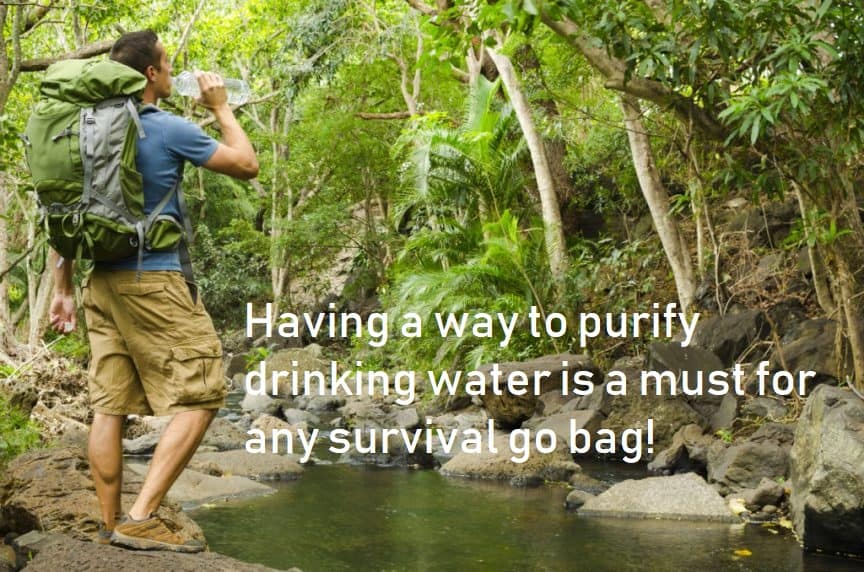
Water Purification Options for Long-Term Survival

December 31, 2018 M.D. Creekmore

go bag contents checklist

by D. Holden

Introduction

Water: the source of life. One can live weeks without food, but only days without water. Water makes up approximately 60-70% of a human’s body weight. It is and should be, one of the most important considerations in planning for a long-term disaster scenario. Given that the average human will need one gallon per person per day minimum, storage of large quantities of water quickly becomes impractical and therefore won’t be discussed in this post.

This article also assumes that you don’t have a private well that is completely off the grid. If you have the land if the city or county allows it, and if you can afford it, then by all means, make getting a private well your first order of business!

So how can one find safe water after a major disaster? If you don’t have a well with a solar or hand pump, you’ll most likely have to rely on natural sources of water such as streams, ponds, lakes, or rivers. It would still be quite dangerous to drink directly from a stream or river, even if it appears completely clean and clear.

There is always the risk from Giardia and Cryptosporidium, not to mention the chance of a dead animal just upstream unbeknownst to you. Even a bit of animal or human excrement upstream can make a person seriously or deathly ill. If you use natural sources of water, then some form of filtration or purification will be necessary.

So, what to do? Well, you have a few options:

  1. Filters

First, you could invest in a ceramic filter, like the British Berkefeld Ceramic Water Filter (click here to check the current price on Amazon.com). While a bit pricey, they’re both highly recommended and receive terrific reviews. I’ve used this particular brand in West Africa for many years, and I admit they are convenient, safe, effective, easy to maintain, and long-lasting. The ceramic filters only need an occasional cleaning and can withstand cleaning many times before needing to be replaced.

They are definitely worth the money, but you should note that they only filter out organic contaminants and sediment from water. Since they don’t have anything like activated charcoal, they don’t filter out chemical contaminants.

I don’t imagine most sources of water would contain dangerous levels of chemicals, but if you take water from a river or stream that is next to a typical commercial farm, there is the risk of ingesting pesticides and herbicides from the farm runoff. It’s the same for water that near an industrial plant. This should not be a problem for most people, but it is good to be aware of the possibilities. Know what is upstream!

For a good portable filter, you could go with the Swiss-made Katadyn Hiker or the Hiker Pro (see this page for MD Creekmore’s filter recommendations). A wonderful benefit to these filters is that they are extremely portable, which makes them vital components of bug-out bags. Another benefit is that they remove virtually all organic and chemical contaminants. The downside is that you only get about 200 gallons out of each filter, and the replacements add up very quickly.

However, if you want more filtration for your money, like say 13,000 gallons worth, you can go with the Katadyn Pocket Water Microfilter. While remaining very portable, it uses a simple ceramic candle similar to the British Berkefeld. Just note that as with all ceramic candles, it won’t filter out chemical contaminants.

An interesting, albeit more primitive option, is to build a BioSand Filter. They’re not perfect, but they are so rugged and easy to build and maintain that they are worth some consideration. They remove around 95% – 99% of all organic contaminants by way of an active “biological layer” and simple sand filtration.

These filters have largely been implemented in the humanitarian realm by organizations such as Samaritan’s Purse and Convoy of Hope. You can build them out of plastic or concrete, and they’re very low maintenance.

Again, they don’t remove 100% of organic contaminants, so there’s still a very small chance of getting a water-borne bug of some kind, but it’s a good semi-permanent solution when your other options run out.

Since the biological layer takes some time to develop, you could use other short-term methods listed here to carry you over until this filter is fully functioning. They really do save lives in the third-world, so it’s worth some investigation, at least for a backup option. You can find plans online for building them.

  1. Boiling

There’s always the idea of boiling your water, but for that, you would need a large source of energy, perhaps something like wood or propane, not to mention a large amount of time as well as storage. Boiling water may work in a pinch, but it would be extremely cost and resource prohibitive in the long run, especially in a long-term grid-down scenario.

On a personal note, many years ago, I went on a weekend camping trip and severely underestimated my water demands, all while carrying foods high in sodium. Needless to say, I became very dehydrated and had to stay up all night boiling, cooling, and drinking river water.

It worked great, but due to the time and the energy necessary to boil water, I quickly realized that relying on this method of water purification in the long-term is not a good idea.

  1. Chemical Disinfection (i.e. Chlorination)

In a common local disaster scenario (hurricane, ice storm, tornado, etc), organizations such as FEMA and the Red Cross suggest using unscented household bleach (5.25 to 6.0 percent sodium hypochlorite) to treat water. FEMAs instructions are as follows:

“Add 16 drops (1/8 teaspoon) of bleach per gallon of water, stir, and let stand for 30 minutes. The water should have a slight bleach odor. If it doesn’t, then repeat the dosage and let stand another 15 minutes. If it still does not smell of chlorine, discard it and find another source of water.”

This method is not really generally recommended for long-term use. Plus, bleach has a limited shelf-life (around 6 to 9 months), so you’d have to rotate your supply often in a long-term disaster. To get around this limit, some people instead buy calcium hypochlorite (rather than the sodium hypochlorite in bleach) in the form of “pool shock.” It comes in granular form, is relatively stable, and has a surprisingly long shelf-life.

I’d be careful with this stuff, however, as storage can be dicey (I’ve heard stories of it corroding surrounding items when not stored properly), and one needs to be aware of proper measurements and mixing amounts. I’m sure with enough research and preparation, the granular calcium hypochlorite could be a fairly good backup method of water purification.

  1. Solar Disinfection: SODIS

SODIS, or SOlar DISinfection, is the cheapest and easiest of the methods listed here. Solar disinfection only requires two things: clear plastic (PET) bottles and sunlight. Find soda or water bottles with the PET recycling mark that are clear and colorless, 2 liters or less in volume, and preferably no more than 4 inches in diameter.

Fill them with water, close the cap, and lay them on their sides in full and direct sunlight for a day. It’s better if you place them on a shiny surface, such as corrugated metal roofing, and angle them towards the sun so that the sun’s rays will strike the bottles more directly.

If the water is cloudy or turbid, filter the water with cloth or cotton until it is clear. Keep the bottles in direct sunlight for at least 6 hours. If the sky is cloudy, you will need to keep the bottles out for two days.

So, how does it work? The strong ultraviolet light (UV-A) from the sun not only destroys bacteria directly, but it also reacts with oxygen to create oxygen free-radicals which can also kill bacteria. One way to improve the effectiveness of the process is to aerate the water by shaking it.

To do this, fill the bottle 3/4 full, cap it off and shake it. Then fill the bottle up the rest of the way until it’s completely full. This oxygenates the water and increases the amount of oxygen free-radicals created by the sunlight.

Conclusion

This is surely not an exhaustive list of water treatment methods, but I wanted to list some common ones for consideration. Rather than rely solely on one method of water purification, I would consider having many methods in one’s survival arsenal.

So goes the preparedness maxim, “two is one and one is none.” This definitely applies to methods and ideas as well. Do you have any other methods not considered here? What do you think?

Also Read:

  • Water For Survival [the essential guide for preppers]
  • How to Make Your Own Water Filter

Filed Under: Prepping

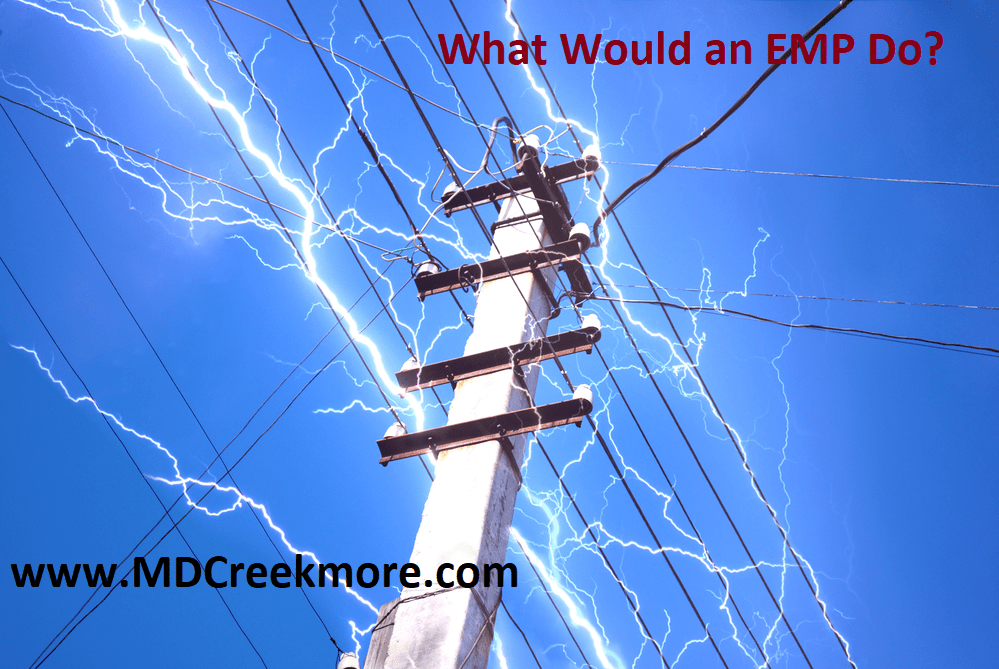
What Would an EMP Do?

December 30, 2018 M.D. Creekmore

What Would an EMP Do

by Ray K

EMP, or Electromagnetic Pulse.  Most of us have heard of it, some of us understand what it is and what it does, and those who have read “One Second After” have an idea of what will happen if we are attacked with it.  Some additional info can be found at http://en.wikipedia.org/wiki/electromagnetic_pulse

The U.S. Government created a commission to study EMP and what it could do to the safety and security of the United States.  Unfortunately, this Committee published its report the same day as the 911 Commission, so it didn’t get much news coverage.  You can read the report at www.empcommission.org.  The bottom line in the report is that it is not a matter of ‘if’ but ‘when’ we will be hit.

EMP will take out everything electronic, whether it is connected to the grid or sitting unplugged on the kitchen counter.  Things connected to the grid may fry from the 100,000-volt surge brought in through the power distribution lines.  Electronics with transistors or integrated circuits are extremely sensitive to static electricity and can be destroyed by as little as 100 volts.

Walking across a carpet and sparking to that door know is well over 1000 volts.  The surge created by the EMP in your electronic device will be sufficient to destroy them if they are not protected.

One of the committee members likened EMP to a time machine, transporting our society from ‘today’ to ‘1870’ in about one second.  We become, once again, an agrarian society, capable of supporting the level of population that we had in 1870.  This means that there will be a lot of Americans dying.

Our goal, your goal, is to be among the survivors.  There are many things that need to be done to prepare:  learning survival skills (read – What Survival Skills Does A Prepper Need), having land and gardening/preserving knowledge, and many other things.

Having communications and some of the gadgets survive could mean the difference between surviving and not surviving.  Things like solar battery chargers (see this article for solar charger recommendation), batteries, inverters, ignition systems for chainsaws, critical farm equipment electronics, walkie-talkies, NV gear among others could be critical when the time comes.

What is EMP?

When a nuclear bomb is exploded above the atmosphere, it releases gamma rays in all directions.  The ones that head towards the atmosphere strike air molecules and strip off electrons.  Those electrons and gamma rays head towards Earth, stripping even more electrons.  This avalanche of electrons called the Compton Effect, interact with the Earth’s electromagnetic field, creating very strong magnetic waves.

When a magnetic field crosses a conductor, electrical current is produced.  When this EMP magnetic wave crosses power lines, electronic equipment, anything conductive, current is produced.  Enough current could be produced to create fires, exploding transformers, extremely high voltage (current pushing through resistance results in voltage) which can break down insulation and create arcing and short circuits.

In 1962 the US detonated a 1.4 megaton bomb over one of the test sites in the Pacific.  It was high enough that the island of Hawaii, 900 miles away, had 300 street lights go out, and some microwave links were damaged.  Hours after the detonation there were still surges and ripples in the power system.  That was when we used vacuum tubes and before transistorized equipment was on the market.  Today, with microcircuits and all of the very high tech equipment that we have in our homes, our factories and our defenses, we are more vulnerable than ever.

The U.S. Senate recently stripped funds for hardening the country’s power grid against EMP from a homeland security bill.

We are on our own.

What Will Work After an EMP Attack

Will EMP harm you?  You, the human, will be safe.  Magnetic waves, even very strong ones, will not harm you.  MRIs use strong magnetic waves to make images of your innards.

But, look around you at anything with a wire or a chip.  Whatever you see, be it a toaster, TV, laptop, microwave oven, radio, chainsaw, car, or truck, it is vulnerable, and the higher the technology the more vulnerable.

WSHTF you won’t need a TV, but you will need a radio, perhaps walkie-talkies, probably solar battery chargers, that ignition coil on your chainsaw, maybe that night vision scope and whatever else you deem necessary for your survival.  EMP won’t hurt you, but it may take away most if not every electronic device that you possess.

If you are part of a group, you might consider building a larger box and sharing it, and the cost.

EMP Protection

One way to protect your gear is to build a Faraday Shielded Box and keep your stuff in it (read this article for detailed Faraday cage instructions with photos).  A Faraday shield is simply a physical device that prevents electromagnetic radiation from passing, in or out.  In our case, we’ll take a cardboard box, cover it with copper screening material, and then ground it well.

I’ll describe the one that I built and you can size it up or down as you think necessary.  Copper screen material with wire spacing of 0.1” is needed, and is the most expensive part of the project.  You can keep costs down by only making as big a box as necessary.  But when you think of the cost, think of the cost of the items that you will be protecting and what it might cost you if they don’t make it.

I started with a 2’ x 2’ x 3’ cardboard box.  I actually had two of them.  I cut the top flaps off of one and cut up the other to bend and fold a lid like a hat box, with about 2” of side overlap.  I wanted a loose fitting top, with plenty of overlap on the sides.  You don’t want any holes or gaps in the copper shielding, which is why I put the 2” flap on the lid for the box.

I laid out the screen coverage to minimize the number of lapped joints, cut the screen and used spots of hot melt glue to hold the pieces in place.  I folded the screen around lips and edges, cut and tucked it into corners, and then used a very hot (150 W) soldering iron to solder all of the lap joints and corners.  On the lid, not only cover the outside but fold the screen into the underside for the side overlaps.  You don’t want any missed areas of coverage of the screen.

Next, take a piece of bare #10 AWG or #12 AWG (house wiring Romex) and strip off the insulation.  Form it into a loop with a pigtail.  Now make a second one.  Lay one on one side flap of the lid and solder the pigtail to the screen.  Put the lid on the box and solder the other loop to the main box a couple of inches below the pigtail loop on the lid.

Your box is ready.  Find an out of the way place where it can stay undisturbed.  From the box, run a copper wire (#10 AWG) outside the house to a ground rod.  You can use a ground rod of copper or galvanized steel, or you can get 10’ of ½” galvanized pipe.

Drive it into the ground at least 8’, attach the copper wire to the clamp, and make sure that you always have the box and lid connected to the ground wire.  At the box end of the wire, use alligator clips to conned the main wire to one of the pigtails and then make a short jumper between the two pigtails.

I haven’t finished stocking mine, but my list includes night vision goggles, IR laser sight for the rifle, game camera, batteries, crank emergency radio, walkie-talkies, solar battery charger, 12V to 110 VAC inverter, ignition coil for the chainsaw and an alternator for the tractor.

Protect Your Whole House From an EMP

Filed Under: Prepping

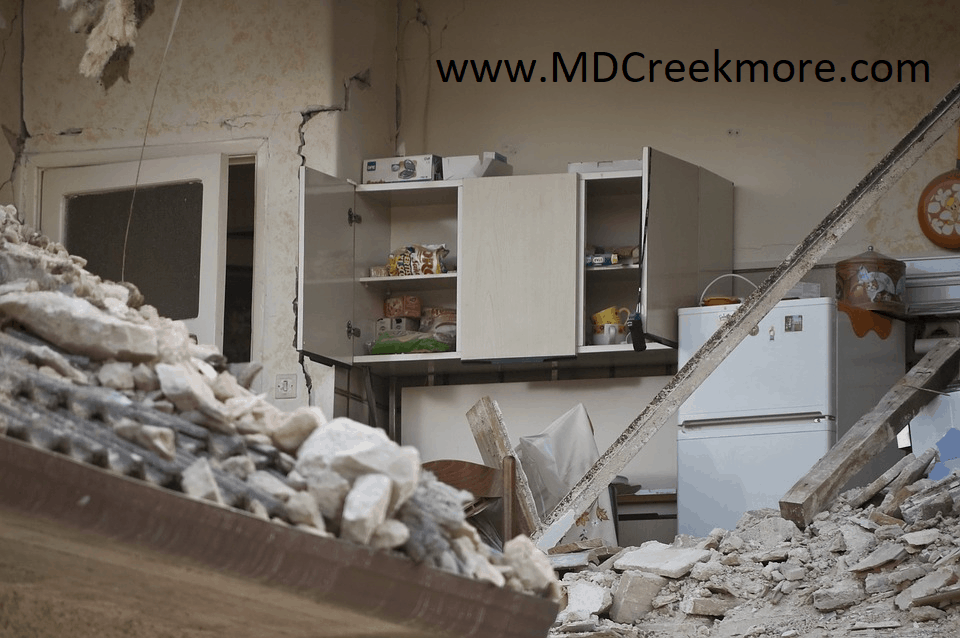
7 Ways to Prepare for and Survive an Earthquake

December 25, 2018 M.D. Creekmore

earthquake-survival tips

by Janet Spencer, Catastropharian Extraordinaire

In 1994 a friend of mine was in the Northridge earthquake. She was awakened in the middle of the night by her apartment collapsing around her. She crawled out of the wreckage wearing nothing but her nighty. She met her neighbors in the street. Most were cut, like she was, from scrambling through broken glass on their way out of ruined buildings. Some were missing. Most were found. Several were dead. It was a long time until dawn.

Hearing her recount the story of surviving an earthquake in the middle of the night made me think about surviving an earthquake in the middle of the night. I’m a thousand miles away from California, but I live on a fault line too. My town has a track record. We’re overdue.

Could what happened to her happen to me? What would I do if it did?

There’s one important difference between California and my home Montana. When she was thrown out of bed, it was a warm night, even though it was January 17. Everyone was standing around barefoot in their pajamas. Nobody was cold. Nobody froze to death.

But Montana has a nasty tendency to get very bitterly frigid on a fairly frequent basis, especially in January. If I get bounced out of bed by an earthquake, it might be below zero outside. And people who experience sub-zero on a regular basis know how bad it would be to stand around in the street wearing nothing but pajamas with bleeding feet and shock coming on when it’s ten or twenty below zero.

She is my friend, and I still hear the fear in her voice when she remembers that night. It was harrowing and horrifying and hard. And I knew that if it happened to me on one of those nasty mid-winter nights, it could be a whole lot harder. It might be a very very long time until dawn.

And that’s what made me think, ‘What can I do now that would make it less terrible then?’

I made a list. Then I checked off everything on that list. And if you’ve ever wondered, ‘What if….’ then maybe you should look at this list too.

If you check off everything on the list, then if you’re ever bounced out of bed on a sub-zero night, things might be easier for you.

Take a look. Here’s the list.

After seeing pictures of the wreckage of her apartment, I imagined trying to find my glasses in the middle of that mess. If my glasses fly off the nightstand, fall to the floor, and disappear down some dark and dusty crevice, then I am immediately handicapped. I am hopeless and helpless without my glasses.

So I bought a glasses case on a string, of the type worn around the neck. I tied it to my bedpost. Every night for a thousand nights when I’ve gone to bed, I’ve placed my glasses in that case. They’re never on the nightstand any more. I reach for them automatically in the morning. I always know where they are. They are always within arm’s reach.

Nothing can shake them loose.

That glasses case cost me a buck and it bought me a whole lot of peace of mind. If I’m going to be coping with a quake in the middle of the night, I don’t have to go into the chaos blind. For a dollar, I can always find my glasses.

That is the first thing on the list.

Of course, the electricity went out in Northridge, and it was night, so it was dark. And if the same thing happened to me, I would want light immediately available. Normally I keep flashlights in the junk drawer in the kitchen, and in the basement on the tool bench, and in the car under the seat, but I didn’t want to be in a position where I had to find a flashlight in order to find a flashlight. I didn’t want to waste any time at all fumbling around in the darkness and confusion searching for it.

So I bought a flashlight with a wrist strap attached, and I gave it fresh batteries, and I hung it from my bedpost along with my glasses. Then I wondered, what would happen if the batteries went dead? No light, no more! So I bought a package of extra batteries and put them in the draw in my nightstand.

I also bought a hand-cranked wind-up flashlight/radio/siren/phone charger. I tuned the radio to the station that’s designated emergency broadcast channel in case of emergency. I hung it by its wrist strap from the bedpost as well. The flashlight cost me a buck, the batteries cost me two, the wind-up one cost me twenty. What will they be worth? Plenty.

That’s the second thing on the list. Got eyes, got light. Good to go.

Where am I going? How am I going to get there?

My friend wanted to get into her car and go somewhere safe, but her car was in the garage and the garage was askew and the garage door would not open. She couldn’t even sit in her car because the doors were locked. The keys were in her purse and her purse was probably on the dining room table, or maybe the kitchen counter and both places were buried under so many splinters.

There was a magnetic key under the bumper but it was dark and she didn’t have a light. She was barefoot and the garage windows had shattered all over the ground. She thought she had a flashlight, but it was in the locked car. (Later it turned out the batteries were dead anyway.) So she just stood around in the street and waited for someone to help her to the hospital.

I don’t want to stand around and wait for someone to show up to help me. If it’s ten below zero, waiting around isn’t an option.

So I had a set of spare car keys made up. I added copies of keys of all the places most important to me—the places I’ll want to check first after a disaster, like my office, and my husband’s business. I clipped the keyring to the wristband of the flashlight hanging on my bedpost.

So now, if I’m bleeding and frightened and cold, I can sit in my car and have heat and light and a radio. I’m glad I don’t have a garage, because it will never collapse, trapping my car. I might be able to get to the hospital without waiting for help.

It cost me four dollars to have the keys copied. Keys are third on the list.

If these three things are all you ever do, you will be so much better off when that night arrives than if you never looked at this list at all.

But if you agree that there are many things you can do now that will help you later, then read the rest of the list.

When my friend jumped out of bed, she did it instinctively, without thinking, and without looking before she leaped. She discovered the hard way that every framed family photo had fallen off her dresser top. Every picture on the wall fell. Every window in her apartment shattered.

Every mirror broke. The floor was covered with shards of glass. Her injuries came not from the quake, but from cutting her feet while making her way out of the wreckage. In fact, 80% of the injuries treated in area hospitals were for cuts from the knees down.

So I took an old pair of sturdy tennis shoes that I don’t wear anymore and I put them underneath my bed.  In one shoe I stuffed a pair of socks, and in the other shoe, I stuffed a clean pair of underwear (because if I need ‘em, I’ll be glad they’re there) and also a big bandana. If I’m going to be doing any crying or bleeding or screaming or throwing up, a hanky could come in handy.

To make sure that shards of glass didn’t fall into the shoes, I stuffed them into an old pillowcase. Then, thinking about the sub-zero scenario, I added a few more things to that pillowcase: a pair of jeans (with their pockets stuffed with useful items), a warm shirt, a sweatshirt, a hat, and sturdy leather gloves. There was still room left in the pillowcase and plenty of space under the bed, so I added a couple bottles of water – again, very useful if crying, bleeding, screaming, and throwing up is happening.

In Northridge, it was a long time before water service was restored. In the pockets of the jeans I placed another hanky, a packet of tissues, some hair ties because I hate having my long hair in my face, a chapstick just for comfort, a whistle because it’s so much easier than shouting, and a few mints to suck on just in case there’s throwing up going on.

I added another copy of my car key just in case, and I tucked some folding money in the pockets too because the ATMs and credit card machines aren’t going to work as long as the electricity is down. I might need to buy something, and who knows where my purse will be or how much money I’ll have on hand. If I depended on medication, I would stick extra meds in the pocket too.

I stuffed all that into a pink pillowcase, and then I made up an identical kit for my husband and packed it in a blue pillowcase. In my mind’s eye, I rehearsed the scene a few times in which I practiced NOT jumping out of bed but instead reaching under the bed for the emergency pillowcase first. This way I can at least put on shoes to get out of the house and have clothes to put on while standing around in the street.

Clothing is fourth on the list.

In Northridge, as in most earthquakes, the shaking broke natural gas lines, water pipes, and electrical lines. Water heaters tipped over, and gas and water poured into basements. Explosions and fires popped up all over. The overwhelmed fire department couldn’t put out the fires because the water mains were broken.

So under my bed went two fire extinguishers – one for my husband, one for me – which cost me $10 each. I learned how to shut off the water, electricity, and natural gas to my home. Shutting off the natural gas requires a wrench, so I put a wrench under my bed, and for good measure, I tied another wrench to the gas valve.

The fire extinguisher and wrench may well end up saving my house from complete destruction while others burn down around me. In my imagination, I rehearsed putting on my shoes, grabbing the flashlight, and running outside to turn the utilities off before the house blows up.

Then I even spoke with my neighbors and found out where the utilities are located, so if they are trapped in their house, or if they can’t find their glasses or their shoes or a flashlight or a wrench, I can turn their gas lines off before their homes blew up. This was partly altruistic and partly selfish because if their houses burn down, the fire department isn’t going to be able to do anything about it – and if their houses burn, my house may well burn down too.

The Fire Prevention Kit is fifth on the list.

Next, I assembled an emergency tool kit with a variety of miscellaneous items that might come in handy.

Communications will be difficult or non-existent, so to hedge my bets I added a telephone that does not require electricity but can be plugged directly into the phone jack. I also added a set of walkie-talkies, along with spare batteries for them.

One for my husband, one for me. I put in a battery operated AM/FM radio that clips to my belt. I found out where to tune it for emergency broadcast information and wrote that in magic marker on the radio itself and marked it on the dial.

I stuck in a really good Swiss Army knife (what’s the best Swiss Army Knife for EDC), along with pliers and a hammer in case I have to help pull people out of wreckage through shattered windows. I also included some extra flashlights and more batteries because I expect working flashlights will be in short supply. This tool kit went into a draw-string bag under my bed next to the pillowcases.

The tool kit and all its contents are the sixth item.

Then I assembled a 72-hour kit using the guidelines at www.Ready.gov. I collected ready-to-eat food, bottled water, a first aid kit, toilet paper, pet food and other items, packing it into a Rubbermaid tub with a locking lid that I stored in my garden shed in case the entire house collapses.

If you have made it to this seventh item on the list, you will be in better shape than about 99% of your friends and neighbors.

At this point, I became very interested in learning more about emergency preparedness, so I took emergency response classes, joined the Red Cross, studied FEMA procedures, and teamed up with other people in my community interested in disaster preparedness.

I expanded my emergency kit to include everything I might possibly need: dust masks, goggles, knee pads, elbow pads, and hardhats with headlamps; tents and tarps; floodlights, a generator, Coleman lanterns, and emergency stoves and heaters; bandages and soup; duct tape, plastic sheeting, and spare lumber for covering shattered windows; down coats and sleeping bags; crow bars and car jacks and plenty more fire extinguishers.

I don’t expect people to go to such lengths as I did, but if they did – it would sure make things easier for everyone when that day arrives.

FEMA statistics show that the average American will suffer three disasters over the course of a typical lifespan, with ‘disaster’ defined as any event that disrupts an entire community simultaneously.

When it comes to disasters, there are only two variables, one of which we can control, and the other of which we cannot: There will either be a disaster or there won’t; and we can either be prepared for a disaster, or not.  When combining these two variables, there are four potential outcomes:

  1. There will be no disaster and I will NOT be prepared. (neutral outcome)
  2. There will be no disaster and I WILL be prepared (neutral outcome)
  3. There WILL be a disaster and I will NOT be prepared (negative outcome)
  4. There WILL be a disaster and I WILL be prepared (positive outcome)

We have two choices. We can either wait around for someone to come help us, or we can be prepared to help ourselves. The failure to consciously choose option #2 means choosing option #1 by default. The post-disaster misery index of both an individual and the community as a whole correlates exactly to the proportion of people who choose option #2.

What’s your choice?

Choose wisely.

Filed Under: Prepping

  • « Go to Previous Page
  • Page 1
  • Interim pages omitted …
  • Page 7
  • Page 8
  • Page 9
  • Page 10
  • Page 11
  • Interim pages omitted …
  • Page 15
  • Go to Next Page »

Primary Sidebar

Subscribe to Blog via Email

Enter your email address to subscribe to this blog and receive notifications of new posts by email.

Join 7,199 other subscribers
  • Amazon
  • Facebook
  • Substack
  • Twitter
  • YouTube

“Do more with less.”

– Minimalist proverb

Recent Posts

  • Just so you know
  • Weather Update for My Corner of Appalachia
  • Why I’m Ordering Ivermectin + Mebendazole Every Year
  • The Website’s Shutting Down (But Here’s the Plan)
  • You Are Hated! Start Training Like It!

Footer

Recent Posts

  • Just so you know
  • Weather Update for My Corner of Appalachia
  • Why I’m Ordering Ivermectin + Mebendazole Every Year
  • The Website’s Shutting Down (But Here’s the Plan)
  • You Are Hated! Start Training Like It!

More about me

Books I’ve written

Books I’ve read

Follow Me on YouTube

Follow Me on Facebook

Gear I Use and Recommend

Newsletter

Search this site

Follow me elsewhere

  • Amazon
  • Facebook
  • Substack
  • Twitter
  • YouTube

© 2008–2025 M.D. Creekmore · As an Amazon Associate, I earn from qualifying purchases.