• Skip to primary navigation
  • Skip to main content
  • Skip to primary sidebar
  • Skip to secondary sidebar
  • Skip to footer

M.D. CREEKMORE

  • Blog
  • Books
  • Newsletter
  • Gear I Use
  • About
  • Contact
  • Facebook
  • YouTube
You are here: Home / Archives for Homesteading

Homesteading

Here you will find articles on small acreage homesteading and farming topics such as homestead setup and how to buy a cheap homestead. You'll also find articles on topics such as gardening, DIY projects, raising livestock etc.

How to Install an Off-Grid Water Well at Your Homestead or Cabin

January 17, 2019 M.D. Creekmore

getting an off grid water well drilled and installed

by Sandra Ogden

Getting out of the city and choosing to live “out in the country” is a goal of many people nowadays.  “Homesteading” sounds so idealistic; getting back to the basics and living the dream!  What most don’t realize is homesteading is hard physical work and has a lot of unknowns.

It requires a lot of planning, prioritizing, setup money and manual labor.  You need shelter, water and food and lots of common sense.

When I bought my homestead (see the previous article on buying a country property), it had the basics:  a house, a water well, septic tank, shed and barn; however, except for the brand new septic, everything was old and poorly maintained.  I had to prioritize the repair/replace list and after refurbing the house, the water well was next in line.

I did my research on the internet about water wells, the various types of pumps, hand pumps, stand-alone mechanical pumps, and solar pump options. I spoke with some of my neighbors about their wells, many who have had to recently replace pump motors and pipes.

One neighbor tried to do his own replacement and it turned out to be trial and error because he did not know what type of pump or how far down it was placed so it was a guessing game and he ended up calling a company to come to fix it after 3 days of failure.

Another neighbor started doing it himself, found his pipe was broken and ended up getting a well company to replace the broken pipes and replace the pump.

In both instances, it was 3 to 7 days to fix the problem, plus between $1500 and $2500.  Another family down the road bought a place without an inspection and found the well didn’t work and $3000 and two weeks of repairs later they were pumping water.

The point is you never know when the pump will stop working or what caused it to stop.  It just happens and usually not at a convenient time!  If you don’t have water stored (300-500 gals) for your family and animals to get you through the repair/replacement, you are in deep yogurt!

Your location is everything!  If you live in the deep south (Louisiana, Mississippi, Alabama, Florida etc.) and you are not in the hills, your drill depth may be shallow (less than 80 ft.).  When I lived in Florida we could dig a well ourselves because the water level was so high.

But the further north and more hilly country you are in, the drill depth may be significant.  The type of the soil also impacts the drilling. Rocky soil or compacted clay can cause you some anxiety as it affects the time to drill and the type of drill bits needed to get through the ground.

If your house is on a scenic hill, it may add hundreds of feet to the water level, which adds money to total cost of drilling and installation. These are just some of the things to think about before buying that country property.

Other things you need to know about your existing well are:  when was it drilled, how deep was it drilled and what was the water depth when it was drilled.  If the well was drilled over 25/30 years ago, there may be no county records of it.

You will have to depend on what the owner tells you (if the property is occupied) or try to ask neighbors about their wells if the property is vacant.  Even if your closest neighbor is 10 miles down the road, the soil composition is similar and the water level is probably pretty close to what you would have.

The property I bought had a residence which was 40 years old and the original builder lived in the house.  Since the well was drilled when the house was built there were no county records of the original drilling to give me the information I needed.

The house sits on the second highest elevation in the community but it is really only a small hill.  The owner told me the well was 120 ft. deep but he didn’t remember what the water level was.  The pump had been replaced 10 years prior.  Since the owners were an elderly couple and did not use the well for irrigation or animals, I had a good chance the pump would last for a while.

You just don’t go out and replace a well pump because you’re worried it may break down on you!  Since I had no idea what type or size of pipe was used (40 years ago) or what brand or size of pump was installed (10 years ago), the decision about the water well kept me up at night for weeks.

Even though I have 500 gallons of drinkable water, 600 gallons of household use water, and 1000 gallons of animal water stored around my homestead, I was worried about not having fresh water.  The thought of having to go almost a half-mile downhill to the meadow where the spring is, fill water containers, transfer water uphill to the house and animal areas, filter and purify it for drinking was constantly on my mind.  I made the decision to drill a backup well using an off-grid Simple (Hand) Pump.

The internet advertising leads you to think you can put in a Simple Pump in or next to your existing well piping. Not unless you had it planned prior to drilling your well and got the right width of pipe!  My 40-year-old well was not a consideration for a Simple Pump, which meant I had to get a company to drill a new well in a new location.

A Simple Pump is a hand pump, which can be adapted to a mechanical pump either electric or solar… for an additional large fee.

Getting a well drilling company is not as simple as calling up and making an appointment.  I called all three companies within 100 miles of my property.  One just told me “no, we’re too busy with commercial work,” the other two agreed to come out and give me an estimate and explanation.

One company was willing to drill on appointment at a much higher price, while the other company offered a lower price if they could work me in over the next four months.  “Working me in,” meant between commercial jobs and when another job in the area could be combined with mine so they could bring the heavy equipment to do two jobs, which is more economical for them; which translated to $1000 less cost to me.

I chose the latter, feeling my existing well would continue to function while I waited.

The ESTIMATED cost of drilling depends on lots of things.  First, your location-how far out are you…what are your county road conditions; can large heavy equipment get to you and what are your farm road conditions…dirt, gravel, paved?

Second, what are the topographical issues with your property (mountains, hilly or flat)?  Third, what is the geological makeup of your soil…clay, sand, rock, etc.?  Fourth, what will the depth of drill to hit water be?  The drilling company can pull the records for your area, but some county well records only go back 15 or 20 years.

Needless to say, if you are on top of a mountain or hill, the drill will most likely be deeper and thus more expensive. Drilling a 50 or 80 ft. well is way cheaper than drilling 100-120 ft. or 350-500 ft. or more.  My house is on a small hill thus the drill went to 140 ft.

You need to ask all these questions up front to the drilling company and find out what their basic costs are and what their additional costs may be.  Do they charge additional fees for drilling more difficult geological makeup, more for drilling over 100 ft.,  what other additional charges…a one-time service fee, an extra mileage fee, non-level ground set up fee?

The supervisor will come out earlier with a contract, want a 50% deposit and want to know the approximate spot where you want the well drilled. He/she may do a soil sample or just use his/her experience to gauge the ground.

When the drill trucks arrive there will usually be two or three trucks: a large drill truck, a water truck, a sand truck and/or a supervisor truck; just depends on the company.  Your spot will need to be mostly flat and with enough space so the trucks can stabilize.

These trucks are heavy and the drill truck has extendable booms that go 100’ in the air over the drill site.  Electrical/telephone wires cannot be nearby and tree branches may be a problem also.  I had two sites picked out but one had too many oak tree branches and the boom could not be raised.  The alternate site was mostly clear of branches but the boom still took out the end of a branch.

My drill took about four and a half hours. Once that was done then the piping was inserted and fitted piece by piece, which took another hour and a half.  Lastly, they blew out the pipes and the water began to flow.  The next day the supervisor was back to measure the water level.

In my situation, the drill was to 140 ft. and the water level was at 115 ft. Because I chose a Simple Pump to be installed, it was necessary to know the water level so the correct measurements could be given to the company to custom build the insert pipes for my property. This took about 2 weeks.

The Simple Pump was installed about three weeks later.  The drilling company sent two men out to install it and while the supervisor said it would take “less than an hour” it really took almost three hours.  The Simple Pump pipes fit inside the water pipes.

Once the pipes were connected they installed the hand pump housing to the pipes.  Then the men pumped for about ten minutes to get the sand out of the new line before the water was clear.  Since it was brand new I was told to expect some dirty or colored water for a bit.

I had my son standing by to be the physical labor part and he was able to pump easily after it was primed.  It takes about six or seven pumps to get the prime to kick in before the water pours out if you pump once a day.  It will tire an office worker out in a heartbeat but a good ole country boy won’t have a problem pumping 30 gallons of water.

The cost of the water well drilling, piping, and Simple Pump and installation came to just under $5000. Once on site, it took a day to set up, drill, and pipe and another half a day to install the Simple Pump and clean up the site.  I am considering adding a solar unit to automate the pump but that would be an additional $2000-$3000 to purchase and install it, as that is not one of my talents.

I have laid a concrete pad around the well site and we’re in the process of building a pump house to secure the Simple Pump.  I know if a worst case grid-down scenario were to occur this pump will be a lifesaver.

Filed Under: Homesteading

Mini Farming on a 1/3-Acre Suburban Lot

January 17, 2019 M.D. Creekmore

Mini Farming on a 1/3-Acre Suburban LotBy: JenMar

Gather together a group of preparedness minded folks and the conversation invariably turns to pulling up stakes and moving to the country to create a self-reliant home and life. But, for many, moving is not an option. Work, family, kids, health, personal responsibilities are all valid reasons keeping people in their present location.

It may not be what we want, but it is where we are right now. We don’t have to postpone our path to self-reliance or preparing for a crisis, though, we can start where we are, with what we have.

Even though a vast country property might be ideal, a large suburban lot can be just as productive. It can be a place to learn and practice, make mistakes; a place to build skills and confidence and learn how to live a life not reliant on a consumeristic society.

When I moved to my property 15 years ago I did so with the idea that I would make it a productive mini farm, with all the pieces of a traditional farm, only smaller. Through the years we have worked and built, reevaluated and rethought what this farm can produce. It’s a creative process that relies on the calculated rotation of livestock and produce for maximum production.

This is what I’d like to share, in hopes of inspiring other city-dwelling pack mates to put their property to maximum use while life’s circumstances keeps them in town.

A Note to Clarify:  This article is primarily about how I survive in suburbia managing my property to produce food for a two-person household. I won’t be talking about alternative energy, heat, water, OPSEC, guns, ammo, or security, although those are all important topics.

Ok, let me give you a visual to set the stage…

I live outside of a mid-sized town (about 30,000 people) in Southern California.  The homes in my area are zoned for all livestock, except horses. The City allows us 33 animal units per home, which is calculated based on a value given to each species. For example, a sheep is 3 units and hogs are 6 units, while chickens and rabbits are ½ a unit each. I can create a mix of animals as long as I don’t go over 33 units.

My property is 1/3-acre, about 85’ wide and 100’ deep. It is all flat and useable. The house fronts to the west, and sits about 30’ from the street, so I have a large front yard with good west and south exposure. Our climate is Mediterranean and the growing season is almost year-round. With small hoop houses, I can grow 365-days, when needed.

The barn is the hub of activity. It is 12’x24’, runs east to west and houses most of our livestock on a rotational basis. To the west is the chicken coop portion (6’x12’) with an outside run that is 8’x12’. The center of the barn is an open space for feed, tack, and supplies.

On the south wall of the center section hangs three rabbit cages, for two does and a buck. The cages have corrugated galvanized roofing that attaches to the front bottom of each cage and extends through the barn wall at an angle. We lovingly refer to this as the “poop chute”.  On the outside of the barn, below the “poop chute” is a collection bin.

The idea is — the droppings roll down into the collection bin, to be used in the garden or compost pile. Litters of meat rabbits are grown out in an 8’ growing cage that is mounted to the wall below the doe and buck cages. When not in use the growing cage is removed and stored in the barn rafters.

The section to the east gets the most activity as we rotate in and out market lambs, pigs, meat chickens, and meat ducks, throughout the year. From the east side, I have the ability to erect an outside corral of different sizes using livestock panels and gates.

There are three 4’x12’ and nine 4’x8’ raised vegetable beds, a squash patch, a 3’x20’ berry patch, dwarf and espaliered fruit trees, trellised grape vines, a dedicated herb garden, and medicinal and perennial herbs interplanted in the flower beds.

The 10’x12’ greenhouse is where plant life begins, whether from seeds, cuttings, divisions or bulbs. Since we have such a long growing season the greenhouse is primarily used to start seeds, store tools, and supplies, rather than growing vegetables during the winter. It’s also my quiet hang out.

The front yard is part of the farm as well. Planter beds have blueberries, herbs, flowers, and one very young pomegranate tree.

So—how do we make all this work? How does this small piece of land produce food for its family?

Carefully, thoughtfully, deliberately, rotationally and with a whole lot of humor and flexibility.

Our life revolves around junior livestock shows, eight months of the year to be exact, so meat production on the farm has to intertwine around that schedule.

Here’s how we do it…

For most of January, the farm is preparing for new livestock and the growing season. The barn is cleaned and outside corrals put up. Feed and feeder lambs are purchased. Fruit trees, berries, and grapes are pruned, fertilized and mulched. Cool weather seeds are direct sown, while many other seeds are started in the greenhouse.

In February, the show season begins, every weekend for the next two months. Succession planting of cool weather crops begins, and more seeds are started in the greenhouse. Outside vegetable beds are tilled and mulched, and bean poles and pea fencing is put in place.

Depending on the rainfall, we are already pulling weeds and mulching garden paths by mid-March. Directly sown seed planting continues, as does seed starting in the greenhouse.

So far, life has been rather routine, lambs get fed, seeds are planted, hens lay eggs, and so on. But, that’s all about to change.

By April, life gets a bit more interesting and busy. That’s when we breed the does and bring in a few turkey chicks, which are brooded in the garage. By the time the chicks feather out and can live in the barn the weather is nice enough that the lambs don’t need (or want) to be in the barn.

The show schedule has also slowed to two weekends a month. Half the lamb space in the barn becomes a growing pen for the turkeys. A week or so before the does kindle we set up the 8’ growing cage on the wall below the does.

The chicken coop is cleaned and all bedding is moved to either the garden or the compost pile (also read – can I keep chickens in my backyard). Nesting boxes are refilled with shavings from the turkey brooding pen. By month end the entire garden has been planted with the first wave of crops.

In May the garden is really taking off and we are seeing the fruits of our labors. Harvesting spring crops is regular now. Winter squash and pumpkins started in the greenhouse are planted in the squash patch.

The doe’s, bred in April, kindle. The turkeys are growing fast and the lambs get a reprieve from the hectic show schedule. Life takes on a rhythm of planting, harvesting, mulching, watering, and weeding until June when the first berries and early summer fruits are ready to pick. The kits are moved to the growing cage.

July is a big month because of the State Fair. All the lambs attend the fair, but only two return home to be shown at the county fair. The others are sold. July’s heat means we must be diligent with watering, weeding, and mulching. The first tomatoes come in July, along with mid-season berries and the last of early summer fruits. Harvesting and replanting is weekly now. Food preservation begins in earnest this month.

Everything we’ve done so far all culminates in August. The garden is bursting, animals are growing, food preservation is non-stop, and just to make things a bit more interesting we throw in the county fair—a week away from home, in the hottest month so far.

The rabbits, turkeys, and the back-up market lamb, not being shown at the fair, are all processed for the freezer before we leave. At the end of the wee,k we come home with an empty trailer. All fair animals have been sold at auction.

By the end of the month, the barn is empty, except for the laying hens and breeding rabbits. We get to take a deep breath, for a little while, at least. The week after school starts 25 meat chicks arrive.

The hot weather in September means I can brood chicks in the garage without using the heat lamp much, saving on my electric bill. When they are ready they’ll take over the entire sheep pen in the barn. If the weather cools enough, the does will be bred again so the litter can be butchered over Christmas break. Some of the garden is slowing down, while some of it seems to be rejuvenated.

Summer squashes are bountiful, in stark contrast to the dying bean, pea and cucumber vines. We continue planting root crops, but the weather is too hot for lettuce greens. Late summer fruits and berries are picked and canned or frozen.

The chicken coop bedding is cleaned out and composted or used as mulch in the garden. The bedding from the sheep trailer becomes bedding for the nesting boxes.

October is a month of contradictions. While we harvest vegetables, potatoes, squash, pumpkins, late berries and a variety of fall fruits, much of the garden is finishing its growing season. We may get a few more plantings of short term crops like beets, radishes and carrots, but we’ll have to wait for the weather to cool before planting cool weather vegetables.

A winter hog arrives early in the month and will be raised in the outside sheep corral through the temperate fall months. By the time the weather gets colder the meat birds will be gone and the hog can have an indoor and outdoor space.

We don’t get freezing weather so raising hogs in the fall is much better than the heat of the summer when the barn is full of other animals. Kits are moved to the growing cage.

Much of the garden comes to an end in November and is replaced with cool weather vegetables and leafy greens. The meat chickens are processed around Thanksgiving. Some of the smaller ones are kept whole, but the rest will be cut in half, giving me chicken each week for about 50-weeks. The hog gets the whole west end of the barn, now. The meat rabbits are growing fast.

In December, we plant a variety of peas for an early spring harvest. Spinach and some hearty lettuces can also handle the cooler temperatures. Over the Christmas break, we butcher the meat rabbits.

The hog will be dropped at the butcher in January as we head north to buy another group of feeder lambs. The only animals left are the laying hens and the breeding rabbits. We get a break for a few weeks, before the whole cycle starts again.

In the course of a year my 1/3-acre suburban lot has produced 4-6 market lambs (1 for the freezer), 3 turkeys, over 30 meat rabbits, 25 meat chickens, one hog, hundreds of eggs and countless pounds of fruits and vegetables; proof that it doesn’t take a large farm to grow and raise your own food.

Filed Under: Homesteading

How to Cure Fungus Problems on Fruit Trees

January 13, 2019 M.D. Creekmore

How to Cure Fungus Problems on Fruit TreesBy Kate in GA

While this technique will work with all perennial plants, my focus for this article is really on the perennials in the garden.  I will specifically talk about fruit trees. However, this will work on all perennial plants that may be giving you problems.

Let me start by saying that I have never seen this technique mentioned in any book or anywhere on the web.  If you ask a master gardener in your county, they will probably say they never heard of it – and may even add that too much fertilizer can be harmful.

However, I can honestly say this technique does work, and with more success than I ever imagined.  This technique has come from my own personal experience and has managed to let my apple trees live less than 20 feet from my (and my neighbor’s) evergreen trees.  All trees are playing well together and are happy.

Let’s start with a comparison in the human vitamin world.  The government gives us minimum daily values for nearly all vitamins.  However, manufacturing companies sell vitamins in much higher doses then the minimum recommends by the government because taking the higher amount makes people feel better.  Vitamin E comes to mind for me.  I take 400 mg every day because it helps me with pain but the government states the daily value needed is only 15 – 30 mg. (Not sure these numbers are correct, I looked up the daily value stat up on the web and found many different values.  I combined them all in the range I displayed here.)

The same holds true for your plants.  I first learned of this fact when we moved to our house 16 years ago.  After the first year, I noticed that my grass always had fungus problems, but my neighbors didn’t.  (Mostly I had dollar spot and fairy rings.)  I just wanted my yard to look like my neighbors (also required by my HOA or I would have been fined).  I put down all kinds of fungicide that I purchased in the home improvement centers.

They worked for a short time, but the problem always came back.  So I had my soil tested.  I found out that I had no phosphorus and very little potash (potassium) in my soil.  I did know that my neighborhood used to be a farm.

I believe that my plot probably had the chicken house on it.  Keeping chickens in one spot for many years will drain the phosphorus from the soil.  I went to the local feed and seed store and purchased two fertilizers: one 50lb. bag of 0-45-0 and one 50lb. bag of 0-0-60.  I spread both (in both the front and back yard) and two weeks later, my lot looked like the rest of the neighborhood!  And it stayed that way for 2 years.

My neighborhood has changed quite a bit in the years I have lived here. We have quite a few Leyland Cyprus trees on our property, as well as Arborvitae Emerald Green trees. My neighbors have them as well. Both of these trees carry the Cedar Apple Rust fungus as well as many others.

I got the evergreen trees long before I got the apple trees.  Knowing that I might have problems with fungus on the apple trees, we planted three trees anyway. I thought that with a spray management program, I could make it work.

My apple trees are now in their 5th year at our house.  We bought two-year-old trees, so I am guessing at the end of this summer, they will be 7 years old.  It has not always been an easy co-existence for my apple trees & evergreens.  The apple trees told me the second year they were here that they didn’t like living at my house and showed me that by picking up both Cedar Apple Rust and Fire Blight.

I thought, no problem, I will spray!  Well, spraying didn’t work!  It worked when sprayed right after a rainstorm, but the dew is so heavy here in the summer, that each morning I got up I had more fire blight!  That year, I cut off so many dead branches I thought I was going to lose the trees.

We managed to scrape by that year, but I didn’t know if we should pull the trees and forget about growing apples or not. We decided to keep the trees and I thought I would try again in year number 3.  I followed the spray recommendations from the University of Georgia and thought that would make the difference.  Nope, it didn’t!  After a lot of rain in April and May, I thought my trees would die.

While out and about one day in mid- May, I pulled into my driveway and noticed that I had dollar spot on my lawn.  I looked at my neighbor’s yards and they did not have dollar spot.  I thought, “Has it been 2 years since I put down phosphorus?”  I called up my feed and seed store to order more.  Then I thought,  if this works for grass, would it work for my apple trees as well?  I ordered 100lbs. of 0-45-0 and 0-0-60 that year.

I put 50lbs. out for the grass, (spread in both the front and back yard) and then put the other 50lbs. of each concentrating on the 1/6 acre where my trees were located (the trees are in my backyard and also got some of the initial 50lbs. that I put down for the grass.)  I added it a bit heavy to the drip line but spread the rest evenly over the 1/6 acre.

I watered it in immediately.  I had to use a drip line because the sprinkler would have caused more fire blight on the trees.  1 week later, the episodes of fire blight and new evidence of cedar apple rust stopped!

This has now been made part of the routine care of my apple trees!  I add one 50lb. bag of 0-45-0 and one 50lb. bag of 0-0-60 to the 1/6 acre where my trees are located each year.  And, as I mentioned earlier, they are now almost 7 years old and much happier trees.

I still used an integrated spray management program, but my emphasis concentrates on the early sprays needed in the spring.  I only spray for fungus now about every 4 – 6 weeks during the summer months and apply the spray with a focus on the new growth.

It is a bit of a challenge to know when to spray because the fungicide can damage the trees if it is over 90 degrees when you spray.  (That is all summer long for me!)  So I try to time it with a rainstorm so the temps are lower.  This is something I am willing to accept for the blessing of having my own apples.

I should also state that the phosphorus and potash fertilizers will not stop all incidences of fungus problems with the trees. However, it so greatly reduces the number of times fungus appears as well as greatly reducing the severity of the problem that I now find it completely manageable.

I have only had to cut off a few small branches from fire blight on my apple trees this year.  And, it has been over 3 years since I have even seen evidence of cedar apple rust. (I do understand that Cedar Apple Rust is a bi-annual problem, not an annual problem.)

Also, just so you know, I store this fertilizer so I always have 2 years’ worth on hand. When the world ends, I will still be able to manage my fungus problems with the apple trees for a while.

Now, if I can just get the squirrels to stop sampling the apples to see if they are ripe yet!  I see covering those trees in netting in my future next year!

Filed Under: Homesteading

Worms for Fishing and Vermicomposting

January 13, 2019 M.D. Creekmore

How to Use Worms for Vermicomposting

by Brian Ford

Well yes, in a sense worms can be farmed. Just as you would keep a few chickens or rabbits. My interest in worm farming (vermicomposting) goes back a few decades. Back then I would often hit one of my favorite fishing spots on the way home from work. Worms were quite expensive, two dozen red wiggle res or a dozen night crawlers for two bucks. It did not take long for my bait budget to be depleted.

I had an old defunct deep freezer in my garage. Remembering back to my childhood, an uncle had filled one with dirt, leaves, sawdust, and food scraps. There was always loads of worms in the bin.

I set out to replicate his “farm”, shredded paper, cardboard, sawdust, leaves, and some rabbit litter all went in the bin (freezer). Holes were drilled in the door for air flow. I carefully added water till the contents were damp. Now to point out this was pre Internet, I quizzed my uncle and read through the local library’s meager selections about worms.

Once I decided the bin was ready I started dumping the leftover worms from each fishing trip in the bin. All in all the endeavor went well. In a few months, I was finding juvenile worms and egg pods! I started to lightly harvest worms, my fishing habit was becoming sustainable!

During this time I noticed that the two largest sources of household waste was paper and food scraps. The worm bin reduced the flow off these two from the house to the landfill to zero! However, there are some things that should not go into the bin. Citrus waste, as the acid will burn the worms, meat and fat products as they draw pest and vermin. No cat or dog waste, as that might carry harmful microorganisms.

So practically all other food waste can go in the bin.  I had an old food processor, I would put the scraps in it with some water and pulverize the food waste before putting in the bin then covering with shredded paper. The scraps and bedding decomposed quickly and the worms were doing quite well!

How to Start Vermicomposting Video

The next spring I needed to empty the bin of castings, also I found quite a few small volunteer seedlings growing in the bin.  I moved the various seedlings out to beds in the yard and then removed and bagged about three-fourths of the castings. Just to note this took several days around my schedule.

After the clean out of the bin, I went back to adding bedding and pulverized foods. I believe I had about 8000 worms in the bin at clean out!  I have read that the population will double every 90 to 120 days.  I was at the point of being overrun with worms!

Back to the volunteer plants, there was tomatoes, peppers, cucumbers, eggplant, and melons along with other types of plants. Since I bought most of my produce from local growers the majority was heirloom produce. I gambled on a good return from setting out those seedlings.

And I got a great return! I did side dress the garden with castings. That summer and fall my dehydrator was working 24/7 to keep up. I had so much fresh produce I was making runs to the local farmers market selling the excess, plus bags of castings and boxes of worms.

In order to save me some bait money, I used items that normally would go to the landfill and in turn ended making a fair amount of money, and saving quite a lot of money.  Some of the seedlings turned out to be fruit trees, like apple, peach, and pear.

No, they did not bare true, but good scions could and was grafted to them to provide fruits.  Same with some grape seedlings, they were transplanted and then later grafted with more desirable cuttings.

If you have more worms than you can use, sell, give away, they can be used for chicken food. I have started a new smaller bin recently, so I expect by spring I will be swimming in worms and castings!

Should you want to try worm farming there is a lot of info on the webs, a little bit of reading and you should find answers to any questions you may have. The savings and earning potential will take a few months but it is defiantly doable.  Have fun if you tackle worm farming.

Filed Under: Homesteading

Advantages to Living and Homesteading in Mexico

January 12, 2019 M.D. Creekmore

moving to mexicoBy BS Garrison

“Note: This article was sent to me back in 2016 and was first published on my old blog, however, with everything that is currently going on at the southern border and all of the back and forth in Washington DC about building a wall I thought it would be interesting to repost this article again… M.D. Creekmore.”

In the early 1990s, we took our homeschooled children and headed to the Ozark Mountains of Missouri. Things looked bad for the USA at the time. We worried about an economic collapse, failing schools, dangerous cities and the eroding values of our society. So, we bought a 23-acre farm just a few miles from the headwaters of a spring-fed river and began our homesteading life, planning to become as self-sufficient as possible.

We raised our own vegetables, berries, and fruit. We had chickens for eggs and chickens to eat and 4 dairy goats for milk. Our 100 ft. deep well supplied the clearest, best-tasting water you can imagine.

Our neighbors were self-sufficient long before we arrived and together we bought grass-fed beef and organically raised hogs, sent them to the local butcher shop for slaughter, then gathered in our neighbor’s basement where they set up stainless steel tables, electric saws, and meat grinders and we processed the meat and readied the hams and bacon for curing.

Later, we smoked the hams and bacon with apple wood, passed through a long pipe into 50-gallon barrels we turned into smokers. At the end of the day, we ate chili and drank homemade elderberry wine and played music with our friends.

It was a great life – the best. We acquired practical homesteading and survival skills. The children grew up, got married and left for jobs in the city and we found ourselves alone, managing a large operation by ourselves. Exhausted, we reluctantly sold the homestead.

Fast forward a few years and things look much worse for the USA than I had ever imagined. We have a government that actively works against the very people who put them in power. Taxes are so high that ‘we the people’ are enslaved to the government for life.

Our leaders believe that laws are for the little people, not for them, and they enrich themselves while using the law to harass and persecute their political enemies. There seems to be no escape. Maybe the answer is to leave the USA.

Three years ago we decided to visit Mexico and several other Latin American countries that we had heard welcomed expatriates. We wanted a life that was free from government interference and oppression, but that allowed us to practice some of our homesteading skills.

Our first stop was Jalisco, Mexico, where people from north of the border are encouraged to settle and where there is an existing infrastructure that supports expats. We had planned to stay only a short time, but we ended up staying for three years, so far. Here are just a few reasons why life in Mexico appeals to us and may appeal to you:

Lower cost of living

Everyday life is a lot cheaper in Mexico. Our electric bill arrives bi-monthly and comes to about $10. You read that right. We use propane to cook and heat the water. Electricity runs fans in the summer, refrigerator, washing machine, and a water pump.

We shop in the local markets where the food is fresh and cheap. I can buy 2 kilos of tomatoes (4 ½ pounds) for 15 pesos, about $.80. Public transportation is efficient and runs often, taking you from the village, forty miles into the city of Guadalajara for about $3.00. You don’t need a car to get around in Mexico. Because so few of the local people have vehicles, the towns are compact and walkable. We live on $1700/month and figure we could easily cut that cost by $500/month.

High quality medical and dental care

If you become a permanent resident, you are eligible for the state-run medical program for about $300/year, or you can pay for the reasonable doctors’ visits out of pocket. Dental services cost about 25% of the cost of similar services in the USA and the quality of care is equal to, or superior, to what you can find north of the border.

Year-round growing season and rich soil

We live in the area known as the volcanic axis so the soil is rich. This is an agricultural area that produces every type of vegetable. Major growers like Dole and Driskoll’s have established large farms here, producing raspberries, strawberries, and blueberries for export.

You can buy the berries at a fraction of the cost you pay in the supermarket in the USA. Because of the abundance of fresh vegetables and fruit, you will eat healthier in Mexico than you ever did in the USA.

We drink coffee a local vendor brings from Vera Cruz and then grinds to order from the back of his truck. At home, we grow an abundance of herbs and vegetables in our container garden and have fresh lettuce, basil, and spinach for salads year-round.

An environment that welcomes self-sufficiency and entrepreneurship

If you become a permanent resident, you may work in Mexico or start a business. There are many expatriates from all over the world who have opened restaurants or created businesses to meet the needs of expatriates, or who sell services that cater to tourists. Some home gardeners sell their organic produce or at home-prepared foods and cheeses, honey, from beehives and health-related products at one of several markets in the area.

Better quality of life

Living in Mexico changes the way you look at life. The people are less materialistic and pretty soon that attitude rubs off on you. You worry less, spend more time over lunch, in conversation with family and friends instead of staring at a cellphone.

You will build relationships with like-minded people who have also decided to escape from the oppressive, constantly monitored rat race that has become our lot in the USA. Is it safe? When we first arrived I asked the same question and a man who had lived here for two decades advised us not to start a brothel or become engaged in the drug trade and we would be fine.

After three years of living in Mexico, I have found his advice to be true. We have never had a problem with our neighbors, who have been kind and welcoming.

living in mexicoI am proposing a different way of achieving a more self-sufficient and freer lifestyle, especially for those who do not have the ability or desire to live on a remote homestead. I know from experience that it is a hard life for those who do not have children to help, or who are older and no longer have the physical stamina to begin homesteading. Your survival skills can still be put to use in a life that is easier, less stressful.

We have friends who have acquired every piece of survival equipment available. They have stockpiled non-GMO seeds and freeze-dried foods, canning equipment and canning jars, and a large library of books about every topic regarding self-sufficiency and survival.

Yet, they have never planted a seed, never killed a chicken to eat, never canned tomatoes or made a jar of jelly. They have the stuff to survive, but not the skills or experience to live the life if it becomes necessary.

The truth is that not all of us are capable of beginning from scratch to build a self-sufficient homestead. Either we don’t have the money or the skills, the physical strength or help from younger, stronger family members.

One way to survive – and even thrive – is to move to a place that makes it easy to live a better life, one that requires less money while providing some distance between you and the mess that has become the USA.  Who knows? Your place in Mexico may even become the refuge for loved ones when times get difficult.

Filed Under: Homesteading

Vegetable Garden Ideas for Small Spaces

January 11, 2019 M.D. Creekmore

vegetable garden ideas for small spaces

by Jason Smith

Living on the side of a mountain is nice, but it raises some interesting challenges to gardening. Since the land my house sits on was literally carved out of the mountain, the soil is blasted rocks and dirt, leaving much to be desired when trying to garden. My solution to this issue was to stay above ground, using pots and barrels as well as building a raised bed more than a foot off the ground.

Raised Beds

The construction of a raised bed requires some thought. Some considerations include the space you have to work with, the materials you will need, the number and type of plants you want to put in, and your ability to reach the plants once they are in the bed.

We don’t have much of a back yard, so we opted to make a smaller bed. The final dimensions for our bed are 7 feet long, 3 feet wide and 1 foot deep. The bed is raised over a foot off the ground on sturdy wooden legs. The dimensions for a raised bed can be altered any way you like to accommodate your space and needs.

Since we had some money saved up, we chose to purchase all new materials to construct the bed. The frame of the bed was created using four 8 foot long boards and four 4 foot long boards. To save money, these boards were not pressure treated. For the legs, I used a pressure treated 4 x 4 cut to 5 feet long for the front legs and 4 feet long for the back legs (the bed sits on a slight slope).

Using four 8 foot long boards and four 4 foot long boards the sides of the boxes come to life. To save money these boards were not pressure treated.

For the legs, I used a pressure treated 4×4 that was 8 feet long and cut it down to the desired lengths. The front legs are cut to 5 feet long and the rear legs cut to 4 feet long. One foot is used lost depth of the bed

I stapled chicken wire to the underside of the bed and reinforced it with slats of reclaimed wood on the short ends of the bed. For added support, I used leftover boards spaced about 1 foot apart across the bed. The best support was given by 5 boards cut 4 foot long.

We applied 3 coats of exterior latex paint to minimize moisture damage. Then, I lined the sides and bottom of the bed with a garden cloth. Garden cloth allows water to pass through the bottom of the bed and discourages root rot without the loss of precious dirt.

Before adding the dirt I leveled the whole bed on all four sides. Once the dirt was added, I checked again to make sure the bed was level. With a perfect level, you don’t have to worry about the dirt running off the plant roots or piling up on the low side of the bed. I also added an irrigation system to my raised bed that consisted of a pipe, a spigot, and a soaker hose.

When the bed was finished, we planted lettuce, 4 pepper plants, 4 cucumber plants, carrots, onions, and spinach. It turns out that there is plenty of extra room for more plants later in the season. You have to be careful with some plants as they want to run and can take over a bed. To get around this we planted the cucumbers in the back of the bed and added a web of hung twine for the plant to run on.

Reach is something important to keep in mind. You have to design bed so that you can reach at least the midway point for weeding and harvesting. However, if you have tall or running plants in the back of the bed you won’t be able to reach in from that direction. Another thing to consider is how much do you want to bend when tending your garden? Raised beds can be built as high or as low as you want.

Pros:

  • Flexible in design
  • Visually appealing
  • Keeps some critters out

Cons:

  • Can be costly
  • Limited space once it’s built
  • Requires some extra watering

Potato Barrels

Potatoes are wonderfully resilient root veggies. I have heard of people growing them in all sorts of conditions. The most interesting was a stack of tires. While I couldn’t get my fiancé on board with that, we compromised on the purchase of two plastic containers for our potato barrels.

Once we had our barrels, we added a layer of dirt followed by a layer of potato quarters with good eyes on them, repeating the process until the containers were full. A few months later, we have large potato plants and tiny potatoes growing. It was surprisingly easy and takes up a 5 foot by 10-foot space. If all goes well we will have a few pounds of potatoes with very little space cost.

Window Boxes

Personally, I love window boxes as they are flexible, well-shaped, and do not take up a lot of space. We currently have 3 24-inch window boxes set out. One with flowers (not food but it makes the lady of the house happy), one with green onions, and one with leafy lettuce.

My fiancé planted a bunch of marigolds in the first box. They are pretty but don’t taste good.

Since the leafy lettuce can be planted closely together and then thinned we loaded it down and now have a thick patch of lettuce for salads. The real benefit is that if you do this correctly you can cut the lettuce and it will re-grow.

Green onions need almost no space to grow and can be quickly and easily replanted. We eat a lot of these in salads and with pinto beans and cornbread, and the window box allows us to grow a crap ton (a very technical term) of them in a small amount of space. The trick is to replace a new bulb in the hole of each onion you pull to enjoy the yummy returns all season.

Final Thoughts

The most important thing I have taken away from figuring out how to garden in a limited space is that, with a little creativity, you can garden successfully no matter how small your space is. Of course, you have to pick the right plants and understand your limitations.

I know that I cannot grow corn in my limited space, but I can grow enough other plants to make that trade-off worthwhile. Fresh, homegrown fruits and vegetables taste better than anything you can get in the store. If you have limited gardening space, container gardening can help you experience this firsthand.

Filed Under: Homesteading

How to Grow a Moringa Tree (and why you should)

January 8, 2019 M.D. Creekmore

How to Grow a Moringa TreeBy TN Mommy

I grow vegetables and fruits in my container garden, plus I’m working on installing some built in garden boxes in the rear of my yard, but that’s about all I can do for now since I live in suburbia and the HOA will fine the shit out of me if I put chickens and goats in my backyard.

For those that don’t know me, I am a Christian and I believe that the good Lord, in his infinite wisdom, surely has created an alternative out there.  So I did my research and stumbled upon the miraculous Moringa tree.  Not only are these trees beautiful, but they also provide an abundant supply of multi-vitamins.

Moringa leaves contain:

  • 2 times the protein of yogurt
  • 7 times the vitamin C of oranges
  • 3 times the potassium of bananas
  • 4 times the vitamin A of carrots
  • 4 times the calcium of milk

In addition to that, Moringa leaves also contain vitamins B1, B2, and B3, as well as chromium, copper, fiber, iron, manganese, magnesium, phosphorous, and zinc.  There are allegedly medicinal uses of the Moringa tree as well.  Some uses include natural antibiotic, help for stomach illness, cold remedy, etc. 

I must include a disclaimer here because I have not tried using Moringa as a remedy for any common ailments.  There is plenty of information available online.

I’m sure by now all of you are thinking, “Wow, I gotta get one of these.”  Moringa trees are not indigenous to the United States, but there are places that grow them.  I purchased my seeds and a couple of seedlings from Moringa Farms in California (www.moringafarms.com).

Shipping is fast and their customer service is out of this world.

My first two saplings did not survive, so I contacted them for advice and was immediately shipped replacements.  The next two saplings grew just fine, but sadly one of them was brutally murdered by my 1-year old who saw me harvesting my cucumbers and tomatoes, and decided to “help.”  My remaining Moringa tree is thriving quite well in a large pot on my deck and it grows faster than most weeds.  You can see in the picture below just how big it has gotten.

Now your next question is probably “How do I grow one of these?”  Moringa Farms will include instructions when you receive your seeds or saplings.  These trees are very resilient and will grow fine in most places.

They will go dormant in winter if you live someplace that gets cold, which is why I potted mine.  I’m going to bring it into the house when it starts to get cold.  They will grow in your yard just fine and your neighbors will have no clue that it’s anything other than a very pretty tree.

Once you have a sizable Moringa tree you can start using the leaves.  You can eat them fresh or dry them and mix the powder with tea, smoothies, or whatever.  Any other information you need can easily be found online.  I have not eaten more than a few leaves just to try them and see how they taste since I have about 4 bottles of SpongeBob multivitamins in my pantry.

How to Best Grow, Harvest, Dry & Profit from Moringa in Your Backyard

Does anyone know anything else that can be grown as a natural multivitamin?  Please post below…

Filed Under: Homesteading

Can I Raise Meat Rabbits In My Backyard?

January 3, 2019 M.D. Creekmore

raising rabbits

by The Mid-west Mrs.

Can I Raise Meat Rabbits In My Backyard? Yes, You Can!

I had rabbits when I was young but only as pets. Our children had rabbits growing up, again only as pets. We now have rabbits but they are for food. You have most likely a basic understanding of rabbits so this article focuses on how we manage our rabbit husbandry. We maintain 3 does and two bucks.

Getting your rabbits

It is not so much where to look but what to look for. Uncrowded caging, clean fur, no drainage from eyes or noses. No smeared loose looking poo in the cage bottoms and clean food/water bowls.

Check the fur for parasites, look in the ears to make sure they are clean. And no rabbits sneezing allowed!

Check for the sex. It is not too hard once you know how. Here is a link

http://www.pet-informed-veterinary-advice-online.com/sexing-rabbits.html

We found our rabbits on Craig list. The young boy wanted $6.00 for each and since everything looked good I was happy to hand him the money. We brought home one white buck and one brown brindle doe at about 10 weeks of age.

Transport them in a cardboard box or small dog kennel. Place hay in the container if possible because they will pee and poo even on the shortest drive. Do not use newspaper. They may eat it and cause a blockage. Take note of the weather and road conditions too, you don’t want to transport them in the back of your pick up if it is freezing outside or you have a 4×4 road to drive on.

Plan on quarantining any new rabbits you bring in from your current stock of bunnies for at least 10-14 days. Keep them as far away as possible during this time.

Here is some info on breeds http://www.arba.net/breeds.htm Maybe you will want Angoras for spinning their wool? Be careful, they require lots of grooming too!

Housing your rabbits

Colony or protected caging? I have never utilized colony style housing of rabbits so I will only discuss protected caging.

Your rabbits need to stay dry, cool and safe from predators. A portion of their cage needs to be covered or needs to be under a lean-to, in a building or such. It needs to be high enough to stay out of reach of raccoons and coyotes. Could you imagine every night being visited by a beast that is trying to get you?

We think we have a pretty good solution. Our rabbits are housed in a “dog trot” shed. This is a long rectangular outbuilding with solid doors on each end. On the entry door end, DH also put a screen door on the inside made of poultry wire and wood frame. On the other end, it can open up into a fully enclosed chain link fence area. (Think dog kennel). Since the fencing butts up against the shed the 4th wall of fencing was put to use as the top. A prop pole sits in the middle underneath for support for when it snow or rains as we have it covered. We have strong white tarps on the top, north and east sides. It is open on the south while the building is on the west. We can close the door between the shed and the “yard” when we want but rarely do.

This yard serves several purposes. The bunnies do get to run in it but mostly it is so we can pick grass and food for them in bad weather without getting wet and to have a cooler spot for them in a hot weather spell.

While we do employ frozen bottles for them when necessary in a grid downtime we plan to just turn the cages over on the door side with the door open and the rabbits will be able to dig down in the ground to get cool. I have seen some amazing excavation work done by them. You do need to be careful in not letting them dig too close to the edge of the fencing.

The cages are one per bunny and are set up on rail shelves attached to the walls of the shed. On these rails are triangle shaped sticks with the cages sitting on top of them. This gives the cages support and yet leaves almost no area for urine or droppings to collect. Round rails would be best also for the same reason. We have regular board rails and I do have to clear them from time to time. Some folks prefer to hang their cages instead. I don’t because I do not like the idea of them swinging as I work around them.

Do plan on scrubbing cages at least quarterly because rabbit urine has a lot of calcium in it that builds up on the wire and when mixed with shedding fur can make for some crud accumulating on the wire.

Make sure your cages allow for your bunnies to stretch out, take a hop or two and to stand up on their hind feet. The floor must allow the droppings to pass through and it should be at least ½” grid. ¼”grid is too small for most meat rabbits. Doors should be big enough to allow nest boxes through.

You can buy your cages or make your cages. We have done both and have lots of different sizes and configurations.

We find we clean out from under the cages about every 2 weeks and since the floor of this building is wood (wish it was dirt) we use straw or dried grass to help soak up moisture from the urine. In never gets too smelly and generally does not have any fly problems.

By the way, we keep our bucks caged across the shed from the does. When we had them side by side it seemed we had less breeding success and smaller litters. Now that there is some distance between them we have better results. Maybe this has something to do with the does being induced ovulators.

Feeding your rabbits

In order for rabbits to help sustain you in a SHTF situation you would want to feed them as cheap and as easily as possible. We have chosen to go as natural as possible. We feed a lot of grass, weeds, garden leavings, brambles, herbs, tree twigs and sometimes a little fruit or dried bread (treats!) and grains. We still feed some pellet food regularly but very little.

Grains are chicken scratch (unmedicated), grass seed heads, corn, sunflowers and other kinds of seed. These are fed sparingly, only about a tablespoon a day in the winter to all and only to lactating does and growing kits otherwise… Check out this link. http://www.homesteadingtoday.com/showthread.php?t=211220. Grain will put fat on your rabbits. You will see it when you butcher. Too much fat can make it hard on your breeding program though

I think this year we will use the gutter gardening technique we learned from the Wolf Pack. We will install the gutters on the chain link and therefore have even more available food growing space for the bunnies close at hand. You gotta just love being able to pick fresh food in the rain and not get wet!

If you use green food introduce it slowly over a two week period to your bunnies. You need to give their gut time to develop the correct bacteria for digesting new foods. In doing so I have never ended up having any trouble with diarrhea. If you do then back off the forage for a day and give a saltine cracker or a small piece of dry bread. Keeping them on both bagged food and green food can help out in case one or the other food source gives out. You need to make sure you feed both types at least every other day to keep them used to it.

I look for food and water bowls at thrift shops and garage sales. This saves a lot of money because you will want at least 3 times the number of bowls you think you need. I will not pay $5.00 per bowl at a pet store or farm outlet! The soup bowls that look like a coffee cup are great. They are squat, heavy and don’t tip easy. We prefer crocks or bowls because rabbits spray urine and it is a pain to disassemble the hook on feed bins to clean them.

In the winter fill the water bowls only halfway full. This saves room in the crock for another filling later and less switching out of the frozen bowls. Do the watering first and while the bunnies are tanking up go about your other hutch chores. Re-check the water levels just before leaving. This has worked out so well in the winter for us. Bring full frozen bowls back to the warmth of the house to thaw out in a bucket.

Breeding your rabbits

We breed only in the spring and fall. Some of this is in consideration of food availability, rest for the does, and heat tolerance in the summer.

I sometimes breed does back to back litters depending on how many kits they had. Every doe we have had has been a great first-time mother. I do believe that tendency can be genetic and also on making sure your does are between 8 and 11 months old for the first breeding (meat rabbits). Any earlier or later the physiological and mental states of the rabbit may inhibit success. This is my own findings, not scientific in basis. It seems to work for me so I go with it.

I also breed the does about one week apart from each other so I am not overwhelmed at birthing time or butchering time.

I let the buck have 2 successful attempts in the morning of the day of breeding and then again about 4 hours later. This can take as little as a couple of minutes. I have found that the doe seems “entranced” immediately after the act and that this is an easy time to get the doe picked up and back to her cage. Wait too long and she will be up and running again. Here is another link for detailed information

http://www.debmark.com/rabbits/breeding.htm.

For replacement stock, I choose from our spring litters. This gives good grow out feeding on natural foods readily available at that time. We also have “baby savers” this is a miniature fence wall we put around the opening of the nest box to catch baby bunnies if they catch a ride out of the nest box on Mom before they are old enough to come out. This keeps them from crawling to the side of the cage and out between the wires to fall on the floor.

THE FOREGOING MAY BE DEEMED UNSETTLING FOR THE SQUEAMISH OR JUST PLAIN GRAFFIC!

Butchering your rabbits

Ok, so you know the whole purpose of this is to be able to raise rabbits for food. This does mean you have to end their life by killing them.

I do not handle our rabbits a lot unless I am picking replacements for breeding stock. I do not give them names. Everyone in the family knows they are raised for food.

On the chosen morning I offer prayers for the rabbits. I ask that I be swift, deliberate and gentle all at the same time. I do not take this action lightly. They have not eaten since last night and I do not remove them from their mother.

I choose to break their neck/skull by stepping on the head and pulling (a good swift yank) upwards with the back legs. This is similar to the broomstick method but only requires one person. They will twitch and quiver for a few moments but they are already gone. I take them back to the kitchen sink and cut the throat for blood drainage and proceed to skin, gut, and process the meat.

More links http://www.rudolphsrabbitranch.com/rrrpt1.htm this is all words, scroll down towards the bottom of the page.

This is a video http://www.youtube.com/watch?v=iali_mkReYA yes, graphic content.

One last note…it is a little unnerving to sometimes see a heart on the kitchen counter still with a heartbeat but that just proves that the saying “it’s just nerves” is true.

Cooking your rabbits

rabbit-meatRabbits have been a Godsend to me. I am allergic to chicken but with rabbit and rabbit broth I can still have a lot of Chicken type dishes. Rabbit can even masquerade as burger and sausage. Hoppy Joes anyone? The DH makes a great Hoppy Joe. A little Worcestershire sauce and beef bouillon cubes mixed with browned ground rabbit in the basic tomato paste sauce with some spices and there you go!

He also makes a chili dog sauce and we make Italian sausage for pizza too. One of the best rabbit dishes though is an adapted recipe for General Tsao’s Chicken. Just substitute rabbit and enjoy! Here’s the link http://www.chinesefood-recipes.com/chinese_poultry_recipes/general_tsao_chicken_recipe.php

I can rabbit both with the bones and without, I make broth too. We make and freeze sausage. We save the ribcages for making soups/broth. The rest can easily be used for almost any dish.

Now, most of our rabbit we pre-cook in the pressure cooker, even for fried rabbit. The exceptions would be for ground rabbit recipes and sausage. The DH doesn’t get to eat much chicken anymore because of me and pressure cooking it seems to bring the texture closer to what he thinks store-bought chicken is like. It’s the least I can do for him.

So here it all is. I’m sure I have left a thing or two out but if anybody has questions just ask. Hopefully, this will give those who want to try to raise rabbits some needed information and please remember to take these ideas and adapt them to your own situations, whether it is backyard suburbia, farm or apartment…

Filed Under: Homesteading

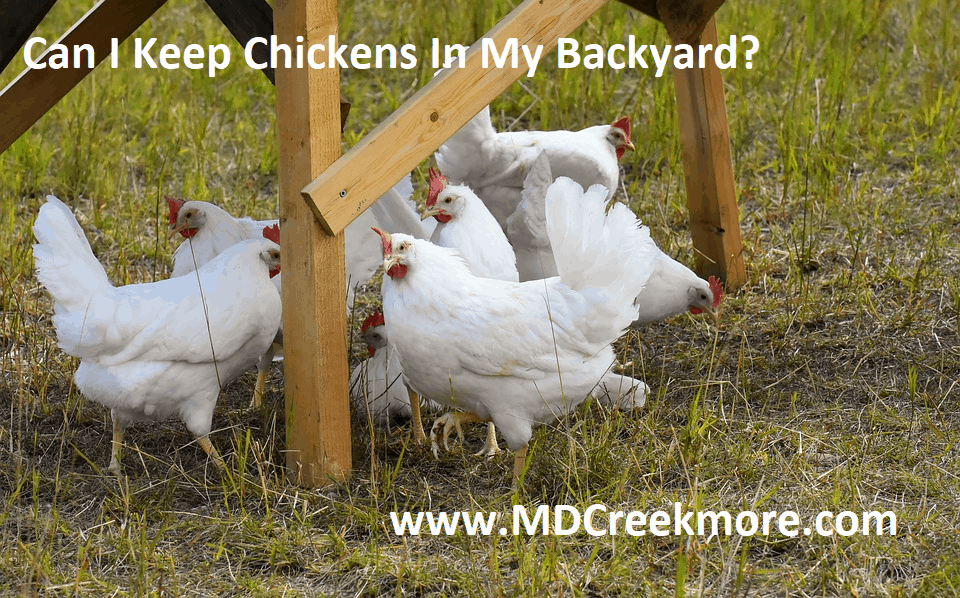
Can I Keep Chickens In My Backyard?

December 31, 2018 M.D. Creekmore

Can I Keep Chickens In My Backyard

by Nate Smith

If you have made the decision that you would like to try your hand at keeping some chickens in your backyard, there are a few considerations that you might want to make first, and although you have probably thought of some of these, there just might be a few that might come as a surprise.

Legality of Raising Backyard Chickens

Probably the very first question you should ask yourself about raising chickens is, can I raise chickens in my backyard?’ You know, legally. I know, I know. If you are slightly stubborn like I tend to be you are probably saying to yourself, ‘this is my property, so surely I can do whatever I want on it’! Am I right? If that thought crossed your mind, or anything at all along those lines, trust me, I know where you’re coming from. Here’s the deal.

If you live within the boundaries of a city as most (but not all) of us do, you will want to start out by getting info on whether or not you can even keep chickens in your backyard while staying within the confines of the law.

The last thing you want to do is to build or buy a chicken coop, purchase a few starter hens, buy some food, get the entire family excited about the adventure that lies ahead, only to have a bureaucrat pay you a visit and let you know (kindly or otherwise), that what you are doing against a city ordinance and that not only will you have to get rid of your new chicks, you will also have to pony up for a fine they’ve decided to hand you. What a slap in the face!

Basic Types of Zoning and Chickens

There are a few different types of zoning that exist, each one having different laws and regulations on what you will and what you will not be able to do. If your property happens to be zoned as agricultural, then you probably won’t have any problem raising chickens or constructing any type of chicken coop you might want to have. Most people reading this article will not fit that description, however, and will live on property that is probably zoned as residential.

Don’t let that discourage you in regards to chicken-raising, as many, many residential areas will allow people to raise a few chickens on their property. The best thing that you can do to make sure is to contact your city offices and simply ask them if there are any ordinances on raising chickens in your backyard, and what they are. You will find typically that there are two different areas of laws that will affect what you are able to do. First, there are often laws specific to the actual birds.

How many birds you are able to have on your property (it might depend on the size of your property), what sex they can be (roosters, anyone?), and in some cases, although not extremely common, you might even have to get written permission from your neighbors! I know, that last one sounds a bit strange.

You haven’t burned any bridges there, have you? The second set of laws have to do with the type of housing you use for your chickens. How large can your chicken coop be? Do you have to get a permit to build or even own a chicken coop in your backyard? Will this chicken coop need to be inspected?

I hope I haven’t scared you away from the idea of even wanting to start raising chickens in your backyard, and honestly I believe I have found some of the more extreme laws that you might want to, as your own city ordinance might include anything from having nearly no regulations at all, so maybe just one or two of these issues, which might not seem like much of a problem at all.

Remember, as you are going into this and inquiring about the local laws of your city just remember that joy of fresh eggs, chickens and the family experience is all very much worth it in the end!

A Personal Example on Chicken Keeping Laws

It has been a number years now that raising chickens in your backyard has been allowed here in my city. In regards to how many chickens can be kept here, a person can keep up to 12 chickens, depending on the size of your property.

Anywhere from house lots as small as 5,000 square feet keeping just two chickens, up to larger lots being allowed 12. There was a small public hearing where people were able to voice their opinions on the matter. For the most part, it was thought that people being able to raise chickens in their backyard was fine and that there wasn’t really any detriment at all.

Even public officials mentioned that when it came to complaints about chickens from neighbors (which were extremely rare as it is), the complaints were never about noise, and never about a smell (neither of those things seemed to be any problem at all).

The only complaints on file were for the occasional chicken getting loose, which was always promptly gathered and put back in its place. I’m sure we can all point to that neighbor of ours that would be the first to complain about the slightest inconvenience, or really anything at all.

Whatever the case may be where you live, make sure you have it on good authority that you are able to keep chickens before going out and finding chicks and a chicken coop. Don’t take the advice of a friend or a neighbor or a real estate agent even someone near you that might be raising chickens.

Sometimes when laws are passed that ban certain things, those who were practicing before the law came into effect are exempt from the new law; they are grandfathered in.

What if My City Does Not Allow Backyard Chickens?

If you find that your municipality does not allow raising chickens, don’t panic just yet. All might not be lost. The process of getting a simple law like this changed is often times much more simple than you might think.

You might be asked to attend a city council meeting to state your case, and often times that will be enough for the city to take a vote on the issue, and I think often times you will find that no one wants to be the lone councilman putting their foot down on people wanting to become more self-sustaining. Be patient on the matter as this process doesn’t usually happen overnight.

It can takes months for the ball to get rolling, but you can be a part of making great changes in your area if you stick with it. If you can find others in your area that back you on this issue and will be willing to work with you, even better.

Nate Smith has been homesteading and dealing with backyard chickens for a number of years. He encourages people who are looking to begin raising chickens to gather information first on the best breeds of chickens, types of chicken coops and requirements that go into raising backyard chickens.

Filed Under: Homesteading

What Are The Best Foods To Grow In A Survival Garden?

December 31, 2018 M.D. Creekmore

best foods to grow for survival

by Jason – www.theselfsufficientgardener.com

It’s generally considered blasphemy these days to be a survivalist and not garden.  Food is the most important survival consideration next to water for the survival minded.  It makes sense to be at least somewhat self-reliant when it comes to food production for you and your family.  In other words, if you don’t garden you should really consider starting.

For those of us who do mix gardening and prepping/survivalism, the perennial question waits:  What to grow?

Gardening prior to SHTF can be a challenge and doing so afterward will be even more of one.  Therefore I’ve devised a rating system for choosing the best vegetables for my garden if I have to rely upon it in an emergency situation.

On a rating scale of 1-5, I rate the following attributes for each crop.

*Reliability—How susceptible is the plant to disease and pests.  Can I count on production?

*Season—How often can the crop be grown?  Does it take long to produce or can multiple crops be grown in one year?

*Nutritional Value—Not only calorie count but also vitamins and minerals.  ATSHTF this will be critical!

*Sustainability—Can the crop be propagated year after year?  We won’t know how long a disaster will last in some cases.

*Storage—Feast or famine?  Eating great for a week won’t sustain a family.  How easy is the crop to store long term?

*Yield—No sense growing things that won’t produce.

*Stealth—If TSHTF, how vulnerable will my garden become?

Of course, everyone’s rating scale will be different.  You can even weigh some things heavier than others or disregard certain ones.  The important thing is that you think about this beforehand and put it to use.

As an example, I will rate three of my go-to crops if I had to survive on garden produce.

Beets

Reliability—4

Almost no pests eat beets.  They are slightly temperature sensitive for germination and initial growth so planting at the right time is crucial.

Season—3

Can be started early and grown late.  Germination, as I mentioned above, is the critical phase.

Nutritional Value—4

High in carbs/sugar.  The green tops can be cut and come again harvested and the root, of course, is very nutritious.

Sustainability—2

Does not produce seeds until it overwinters.  This makes seed saving difficult.

Storage—4

Excellent capabilities.  Beets will store great in a root cellar.  They can be stored in a small box full of sand for a long time.

Yield—3

The greens and the root can be eaten as I mentioned.

Stealth—4

Other than the burgundy color, beets and inconspicuous lying low to the ground.

Tally the numbers and I get 24 for beets—not bad.

Potatoes

Reliability—2

Several pests like potatoes and we can’t forget about the blight that caused the great famine in Ireland.

Season—2

Potatoes grow well in cold weather but the require a long growing season.

Nutritional Value—5

This veggie is off the charts in nutritional terms.

Sustainability—3

The tubers can be divided or even just a small chunk can be used to grow another plant.

Storage—5

Outstanding storage life.  Kept in a root cellar these will last quite a while.

Yield—5

Use a tire or tower setup and one plant can produce ungodly amounts.

Stealth—3

Potatoes don’t really have an obvious appearance for non-gardeners but they do get rather big in some cases.

So potatoes score high as well with a 25.

Amaranth

Reliability—4

Almost no pests or diseases to speak of effect amaranth.

Season—2

The growing season is somewhat long and limited to warmer times.

Nutritional Value—4

Very high in many vitamins, minerals, and amino acids.  Both the greens and the grains can be eaten.

Sustainability—5

Produces tons of seeds!

Storage—5

Though the greens do not store well at all, the grains will store almost indefinitely once dry.

Yield—4

Outstanding.

Stealth—1

Tall with bright flowers.  The only saving grace is that most people have never seen amaranth.

Amaranth scores a 25.

Just, for example, I’ll give you a crop that most gardeners love but I consider a poor choice for survival gardens.

Tomatoes

Reliability—2

Cutworms are a problem.  A disease is the real killer here.  Early and late blights combined with blossom end rot leave tomato harvests in doubt.

Season—2

Only grows in warmer weather and takes a while to produce.

Nutritional Value—4

Good nutritional profile.

Sustainability—3

The seeds are easy to harvest and store and are generally reliable but only if the plant makes it to production.

Storage—3

Tomatoes are horrible for storage.  The best bet is to harvest green and let them ripen on their own.

Yield—4

Good yields

Stealth—1

Everyone knows what a tomato plant looks like and bright red fruit does little to disguise it.

Tomatoes score a 19.

I hope this rating system has at least caused you to look at garden crops in a different way.  Its good to know how to grow a variety of things but it’s also good to know which we can rely on when it comes down to it.

Filed Under: Homesteading

Raising Livestock on a Small Piece of Property

December 24, 2018 M.D. Creekmore

goats-small-homestead

by Robbins

I have strived for the last 10 years to become more and more self-sufficient. This was not the result of any event or premonition. I had no inkling there was a prepper movement or survival community. It was just something in my DNA. I wanted the security and peace of knowing I was prepared.

I wanted to take care of my family if something were to happen that would interrupt our modern existence. I was very interested in how people existed on small homesteads in the ’30s and ’40s.  This led to my interest in raising and eating livestock on my small piece of property.

If our modern infrastructure were to become disrupted for 1-2 weeks our supply of animal protein would disappear. This means all canned tuna, ham, salmon, spam, beef stew, chili, roast beef w/ gravy, chicken, and turkey would be used up very quickly. The fish, chicken, and beef in our freezers would go first, then the canned meat products, and finally our long-term stores.

Our menus would change immediately. The ability to raise your own meat supply would be vital. The time to learn how to raise your own food is before you have to. The learning curve is steep and unforgiving.

The gestation period of the animal considered would be important. The number of births and days to maturity also. I would want an animal that can produce the most offspring reliably. It would help if it could accomplish this with little assistance. Can the animal feed itself? Does it compete for resources with you?

What type of workload does it generate for you?  Ideally, I would look for the highest gain with the least input.   Can it be butchered easily at home? Is the amount of meat at butchering a quantity that can be preserved in one day? Preserving meat without refrigeration would mean a race against time on butchering day.

How much land and fence is needed. Are you going to be able to manage its health yourself? These are all questions that I hope to answer below.

The animal I would promote for consideration is the modern sheep. Sheep are the oldest domesticated animal used for food. They have been raised by man for  7-9000 years. I have raised the Katadhin/Dorper breed for many years. I know that a lot of people don’t think they like sheep\lamb.

Usually, this is from a bad experience eating badly prepared lamb. Some can’t reconcile the image of eating a small adorable baby lamb. Some think it is too gamey. Let me explain.

The Lamb you buy at the grocer is by no means a benchmark for lamb palatability. They are usually from wool breeds of sheep which have a stronger taste. The katadhin\dorpers that I raise are hair sheep; they do not grow the thick wool coat that is so strongly associated with sheep.

They, in general, are much milder tasting than wool breeds. Also, the idea that you are eating a baby lamb is false. The sheep that you eat are butchered at 6-12 months. This is the age which they would begin to breed and weigh from 50 to 80 lbs.

One of the attributes I find desirable in the hair sheep I raise is, of course, the lack of wool. This means the sheep devote their nutritional intake to growing meat and making more sheep. No large woolen coat to trim. Their hair coat gets thicker in the winter and is shed in the spring.

This means less work for you, fewer parasites making a home out of the wool, and more heat resistance. These sheep will mature to around 125 lbs for a ewe and up to 200 lbs for a ram. The gestation period for sheep is an average of 150 days (5-months). This means you can have 3 lamb crops every 24 months.

These sheep have the ability to breed and lamb year round. While not all ewes in a flock will breed back as quickly as others I consistently have ewes that do with zero breeding management from me.

This means a mature ewe can put a lot of meat walking around in 2 years. I can count on mostly twins out of 1-year-old ewes, younger ewes will throw out single lambs, and I have triplets every year. This means lambs of all ages in your pasture year round. My small flock of 20 ewes lambed in January.

I culled and sold off all but the best 14 ewes in August. Three rams went to the butcher and in the freezer. Last week (8\20) I had a ewe drop a single lamb. It looks like a few more will lamb soon. These few lambs will mature in six months and either be retained for breeding, sold or butchered.

Now the great thing about having a flock of sheep is the MEAT. Walking, baa-ing Meat. If we enter into a SHTF situation these animals are going to be life-savers. A self-renewing resource of hi-protein and hi-energy food.

A flock of 1 ram and 3 mature ewes could generate between 0-6 lambs every 8- 12 months. (I include 0 because nothing is for sure, animals die, predators succeed, or you have a bad set of lambs or mother ewes) Let’s say we have a lambing success of 150%. That means you add 4.5 more animals to your flock each year.

You may save the best ewe to raise. This still leaves you with 3 or more sheep that can be added to your food supply. They will be happily grazing (gaining valuable size) until you need them. These animals will be easier to manage at butchering time weighing between 50 to 100 lbs and yielding 20 to 50 lbs of high-quality meat.

They could be staggered every 3 or four months to stretch out your food supply. If you were in a TEOTWAWKI situation you could smoke, can, salt cure, or jerky the meat. (You have been stockpiling non-iodized salt haven’t you?) In a grid down event meat will disappear quickly.

These animals will become very valuable. They may have to be locked up at night and only grazed under supervision or guard. As a self-perpetuating food supply, these animals can be a very important part of your long-term food plan.

A flock of 1 ram and 3 ewes could be raised on an acre and a half with good grass. It would work best to divide it into 3 equal 1\2 acre parcels and move the sheep every 2-3 weeks as the grass gets low. In the heart of winter, you may have to bring in some hay.

These sheep are parasite resistant. Keep the sheep moving from paddock to paddock to beat the parasite load that builds up when they stay to long in one place.

Stockpile wormer, preferably 2 different kinds. Worm them before they show signs of sickness. Be proactive. Sheep have a bad rap as looking for somewhere to die. This is far from the truth. They often don’t show signs of sickness until it is too far progressed to be successfully treated, and then you waste your time and wormer treating a dead sheep walking.

Make a schedule for checking your flock and stick to it. Be a smart shepherd and cull aggressively.

Only the best sheep should be retained. The Ram is 1\2 the herd’s genetics. Breed for parasite tolerance and good mothering. Don’t reward bad mother ewes or sickly sheep by keeping them in your flock.

Each winter I cut brambles and privet hedge and throw over the fence to supplement their food. They go insane for anything green in winter.  These hair sheep are browsers as well as grazers and will clean up brambles like goats do. Start small and remember to balance your number of animals to your amount of grass. They will multiply like credit card debt when you keep them healthy.

If sheep is not a fit for your situation, try rabbits, chickens, goats or ducks. All have short reproductive cycles and can be intensively managed. I like sheep because they eat grass and turn it into meat without a lot of labor from me. —good luck

Also Read:

  • Small Acreage Homesteading Guide
  • The Lost Ways Book Review

Filed Under: Homesteading

  • « Go to Previous Page
  • Page 1
  • Page 2
  • Page 3
  • Page 4
  • Page 5
  • Page 6
  • Go to Next Page »

Primary Sidebar

About the author

I’m M.D. Creekmore, and I’m all about simple living, financial freedom, and life here in Appalachia. I grew up poor in these mountains and built a life around doing more with less. Read more→

  • Amazon
  • Facebook
  • Substack
  • Twitter
  • YouTube

Subscribe to my newsletter

Join the thousands of readers who get it delivered free to their inboxes every week

“Do more with less.”

– Minimalist proverb

Secondary Sidebar

Read My Books

Paperback and Kindle

Footer

Recent Posts

  • Weather Update for My Corner of Appalachia
  • Why I’m Ordering Ivermectin + Mebendazole Every Year
  • The Website’s Shutting Down (But Here’s the Plan)
  • You Are Hated! Start Training Like It!
  • I don’t really give a damn anymore.

More about me

Books I’ve written

Books I’ve read

Follow Me on YouTube

Follow Me on Facebook

Gear I Use and Recommend

Newsletter

Search this site

Follow me elsewhere

  • Amazon
  • Facebook
  • Substack
  • Twitter
  • YouTube

© 2008–2025 M.D. Creekmore · As an Amazon Associate, I earn from qualifying purchases.

  • Blog
  • Books
  • Newsletter
  • Gear I Use
  • About
  • Contact
  • Privacy Policy