• Skip to main content
  • Skip to secondary navigation
  • Skip to primary sidebar
  • Skip to footer

M.D. CREEKMORE

  • Blog
  • Books
  • Newsletter
  • Gear I Use
  • About
  • Contact
  • Facebook
  • YouTube
  • Blog
  • Books
  • Newsletter
  • Gear I Use
  • About
  • Contact
  • Privacy Policy
You are here: Home / 2018 / Archives for December 2018

Archives for December 2018

Methods of Purifying Water That Are Simple, Effective, and Inexpensive

December 14, 2018 M.D. Creekmore

Methods of Purifying Water That Are simple, Effective, and Inexpensive

by Donald Thompson – Emergency Management Specialist

What I would like to touch on here today is Water Treatment. I know that for some, it would be hard for me to teach you something new on this subject. But this particular aspect I have not seen addressed anywhere else.

First, let’s just say it’s been a bad day in Muddville, and whatever nasty situation you are planning for has unfortunately happened. Now you find yourself and your family in the position of bugging out. There may or may not be some others with you.

You may or may not link up with others for that safety in numbers thing. At this time your most pressing problem will be, how will you provide enough drinkable water for your journey? Your journey will have you on the road long enough that it is not possible for you to even attempt to try and carry an adequate amount. Stop and think a moment, how will you approach this problem?

To set the stage here are a few key points so that we are all on the same sheet of music.

A widely accepted way to purify water is to use unscented household Bleach, such as Clorox. Just be sure that it has no scents or additives. Here is the simple formula to use the Bleach.

Water purification – 8 drops (1/8tsp) per gallon/4 liters.  Let stand for 20 minutes, retreat if water does not smell of Chlorine.  Only do this twice (a total of 16 drops). Now, this part is important to remember. Bleach does have some problems – it has a limited shelf life (6 months to 2 years depending on who you ask).  It’s also messy and nasty to clean up if spilled.

We understand that the short shelf life of bleach poses a problem when packing a GOOD bag. So that being said another more economical solution is to use “Pool Shock” a common ingredient to make pools safe to swim in. It is available from any pool care store online or in your town depending on your environment.  Make sure that Calcium Hypochlorite is the only active ingredient in the product and at 65% or greater, (Note: You will not be able to find this concentration at Wally-World, you will need to go to a pool supply store) with no added anti-fungal’s, or clarifiers, if not you can seriously endanger you and your family.

You mix 1 heaping Teaspoon, about ¼ ounce into two gallons of water. The mixture will produce a Stock Chlorine Solution of approximately 500 mg/L, since the Calcium Hypochlorite has an available chlorine equal to 65 percent of its weight. You just made a form of Bleach, and with that you can use this bleach solution to treat water at 1 part per 100 parts water, roughly 2.5 tablespoons per gallon of water.

This Stock Solution will also have a shelf life so don’t mix it up until you need it. As for the dry C-H I do not know what the shelf life of this is. All I can say is that in all of my research I have not seen or heard of a limited lifespan. For me the basic rules apply here, Keep it sealed tight, Keep it in the dark, and Don’t play with temperature fluctuations. This should at the least, last many years. If someone knows the actual lifespan, please let me know. I would appreciate it greatly.

But then you all knew this, so let’s see if I can walk you down a bit of a different path.

We know that the basic formula of 1 teaspoon of Calcium Hypochlorite will make 2 gallons of a stock solution, which then treats 200 gallons of water. This is a 1:100 ratio. But then my DW asked the show-stopping question. “Do you have a 2 gallon and a 200-gallon container”? With a dumbfounded look and a rather sheepish “I’ll get back to you on that” I realized I had a problem to solve. How will I measure out a 1:100 batch of safe water?

Who really, does have these kinds of containers to use this treatment option? And how would we do this if we were out on foot. My best guess is not too many. I set about figuring out how to break down the containers of solution into manageable amounts.

But even using a small readily available container meant that I had to accurately measure out 1 unit of the stock solution and then 100 units of water to accurately make the 1:100 ratios. There had to be a better way!

And then I had my AHA moment. Now follow me on this, and you will see the method to my madness.

If 1tsp. to 2 gallons of water makes a 1:100 stock solution, (this treats 200 gallons of water)

Then that same 1tsp. to only 1 gallon of water makes a 1:200 stock solution, (this still treats 200 gallons of water) only the concentration is doubled.

With me so far?  Good.

  • Then 1tsp. to ½ gallon of water makes a 1:400 stock solution, (this also treats 200 gallons of water)
  • Then 1tsp to 1qt. of water makes a 1:800 stock solution, (this treats 200 gallons of water)
  • And finally 1tsp, to 16oz. (a pop bottle) of water makes a 1:1600 stock solution (this still treats 200 gallons of water).

Remember:

The 1tsp of Calcium Hypochlorite treats 200 gallons of water no matter what concentration you decide to make.

OK, that was a bit much. I hope you are still with me because I am going to add in another factor.

This is the second part you need to know. Copy this down it is important. “1oz. of water is made up of 596 drops”.

That 1 oz. of water equaling 596 drops is a key element of this concept. So let’s carry this out a few steps. By the power of deduction (all that Sherlock Holmes holds dear), we also know that 2oz of water = 1,192 drops of water, and 3oz. of water = 1,788 drops. I’m gonna stop here as 3oz. makes my point.

Did you notice that 1 drop of the 1:1600 stock solution (1 drop treats 1600 drops) will treat just less than 3oz.? Good. Now let’s move along and jump to16 oz. 16oz. x 596 = 9,536 drops, divide this by 1600 and you can see that it will take 5.96 (go ahead and round it up to 6) drops to treat a 16oz bottle of water.

So if 6 drops treat 16oz., then 12 drops must treat 1qt., and 24 drops will treat 2qts. and 48 drops will treat 1 gallon of water. It took a few minutes for the full impact of this to register on me. 48 Drops treat a gallon. I can count to 48 in my sleep. (Do I get an AHA?)

Now if you are as intuitive as I believe you are, you would have seen all of these little golden gems?

  1. All of these size bottles will be laying everywhere.
  2. Anyone can easily carry 16 oz. of Stock Solution.
  3. You can now mix up a batch of treated water to fill the size of container you have.
  4. If you are on the move you can make enough water for your daily needs. And be able to carry it.
  5. You can carry only the amount you will need for the day. If water is plentiful.
  6. You can afford to share with your fellow travelers. (This will earn you near God Like status.)
  7. You could even mix up and hand out 16oz bottles of stock solution to others.

That one bottle can make many, many more, on an as-needed basis. Yes, that 16oz bottle of stock solution means you are carrying 200 potential gallons of safe drinking water.

This revelation sure did take a burden off of my shoulders, both physically and mentally. And it works in both bug out and or hunker down scenarios. I see this as a fairly easy way to address all of my water needs, especially when I have to be on the move.

Find yourself a way to package up a few individual Teaspoons of this, and you will be able to carry potentially thousands of gallons of drinkable water when you needed it.  And all you will need in addition to a few pop bottles is an Eye Dropper.

I have been working on this for a while so it took me a while to come up with this (OK, I got it from someone else). Here is where I need to add in an afterthought. It has to do with fixing up additional packages of 1 tsp. (heaping) of the Calcium Hypochlorite.

Pinch the end of a common plastic straw leaving about an 1/8” (I find that a needle nose pliers works best). With a lighter melt that 1/8” so that it seals up the end. 1 tsp. of the Calcium Hypochlorite will nearly fill the body of the straw. For me using a powder funnel for reloading seems to work pretty good.

Now with the pliers just snug up to the C-H, trim off the excess straw leaving 1/8” and melt this end also. WAL-LA.  200 Gallons to go. Ten of these straws can easily fit into a standard 16oz. COKE bottle.

They will just sit there waiting for their moment to shine. Ten straws, that’s 2,000 gallons in your pack. This is not just a good way to store and carry the Calcium Hypochlorite. It also makes it an easy way to dispense a life-saving commodity. Just think of the good you can do with a handful of these straws.

Oh and one last point. I like to use the regular Coke bottle with the RED cap to hold my stock solution. The red of course signifies Danger. Diet Coke bottles (or any other without a red cap) will hold the water that I can drink.

Additional good information-CDC recommends a fresh 1:10 to 1:100 solution for cleaning up blood spills.
FEMA recommends 8oz of bleach to 5 gallons of water for killing mold and 4 oz. to 5 gallons for disinfecting flood-contaminated articles:
(That’s 125ml / 20liters and 250ml / 20 liters for you metric folks).

Here is the mixing chart again in case you want to print out labels for instruction.

  • 1Tsp. to 2 Gal. of water makes a stock solution that treats 200 Gal., at a 1:100 ratio.
  • 1Tsp. to 1 Gal. of water makes a stock solution that treats 200 Gal., at a 1:200 ratio.
  • 1Tsp. to 1/2 Gal. of water makes a stock solution that treats 200 Gal., at a 1:400 ratio.
  • 1Tsp. to 1 Qt. of water makes a stock solution that treats 200 Gal., at a 1:800 ratio.

1Tsp. to 16 oz. of water makes a stock solution that treats 200 Gal., at a 1:1600 ratio.  1 oz. = 596 Drops.  If 1 drop of stock solution (1:1600 ratio) treats 1600 drops and 1 oz. = 596 drops, then 1 drop of solution treats just under 3 oz. (1788 drops) or 2.68 oz.  If 16 oz. = 9,536 drops divide by 1600, then 5.96 (go ahead and round it up to 6) drops will treat a 16oz. pop bottle of water, then 12 drops will treat a Qt., and 24 drops will treat 2 liter’s., and 48 drops will treat a Gal..

For me, this is a doable solution to a problem that has been eating at me.

I hope in a small way this helps to add a bit to the collective knowledge. I also hope it starts to pay back some of what I have received from all of you.

Thanks for your time, and as Red Skelton would say “MAY GOD BLESS”.

THE OXY-MORON

Filed Under: Prepping

Ten Ways to Keep Your Campsite Clean (and why you should)

December 14, 2018 M.D. Creekmore

how to keep your campsite clean

by Estar H

If you are prepping packs or vehicles to bug out, where are you planning to go? Will you seek refuge in a rural area, maybe even in the wilderness? Whether you retreat to a fully stocked off-the-grid hideaway, set up camp on private acreage, or wing it on public lands, everyone in your circle should be committed to keeping the area clean and safe. Your methods will vary according to location and duration.

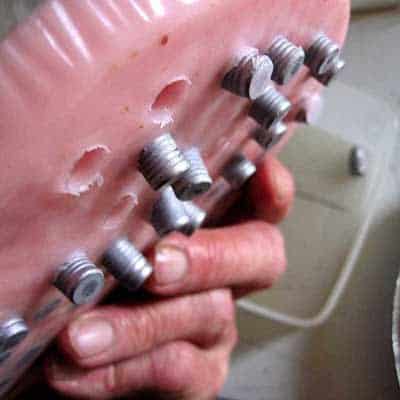
This article focuses on activities related to eating. Thoughtfully managing the food cycle will deter pests, preserve the food supply, and help you keep a low profile. Failing to keep your area clean may wreak havoc in the camp, especially if you attract a bear. Then you could end up with a hole like the one in the accompanying photo in your camp.

When living in the wild there are no guarantees. But here are 10 things I do that usually work.

  1. Pack all food in solid metal or plastic containers with tight-fitting lids.

Start collecting containers of various sizes and storing food in them now. When you arrive at your destination, stash these containers in a secure area. This could be a cabin, cellar, vehicle, cache box, or a sack hung high in a tree.

  1. Don’t bring food in cardboard or paper containers.

It always amazes me when people bring sacks of sugar and flour to camp in the wilds. Such containers are easily chewed and clawed through. When they get wet you’ll have a mess on your hands. No boxes of crackers, mac, and cheese, or cookies in paper wrappers. Your food won’t be safe in cellophane or Styrofoam either.

  1. Leave plastic bags in civilization

Ziplock plastic bags can be washed out with soap and hot water and remain useful for a while. It’s nice that they’re waterproof, but they tend to retain food odors. They also fall apart. It’s better to bring containers that will last a long time. Besides, plastic is out of place in the wild.

  1. Don’t bring sweet condiments into nature

You may yearn to satisfy your sweet tooth, but so do all sorts of critters, from ants and Yellow Jackets to bears. Bring dried fruits and berries in canisters. Leave sweet sauces, syrups, and condiments behind. Pack hard candy sparingly. Nobody wants to suffer through an extended emergency with cavities.

  1. Clean up your food scraps

If you are fortunate to have any fresh fruits and vegetables there will be food scraps to deal with. If you are near a working compost pile, put your vegetable and fruit scraps there. It helps to cut them into small pieces. In a remote undeveloped area, rather than try to start a compost pile, the best bet is to bury those scraps a safe distance from camp.

Thoroughly dispose of meat and fish scraps, fats, and bones you don’t use. The most efficient way is to burn them. If you are trying to lay low, however, a fire will disclose your location. Rocket stoves are efficient and cause much less smoke, so check them out.

  1. Clear your plate

Like mom’s of old said, “Clear your plate!”. Leftovers are a liability where there is no refrigerator or ice, and they will attract animals in the wilderness. Before you head for the hills, practice cooking only as much as can be consumed in one meal. Train everybody you plan to retreat with to clear their plates.

  1. Washing the dishes

This is where you will be really glad to be camped near water. If you have a fire, wash and rinse dishes in water that is as hot as you can bear. Items used closest to the mouth get washed and rinsed first, in descending order.

What about soap? You may be intending to bring a stash, then make some as time goes by. Some folks like to use baking soda instead. Bicarbonate of soda offers an advantage in that it is versatile. In addition to washing dishes, it can be used as an anti-acid, toothpaste, foot powder, ant deterrent, and more.

For safety sake, assume all surface water contains something that can make you sick. It’s good to bring the water to a boil. This becomes a problem when fuel is scarce. Maybe you only have enough to boil the rinse water. If not, you will have to use cold water. Shake the excess off the dishes and, if there is sun, lay them in it to dry.

If you’re purifying potable water, decide whether you have enough to give implements destined for mouths a final rinse. Don’t worry so much about the pots and pans because high temperatures kill most pathogens. Rainwater is handy, but not ideal due to atmospheric pollution.

Did you bring food in tin cans? These will have to be washed out. Be really careful not to cut your fingers on the sharp edges. Take extra care with cans that contained fish because the strong odor will likely attract critters. Cleaning cans that contained fish packed in oil requires more hot water and soap than those canned in water. Fill used cans with water immediately so they can soak before getting crusty.

You may be tempted to flush waste away by simply discarding it into moving water. It’s not a healthy or aesthetic practice, especially if a lot of people are doing it.

  1. Bury the garbage

Limit the amount of garbage you bring with you. For example, what will you do with the cans once they’re clean? They will either pile up or you will have to bury them. (This goes for all your trash). If you think you can bury cans without cleaning them, you’d better dig down at least a good three feet if your hole is near camp.
The picture accompanying this article was taken the morning after a bear visited one of my camps. Some leftovers a fellow camper had buried about a foot in the ground attracted the bear. The hole is about 18 inches down.

  1. Managing the gray water

Gray water is what you get when you wash things, including yourself. During a SHTF scenario, gray water may no longer be flushed away through pipes. You’re going to have to collect it and do something with it.

If you will be stationary for a season, you might plant seeds. If water is scarce, you may consider applying gray water to the plants. Check out the pros and cons at oasisdesign.net. Does your gray water contain little scraps of food or oils? Think about insects and animals that may be attracted to it.

  1. What goes down must come out

Your destination probably won’t include toilet facilities managed by authorities. Therefore, you will have to take responsibility for your own excrement.

A preplanned refuge should include a composting system or outhouse. If you are escaping in an RV, better not rely on its toilet in case the emergency doesn’t pass before the collection tank is full. The same goes for chemical camping toilets that will have to be emptied somewhere.

On undeveloped acreage, you will either have to relieve yourself in small holes that are covered after each use, or you might dig a latrine, which you may prefer when bad weather hits. A tarp can be strung over the pit to get out of the weather and for privacy. In some cases, it may be practical to build a hut over the hole. Each deposit in the pit should also be covered after use. Ashes make an excellent covering that eliminates odor and flies. Just make sure any coals are cold. If your pit is at a temporary remote camp, fill it with dirt and restore ground cover before moving on.

If you flee to an undeveloped area in winter, with snow and frozen ground, hole digging will be severely limited. If you have a bonfire, burn things that will be completely consumed. Don’t leave half burned garbage lying around on the ground. When the fire is out, you may be able to dig there. If you have to store trash until spring, remove all food residues. Do everything in your power now to arrange for a safe and comfortable place to hole up, in case winter retreat becomes necessary.

Each person should consider it his or her responsibility to maintain a clean camp. Methods will vary according to location and circumstance. One thing is certain: strategies for keeping the camp clean are a crucial part of any bug out plan.

Filed Under: Bushcraft

How To Cast Your Own Bullets – A Step-By-Step Guide

December 13, 2018 M.D. Creekmore

How to cast your own bulletsby Jim Shy Wolf

Before we begin, we’ve got to lay down the rules. First, this is a potentially very dangerous activity. The least that can occur is mild burns, progressing to severe burns and culminating in burning down your home or shop. It is mandatory every safety rule is followed- both those of the tool-maker and common sense. Fools will suffer their foolishness: don’t be a fool. Wear safety glasses at all times. If you can manipulate tools wearing gloves, so much the better- wear them.

Also, my experience is that of having been doing this since 1975, without any training other than reading and experience. I am not- repeat: not- a professional nor do I claim to be doing all procedures correctly, only as they’ve worked for me over the years.

With that out-of-the-way, should you decide to engage in this activity, do so at your own risk. I lay no claim nor desire to claim ownership of your errors, foolishness or injuries incurred. We are a Free People, let us act thusly.

We’ve been reading post after post of ‘What’s the best gun I can get for my buck?’ And every person with a weapon has put in their two cents.

We’ve brought those shiny new weapons home and looked at the box and fondled the gun, anxious to get to the range and fire off a few bazillion rounds of bullseyes. So we grab that expensive box of XXX Guaranteed Bullseye rounds and head to the range.

Unless we’re the well-heeled type, after a few boxes we start to realize how spendy this little game is becoming. But we love shooting and begin to wonder if there are ways to cut those costs so we can keep shooting and having fun.

Hark! We can hear the glass shattering as the light breaks ‘pon yon window…

We Can Reload!

Reloading can take many forms with many different tools, but all lead to the same point: a bullet down the barrel headed down range. What we’ll be doing from here on is making our own Guaranteed Bullseye rounds from the ground up. (OK: I’m going to renege on the ‘guaranteed bullseye’ bit since I have no control over another’s quality control. But we’ll get that led down the barrel.) And we’re going to do it from the beginning, starting with making our own bullets.

Required tools are going to be minimal and not very expensive even with today’s weak dollar. As you’ll notice, all my tools are Lee brand. No particular reason other than those are what was available when I wanted the tool. I have no experience with and will make no comment about another maker’s tools because I think such arguments are no more valid than the 9mm vs. .45 arguments. If anyone is interested in pricing Lee products they can go to www.leeprecision.com and peruse the catalog. Otherwise, I will make no claim to usefulness for any particular purpose you intend putting the tool to.

When it comes to doing or learning something, I’m about as low as a human can get on the mental ladder. Which means, if I can do something, I’m absolutely positive there is no one else in the world who cannot do the same thing. So don’t think you’re incapable of learning or that it’s too difficult. Also, think of all we have in today’s world and consider the people who invented it. Really, Folks- cavemen invented the bow and arrow, so how hard can things be to learn? You can do it, be sure of that. After all, it ain’t brain surgery or rocket science. Now, let’s make some bullets…

It takes a very secure man to paint his cave pink… oh, wait- sorry, we’re not painting…(sorry: Honey was nudging me)… but you’re going to get burnt and those burns will be pink, then white, then red. And they’re going to hurt! So be very careful: don’t listen to MSM news, the Tv, Glenn Beck, Rush Limbaugh or especially BSHO while working.

Follow manufacturers’ directions for all tools and keep a fire extinguisher handy. A gel burn-blanket won’t be a bad idea, either.

What We Need…

Our tools will be minimalist: just enough to get the job done well at low-cost and super efficiency.

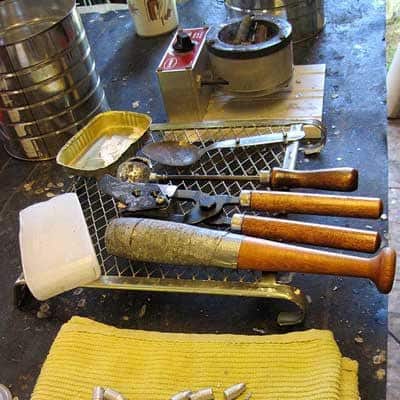
Note the picture above: from the bottom left and going up, you will see a towel. This is what we will drop our molded bullets onto. Some people like a pail of cold water, which also helps make the bullet a little harder.

We will need a slice of wax- any kind will do, I use paraffin. We will use this to flux our lead before molding. Later we’ll use it to make a lubricant.

Besides the wax is a bung stick for working the mold’s sprue bar and to tap the bullet(s) free if needed. Do not use a hammer or metal to beat on your molds.

Next is the bullet mold. This is a two cavity 158-grain Lead Round Nose (LRN) .357 mold. Beside that is the ladle. This is what we dip the lead with to pour into the mold.

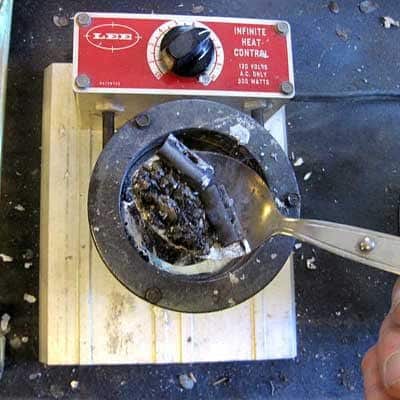
Next is a spoon: don’t use your eating utensils for working with bullets. We don’t want to ingest lead particulate. Use dedicated tools for this and all reloading. The spoon is used to load lead into the pot rather than dropping with our fingers. The pot gets very hot and lead can splash. We don’t want accidents.

Finally, the melting pot. Mine will hold two pounds of lead, which gives me about 75 finished bullets of this size.

To make my bullets, I use lead wheel weights, ‘found’ bullets from the range, and lead ingots. Wheel weights are getting more difficult to find since recycling is so rewarding. When the fed made lead shot illegal for ducks, I suddenly found myself in possession of a ton of lead shot- perfect for making cast boolits. (OK, not a ton, but a couple hundred pounds.

If/when TSHTF, some of this shot will go back into shotgun cases.) You can see the dross in the spoon: wheel weight anchors, sand, copper, steel- anything that is foreign to lead will float to the surface to be scooped off before we flux with wax.

casting bullets made easy

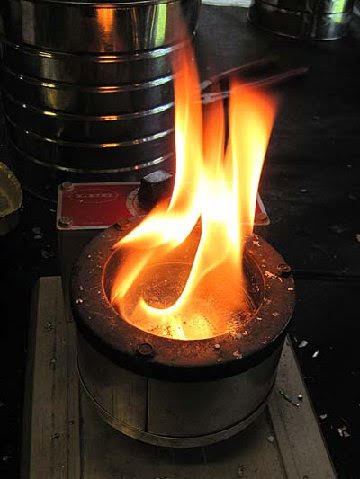
Fluxing is taking a thumbnail size piece of wax and dropping it onto the molten lead. Be very cautious here- this will most likely flare up. If your body parts are in the way, you will be burned. Wait for the smoke to clear, then with the spoon, gently scoop the black/dark gray scum from the surface of the melt. Our lead is now ready to be used.

Our ladle/dipper and mold will have to be heated. I use one of two methods, depending on my mood and how antsy I am to get started. The recommended way is to set the ladle in the pot and rest a corner of the mold into the melted lead. If I’m in a hurry, I open the sprue cutter and pour a ladle of melt into the cavities, dump them, and repeat five or six times. You’ll know the mold is hot enough when the bullets come out uniformly neat, with no folds or vacancies in the finished bullet.

As stated earlier, I drop the bullets from the mold onto a folded towel. Since the bullet is still very hot and soft, I have to be careful to not drop them onto each other: they will deform, sometimes badly. Once the molds reach maximum temperature, even dropping from too much height will imprint the towel pattern onto the bullet, so we have to be careful.

A note here about my bullets: these are for the .357 revolver and rifle. I’m not overly concerned with ‘¼ MOA’ results for either of these, just good, acceptable accuracy. Two to three inches at 100 yards is sufficient for my desires. For the LR rifles- .243, .308, 30-06- I don’t cast bullets, I buy them. Reason being, with those calibers I am very interested in ¼ MOA accuracy (though I don’t achieve it often). I can’t make as good a bullet for those calibers as I can buy. Perhaps one day, when the pockets are overflowing…

Once we’ve reached our goal on the number to be molded, turn off the melting pot, set the tools on a fireproof pad and dig out the bullet lube.

The WUT?

Cast bullets shot from modern firearms reach some very hot and fast velocities. As a result, as the bullet goes down the barrel, it leaves small deposits of lead on the lands and grooves. This results in poor accuracy and can lead to barrel damage if unchecked by cleaning and using a lubed bullet. Anyone who has handled .22 bullets knows about the lubricant on them. A greasy, wax type something that… well, is sticky. Bullet lubricant.

Lubes can be bought- Lee sells Alox bullet lubricant, which is supposed to be really good. Others sell their brand and all are probably really good. If anyone has questions on which is better, ask around the gunny sites and you’ll get enough answers to confuse you more.

Since I’m the kind of guy that Honey says is ‘cheap’ because I think spending more than five bucks on a gift for a kid we don’t know is a bit much, I make my own for pennies and save the bucks for other things. Like primers.

To make my cowboy type lubricant, I melt one block (a one pound brick of paraffin is comprised of four blocks) of paraffin in a double boiler. With this is a small 3.75 or 4-ounce jar of Vaseline petroleum jelly. Stir and blend (they’re grease, they’ll blend themselves, really), remove from heat and add about ¼ cup of Marvel Mystery Oil and blend in. No more than a quarter cup or you’ll get a mess. Of course, you could add more paraffin and Vaseline to smooth things out… but why? This quarter pound batch is going to last a long time.

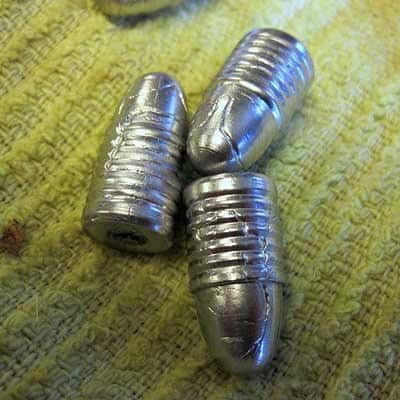
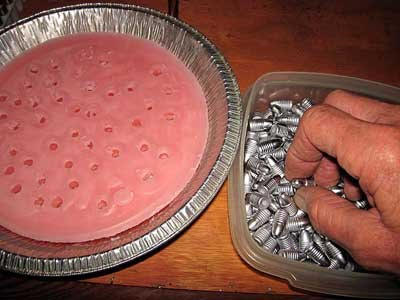
Using aluminum pie tins (‘cuz they’re cheap and everyone has a few), stand about 30-40 bullets nose up and pour enough lube in to cover the lubricant grooves. (Those are the ‘rings’ you see on the bullets.) Don’t go past these- it’s not needed above the groove and just a waste. Once covered, put the tin in a freezer until the lubricant hardens enough to pull itself easily away from the tin.

Once free of the tin, just push the bullet nose until it goes out the bottom side of the lube plate. All done. Now rinse and repeat for the next batch – and this time, you have holes pre-punched to put the bullets in before liquefying the lube and freezing again. Rinse and repeat… until you’re done.

Up next: Putting all this fun together with more fun before the real fun begins.

Filed Under: Uncategorized

Best Survival/Hiking Water Filter

December 13, 2018 M.D. Creekmore

Review of the Katadyn Vario Water Filter

by Dean C

A few months back, I had sold a few things of value and used that money to buy a Katadyn Vario water filter (click here to check availability and the current price at Amazon.com).  Since water is so important, and the items I sold had no real value to prepping, it was an easy decision.

I had been wanting a portable water filter for some time.  The Vario meets industry standards for reducing bacteria at 99.9999% efficiency, and protozoan cysts at 99.9%.  Now I’m not going to pretend I know much about these little buggies, I just know we don’t want em’.  I wanted to end up with a Katadyn due to company reputation, and that of Swiss-made products in general.  Thus far, I am quite pleased with the purchase.

Review of the Katadyn Vario Water Filter

The Vario is very lightweight and very easy to use.  Disassembly and reassembly for cleaning and filter cartridge replacement are very simple.  The main body of the filter breaks down into six main parts, and there are also the intake and output hoses.  At all critical breakdown points, there are o ring gaskets to help maintain the integrity of the filter.

Katadyn was also kind enough to include an extra set of o rings for replacement purposes, as well as a small tube of lubricant, and a small scouring pad for cleaning.

The Vario is the first microfilter with two different filtering modes, “longer life” and “faster flow”.  In longer life mode, water flows through a ceramic pre-filter disc before passing through the carbon core filter cartridge.  Faster flow mode bypasses the ceramic pre-filter and flows straight to the carbon cartridge, allowing a higher output rate.

It is recommended that faster flow mode only be used when water is already relatively clear.

Review of the Katadyn Vario Water Filter

Switching from one mode to another is as easy as taking the top housing off, turning the ceramic disc to line up with clearly indicated points, and replacing the top housing.  As with most filters, the ceramic pre-filter disc, the filter cartridge, and the carbon within the cartridge are all independently replaceable.  This will allow you to extend the life of the overall filter system.

At the end of the two feet of intake hose, there is a small strainer to keep large debris from getting into the pump assembly.  There is also a small weight to keep the hose in the water, and a small float to keep the strainer off the bottom of the pond/stream etc.. In murky or heavy sediment water, to extend cartridge life, it is recommended to wrap a coffee filter around the intake strainer and weight.

When possible, you could also put murky water in a bucket and wait for the sediment to settle before filtering.  The output hose will feed into whatever, or you can remove the bottom cap and the Vario will fit onto the tops of most standard sized water bottles.

Review of the Katadyn Vario Water Filter

The Vario retails for $89-$99 depending on where you get it.  The cartridges are good for 500 gallons, easily replaceable and retail for about $40.  Also, when water taste starts to decline, the carbon inside the cartridge can be easily replaced, and those pouches of carbon run about $12.

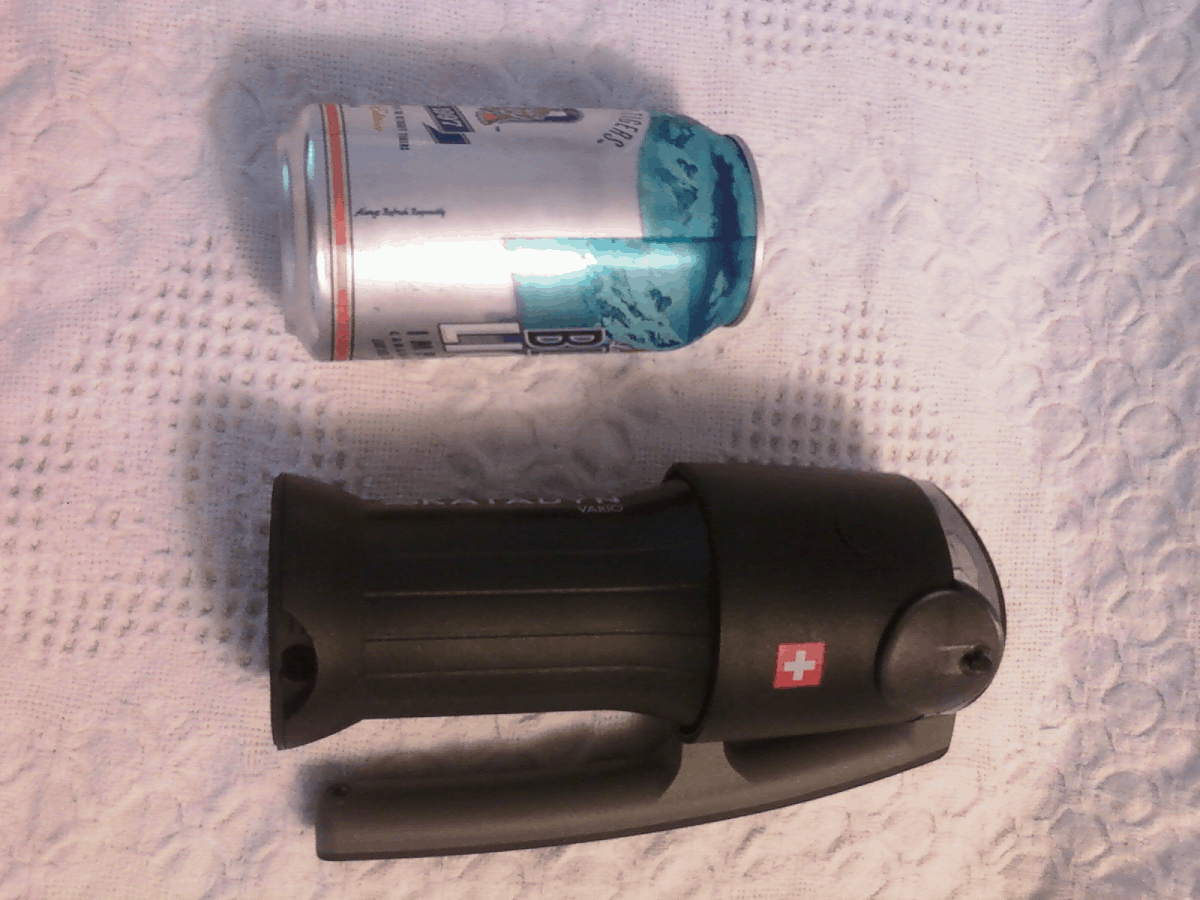
Now we all know that when TSHTF, water is going to be one of the most crucial factors to our survival, and we can only store so much.  Portability and affordability were my two deciding factors.  Yeah, it would be great to have a Big Berky, but in a bug out, it isn’t going to fit in a backpack.  The Vario, being two inches larger than a full can of beer, and weighing slightly less, leaves plenty of room in the backpack.

I’m very happy with the Vario, so cheers to clean water,(and the beer if you’re so inclined.)

Click here to check availability and the current price at Amazon.com

Filed Under: Gear Reviews

Prepper Food Storage Ideas… Wheat and Gluten Sensitivity

December 13, 2018 M.D. Creekmore

by Michele O

Wheat is the backbone of most long-term storage and bread made from wheat the “staff of life”.  After all, 3000 – 4000-year-old wheat found in pyramids was able to sprout, and it’s not exactly frigid in Egypt.  Now that is some long-term storage.

But what happens to you or a family member who discovers they have either a wheat or gluten allergy, or intolerance?  Most people think that an allergic reaction is the typical hives, runny nose, all the way to life-threatening anaphylactic shock, but there are many others.

Other lesser known symptoms of wheat and or gluten sensitivity include stomach upset, bloating, abdominal discomfort, pain or diarrhea; or it may present with a variety of extra-intestinal symptoms including eczema, allergic rhinitis, bronchospasm (asthma-like symptoms) headaches, and migraines, lethargy and tiredness, attention-deficit disorder and hyperactivity, schizophrenia, muscular disturbances as well as bone and joint pain.

I personally get fibromyalgia from accidentally ingesting even tiny amounts of wheat.  Sometimes, allergies SUDDENLY manifest after eating something without any difficulties your whole life.

Doctors and scientists now believe that 10% of the general population is has a gluten sensitivity, and that does not include strictly wheat allergy/intolerance.

For me personally, sprouting the wheat takes care of my problem – but I have to make sure EVERY SINGLE grain is sprouted.  Even one or two now sprouted causes me several days in incredible pain.  However, for someone with an undiagnosed celiac sprue (gluten allergy) or gluten intolerance, sprouting will probably not help.  Sprouting may make wheat more tolerable for some, but does NOT get rid of the gluten.

Sprouted glutinous grains (wheat, rye, barley, and contaminated oats) still have the protein gluten present. Sprouting begins some enzymatic breakdown of the protein and for those who are not gluten intolerant but merely have difficulty digesting certain grains, sprouting can make that process of digestion easier.  For these people eating sprouted grains/bread may alleviate some of the symptoms, they get from eating non-sprouted regular bread.

Again, in NO WAY does sprouting eliminate gluten from the grain and these sprouted grains are NOT SAFE for anyone with gluten intolerance – celiac nor gluten sensitivity.

For those people who are, or become allergic/intolerant to gluten, eating wheat as a daily staple will cause life to be unbearable and may result in death.  So, what can you do?  Well, I personally store many other grains, such as Milo (sorghum), rice, tapioca, teff, corn, amaranth, quinoa (both amaranth and quinoa are complete proteins), buckwheat (which is not related to wheat at all) – AND YOU SHOULD TOO.

I buy Milo at the feed store in 50 lb bags, just as I do wheat (I’m prepping for 30 people, and none of the rest of them have a wheat allergy that I’m aware of).   Also, consider using some of your non-gluten food grains as seed (although NEVER eat grain that is specifically seed grain – it sometimes has additives that might not be good for you).

Milo/grain sorghum is an easy to grow grain, and both wet and drought resistant.  You will get slightly better yields watering it occasionally, but for drought areas, this is a good crop to grow to sustain your family if a SHTF scenario goes on longer than a year or two (and at that point in time, probably 80% of the population will be dead, so you’ll have a bit more room to grow grain in).  The leaves and stalks can be fed to your animals too – no waste.

Buckwheat is both a grain (strong flavored) and green manure.  If growing it for green manure, early spring or summer is fine, but it doesn’t set grain well in high heat so for grain production, it should be planted in the late summer/early fall so that the grain has time to mature – maybe 11-12 weeks before the first frost.

THE BENEFITS OF SPROUTING GRAINS

As the grain germinates, enzyme inhibitors are disabled, and water-soluble vitamins such as B complex and vitamin C are created, fats and carbohydrates are converted into simple sugars. When examining the nutrient density of sprouted wheat to un-sprouted wheat on a calorie-per-calorie basis, you’ll find that sprouted wheat contains four times the amount of niacin and nearly twice the amount of vitamin B6 and folate.  Folate (folic acid) is VERY IMPORTANT for women of childbearing age, as folic acid in the diet (even before pregnancy) prevents spina bifida.

Moreover, sprouted grains generally contain more protein and fewer starches than non-sprouted grain. Another plus is that it is lower on the glycemic index making it more suitable for those suffering from blood sugar issues and diabetes. Sprouted grains, seeds and nuts also encourage the growth of good bacteria, known as pro-biotics, which help to keep the colon clean, and are high in protective antioxidants.

Flourless bread (and cakes!) are made with grains and legumes that are sprouted before grinding. The sprouted grains used most often for these flourless breads include wheat, millet, and spelt.  Sprouted grains take on a very sweet taste because sprouting changes some starches in grains to sugars.

Sprouting barley, then drying it increases its sweetness and makes malt (note to you makers of beer).  The bread can also be made with no yeast (traditional), or you can add your sourdough starter if you like sourdough, no or low salt, and you can flavor it with raisin and cinnamon, grated carrot or small pieces of fruit to make the bread almost dessert-like. Sprouted breads are generally denser, allowing the fruits to evenly spread throughout instead of sinking to the bottom.

HOW TO MAKE SPROUTED WHEAT (ESSENE) FLATBREAD

Note:  This is a very dense bread – not even remotely related to Wonder Bread.

Soak 3 cups of whole wheat berries (not flour) in water for at least 8 hours. You can also sprout other grains, legumes, and beans to make your bread.  This will add variety, flavor and more complete nutrition but you’ll have to experiment with their sprouting times. Soak them in a large stainless steel or ceramic bowl overnight. In the morning, drain and discard the soak water. Rinse the soaked berries a couple of times again and drain well.

Spread the berries out as best you can in the bowl, cover with a clean cloth and let it sit in a warm place for about 10 hours in warm conditions, 24 hours in winter/cooler conditions, maybe 48 hours in Canada and Alaska, I don’t know. Rinse with clean water a couple of times a day. When it is sprouted, you will see the tiny root poking out of the seed.

As soon as it is about 1/16″ or 1/8″ long, it is ready.  If you don’t catch it at the right time you will soon discover what living food is. Instead of sprouted wheat, you’ll have baby grass and it won’t make sweet tasty bread.

As soon as it is ready you have to dry them or bake it right then.

If we still have electricity, place them in a strong food processor like the Cuisinart, and process well. Scrape the sides of the food processor if you have to, but blend the mixture well until it forms a sticky dough ball.

If no electricity, it might be easier to dry the grain in the sun (or solar oven), grind into flour then add just enough water to make a sticky dough.

Traditionally, Essene Flat Bread contained only sprouted wheat and nothing else. During the sprouting process, the starch is converted into simple sugars which make a sweet tasting dough. If you want to make sweeter bread, (especially the first time, or for kids) add 1/4 cup of raw honey and 1 teaspoon of salt. You can also add cinnamon and raisins, or other small pieces of fruit for variety.  This kind of bread metabolizes slowly and helps you feel satisfied with less; it also improves digestion and elimination.

Squeeze and knead the grain for about 10 minutes, and then form into 2 small flattened round loaves with your hands.  Sprinkle an insulated cookie sheet with a little bran or cornmeal, and put the loaves on it.

Traditionally, the loaves were baked in the sun and/or on hot rocks.  You can bake it in a solar oven, wood-fired brick oven (I’ll be posting an article on the building of one in a month or two, once we are done making mine) or if we still have electricity, a regular oven.

In a solar oven, bake for an hour or two, then flip the loaves and bake on the other side if you like.

In a regular oven, preheating the oven is not necessary. Bake at 350 degrees F (175 degrees C) for 30 minutes – 40 – 45 if the oven was not preheated. Then turn the oven down to 325 degrees F (165 degrees C), and bake for approximately 2 hours and 15 minutes more. Allow the bread to cool thoroughly on cooling racks for several hours (if you can wait that long).

Filed Under: Prepping

Can I Use My FoodSaver® to Vacuum-Seal Mylar Bags?

December 13, 2018 M.D. Creekmore

Drawing a vacuum with Mylar / plastic collar sandwich.

by KW

Some time ago, I was having a problem vac-sealing grains such as oat groats and hulled barley in plastic bags. It seems they have sharp points that puncture even heavy duty bags. So I posed the question in the comments: “Can I use my Food Saver to vac-seal in Mylar bags?” The fine folks in here provided answers, suggestions, links to YouTube videos and the like.

Thank you for all your help!

I was discussing this with Dear Significant Other and told him it couldn’t be done. I even showed him a YouTube video where a man used a vacuum cleaner, electrical tape and the hose that comes with the Food Saver to seal canisters. Well, with him being the super techno-geek that he is, he took it as a personal challenge to find a way to use these two tools together to create a new process.

In our experiment, we used 3.5 mil, and later 5 mil, Mylar bags, and the Italian made Tilia vac sealer. First, we simply sealed a bag with the sealer to see if it would work. It did, beautifully. Then we tried to draw a vacuum and seal the bag. This was met with failure. The Mylar is too smooth to allow the machine to pull the air out of the bag.

I could hear the gears turning as the light bulbs in Dear SigO’s brain started popping.  What if we used the plastic from regular vac seal bags inside the Mylar so that the machine could pull the air out? Would the plastic melt to the Mylar? If it did, would it still seal?

We cut a strip off of a pre-made plastic Food Saver bag and tried to fit it inside the Mylar bag. It didn’t work because even though the bags were the same size on the outside, there was not enough room inside the Mylar bag to slip the plastic inside.

Take 2: we cut the strip off the textured side from a bag, and cut it to fit inside the Mylar bag. When lined it up in the machine, it began to draw the vacuum. The machine pulled the vacuum just as it normally would.

Then came the seal part. We knew we could seal Mylar to Mylar, but would a Mylar/plastic sandwich seal. Yes! But only to one side. The smooth side of the texture piece of plastic was sealed to the Mylar, but the entire sandwich would not seal together. So it was back to the drawing board for us.

We decided to try both sides of the plastic bag. We cut a collar of the roll and trimmed it to fit inside the Mylar bag. It worked. (insert a recording of angels singing and the sweet smell of success here J ).

In fact, it worked so well, we reduced the size of the piece of the plastic collar and tried again. Success again.

VAC SEAL
Second sealed bag with a smaller piece of plastic collar sandwiched between the Mylar.

It seems that the vac sealer machine needs the texture in order to pull the air out of the bag, but the sealer needs both sides of the bag to make a complete seal.  After a bit of research, we . . . Ahem  . . . Dear SigO found a product that will do the job beautifully without having to cut open the all those plastic Food Saver bags.

It is called VacStrip by VacMaster (Disclaimer:  I am not affiliated with this company in any way; just a happy user). VacMaster has supplied professional kitchens with suction machines for quite a while.  They carry a line of bags that can be used just like the regular vac sealer bags, and the VacStrip bags. You can use them alone OR . . . you can remove the mesh, cut it into strips and use it with Mylar.

The VacStrip worked with both 3.5 mil and 5 mil Mylar; we tested with what we had on hand. I have a 4 lb package of hulled barley, sharp edges and all, sealed in 3.5 mil and in 5 mil. It’s been sealed for 2 weeks now with no sign of leakage. I now have a new tool in my food storage arsenal.

Filed Under: Prepping

  • « Go to Previous Page
  • Page 1
  • Interim pages omitted …
  • Page 3
  • Page 4
  • Page 5
  • Page 6
  • Page 7
  • Go to Next Page »

Primary Sidebar

Subscribe to Blog via Email

Enter your email address to subscribe to this blog and receive notifications of new posts by email.

Join 7,202 other subscribers
  • Amazon
  • Facebook
  • Substack
  • Twitter
  • YouTube

“Do more with less.”

– Minimalist proverb

Recent Posts

  • Just so you know
  • Weather Update for My Corner of Appalachia
  • Why I’m Ordering Ivermectin + Mebendazole Every Year
  • The Website’s Shutting Down (But Here’s the Plan)
  • You Are Hated! Start Training Like It!

Footer

Recent Posts

  • Just so you know
  • Weather Update for My Corner of Appalachia
  • Why I’m Ordering Ivermectin + Mebendazole Every Year
  • The Website’s Shutting Down (But Here’s the Plan)
  • You Are Hated! Start Training Like It!

More about me

Books I’ve written

Books I’ve read

Follow Me on YouTube

Follow Me on Facebook

Gear I Use and Recommend

Newsletter

Search this site

Follow me elsewhere

  • Amazon
  • Facebook
  • Substack
  • Twitter
  • YouTube

© 2008–2025 M.D. Creekmore · As an Amazon Associate, I earn from qualifying purchases.