• Skip to main content
  • Skip to secondary navigation
  • Skip to primary sidebar
  • Skip to footer

M.D. CREEKMORE

  • Blog
  • Books
  • Newsletter
  • Gear I Use
  • About
  • Contact
  • Facebook
  • YouTube
  • Blog
  • Books
  • Newsletter
  • Gear I Use
  • About
  • Contact
  • Privacy Policy
You are here: Home / 2019 / Archives for September 2019

Archives for September 2019

Complete Guide to Concealed Carry While Backpacking

September 29, 2019 M.D. Creekmore

Appalachian National Scenic Trail Sign

Those of us who carry a handgun while hiking in the backwoods quickly realize that carrying a handgun while also carrying a backpack presents its own set of challenges. Sure you could put the handgun in the pack with the rest of your hiking gear, but then it wouldn’t be easily accessible should you need it on the trail.

Carrying a handgun in your backpack while hiking is kind of like carrying a handgun in the trunk of your car when driving. If a bear or human attacker is threatening your safety, what are you going to do… ask them to halt their attack while you remove your pack and sort through the contents until you can find your handgun so you can defend yourself…

That’s not going to work! If you’re going to carry a handgun while backpacking then it must be easily accessible and able to be drawn and brought into action quickly.

Don’t make the mistake of throwing a handgun in your pack and then thinking you’re protected. You’re not, really all you’ve done by doing that is added extra weight on your back while giving yourself a false sense of security.

Those of you reading this who have never actually hiked are probably asking yourselves why not just strap the handgun on your side, a shoulder holster or use an IWB type holster to carry while backpacking and those might seem feasible at first, however, as soon as you strap on a pack you realize that everywhere you want to carry a handgun there is a strap from the pack that’s crossing directly over that position.

Fortunately, there are several solutions to carrying a handgun while backpacking and we will get into those in detail below, but first, you need to ask yourself do you really need to carry a gun while hiking? Some people don’t and you need to be honest with yourself about this before strapping on a handgun.

Should YOU Carry Handgun While Backpacking?

black bear

If you aren’t proficient with your handgun via competent training and actual live-fire practice then please get some training and become efficient and effective with your handgun before carrying it while backpacking or at any other time.

Please read our article on where to find concealed carry firearms training and become proficient before carrying a handgun and relying on it as a tool to defend your life.  Don’t think that just because you’ve shot it a couple of times a couple of years ago that you’ll be able to use it effectively during a stressful situation… like when a bear is charging at you from 25 yards away and closing fast!

Okay, so who else shouldn’t carry a handgun while hiking? I’ve talked to people who are so opposed to taking a life, any life, that they have told me that they couldn’t shoot anyone even if it was to save their own life.

If you’re one of those folks who deep down you don’t think you could actually shoot anything or anyone even if your life depended on it then no you don’t need to carry a handgun when hiking, backpacking or at any other time.

Carry a can of pepper spray instead, or better yet a large can of bear spray – you can read my article on pepper spray here.

To me that type of thought process is incomprehensible, but those people have made a conscious decision to never take a life no matter the circumstances and I’ve found that trying to convince them otherwise is nearly impossible.

Realistic Threat Assessment

agressive dogs while hiking and packpacking
In my experience domestic aggressive dogs have been the most common threat when hiking through and near rural areas or when meeting other hikers with dogs.

Before deciding how to carry when hiking and backpacking you’ll need to do a threat assessment. What are the most likely dangers that you’re likely to face while on the trail or at camp? While it’s easy for many people to let their imagination run wild and foresee themselves being caught up in a scene from the moving Wrong Turn or Deliverance, in reality, you’re much more likely to have to deal with a wild animal or aggressive dog(s) when hiking trails run near farms and rural homes than anything else.

When it comes to dealing with aggressive dogs near rural homes and farms extra caution should be taken because pulling a gun and shooting someone’s dog can quickly spiral downward and into a deadly encounter with the dog’s owner.

Most dog owners aren’t going to be giving you a pat on the back and an apology for their dog’s aggressive behavior after you shoot it. No, most will be pissed off, to say the least, because after all, you are a stranger and the way they see it their dog was only trying to protect their home or farm when you shot it.

A situation like this could quickly turn into a deadly encounter with the dog’s owner and that’s something that you don’t want. A much better option when dealing with aggressive dogs when hiking near rural homes and farms is to use bear or pepper spray which is why I always carry both a handgun and bear spray while hiking.

So remember that even though a human threat is possible a threat from a wild animal or domestic dogs is far more likely, so plan accordingly.

Open or Concealed Carry When Backpacking?

Should you open or concealed carry when backpacking? The answer to that question will depend on several factors with the first factor being where you are backpacking and the open and concealed carry laws in that state. Another factor would be… do you have a handgun carry permit/license and does it allow for both open and concealed carry in your state?

In some states, such as Kentucky, for example, open carry is permitted by state law without a permit as long as you’re legally allowed to own a firearm, but you’ll need a license to carry concealed in the state. Another question you’ll need to find the answer to if you’re carrying outside of the state where your carry permit is issued is does that state have a Concealed Carry Reciprocity agreement with your issuing state?

And the last question you’ll need to consider is which do you prefer? Do you prefer open or concealed carry? I personally prefer open carry whether it a day hike, section hike, or through hike that crosses several states like the Appalachian Trail.

Best Concealed Carry Gun for hiking?

What handgun and in what caliber you carry will depend on your location and what threats you perceive. The most common handgun calibers recommended for “bear country” are 10mm and .44 magnum and I can’t argue with those recommendations.

My advice is to carry as large of caliber and as heavy a bullet as you’re comfortable and proficient with. I’m in “black bear country” and carry a Glock 19 X loaded with Cor Bon +P 125gr Self-Defense JHP ammo. This handgun and bullet have almost identical ballistics compared to the .357 magnum with the same bullet weight, but with the advantage of having 17-rounds in the magazine.

Some people will probably disagree with my handgun and caliber choice and that’s okay, however, if I were hiking in grizzly bear country I’d definitely up my handgun choice to a 10MM or larger because when it comes to large and aggressive wild animals bigger is usually better. But then my first line of defense against a black bear that gets to close or other animals like aggressive dogs is bear spray.

I carry the handgun mainly for those aggressive two-legged predators… aka humans who are intent on robbing and or killing me should we cross paths or if they come into my camp at night with the intent of doing me harm.

9mm vs Bear – while not ideal it can work… when in doubt empty the magazine (accurately).


The Best Way to Carry a Gun While Backpacking

There are several viable options for concealed as well as open carry of a handgun while backpacking and day hiking with my favorite for open carry while lugging a backpack being the Kenai Chest Holster (check current price and availability at Amazon.com).

For concealed carry, while backpacking I suggest this Active Pro Gear Jogger Concealment Holster. There are others that are similar to the Active Pro holster but the Active pro is one of the lowest cost options that are still well made and functional.

The Alien Gear holsters ShapeShift Backpack Holster is another option and I’ve read some great reviews recommending it, however, I don’t own one myself so I can’t give you a firsthand recommendation on it (you can check availability and the current price on Amzon.com).

Related Question

Can I carry a rifle or shotgun when hiking or backpacking? It depends on your location and the laws there. It’s best to do independent research for your area to find out what laws there are regarding carrying a rifle where you’ll be hiking. Start with online research and then contact the park service and fish and game enforcement for each state where you plan to hike. Remember that some hiking trails (such as the Appalachian Trail) pass through several states.

Personally, I would not want to lug around a rifle and ammo while covering miles of trails and then there is the question of what do you do with a rifle when you have to go into or through a town while on a long-distance through hike. A handgun is much easier to deal with.

Filed Under: Bushcraft

10 Ways to Dramatically Improve Your Front Door Security

September 29, 2019 M.D. Creekmore

improve-Front-door-security

If you’re looking to save yourself from the possibilities of a potential home break-in, it is high time you consider upgrading your front-door security. But how exactly do you get your security a notch- above? What measures should you take? Let’s explore!

1. First Upgrade your Locks

Locks are one of the most essential aspects of your front door security. So, before anything else, you need to invest in a good set of locks. One of the best options here would be a deadbolt lock. These locks are solid, hardy and incredibly useful.

Once you get the lock, make sure the deadbolt of your door completely extends to the opening of the door jam. This should be further reinforced with a strong metal strike plate.

Also, while choosing a lock, do make sure that the bolt doesn’t have any exposed set of exterior screws. This will ensure an added layer of security.

Finally, you should also take the time to reinforce your existing key locks. Using cylinder guards is a good idea here. These guards around your locks will prevent someone from trying to wrench your locks loose.

2. Next, Get a Security Screen

Having two doors is always better than having a single one. And this is exactly why you need a security screen. For the uninitiated, security screens are the pierced metal barriers that have enough space for extra locks. They are usually installed in the open along with the point of the ingress. This, in turn, prevents the possibility of attacks that involve kicking your door wide open.

The extra locks in the security screen will also prevent the possibilities of covert entry. This is because you have an added deadbolt and knob as an add-on for the security of your front door. The best part: since these security screens have pierced openings, you can easily open the door and see everything that’s happening outside without involving in the risk of getting yourself outside. Security screens offer more vision than regular peepholes.

While choosing a security screen for your front door, make sure the product is durable enough here is a nice one on Amazon.com. A durable and high-quality product will go a long way in preventing destructive entry. In fact, the stronger the metal is, the better will be your defense.

3. Then Lengthen the Set Screws

If you’re looking for a quick, affordable DIY home security hack, this is one of the best ways to go about it. For this, all you must do is replace your existing set screws with longer, 3-inch screws. But how does this work in the first place? Well, the idea is simple.

Thief Kicking The Door - front door security tips

When your standard door is kicked, the pressure is exerted by the bolt of your deadbolt. Now, when you have smaller set screws, your strike plate will only be secured till the door trim. Since this trim isn’t usually strong, the strike plate will be easily destroyed.

Finally, your bolt won’t be able to extend anywhere. Luckily, with 3-inch set screws, you’d be biting along the stud of your door jam. This will further prevent your strike plate from being easily destroyed.

4. Consider Strengthening the Glass Surfaces

Broken glass front door outside

Most front doors are located at a proximity with windows. Some of them even feature glass windows on them. Either way, both the arrangements can cause major damage to your front door security, if not addressed the right way. There are three ways in which you can deal with the issue.

First, get rid of the glass so that if someone smashes it, they won’t be able to get their hands inside for manipulating the thumb turn on the other end.

Next, try installing bars on the glass. As you do this, make sure the bars are close enough, thereby preventing the possibility of anyone reaching them. Finally, place a security film on your windows to offer an extra notch of security.

This will keep your windows safe and prevent the possibility of sudden, unannounced disruptions. You can order a roll of security film from Amazon.com click here to check the current price.

5. If Possible Get a Surveillance System

If you really want to protect your loved ones from potential danger, it is high time you invest in a good surveillance system. A good security system will help you deter burglars while also identifying intruders. But in order for this to happen, you need to place the camera the right way.

To start off, try to place the camera right above your front door. Make sure this is completely visible from your subsequent street. Now, get another camera and position it directly, pointing to your door. This will further ensure that you get the footage from different angles. Since this will also give you the footage of the intruder’s face, it is especially useful.

Here is the wireless camera system that I use. I bought this from Amazon a few months ago and so far it’s worked great and super easy to set up. You can click this link to see it at Amazon.com.

In addition to deterring burglars, the right security system will also play a major role in helping you monitor your deliveries and kids when they play outside. At the end of the day, you’ll be at complete peace of mind.

6. Strengthen your Door Frame

If you’re really looking forward to proper home security, take adequate measures in strengthening your door frame. While most external doors are built quite sturdy, not all of them fall under this category. Also, if your door is hollow in the interior, it’ll be easy to break through even if its body is made from metal.

So, before anything else, check if your front door is completely solid. Double-check to ensure that it isn’t hollow in the interior parts. Since solid wood doors are much better than their hollow core variants, it is always better to invest in a good, solid door frame.

Also, while you strengthen the front door, don’t ignore your back doors either. Ideally, your back door will need the same degree of security as your main door. So, add deadbolts, sophisticated locks, and strike plates to your back door as well.

If your door is sliding, try getting key locks both at the top and the bottom. Alternatively, you can also get a metal rod and fit it along your door’s track. This will prevent it from automatically sliding open, while you’ve locked the door.

7. Door Jammers and Security Bars

Another way to strengthen the security of your front doors is by using sophisticated tools. While there are many tools that can help you here, some of the top options include:

Door lock Reinforcer – These tools are positioned along with the existing lock of your door for offering extra security when someone picks or tries to break the lock for forcefully entering your house.

These reinforcers are extremely portable, and you can conveniently install them by snapping them in place along with the lock. However, before investing in a good reinforcer, check if the device works with your lock because certain products don’t work well with smart and horizontal locks.

Door Jammers- Made from plastic or steel, door jammers are yet another common measure for notching up your front door’s security. Ideally, a door jammer will be placed on the floor while having a distance of at least half an inch from your door.

These devices are pressure mounted for added portability and can be easily removed during emergencies. Click here to see an example of a door jammer.

Door Security Bars- These devices are kept right at the center of your door for preventing burglars from directly kicking your door. While some are hardware mounted variants, others can be easily installed with their pressure-mounting functionality.

Available in plenty of shapes and sizes, you can easily adjust these bars with the width of your door.

8. Get Wide-Angled Peep Holes

One of the most common ways criminals intrudes into your privacy is by knocking on your door or ringing the doorbell. Once you gullibly answer the door, they forcibly intrude in your property. Yes, this can even happen when your door is partially open.

A good way to avoid this issue is by getting wide-angled peepholes. Once you have this installed, you’d get to know if the person at the other end of the door is carrying any harmful tools.

9. Consider Instaling Metal Grills

If you have a glazed or semi-glazed door, you can always notch up its security by getting decorative metal grills in the interior of your door. Alternatively, you can also add a protective layer along the back of your door’s glass.

If you’re planning to replace the glass or purchase side panel or glazed door, make sure the glass is completely laminated. In this way, it’ll hold itself in place even when it is completely shattered. Also, when a laminated door is installed from the interior, it can’t be easily removed from outside, thanks to its solid beading.

10. Strike Box

A strike box will strengthen your front door and prevent intruders from barging into your home. This is usually done by getting the existing strike plates replaced with a stronger structure that features a metal pocket, big plates, and a strong connection to the wall studs. For accommodating this added feature, you’ll have to enlarge both the recesses of your cover plate as well as the hole in your jam.

The Bottom Line

Once you adopt the given measures you will successfully end up securing your front door against burglars, strangers, and intruders. Since the given hacks are easily accessible and simple to follow, we are sure it won’t take you much time to get through.

Filed Under: Security

Long-Term Storage : Know your Enemy The Moth

September 3, 2019 M.D. Creekmore

by Bandurasbox – AKA Salena.

Not too long ago, my husband took a three-week-long business trip to the West coast. Although he has traveled often domestically and abroad for his job in the past, this trip was particularly difficult for me and our special needs son.

Our son was out of school for the summer, and because he has special needs, he requires more monitoring and care than most children. I was working on a difficult semester in the Ph.D. program to which I am involved. To add to this typical stress, several things around the house needed repairs that couldn’t wait.

One morning as I was putting on my running shoes, I noticed a moth flying around in our walk-in closet. A brief look through our clothing led me to find several more. Needless to say, I was not the least bit thrilled. Although our house is not that large, our walk-in closet is rather roomy. As a result, we store more than clothing in there, including books, backpacks, my husband’s military equipment, uniforms, and our food preps.

Once I determined how to get rid of the moths, I began tackling a tiring job without any assistance. I moved everything out of the closet except for our food stores. I spent several days washing every article of clothing in hot water, and those that couldn’t be washed were dry cleaned or placed in the freezer. I sealed off the closet until my DH came home and I had his help cleaning the walls, shelves, and floor. We undertook this with a vengeance!

We covered the food stores with visqueen, and vacuumed all of the larvae. Then we scrubbed the shelves, ceiling, and walls with bleach water. Once that dried, we vacuum the floors and coated the whole closet with Permethrin. The closet was sealed off for four days before we began moving everything back in.

Flash forward to a recent morning. As my husband was getting dressed for work, he noticed moth larvae all over the walls and ceiling. We were both very frustrated as you can imagine. All of that work for nothing as the pesky critters had come back with a greater vengeance that our cleaning efforts.

He took off work and once again, we began a second cleaning effort. This time, however, we consulted our neighbor who is in pest control. He said he would come over and spray once we had everything moved out of the closet. Everything, including the food preps.

We gathered as many boxes as we could find to put the food in and once we started moving it, we noticed the rice had live larvae inside the bags. Both hubby and I felt like idiots at this point. Our “moth patrol” efforts had been in vein.

Being unfamiliar with moths, and since neither of us had any experience with clothes moths, we both assumed this was the pest with which we were dealing. As it turned out, we had an Indian meal (pantry) moths all along. Our first cleaning effort was a waste of time because we left all of the infested food in the closet. As a result, the moths were safe and had a nice clean breeding ground with lots of food to eat.

We were able to salvage about half of the food we had been storing in our closet for five years. We lost hundreds of dollars of rice, beans, dry potatoes, pasta, snacks, Ramen, and powdered milk. We were heartbroken that so much had to be thrown out, but relieved that we were finally able to identify our enemy thereby gaining a permanent solution to the problem. We also learned that our food storage practices had to change.

We will now store our dry foods in sealed Mylar bags inside of sealed buckets. It’s pricier than just stacking things on a closet shelf, but not anywhere near as pricey as losing hundreds of dollars in contaminated food.

An important lesson we learned is that it is crucial to know your enemy. Had we have spent the time to educate ourselves on the different types of moths, we could well have saved ourselves some time, some energy, and a great deal of frustration.

This lesson goes a long way not only in our experience with insects but in our lives as preppers. We weren’t able to share our moth experience with but a few people because we were fearful that being “exposed” as a preparedness family could jeopardize our safety in the event of a WTSHTF scenario.

Fortunately for us, we trust our neighbor who is in pest control. We take care of his dog when he is busy or out of town. He loves our son, and he watches over our property when we travel. He is now interested in participating in preparedness efforts. Thankfully, he owns and knows how to use his firearms, and his loyalty to us give us the encouragement to “bring him on board”, so to speak.

One thing I would like for you to take away from this: We learned that pantry moth exists on bags of beans and rice and other malleable food items before they are brought into our homes. If you purchase your stores from places that have large warehouses (Sam’s, Walmart, Target, Kroger, Publix, etc.), you run the risk of introducing pantry moths to your home.

In the south, it’s very common. My best advice is to check the bags/packages for larvae prior to purchase, and not store them in an open-air area (closet, garage, etc). The best storage practices involve the reduction of air/oxygen and humidity. It will save you what can end up being a ton of money and a great deal of stress.

Filed Under: Prepping

The Lights Went Out in Texas

September 3, 2019 M.D. Creekmore

by Texican

Last week our small area of the world experienced a power outage which lasted just an hour and 55 minutes. The power went out at 5:55 pm. Not a big deal, right? I’m prepared, I have batteries, I have flashlights, I have candles, I have lanterns, I have kerosene, I have…….! Yep, I pretty much have it all. Now if I could only find it all.

I write about this very simple inconvenience for the simple fact that although I had everything I needed to get through it, I did not have all I needed very handy. Sometimes it’s the very small things, like this power outage, that show some major flaws in our preparedness.

So, it’s 5:55 pm and since it is late November it is already dark. The power goes off while I’m on the computer in the front part of the house. My wife is in the living room in the back part of the house. I don’t know why this came as a surprise to me but, it did…. it is pitch black in my house with no lights!

For the first few seconds, I just sat there waiting to see if the power would come back on. After about a minute I decided it wasn’t coming back real soon and I figured I needed to do something to get some light in the house.

The problem was I could hardly see to get out of my chair much less out of the room and down the hall to the living room. Luckily I had my cell phone with me and I used it as a flash light to get to the living room to make sure my wife was alright.

She used hers to get to the kitchen to get a flashlight and I took mine to another room to get a second flashlight. Once we both had a light source the first hurdle was jumped. This took no more than 5 minutes so we waited another 5 minutes or so just in case the power should come back on, which it has some times in the past.

But, after 10 minutes or so we were still in the dark. Now we start thinking of having more light than just the flashlight. I have that covered because a few months back we were without power for almost 4 hours. It was during the day so we didn’t need much extra light but, I decided to get two of my lanterns out of storage and fill the tanks and store them in a reachable location inside the house.

I also put 3 of the quart bottles of kerosene and a small funnel and a box of kitchen matches with the lanterns. That foresight worked out well for us and they really were in a good location and easy to get to, once I found the flashlight.

Now, here is an embarrassing admission, I have never in my life lit, used or otherwise depended on a lantern for light. Come on be honest, how many of you have never used a lantern? My knowledge of lantern use comes from watching Little House On The Prairie and I know enough to never leave one unattended in the barn!

Well, I raised the mantle and the wick, struck the match, placed it on the wick and just like that we had light, a very poor light but it was still light. I adjusted the wick a bit and I was so proud of myself that I was just a beaming. Since I did so well with the first one I grabbed the second one and got it going so each of us would have our own light source.

After a few moments of patting myself on the back, we became aware of just how little light the two lanterns were putting out. It was nothing like the light on Little House! I think they may have used a little trickery on the set.

My wife and I both like to read and since there was nothing else to do we picked up our books and started to read. OK, we tried to read and found out real quick that the only way to do so was to get right up to the lantern with the book pretty much touching the lantern. I swear I got a couple of nose hairs singed! We did manage to do some reading but it was accomplished by twisting the body in too many ways for me to describe.

After a few minutes of reading, we decided we needed a smoke break. We never smoke in the house and we couldn’t just flick the switch for the outside lights so we each took our lantern and went out back to the patio. Now that was the only nice thing about the outage. It was kinda like mood lighting and not too bad.

That was over all too soon and we had to return to the dark house. We picked up the books again and read until the lights finally came back on. That was the longest hour and 55 minutes we have spent in a long time. We were happy to have the use of electricity again.

Now to the lessons learned from this minor yet very instructional time period. The first thing I plan on correcting is the number of flashlights in the house. I want at least 1 in every room plus extra batteries in each room. Secondly, I will learn the number of steps to get to and from each room in the house.

Thirdly I will purchase several more lanterns and more quart bottles of kerosene. My storage location for the lanterns and kerosene is a good location and doesn’t need to be altered. From this experience, I would like to be able to get more light in the living area.

I don’t know if more lanterns is the answer or something else, any suggestions?

With very little light we noticed it to be very depressing and somewhat stressful which was something we did not count on. During a prolonged period like months or more that could be a real problem, for us anyway. Since my only knowledge of lanterns comes from Little House On The Prairie, as noted above, I have a question.

I know by extending the wick(turning it up) the flame burns higher and brighter. The higher it goes the more smoke it emits and darkens the mantel. Is there a ROT for how high the wick should be? My lanterns are cheap ones, do more expensive ones work better(I think I know the answer to that)?

To sum up our little outage, I know that light is good. I know that some light is better than no light. I know a small amount of light in a living area is depressing. I’m sure one could get used to it but at my age, I may not have enough time.

I know now that having everything one needs to survive most anything that comes along is worthless unless it can be retrieved quickly and put to use easily. I know that preparing for the unknown future is a lot more fun than it will be living it.

Well, that is a description of my little survival moment. I hope it may serve in some small way to assist some of you in your preparations. At the very least it should tell you not to depend on Little House On The Prairie for your survival needs.

Filed Under: Prepping

Earthquake Log Splitter Review (read before you buy)

September 2, 2019 M.D. Creekmore

By BCTruck – rebuild, repair, repurpose

Strange things are occurring all over the world. One of those strange things is that​ wood has grown tougher and far less tolerant to being split, as I’ve grown older. To combat this ever-increasing hardness, I decided to use my head and not my back. I did a lot of research concerning log splitters.

Mostly I concentrated on gasoline engine powered splitters in the 20 to 30-ton range. I scoured for sale ads in the paper and on craigslist. I put my own ad offering to trade a garden tractor for a splitter.

Finally, after months of trying to barter and wheel and deal my way into something I could get cheap, even if it needed repair, I realized I was going to have to buy new. I started looking at Lowes, Home Depot, Tractor Supply, and Harbor Freight.

What I found was that the prices were so high on these gas-powered splitters that I just couldn’t justify buying one, considering I was just heating my shop, in Louisiana. The ROI on something that costly would take many years to realize.

So, I started doing some research on electric splitters which were 1/4th the price of gas-powered ones. I read a lot of reviews and while most brands seemed to have the same amount of satisfied purchasers, I settled on one that,while wasn’t made here in the states (surprise surprise) The distributor/importer,kept a substantial amount of parts on hand and had great reviews by the folks who had the need for warranty or just wear and tear replacement parts.

That brand was “Earthquake” sold on Amazon. They only offer the five-ton splitter and though there are electric splitters that offer higher ton ratings, both the cost of the machine and demand for electricity increase as well. I mentioned to the manager that harbor freight had their 5 ton marked at $279, and the manager knocked 20 bucks off the $299.00 price tag.

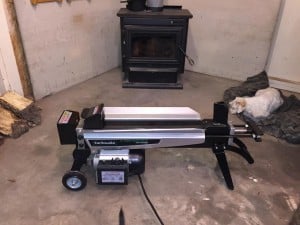
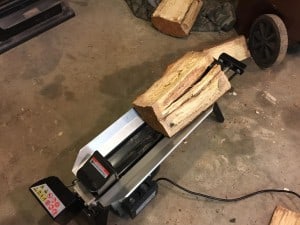
So, I get up in the truck without making to many unmanly grunting noises (its 100 pounds). I get it home and unbox it and within a few minutes I had the handle bolted on and the wheels and metal shroud that goes around the operating lever bolted on as well. It comes already filled with hydraulic fluid, so I am ready to split wood.

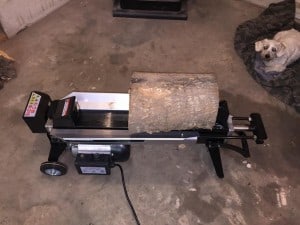
I get it in my shop, find an extension cord, put a log on the splitter. Now I have to press a button on the motor, while simultaneously throwing the lever that operates the ram, ​​that pushes the log against the splitting wedge.

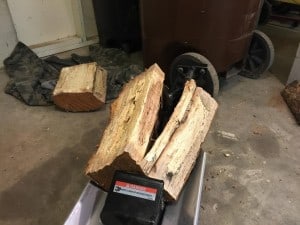
Success!!! This modern wood with advanced hardening technology just pops into small pieces like… well like a sharp wedge through firewood.

The instructions, ( I swear didn’t read them) I’ve heard, say that the limit in size of log you should be able to split is nine inches. Me, not being one to conform to instructions and rules, used a 12-inch log for the first test, and a 15-inch log for the second test. I’m totally blown away with the results.

Now I’ll list the pro’s and cons as I’ve found so far;

Pro’s ?

Very quiet machine. no gas, no oil, no engine maintenance, just an occasional check of the easily accessible hydraulic fluid level. Easily capable of splitting the hardest wood known to man ( I used white oak) in sizes that far exceed their puny recommendations.

No need to trailer it to a location, just pick it up and toss it in the truck, or ask for help if you’re a girly man.

Cons ?

It says that it requires 120 volts at 20 amps, and they mean it! I had to cut the fans that circulate my wood heat into the other side of my shop, off. When I went inside to get coffee,my wife said the house lights dimmed a few times. It pulls a lot of juice and unless you can provide that, it won’t work. I have a generator that will more than suffice if power becomes problematic.

I don’t like the fact that it requires two hands to operate the splitter. You have to press a button on the motor with one hand while operating a lever with the other hand. My devious mind is already thinking of ways I can circumvent this safety feature. “life on the edge” I always say.

Weight. This thing is freegin heavy! Like wood that is much harder to split,100 pounds is far heavier than it was in the 80,s and 90,s

That’s all folks. I feel good about this purchase and I think I’m gonna get a lot of use out of this thing in the future.

Click here to see it on Amazon, check price and read customer reviews

Filed Under: Gear Reviews

Primary Sidebar

Subscribe to Blog via Email

Enter your email address to subscribe to this blog and receive notifications of new posts by email.

Join 7,202 other subscribers
  • Amazon
  • Facebook
  • Substack
  • Twitter
  • YouTube

“Do more with less.”

– Minimalist proverb

Recent Posts

  • Just so you know
  • Weather Update for My Corner of Appalachia
  • Why I’m Ordering Ivermectin + Mebendazole Every Year
  • The Website’s Shutting Down (But Here’s the Plan)
  • You Are Hated! Start Training Like It!

Footer

Recent Posts

  • Just so you know
  • Weather Update for My Corner of Appalachia
  • Why I’m Ordering Ivermectin + Mebendazole Every Year
  • The Website’s Shutting Down (But Here’s the Plan)
  • You Are Hated! Start Training Like It!

More about me

Books I’ve written

Books I’ve read

Follow Me on YouTube

Follow Me on Facebook

Gear I Use and Recommend

Newsletter

Search this site

Follow me elsewhere

  • Amazon
  • Facebook
  • Substack
  • Twitter
  • YouTube

© 2008–2025 M.D. Creekmore · As an Amazon Associate, I earn from qualifying purchases.