• Skip to main content
  • Skip to secondary navigation
  • Skip to primary sidebar
  • Skip to footer

M.D. CREEKMORE

  • Blog
  • Books
  • Newsletter
  • Gear I Use
  • About
  • Contact
  • Facebook
  • YouTube
  • Blog
  • Books
  • Newsletter
  • Gear I Use
  • About
  • Contact
  • Privacy Policy
You are here: Home / 2020 / Archives for January 2020

Archives for January 2020

Greenhouse Gardening Tips – Growing Vegetables in a Greenhouse Year Round

January 12, 2020 M.D. Creekmore

by Crazy Joe

It is in the greenhouse that seeds are started so a larger seedling/plant can go out in the spring and increasing the chances of an earlier and better crop The larger scale greenhouses with their heating units, air circulation systems, automatic water sprinklers, and temperature controls are on a scale most homeowners could not afford or just not have the room or need for.

I have met so many people over the years who garden and stated how they wished they had a greenhouse. I have shown many folks and helped a few to build one the easy and cheap way out with a cold frame.

The most simple is to get some old storm windows of equal size – 4 for the four sides and 2 for the top. This is good enough to get a few dozen herb plants started or 20 or 30 tomato plants. It only takes a little time to read up on watering requirements for seedlings and the fact that even on a windless cold sunny day in March a small cold frame being 5 feet by 5 feet and 3 feet high can get up to the 60 to 70-degree range.

Getting old storm windows and putting them on a frame or making them with wood lathe and greenhouse plastic and securing them to the south side of any building will give you a much larger cold frame with some standing room.

I have built cold frames as small as 3 foot by 5 foot up to some in the 10 feet to 20 feet long range. On the larger angle cold frames a couple of hinges on a window gives you a window to prop open slightly for those cold sunny days and NO you cannot do this and go to work for 10 hours You will come home to dried out seedlings – as in dead seedlings. The same goes for watering.

Even on cold late spring days a closed cold frame or greenhouse can get up to 90 plus degrees – death for newly sprouting seedlings or very young plants. You want the advantage of a greenhouse or cold frame, therefore some attention is required. Believe me, the attention and advantage is well worth it. I have gotten way ahead on cantaloupe output by getting them started 8 weeks earlier in a small greenhouse.

Building a greenhouse, especially with scrap material (saves money), is not that difficult. It is the same as building a dog house only bigger and it gets covered with glass or plastic instead of plywood. One does not have to have the 3 foot high benches inside as the bigger houses have.

In a smaller greenhouse, with enough headroom to walk down the middle flower pots can sit on the ground or on some lattice or lattice type of structure raised on some bricks works fine At present my greenhouse is in a pile – I dismantled it. The 30 foot long 12 foot wide -at base – by 9-foot high center was all white so boring and it was warping-both deficiencies bothered me equally.

I found a web site with “Victorian Greenhouses” which some include scalloped cedar shake shingles on the bottom part of the greenhouse and some brass or bronze accents. I have about 120 recycled wood frame windows that I have trash picked from homes getting the new and improved vinyl windows. All of these were all white.

I chose an oil-based paint in a shade of forest green (semi-gloss) for the frames and will keep the caulked part of the window panes in an oil base gloss white. Now I have 30 or so painted. In the next 4 months, I hope to get as many done as possible but do not expect to rebuild the greenhouse by next July.

Last but not least is the upkeep and care of a greenhouse that brings me back to the day before Thanksgiving. Greenhouses can provide shelter for small critters seeking warmth on a cold January day. The glass gets dirty or the plastic gets old and brittle.

Weeds may have spouted up and you were busy doing other chores so they kept growing all summer in the empty greenhouse. This is the time to get that empty greenhouse or cold frame in shape. Spring is about 18 weeks or so away.

Here are some web sites for greenhouses, cold frames and their construction, care and what can be started in them. Trust me. Gardening is simple and with a cold frame or greenhouse, you get a major head start over the competition.

  • The Solar Greenhouse That’s Right for You (Text & illustrations for this web page came from the August 1978 issue of Organic Farming & Gardening) Here is a new gardening tool that produces fresh food when the snow flies.
  • Helpful Hints for Using Your Greenhouse <—- ONCE YOU BUILD ONE GO HERE FOR STUFF
  • Amazon.com: greenhouse: Books <—- AND OF COURSE THIS WEB SITE AND THE 8 TRILLION BOOKS TO LEARN FROM
  • Secret Greenhouse of Survival: How to Build the Ultimate Homestead & Prepper Greenhouse (Secret Garden of Survival)
Even if you should just get a cold frame going you will reap the benefits.

Filed Under: Homesteading

Buying Used Canning Equipment (Buyer Beware)

January 6, 2020 M.D. Creekmore

Home canning. Pickled vegetables and jam

by Vickie from Frugal Canning

Although I tout the virtues of shopping at yard sales for canning equipment, it is time to give some words of caution. Know what you are buying! All canning equipment (check out this selection of canning equipment at Amazon.com) was not created equal.

Hot water bath canners are fairly simple to examine. Hot water bath canners are meant to can high acid foods like fruits, jams, jellies, preserves, pickles, relish, and tomatoes. Hold the canner up to the light. Can you see any light peaking through? Is it extremely rusted? Is it dented?

 
Does the lid fit? What size is it? Will it hold a double layer of jars? Are the handles made so that it will be easy to lift when full of water?
Hot water bath canners come in aluminum, enamel, and stainless steel. Since the water does not enter the jars and touch the food, an aluminum canner is safe to use.

Test a used water bath canner by filling it with water to ensure it does not have any leaks. Leave it in the sink for a while. Then put it on the stove and heat the water to boiling. If there aren’t any leaks and if the lid fits so that the steam does not escape and if the handles are sufficient so that you can lift it safely, you may have scored a useful find.

When you are finished canning, always dry out the canner and put it safely away in a dry place.

Pressure canners need careful examination and decision making before buying. Pressure canners are used to can low acid foods like vegetables, meat, poultry, fish, soups, stews. Don’t think because the pressure canner is being sold that it is safe.

 
There are many factors to consider. First how old is the canner? What condition is it in? Is the brand name familiar? Is the instruction booklet with it? Is the weight with it? Are the handles in good condition? Are there signs of staining around the seal?

Let’s be more specific. Does the age matter? Yes. If the cooker was made prior to 1960 it was probably manufactured using a process called die-casting. Molten metal, most likely aluminum, was poured into a mold to create the pot.

 
This was the standard manufacturing process during and after WWII, and such pans are not of the same quality as those made today. Modern manufacturing makes pressure cookers from rolled and stamped metal sheets that form the pot from one single piece of metal.

Cast metal is brittle and it is subject to tiny, microscopic cracks or thin spots that weaken the container. Pots and pans take a lot of abuse, they get banged around and they get dropped and may result in cracks in the metal.

 
All these tiny fracture lines or hairline cracks are microscopic and they can only be picked up through industrial X-rays, they are not visible to the naked eye. While you might be able to use that old cooker safely for a while, eventually such a fault will cause a failure, sometimes with catastrophic results.

The only way to be sure if an old pressure cooker or canner (MD Creekmore adds – this is the one that I use at Amazon.com) is safe is to send it back to the factory for testing. The original manufacturer – although sometimes other manufacturers may be willing or have the special equipment to test other brands.

 
Be prepared to pay a small fee, plus round trip shipping costs to have it tested for unseen faults. Be sure to call the manufacturer first, if they are no longer in service then Presto of Mirro may offer testing on some models.

Also, check with your country or university extension office. Often they will provide this service, although it may only be offered at certain times by appointment as the testing equipment travels from place to place.

Check for the brand name. If it is not a common name then it might be difficult to get parts or be able to send it back to the manufacturer for inspection. Stick with an American brand name like Presto, All American, Wisconsin Aluminum Foundry or Mirro. Foreign brands may be difficult to track down and more difficult to get parts from.

If it is a weighted canner is the original weight with it? It is important to use the same kind of weight designed for that model. I collect old weights and there are subtle differences that could affect being able to calculate the correct pressure.

Are the handles in good condition? Older canners had wooden handles and over the years they become brittle and crack. Check with the manufacturer to see if the handles can be replaced and at what cost. I had the handles break on an older canner once while canning and it was extremely difficult to get the lid off and remove the jars.

 
It was extremely hard to pick it up as well once the handles had broken. That canner became a planter in my garden collection of canning pot planters.

Are there signs of staining around the seal? If so possibly this canner leaked and did not seal tightly. Always get a new gasket for a used pressure canner. No matter what story the seller tells you always be on the safe side. Improperly canned foods can be fatal or at best make you sick as a dog.

 
Make sure you can find the model number so you will be able to order the right gasket. Take pressure canners in to have gauges checked annually by your local County Extension Agent.

Have I frightened you away from buying a used pressure canner? Good, that is what this article was meant to do. Study up or better yet do not buy an old pressure canner. Invest the money in a new model and save yourself time, money and most importantly your safety. New models are technologically safer and will inherently have fewer problems.

Please go to http://missvickie.com to read all about pressure canning. Miss Vickie is the Queen of pressure canning and pressure cooking information. When I grow up I want to be just like her! Thank you, Miss Vickie, from the Frugal Fraulein at Frugal Canning.

Filed Under: Homesteading

How to Get Free Food When You Don’t Have Much Money

January 3, 2020 M.D. Creekmore

By Frugal Canner

Being the Frugal Fraulein that I am, the word free gives me tingles. This is my favorite time of year. The gardens are calling to be harvested, the trees are laden with fruit, the fish are moving up the streams and the deer and elk are fattening up in orchards and berry thickets. I hear the sound of plink, plink, plink in my head while I have visions of full canning jars filled with free food.

Did you pick up on the word free? Yes, this time of year there is free food everywhere I look. I happen to be among the officially unemployed but no boo hoo hoo from me. I have stored food as a way of life for years and live simply.

Let me share with you some ways to get free food.

Be observant

All year I keep my eyes open for fruit trees and easy access berry thickets on the side of the road and in yards. It is fairly simple to tell which homes are probably not picking their fruit because it is still hanging on the trees.

If the tree sits in a yard, I stop and knock on the door and politely ask if I might pick some fruit in exchange for either leaving some picked fruit on their doorstep or bringing back some canned items. I have never had anyone say no to me in all the years I have done this.

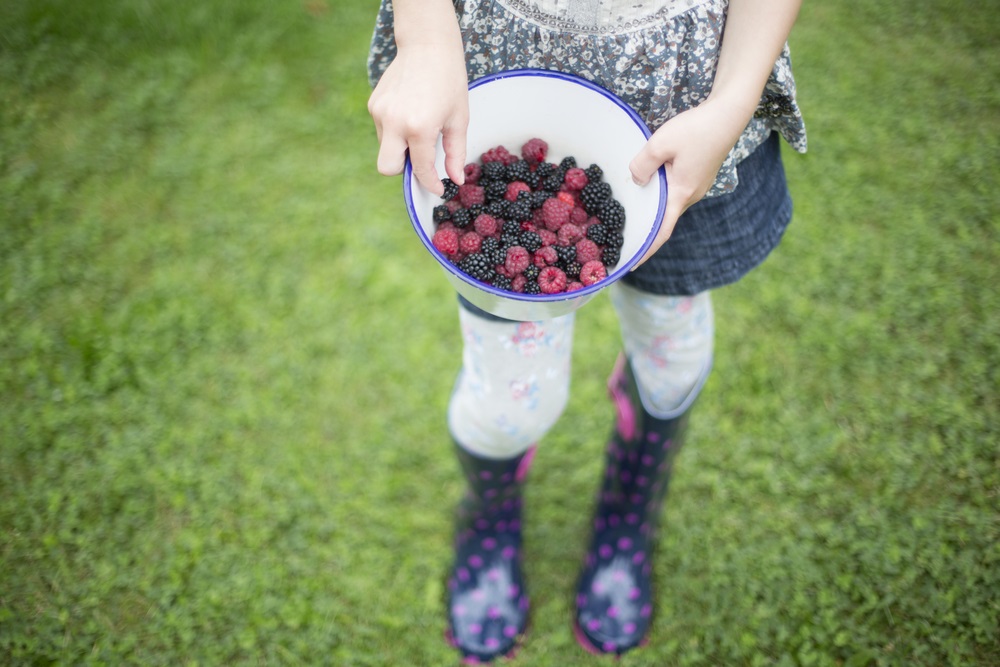
Right now I am watching a plum, apple, Bartlett pear, Asian pear, crab apple, and elderberry trees for the right moment to pick. I have already picked all sorts of wild berries and blueberries. In the Pacific Northwest if you do not pick free blackberries there is something wrong with you!

My supplies are always in the car. I have a couple of “pickers on a stick” and tubs for large fruit and stainless steel bowls, zip lockable bags, handheld pruners and hand wipes for berries. A picker on a stick is simple to make. A bleach bottle is cut and bolted to a broom handle.

This tool allows you to reach higher and pull the fruit off the tree without having it fall and get bruised. Two Christmas’s ago a commercially produced fruit picker was given to me which I also like. I also have a hands free container which is a coffee can that has a wire coat hanger that hooks over the top of my pants.

I always clean up the area where I pick as a service to the homeowner and rake up the drops and deposit them on their compost pile. There are a few homes that actually look forward to my annual visit. I don’t know why they don’t seem to want any canned items but I don’t argue because that is more for me. They just don’t know what they are missing! All for free.

Put the word out

Tell everyone you know you are willing and very happy to take their year-end produce. Towards the end of the season, some folks are tired of zucchini boats, cabbage that might have some brown leaves or slug trails, too many tomatoes or cucumbers or can’t bear the thought of picking any more beans.

I volunteer to clean out the garden and take home the left overproduce. I put up signs, let church-going friends know, club members, post signs on Craigslist and at supermarkets and am not bashful about putting the word out that I will take garden leftovers. All for free.

Make an exchange

This year I offered to advertise for a fellow with a produce stand near my home in exchange for produce. He called me when he had leftovers and I was able to either get them free or at a very low price. Daily these guys have to throw away perfectly good food.

You are doing them a favor by cutting their disposal costs. This arrangement can be made with your local produce man as well. I have known people who said they were picking up produce for their chickens when they were really talking about kids, the humankind. All for free.

Gleaning

A friend of mine who happens to be a member of the L.D.S. church invited me to join a group of ladies that glean a corn farm annually. I thought I was bold taking two plastic tubs with me but to my surprise, these ladies showed up with pickup trucks! It seems the farmer picks two to three times a season and the last of the corn is not worth his effort.

Some are small but most were perfect. It is always an adventure to travel down the tall aisles of corn stalks looking for leftover ears of corn and smelling the sweet smell and hearing the fall crickets and birds chirping.

We have always done this activity late in the day so the sun is setting and fall is in the air. Since my first experience, I have picked corn, cucumbers, and pumpkins as gleaning activities. Most often a percentage is brought to the local Food Bank so others are benefiting as well. All for free.

Barter

This year I bartered my canning experience for fresh tuna fish. A local fisherman brought 60 pounds of fish ready to go and I did the canning. Yes, it was labor-intensive and time-consuming but I now have jars of the most delicious tuna in my food storage that is not comparable to that stuff in the can from the supermarket.

I also barter fresh salmon from a neighbor in exchange for babysitting and some extra camping equipment I had. The salmon is usually eaten fresh but I have canned it before. One year the local Native American Tribal caught more salmon than the market could handle and they put out the word to come and get it.

I brought home about 15 very large salmon and canned it. This year I have posted ads for hunters to can meat in exchange for a percentage of the bounty. All for free.

Learn to forage

If available take a class on foraging in your local area to learn which local plants are edible. If no classes are available in your area (and even if they are) then I suggest you get a copy Nature’s Garden: A Guide to Identifying, Harvesting, and Preparing Edible Wild Plants from Amazon.com and The Forager’s Harvest – Wild Food, 2 DVD Set. These are both excellent.

Once you have a knowledge base of what is out there, you can go out and pick, pick, pick. Items can be canned, dehydrated or made into tinctures for healing nutritional purposes.

This year I am picking wild elderberries to make a tincture. Elderberry tincture is good for the flu and it is a great additive to anyone’s medical kit. I have foraged fiddleheads, many types of greens, mint, leaves for tea, wild onions, Oregon grapes, berries, mushrooms. All for free.

MD Creekmore has several great articles here at MDCreekmore.com about foraging for wild foods and I will add links to those below.

  • Can You Forage for Wild Plants to Eat In The City? Yes!
  • Edible Wild Plants: 25 Wild Plants You Can Eat to Survive in the Wild
  • Identifying and Harvesting Wild Berries for the Homestead

Are you getting the idea? Are you inspired? All of you who smart enough to be ants and not grasshoppers do not have to have huge reserves of cash to do food storage.


Just be frugal, bold, polite and the Universe will provide. Please follow my blog frugalcanning.blogspot.com for more tips and articles on frugality.

Filed Under: Money and Finances

Quick Tips For Planning an Effective Family Bug Out

January 2, 2020 M.D. Creekmore

What Should I Put In My Child's Bug Out Bag?by Anonymous
 
If you are a family leader, you must plan for the entire family also.
 
I recommend a grab bag for each person who is old enough to carry and hang onto one…and a separate medical pack for the entire group (here is a great kit on Amazon.com). Besides a separate well-stocked medical kit, each pack should have a small first aid kit (this kit at Amazon.com is perfect for individual bug out kits).
 
Each person, even children who are old enough to carry a small book bag type pack, should carry a pack of some sort. Each pack should have some food, extra underwear and clothing and rain protection, and toilet paper and soap and a washcloth.
 
MD Creekmore has gear article on bug out bag contents here – The First 23 Things I Put In My Survival “Go Bag” and you can see his bug out bag video below for his most recent bug out bag recommendations. 

Bug Out Bag Checklist | Survival Prepper Gear Recommendations

 
Each person should have at minimum a bar of soap, dry or dehydrated energy food, etc. Remember to take salt along also. A bottle of saccharine tablets (available at Amazon.com) and some kool-aid packets and instant coffee will make life a lot more pleasant for everyone, especially children in a harsh environment. Remember, keeping spirits up is essential, especially for the young.
 
Each adult pack should have two rolls of toilet paper. Pull half-used rolls out of your bathroom and squeeze them flat so they don’t take up much space.
 
Sheets of toilet paper can also be used for marking trails if you want someone to follow you, or for marking the blood trail of a wounded animal or person…just leave a sheet at the last drop of blood, and cast forward until you find another drop, and so on until you find the wounded animal or person.
 
A wounded animal or person will seek shelter and a place to rest and hide.
 
Mouth-blown game calls can be used as signaling devices. Where crows are, you can outfit your crew with crow calls, and set up natural-sounding signals. A crow will caw three times in a row if danger is near, and this is a good way to warn your team if you spot danger…or a crow might warn you also.
 
All packs should have some tough plastic ground cover sheets in them. Remember, you must separate yourself from the cold ground with some kind of insulation in the winter. Pine boughs covered with plastic will do, or else, the cold earth will absorb your body heat and cause hypothermia. In summer, the plastic keeps chiggers and ticks and other creepy crawlers away from your skin.
 
Meaning no disrespect for women, but mature females need extra consideration for the cleaning of their vaginal area in a wilderness environment since their urethra is shorter than males making them much more susceptible to bladder infections. A bladder infection can literally drain the energy from a person.
 
Just ask anyone who has ever had one. So, soap and two washcloths and tampons for female menstrual periods should be in their packs. These essential considerations make all of the difference in the world in a harsh environment, and these extras keep spirits up.
 
Also, sulfa drugs to treat female bladder infections should be packed in the medical grab bag…and condoms should be packed for all females who are sexually active, if the wilderness stay might be an extended one.
 
For weapons, except for young children, I recommend the above-suggested choices of a .22 and one or more team members with a …….308 or .223 semi-auto or other weapons.
 
For other members, especially female family members I suggest a very small palm-sized .22Lr revolver or other small reliable derringer or small pocket pistol which can be hid in a pack or shoe or pocket of each adult, especially each woman and girl who might be susceptible to rape from roving males who might try to overpower them when other team members are away from camp and they are venerable.
 

The goal is to have a weapon of last resort handy if the person is overcome by someone who gets the drop on them and then wants to do them extreme harm. Just some ideas from my tour in Vietnam and from my years of deer stalking.

If you have other ideas and or advice, please add in the comments section below…

Filed Under: Bugging Out

Primary Sidebar

Subscribe to Blog via Email

Enter your email address to subscribe to this blog and receive notifications of new posts by email.

Join 7,202 other subscribers
  • Amazon
  • Facebook
  • Substack
  • Twitter
  • YouTube

“Do more with less.”

– Minimalist proverb

Recent Posts

  • Just so you know
  • Weather Update for My Corner of Appalachia
  • Why I’m Ordering Ivermectin + Mebendazole Every Year
  • The Website’s Shutting Down (But Here’s the Plan)
  • You Are Hated! Start Training Like It!

Footer

Recent Posts

  • Just so you know
  • Weather Update for My Corner of Appalachia
  • Why I’m Ordering Ivermectin + Mebendazole Every Year
  • The Website’s Shutting Down (But Here’s the Plan)
  • You Are Hated! Start Training Like It!

More about me

Books I’ve written

Books I’ve read

Follow Me on YouTube

Follow Me on Facebook

Gear I Use and Recommend

Newsletter

Search this site

Follow me elsewhere

  • Amazon
  • Facebook
  • Substack
  • Twitter
  • YouTube

© 2008–2025 M.D. Creekmore · As an Amazon Associate, I earn from qualifying purchases.