• Skip to main content
  • Skip to secondary navigation
  • Skip to primary sidebar
  • Skip to footer

M.D. CREEKMORE

  • Blog
  • Books
  • Newsletter
  • Gear I Use
  • About
  • Contact
  • Facebook
  • YouTube
  • Blog
  • Books
  • Newsletter
  • Gear I Use
  • About
  • Contact
  • Privacy Policy
You are here: Home / Archives for M.D. Creekmore

M.D. Creekmore

Hello, I’m M.D. Creekmore. I’ve been interested in self-reliance topics for over 25 years. I’m the author of four books that you can find at Amazon.com as well as Barnes and Noble. Over the years, I’ve learned a lot about prepping, homesteading, and self-reliance topics through first-hand experience and now I want to share what I’ve learned with you.

Can I Keep Chickens In My Backyard?

December 31, 2018 M.D. Creekmore

Can I Keep Chickens In My Backyard

by Nate Smith

If you have made the decision that you would like to try your hand at keeping some chickens in your backyard, there are a few considerations that you might want to make first, and although you have probably thought of some of these, there just might be a few that might come as a surprise.

Legality of Raising Backyard Chickens

Probably the very first question you should ask yourself about raising chickens is, can I raise chickens in my backyard?’ You know, legally. I know, I know. If you are slightly stubborn like I tend to be you are probably saying to yourself, ‘this is my property, so surely I can do whatever I want on it’! Am I right? If that thought crossed your mind, or anything at all along those lines, trust me, I know where you’re coming from. Here’s the deal.

If you live within the boundaries of a city as most (but not all) of us do, you will want to start out by getting info on whether or not you can even keep chickens in your backyard while staying within the confines of the law.

The last thing you want to do is to build or buy a chicken coop, purchase a few starter hens, buy some food, get the entire family excited about the adventure that lies ahead, only to have a bureaucrat pay you a visit and let you know (kindly or otherwise), that what you are doing against a city ordinance and that not only will you have to get rid of your new chicks, you will also have to pony up for a fine they’ve decided to hand you. What a slap in the face!

Basic Types of Zoning and Chickens

There are a few different types of zoning that exist, each one having different laws and regulations on what you will and what you will not be able to do. If your property happens to be zoned as agricultural, then you probably won’t have any problem raising chickens or constructing any type of chicken coop you might want to have. Most people reading this article will not fit that description, however, and will live on property that is probably zoned as residential.

Don’t let that discourage you in regards to chicken-raising, as many, many residential areas will allow people to raise a few chickens on their property. The best thing that you can do to make sure is to contact your city offices and simply ask them if there are any ordinances on raising chickens in your backyard, and what they are. You will find typically that there are two different areas of laws that will affect what you are able to do. First, there are often laws specific to the actual birds.

How many birds you are able to have on your property (it might depend on the size of your property), what sex they can be (roosters, anyone?), and in some cases, although not extremely common, you might even have to get written permission from your neighbors! I know, that last one sounds a bit strange.

You haven’t burned any bridges there, have you? The second set of laws have to do with the type of housing you use for your chickens. How large can your chicken coop be? Do you have to get a permit to build or even own a chicken coop in your backyard? Will this chicken coop need to be inspected?

I hope I haven’t scared you away from the idea of even wanting to start raising chickens in your backyard, and honestly I believe I have found some of the more extreme laws that you might want to, as your own city ordinance might include anything from having nearly no regulations at all, so maybe just one or two of these issues, which might not seem like much of a problem at all.

Remember, as you are going into this and inquiring about the local laws of your city just remember that joy of fresh eggs, chickens and the family experience is all very much worth it in the end!

A Personal Example on Chicken Keeping Laws

It has been a number years now that raising chickens in your backyard has been allowed here in my city. In regards to how many chickens can be kept here, a person can keep up to 12 chickens, depending on the size of your property.

Anywhere from house lots as small as 5,000 square feet keeping just two chickens, up to larger lots being allowed 12. There was a small public hearing where people were able to voice their opinions on the matter. For the most part, it was thought that people being able to raise chickens in their backyard was fine and that there wasn’t really any detriment at all.

Even public officials mentioned that when it came to complaints about chickens from neighbors (which were extremely rare as it is), the complaints were never about noise, and never about a smell (neither of those things seemed to be any problem at all).

The only complaints on file were for the occasional chicken getting loose, which was always promptly gathered and put back in its place. I’m sure we can all point to that neighbor of ours that would be the first to complain about the slightest inconvenience, or really anything at all.

Whatever the case may be where you live, make sure you have it on good authority that you are able to keep chickens before going out and finding chicks and a chicken coop. Don’t take the advice of a friend or a neighbor or a real estate agent even someone near you that might be raising chickens.

Sometimes when laws are passed that ban certain things, those who were practicing before the law came into effect are exempt from the new law; they are grandfathered in.

What if My City Does Not Allow Backyard Chickens?

If you find that your municipality does not allow raising chickens, don’t panic just yet. All might not be lost. The process of getting a simple law like this changed is often times much more simple than you might think.

You might be asked to attend a city council meeting to state your case, and often times that will be enough for the city to take a vote on the issue, and I think often times you will find that no one wants to be the lone councilman putting their foot down on people wanting to become more self-sustaining. Be patient on the matter as this process doesn’t usually happen overnight.

It can takes months for the ball to get rolling, but you can be a part of making great changes in your area if you stick with it. If you can find others in your area that back you on this issue and will be willing to work with you, even better.

Nate Smith has been homesteading and dealing with backyard chickens for a number of years. He encourages people who are looking to begin raising chickens to gather information first on the best breeds of chickens, types of chicken coops and requirements that go into raising backyard chickens.

Filed Under: Homesteading

Is the .22 Rimfire The Best Firearm For Preppers?

December 31, 2018 M.D. Creekmore

Is the .22 Rimfire The Best Firearm For Preppers?

by Joe I

Lately, I’ve seen quite a bit of information on using the .22 rimfire as a primary self-defense weapon, an option when hunting large game, and even a primary offensive weapon.

This reasoning has surfaced in recent years due to several factors, including better bullets, higher velocity bullets, better quality rifles and pistols, and inexpensive weapons when compared to the larger calibers. It also reflects a large number of new gun owners who have never hunted, and have just started prepping.

As I thought about writing this article, I wanted to first look at the advantages of the .22 rimfire, and there are many.

  1. Recoil is almost non-existent. Anyone can shoot a .22, from a small child to an old codger. And most can shoot it accurately given only minimal training, and follow-up shots are quick.
  2. Ammunition is cheap. Just about everybody can afford to stock a substantial amount of .22 ammo.
  3. Ammunition is compact. Storing several thousand rounds of .22 rimfire takes up minimal space. And it is lightweight as well.
  4. Variety of ammo. One can get long rifle, longs, shorts, and even CB caps. Shotshells are also available.
  5. The new ammo is quite accurate. Within its capabilities, a good rifle will shoot very tight groups out to 50 or more yards.
  6. It will kill, as probably more people have been killed with a .22 than any other round. Of course, more people have been shot with one, too.
  7. Good guns are inexpensive. Quality guns are available at very attractive prices.
  8. There are a large number of configurations, from semi-auto to lever action to bolt-action, and single shot on some combination rifles.
  9. Low noise. The .22 is quiet compared to the larger calibers and is easy to suppress.
  10. They are fun. A day plinking with a .22 is a great day.
  11. Training with the .22 is invaluable, and the training is affordable.

I’m sure there are other advantages of the .22, but one need only look at the reasons I’ve given, and you can see why everyone should have several .22s in their survival battery. This is where I think we need to insert a level of caution on the .22 rimfire, as it’s easy to get enthusiastic about a gun that has all the good attributes mentioned. I’ve hunted with a .22 all my life, and it was my first rifle, as I’m sure it is for most.

I can’t even count the number of birds (I’m truly sorry I ever killed any birds I didn’t eat, but God forgive me I did when I was to young to know better), rabbits, squirrels, raccoons, skunks and other critters I’ve dispatched with a .22. I remember finally catching that raccoon in the corn about midnight one night that had destroyed a lot of our corn crop one year. Got him with my .22.

So, what are some of the disadvantages of the .22 rimfire?

  1. Centerfire cartridges are more reliable. There are more misfires with .22 rimfire, it’s just the nature of the beast. But, good cartridges have offset this somewhat in recent years.
  2. Knockdown power is the lowest of all the cartridges. It’s one thing to hit someone or something, it’s quite another to put them out of the fight immediately. Or take large game before it gets away. Surgical shots are required, such as shooting in the ear or eye. That will be much more difficult once the crap hits the fan as game becomes more wary and scarce. The muzzle energy of .22lr is about 135ft/lbs. through a 22-in barrel.
  3. Distance is the enemy of the .22, as velocity at 100 yds. is less than 80 ft/lbs in a 22-in rifle barrel. Carbines and pistols/revolvers have even less.
  4. Engaging at distances over 100 yds. puts the .22 owner at a grave disadvantage to most centerfire rifle cartridges. The .22 falls off rapidly after that and loses its punch.
  5. Shooting large game with a .22 is against the game laws in most states. However, that may or may not be a consideration in the future.

After reviewing the above, I decided to do a few range tests to confirm some of my points. I took my Ruger Mark II .22 pistol, backed up 7 yards, and fired 6 times into a target. I put 6 shots in a 2-3 in. circle in 5.3 seconds as timed by my best friend. I then took my Colt Combat Commander in .45acp and fired 6 shots into another identical target.

I put 6 shots in a 3-4 in. circle in 6.2 seconds. I just don’t see enough difference in time or accuracy of the .22lr to make it a primary self-defense pistol. I then set up a 100 yd. target and shot my 10-22 at that target 6 times. I hit all 6 within a 4-in group.

I then fired my AR-15 6 times, and I put all 6 rds inside a 2 in.circle. The AR-15 is more accurate at distance than the 10-22, and has way more energy at that distance. I didn’t conduct any game tests, as I’ve hunted all my life and I’ve seen too many deer shot with a .22 get away and die days later. Only an expert should hunt large game with a .22.

In my opinion, not having a number of .22s in your survival arsenal would be a mistake, but I think it would be a bigger mistake to rely on the .22 exclusively. It is under-powered for a number of important uses, it puts one at a tremendous disadvantage at distance, and it’s not a sudden killer of large game.

Although people and large animals have been killed by the .22, it’s just not consistent enough to be a compromise. I will say this in the .22s favor, if one is elderly, or has arthritis or other infirmities, there is nothing wrong with having the .22. It is way better than nothing, and if that is all you can afford, then it’s certainly better than not having any options at all.

Just remember that it was never intended to be the cartridge for a main battle rifle or kill large game. It has it’s greatest use as an inexpensive training aide, a small-game getter, pest control, and best of all, just sheer fun shooting the guns that use the diminutive cartridge.

Also Read:

  • The Prepper’s Firearms Checklist of Handguns, Shotguns, and Rifles
  • What Are The 5 Most Reliable Handguns in The World?

Filed Under: Prepping

Water Purification Options for Long-Term Survival

December 31, 2018 M.D. Creekmore

go bag contents checklist

by D. Holden

Introduction

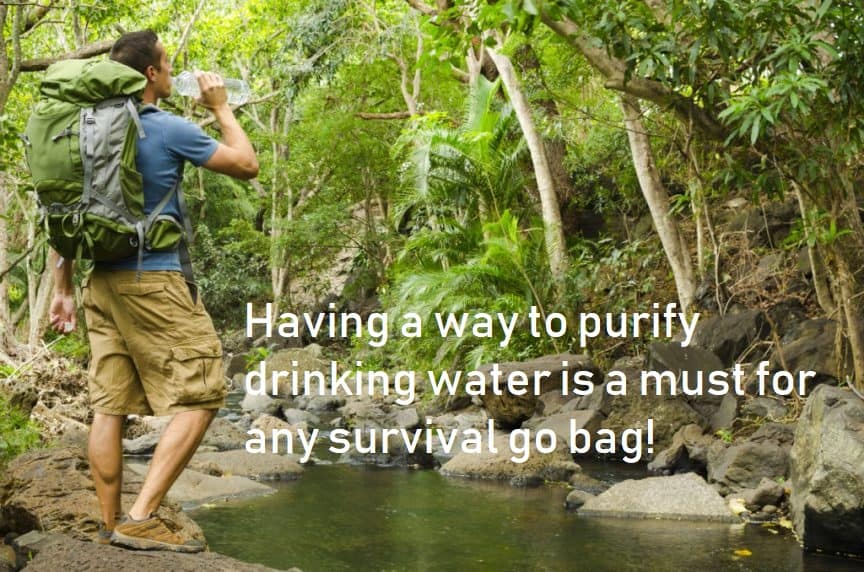
Water: the source of life. One can live weeks without food, but only days without water. Water makes up approximately 60-70% of a human’s body weight. It is and should be, one of the most important considerations in planning for a long-term disaster scenario. Given that the average human will need one gallon per person per day minimum, storage of large quantities of water quickly becomes impractical and therefore won’t be discussed in this post.

This article also assumes that you don’t have a private well that is completely off the grid. If you have the land if the city or county allows it, and if you can afford it, then by all means, make getting a private well your first order of business!

So how can one find safe water after a major disaster? If you don’t have a well with a solar or hand pump, you’ll most likely have to rely on natural sources of water such as streams, ponds, lakes, or rivers. It would still be quite dangerous to drink directly from a stream or river, even if it appears completely clean and clear.

There is always the risk from Giardia and Cryptosporidium, not to mention the chance of a dead animal just upstream unbeknownst to you. Even a bit of animal or human excrement upstream can make a person seriously or deathly ill. If you use natural sources of water, then some form of filtration or purification will be necessary.

So, what to do? Well, you have a few options:

  1. Filters

First, you could invest in a ceramic filter, like the British Berkefeld Ceramic Water Filter (click here to check the current price on Amazon.com). While a bit pricey, they’re both highly recommended and receive terrific reviews. I’ve used this particular brand in West Africa for many years, and I admit they are convenient, safe, effective, easy to maintain, and long-lasting. The ceramic filters only need an occasional cleaning and can withstand cleaning many times before needing to be replaced.

They are definitely worth the money, but you should note that they only filter out organic contaminants and sediment from water. Since they don’t have anything like activated charcoal, they don’t filter out chemical contaminants.

I don’t imagine most sources of water would contain dangerous levels of chemicals, but if you take water from a river or stream that is next to a typical commercial farm, there is the risk of ingesting pesticides and herbicides from the farm runoff. It’s the same for water that near an industrial plant. This should not be a problem for most people, but it is good to be aware of the possibilities. Know what is upstream!

For a good portable filter, you could go with the Swiss-made Katadyn Hiker or the Hiker Pro (see this page for MD Creekmore’s filter recommendations). A wonderful benefit to these filters is that they are extremely portable, which makes them vital components of bug-out bags. Another benefit is that they remove virtually all organic and chemical contaminants. The downside is that you only get about 200 gallons out of each filter, and the replacements add up very quickly.

However, if you want more filtration for your money, like say 13,000 gallons worth, you can go with the Katadyn Pocket Water Microfilter. While remaining very portable, it uses a simple ceramic candle similar to the British Berkefeld. Just note that as with all ceramic candles, it won’t filter out chemical contaminants.

An interesting, albeit more primitive option, is to build a BioSand Filter. They’re not perfect, but they are so rugged and easy to build and maintain that they are worth some consideration. They remove around 95% – 99% of all organic contaminants by way of an active “biological layer” and simple sand filtration.

These filters have largely been implemented in the humanitarian realm by organizations such as Samaritan’s Purse and Convoy of Hope. You can build them out of plastic or concrete, and they’re very low maintenance.

Again, they don’t remove 100% of organic contaminants, so there’s still a very small chance of getting a water-borne bug of some kind, but it’s a good semi-permanent solution when your other options run out.

Since the biological layer takes some time to develop, you could use other short-term methods listed here to carry you over until this filter is fully functioning. They really do save lives in the third-world, so it’s worth some investigation, at least for a backup option. You can find plans online for building them.

  1. Boiling

There’s always the idea of boiling your water, but for that, you would need a large source of energy, perhaps something like wood or propane, not to mention a large amount of time as well as storage. Boiling water may work in a pinch, but it would be extremely cost and resource prohibitive in the long run, especially in a long-term grid-down scenario.

On a personal note, many years ago, I went on a weekend camping trip and severely underestimated my water demands, all while carrying foods high in sodium. Needless to say, I became very dehydrated and had to stay up all night boiling, cooling, and drinking river water.

It worked great, but due to the time and the energy necessary to boil water, I quickly realized that relying on this method of water purification in the long-term is not a good idea.

  1. Chemical Disinfection (i.e. Chlorination)

In a common local disaster scenario (hurricane, ice storm, tornado, etc), organizations such as FEMA and the Red Cross suggest using unscented household bleach (5.25 to 6.0 percent sodium hypochlorite) to treat water. FEMAs instructions are as follows:

“Add 16 drops (1/8 teaspoon) of bleach per gallon of water, stir, and let stand for 30 minutes. The water should have a slight bleach odor. If it doesn’t, then repeat the dosage and let stand another 15 minutes. If it still does not smell of chlorine, discard it and find another source of water.”

This method is not really generally recommended for long-term use. Plus, bleach has a limited shelf-life (around 6 to 9 months), so you’d have to rotate your supply often in a long-term disaster. To get around this limit, some people instead buy calcium hypochlorite (rather than the sodium hypochlorite in bleach) in the form of “pool shock.” It comes in granular form, is relatively stable, and has a surprisingly long shelf-life.

I’d be careful with this stuff, however, as storage can be dicey (I’ve heard stories of it corroding surrounding items when not stored properly), and one needs to be aware of proper measurements and mixing amounts. I’m sure with enough research and preparation, the granular calcium hypochlorite could be a fairly good backup method of water purification.

  1. Solar Disinfection: SODIS

SODIS, or SOlar DISinfection, is the cheapest and easiest of the methods listed here. Solar disinfection only requires two things: clear plastic (PET) bottles and sunlight. Find soda or water bottles with the PET recycling mark that are clear and colorless, 2 liters or less in volume, and preferably no more than 4 inches in diameter.

Fill them with water, close the cap, and lay them on their sides in full and direct sunlight for a day. It’s better if you place them on a shiny surface, such as corrugated metal roofing, and angle them towards the sun so that the sun’s rays will strike the bottles more directly.

If the water is cloudy or turbid, filter the water with cloth or cotton until it is clear. Keep the bottles in direct sunlight for at least 6 hours. If the sky is cloudy, you will need to keep the bottles out for two days.

So, how does it work? The strong ultraviolet light (UV-A) from the sun not only destroys bacteria directly, but it also reacts with oxygen to create oxygen free-radicals which can also kill bacteria. One way to improve the effectiveness of the process is to aerate the water by shaking it.

To do this, fill the bottle 3/4 full, cap it off and shake it. Then fill the bottle up the rest of the way until it’s completely full. This oxygenates the water and increases the amount of oxygen free-radicals created by the sunlight.

Conclusion

This is surely not an exhaustive list of water treatment methods, but I wanted to list some common ones for consideration. Rather than rely solely on one method of water purification, I would consider having many methods in one’s survival arsenal.

So goes the preparedness maxim, “two is one and one is none.” This definitely applies to methods and ideas as well. Do you have any other methods not considered here? What do you think?

Also Read:

  • Water For Survival [the essential guide for preppers]
  • How to Make Your Own Water Filter

Filed Under: Prepping

What Are The Best Foods To Grow In A Survival Garden?

December 31, 2018 M.D. Creekmore

best foods to grow for survival

by Jason – www.theselfsufficientgardener.com

It’s generally considered blasphemy these days to be a survivalist and not garden.  Food is the most important survival consideration next to water for the survival minded.  It makes sense to be at least somewhat self-reliant when it comes to food production for you and your family.  In other words, if you don’t garden you should really consider starting.

For those of us who do mix gardening and prepping/survivalism, the perennial question waits:  What to grow?

Gardening prior to SHTF can be a challenge and doing so afterward will be even more of one.  Therefore I’ve devised a rating system for choosing the best vegetables for my garden if I have to rely upon it in an emergency situation.

On a rating scale of 1-5, I rate the following attributes for each crop.

*Reliability—How susceptible is the plant to disease and pests.  Can I count on production?

*Season—How often can the crop be grown?  Does it take long to produce or can multiple crops be grown in one year?

*Nutritional Value—Not only calorie count but also vitamins and minerals.  ATSHTF this will be critical!

*Sustainability—Can the crop be propagated year after year?  We won’t know how long a disaster will last in some cases.

*Storage—Feast or famine?  Eating great for a week won’t sustain a family.  How easy is the crop to store long term?

*Yield—No sense growing things that won’t produce.

*Stealth—If TSHTF, how vulnerable will my garden become?

Of course, everyone’s rating scale will be different.  You can even weigh some things heavier than others or disregard certain ones.  The important thing is that you think about this beforehand and put it to use.

As an example, I will rate three of my go-to crops if I had to survive on garden produce.

Beets

Reliability—4

Almost no pests eat beets.  They are slightly temperature sensitive for germination and initial growth so planting at the right time is crucial.

Season—3

Can be started early and grown late.  Germination, as I mentioned above, is the critical phase.

Nutritional Value—4

High in carbs/sugar.  The green tops can be cut and come again harvested and the root, of course, is very nutritious.

Sustainability—2

Does not produce seeds until it overwinters.  This makes seed saving difficult.

Storage—4

Excellent capabilities.  Beets will store great in a root cellar.  They can be stored in a small box full of sand for a long time.

Yield—3

The greens and the root can be eaten as I mentioned.

Stealth—4

Other than the burgundy color, beets and inconspicuous lying low to the ground.

Tally the numbers and I get 24 for beets—not bad.

Potatoes

Reliability—2

Several pests like potatoes and we can’t forget about the blight that caused the great famine in Ireland.

Season—2

Potatoes grow well in cold weather but the require a long growing season.

Nutritional Value—5

This veggie is off the charts in nutritional terms.

Sustainability—3

The tubers can be divided or even just a small chunk can be used to grow another plant.

Storage—5

Outstanding storage life.  Kept in a root cellar these will last quite a while.

Yield—5

Use a tire or tower setup and one plant can produce ungodly amounts.

Stealth—3

Potatoes don’t really have an obvious appearance for non-gardeners but they do get rather big in some cases.

So potatoes score high as well with a 25.

Amaranth

Reliability—4

Almost no pests or diseases to speak of effect amaranth.

Season—2

The growing season is somewhat long and limited to warmer times.

Nutritional Value—4

Very high in many vitamins, minerals, and amino acids.  Both the greens and the grains can be eaten.

Sustainability—5

Produces tons of seeds!

Storage—5

Though the greens do not store well at all, the grains will store almost indefinitely once dry.

Yield—4

Outstanding.

Stealth—1

Tall with bright flowers.  The only saving grace is that most people have never seen amaranth.

Amaranth scores a 25.

Just, for example, I’ll give you a crop that most gardeners love but I consider a poor choice for survival gardens.

Tomatoes

Reliability—2

Cutworms are a problem.  A disease is the real killer here.  Early and late blights combined with blossom end rot leave tomato harvests in doubt.

Season—2

Only grows in warmer weather and takes a while to produce.

Nutritional Value—4

Good nutritional profile.

Sustainability—3

The seeds are easy to harvest and store and are generally reliable but only if the plant makes it to production.

Storage—3

Tomatoes are horrible for storage.  The best bet is to harvest green and let them ripen on their own.

Yield—4

Good yields

Stealth—1

Everyone knows what a tomato plant looks like and bright red fruit does little to disguise it.

Tomatoes score a 19.

I hope this rating system has at least caused you to look at garden crops in a different way.  Its good to know how to grow a variety of things but it’s also good to know which we can rely on when it comes down to it.

Filed Under: Homesteading

What Would an EMP Do?

December 30, 2018 M.D. Creekmore

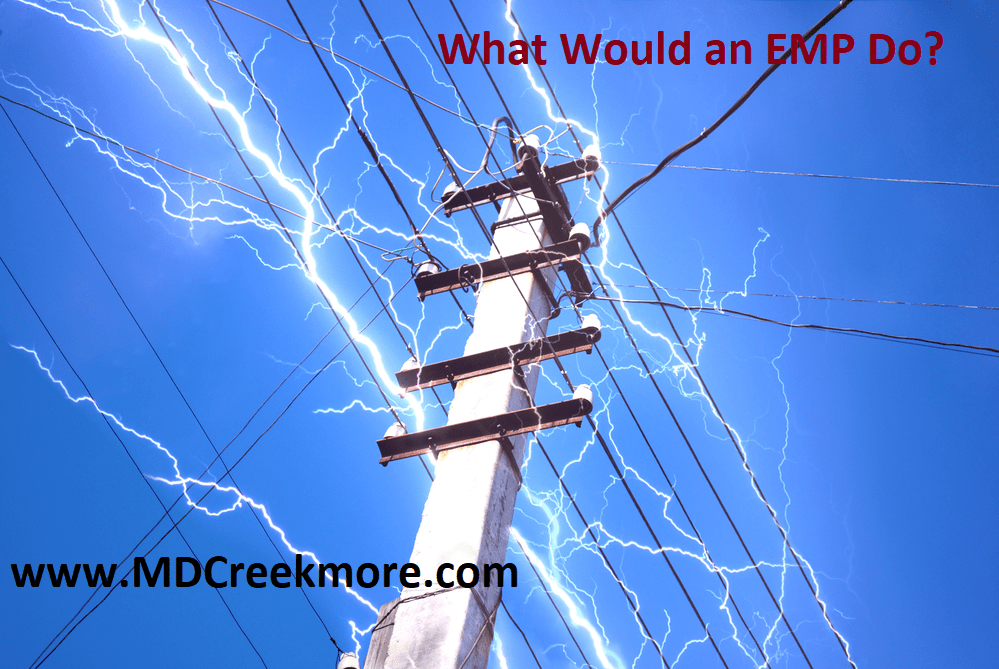
What Would an EMP Do

by Ray K

EMP, or Electromagnetic Pulse.  Most of us have heard of it, some of us understand what it is and what it does, and those who have read “One Second After” have an idea of what will happen if we are attacked with it.  Some additional info can be found at http://en.wikipedia.org/wiki/electromagnetic_pulse

The U.S. Government created a commission to study EMP and what it could do to the safety and security of the United States.  Unfortunately, this Committee published its report the same day as the 911 Commission, so it didn’t get much news coverage.  You can read the report at www.empcommission.org.  The bottom line in the report is that it is not a matter of ‘if’ but ‘when’ we will be hit.

EMP will take out everything electronic, whether it is connected to the grid or sitting unplugged on the kitchen counter.  Things connected to the grid may fry from the 100,000-volt surge brought in through the power distribution lines.  Electronics with transistors or integrated circuits are extremely sensitive to static electricity and can be destroyed by as little as 100 volts.

Walking across a carpet and sparking to that door know is well over 1000 volts.  The surge created by the EMP in your electronic device will be sufficient to destroy them if they are not protected.

One of the committee members likened EMP to a time machine, transporting our society from ‘today’ to ‘1870’ in about one second.  We become, once again, an agrarian society, capable of supporting the level of population that we had in 1870.  This means that there will be a lot of Americans dying.

Our goal, your goal, is to be among the survivors.  There are many things that need to be done to prepare:  learning survival skills (read – What Survival Skills Does A Prepper Need), having land and gardening/preserving knowledge, and many other things.

Having communications and some of the gadgets survive could mean the difference between surviving and not surviving.  Things like solar battery chargers (see this article for solar charger recommendation), batteries, inverters, ignition systems for chainsaws, critical farm equipment electronics, walkie-talkies, NV gear among others could be critical when the time comes.

What is EMP?

When a nuclear bomb is exploded above the atmosphere, it releases gamma rays in all directions.  The ones that head towards the atmosphere strike air molecules and strip off electrons.  Those electrons and gamma rays head towards Earth, stripping even more electrons.  This avalanche of electrons called the Compton Effect, interact with the Earth’s electromagnetic field, creating very strong magnetic waves.

When a magnetic field crosses a conductor, electrical current is produced.  When this EMP magnetic wave crosses power lines, electronic equipment, anything conductive, current is produced.  Enough current could be produced to create fires, exploding transformers, extremely high voltage (current pushing through resistance results in voltage) which can break down insulation and create arcing and short circuits.

In 1962 the US detonated a 1.4 megaton bomb over one of the test sites in the Pacific.  It was high enough that the island of Hawaii, 900 miles away, had 300 street lights go out, and some microwave links were damaged.  Hours after the detonation there were still surges and ripples in the power system.  That was when we used vacuum tubes and before transistorized equipment was on the market.  Today, with microcircuits and all of the very high tech equipment that we have in our homes, our factories and our defenses, we are more vulnerable than ever.

The U.S. Senate recently stripped funds for hardening the country’s power grid against EMP from a homeland security bill.

We are on our own.

What Will Work After an EMP Attack

Will EMP harm you?  You, the human, will be safe.  Magnetic waves, even very strong ones, will not harm you.  MRIs use strong magnetic waves to make images of your innards.

But, look around you at anything with a wire or a chip.  Whatever you see, be it a toaster, TV, laptop, microwave oven, radio, chainsaw, car, or truck, it is vulnerable, and the higher the technology the more vulnerable.

WSHTF you won’t need a TV, but you will need a radio, perhaps walkie-talkies, probably solar battery chargers, that ignition coil on your chainsaw, maybe that night vision scope and whatever else you deem necessary for your survival.  EMP won’t hurt you, but it may take away most if not every electronic device that you possess.

If you are part of a group, you might consider building a larger box and sharing it, and the cost.

EMP Protection

One way to protect your gear is to build a Faraday Shielded Box and keep your stuff in it (read this article for detailed Faraday cage instructions with photos).  A Faraday shield is simply a physical device that prevents electromagnetic radiation from passing, in or out.  In our case, we’ll take a cardboard box, cover it with copper screening material, and then ground it well.

I’ll describe the one that I built and you can size it up or down as you think necessary.  Copper screen material with wire spacing of 0.1” is needed, and is the most expensive part of the project.  You can keep costs down by only making as big a box as necessary.  But when you think of the cost, think of the cost of the items that you will be protecting and what it might cost you if they don’t make it.

I started with a 2’ x 2’ x 3’ cardboard box.  I actually had two of them.  I cut the top flaps off of one and cut up the other to bend and fold a lid like a hat box, with about 2” of side overlap.  I wanted a loose fitting top, with plenty of overlap on the sides.  You don’t want any holes or gaps in the copper shielding, which is why I put the 2” flap on the lid for the box.

I laid out the screen coverage to minimize the number of lapped joints, cut the screen and used spots of hot melt glue to hold the pieces in place.  I folded the screen around lips and edges, cut and tucked it into corners, and then used a very hot (150 W) soldering iron to solder all of the lap joints and corners.  On the lid, not only cover the outside but fold the screen into the underside for the side overlaps.  You don’t want any missed areas of coverage of the screen.

Next, take a piece of bare #10 AWG or #12 AWG (house wiring Romex) and strip off the insulation.  Form it into a loop with a pigtail.  Now make a second one.  Lay one on one side flap of the lid and solder the pigtail to the screen.  Put the lid on the box and solder the other loop to the main box a couple of inches below the pigtail loop on the lid.

Your box is ready.  Find an out of the way place where it can stay undisturbed.  From the box, run a copper wire (#10 AWG) outside the house to a ground rod.  You can use a ground rod of copper or galvanized steel, or you can get 10’ of ½” galvanized pipe.

Drive it into the ground at least 8’, attach the copper wire to the clamp, and make sure that you always have the box and lid connected to the ground wire.  At the box end of the wire, use alligator clips to conned the main wire to one of the pigtails and then make a short jumper between the two pigtails.

I haven’t finished stocking mine, but my list includes night vision goggles, IR laser sight for the rifle, game camera, batteries, crank emergency radio, walkie-talkies, solar battery charger, 12V to 110 VAC inverter, ignition coil for the chainsaw and an alternator for the tractor.

Protect Your Whole House From an EMP

Filed Under: Prepping

7 Ways to Prepare for and Survive an Earthquake

December 25, 2018 M.D. Creekmore

earthquake-survival tips

by Janet Spencer, Catastropharian Extraordinaire

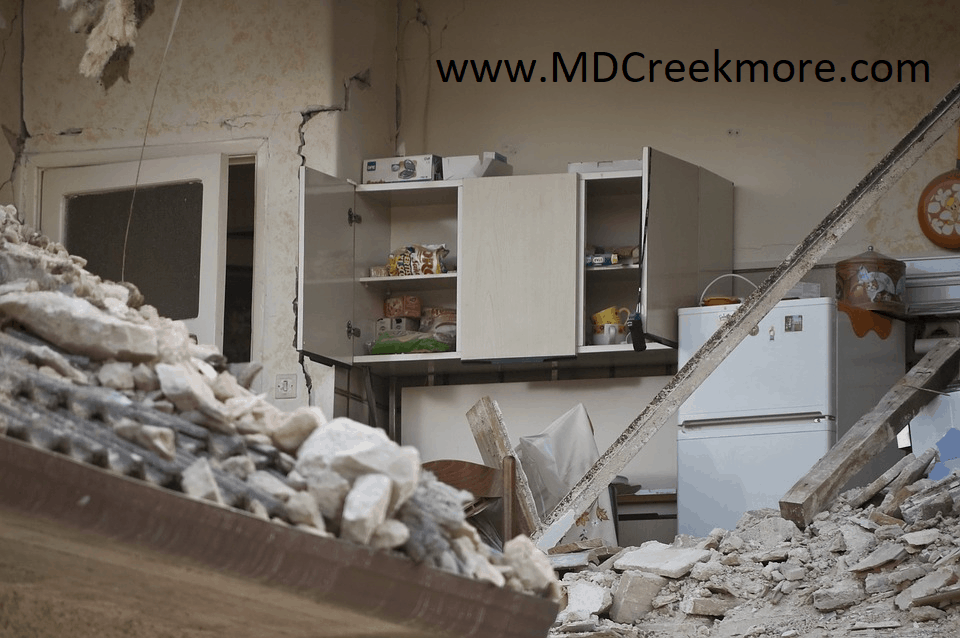
In 1994 a friend of mine was in the Northridge earthquake. She was awakened in the middle of the night by her apartment collapsing around her. She crawled out of the wreckage wearing nothing but her nighty. She met her neighbors in the street. Most were cut, like she was, from scrambling through broken glass on their way out of ruined buildings. Some were missing. Most were found. Several were dead. It was a long time until dawn.

Hearing her recount the story of surviving an earthquake in the middle of the night made me think about surviving an earthquake in the middle of the night. I’m a thousand miles away from California, but I live on a fault line too. My town has a track record. We’re overdue.

Could what happened to her happen to me? What would I do if it did?

There’s one important difference between California and my home Montana. When she was thrown out of bed, it was a warm night, even though it was January 17. Everyone was standing around barefoot in their pajamas. Nobody was cold. Nobody froze to death.

But Montana has a nasty tendency to get very bitterly frigid on a fairly frequent basis, especially in January. If I get bounced out of bed by an earthquake, it might be below zero outside. And people who experience sub-zero on a regular basis know how bad it would be to stand around in the street wearing nothing but pajamas with bleeding feet and shock coming on when it’s ten or twenty below zero.

She is my friend, and I still hear the fear in her voice when she remembers that night. It was harrowing and horrifying and hard. And I knew that if it happened to me on one of those nasty mid-winter nights, it could be a whole lot harder. It might be a very very long time until dawn.

And that’s what made me think, ‘What can I do now that would make it less terrible then?’

I made a list. Then I checked off everything on that list. And if you’ve ever wondered, ‘What if….’ then maybe you should look at this list too.

If you check off everything on the list, then if you’re ever bounced out of bed on a sub-zero night, things might be easier for you.

Take a look. Here’s the list.

After seeing pictures of the wreckage of her apartment, I imagined trying to find my glasses in the middle of that mess. If my glasses fly off the nightstand, fall to the floor, and disappear down some dark and dusty crevice, then I am immediately handicapped. I am hopeless and helpless without my glasses.

So I bought a glasses case on a string, of the type worn around the neck. I tied it to my bedpost. Every night for a thousand nights when I’ve gone to bed, I’ve placed my glasses in that case. They’re never on the nightstand any more. I reach for them automatically in the morning. I always know where they are. They are always within arm’s reach.

Nothing can shake them loose.

That glasses case cost me a buck and it bought me a whole lot of peace of mind. If I’m going to be coping with a quake in the middle of the night, I don’t have to go into the chaos blind. For a dollar, I can always find my glasses.

That is the first thing on the list.

Of course, the electricity went out in Northridge, and it was night, so it was dark. And if the same thing happened to me, I would want light immediately available. Normally I keep flashlights in the junk drawer in the kitchen, and in the basement on the tool bench, and in the car under the seat, but I didn’t want to be in a position where I had to find a flashlight in order to find a flashlight. I didn’t want to waste any time at all fumbling around in the darkness and confusion searching for it.

So I bought a flashlight with a wrist strap attached, and I gave it fresh batteries, and I hung it from my bedpost along with my glasses. Then I wondered, what would happen if the batteries went dead? No light, no more! So I bought a package of extra batteries and put them in the draw in my nightstand.

I also bought a hand-cranked wind-up flashlight/radio/siren/phone charger. I tuned the radio to the station that’s designated emergency broadcast channel in case of emergency. I hung it by its wrist strap from the bedpost as well. The flashlight cost me a buck, the batteries cost me two, the wind-up one cost me twenty. What will they be worth? Plenty.

That’s the second thing on the list. Got eyes, got light. Good to go.

Where am I going? How am I going to get there?

My friend wanted to get into her car and go somewhere safe, but her car was in the garage and the garage was askew and the garage door would not open. She couldn’t even sit in her car because the doors were locked. The keys were in her purse and her purse was probably on the dining room table, or maybe the kitchen counter and both places were buried under so many splinters.

There was a magnetic key under the bumper but it was dark and she didn’t have a light. She was barefoot and the garage windows had shattered all over the ground. She thought she had a flashlight, but it was in the locked car. (Later it turned out the batteries were dead anyway.) So she just stood around in the street and waited for someone to help her to the hospital.

I don’t want to stand around and wait for someone to show up to help me. If it’s ten below zero, waiting around isn’t an option.

So I had a set of spare car keys made up. I added copies of keys of all the places most important to me—the places I’ll want to check first after a disaster, like my office, and my husband’s business. I clipped the keyring to the wristband of the flashlight hanging on my bedpost.

So now, if I’m bleeding and frightened and cold, I can sit in my car and have heat and light and a radio. I’m glad I don’t have a garage, because it will never collapse, trapping my car. I might be able to get to the hospital without waiting for help.

It cost me four dollars to have the keys copied. Keys are third on the list.

If these three things are all you ever do, you will be so much better off when that night arrives than if you never looked at this list at all.

But if you agree that there are many things you can do now that will help you later, then read the rest of the list.

When my friend jumped out of bed, she did it instinctively, without thinking, and without looking before she leaped. She discovered the hard way that every framed family photo had fallen off her dresser top. Every picture on the wall fell. Every window in her apartment shattered.

Every mirror broke. The floor was covered with shards of glass. Her injuries came not from the quake, but from cutting her feet while making her way out of the wreckage. In fact, 80% of the injuries treated in area hospitals were for cuts from the knees down.

So I took an old pair of sturdy tennis shoes that I don’t wear anymore and I put them underneath my bed.  In one shoe I stuffed a pair of socks, and in the other shoe, I stuffed a clean pair of underwear (because if I need ‘em, I’ll be glad they’re there) and also a big bandana. If I’m going to be doing any crying or bleeding or screaming or throwing up, a hanky could come in handy.

To make sure that shards of glass didn’t fall into the shoes, I stuffed them into an old pillowcase. Then, thinking about the sub-zero scenario, I added a few more things to that pillowcase: a pair of jeans (with their pockets stuffed with useful items), a warm shirt, a sweatshirt, a hat, and sturdy leather gloves. There was still room left in the pillowcase and plenty of space under the bed, so I added a couple bottles of water – again, very useful if crying, bleeding, screaming, and throwing up is happening.

In Northridge, it was a long time before water service was restored. In the pockets of the jeans I placed another hanky, a packet of tissues, some hair ties because I hate having my long hair in my face, a chapstick just for comfort, a whistle because it’s so much easier than shouting, and a few mints to suck on just in case there’s throwing up going on.

I added another copy of my car key just in case, and I tucked some folding money in the pockets too because the ATMs and credit card machines aren’t going to work as long as the electricity is down. I might need to buy something, and who knows where my purse will be or how much money I’ll have on hand. If I depended on medication, I would stick extra meds in the pocket too.

I stuffed all that into a pink pillowcase, and then I made up an identical kit for my husband and packed it in a blue pillowcase. In my mind’s eye, I rehearsed the scene a few times in which I practiced NOT jumping out of bed but instead reaching under the bed for the emergency pillowcase first. This way I can at least put on shoes to get out of the house and have clothes to put on while standing around in the street.

Clothing is fourth on the list.

In Northridge, as in most earthquakes, the shaking broke natural gas lines, water pipes, and electrical lines. Water heaters tipped over, and gas and water poured into basements. Explosions and fires popped up all over. The overwhelmed fire department couldn’t put out the fires because the water mains were broken.

So under my bed went two fire extinguishers – one for my husband, one for me – which cost me $10 each. I learned how to shut off the water, electricity, and natural gas to my home. Shutting off the natural gas requires a wrench, so I put a wrench under my bed, and for good measure, I tied another wrench to the gas valve.

The fire extinguisher and wrench may well end up saving my house from complete destruction while others burn down around me. In my imagination, I rehearsed putting on my shoes, grabbing the flashlight, and running outside to turn the utilities off before the house blows up.

Then I even spoke with my neighbors and found out where the utilities are located, so if they are trapped in their house, or if they can’t find their glasses or their shoes or a flashlight or a wrench, I can turn their gas lines off before their homes blew up. This was partly altruistic and partly selfish because if their houses burn down, the fire department isn’t going to be able to do anything about it – and if their houses burn, my house may well burn down too.

The Fire Prevention Kit is fifth on the list.

Next, I assembled an emergency tool kit with a variety of miscellaneous items that might come in handy.

Communications will be difficult or non-existent, so to hedge my bets I added a telephone that does not require electricity but can be plugged directly into the phone jack. I also added a set of walkie-talkies, along with spare batteries for them.

One for my husband, one for me. I put in a battery operated AM/FM radio that clips to my belt. I found out where to tune it for emergency broadcast information and wrote that in magic marker on the radio itself and marked it on the dial.

I stuck in a really good Swiss Army knife (what’s the best Swiss Army Knife for EDC), along with pliers and a hammer in case I have to help pull people out of wreckage through shattered windows. I also included some extra flashlights and more batteries because I expect working flashlights will be in short supply. This tool kit went into a draw-string bag under my bed next to the pillowcases.

The tool kit and all its contents are the sixth item.

Then I assembled a 72-hour kit using the guidelines at www.Ready.gov. I collected ready-to-eat food, bottled water, a first aid kit, toilet paper, pet food and other items, packing it into a Rubbermaid tub with a locking lid that I stored in my garden shed in case the entire house collapses.

If you have made it to this seventh item on the list, you will be in better shape than about 99% of your friends and neighbors.

At this point, I became very interested in learning more about emergency preparedness, so I took emergency response classes, joined the Red Cross, studied FEMA procedures, and teamed up with other people in my community interested in disaster preparedness.

I expanded my emergency kit to include everything I might possibly need: dust masks, goggles, knee pads, elbow pads, and hardhats with headlamps; tents and tarps; floodlights, a generator, Coleman lanterns, and emergency stoves and heaters; bandages and soup; duct tape, plastic sheeting, and spare lumber for covering shattered windows; down coats and sleeping bags; crow bars and car jacks and plenty more fire extinguishers.

I don’t expect people to go to such lengths as I did, but if they did – it would sure make things easier for everyone when that day arrives.

FEMA statistics show that the average American will suffer three disasters over the course of a typical lifespan, with ‘disaster’ defined as any event that disrupts an entire community simultaneously.

When it comes to disasters, there are only two variables, one of which we can control, and the other of which we cannot: There will either be a disaster or there won’t; and we can either be prepared for a disaster, or not.  When combining these two variables, there are four potential outcomes:

  1. There will be no disaster and I will NOT be prepared. (neutral outcome)
  2. There will be no disaster and I WILL be prepared (neutral outcome)
  3. There WILL be a disaster and I will NOT be prepared (negative outcome)
  4. There WILL be a disaster and I WILL be prepared (positive outcome)

We have two choices. We can either wait around for someone to come help us, or we can be prepared to help ourselves. The failure to consciously choose option #2 means choosing option #1 by default. The post-disaster misery index of both an individual and the community as a whole correlates exactly to the proportion of people who choose option #2.

What’s your choice?

Choose wisely.

Filed Under: Prepping

  • « Go to Previous Page
  • Page 1
  • Interim pages omitted …
  • Page 50
  • Page 51
  • Page 52
  • Page 53
  • Page 54
  • Interim pages omitted …
  • Page 79
  • Go to Next Page »

Primary Sidebar

Subscribe to Blog via Email

Enter your email address to subscribe to this blog and receive notifications of new posts by email.

Join 7,202 other subscribers
  • Amazon
  • Facebook
  • Substack
  • Twitter
  • YouTube

“Do more with less.”

– Minimalist proverb

Recent Posts

  • Just so you know
  • Weather Update for My Corner of Appalachia
  • Why I’m Ordering Ivermectin + Mebendazole Every Year
  • The Website’s Shutting Down (But Here’s the Plan)
  • You Are Hated! Start Training Like It!

Footer

Recent Posts

  • Just so you know
  • Weather Update for My Corner of Appalachia
  • Why I’m Ordering Ivermectin + Mebendazole Every Year
  • The Website’s Shutting Down (But Here’s the Plan)
  • You Are Hated! Start Training Like It!

More about me

Books I’ve written

Books I’ve read

Follow Me on YouTube

Follow Me on Facebook

Gear I Use and Recommend

Newsletter

Search this site

Follow me elsewhere

  • Amazon
  • Facebook
  • Substack
  • Twitter
  • YouTube

© 2008–2025 M.D. Creekmore · As an Amazon Associate, I earn from qualifying purchases.