• Skip to main content
  • Skip to secondary navigation
  • Skip to primary sidebar
  • Skip to footer

M.D. CREEKMORE

  • Blog
  • Books
  • Newsletter
  • Gear I Use
  • About
  • Contact
  • Facebook
  • YouTube
  • Blog
  • Books
  • Newsletter
  • Gear I Use
  • About
  • Contact
  • Privacy Policy
You are here: Home / Archives for M.D. Creekmore

M.D. Creekmore

Hello, I’m M.D. Creekmore. I’ve been interested in self-reliance topics for over 25 years. I’m the author of four books that you can find at Amazon.com as well as Barnes and Noble. Over the years, I’ve learned a lot about prepping, homesteading, and self-reliance topics through first-hand experience and now I want to share what I’ve learned with you.

How to Build a Small Game Survival Snare For Rabbit

October 3, 2018 M.D. Creekmore

trap-basic-power-snare-setby SurvivorDan

Before we begin with a discussion of the construction of the most basic primitive/minimal* tension trap; a quick look at the ethics of primitive trapping.

Modern trap use is legal as long as you obey the local laws, licensing, seasons, limits, etc.

Primitive trapping is illegal in most places and definitely in my neck of the woods…er…desert. Exigent circumstances may negate that illegality.

It is to be used in an extreme emergency survival situation only. It is only for keeping you and yours alive in an all-out emergency survival situation. Even practicing setting your traps may run you afoul of the law.

Last year I took Mrs. Survivordan into a national forest and taught her to make a variety of traps. I had her cut the pieces of stick we would need in advance from private property with permission. Any saplings we used in the National Forest for tension were not stripped of ancillary branches and leaves. In other words, we left everything the way we found it.

All traps were sprung after completion, then disassembled and re-bagged. Nothing in that riparian area was disturbed. Still could have ended up having to do some fast talking with the local game warden or ranger. So be careful where you practice these techniques.

And pre-cut whatever devices you need for your traps. Even simply chopping and/or slashing greenery in a state park, National Park or National Forest may land you in a more modern trap. The local hoosegow. The lock-up. Jail. So obey the law and when walking that fine line betwixt legal and illegal while practicing primitive trap building, be law abiding………….and discreet.

Pre-Trapping Strategy

First, I rig up a shelter and build a small fire and put on some water. I dig a little slit trench. Then I sit down and prepare a cup of coffee or tea or some chow. I listen and observe while I work. Usually, while my food or java is heating I walk around the area and reconnoiter a bit. Look for critters and sign. Then I go back to the campsite and eat and drink. Gives me a chance to think about the lay of the land. Did I spy any critters?

Where were the game trails? Did I see any scat? Rub marks and wallows and such? Tracks down by the water (if any water)? If I determined there are game and what kind, for instance, rabbits, then I decide what kind of traps I am going to make and where I might put them.

For rabbits, I usually make a giant crossbow thingy that fires a great big eight-foot spear capped by a massive trident with exploding tips made from .357 magnum shells……….

I’m just kiddin’! The rabbits will get fixed snares (if I have wire) and tension snares on the ground. In this article, I am mainly dealing with traps constructed with string, vines or paracord. Assuming primitive/at-hand materials – no wire. If you do have wire….wire is good. I go where I figure the rabbits ain’t and cut the pieces of stick I’ll be needing.

When I’ve got them whittled up and partially rigged with cord, I usually try to rinse them off with water or wipe some dirt and such on them to get some of my scent off. But I’m getting ahead of myself…..

Making The Trigger Stick

Cut a small simple cylinder of wood, about 5 – 6” long and 1 1/2” – 2” thick. This is the simple trigger for many traps. This is a fundamental piece that you need to learn to make. It is very simple to fabricate. As is the second part of our first trap, the anchor which looks and functions much like a tent stake. That and some cord and we can build our first spring or tension snare.

trap-basic-snare-trigger
Basic Snare Trigger

Back to the trigger…..cut a small 5 – 6” length of wood 1 ½” to 2” thick and about a third of the way from an end, score it about 1/8” deep all the way around with your camp saw or drywall saw. (You can do all this with a knife but why? Cruder but easier with the camp saw.

Either way, watch out that you keep all your fingers so you don’t have to practice one-handed first aid.) That will be a good place to anchor your paracord or another line that goes up to your tension pole. Tie it on good ‘cuz if anything pulls loose you have no dinner and something may smack you in the face while you are setting your trap. But first, let’s cut another notch.

At approximately a third of the way from the other end of the stick, you need to make a mark across it. Cut straight down at that center line mark and alternately shave from the middle of the stick towards the mark until you have a nice ½ to ¾” deep flat surfaced notch. That is where you will catch your trigger stick on its anchor stick. Sounds more complicated than it is. It’s easy.

The Anchor stick
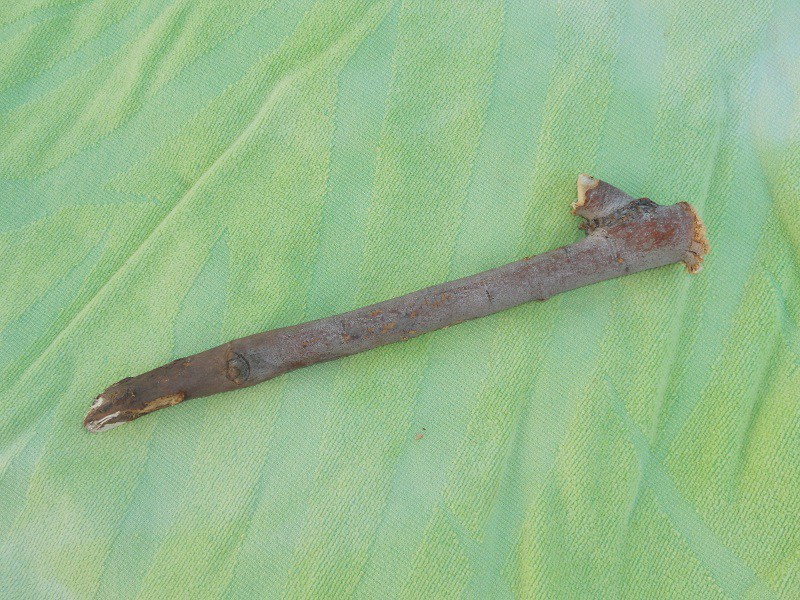
The Anchor stick
The Anchor stick

Find a spot where a branch forks off and cut a stick roughly shaped like this longish stick pictured above. Twelve inches to the fork would be good. If your trap will be set in soft marshy ground in a riparian area, then make it a bit longer.

You want a long strong piece as it will be pounded into the ground. Leave a couple of inches above the forked area as that will be the head of your ‘nail’ when you pound it into position. The fork that you cut off has to be shaped to match up to your trigger so bear that in mind when you cut it originally as it can save you some sawing and filing.

Anyway, this ain’t about mil specs. When you set your trap you can make last-minute adjustments to the interlocking surfaces of the trigger and anchor sticks. Line up the trigger and anchor sticks. It is simpler than it sounds.

The Power Pole

 twitch-up rabbit snare.
How the two go together for a twitch-up rabbit snare.

The power pole should be very close to the actual noose placement. It can be a sapling or a large overhanging branch. If saplings and such are not located where you want to site a trap then you can cut a strong branch and place it vertically in a hole and brace it with rocks.

You could even throw a line over a big overhanging branch and tie it securely to a good size rock or log for your power source. Hoist the rock up and set your tension on your trigger. It’s a fairly simple concept so I will assume common sense will guide you to figure out what to use for a power source.

Once on site, find a good tension pole (rooted sapling or branch) that bends down to about a foot from your trap site with enough tension (power) to hoist your dinner aloft. Bend the tip of the power pole down to where you want to site the trap. Line it up. Pound your anchor stick in with a rock or small log.

Out of respect for the environment and fear of the law, I would not strip the ancillary branches and leaves but in exigent circumstances (ie: you are hopelessly lost and hungry) you can strip the sapling, reducing the weight, and thus increase its power. (For these photos I am using a fishing pole for a power source) You will tie a paracord (Use green, tan or camo cord.- I used this multi-color easy-to-see cord for illustration purposes) to the end of the sapling and allow a foot or so of free cord until you fasten it securely to your trigger stick.

If you can’t tie a basic knot then get on Google and learn as there are all kinds of knot loving sites. Climbers and sailors I reckon. I can only tie about 6 knots and they serve me well. I couldn’t tell you the difference between a reef knot and the Flemish eight. But I got my little arsenal of idiot proof knots and they work. Get yours.

The Noose

Basic power set noose

Assuming you only have the paracord or other strong line and no pre-made wire nooses then you must form a noose from your line. Pretty straightforward. Tie a little loop in the end of a 3-5 foot piece of cord and feed the end of the line thru it (Don’t make the loop too tight so, when sprung, the noose cinches up quickly without binding).

Now you have a nice snare loop (make it 6 – 8 inches across) you can position it horizontally atop of 3-4 small forked twigs, so your future dinner guest steps in it.

Or you can prop it up vertically so your bunny or what-have-you walks into the loop. For bunnies have the bottom of the loop about 3-4 inches off the ground. In my experience, vertical orientation tends to be more productive.

Note: I don’t like set (non-powered) snares with cordage as the critter is likely to chew off the line before expiring or may suffer for a prolonged period of time. There are examples of set snares (no power pole) that are reasonably efficient even with cordage and I may address them in the future.

Modern snares have a one-way device that continually constricts as the animal pulls to get loose and are more likely to effectuate a ‘clean’ kill. Herein I am only addressing primitive powered snares using cordage or vines.

Powering The Snare

DANGER! CAUTION! First, you need to tie the free end of the noose to the trigger stick and set it under power. Now you need to set your loop vertically or horizontally but very gingerly, very carefully so you don’t lose an eye or some teeth if you inadvertently trigger the trap while setting the noose.

Sounds a bit scary but I have never been hurt though I have experienced premature triggering (No jokes please. I’m sensitive.) of my traps while setting them. Keep your head back and your hands-free of the noose while setting. I was wearing safety goggles while setting this trap. You need to have a healthy respect for all traps you set.

The Trap site

Assuming you are a natural-born trap builder and can extrapolate the basic design into a dozen different sure-fire can’t miss critter-killer primitive traps, that doesn’t mean you are going to eat! You could put up 50 traps hither and thither and get nary a bunny for your efforts.
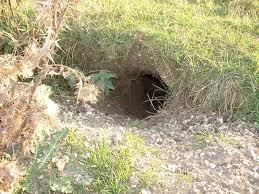
Down-the-rabbit-hole
Rabbit hole

The cardinal rule that applies to retail locations, restaurant sites, hotels, survivalist retreats, gas stations, hunting camps and just about everything else you could want to build or locate somewhere consists of three principles, “Location. Location. Location.” You have to place your traps along the routes between where the animals eat, sleep and drink.

Where do they sleep? Well, a lot of little critters sleep in dens. Holes in the ground (don’t reach in and feel around…ya might find claws, fangs and maybe even some venom), hollowed out logs and tree trunks, nests in the trees ( squirrels ), etc. Larger game like deer, elk, and horses tend to bed down in the grass when they can get it.

You will notice large flattened out areas in the bush. These are not your trapping sites. Wild pigs tend to bed down deep into a thicket and will have scraped away the ground cover down to the dirt, in fact, if you can stand and see their bedding area you are not looking at their bedding area.

You would usually have to crawl back into it and you do not want to meet a feral hog in that position. It would get ugly.

Of course, the type of trap in this article is not designed to take out a large animal. But by understanding the signs for large animals you will not waste your tension trap there. Your target critter is most likely going to be a bunny. Typically you can find bunnies in many environments.

They will den in holes, usually inter-connected to form warrens so watch out as there will be more than one way in and out. You can locate a few holes and place a snare at each one. You should look for runs which are the flattened out paths through the bush that the rabbits use to get from their dens to their feeding and watering areas.

The rabbit runs often exhibit sign like bits of grass clipped off and rabbit ‘pellets’ (scat/poop) scattered along the run.
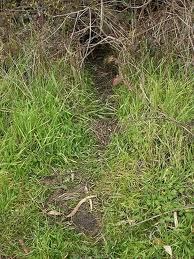
rabbit-run
Rabbit run

If the run is very large and you see large hoof prints then you are probably looking at a pig run and need to build a bigger trap! I suggest that if you are a new survivor trapper, you should stick to bunnies, chipmunks, squirrels and such until you get a bit more confident and a bigger repertoire of traps.

Besides, you need snare wire and cable for the big critters like feral hogs. Back to the bunnies …. some species of rabbits sleep in the dense thickets and thorns rather than underground.

You will set traps for all types of rabbits on their runs and catch them coming and going. {By the way, if you’ve got a slingshot or smoke pole you might just lurk somewhere and pop off a bunny around sunset or dawn when they’re on the move along one the rabbit runs.

I’m just saying that two layers of critter harvesting is better than one.} Be aware that rabbits don’t stray to far from where they den up as they have many enemies.

If you have had little luck finding the rabbit’s runs for some reason and you have located a water source such as a small stream or a pond you will need to backtrack from there. Many critters doubtless come to that water to drink eventually.

If there is small game in the area you will find runs and bigger game trails leading to and from the water. Pick the ones that seem to have your target critter using them (meaning if there are huge hoofprints or paw prints and you can’t discern any little tracks, find another game trail or run) and set your traps.

Remember….look for tracks and scat (poop). Site your traps in the narrowest part of the runs. You may need to place some sticks or brambles in such a way as to funnel the rabbits to your noose. While you are doing that and when you are setting your traps try to avoid leaving too much human scent on everything.

At least don’t be wearing any deodorant, cologne, hairspray/gel, soap residue, hand lotion, bug spray…..well, you get the picture.

rabbit-pellets
Rabbit pellets

Try not to stink up the bunnies world cuz they will know something is not right. If setting your snare or noose vertically then you want the bottom end only 3-4 inches from the ground. We are aiming for the bunnies head.

Speaking of his head, bring a big stick when you go to check your traps. Cordage snares don’t always dispatch your critters. Make it quick. And on that note, check your traps often (every 5-6 hours). You don’t want the little critters to suffer and you want a coyote to steal ‘em neither.

Those of you more sensitive to killing and field dressing an animal, I want you to know that I am not a natural-born hunter. Some of my friends enjoy the kill. I really don’t. It’s for meat. To survive. It’s a necessary task in order to keep yourself and comrades fed. You don’t have to enjoy it. Just do what you have to do.

Get Your Hands Dirty

You think you’ve got all this down? You can do it when you need to? Photographic (eidetic) memory? Practice now when you don’t need this skill. When you need to do it for real it will seem so natural and you will build your traps easily and correctly so they are effective.

Lives may depend on it. You don’t want on-the-job training and have your dinner get loose from a defectively constructed tension trap.

So cut some sticks. Make a couple of basic traps until you are comfortable and confident in building them. Securely prop up a fishing pole in the backyard and use it for a power source (wear safety glasses) to practice your trap building skills. (In my backyard I buried a 14″ PVC pipe with a removable cap to put my power stick in for teaching purposes) You will come to realize that you could fashion a half-dozen such traps in an hour and set them in another hour or two.

Trigger your practice traps immediately so you don’t snare/kill Fluffy. Don’t run to get Momma to show her your neat-to new trap cuz, for sure and for certain, that’s when Fluffy will find it! Anyway, that’s 6 traps out there working for you 24/7. Think about that. Much more productive than chasing fast-moving rabbits with your tire iron in hand. Smarter too. Good trapping!

Practice your trapping skills. Be a survivor.

* As we are utilizing manufactured cordage one could argue these traps are not truly ‘primitive’ traps. For instructional purposes and simplicity here we will designate such traps as primitive as opposed to ‘humane’ modern manufactured traps.
Filed Under: Bushcraft

How To Be A Prepper With A Disability

September 22, 2018 M.D. Creekmore

how to be a prepper with a disability

by W. D. Sultemeier – The Wheelchair Prepper

When MD asked for readers’ help I responded with a suggestion for an article about and for the prepper who finds himself in a handicapped situation. I really meant the suggestion for MD to take the ball and run with it but he turned the table and challenged me to prepare a guest post.

I was diagnosed with a syrinx on my thoracic spinal cord in 1996. I was a teacher/coach at the time at a local public school and due to a stroke suffered by my dad in ’93, I was also operating the family cow/calf business. I was while having earned a pair of college degrees, someone who preferred a physical, outdoor lifestyle.

The prospect of spinal surgery was frightening, to say the least but the option was limited. The cyst was removed but the damage to the spinal cord was already done due to its lack of elasticity. Thus began a slow debilitation.

Let me say I seek no sympathy and have looked at this episode as a challenge. Pain management is the biggest part of my altered life. A gradual change in my mobility required an “adjustment” to my lifestyle. I went from a limp to a cane, to crutches and walker, to finally a wheelchair.

I had time to make some preparations for the changes that were coming. Those who find themselves faced with an abrupt physical change have a daunting but do-able task before them.

Making the structural changes necessary will challenge many depending on the individual’s situation. I was able to make my surroundings more easily manageable due to the length of time involved. Construction of ramps(not ADA approved), installation of handicap bars in the shower and at the toilet, making room to access the bed and closet space, were all things I was able to deal with.

Early on I was able to build and improve pathways around my house, shop, and barns, using hard-packed granite gravel from sources from the ranch. I was fortunate to have access to equipment and even unto this day have some ability to operate that machinery. I have to remind myself daily what can be done or should not be attempted, with safety being paramount.

I never leave the house without my cell phone. I sometimes feel a slave to that concession to my wife. I am very lucky that I have access to a battery-powered scooter and a power chair. These are used at the house and around the place. I do not take off out into the pastures with the scooter ( even though I would love to ) but do use it in the yard and to the shop and barns.

When we go somewhere, i.e. church, doctor, store, etc., I use a handed down traditional wheelchair for ease of handling into and out of the vehicles.

Like any of you, my wife and I stockpile canned and dry foods, store potable water, maintain first aid supplies, add to the ammunition stores, and do many of the things we have learned from MD’s blog. The point of this missive is to make one see that preparing can be done regardless of one’s physical abilities. Contributions can be made by pretty much anyone.

I come from a very tall family. I stand 6’5”, the wife is 5’10”, son is 6’8” and my daughter and her husband are both over 6’. Our house was built with that in mind 20 years ago with cabinets and pantry shelves reflecting our stature.

Today I need a “grabber” to reach some of the items and a careful balance to get others. We raised the kitchen table (hand-made by my grandfather) to allow me access in my power chair. Since my wife still works off-farm, I do the meal preps and try to keep the house (not very good at that). Because I can get to the table to help cut up meat, process fruit and vegetables, we have been able to keep our freezers full.

Gardening has been a tough one for me. I grew up with a seasonal garden at least a half acre in size. I would still love to get out into the middle of one but riding a scooter into a plowed garden would not be too simple. This year I had my son plow strips with space for packed ground to drive between rows. I have been keeping my hands dirty by container gardening.

Because I cannot get out among the cattle easily or safely to feed them, I began feeding them using 250# tubs of molasses lick. When empty, with perforated bottoms, these tubs make great container beds and are a good, easily accessible height.

I have gone from a short hoe to tractor and tiller, back to a short hoe for my gardening tool of choice. This past spring-summer I grew okra, beans, squash, tomatoes, peppers. I still have various herbs and shallots growing in these tubs.

After reading ONE SECOND AFTER, my wife became more supportive of the idea and efforts of being prepared for different situations (she recently broke her right arm). My adult children are like-minded and contribute as they can, be it with the butchering, vegetables, or keeping a good supply of firewood up to the house. Of course, they help with the regular ranch work as much as they can since they have been exposed to this life from the time they were little and not afraid to get a bit dirty.

We put together a rig for me to haul firewood to the house by pulling it with my scooter. I have moved my target range closer to the house so I can practice shooting. My kids are both shooters and better shots than I.

These days the practice is mostly with 22’s but the occasional feral hog still meets the business end of my .357 magnum. I am still proficient with my other pistols, rifles, and shotguns.

I don’t really foresee myself clearing the house at night with my wheelchair and Glock 21 but it would not be wise to enter our house uninvited. I have not thought too much about renewing my CCW permit, but I am determined to do so.

For those who think there is little hope or usefulness left to them due to a handicap…they are wrong. I have and continue to acquire source material on many topics covered in this blog. When TSHTF providing information will be a major contribution to keep you and yours safe and prepared.

Being a keeper of knowledge (sharer of knowledge) is and always has been a revered place in society. One can still work in one’s shop, doing projects, limited only by one’s imagination. After making room to navigate around the workbench and various tools, I recently began working on a Vertical Axis Wind Turbine using the heavy lids from the same feed tubs as the wings.

Getting power to make our lives easier when TSHTF is now a bigger concern. I will need something to charge my mobility batteries when the grid goes down. Solar panels and a bank of batteries are on the “someday” list. Money is always a factor for most of us.

The concept of bugging out is a bit more difficult in a wheelchair situation. I still have bags for my wife and myself in case we have to get out in a hurry. Preparations have been made setting up a site away from the house if the need arises.

The thing that disturbs me is being able to get back home if something catastrophic occurs while away. I keep emergency bags and firearms in each vehicle that sees time away from home. My fear is making a 30 to 60 mile trip in a wheelchair. I cannot jog but do try to keep the upper body fit.

There are assuredly many things I have omitted and others’ situations will be different, but one must remember that just because one is in a wheelchair or is in some way handicapped, one must still do what he can to prepare and help himself and his loved ones survive.

If you have tips, advice or survive with a disability I would love to hear from you in the comments below…

Filed Under: Prepping

Colorado Knife Laws: A Guide for Knife Carriers!

September 22, 2018 M.D. Creekmore

colorado knife laws
Colorado Knife Laws

Colorado conjures images of the Rocky Mountains, snow-capped ski slopes and wide-open space. Colorado is not the most restrictive state in terms of knife laws, but it is certainly not the most relaxed either.

As a state that falls in the middle of being knife friendly and knife-restrictive, it is important to understand which knives are legal to own and carry, whether open or concealed.

In short, it is legal to own almost any knife, including a gravity knife and/or a switchblade, in Colorado other than a ballistic knife. Additionally, pocket knives or any other knife with a blade that is shorter than three and one-half inches is legal to carry open or concealed.

Overview of Colorado Knife Laws

Knife laws in Colorado are a combination of several other states’ restrictions with additional rules thrown in. There are important restrictions to understand relating to ownership, conceal carry and affirmative defenses available to knife owners.

Permitted Knives

First, it is legal to own the following knives:

  • Dirks
  • Daggers
  • Push knifes
  • Stilettos
  • Bowie knives
  • Disguised knives

According to Colorado law, it is not only illegal to own ballistic knives, but ownership is a felony. Colorado Law provides: “(1) As used in this section, the term “dangerous weapon” means a firearm silencer, machine gun, short shotgun, short rifle, or ballistic knife. (2) As used in this section, the term “illegal weapon” means a blackjack, gas gun, metallic knuckles, gravity knife, or switchblade knife. (3) A person who knowingly possesses a dangerous weapon commits a class 5 felony. Each subsequent violation of this subsection (3) by the same person shall be a class 4 felony. (4) A person who knowingly possesses an illegal weapon commits a class 1 misdemeanor.”

Concealed Carry in Colorado

The relevant law reads, in part: “ (1) A person commits a class 2 misdemeanor if such person knowingly and unlawfully: (a) Carries a knife concealed on or about his or her person; “Knife” means any dagger, dirk, knife, or stiletto with a blade over three and one-half inches in length, or any other dangerous instrument capable of inflicting cutting, stabbing, or tearing wounds, but does not include a hunting or fishing knife carried for sports use. The issue that a knife is a hunting or fishing knife must be raised as an affirmative defense.”[i] (emphasis added)

Blade Length Limits in Colorado

It is a crime to conceal carry certain knives over three and one-half inches long. The law reads, in part, that a knife including “… any dagger, dirk, knife, or stiletto with a blade over three and one-half inches in length or any other dangerous instrument capable of inflicting cutting, stabbing, or tearing wounds, but does not include a hunting or fishing knife carried for sports use.”

Recent Case Law and Defenses

Like many other states, Colorado looks to the intended use of a knife in addition to the legislation. In a widely cited case, The Colorado Supreme Court has interpreted the unlawful carrying statute as prohibiting the conviction of a person for carrying a knife with a blade less than three-and-one-half inches (3½”) in length, absent proof that the person intended to use the knife as a weapon. Moreover, such intent cannot be inferred solely from the appearance of the knife in question. A.P.E., a Juvenile v. The PEOPLE of the State of Colorado, 20 P.3d 1179 (Colorado Supreme Court 2001).[ii]

Moving Forward

While ownership of knives is rather lax in Colorado, it is not without limits. There is no state law preemption in Colorado, meaning that knife owners should be cognizant of their surroundings at all times.

Additionally, there is no specific law relating to the transfer of knives to minors or carrying limitations applicable to minors. As always, knife owners should be cognizant of their surroundings and be particularly mindful of carrying knives on public property, government buildings, schools, and airports.

[i] 18-12-105. Unlawfully carrying a concealed weapon – unlawful possession of weapons

[ii] https://www.akti.org/state-knife-laws/colorado/

None of the material in this article should be interpreted as legal advice.  I am not a lawyer. Never take any action with legal consequences without first consulting with a lawyer licensed in your jurisdiction. This article should not be relied upon for making legal decisions. This information is provided for scholarship and general information only.

[ Note: Out of all of the pocket knives available on Amazon.com this one is my favorite everyday carry knife – click here to see what it is on Amazon.com. I love this knife! It’s built like a tank and holds an edge better than any other knife that I’ve owned…]

Check out these related articles:

  • What’s The Best Multi-Tool to Buy For EDC
  • Best Survival Knife of for Under $100
  • Best Folding Knives For Self-Defense
  • Work Sharp Pocket Knife Sharpener Review
  • SOG Tactical Tomahawk Review

Filed Under: Knife Laws by State

Maryland Knife Laws: A Guide for Knife Carriers!

September 22, 2018 M.D. Creekmore

Maryland knife laws
Maryland Knife Laws

Maryland’s knife laws have been under scrutiny lately. The Chesapeake State is not only in close proximity to the Washington, D.C., but it is the home to one of the most violent cities in America, Baltimore, which reported 98.6 violent crimes per 10,000 residents in 2018.[i]

However, it is not just a surge in violent crimes that have brought Maryland’s knife laws back into focus.

It is the prohibition on the possession of switchblade knives, thought to be an antiquated law that has led to alleged thousands of invalid arrests, that have led activists to investigate and question the laws utility, if any.[ii]

Restrictions do not just apply to switchblades and gravity knives in Maryland, however.

A far more cumbersome system exists in Maryland— and one that has proven not to be knife friendly.

Overview of Maryland Knife Laws

While there are no limitations on the type of knife you can own in Maryland, there are limits on open and concealed carry. Additionally, there are no state preemption so different counties may impose stricter limits on carrying. The law, which is codified at Md. Criminal Law Code Ann 1-101(2012), is regularly described as archaic.

For this reason, many find Maryland knife laws confusing. The text of the law has been the subject of debate recently in the high-profile case regarding the death of Freddie Gray, where there was a sizable debate on whether the knife he was carrying at the time of his arrest was legal or not.[iii]

Given that the knife was never shown to the public, this may seem like a moot point, but it speaks to a larger issue in Maryland knife laws – how a dangerous weapon is defined in black letter law.

Even before the case of Freddie Gray, a man was charged with carrying a concealed weapon when he was in possession of a knife at Starbucks.[iv] A careful reading of Maryland’s knife laws is critical.

Permitted Knives

There are no restrictions on the types of knives that are legal to own in Maryland. Surprisingly, and unlike many other states, undetectable knives, larger knives, throwing stars and bowie knives are also legal to own.  The following knives are legal to own:

  • Butterfly knives
  • Dirks, daggers, stilettos, and other slim knives.
  • Switchblades
  • Gravity knives
  • Automatic knives
  • Ballistic knives
  • Disguised knives

Dangerous Weapons

  • 4-101 defines star knives and classifies which knives are deemed weapons. The statute, in part, reads: “ ‘[A] Star knife’ means a device used as a throwing weapon, consisting of several sharp or pointed blades arrayed as radially disposed of arms about a central disk. [A] ‘Weapon’ includes a dirk knife, bowie-knife, switchblade knife, star knife, sandclub, metal knuckles, razor, and nunchaku.”

Interestingly, Md. Code, CR § 4-101(a)(5)(i) excludes penknives as a dangerous weapon unless it has a switchblade.

Maryland law does prohibit concealed carry of a dangerous weapon, which includes “chemical mace, pepper mace, or a tear gas device openly with the intent or purpose of injuring an individual in an unlawful manner.” It is worth noting that this prohibition applies in certain counties, including Anne Arundel County, Baltimore County, Caroline County, Cecil County, Harford County, Kent County, Montgomery County, Prince George’s County, St. Mary’s County, Talbot County, Washington County, and Worcester County.

Here is where the arcane language comes in. Minors in certain counties cannot carry a dangerous weapon between certain times. The law reads: “(ii) A minor may not carry a dangerous weapon between 1 hour after sunset and 1 hour before sunrise, whether concealed or not, except while: 1. on a bona fide hunting trip; or 2. engaged in or on the way to or returning from a bona fide trap shoot, sport shooting event, or any organized civic or military activity.”

In Maryland, a person who violates this law is “guilty of a misdemeanor and on conviction is subject to imprisonment not exceeding 3 years or a fine not exceeding $ 1,000 or both” and if it “appears from the evidence that the weapon was carried, concealed or openly, with the deliberate purpose of injuring or killing another, the court shall impose the highest sentence of imprisonment prescribed.”

Prohibition on the Transfer of Switchblades and Ballistic Knives

The relevant law reads, in part, “A person may not sell, barter, display, or offer to sell or barter: (1) a knife or a penknife having a blade that opens automatically by hand pressure applied to a button, spring, or other device in the handle of the knife, commonly called a switchblade knife or a switchblade penknife; or (2) a device that is designed to propel a knife from a metal sheath by means of a high-compression ejector spring, commonly called a shooting knife.” The penalty for violations of this law? Imprisonment and a fine not exceeding $500 or possibly both.

Specific Bans on School Property

A person cannot possess, display or carry a knife on school property. The pertinent law reads, in part: “A person may not carry or possess a firearm, knife, or deadly weapon of any kind on public school property.” There are, of course, limited exceptions. However, the penalties are stiff: “[A] person who violates this section is guilty of a misdemeanor and on conviction is subject to imprisonment not exceeding 3 years or a fine not exceeding $ 1,000 or both.”[v] Knife owners should be particularly aware of this law and ensure that they do not carry by any means on school grounds.

Moving Forward

Given the proximity to the Nations’ capital, advising all knife owners to be wary of their surroundings and jurisdictional changes when traveling is an understatement.  While Maryland is not the most restrictive state, there is certainly more that can be done in terms of evolving the state’s knife laws.

While switchblades and gravity knives are legal to own, as with many other states, possessing a knife on public school property is illegal.[vi] There are also specific rules relating to the transfer of switchblades and ballistic knives. Given that Maryland does not have state law preemption, county rules are also important to note. In sum, Maryland knife owners – be careful.

[i] https://www.businessinsider.com/most-violent-city-every-us-state-fbi-2018-4

[ii] http://blogs.villagevoice.com/runninscared/2014/10/nyc-gravity-knife-law-arrests.php

[iii] For more information: https://www.villagevoice.com/2015/04/27/prosecutor-says-freddie-grays-knife-was-legal-under-maryland-state-law/

[iv] https://www.fredericknewspost.com/news/crime_and_justice/man-charged-with-carrying-knife-in-starbucks/article_984327ba-0bbc-53bf-8d5c-3624aed48226.html

[v] Md. CRIMINAL LAW Code Ann. § 4-102 (2012)

[vi] Md. Code, CR 4-102.

None of the material in this article should be interpreted as legal advice.  I am not a lawyer. Never take any action with legal consequences without first consulting with a lawyer licensed in your jurisdiction. This article should not be relied upon for making legal decisions. This information is provided for scholarship and general information only.

[ Note: Out of all of the pocket knives available on Amazon.com this one is my favorite everyday carry knife – click here to see what it is on Amazon.com. I love this knife! It’s built like a tank and holds an edge better than any other knife that I’ve owned…]

Check out these related articles:

  • What’s The Best Multi-Tool to Buy For EDC
  • Best Survival Knife of for Under $100
  • Best Folding Knives For Self-Defense
  • Work Sharp Pocket Knife Sharpener Review
  • SOG Tactical Tomahawk Review

Filed Under: Knife Laws by State

Maine Knife Laws: A Guide for Knife Carriers!

September 22, 2018 M.D. Creekmore

maine-knife laws
Maine Knife Laws

Maine has some of the most picturesque landscapes in the United States. It only makes sense that the state most known for lobster would allow permit possession of most types of knives.

It is legal to own all types of knives in the Pine Tree State including switchblades and automatic knives. However, the laws around concealed carry and the display of knives are less concrete. Recent changes in the law and cases that have tried to illuminate distinctions in what makes a weapon “dangerous” have led to confusion.

However, a brief history of knife laws in Maine will assist in clarifying what one can and cannot do. In summary, Maine, like many other states, relies on an expansive definition of intended use.

History of Maine Knife Laws

Like many states, the year 2015 was a turning point year for residents of Maine. Before 2015, anyone who wanted to carry a concealed weapon needed a police-issued permit.

The permit requirements were extensive and included a background check, fingerprints, criminal history information, domestic violence investigation(s), a screen for drug use and mental health disorders, and proof that the permit applicant passed a gun safety course.

The current law allows legal firearm owners to carry concealed handguns without a permit. The new law also repealed a 1959 ban on switchblades, butterfly knives and other blades that open automatically.

Permitted Knives in Maine

The following are legal to own in Maine:

  • Pocket knives
  • Bowie knives
  • Daggers
  • Single-edged and double-edged fixed blades
  • KA-BAR knives
  • Sword Canes
  • Stilettos
  • Throwing knives
  • Belt knives and other disguised knives
  • Hunting knives
  • Utility blades

Restrictions on Concealed Carry

A person is not allowed to carry certain concealed weapons which include dirks, bowie knives, stilettos, and other dangerous or deadly weapons. With the exception of knives used to hunt, fish or trap, a person may not “display in a threatening manner a firearm, slungshot, knuckles, bowie knife, dirk, stiletto or other dangerous or deadly weapon usually employed in the attack on or defense of a person; or wear under the person’s clothes or conceal about the person’s person a firearm, slungshot, knuckles, bowie knife, dirk, stiletto or other dangerous or deadly weapon usually employed in the attack on or defense of a person.”[i] (emphasis added)

There are two elements that are important to the interpretation of this law. First, the statute clearly states that a person cannot “display in a threatening manner” which is not clearly defined. Of course, holding a knife to someone’s throat would be a display in a threatening manner.

However, given that the statue is not clear what constitutes such a display it is easy for one to conclude that a determination one has broken the law will come down to a fact-based scenario. Second, the law does not define the type of weapon that would be usually employed in the attack or defense of another person.

However, it seems that the intended use of the knife, rather than simply the classification of the knife itself, is paramount in determining if it is a dangerous or deadly weapon. As an example, if one can conclude that if a knife was not designed for use against humans it can be carried concealed.[ii] Put another way, if a knife was designed solely to harm other humans it cannot be carried concealed.

It does appear that the Courts are moving away from a strict reading of the statute. In 2012, the Maine Supreme Court overturned the conviction of a man who was found in possession of two ordinary folding knives. The Court stated in State v. Jones, that:

“The [trial] court, in its written findings of fact and conclusions of law, noted ‘the size, the heft, and the sharp and serrated edges of the [blades]’ and that ‘these knives would easily do significant damage to human tissue, human organs, and major arteries.’ Such a description, however, could be given of any knife and renders Jones’s knives indistinguishable from those that the Legislature has expressly exempted from the prohibition against concealment.

Thus, there is no factual basis in the record to support a conclusion that Jones’s knives fall within the class of knives that the Legislature has prohibited individuals from concealing.”[iii] (emphasis added)

This decision is important for a number of reasons, among them, being that the decision came down from the state’s highest court. It is also important to note that the Court discussed legislative intent in its decision. The Court also noted: “It is the intrinsic qualities of the knife, not the circumstances in which it is found, that informs the determination whether it is the type of knife that the Legislature has prohibited from being concealed.

Any other approach would produce inconsistent results, leave the public to guess as to how to conform its conduct to the law, and judicially engraft a culpable state of mind requirement into a statutory provision that is silent as to intent.”

Limit of Blade Length & Other Exceptions

There is no maximum blade length is established by Maine’s knife laws. One-armed people are permitted to own and transport gravity knives, switchblades, or balisong knives if the blade of the knife is shorter than three inches long. The only knife length limit is the 3” limit for exempted switchblades and gravity knives carried by one-armed individuals.

Knife Laws Moving Forward

Cases will further clarify Maine’s knife laws by adding to the canon of intended use. Additionally, cases will help clarify which knives (and perhaps which situations) will permit concealed carry. Remember that knives are still prohibited on school grounds under school district rules – state preemption does not apply in Maine.

Knife owners should be cognizant of the jurisdictions they are traveling in at all times. Given that a sweeping overhaul of the law has already occurred in Maine, it is unlikely we will see any changes in the near future. Travelers to Maine should rest assured that residents can own switchblades – a welcome lift of a generations-old restriction.

[i]  25 M.R.S. §2001-A (2012)

[ii] http://www.mainelegislature.org/legis/statutes/25/title25sec2001-A.html

[iii] https://docs.google.com/viewer?url=http%3A%2F%2Fwww.courts.state.me.us%2Fopinions_orders%2Fopinions%2F2012_documents%2F12me88jo.pdf

None of the material in this article should be interpreted as legal advice.  I am not a lawyer.  Never take any action with legal consequences without first consulting with a lawyer licensed in your jurisdiction.  This article should not be relied upon for making legal decisions.  This information is provided for scholarship and general information only.

[ Note: Out of all of the pocket knives available on Amazon.com this one is my favorite everyday carry knife – click here to see what it is on Amazon.com. I love this knife! It’s built like a tank and holds an edge better than any other knife that I’ve owned…]

Check out these related articles:

  • What’s The Best Multi-Tool to Buy For EDC
  • Best Survival Knife of for Under $100
  • Best Folding Knives For Self-Defense
  • Work Sharp Pocket Knife Sharpener Review
  • SOG Tactical Tomahawk Review

Filed Under: Knives and Blades

California Knife Laws: A Guide for Knife Carriers!

September 22, 2018 M.D. Creekmore

California knife laws
California Knife Laws

Knives laws in the Golden State are not as complicated as they initially seem. California is a big state and there is no state law preemption. Surprisingly, however, California is relatively relaxed in terms of ownership.

Broadly speaking, carrying knives whether open or concealed is legal in California. However, it is illegal to own many knives which are detailed below. It is also important to note that California, unlike many other states, has a very clear and strict definition of switchblades.

While knife owners should always be cognizant of the jurisdiction in which they are carrying, California is more welcome than most. The open and concealed carry of many knives is completely legal.

Restrictions on Knife Ownership in California

California is an open-carry state. Rather than listing, the knives are that legal to own, it may be easier to list the knives that bear restrictions. It is illegal to own the following types of knives in California:

  • Cane knives, lipstick knives, belt knives and any other knife that can be classified as misleading is illegal to own in California;
  • Undetectable knives, like misleading knives, are also outlawed
  • Dirks
  • Daggers
  • Stillettos
  • Ballistic knives

Switchblades in California

It is legal to own a switchblade that is less than two inches or shorter. The relevant law reads: “Every person who does any of the following with a switchblade knife having a blade or two or more inches in length is guilty of a misdemeanor: (a) possesses the knife in the passenger or driver’s area of any motor vehicle in any public place or place open to the public (b) carries the knifes upon the person (c) Sellers, offers for sale, exposes for sale, loans, transfers or gives the knife to any person.”[i]

This statute begs the question of whether it is legal or not to carry a switchblade in one’s personal vehicle. The plain reading of this statute suggests that it is legal to carry a switchblade in one’s car as long as the blade of the knife is less than two inches long. However, California defines switchblade in great detail stating that a switchblade is:

“[A] knife having the appearance of a pocketknife and includes a spring-blade knife, snap-blade knife, gravity knife, or any other similar type knife, the blade or blades of which are two or more inches in length and which can be released automatically by a flick of a button, pressure on the handle, flip of the wrist or other mechanical device, or is released by the weight of the blade or by any type of mechanism whatsoever.

“Switchblade knife” does not include a knife that opens with one hand utilizing thumb pressure applied solely to the blade of the knife or a thumb stud attached to the blade, provided that the knife has a detent or other mechanism that provides resistance that must be overcome in opening the blade, or that biases the blade back toward its closed position.”[ii] (emphasis added)

Knife owners should be cognizant of whether their particular knife fulfills all of the criteria outlined by this definition.

Open and Concealed Carry in Calfornia

The law also notes that all legal fixed blades knives must be worn in plain sight. Dirks and daggers are exempted from this law. There is no language in the law that prevents openly carrying a sword or similar knife.

Any blade that is concealed that is found to be locked in the open position cannot be conceal carried. The law, in relevant part, reads: “As used in this part, “dirk” or “dagger” means a knife or other instrument with or without a handguard that is capable of ready use as a stabbing weapon that may inflict great bodily injury or death.

A nonlocking folding knife, a folding knife that is not prohibited by Section 21510, or a pocketknife is capable of ready use as a stabbing weapon that may inflict great bodily injury or death only if the blade of the knife is exposed and locked into position.” (emphasis added)[iii]

Moving Forward

California is one of the friendlier states for knife owners. Following a “two-inch” rule, however, is prudent. If the blade of the knife is longer than two inches, it is not wise to conceal carry. There are additional rules for Los Angeles County specifically, which outlaw openly carrying a knife with a blade over three inches long.

It is important, as always, for knife owners to be cognizant of their surroundings and take appropriate precautions when carrying in a public place.

[i] https://leginfo.legislature.ca.gov/faces/codes_displaySection.xhtml?lawCode=PEN&sectionNum=21510

[ii] http://leginfo.legislature.ca.gov/faces/codes_displaySection.xhtml?lawCode=PEN&sectionNum=17235

[iii] https://hobanco.com/blogs/news/california-knife-laws

None of the material in this article should be interpreted as legal advice.  I am not a lawyer. Never take any action with legal consequences without first consulting with a lawyer licensed in your jurisdiction. This article should not be relied upon for making legal decisions. This information is provided for scholarship and general information only.

Note: Out of all of the pocket knives available on Amazon.com this one is my favorite everyday carry knife – click here to see what it is on Amazon.com. I love this knife! It’s built like a tank and holds an edge better than any other knife that I’ve owned…]

Check out these related articles:

  • What’s The Best Multi-Tool to Buy For EDC
  • Best Survival Knife of for Under $100
  • Best Folding Knives For Self-Defense
  • Work Sharp Pocket Knife Sharpener Review
  • SOG Tactical Tomahawk Review

Filed Under: Knife Laws by State

  • « Go to Previous Page
  • Page 1
  • Interim pages omitted …
  • Page 61
  • Page 62
  • Page 63
  • Page 64
  • Page 65
  • Interim pages omitted …
  • Page 79
  • Go to Next Page »

Primary Sidebar

Subscribe to Blog via Email

Enter your email address to subscribe to this blog and receive notifications of new posts by email.

Join 7,202 other subscribers
  • Amazon
  • Facebook
  • Substack
  • Twitter
  • YouTube

“Do more with less.”

– Minimalist proverb

Recent Posts

  • Just so you know
  • Weather Update for My Corner of Appalachia
  • Why I’m Ordering Ivermectin + Mebendazole Every Year
  • The Website’s Shutting Down (But Here’s the Plan)
  • You Are Hated! Start Training Like It!

Footer

Recent Posts

  • Just so you know
  • Weather Update for My Corner of Appalachia
  • Why I’m Ordering Ivermectin + Mebendazole Every Year
  • The Website’s Shutting Down (But Here’s the Plan)
  • You Are Hated! Start Training Like It!

More about me

Books I’ve written

Books I’ve read

Follow Me on YouTube

Follow Me on Facebook

Gear I Use and Recommend

Newsletter

Search this site

Follow me elsewhere

  • Amazon
  • Facebook
  • Substack
  • Twitter
  • YouTube

© 2008–2025 M.D. Creekmore · As an Amazon Associate, I earn from qualifying purchases.