• Skip to main content
  • Skip to secondary navigation
  • Skip to primary sidebar
  • Skip to footer

M.D. CREEKMORE

  • Blog
  • Books
  • Newsletter
  • Gear I Use
  • About
  • Contact
  • Facebook
  • YouTube
  • Blog
  • Books
  • Newsletter
  • Gear I Use
  • About
  • Contact
  • Privacy Policy

Blog

New Hampshire Knife Laws: A Guide for Knife Carriers!

September 22, 2018 M.D. Creekmore

Flag-of-New-Hampshire-knife laws
New Hampshire Knife Laws

New Hampshire is one of the original thirteen colonies. Only three years after the Pilgrims landed at Plymouth, the first settlers inhabited present-day Portsmouth. When New Hampshire adopted its own constitution in January of 1776, that founding history of leadership and independence was underscored.

While the state motto of “Live Free or Die” was not officially adopted until 1945, it is arguably the most well-known state motto and undoubtedly rings true – particularly as it applies to the state’s knife laws.

New Hampshire is one of the most knife-friendly states. In recent years, the state has made great strides in overturning legislation many found to be archaic. Today, there are few restrictions on knife owners. In sum, non-convicted felons may own and carry knives with little restriction almost anywhere in the state. There are a few other important points to note about knife ownership as well.

History of New Hampshire Knife Laws

In 2010, bipartisan support for reform in New Hampshire’s knife laws led to a repeal of the ban on switchblades, dirk-knives, daggers, and stilettos.[i] While this would have been revolutionary in and of itself, the very next year, the legislature passed a bill abolishing the complicated local ordinance laws that fragmented the legality of knife ownership.

Currently, New Hampshire joins Alaska, Arizona, Georgia, Kansas, Oklahoma, Tennessee and Utah that also have state knife pre-emption laws.

By prohibiting local ordinance rules from being more restrictive than state law, New Hampshire knife laws are now uniform. The pertinent law, HB 159:26 reads, in part: “[A]ll municipal ordinances and regulations … relative to the sale, purchase, ownership, use, possession, transportation, licensing, permitting, taxation, or other matter pertaining to firearms, firearm components, ammunition, firearms supplies, or knives shall be null and void.”

Given the state law preemption that is at play, there is a dangerous misconception that New Hampshire has no knife laws.[ii] This is patently untrue. In an article written by Dan Tuohy in the New Hampshire Union Leader, Representative Jennifer Coffey, prime sponsor of the legislation repealing switchblades, is quoted as saying “All we did was get rid of an old, antiquated law that was enacted in the 1950s…We need laws on criminal activities, not on objects.”[iii]

Restrictions for Convicted Felons

Unlike other states that rely on the intended use of a knife or take a fact-based approach to possible convictions, there are clear-cut restrictions on knife ownership in New Hampshire.

The most notable restriction on the ownership and possession of knives in New Hampshire applies to convicted felons. HB 159:3 also reads, in part, that a person is guilty of a class B felony if he: “(a) Owns or has in his possession or under his control, a pistol, revolver, or other firearm, or slungshot, metallic knuckles, billies, stiletto, switchblade knife, sword cane, pistol cane, blackjack, dagger, dirk-knife, or other deadly weapon as defined in RSA 625:11, V; and (b) Has been convicted in either a state or federal court in this or any other state, the District of Columbia, the Commonwealth of Puerto Rico, or any territory or possession of the United States of a felony.” Knife owners and convicted felons should be critical of the language in the law– it does not simply state “possession” but adds “under his control.”

It is also important to note that a person is guilty of a class B felony if he “completes and signs an application for purchase of a firearm and the person is a convicted felon.” Note that the sale of the firearm need not be completed for a person to be guilty of a crime under this law. Clearly, New Hampshire has prioritized knife ownership, as well as pathways to ownership, for convicted felons as a serious issue.

Permitted Knives in New Hampshire

Where legal, there is no limit on the length of knife blades, the number of edges or the construction of the knife. For non-convicted felons, the following types of knives are legal to own and carry in New Hampshire:

  • Gravity knives
  • Switchblades
  • Balisong knives
  • Machetes
  • Swords
  • Bowie knives
  • Daggers
  • Dirk-knives
  • Martial arts throwing knives

It is important to note that the statewide ban on metal knuckles extends to knives in so much that carrying or selling knives with metal finger rings is a misdemeanor.[iv]

Open Carry and Concealed Carry

Lawful knife owners should avoid carrying knives in schools, government and public buildings (including courthouses) and airports. This same precaution should be applied in all states, but it is particularly important in New Hampshire due to the misconception that there are no knife laws whatsoever in the Granite State.  It is also worth noting that New Hampshire is a small state that borders much less knife-friendly states. It is easy for travelers to cross state lines. Knife owners should be cognizant of jurisdictional boundaries at all times.

Sale and Transfer of Knives to Minors

Other than the restriction on knife ownership and possession that applies to convicted felons, New Hampshire state law does prohibit the sale of paintball guns and BB guns to minors. However, there is no law regarding the sale or transfer of knives to minors.

Knife Laws Moving Forward

A review of New Hampshire’s legislative docket suggests that changes in the state’s knife laws are not on the horizon. Further reform would push New Hampshire over the threshold of being the utmost friendliest states for knife owners in the United States. T

he Granite State, however, is not too far from being number one. For now, convicted felons cannot own, possession or be in the control of any knife. Knife owners enjoy a substantial amount of rights, including the right to own almost any type of knife including switchblades.

Metal knuckles and knives with metal rings are illegal to own and, lastly, knife owners should not tout their knives in schools or public buildings. Otherwise, law-abiding citizens should feel relaxed in New Hampshire – the state legislature has certainly fulfilled the motto of “Live Free or Die!”

[i] http://knife-expert.com/nh.txt

[ii] http://www.thetruthaboutknives.com/2013/05/know-your-knife-laws-9-new-hampshire/

[iii] https://kniferights.org/UnionLeader05202010.pdf

[iv] http://www.gencourt.state.nh.us/legislation/2010/HB1665.html

None of the material in this article should be interpreted as legal advice.  I am not a lawyer.  Never take any action with legal consequences without first consulting with a lawyer licensed in your jurisdiction.  This article should not be relied upon for making legal decisions.  This information is provided for scholarship and general information only.

[ Note: Out of all of the pocket knives available on Amazon.com this one is my favorite everyday carry knife – click here to see what it is on Amazon.com. I love this knife! It’s built like a tank and holds an edge better than any other knife that I’ve owned…]

Check out these related articles:

  • What’s The Best Multi-Tool to Buy For EDC
  • Best Survival Knife of for Under $100
  • Best Folding Knives For Self-Defense
  • Work Sharp Pocket Knife Sharpener Review
  • SOG Tactical Tomahawk Review

Filed Under: Knife Laws by State

Oregon Knife Laws: A Guide for Knife Carriers!

September 22, 2018 M.D. Creekmore

Oregon knife laws
Oregon Knife Laws

While Oregon doesn’t top the list as the most knife-friendly state, it is certainly less restrictive than most. The difference between Oregon’s knife laws and most other states is that Oregon relies on court decisions, rather in codified statutes. This information is not as readily available and consequently many find Oregon’s knife laws confusing.

Knife ownership in The Beaver State, however, is relatively straightforward. It is legal to own most types of knives, including dirks, daggers, and switchblades. There are certain restrictions regarding conceal carry which is important to consider and discussed below.

Permitted Knives In Oregon

The following knives are legal to own in Oregon:

  • Bowie knives
  • Switchblades
  • Ballistic knives
  • Gravity knives
  • Butterfly knives and balisong trainers
  • Stilettos
  • Dirks
  • Daggers

Restriction on Convicted Felons

Like New Hampshire, one of the most prominent restrictions on knife ownership in Oregon applies to convicted felons. Unlike the language in other states’ statutes, the language in Oregon’s statute is incredibly broad. It specifically outlaws ownership, possession, custody, and control of the instrument.

The relevant law reads: “Any person who has been convicted of a felony under the law of this state or any other state, or who has been convicted of a felony under the laws of the Government of the United States, who owns or has in the person’s possession or under the person’s custody or control any instrument or weapon having a blade that projects or swings into position by force of a spring or by centrifugal force or any blackjack, slungshot, sandclub, sandbag, sap glove, metal knuckles … or who carries a dirk, dagger or stiletto, commits the crime of felon in possession of a restricted weapon.”[i] (emphasis added)

Length of a Blade and Pocketknives

It is legal to conceal carry a pocketknife. However, it would appear from case-law that knives with blades over six inches are illegal to conceal carry.

In State v. Witherbee, the defendant “indicted and convicted for carrying ‘concealed about his person a 6″ Survival Knife, not an ordinary pocketknife.’”[ii] It is worth noting the facts of that case as the defendant was charged with burglary after effecting unlawful entry to a building while carrying the knife in question.

Earlier decisions, such as State v. Pruett and State v. Strong found that knives with a 3 and one-half inch blade and a knife that was four and three-quarter inch blade, respectively, fit the definition of an ordinary pocketknife. While the Witherbee case was later than the other two cases, the Court’s finding begs the question of whether it was the intended use of the knife in addition to the length of the blade that concluded the issue.

Oregon Law on Concealed Carry

Oregan law is incredibly clear on the restriction for concealed carry. The pertinent law reads, in relevant part: “Any person who carries concealed upon the person any knife having a blade that projects or swings into position by force of a spring or by centrifugal force, any dirk, dagger, ice pick, slungshot, metal knuckles or any similar instrument by the use of which injury could be inflicted upon the person or property of any other person, commits a Class B misdemeanor.” [iii] (emphasis added)

Case law concerning concealed carry provides clues into the definition of dirk and dagger knives, which are not discussed in statutes. In 2009, the Court of Appeals of Oregon decided this issue by looking at the plain reading of a definition of dirks and daggers.

The facts of State v. Ruff are as follows: “Officer Linck, a member of the Newberg Dundee Police Department, went to a city park after a police dispatcher informed him that ‘an off-duty officer called in [about] a man sitting in the bushes and [the man] had been swinging a samurai type sword around and the information was also given that he was carrying it under his coat.’ When Linck arrived at the park, there were several people in the vicinity of the sidewalk adjoining the park watching the defendant.

The officer spoke with the informant who had called the police because he was concerned about the defendant’s mannerisms and the fact that he had a sword in a public area. As Linck conversed with the informant, the defendant came walking up out of the park and got in his vehicle. At the time, Linck was able to observe that the defendant had an object with him, although he could not determine if it was a sword.”

The Court noted: “The terms “dirk” and “dagger” are not defined by statute. We conclude therefore that the legislature intended that the ordinary meanings of the words apply. A “dagger” is defined as a “short knife used for stabbing.” Webster’s Third New Int’l Dictionary 570 (unabridged ed. 2002). A “dirk” is commonly understood to mean a “long straight-bladed dagger[.]”

The historical function of a dagger was to pierce armor.  Historically, daggers existed in several varieties; a dirk was one kind of dagger with a blade of approximately 18 inches. While a three-and-one-half foot long samurai sword is not a dirk or a dagger, it could qualify as an “other similar instrument” for purposes of ORS 166.240(1) if it also is designed for stabbing.” Therefore, the Court concluded:

“By ordinary definition, a sword is “a weapon with a long blade for cutting or thrusting set in a hilt usually terminating in a pommel and often having a tang or a protective guard where the blade joins the handle [or] an instrument of destruction.” …Here, given the description provided, Linck could reasonably suspect from the information furnished by the informant that the sword in defendant’s possession, while he was in the park, was designed primarily to inflict injury on the person or property of another by stabbing, similar to the function of a dirk or dagger, and that the sword had been concealed on the defendant’s person.”[iv]

Moving Forward

In sum, convicted felons face serious restrictions on knife ownership in Oregon. While there is no indication that there are any changes or other reforms in knife law on the horizon in Oregon, it is safe to say that Oregon is one of the more lenient states. It is legal to own any knife and legal to open carry any knife. Individuals may not conceal carry dirks, daggers, butterfly knives, gravity knives or any knife that swings into position by force.

[i] https://www.oregonlaws.org/ors/166.270

[ii] https://www.leagle.com/decision/19861378717p2d66111328

[iii] https://www.oregonlaws.org/ors/166.240

[iv] https://www.courtlistener.com/opinion/2562314/state-v-ruff/

None of the material in this article should be interpreted as legal advice.  I am not a lawyer.  Never take any action with legal consequences without first consulting with a lawyer licensed in your jurisdiction.  This article should not be relied upon for making legal decisions.  This information is provided for scholarship and general information only.

[ Note: Out of all of the pocket knives available on Amazon.com this one is my favorite everyday carry knife – click here to see what it is on Amazon.com. I love this knife! It’s built like a tank and holds an edge better than any other knife that I’ve owned…]

Check out these related articles:

  • What’s The Best Multi-Tool to Buy For EDC
  • Best Survival Knife of for Under $100
  • Best Folding Knives For Self-Defense
  • Work Sharp Pocket Knife Sharpener Review
  • SOG Tactical Tomahawk Review

Filed Under: Knife Laws by State

Backyard Beekeeping for Beginners – The Complete Guide!

September 21, 2018 M.D. Creekmore

Wooden Beehives. Natural Beekeeping in Your Backyard.

by  Petticoat Prepper

First let me say, I am no expert. I have been keeping bees for the past year. It’s been fun, frustrating, interesting and challenging. I’ll share what I’ve done and hopefully those interested will find a bit of help. Just keep in mind; it’s rather like herding cats.

I am setting up to add 3 more hives to my backyard this year. I just placed my order for two more starter kits as I have one empty which I got for a swarm that left before I got back with it and then I have the original one (bees are still there).

Once I have all of them set up I will have 4. The maximum number allowed by my city is 5.

By law, if I have 5 or more I am required to register them with the State Agriculture Department. I don’t care to have the government in my backyard so I’m stopping at 4. The fee is very small and they check for diseases to help keep all the honeybees healthy.

I am prohibited from selling any of the bees, honey, etc. as that would make them ‘livestock’ and I’m not zoned for livestock…gotta love ‘em!

I would strongly suggest you look for a local beekeeping club to join. I would also suggest getting a decent book. My club suggests Beekeeping for Dummies. There are lots of YouTube videos that are very helpful and tons of websites too.

The first thing you need to understand is that it’s December 30, 2012, as I write this and that means you’re almost behind if you want to get going this coming year. Even if you don’t have a hive set up and clothes; get your bees ordered. You have no idea how hard it is to get them if you wait. My bees will come in April but I have to order them now.

Bees come in 3-pound boxes. Yes, that’s 3 pounds of bees and one mated queen shipped with a can of food. 3 pounds of bees will be about 11,000 bees. Yes, 11,000 that’s a lot of bees and you’re going to let them out of that box! My bees are Italian; they are yellow-brown in color with dark bands.

They are gentle, produce a good amount of comb and large brood which results in quick colony growth. They winter over a large amount of bees so they need a good amount of food storage. Italian bees are the most popular followed by Carniolan.

Ok, you’ve ordered your bees and now you need to start looking at a home for the ‘girls’ and a place to put them. There are several options for homes but I’m only talking about mine. I use the Langstroth method named after the ‘Father of Modern Beekeeping’.

I order my supplies from Ruhl bee supply as they are about 45 minutes from me. You can see their products at www.ruhlbeesupply.com depending on where you live you may want to order closer to home.

I order their PNW starter kit assembled. I have no desire right now to put this stuff together and I pay them the extra $50 figuring it’s worth the loss of frustration. Plus I don’t have to make a second ‘oh crap!’ trip to get something I broke.

This gives me everything I need to get the girls going. I also get a second medium super (terms are coming up hang in there), a queen excluder, mouse guard, and plastic feeder.

Raising Honey Bees Terminology on Hive Parts:

  • ‘Super’ this is the box sections.
  • ‘Deep Super’ this is where the girls live or stockpile food.
  • ‘Medium Super or Shallow Super’ is where they make YOUR honey.
  • ‘Frames’ this is the wood or plastic part that hangs from the super and to which foundations are attached.
  • ‘Foundations’ this is a flat plastic or beeswax form that is held in place on the frames. They are stamped with a honeycomb pattern and the girls will draw comb on this.
  • ‘Draw Comb’ this is where the girls make wax honeycomb.
  • ‘Queen Excluder’ a plastic grate that keeps the queen from reaching the medium supers so you don’t get brood in the honey.
  • ‘Brood’ baby bees.
  • ‘Entrance reducer’ a small board with a notched section. This gives a new hive a smaller area to defend.
  • ‘Plastic Feeder’ this is a small flat dish if you will that a canning jar of syrup fits into to feed the girls.
  • Ok, the kit will/should have:
  • 1 screened bottom board with a sloped front (don’t get the solid flat ones)
  • 1 entrance reducer
  • 2 deep supers
  • 20 frames (10 each super)
  • 20 foundations
  • 1 medium super
  • 10 frames
  • 10 foundations
  • 1 inner cover
  • 1 telescoping or English garden cover

I also get cinder blocks from the lumber yard for the hive to sit on. I want them off the ground to help keep them dry. I want them up so any invading animals will have to stand on its back legs thus exposing their tender tummies to painful stings.

When you site the hive you want dappled shade. The sun will wake them so you want them to get some but you also want to protect from the heat of the day. A windbreak is important too as is a water source. I’m on a creek so the girls have plenty of water and the shade from my fruit trees helps keep them cool when we get hot.

A 5-gallon food grade bucket with a line of holes drilled a couple inches from the top and filled with water and a couple inches of packing peanuts will work fine if you don’t have water within half a mile. Peanuts give the girls something to stand on so they don’t drown and the holes let rain water drain out so you don’t lose the peanuts.

Wet bees are sick and unhappy bees. Take care to adjust the blocks or pallets so the hives lean forward a bit to help drain out any moisture. In the valley here we get lots of rain so I worry about drainage a bunch.

The last I’m covering for this part is clothing and hand tools. Look through the style and types of beekeeping clothing and pick out what appeals to you. I bought a one piece pull over jacket with hat and veil. I like it as there is no zipper opening for a bee to find.

The ‘hat’ part slides around a bit and I’m sewing a ribbon inside to tie under my chin to see if it will be still on my head. I find a bandana helps to keep my long hair contained and sweat out of my eyes while working the bees.

I added painter’s coveralls for my pants. It’s a disposable one and I found it hot to work in during the heat of summer. I like it because the pant cuffs have elastic and I wear them outside my boots. I may look for just pants. I bought bee gloves with mesh at the wrist to help cool me off.

The thing to think about when trying on the official outfit is being able to bend and stretch. AND how many openings are there? Bees will search you while you work and I for one do not want one inside with me!

Raising Honey Bees Tools

Get a good hive tool. Don’t scrimp here you use this for just about everything. A smoker and fuel is a must. Learn to keep the smoker going. You want cool smoke for the girls never hot. A bee brush is nice. I used a small fresh branch with leaves before I got my brush and it worked fine, but I like the brush.

A frame holder is great to have. This hangs on the side of the super and you remove the first frame and place it there while you work your hive. This gives you a bit of space to move the remaining frames forward.

A frame grip is one of those things you think is stupid to have until later in the season when you’re trying to pull up a frame filled with pounds of honey and bees. Trust me you never want to drop a frame of bees. This stupid little tool is a must!

The big day has arrived; your bees are ready for pickup!

I was both nervous and excited when mine came. Something I wish I’d had and will for this next group of bees is a sprayer bottle of water. You know those plastic plant misters? It was hot the day mine came and I picked up in my car. The girls rode in the trunk.

I was worried about them overheating and stopped often to cool them down. I was afraid some police officer would see me on the side of the freeway fanning my open trunk frantically and think something was amiss…. I think lightly spraying them may have helped. They use their wings as fans and boy were they trying to cool down.

When you pick up your bees be sure to get a container of Terramycin. American and/or European Foulbrood isn’t something you want. Make sure you’re getting bees from a seller with a good reputation. If they get American Foulbrood your bees and hives will most likely need to be destroyed.

I gave the girls two tablespoons shaken over them when I first hived them. After that you treat spring and fall, follow the package directions. Also, pick up some pollen patties to feed them as this will give them a good start.

Your hive should be set up already. You’ll only need one deep super for now. The bees will build up and you want to make them almost fill each super before adding another. Store your second deep and the honey supers until later in the season.

When you arrive home with them place the box near the hive unless it’s raining then put them out of the wind and rain. Give them a spray of water and let them sit. They can stay in the box for a day or two just be sure to spray with water off and on. The can hanging inside is their food.

This day or two of rest will give them time to become acquainted with their queen. Each queen has her own pheromone scent and there may be some confusion during shipping as many boxes of bees will have been shipped together thus mixing the pheromone scents.

You will need to feed them at first until they have their house set up. 2 parts sugar to 1 part water. Bring your water to a boil turn off heat and add sugar, stir until dissolved, cool completely. This will be the food for them. Pour into canning jars or old mayo jars and screw into the plastic feeder.

Now let’s get ready to hive your bees hopefully on a sunny day with no wind. First, take a shower. Don’t use scented soaps, perfume, cologne or deodorants. Take off any rings just in case you get stung, don’t want to have your favorite ring cut off a swollen finger.

If you do get stung, scrape off the stinger never pull it out as there are venom sacks and you’ll only add to the amount in the bite. Stay calm and smoke around yourself quickly. There is a pheromone released by the bee when it stings that signals others to follow and defend the hive; smoke and step away for a minute.

Ok, the smoker is working nicely with cool puffs of smoke and you’re showered and ready to don your official outfit. Sprinkle some baby powder on your hands, according to the dummies book the bees like it. I figure it helps for sweaty palms.

Dress in your beekeeper suit making sure to close any openings at ankles, neck, and wrists. Take your hive tool, sugar water sprayer and smoker with you; spray the girls with the sugar/water mix. Don’t saturate them but give them enough to get them busy cleaning each other.

Pick up the box and give it a sharp rap or two on the ground to force the bees to drop to the bottom. See the little wooden cage inside the box of bees? This is your queen bee and her attendants. You want to remove this box first. Locate the metal tab that holds this cage in place next to the can.

Carefully pry the can of food up while holding onto the metal tab keeping the queen cage in place. Do Not Drop The Queen! Once the can is out, quickly remove the queen cage and replace the can in the box, don’t worry about the bees that escape they’ll stay near the queen.

Remove one frame from your deep super and store until next week. Hopefully, the place you got your bees from gave you some mini marshmallows to plug the queen cage with. If not, I guess you’d better have bought some. The queen cage will have a candy plug in the end.

You want to remove this plug, use a screw to get a hold on and then gently pull out and replace with 2 mini marshmallows. Don’t let the queen or her attendants escape.

Take a really good look at your queen; you’ll need to be able to locate her next week. If you managed to buy one that’s marked it’s a lot easier to find her. .Once you replace the candy plug fit the queen cage between the two middle frames.

There is generally a metal tab on her cage that you can bend over the top of one frame to help secure it in place; if not then wedge between the two frames in the middle. Make sure to angle the plug end up in case one of the attendants dies so its body doesn’t block the queen’s escape route.

Also, be sure the screened side is facing down so the bees can bring her food. The bees will eat through the marshmallows to free the queen. Once you’re sure you’ve got the queen secured, it’s time to let the bees out and into their new home.

If they are very active inside the box, spray them again and rap box to drop them to the bottom. Pry out the feed can and set aside. Then shake and pour the bees over the queen’s cage. Some will stay in the hive around the queen and others will fly around.

Stay calm and work slowly; it’s scary to be surrounded by this many bees but remember, they are looking for the queen right now and have no honey to defend. You can give puffs of smoke around to help calm them if needed. Once you have most of the bees out of the box sit it at the entrance to the hive, opening facing up. The remaining bees will smell the queen and move into the hive.

If they are very active you can smoke them to calm them down just don’t overkill with the smoke. Shake two tablespoons of the Terramycin over the bees and frame tops in the hive. Place half a pollen patty on top of the frames; you don’t need to remove the paper.

Take the inner cover and starting at the back of the hive, slide it carefully into place. This will allow the bees to move out of the way and you won’t squish any. Place the telescoping cover on top of that.

Insert the plastic feeder with filled food jar into the front of the hive at the entrance. I find with the slope of my hive I have to shim the feeder to make it leveler. If I don’t then the food seems to flood out instead of dripping out slowly. The entrance reducer will most likely not fit with the feeder in place.

Stuff the entry with grass or leaves to reduce the area leaving only about 2 inches of opening. This will give the girls a smaller spot to defend from invaders.

They will remove this on their own as they feel more confident in their ability to defend their new home. Once you see they’ve done this you can clean the remaining grass and leaves out with your hive tool. You’ll use the entrance reducer later to help combat stealing. In the morning you’ll be able to remove the box and return it for the deposit.

Congratulation! You’ve hived your first bees!

Now leave them alone for the next week, no peeking. Just be sure to keep the food jar filled and enjoy their gentle hum. Part three will go over the types of bees in a hive, their jobs, and your first inspection. Your bees have been coming and going now for a week and if you’re like me you’re dying to take a look inside.

Before you do, however, I want to explain what’s going on inside so you’ll know what to look for and what to expect. I’m listing the bee’s jobs in the order assigned as the bee gets older.

Your bees have been coming and going now for a week and if you’re like me you’re dying to take a look inside. Before you do, however, I want to explain what’s going on inside so you’ll know what to look for and what to expect. I’m listing the bee’s jobs in the order assigned as the bee gets older.

Housekeeping – is the first job a new bee has from the moment it crawls from the cell. They clean the cell they emerge from as well as any others that need tidying up for more babies, pollen or honey.

Undertaking – the hive is a very clean environment and the most sterile in nature. During the first couple of weeks of life, one of the tasks is to remove as far as possible from the hive any bee that’s died. If you sit and watch the comings and goings you’ll see a dead bee being dragged off. Sometimes the best the little bee can do is move to the entrance and push off to the ground.

Nurse bee – the young worker bee tends to her baby sisters by feeding and caring for the developing larva. On average up to 1,300 times a day for each developing bee.

Royal duty bees – because the queen isn’t able to tend to her most basic needs, she has attendants. They not only groom, feed and ‘pooper scooper’ for her; they also coax her to keep laying eggs. While she may be queen she is a slave to her job.

Stockpile bees – these are bees inside the hive that greet the forager bees and take the nectar and pollen from them. They deposit the nectar or pollen in the designated comb cell. If nectar they add an enzyme and fan to evaporate moisture to turn it into honey. Both honey and pollen are food for the colony.

Fanner bees – workers take turns cooling the hive and reducing the humidity. You may see during honey flow or high heat days a line of bees at the entrance facing the hive. They will be fanning their wings drawing cooler air into the hive and others inside will fan to move it through the hive. They also have a gland that releases a pleasant sweet odor into the air. You may be able to smell it as you approach. This signals the bees an orientation scent to help them find their home.

Builder bees – these are the bees that make the wax and draw comb.

Guard bees – these are the bees at the entrance to the hive. You’ll know who they are if you sit and watch for a bit. Every returning bee will check in with the guards before entering. If a bee from another hive were to try to gain entrance the guard would fight and kill them.

Forager bee – these are middle-aged bees. You’ll see them hovering up and down and side to side in front of the hive to orient before taking off to find food. This is the most dangerous job in the colony.

Aside from maybe being eaten by a bird, they must visit about 5 million flowers to produce one pint of honey. And they will forage a two to three-mile radius from the hive in search of provisions.

They literally work themselves to death, you see them returning with torn wings and battered bodies but they keep at it until the very end of life.

The Drone – the only males in the colony! There are only about 100 in the entire colony of probably 60,000 bees. His only purpose is to mate with the queen. Now before you guys cheer him on, come fall when the weather cools and mating season is over…the girls toss them out to die 🙁 .

The Queen – She controls the hive. She lays eggs to keep the colony alive and if needed signals half the colony to swarm away with her.

So now you know who’s who on the playing field. Let’s go over what you’ll be looking for on each inspection.

Repeating the prep on shower, outfit, smoker, and tools grab your one frame you took out when you hived your bees and head to the girls. Let them know you’ve arrived by giving a few puffs of smoke at the entrance. Then after a minute, pry the telescoping lid up and give a couple of puffs of smoke there and close the lid.

Wait a minute before removing the lid. Carefully, lay it on the ground inside up. Now a puff or two of smoke through the hole of the inside cover. Gently pry the cover up and lay it across the upturned lid.

If the girls are still topside drift a bit more smoke over the frames and into the hive. This will make them think there’s a fire and they will busy themselves by gobbling provisions in case they need to bug out. Position the frame holder on one side of the hive and place the frame you brought back there. T

ake hold of the queen’s cage and gently slide the frames so you can remove the queen cage. Have they eaten the marshmallows and is she out? If she’s out ….yippee! If not go ahead and release her. If you have to release the queen then slide all the frames to one side and add the frame you brought back.

Position the frames together and evenly spaced from the super on the end frames. Replace the two lids and wait a week to check for the information below. Your queen needs time to work.

If your queen was released you want to slide the frames to one side and start checking each frame; both sides of the foundation. You’re looking for drawn comb and eggs and larva. The eggs will look rather like a very small piece of rice in the middle of each honeycomb cell.

You only want to find one per cell. If you’ve two then the queen may have left/died and you have a laying worker and will need to re-queen right away. It’s the same procedure as installing the first queen; other than the bees are already in the hive.

While you work your inspection listen to the girls. There should be a gentle hum from them, happy busy bees. If you hear them start to rev up, stop and look at them. Are they lining up and looking at you? If they are then they’re becoming upset with you.

Give them a bit more smoke to calm them down. I always carry my lighter and additional smoker fuel just in case. Sometimes it seems I can’t keep the smoker going and have to relight it or I take too long and need to refuel.

They will start working on drawing comb and laying eggs in the middle frames and work their way out. You want to check the egg pattern of your queen. There should be few cells she’s missed and there should be pollen and honey/nectar around the perimeter although not so much the first week.

Remove each frame, shift the lower edge slightly towards you so you can see the surface of the foundation but not so much that the nectar drips out. Then to view the other side, raise your left arm straight up so the top of the frame is straight up and down, then turn the frame to show the other side (rather like turning a book page)and lower your arm again.

You have to keep the foundations fairly straight or any nectar will fall out. The dummies book has a good picture in it.  When you pull the frame out of the hive the wood top will be on top of the foundation and when you flip it to view the other side it will be on the bottom.

Reverse the procedure to right the frame and replace in the super. Each frame goes back in the same spot you took from. Work over the hive in case the queen is on the frame you pulled to check, she may jump off to hide and you don’t want to drop her in the grass as she may not be able to find her way home.

Later in the season, you can move the far outside frames one or two spaces towards the middle to encourage them to draw comb but never move to the center of the hive.

Try to find the queen as you work through the hive. If you can’t find her but see eggs then you know she was there at least two days ago. She’s hard to find especially if you’re looking through a full colony of 60,000 bees. If you have a queen that has a bad laying pattern, lots of skipped cells then you might want to dispose of her after acquiring a new queen.

Once you’ve checked all the frames gently slide them as a single unit back across the super and re-add the one frame you removed last week. Every week check your bees for eggs, larva and brood.

Here’s a photo I found on one website http://www.arkive.org/honey-bee/apis-mellifera/image-A22601.html of eggs, larva, and capped brood. As the season progresses you also want to check for pollen and honey stores. Smoke them once more and replace the inner and telescoping cover. Check the food jar and top up as needed.

The first few weeks have passed and your bees have been busy. You’ve kept the 2:1 sugar syrup in the feeder and they’ve built comb and the queen has laid thousands of eggs. As you’ve done your weekly check you’ve noticed they started in the middle and began to work their way out.

Once your bees have filled 7 out of the 10 foundations it’s time to add the second deep super. There’s no big procedure; you just add it when doing your weekly check, the inner cover goes on top followed by the telescoping lid.

The next couple of weekly checks you may find they’ve moved into the second deep and haven’t finished filling the lower deep.

You can move a frame in one or two spaces in the lower deep to help encourage the girls to fill them. Just be sure not to break the brood area.

You can continue to feed them the sugar syrup mixture. It encourages wax making, comb building, and egg-laying. Once you’re into your local nectar flow, you can stop. In my area we have a dearth of flow for about 3 weeks; I may feed them during that time. I have planted many helpful flowers in my yard but it’s not enough to really assist them.

On your weekly hive check keep an eye on the second super. The Dummies book said 7 out of 10 frames drawn was when you added your honey super. I felt I’d been a bit early on adding the second deep so I made myself wait until 7 were drawn.

I should not have done so. I should have listened to my gut as it was telling me to add that honey super.

The next week, I was getting my gear ready to go down and check the girls only to see them swarming. Amazing sight but sickening at the same time. I did collect them from my neighbor’s yard but didn’t have a second hive and by the time I could drive to the store and return with one…they were gone.

This began the frantic attempt to re-queen. Queens are expensive, I still won’t tell my DH what they cost but he does know I made two attempts to requeen. They killed each one off and made their own. From now on, I’m letting them make their own.

The advantage to a swarm is that it disrupts the brood cycle which helps with varroa mite control.

The disadvantage is it disrupts the brood cycle and impacts honey production as the girls leaving gorge on honey to help start the new hive. The only good thing about a swarm is when it’s someone else’s bees and YOU got them.

This year once the second deep is 5-6 frames filled, I’m adding my queen excluder and honey super. The queen excluder keeps her highness out of the honey supers so you don’t have to worry about eggs and larva.

I found the girls didn’t work on the honey supers until after the two deeps were filled so honey supers are going on the hives before they need them. An old beekeeper told me (after my swarm) ‘gotta give them something to keep them busy.’

Swarms happen to all beekeepers. It’s a natural way for honey bees to reproduce. However, we should work hard to keep the girls home. Fewer bees mean less honey for you.

So remember to:

  • 1 Avoid congestion. A crowded hive is one that will swarm.
  • 2 In overwintered hives, reverse the bodies. (info on this in the next part)
  • 3 Add the queen excluder and honey supers
  • 4 Provide good ventilation. This is one reason I like the screened bottom board.
  • 5 If your inner cover doesn’t have a notch on the edge for additional airflow, glue small sections of Popsicle sticks on the four corners

So aside from seeing the second deep nearly full, what could I have seen to know the bees were readying to swarm? When you’re inspecting you’re looking for the egg pattern, brood, etc. but you also want to watch for crowded bees and supersedure cells/queen cells.

If you see these cells you must remove all of them. 100% of them, if you leave even one then the hive have the signal to bug out. I didn’t take any photos of my girls and their supersedure/queen cells and I didn’t want to link to anyone’s photos due to unknown copyright issues. Just do a photo search, there are tons of pictures out there.

If you find they are still moving forward with swarming then the other thing to try is to remove ALL the frames with capped brood and the bees on them to a new hive, try to assure the queen isn’t on those frames. Then replace those removed frames with new, empty frames.

A hive won’t swarm if they don’t have capped brood equal to the number of bees leaving. Move the new hive as far from the old one for at least 24 hours. Two miles would really be good but for me not really practical so off to the other side of the yard.

After a week check to see if you’ve eggs in the old hive. If you do then yippee, the queen is there and working! If not, then you need to re-queen. So, order a new queen and go through the same procedure as installing her when hiving your first bees.

Check the new hive to see if they have queen cells. If they do then the girls are making a new queen and you can sit back and enjoy. I’d remove all but 2 or 3 queen cells. The first queen to emerge will kill off the others but I don’t want her to have to expend too much energy for that as I want my virgin queen to take flight and mate as soon as possible.

Things are moving along nicely in your hive and you’re doing your weekly checks. You notice there is a brown, sticky substance appearing on the frames, covers, your hive tool and maybe you. This stuff is like super glue what the *#$@ is this? It’s propolis.

The girls gather this super stick stuff from trees and plants and use it to seal the hive, strengthen comb and sterilize their home. You want to remove as much as you can every time you inspect.

As you gather this uber sticky stuff save it to a small container. Propolis has amazing antimicrobial qualities that help fight bacteria and fungi. The Chinese have been using it for thousands of years. You can make a tincture with it. You can even make a fine wood furniture polish with it.

Many beekeepers use a propolis trap to encourage their bees to make more. This trap looks rather like a queen excluder and goes where your inner cover usually fits. In cold weather, propolis is hard and easy to crack and scrapes off your traps much easier.

Propolis tincture from the Dummies book:

  • Measure the crumbled propolis and add an equal measure of 100 proof vodka or grain alcohol. (For example, one cup propolis, and one cup alcohol). Place in oven proof bottle with lid.
  • Heat the closed bottle in a 200 degree F oven. Shake the bottle every 30 minutes. Continue until the propolis has completely dissolved in the alcohol.
  • Strain through a paper coffee filter or nylon stocking.
  • Bottle the tincture into dropper bottles.

It’s now the end of your season and the bees have been hard at work laying in their winter provisions. Depending on your area they may need more than other warmer locations. My understanding for MY area is that the girls need 80 lbs of honey to make it to spring.

Beekeeping in Your Backyard

Remember they visit about 5 million flowers to make one pint of honey. One pint of honey is about one pound; 80 pounds is a #$%@ load of flowers! I tried to be very grateful and respectful when I harvested my honey.

There are lots of different types of equipment for extracting honey. But given that I’m cheap or more nicely said ‘frugal’ and given the expense of startup (and two dead queens) I refused to buy any harvesting equipment. I will add to my supplies this season.

The girls will be very, very defensive of their honey and who can blame them? I did use a ‘fume board’ but found it didn’t do anything for me. It’s supposed to with the addition of some smelly stuff, drive the girls out but that didn’t happen for me.

I ended up just gently brushing the girls off each honey frame. I then quickly removed that frame from the area. This year I’m going to get a plastic file box to hang the frames in so I only have to make one trip.

Honey is dried and ready to harvest when it’s capped. The girls will have a white wax cap over the openings. Again, there’s a piece of equipment you can buy to test the moisture content but cheap me…

I figured the girls wouldn’t cap if it wasn’t ready. Robbing can be a problem and if you see strange bees fighting with your girls you should probably add the entrance reducer now. This will help them keep the thieves a bay.

I decided not to buy/rent an extractor as people have been harvesting honey for centuries without this little helper. I used one of my 5-gallon food grade plastic buckets to collect the honey in. A cap scrapper would be helpful or a hot knife better. I’m hoping for the hot knife. I, of course, had neither, so I used my freshly washed and dried fingers to break open the honeycomb.

I left each frame in the bucket at a slight angle and let the warm honey drip slowly into said bucket. Yes, this took way more time than a machine that spins the frames really fast to fling the honey out.

Once both sides of a frame were done dripping I took it out to the girls and let them clean up the messy honey that remained. They made short work of it.

Once I had harvested all the honey I strained it through a fine sieve although you could use a paint strainer. Save the wax as there are many things to be done with it. I poured it into clean, dry pint canning jars with lids. This is the best honey I’ve ever had. No processing, no heating just pure honey from my girls.

In preparation for winter, I gave the girls an extra half of a pollen patty. The deep supers were so very heavy that I stopped checking the bottom deep. The last check on the bottom one I realized I was in trouble when lifting the top deep super. It was extremely heavy for me.

I did take it to the inner cover on the ground but thought it was a mistake as I did so. (See, listen to your gut!) When I went to replace it I KNEW it was a mistake as I couldn’t lift it up more than knee high. Of course, the bottom super on its stand is about waist high.

So, what’s a girl to do? Well, if you’re going to work with honeybees you’re going to get stung. I figured I just had to take the stings. I lifted the deep super weighing in at close to 80 pounds and gently slid my leg from the outside corner along the super’s edge to help me lift it the remaining distance. Imagine my surprise when the girls all moved out of the way and I didn’t get even one sting! I will not be lifting them filled again.

To help with mite control I gave the girls a heavy dusting of powdered sugar. Yes, I powdered the bees. This makes them groom each other and that helps to knock off the mites. If you have a screened bottom board the mites will fall to the ground and not be able to get back to the bees.

If we were bees with mites it’d be like having rats on us that we couldn’t get rid of. I treated for foulbrood with terramycin following the package directions. I covered the hive with an insulating wrap, removed the entrance reducer and placed the mouse guard over the entrance.

I also ran a tie-down strap (like for a boat cover) over the entire hive to help keep the top on in case of winds.

My girls were buttoned up for winter and on their own. Great now I can worry till spring…..

During winter bees stay inside and do not use the ‘restroom’ so on nice days when the sun is shining, there’s little wind and temps are close to 60 degrees F. they will do a ‘cleansing flight’. This means they fly outside to poop, try not to be in their line of fire.

Many hives die as they approach spring due to lack of food. If you have a nice day and the girls are out you can do a quick peek to see how their stockpile is holding up. If you fear they are getting low you can give them sugar cakes and pollen patties. Do Not give sugar syrup.

If you’re going to give them sugar cakes you’ll need a taller inner cover which you can get from your local supplier.

Sugar cake

  • 5 pounds of granulated sugar
  • 7 ½ ounces water
  • 3 tablespoon of lemongrass and spearmint essential oil mix (see below)

Pour everything over the sugar and stir to mix well.

Pour into a wax paper lined 9 x 13 pan. Cut into 4 sections, pushing the sugar mix to give about ½ inch between each section. Place in oven with the oven light on. Leave the light on for 24 hours to dry out the cakes. Do not turn on the oven….

Place on the top of the frames to give emergency food to the bees.

Essential oil mix

  • 100% pure food grade spearmint and lemongrass essential oils
  • 1/8th teaspoon Lecithin granules (local health food store)
  • 2 ½ pounds sugar
  • 5 cups water

Bring water to a boil add sugar, stir until dissolved. Remove from heat and add lecithin stir well. Once this is cooled add 15 drops each of the essential oils.

To help combat tracheal mites you can give grease patties…

Grease Patties

  • 1 pound of granulated sugar
  • 1 ½ tablespoon corn oil
  • 1/4 pound Crisco (not lard)
  • 1/4 pound honey
  • 2 ounces pink salt (can use rabbit wheel salt ground up)
  • 3 teaspoons lemongrass essential oil

Mix all together with gloved hands. Scoop into about 2-ounce portions and form into ‘hamburger patties’. Extra patties can be frozen until needed. Place two around the frames tops.

A few weeks before the first blossoms appear you’ll want to treat for Nosema and Foulbrood. Follow the package directions. Keep an eye on their general health. Again, the Beekeeping for Dummies is a great book and will give more detail than I’m going to.

The final topic for this series is reversing hive bodies. Again, springtime only and there is some discussion as to the importance of this. Your apiary, you decide.

On a nice sunny fairly warm spring day of not less than 50 degrees F. smoke the bees. Remove the outer lid and lay upside down on the ground. Then without removing the inner lid, lift the top deep super and move it to the upturned outer lid.

Look inside the lower super, it will probably be close to if not empty. Lift if off the bottom board and set it crosswise on the upper super. Scrape and clean the bottom board. Then lift the super that was the lower super and set it on one end on the ground.

Take the original upper super and set it on the bottom board. Smoke the bees and then remove the inner cover. Place the old lower super on top of the new lower super; replace the inner cover and outer lid.

This is supposed to help with distribution of brood, honey, pollen etc. Plus bees like to move up so it gives them that too. In about three or four weeks you do this again, returning the hive to its original superpositions. When you do, you can add your honey supers, assuming, of course, the bees bring nectar and you’re not medicating any longer.

Remember, this is a very, very short tutorial on beekeeping.

The book “The ABC and XYZ of bee culture” is considered to be the bible of beekeeping. You can find free downloads of it here: http://archive.org/details/abcxyzofbeecultu00root it’s very detailed and for the beginner, the ‘Dummies’ book is much easier; at least in my humble opinion.

How do you eat an elephant? One bite at a time. Hopefully, I manage to give you bites on this elephant of a subject. Honey bees are very important to our food crops, 2/3’s of them need the bee for pollination without which they can’t produce the food. Colony Collapse Disorder, not disused here is a huge issue.

There are several thoughts about what’s causing this problem and the EPA doesn’t want to hear that corn and soybean farmers, GMO’s, insecticide usage etc, could be the issue. One thing is pretty certain. If something isn’t done to help the little honeybee…by 2035 North America will not have any.

So with that thought, I want to encourage everyone to practice backyard beekeeping. If you can’t do that, how about landscaping with the girls in mind? Thanks for hanging in there with me on this how to raise honey bees series.

Filed Under: Homesteading

Living in Your Car to Save Money or Out of Necessity

September 21, 2018 M.D. Creekmore

living in a car tipsby J. Cirerol

For over a year, I slept and lived in my car in Los Angeles, California. I moved to Los Angeles for a dream and did not realize how expensive it was to live there.

So I began planning in my head and thinking about how I might save money and how I might get out of the frustrating living situation I was in at the time. I decided living and sleeping in my car would be an idea that would satisfy both of those things I wanted for my life in Los Angeles. It was truly a survival experience.

Throughout my time sleeping and living in my car, I learned a tremendous amount. It was a very tough time as well. But it did, in fact, help me achieve my goals of saving money and being able to live on my “own” in my car.

It didn’t come easy getting that life though. There were many learning experiences. I began writing a book while I was sleeping in my car. About how to live in a car. There are many different aspects when it comes to sleeping and living in your car successfully.

Living in your car takes a plethora of survival skills. It truly is a “survival” experience attempting to live in your car.

I was doing this so I could save money and get ahead in life. You have to sacrifice in life if you want to get ahead in life. That’s what I have learned. Especially in this economy today, you never know when hardship may hit and having these survival skills in your pocket may just save your life one day when you experience hardship.

I saved a great deal of money and had extra money I wouldn’t have had if I was paying rent somewhere.

I am going to go over a few key aspects it takes to successfully live in your car. Even if you never have to live in your car in your life, it’s good to be prepared. You never know what life may throw your way one day.

What to do for Food:

When it comes to food, there are many options when living in your car. My purpose for living in my car was saving as much money as I could. So I keep that in mind when thinking about food.

Canned Foods: There are canned foods such as beans, pastas, and tuna. Have a can opener ready or preferably have an easy to open top. That makes things much easier. Like canned fruits or fruits in plastic cups work as well. They store well too.

Peanut butter and Jelly sandwiches are easy to make in a car. Just have a plastic knife to use to make it.

Homeless shelters: Sometimes or much of the time homeless shelters give free food away as well. Just find one in your local area.

Protein Bars: These are pre-packaged, somewhat healthy and easy to eat on the go.

Fast Food: This is a somewhat cheap and accessible option but I generally went for the foods that were in a grocery store as they were cheaper.

In grocery stores, they usually have a bakery or already-cooked foods section and these are somewhat affordable as well. I used to get 2 pieces of fried chicken and some potatoes and it was decently priced and nice to have some “real” food for a changes sometimes.

Where to Sleep:

Where to sleep is probably one of the most key elements of sleeping in your car. A good sleeping area can make or break you living in your car. You have to find a place that is safe but also a place where you can stay on the down-low enough to not be noticed.

I personally slept at a 24-hour grocery store I used to work at. I lucked out. But I’d say if you can manage to sleep at a 24-hour store somewhere that would be good. Or in a neighborhood that is safe where you can stay under the radar.

Once you do find that place you have to make sure to do everything you can to not be noticed.

Your car has to be primed and ready.

I had dark tint on my windows some of the time I slept in my car. If you don’t, you can put dark towels up in front of all windows. You have to be conspicuous though and make sure no one is around when you put them up. Just go to your spot, park, shut the car off and set the towels up.

That is what I did. Make sure you choose the same place for sleeping every night. It makes things a lot easier. Don’t tell anyone where you sleep.

Have the radio off long before you get to your spot so you don’t draw any attention to yourself. Additional tip: do not open your doors once you get to your spot or get out of your car at all. It only draws more attention to yourself.

Where to take Showers:

Keeping your hygiene good is absolutely key to sleeping and living in your car and staying unnoticed. The more you are noticed the worse it is for you. You have to give an appearance you are not homeless. If not, you will be kicked out of a lot of places you may hang out at. I took showers at a gym. I got a monthly gym membership. It was only $40 a month.

So it was not much. I got to both workout and get clean. I recommend having a backpack with everything you need for the shower and a combination lock to lock up your stuff while you are in the shower.

Where to Spend Your Spare Time At:

There are a few options of where to hang out on your day off work or when you have free time.

Fast food chains. They usually have free WiFi for laptops. If you keep a low profile, it’s likely you will go generally unnoticed. Just make sure to keep to yourself for the most part. I didn’t even buy anything much of the time and no one cared to be honest.

Public libraries are great places to hang out in your spare time especially if you have a laptop. There is free WiFi that does not expire like many food places. There are usually a good amount of seats. It is nice and cool inside or warm depending on the climate where you live.

Malls are a decent area to hang out at as well. To find a seat and read a book or walk around. Just as long as you don’t have to pay for parking to be at a mall then it’s great.

A gym is a great place as well. You can work out for a while to kill time and be inside.

Also, if you have made any friends or anything like that, then that will help a ton as well.

Key items to Keep in your Car:

  1. A gallon of drinking water: It’s important to always stay hydrated when living in your car. You are always going, always on the move much of the time. There were many times it was after work and I hadn’t had any water. It was always nice to have my gallon of water in the back seat under a towel. It costs about $.25 to fill it up at a grocery store.
  2. Pain medicine: Very useful when you have any kind of pain. There were many times while I was living in my car, it was late at night and my head was throbbing. It was nice to reach in my little soccer bag and take some pain medicine and be able to sleep peacefully after that.
  3. Car Fan: At night time I find it tough to sleep without some background noise, so this came in handy. It costs about $20 at an automotive store. It is enough wattage to be on all night and not kill the battery. Many nights it is too hot to sleep in a car without a fan. In the summertime, if I didn’t have a fan I would have suffered greatly.
  4. Power Inverter: This is a device you can plug into your cigarette lighter and charge your laptop, cell phone, or any other electronic device as long it is a small enough wattage. It costs about $20 at many stores. Be careful what you charge. Some things will kill the battery if you charge it too long. Try to charge things while driving when possible because it doesn’t use the battery. The one I had had was 100 watts, which means anything you charge has to generally generate less electricity than that.
  5. Sleeping Bag: A good sleeping bag is key in any environment. Even in Los Angeles, in the winter and many times other seasons of the year as well I needed it. If I hadn’t had a good sleeping bag, I would have frozen and been very uncomfortable the entire night.
  6. Snacks/ Food: It is important to always have some sort of food in your car. Preferably on the floor on the passenger seat side as I did. I used that section for my food. It was easy when I got hungry, I could just reach over and grab a banana to eat when I needed it. It’s crucial to always have at least some stuff ready to eat anytime you may need it. Not eating can cause many problems. There were many times after work I was extremely hungry and was leaving work and had a piece of fruit I reached for and ate right from my car.
  7. Jumper Cables: Sometimes for a couple different reasons, I found that my car battery died and I needed a jump. Most likely because I left the lights on or I charged my electronics too long without driving. It was a pain standing in front of a store asking people if they had jumper cables. I eventually got some jumper cables so when my car battery died, all I had to do was ask anyone who had a car around me if they could give me a jump rather than also having to ask them if they had jumper cables too.
  8. Vitamin C: Living in your car is not a normal thing obviously. There is more wear and tear and hardship than if you had a place to live. So it’s important to keep your immune system up. Vitamin C boosts the immune system. Anything you can consume with a lot of Vitamin C is great. Oranges or any drinks that have vitamin C in them are great. You cannot afford to get sick in your car when you already have enough other things to worry about.
  9. Spare Keys Container: Having spare keys around are very important while sleeping in your car. You never know when you may need them. I kept a spare key for my car always in my wallet. Also, I went to an automotive store and got 2 containers for about $10 that store keys and have a magnetic cylinder on the back so you can connect it to any metal at the bottom of your car for when you lose or lock your keys in your car. Make sure to put it where no one can see it. Make sure no one knows it is there. Only you.

There are many important aspects to surviving living in one’s car. These are a few of the key ones. The key thing is keeping a low profile in all you do. That way, you can have the longevity to stay in your car as long as you need to.

You have to stay mentally strong and continually aware and focused on everyone and everything around you. Keep your head up. Always know it is not forever and is only a temporary situation.

Also Read:

  • Homeless Survival Tips – What to do if You’re Homeless and Unemployed

Filed Under: Uncategorized

Installing a Tankless Propane Water Heater for Home or Off Grid Cabin

September 21, 2018 M.D. Creekmore

tankless-water-heater for off the grid showerby Patientmomma

When I purchased my country property several years back it was in dire need of updating.  Over the last few years, I have gradually replaced many items which were hanging on at their end of life!  The conventional, tank water heater was approximately 15 years old and while it worked, it took between 5 to 7 minutes to get hot water to the master bathroom, depending on outside temperature.

I knew it needed to be replaced so I began researching tankless water heaters.  I have no connection to any brand mentioned other than being a happy customer.  I had already decided to use propane gas as a fuel source as I did not want electric and I don’t have access to natural gas.

This article describes my research and choice of a water heater.

I lived in Europe for five years and most of the housing had tankless water heaters so I gained some valuable experience with on-demand water heaters; both good and bad.  Fast forward a bunch of years and the on-demand heaters were becoming the rage in the USA because of the high utility costs of conventional tank water heaters.  But I stayed with my 50-gallon tank and paid the price of heating water 24/7/365.

About 8 years ago I was faced with replacing water heaters in a large house. I had a choice to replace three 50 gallon tank heaters with newer models or go tankless.  About that time a friend of mine had her 50-gallon tank water heater, located in her attic, fail and the water damage was significant.

She had to move out of her house for six weeks while ceilings, floors, carpet, drywall, etc., were replaced.  Her experience was a motivator for me!  I did my due diligence and researched all types of water heaters; both tank and tankless.

The tank type was much cheaper to purchase and install but the utility bill is what made the difference.  The tankless heaters had higher upfront costs but saved on the utility bill the rest of its useful life.

After going back and forth for months, I made the decision to go tankless.  While the research you must do is the same for any type of tankless water heater, your family lifestyle, location, how long you think you will stay in the house, the availability of desired fuel, and maybe Home Owner Association (HOA) rules will influence your decisions.

I also considered the improved resale value of the home by having energy efficient tankless water heaters.

So what’s the difference?  Basically, the tank heaters hold the water at a constant temperature 24/7/365.  When you turn on your hot water faucet the hot water in the tank mixes with cold water from the house water system and gives you warm water.

You pay your utility provider a fee to keep that water hot all the time.   In a tankless system, the water heats only at your demand.  When you turn the hot faucet on, the heat exchanger in the tankless unit turns on and provides you hot water, then stops heating water when you turn the faucet off.  Below is a diagram I copied from the Navien website on the components of a tankless water heater.

Choice of Fuel Type:

One of the first decisions you have to make is the type of fuel for the water heater; the choices are electric, natural gas (NG) and propane gas (PG).  If your house is all electric that may influence a decision to install an electric heater, but there is always the possibility of running NG to your house if you are close to an existing line.

Some city/communities/HOA will not allow a propane tank in the yard, but you must ask the HOA and city ordinance folks.  They might allow a buried underground tank, but not an above ground tank. Do a cost comparison of fuel types (if all are available to you); the cost of electric, NG or PG.

How big a tank do I need?

Another research and decision to make is sizing; how large of a water heater do you need?  Basically, the larger the heater, the more expensive the heater, no matter what brand it is.  The following general information comes right off the internet and you can query “tankless water heaters” and find a lot of data. Now down to the details you need to know…

Maximum Flow Rate:

This is the measure of how much water passes through the water heater at a time, in gallons per minute (GPM). For NG/PG tankless water heaters, it averages between about 6 GPM and 10 GPM but some go higher.  I was told an average shower or faucet has about 2 GPM flow rate; so you can get an idea of how much water flow you use.

If you have two adults, two teenagers and 2 younger children, think about the number of water fixtures that will be used simultaneously and how long the water will run if you have teenagers in the bathroom. Will you have people in the shower at the same time you are running the washing machine and your dishwasher?

If your family is two adults and some fur babies, your demand will be different.

The important point is not to confuse the flow rate value with the water heater’s heating capacity. Water flow capacity is NOT how hot the water will be if it’s flowing at 10 GPM. For example, a tankless water heater listed as providing 10 GPM will give you water at that rate, BUT how hot that water can rise to depends on the energy input of the unit.

That is why when choosing a NG or PG tankless water heater you need to pay attention to its energy input per hour, or BTUs per hour.  Now here’s where the info gets more complicated.

Heating Power:

There is a whole complex discussion of British Thermal Unit (BTU), joules and temperature explained on many different websites on the internet.  I am not an expert on this so I just used the common knowledge I read on several internet sites.

Basically, about 500 BTU/hr is enough to heat water flowing at 1 GPM by 1 °F. If you know what the incoming water temperature is, it is possible to estimate how many BTUs per hour you need from a tankless water heater. You can ask your plumber to figure this out for you.

Water temperatures can vary by season and by location; e.g., New York is colder than Mississippi in the winter so the groundwater temperatures will be different.

From my experience,120 °F is the maximum temperature I wanted, because higher temperatures create a scalding risk. You should also know that the BTU number in the product specification sheet is not the actual heating capacity. T

o calculate how many BTUs are actually used to heat the water, you need to use the energy factor.

Energy Factor:

The energy factor for water heaters means the part of the heat energy actually applied to the water and to the total energy input which is delivered to the heater. I wanted an energy factor of at least .9.5.  If you have a four-person family, you will need at least 160,000 BTU, higher would be better.

The energy factor needs to be about .9.   For natural gas and propane tankless water heaters, the energy factor varies between 0.8 and 0.95, depending on whether it is a condensing unit or not.  So what is the difference between condensing or non-condensing water heaters?

Condensing Water Heaters:

Simply put, a condensing water heater uses the heat of the expanded gas, which would normally be expelled through a vent, as an additional heat source. The waste gas released from the exhaust vent of a condensing water heater is cooler and in the cooling process, the water vapor often condenses back to the liquid state, which is why it is called a condensing water heater.

Non-condensing tankless gas water heaters have an average energy factor of 0.82; condensing water heaters have an energy factor of up to 0.95. Guess what? Condensing units cost more money, but I think they are worth it.

Activation Flow Rate:

One of the things you need to realize is tankless water heaters only start heating when their sensors confirm a certain amount of water is flowing through the system. If the water use does not reach that minimum flow rate, the unit will not be activated and you get cold water.

This means if you don’t turn the faucet on full open, the water heater may not turn its heating element on.  Look for a water heater that has a .4 to .6 flow rate.  You do NOT want a 1 GPM flow rate.  Do your homework and check out the product specification sheets and make sure you get a unit with a LOW number minimum activation rate.

Brand and Build Quality:

I am very opinionated on this topic so bear with me.  I like hot water; that is why I purchased tankless hot water heaters.  In a former house, I had a whirlpool tub that I could not use because the tank water heaters could not provide enough hot water.

After I installed the tankless water heater, I was able to fill the big whirlpool tub and enjoy the experience with HOT WATER.  Sorry, I digressed.

The old saying “you get what you pay for” is true and especially with tankless water heaters. I won’t demean various brands, but I say, do your homework.  If you are on city water your brand choices are wide. Talk to people and quiz your plumber and friends on their opinions of different brands.

Check out websites which compare brands and prices but examine the specification sheets in detail.  Look at:

  • Energy factor: Over 160,000 BTU; Desired 180,000 to 199,000
  • Minimum flow rate: Desired: over 0.26 GPM
  • Minimum activation flow rate: Desired: 0.4 GPM
  • Maximum flow rate: 7.5 to 11.5 GPM/min — this depends on the model and your need

Other Things to Know:

  • Tankless water heaters can be indoor or outdoor, vented or non-vented; depends on what you want/need.
  • Outdoor units should have ALL pipes insulated; some indoor units should also be insulated, depends where you have it installed. I have had both indoor and outdoor units insulted, even though I live in the South. Northern folks MUST have insulation!
  • Tankless water heaters require a minimum of ¾” pipes while conventional tank water heaters only have ½” pipes; this should be included in your install price; everything is negotiable.
  • Water heaters need some annual maintenance so put them where you can get to them.

Oh By the Ways:

  • It will take a minute for the hot water to get to your faucet, depending on where you place your water heater. I had to wait 6-7 minutes for my conventional tank electric water heater to get hot water to my master bath shower.  Now with the new tankless one, it takes 1-2 minutes to get to my shower.
  • Before you turn on your dishwasher, turn your kitchen faucet hot water full open and let it get hot; then start your dishwasher.
  • It will take a few seconds for the tankless water heater to adjust temperatures from hot to warm or warm to hot. Depending on the type of faucet you have, once you get used to the tankless water heater, you’ll know where to turn the faucet the first time to get the temperature you want.

If you live in the country and are on well water your choices are more limited.  Unless filtered at the entry point, most well water contains a lot of minerals and will corrode any water heater.  Navien brand water heaters have stainless steel innards and will hold up better when connected to well water.

Other brand heaters are less expensive; but they usually have cooper innards, which corrode more quickly.

At my place, the well pumps water to an underground holding tank. Occasionally, there is low water pressure between when the well pump kicks on and the pressure pushes the water to the faucets.

This causes a lower flow rate to my faucets, which delays the water heater kicking on.  To me, this is just part of having well water so it does not cause me any concern; I just patiently wait until the well pump does its thing. But it is something you should be aware of if you are on well water.

My Choice:

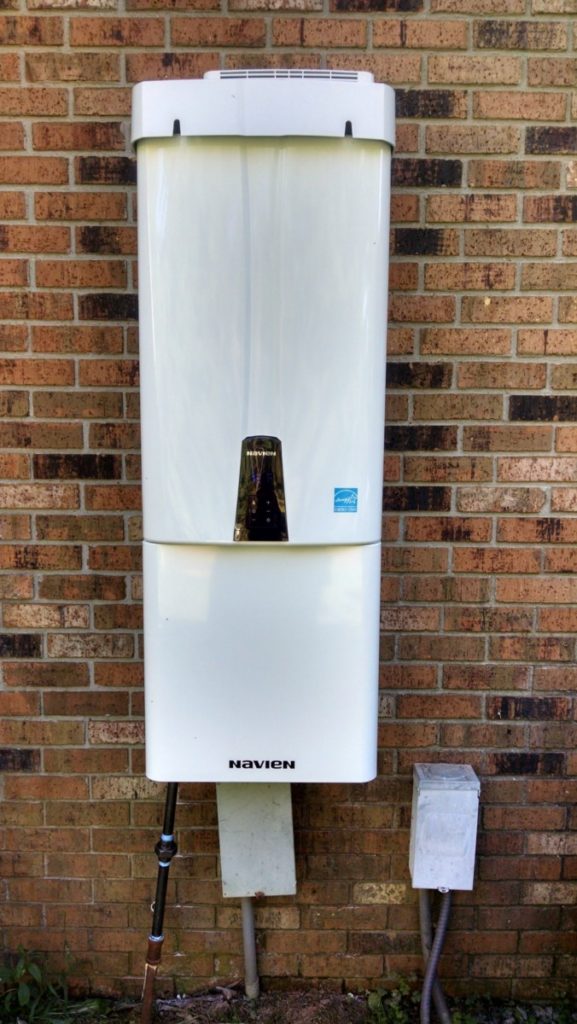
Because I live in the country, have a set income and I really like hot water, I decided to purchase and install a propane tankless water heater.  It is an outdoor condensing unit.  I choose Navien (click here to check price and availability on Amazon.com) because I use well water and Navien is the only brand (that I researched) which has stainless steel innards.

The picture below is of the installed tankless water heater on the exterior of my house. This is the largest residential unit Navien makes and the insulation is protected by the unit cover. Other brands will work but they will corrode faster from well water.

With Navien’s 15-year heat exchanger warranty, the water heater may outlast me. I am not affiliated with Navian, I am just a happy customer.

I have purchased three Navien tankless hot water heaters for various houses and I have had no problems with them providing hot water when I wanted it.

That said, Navien requires a licensed plumber to install the unit to receive their 15-year warranty.  A good DIYer could probably install the unit, but again, Navien will not warrant it unless installed by a licensed plumber.

The only thing I am unhappy about is I cannot independently light the water heater because it has a closed, self-contained ignition.  That means I cannot take a match to a pilot flame like we could in the old days.

But, I have a propane generator so unless manufacturers stop making propane, I’m good!

tankless-water-heater

The Cost:

Tankless water heaters will cost you more up front; there is no getting around that. But…your utility bill will go down.  In my former city house, the three conventional tank water heaters were NG.  After the Navien tankless NG heater was installed my gas bill reduced by 45% the first full month and after a year the bill was down by 52%.

Currently, my conventional electric 50-gallon water heater cost about $700/year to operate.  Since I have only had this tankless water heater a short while I don’t have statistics to give you; but I anticipate about 4.5-year return on investment (ROI) for the tankless water heater.

The cost will vary around the nation; your location makes a big difference in the price. Your cost reduction and ROI will be different depending on the brand, size of tankless water heater you choose and your family size and use.  You can see most of the retail prices on the internet but remember, your plumber can get a discount.

Installation charges could vary from $800 to $2000, depending on your location, codes and ordinances, how much ¾” piping is used and your plumber’s profit margin. One last plus for tankless water heaters: In 2016 the IRS is allowing a $300 tax credit for installation of energy efficient tankless water heaters.

I’m sure there are some really knowledgeable readers that can talk technical specs better than I can, so please pitch in and clarify if you can.

My need was to have hot water and my desire was to save money so I decided to switch to a propane tankless water heater.  I cannot put a price on my peace of mind.  I hope this information is helpful.

Filed Under: Power Generation

Long-Term Fuel Storage: Where and How To Store Fuel for Emergencies?

September 18, 2018 M.D. Creekmore

By R. V. Zeigler

In any survival situation, some type of fuel is necessary be it liquid, vapor, or solid. Fuel will be used for heat, light, transportation, and cooking. Each fuel has its good and bad points. You do not know when you will need this fuel so the effects of long-term storage are a primary consideration.

Solid Fuel:

The most common solid fuel is firewood. Different woods give different amounts of heat for the same amount of space. I have used softwoods like cottonwood, which give off little heat, burn fast, and leave a lot of ash. They also have a pungent smoke that could travel a good distance and alert others to your presence.

I have also used hedge (Osage Orange) which is an extremely hard wood, burns slowly and leaves little ash. Its smoke has fewer odors as well. The tradeoff? Dry, standing cottonwood is plentiful and easy to find. A dry hedge is more difficult to find in many parts of the country, and is extremely difficult to cut, especially with hand tools.

Sparks will come off of this wood when cutting with a chainsaw.

Cottonwood will deteriorate faster than hedge too. No matter what wood you have in your part of the “woods”, cut it to length, split it to a usable size, make sure it is tightly stacked, and cover it for a year before use. If not, you will create much more smoke than necessary, it will not give you the maximum amount of heat, and if it is used in a stove or fireplace, it will cause creosote buildup that can lead to a chimney fire.

Chimney fires are not something you want to have to deal with, ever. There are many other kinds of woods between cottonwood and hedge. Find out what is available in your area, and talk to some of the “old-timers” that have used them. Find out which have the most heat for the least work. In a survival situation, the most bang for your labor buck is what you are after.

There are other solid fuels such as charcoal, and “faux” fireplace logs, and some chemical fuels. Use each in accordance with the instructions provided by the manufacturer. I am personally a bit skittish about cooking directly over the flame of some commercially-produced products such as the fireplace logs.

I am not really sure of what chemicals were used in the manufacturing process and would rather be safe than sorry. As with all fire, be careful of heat impinging on other surfaces in the area, and be careful that you are not using fire in an enclosed space.

It can lower the oxygen content to a fatal level, such as leaving a fire going while you sleep. NEVER leave a fire unattended under any circumstances.

Liquid Fuels:

Liquid fuels are for the most part hydrocarbon-based such as gasoline, kerosene and diesel fuel. There are also alcohol and Sterno type of chemical fuels.

Alcohol can be stored for a considerable time as long as it remains sealed. Once alcohol is unsealed it absorbs a small amount of water from the air. The more water the less effective the fuel becomes.

Alcohol is a good liquid fuel for small, fast cooking fires, but be warned, you cannot see the flames of an alcohol fire. They are there, but a sleeve or part of your body could be exposed with no warning. Keep alcohol fires small and well supervised.

Sterno type fuels are used for small cooking fires like alcohol. There are accessories for them that make them more useful and they are easily transportable. Do not use them in tightly enclosed spaces and follow all directions.

Gasoline, as used for internal combustion engines, is not the best choice for long-term storage. It has a short shelf life (less than a year) and can harm an engine once it becomes old. Gasoline is also very volatile and has explosive vapors.

Follow all gasoline handling safety instructions to the letter. An uncomfortable burn in normal times can become a fatal burn in a survival situation. Storage of gasoline is also something to be very cautious about. Venting vapors can build up in enclosed spaces, so well ventilated areas, and approved containers, are the only place to store gasoline.

Kerosene is a bit more stable than gasoline and only has flammable vapors. It can be stored a bit longer and is much more “user-friendly”. It is generally used for heat and light which makes it more likely to be used in living spaces. It does produce carbon monoxide when burned and should be used in spaces where there is ventilation.

Nothing with an open flame should be used in an enclosed area at any time. Why take the time and trouble to prepare and then die because you slept with an increasing carbon monoxide level? Doesn’t make a lot of sense does it? When our ancestors used “coal oil lamps” they lived in very drafty houses. For the most part, we don’t. What worked for them might very well kill us. Be safe!

Diesel fuel, or as is most likely encountered today Ultra Low Sulfur Diesel Fuel (ULSD), is not our granddads’ diesel fuel. The “old days” diesel fuel was good for a number of years and was quite easily stored. Not so much today. ULSD is an extremely fragile fuel that is only good for about 6 months without additives or extreme measures of storage.

If you have a supply of diesel fuel for a generator (the most common reason for long-term storage) either have it tested or have it “recycled” by your vendor, if possible.

There are additives available that will extend the life and there is a technique called “nitrogen blanketing” which, in theory, can extend the life of the fuel indefinitely. Blanketing requires the injection of external nitrogen gas into the storage tank as the fuel in the tank increases and decreases by either use or temperature change. The idea is to replace any empty space in the tank with nitrogen instead of atmospheric air which has water and oxygen.

Oxygen and water are the two most detrimental elements to ULSD. These are what cause fungus to grow in the tank and clog filters and injectors in the diesel engine. Diesel fuel is made to be used and used quickly. Long-term storage is a small percentage of fuel use, and not really taken into consideration by the industry.

It is up to you, the end-user, to do whatever you can to preserve your fuel supply. Bio-Diesel, which is a mixture of hydrocarbon diesel fuel and organic oil, is meant to be used almost immediately as the organics and hydrocarbons will separate over time. They cannot be re-combined by the end-user. Unless you are going to use it soon, do not get Bio-Diesel for long-term storage.

Vapor Fuels:

This is somewhat of a misnomer as most of these are derived from a liquid such as propane and butane. I am not going to delve into natural gas as storage of this fuel by the average citizen is not easily accomplished nor is it readily available in a portable and storable form in most areas.

Propane is possibly the best long-term storage fuel for the average person. It does not deteriorate over time and is relatively safe. There are also many appliances that will work on it such as stoves, refrigerators, water heaters, and lights.

Propane can be stored in large and small quantities (as allowed by law) and can be transported easily in small to medium-sized quantities. Extreme amounts can be stored in certain locations, but these large tanks are rather hard to hide and virtually impossible to move once installed. Propane can lose its vapor characteristic when exposed to extremely cold temperatures. Be cognizant of this in colder climates.

Check with your propane supplier as to the size, and number, of tanks you can personally store in your area. Propane is a very clean fuel for generators and vehicles. While it does not have the energy output of diesel fuel, it has few of the drawbacks.

A propane-fired engine is just like a gasoline-fired engine as far as the way it works, not so with diesel. Most people can, with study, or mentoring, do minor repair and maintenance on a propane or gasoline engine. Diesel engines take specialized training and tools the general handyman is unlikely to have. Like any fuel, it can be dangerous so follow all safety precautions to the letter.

Safety First and foremost FOLLOW THE INSTRUCTIONS TO THE LETTER. The safety instructions on fuel-fired appliances are from years of experience and not always from the legal departments of the manufacturers.

Even if you have experience with any of the above-mentioned items not everyone in your party may have the same familiarity. If you set a good example, they will follow.

Remember, a survival situation many times becomes one long learning, and teaching, event. There will be enough things to worry about along the way, pulling a stupid stunt with a flammable item should not be one of them.

Preparing means getting ready BEFORE an event, otherwise, we would call it Postparing!

Practice, practice, practice. Cutting and splitting wood before the balloon goes up will be good exercise, and teach you some of the little things that can save you time, or body parts, now.

It will also introduce you to the labor/benefit ratio in a way that you will remember. Spending a lot of time getting wood that is going to burn as fast as you cut it is counter-productive. Burning wood is a science and art all by itself.

Read what you can, and buy a book or two on the subject. Try some of the different fuels for cooking to see what works best in your climate and what does not. Better to find out now that the chemical fuel cans you bought will not boil water, except for small amounts, in your area.

It is also better to find out now that your appliances and engines will work for extended times. Learn what you need to regarding maintenance on everything you expect to use.

Practice this maintenance and stock up on the items you will need for maintenance. Filters, oil, hoses, belts, and fuses will be difficult or impossible to get should things go all the way south. Know how to sharpen an axe, hatchet, saw, and knife and have the items needed to do this.

A dull axe will tilt your labor/benefit ratio too far towards the labor side. I expect to use these items a whole lot more than my firearms should that day come.

Filed Under: Power Generation

  • « Go to Previous Page
  • Page 1
  • Interim pages omitted …
  • Page 66
  • Page 67
  • Page 68
  • Page 69
  • Page 70
  • Interim pages omitted …
  • Page 87
  • Go to Next Page »

Primary Sidebar

Subscribe to Blog via Email

Enter your email address to subscribe to this blog and receive notifications of new posts by email.

Join 7,202 other subscribers
  • Amazon
  • Facebook
  • Substack
  • Twitter
  • YouTube

“Do more with less.”

– Minimalist proverb

Recent Posts

  • Just so you know
  • Weather Update for My Corner of Appalachia
  • Why I’m Ordering Ivermectin + Mebendazole Every Year
  • The Website’s Shutting Down (But Here’s the Plan)
  • You Are Hated! Start Training Like It!

Footer

Recent Posts

  • Just so you know
  • Weather Update for My Corner of Appalachia
  • Why I’m Ordering Ivermectin + Mebendazole Every Year
  • The Website’s Shutting Down (But Here’s the Plan)
  • You Are Hated! Start Training Like It!

More about me

Books I’ve written

Books I’ve read

Follow Me on YouTube

Follow Me on Facebook

Gear I Use and Recommend

Newsletter

Search this site

Follow me elsewhere

  • Amazon
  • Facebook
  • Substack
  • Twitter
  • YouTube

© 2008–2025 M.D. Creekmore · As an Amazon Associate, I earn from qualifying purchases.