 by Petermccue
Like me, I’m sure you’ve seen the numbers out on the internet – “You only need a quarter of an acre to support a family of four” or “Five acres for a family of four” or “20 acres for a family of four” – but what is the basis for these figures?
I originally started this article to debunk the “seed safety in a can” products. I’m sure everyone’s seen them, and I’ve always had the idea they were a crock of … err, horse-by-product, but I’d never seen anyone actually sit down and crunch numbers on why they aren’t. So I began looking at numbers – figuring out food you could get for a given amount of seed.
I knew that the numbers I’d seen in various gardening books for recommended numbers of plants to have were insane – mainly based on my own experience with gardening. Those numbers may be enough to supplement a family during the summer, but they aren’t enough to actually support a family for a whole year.
So, I started by looking for data on how much food a typical family consumes in a year. Weirdly, this was quite difficult to find. Oh, yeah, there’s plenty of lists out there for how much to store for a family/person, but not much on how much fresh food a family will consume in a year. While I could have tracked my family’s consumption for the year, this would have delayed this article a bit! Eventually, I tracked down some data from the USDA (hey, finally some use from my tax dollars!) where they gave stats for various ages of both genders.
While the information on meat and such like wasn’t that useful to me, the vegetable and fruit guidelines were quite helpful. Under their “thrifty” plan (and allowing for loss/wastage, and taking the highest possible number for the various age/sex breakdowns), I came up with needing 100 pounds of potatoes, 125 pounds of dark green veggies (broccoli, chard, spinach, etc), 100 pounds of orange veggies (carrots, sweet potatoes, winter squash, pumpkins), 120 pounds of legumes, 305 pounds of other veggies (this includes ALL others – tomatoes, radishes, onions, garlic, etc.), 425 pounds of fruit, and 240 pounds of grains.
The fruit, I’m leaving out of this (except in as far as melons and watermelons figure in), mainly because you mostly get that from bushes and trees. Because in a SHTF situation (or even in an off-grid homesteading situation) we will likely eat a lot fewer fruits and more veggies than the current American diet, I did increase the veggies a bit to account for fewer fruits (especially those from tropical sources – such as bananas or citrus).
I then looked at the various veggies/beans/fruits/grains in the categories and looked for ease of seed saving and ease of growing. I wanted to avoid “finicky” vegetables such as cauliflower or ones that aren’t really that nutritious such as celery (which is also picky on growing). I also wanted to avoid too many biennial vegetables, but that was more difficult – lots of very nutritious veggies are biennials, which makes saving seed a bit more difficult.
My assumption was that we were dealing with a family of four, who had never gardened before, and who would make LOTS of mistakes in the process of learning how to garden well. Also, I assumed they’d need to do other things than a garden, so we went with plain row cropping for the garden, rather than more intensive (and thus more productive) methods of gardening. Thus, I took the lowest yield assumptions for the various veggies I chose, as well as assuming a lot of wastage in seeds.

I then plugged a LOT of data into a spreadsheet (Which if you contact me, I’m happy to share – MD, if you want if for your next edition of the CD, I’ll get you a cleaned up version with the ability for folks to plug in their specifics and get data out… my spreadsheet doesn’t only include a “thrifty” plan, but also a stepped-up version for moderate needs and then a “lavish” plan for what I’m aiming at. It will give you approximate numbers of seed you need each year, etc as well as figure what sort of spacing requirements you’ll need.)
So, with those assumptions in mind – I looked over the choices and made some picks. Any biennials I figured I needed twice as many seeds, so I could plant the second year as well. (I’m not going to show the row feet or the square feet calculations I made, but they are in the spreadsheet).
In the dark green veggies, it’s very hard to avoid biennials. It’s also very hard to avoid vegetables that could potentially cross with each other, which makes seed saving even more difficult, as you must bag/isolate/etc the various plants you’re saving for seed. I ended up settling on broccoli, collard greens, mustard greens, and spinach.
Mustard and spinach are annuals, which makes them easier to deal with, and along with the collards, they can be canned for storage. Broccoli doesn’t can well, but it can be dehydrated and it is also cold hardy, so you can grow it in spring and fall as well as winter if you’re in a mild climate or have cold frames. Kale and chard, although falling in this category, are not only more unfamiliar with most Americans but also biennials.
For our mythical family of four, I was aiming for 280 pounds of broccoli, 60 pounds of collards, 60 pounds of mustard greens, and 100 pounds of spinach. Including plants raised for seeds, they would need 14,000 (2 ounces) broccoli seeds (remember, it’s a biennial, so we double the seeds to allow for two years before our seed saving bears fruit), 2800 (third of an ounce) collard seeds (also a biennial), 3200 (quarter of an ounce) mustard seeds, 3200 (1.5 ounces) spinach seeds.
Orange veggies only have one biennial, but it’s an important one – carrots. Carrots are tricky to save seed from because they can so easily cross with Queen Anne’s Lace. So having extra carrot seed is probably a good idea, so you can keep your seeds pure (and make lots of mistakes in the process of learning). The other tricky veggie here is sweet potatoes, which are very nutritious but do not reproduce from seed.
So you can’t store seed for them. Note that squash and pumpkins will cross with each other, but the procedure for saving their seeds is a bit easier than say … carrots. Although my spreadsheet plans on using sweet potatoes for my family (because we grow them already), I’ve replaced that for our phantom family with extra pumpkins and winter squash, to go along with the carrots. I’ve assumed that our family would need 160 pounds of carrots (they want good eyesight!), 80 pounds of pumpkins, and 160 pounds of winter squash.
Note that the carrots can be canned, but can also be stored long-term, so these are good choices. For this family’s need, they’d probably want 26,400 (1.5 ounces) carrot seeds, 150 (1 ounce) pumpkin seeds, and 1200 (4 ounces) squash seeds.
Beans and legumes are basic to nutrition and can help make up for lack of meat in our diet. Beans aren’t that difficult to save seeds from and the whole family is annuals, so they aren’t tricky for our family. (The main problem is learning when to start harvesting the dry pods!) For our family, I’ve figured on them wanting 280 pounds of dry bush beans, 120 pounds of dry pole beans, and 80 pounds of cowpeas (crowder peas/southern peas/black-eyed peas). For this, they’d need 14,000 (156 ounces or about 9.75 pounds) of bush dry beans, 2800 (43 ounces or 2.75 pounds) pole dry beans, and 5200 (20.8 ounces) of cowpeas. Luckily, you can mostly use storage beans for this, if you increase the amounts somewhat to allow for lower germination rates.
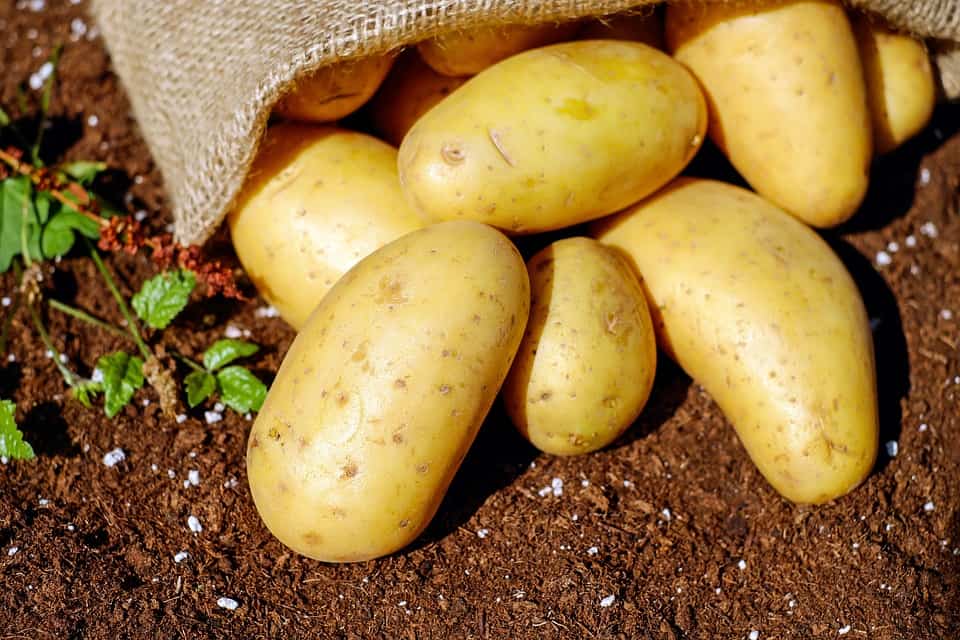
Potatoes are a problem. You need them but you can’t grow them from seeds. And they don’t store past a year. You need about 10 pounds of seed potatoes to plant a 100′ row, which will usually yield about 100 pounds of potatoes. Our mythical family of four will need about 400 pounds of potatoes to eat, and about 40 pounds to seed for next year. What we’re doing here is always trying to keep at least 10 pounds of potatoes in the house, so we can grow them if need be. It’s not an ideal solution, but it’s the best we can do.
Other veggies include a LOT of things that American’s really want to eat. For our mythical family, I’ve culled the large list down to pole green beans, beets (good for both roots AND greens but a biennial), cabbage (biennial and will cross with our broccoli and collards!), sweet corn, cucumbers, garlic (doesn’t reproduce from seed – we’ll discuss later), leaf lettuce, onions (biennial), garden peas, peppers (both hot and sweet), radish, summer squash, and tomatoes.
Peppers and tomatoes don’t cross-pollinate easily, so you can choose a number of different varieties if needed. They are also easy to save seed from. Cucumbers will cross with themselves but can be hand-pollinated if more than one variety is desired to be grown. Garlic is a bit more difficult as it is not only best grown in the fall in most of the US, but it also doesn’t seed, so you need to have cloves to start from. Best bet is to keep some garlic cloves around at all times to have some to start.
Ideally, our family would need 100 pounds of pole green beans, 120 pounds of beetroots (and that would give them about 20 pounds of greens to eat fresh), 120 pounds of cabbage, 120 pounds of sweet corn, 60 pounds of cucumbers (although you’ll likely get a LOT more), 80 pounds of garlic, 80 pounds of leaf lettuce, 120 pounds of onions, 80 pounds of garden peas, 60 pounds of peppers, 20 pounds of radish, 80 pounds of summer squash (although since this is zucchini – it’ll likely be more), and 160 pounds of tomatoes (likely more, but …).
For this, you’ll need 560 (9 ounces) pole green bean seeds, 4400 (2 ounces) beet seeds, 5200 (three quarters of an ounce or so) cabbage seeds, 2400 (2 pounds) sweet corn seed, 320 (half an ounce or so) cucumber seeds, 4 pounds of garlic, 12,400 (half an ounce) leaf lettuce seeds, 21,200 (3 ounces) onion seeds, 9200 (84 ounces or 5.25 pounds) garden peas, 400 (tenth of an ounce) peppers, 1320 (half an ounce) radish seeds, 120 (half an ounce) summer squash seeds, and 240 (under a tenth of an ounce) tomato seeds.
Fruits mainly concern melons and watermelons – you don’t need much of these because they don’t store well and are hot weather growing plants. I’d be comfortable with 200 seeds of each type for our mythical family, which should give them plenty of fruit.
Grains are the last category. For our mythical family, I’ve chosen flint or dent corn, popcorn (which can do double duty but will have to be hand pollinated to keep it from cross-pollinating with each other and with the sweet corn), wheat and oats. The wheat can come from storage – like the beans, just increase what’s used for lower germination. The corn cannot come from storage, as it’s most likely hybrid.
And most folks store rolled oats, which won’t work for sprouting. Ideally, the family would grow 100 pounds of dent corn, 100 pounds of popcorn, 120 pounds of oats, and 600 pounds of wheat. To get that, they’ll need 2 pounds of dent corn, 2 pounds of popcorn, 32 pounds of oats, and 100 pounds of wheat. The corns would be planted in rows, but the oats and wheat would be broadcast as it’s unlikely they will have the equipment to drill plant the other grains.
Now, what amount of space would be needed for this? Assuming row cropping the garden vegetables, and broadcasting the oats and wheat, and NOT doing any double planting throughout the year, you’re looking at about 1.68 acres for our family of four – assuming normal soil conditions. If you have access to manure/compost, spacing requirements would probably be lower. If you’re in dry conditions or on poor soil, it’d be more. And this doesn’t allow for letting a field lie fallow for a while or something similar.
Looking at those numbers of seeds, it’s easy to see that most “survival seed banks” are not really worth it. They won’t be tailored to your climate, firstly. Also, they will include seeds that will not store well – onions for example. Sweet corn is another seed that doesn’t store long. They also get the numbers way wrong. For example – one seed vault has 65 green bean seeds. This isn’t going to be near enough to allow for any loss in germination or other catastrophes.
Another one out there (marketed as working for 1 acre of gardening) has 1700 tomato seeds! That’s about 1000 more than even *I* would store at my most paranoid. And they are all one variety too! But they don’t just get the numbers wrong – they also get the varieties wrong. Many many vaults include onions that don’t keep well – such as Walla Walla. Don’t get me wrong, WW’s are a great onion, but they don’t keep. You want a long keeper such as Stuttgarter or Yellow Flat Dutch.
I found one vault that included 700 jalapeno seeds – really? Does anyone need that many jalapenos?? I had 10 plants last summer and that made so many peppers we were drowning in them. (Lesson learned – next year – 4 plants!). They also include vegetables that are very difficult to grow for beginners – such as eggplant or celery. And celery is not exactly high in calories or nutrition, so it’s taking up space better used for other seeds. Even the ones that include grains, don’t include enough. Most include at most half a pound of grain seed – which isn’t going to be near enough.
When I started this project, I’d originally thought that having one of those seed vaults wouldn’t be a complete waste of space. I had hoped I’d find one that could serve as a useful backup to my own seeds. However, I’ve come to the conclusion that they are pretty much utterly useless.
And that’s without having seen the “instructions” that are included! I’ve come to the conclusion that they give a false sense of security to folks, who think that if they have one, they don’t need to bother with gardening or practicing – but they can just “grab the can” and start gardening and grow tons of food. You’re better off getting the supplies to store your own choices and tailor it to your own needs than buy one of the over the counter collections.


 By Joel Skousen
 After some study and experimentation, we have set up a productive food chain– table scraps to earthworms to catfish–in our backyard. The project is satisfactory in many respects, utilizing waste materials to produce fresh fish for food and at the same time yielding ample compost for a small garden. The material cost is minimal. The whole operation can be set up for less that $15.00. The equipment occupies only about 12 square feet of space, and the entire assembly can be easily moved if necessary.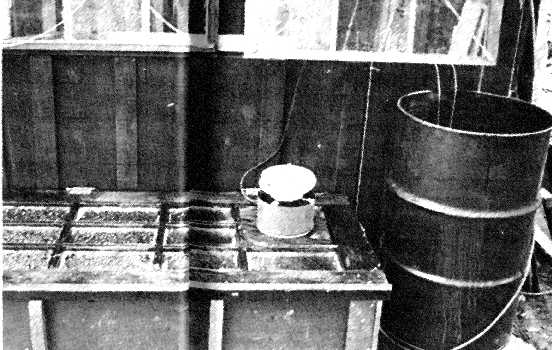
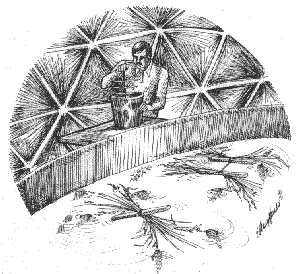 Building a geodesic dome is relatively easy and inexpensive. You should plan on two or three days to complete the task. Some of you living in the more southerly regions of the country will be able to build them for less than $50. More sophisticated structures, incorporating a double skin of clear greenhouse vinyl with an air layer in between to prevent heat loss, will last for a number of years but could run as high as $200 for materials.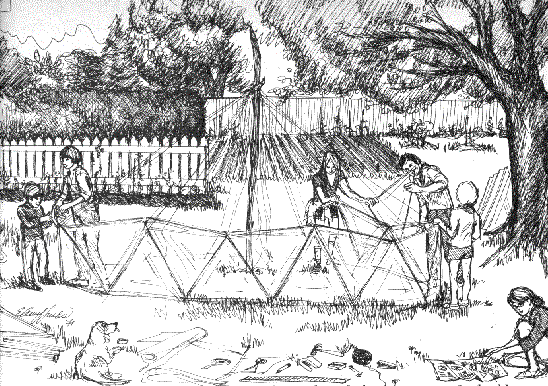
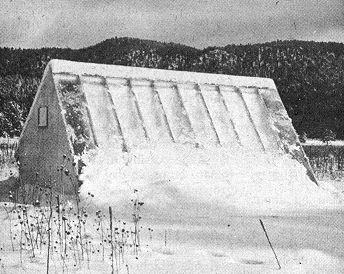
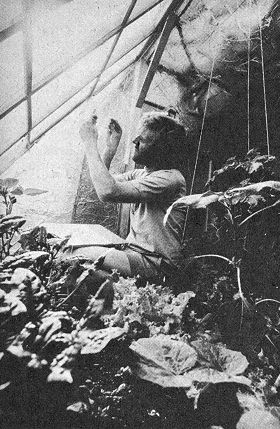 Dave MacKinnon, Ph.D., ORGANIC GARDENING greenhouse designer, has put it all together after three years of experimenting and has created a design formula that gardeners in any climate can follow. His newest solar greenhouse, which he has built and tested in Flagstaff, Arizona, epitomizes a good solar shape. It has produced food through two winters without requiring any outside heat source. Almost all the floor space is usable for growing beds because the energy storage is on the walls. And it uses a minimum of materials because the design, insulation and heat storage are in balance and arranged to complement each other.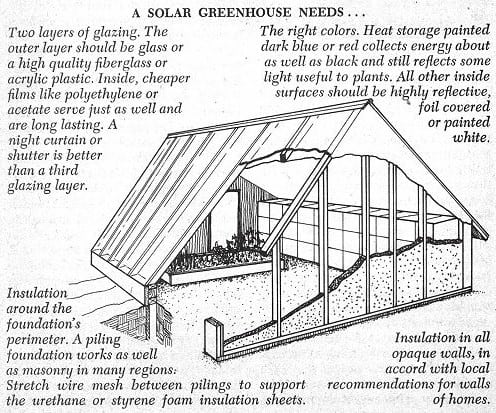
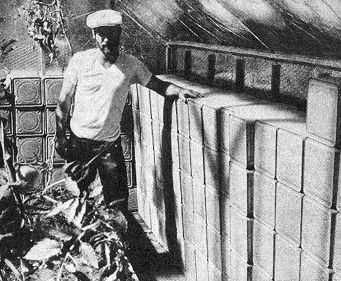 Why do we rely so heavily on water? It is admittedly hard to work with because it tends to corrode containers and to leak. But water is about the best heat-storing material known and is cheap. The best alternative is rock (in any form from sand through concrete), but water holds about five times more heat. So water reservoirs on walls make compact heat storage that gets a good share of direct incoming sunlight.
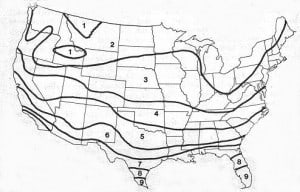 The amount of insulation that MacKinnon judges to be practical in various regions is roughly the same as local, energy-efficient recommendations for homes. If that seems lavish for a greenhouse, remember that homes get a lot of extra heat; the greenhouse is designed to get along with none. To me, the need for plenty of insulation is a reminder that people aren’t much different from plants in their requirement for warmth, among other things. To use less insulation, however, is to need more heat storage, which demands more space and money.
 Without a doubt, a thin, aluminized fabric which is operated by ropes or a pulley is the cheapest system to make and work with. The best one Dave MacKinnon tried was made of aluminum foil glued to one side of parachute fabric. That curtain lasted two years before needing repairs.