• Skip to main content
  • Skip to secondary navigation
  • Skip to primary sidebar
  • Skip to footer

M.D. CREEKMORE

  • Blog
  • Books
  • Newsletter
  • Gear I Use
  • About
  • Contact
  • Facebook
  • YouTube
  • Blog
  • Books
  • Newsletter
  • Gear I Use
  • About
  • Contact
  • Privacy Policy
You are here: Home / Archives for 2019

Archives for 2019

How to Make a Seed Starter Box

January 18, 2019 M.D. Creekmore

how to make a seed starterBy Juleigh Howard-Hobson

Mirrored flush-mounted bathroom medicine cabinets are easily one of the most non-upcycled objects out there. They are short and shallow. They don’t stand by themselves. And, frankly, they aren’t very nice to look at once they are out of their recessed wall enclosure.

But, the thing is, just about every house has one…sometimes two or more. You can pick them up for a song at garage sales, rebuilding centers or CraigsList. Sometimes they are free at all these places because very few people actually want old medicine cabinets. New ones are cheap. Also, old ones are frequently….um….not as fastidiously clean as one would prefer.

All to the good, my friends.

You see, old medicine cabinets may seem useless if you look at them as cabinets, but if you look at them as hinged lid boxes….well….the possibilities to use them for are vastly improved.

One of the things they are great for, once you see them as a box, is as a seed starter box.

First, you must take all the shelves out. If you are lucky, they are clear glass shelves that you can tape together to make a nice glass sheet out of. Most medicine cabinets seem to have these sorts of shelves. If yours doesn’t, don’t despair,  use a piece of window glass or clear plastic or even cling wrap instead of the taped glass sheet.  Put the glass away for now.

how to make a seed starterSecond, you have to rehang the door of the cabinet. The mirror needs to face into the opening. I’ll get to why this is so later in this article.  Pull the pins out of the hinge, separate the two pieces.

Take the mirror out of its housing, then mount a door hinge to the mirror housing, put the mirror back in, and mount the other side of the door hinge to the metal frame of the cabinet.

It doesn’t have to shut like a lid or a door, it just has to move back and forth.

Third, take the wood and cut the middle out of it. Basically, you are making a frame. Now, tape or glue the glass(or plastic)  to this.

Line the interior of the cabinet with the aluminum foil. Top with the glass/wood frame.

Now, angle the mirrored door above the open part of the cabinet so that the most light possible enters the box. This is how the box will get warm enough to germinate seeds.

You can move this anywhere you want, because it is light and portable, making it a very handy sun catcher.

Put starter pots of seeds in it, water them. Set the glass frame in place. Then angle the mirror to catch the most light and there you have it. A seed starter you can use in any climate. We just used ours to germinate kale and cabbage seeds in early November.

how to make a seed starter

An added bonus to this is that you can also use it to cook some foods. It’s a little small to be a powerful solar oven, and it is much slower, but it got a lentil dish cooked in time for dinner when we tried it out. (We used a sweet and sour lentil recipe adapted from Jay Solomon’s Lean Bean Cookbook)

Supply list:

  • 1 Medicine cabinet
  • 2 Old hinges (old door hinges work well)
  • As many screws as needed for the hinges
  • 1 Piece of wood the same size as the cabinet
  • Packing tape (or a piece of glass/clear plastic smaller than the piece of wood above, or cling wrap)
  • Aluminum foil
  • Saw, hammer, screwdriver etc
  • Seeds, seed starter pots, water
  • Sunlight

Filed Under: Homesteading

Types of and Effects of Nuclear Weapons on Humans and The Environment

January 18, 2019 M.D. Creekmore

Effects of Nuclear Weapons on Humans

by Ron G

Think of this as a primer if you will. It is written to cover the basics that will matter most to you as a prepper. I am intentionally leaving out a lot of technical jargon; there are others willing to throw that out at you.  There will be some terms and concepts that do need to be understood. One I will use a lot is Ground Zero (GZ).

Ground Zero is that point on the surface of the earth directly under, at, or over, a nuclear detonation. Your location, distance, and direction, from GZ is very important.

It’s important that you understand that there are four types of nuclear detonations or “burst”. Sub Surface Burst, Surface Burst, Air Burst, and High Altitude Burst.

All nuclear burst will produce the same basic effects, blinding light, tremendous heat, massive blast wave, radiation, and the electromagnetic pulse. However, the type of burst will greatly determine the degree of each effect upon the target.

A Sub Surface Burst is one that occurs underground in which the fireball produced does not break thru to the atmosphere. The ground will shake and there may be a surface collapse at GZ but on the surface, there will be no radiation or EMP released or blast wave.  Really nothing to be concerned with and I mention it only because they have been used during weapons design testing programs in the past.

A Surface Burst is a detonation on or near enough to the surface where the fireball touches the earth’s surface. This is the one we almost always see in the movies and in illustrations for articles like this.  There will be a brilliant flash of light, a massive fireball, and an intense outward-bound blast wave outward from GZ. As the fireball starts to rise a second blast wave, this time returning towards GZ, arrives and brings with it massive amount of debris.

This debris is forced upward into the fireball and creates the stem of the familiar “Mushroom Cloud”. At GZ there is total destruction and depending on the size, design of the weapon, and to a degree, the terrain, the area of total destruction can be considerable. Large areas of partial and incomplete destruction will extend even further.

Meanwhile, the Mushroom Cloud continues to rise through the atmosphere, the stem discontinues and temperatures inside the fireball start to cool down. As it cools the prevailing winds will start to push the fireball downwind. The material inside the fireball, now radioactive, cools and starts to fall, largest, heaviest material first.

By the time it reaches 30,000 feet the fireball will appear to be just another cloud but this cloud will be leaving behind a trail of radioactive fallout for several hundred miles.

GZ will not be survivable and will be radioactive for a long time. The further away from GZ you are the better your chances. A safe distance downwind will be much further then a safe distance cross or upwind.

An Air Burst is a detonation in which the fireball does not touch the surface of the earth. It has all the other characteristics of a Surface Burst but there is no Mushroom Cloud and most important there will be no significant fallout. What the Air Burst will do however is create a much larger area of destruction. It does this by creating three blast waves.

As the expanding blast wave (or initial wave) strikes the surface of the earth, it is reflected off the ground to form a second shock wave traveling behind the first. This reflected wave travels faster than the initial wave since it is traveling through the air already moving at high speed due to the passage of the initial wave.

The reflected blast wave will merge with the initial wave to form a single wave. This is called a Mach wave. The overpressure at the front of the Mach wave is generally about twice as great as that at the initial blast wave.

If you have trouble picturing this try thinking of a ripple hitting the edge of a calm pond. This deflected wave becomes a second wave. The third wave will be the displaced air mass returning to GZ.

These types of detonation will double the area of destruction without the messy fallout. You can see the military advantage of this type of detonation. GZ will not be survivable but will not be radioactive for long. The distance from GZ you will need to survive the destructive blast are much greater but fallout will not be an issue.

Last of all is the High Altitude Burst. A detonation above 100,000 feet is a High Altitude Burst. No blast damage. No fallout. Your personal physical threat from this would be the potential flash blindness from the initial burst. The purpose of this type of detonation is the Electro Magnetic Pulse.

Lets review. A Sub Surface Burst is really not a military option. Surface or Air Burst, if you are at or are too close to GZ you are either toast or soon to be toast. If it was an Air Burst fallout is not a threat. If it was a Surface Burst and you are located far enough up or cross wind you should be in good shape. If you are downwind…

Fallout.  Fallout is material that was made temporarily radioactive in the fireball through a process called ionization. It has a known decay rate.

There are multiple layers in the atmosphere; each layer is capable of having different wind speeds and directions. As the fireball becomes a fallout cloud and raises and lowers thru each layer the winds in that layer will have an effect. Lower levels will have less effect while upper levels will have more. In predicting where the fallout will go it helps to be a weatherman.

Generally, Continental US weather patterns flow from the South to North and West to East. But, there are seasonal variations. Understanding Highs and Lows and where you are in relation to them, would be useful information.

Knowing that your westerly winds are the lower part of an upper-level low that is moving south you can determine that the fallout will mostly travel south and east. (I once had to explain why surface winds have no effect to an Air Force General. The Major who ran the DoD weather school just sat there and grinned.

Fallout Protection is all about Time, Distance, and Shielding. The longer it takes for fallout to arrive the less there will be. If you are in a safe space, the longer you wait to go out the less you will be exposed to. The greater the distance between you and fallout that has arrived the less radiation you will be exposed to.

The more mass between you and the fallout the less radiation will reach you. I think everyone understands these concepts well enough.

The next thing topic is very important. Targeting in Nuclear War.

In an all-out war the first strikes will be against an enemy’s ability to strike back. Missile Silos, Bomber and Submarine Bases, and Command and Control Centers will be the first targets. Major military bases, seaports and manufacturing centers would be secondary.

In a nuclear war, most targets are going to be hit with Air Burst. Let me say it again. In a nuclear war, most detonations are going to be Air Burst. (ICBM Silos and Cheyenne Mountain in Colorado will be exceptions to this). The fallout will be a problem, but probably not to the extent most of us think. Nuclear Winter? Forget about it. Totally made up bull!

One last thing, if you are outdoors and see an unexplainable, sudden, intense, flash of light and cannot identify the source, immediately drop to the ground, close your eyes, and cover your ears and open your mouth. You want to protect against flash blindness and the oncoming overpressure of the blast wave.

Remember, there will be a second blast wave in the opposite direction, so don’t be in a hurry to get up. Of course, you may be far enough away that the wave(s) may never get there. Count that as a blessing.

Filed Under: Uncategorized

How to Make a Rocket Stove

January 18, 2019 M.D. Creekmore

How to make a rocket stove

by Randy

As a frugal and self, sufficient individual, you may be interested in an alternative to the earthen block, tin can or commercially made, version of a rocket stove.  Here is another effective alternative to those found in articles that are circulating on the internet, YouTube or in “Prepper Blogs” these days.

I have not seen anyone touting or describing how to turn common black stove-pipe fittings into a rocket stove so I will try to explain the process I use to make a rocket stove out of common stove-pipe fittings. This version is possibly one of the best compromise devices for cooking over wood in a grid down or where firewood is of limited supply.

When firing up this little stove, I typically use cut up and split SYP scraps from my home repair business, which I set aside for just this use.  I find that utilizing this design for a rocket stove it only takes about 3 or less, one foot sections of 2×4 split down into ¼ or ½ inch thick kindling to boil water in as little as 5 mins, if you have the wood pre-split and readily available, along with your utensils, pans, and foodstuffs close at hand.

With this very fuel-efficient, design, there is very little smoke exiting from the stove, and little or no ash to contend with.  Other than the usual soot associated with using SYP (southern yellow pine) wood due to the high resin content of the wood there are few drawbacks to this stove.

f using tree limbs gathered from the forest floor, this soot may not be as much a problem in a conifer filled area.  I carry my stove in an old canvas, firewood tote, so as not to get much of the associated soot on my person but this may or may not be suitable for you.

How to make a rocket stove

Some of the advantages of the rocket stove designs out there are the speed and efficiency they offer and this design is not different.  If you are familiar with hand tools, and your local hardware stores you should have little or no problem making one of these little stoves in as little as 4 hours or less not including time to gather your materials.

The tools I recommend for making this small stove are as follows:  Philips head screwdriver/cordless drill, 1/8 dia. And ¼ inch Drill bits, two dozen or so 1-1/2 to 1-1/4 inch long drywall screws, or deck screws, a set of good tin snips (I like the 2 inch long-bladed, RH version).

The drill you use should have at least 2 speeds, high and low.  I believe using the higher speed to drill metal works best. I also recommend leather, work gloves, safety goggles, pencil or sharpie a tape measure and a free afternoon to purchase the materials and assemble the stove.

Below I have listed the materials I recommend as well as some price points of the materials found at my local “ big box” store, for the major items you will need, these prices are only for comparison purposes and may vary as this article ages, your place of purchase will probably be different.  The prices I found are included next to the Item description as of December 2015.

Materials List:

One black pipe cleanout, T fitting, 6-inch dia. (may also use 8-inch dia. T as a substitute just make sure you buy corresponding fittings) $15.00.  This fitting will become the main body of the stove.

Two each cleanout caps/end caps, 6-inch dia. $6.00 each.  One will become the base/clean out at the bottom and the upper cap will become the burner plate/diffuser at the top of the stove.  When orienting the stove one end will be smooth, and one end will be crimped to accept the pressure fit, end caps.   Please note the two different orientations of couplings so when you buy them, you wind need to line them up with the correct configuration.

One 4 inch vent pipe, elbow, 26 gage or heavier, $3.50 ea. (I could not find 4-inch single wall black pipe, elbow fitting so I was forced to use a galvanized pipe).

The next Item you will need to purchase is a 4-inch window thimble made of 24 gage aluminum or if you cannot find a window thimble use surplus sheet metal left over from the 2 ft. section of vent pipe listed below.  I chose to go the route of using a window thimble as I had one on hand from another project.

A blank piece of galvanizing can be used if a thimble is not available.  I do not have the price of the thimble since I had it on hand.

How to make a rocket stove

The next item you will need to assemble your stove is a 2 ft. section of 4-inch dia. stove-pipe or 26 gage, galvanized vent pipe $4.00 each.

Next up for those who want to use a stainless steel “hose clamp” please find a clamp that will accommodate the dia. of the pipe you have assembled using the appropriate size of your legs coming off of the clean-out T, (mine was made of a 6-inch dia. coupling). I Opted out of using a stainless clamp and used some aluminum strapping I had lying around but the clamp would work just as well or better than my arrangement.

It might also be handy to have on hand ½ dozen or so, ¼ x ½ inch sheet metal screws with the slotted hex heads for easy driving.

The last item you will need is hardware mesh or wire.  The wire I used was 18 gage with ½ inch grid but you may find wire with larger or smaller mesh.  The fire-grate will be constructed from this material and the heavier gage, the better, as long as the mesh size remains smaller than 1 inch or so in order to retain the coals better in the small firebox.

The total cost of the materials of the stove should be around $40.00 to $50.00 not counting your labor, which I believe makes this a very affordable and portable addition to your arsenal of grid down appliances.

This completes the list of Items you will need unless you chose to insulate the 4-inch interior, lining of the stove to keep the outside body of the stove from getting too hot.  I chose to forgo the use of vermiculite or insulation since I wanted my stove to cool off quickly and give off radiant heat while it operates.  I could not tell if the stove would use less fuel by being insulated but some swear by it so let your stove be built as you please and publish and findings you have supporting insulation if you like.

A word of caution here, do not operate any open flame stoves such as the one described in this article, inside the home unless this item is vented through an approved fireplace or wood burning stove-pipe properly constructed and designed to prevent smoke/C02 buildup in your home. 

In addition, when using galvanized pipes/materials as a substitute for black stove-pipe realize that burning galvanized pipe will give off harmful fumes until the galvanizing has turned white and started to rust. 

This curing of the galvanized parts must be done prior to cooking or using of the stove to make meals over and should be done in a well-ventilated location such as an open fire pit or wood burning stove.  Once the galvanizing is burned or cured, normal use can be observed).  If you have a source of 4-inch black stove pipe you can eliminate this step, but again I was not able to find 4 inch, black, stove-pipe in my area.   

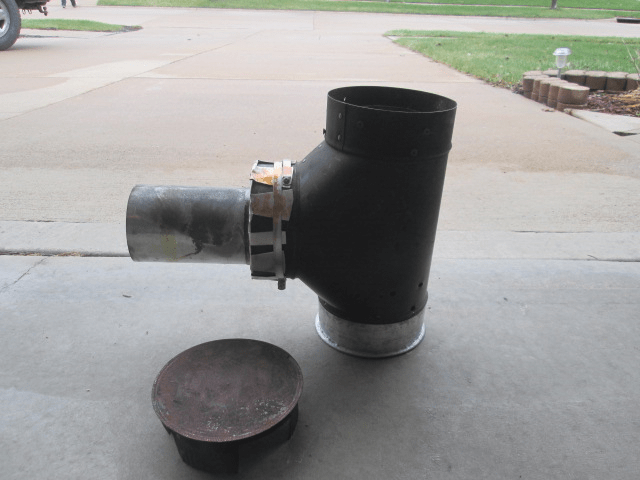
Now onto the fun part, the assembly of the rocket stove.  This assembly is pretty straight forward and if I leave out any details you should be able to figure out the assembly from the pictures provided.

First I took a pair of tin snips like the one listed above and cut a section of the 26 gage vent pipe/stove pipe about 10 to 12 inches long.  This was then assembled to the normal configuration so the sheet with snap fold becomes a pipe again (easier to cut the sheet when it is uncoupled). The section of short pipe can be set aside for now.

How to make a rocket stove

Next take the 4-inch vent pipe, 26 gage elbow, and configure the fitting so it represents a 90-degree elbow.  This may take some manipulation but the design of the modern vent elbows makes life so much easier for those of us who do home improvement projects, and in fact, it is very hard to find a true 90-degree elbow should you try to find one in the galvanized and aluminum duct or vent pipe.   A word of caution, do not substitute aluminum pipe for steel or galvanized pipe here as the aluminum pipe is very thin gage and will melt through after a few uses, (I found out the hard way).   

Now place the 4 inch elbow inside of the larger (body of the stove), cleanout T fitting, with the top of the elbow fitting in the top of the stove body (will fit down inside 1.5 inches from the top of the stove body) and the elbow portion sticking into the horizontal section of the stove T.   This smaller coupling will sort-of “slop around” in the bigger fitting for now but do not be concerned as we will address that issue shortly.

Now slide the 10 inch or so section of 4-inch pipe in the lower leg of the 4-inch elbow, at the horizontal leg of the stove body.  This will become the combustion chamber, once you get the stove assembled.  This will fit but your 4-inch elbow pipe should be able to be centered in the top leg and side leg with the 4-inch elbow touching the interior of the stove body at the inside corner of the curve.  Things will be secured later but for now just test fit and set aside.

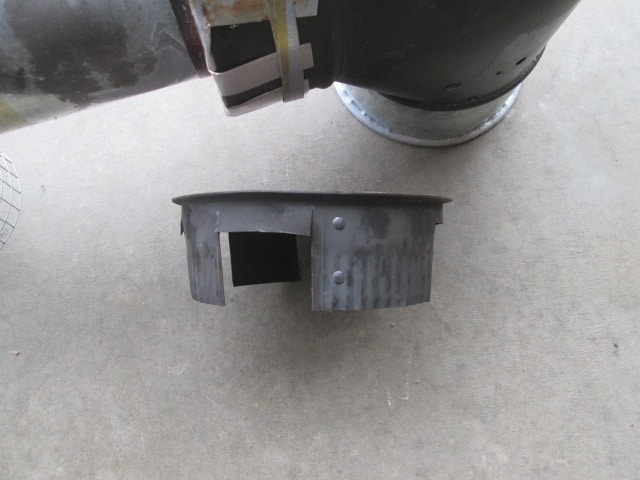
The next step is to cut notches in one of your 6-inch caps (this will be your top burner plate/flame diffuser).  The cap, notches should be equally spaced around run of the pipe, mine are about 1.5 inches long by about 1.5 inches deep, and I made about 4 of them.

These notches do not extend all the way up to the flat part of the cap and are deliberately designed this way but if you choose to or did so by accident do not be alarmed things will work just fine this way also.

These notches will act as air vents and smoke exhaust ports.  You will notice that the 4-inch coupling does not come all the way to the top of the stove body, but this is to allow for the flames to form and breathe

Now get your drill and drill bit and drill 1/8 inch holes in the top of the stove body.  These holes need to be about 1.5 inches down from the top edge of the T-pipe.  I chose to make the top of my stove the smooth edge as my end cap compatibility was so oriented, as opposed to the crimped edge but this is not critical just so long as the lid/cap will fit inside or outside of your main stove body/Cleanout.  Now you can choose to drill a mirror image of these holes for the bottom edge of the T-Pipe but I chose to just push my bottom cap in place with the good pressure fit the smooth/crimped edge of the pipes come supplied with from the factory.  I chose to use a galvanized, 6 inch cap for the bottom as there is little or no heat buildup at the base other than a few coals finding their way to this location, and If I recall, I was not able to find the male crimp end made of black stove pipe when I assembled my stove a few years ago.

Now comes part where you center the smaller pipe and the larger pipe so the stove functions as a rocket stove and the walls will allow for convective air flow if you want to have radiant heat.

I drilled holes on the upper T-leg about 4 inches of the way down from the top at 4 locations symmetrically around the diameter.  Then using 1- ¼ inch drywall screws as set screws to hold the inner elbow in place.  I then repeated the process for the Horizontal firebox section of the 4” pipe and tried to run the screws just as a press fit and tried not to penetrate the exterior of the inter-pipe.

This did leave a small portion of the drywall screws proud of the 6 inch, T’s, outer wall but did a great job of holding the inner pipe and elbow in place using the 8 screws as jamb screws.  The pictures of the interior of the stove should make this pretty clear.

Next, I fabricated the thimble wall of the horizontal leg cover of the stove where the fire-box leg comes out of the larger leg of the 6” clean out pipe/main body of the stove.  In order to do this I held the 4-inch window thimble at the bottom of the stove and made a trace of the diameter onto the window panel.

The 4-inch diameter Thimble hole will be situated at the lower portion of the firebox so it should be positioned as such.  What this will look like properly positioned, will allow for dove tail fingers to be cut in the panel that sticks out past the traced line.

This will become a 6-inch circle, inside the center of an 8-inch circle, with the 4-inch thimble hole located at the lower center of the fabrication.  The 4-inch thimble, hole will be positioned so it rests near the bottom of the 6 inch horizontal opening of the body of the pipe, with the flat surface covering the remainder of the horizontal, 6-inch hole.  This sounds a bit complicated, but please look at the photos accompanying this article for clarification.

Now it is time to cut the 2-inch dovetail fingers into the sheet of aluminum or steel of the remaining metal outside of the 6-inch hole.   Dovetail fingers can be cut at straight or tapered cuts but should be spaced about ¾ to 1-inch intervals.

I found that tapered cuts work better for me but your results may vary.  There is a bit of art to cutting fingers but I came up with about 24 fingers (48 tapered cuts), using tin snips to make them.  I did not remove the alternative fingers but bent every other finger in, in order to fit inside of the 6 inch vertical leg of the stove body.  The remaining 12, alternative fingers fit outside of the body of the stove.

I then used my aluminum straps (or stainless hose clamp) and sheet metal screws to fit and hold the window thimble in place so the hole of the thimble helps hold the firebox of the stove in place.

Alternative methods can be used to make this cover up the horizontal hole, up to and including using a hole in a flattened piece of tin made out of any type of sheet metal as long as it will be large enough to make the cover accommodate the dovetails and hold the firebox in position.

Four to six sheet metal screws can also be used to hold this cover in place or in conjunction with the straps or pipe clamp.

The only thing that remains to be fabricated in order to fire up the stove is a fire grate.  I chose to use the hardware mesh mention in the materials list above.  I cut a section of mesh long enough to fit from the outside edge of the 4 inch, horizontal, firebox to the back of the body of the stove so my mesh was about 14 inches long.

The mesh was cut wide enough to make a role of wire mesh just big enough to just fit snugly inside the 4-inch diameter of the firebox.  The mesh can be a little short but should not fit outside of the 4 x 6-inch firebox section, fitting outside of the main body of the stove.

The pictures I took do not have the hardware mesh fitting in the firebox but what I found works best is to collapse one half of the diameter of the mesh so that it just comes within about ¼ inch of the opposite side of the mesh roll, with the large divert of the mesh on top of the basket or coals catcher (looks like a crescent moon laying on its back when it fits inside the 4 inch firebox).

This arrangement provides maximum, retention of the coals and draft of the air in the combustion chamber.

The next step is the decision to make this an insulated or radiant stove.  I opted to make the stove with the ability to radiate heat so I drilled about a dozen ¼ inch dia. holes 2 inches from the base of the stove body.  These are for convection and do not enhance the stoves oxygen intake as far as I can tell.  These may not even be necessary and if you are a mechanical engineer, you can tell if they are even needed.

On the second version of the stove I made for a friend of mine who fell in love with mine, I made some legs out of the remainder of the 4 inch galvanized pipe that was triangular in shape, made of three folds of metal bent into a one inch wide strap with the bottom of the triangle resting at the base and the back tabs screwed into the wall of the 6 inch body of the stove.

These were made of 12-inch strips cut 3 inches wide with a 6-inch base but if you use small, light, weight pans to cook with these should not be necessary.

I hope you found this article to be informative and give you and your alternatives if the grid should ever go down and your source of wood to burn is scarce.

Filed Under: Power Generation

How to Properly Take Care of Egg Laying Chickens

January 18, 2019 M.D. Creekmore

How Properly Take Care of Egg Laying Chickens

by Jane W

My interest in chickens began at age three when my grandmother would allow me to gather eggs from the nests in the chicken house at their farm. I learned from her to be observant and gentle with animals. When my own child reached that age, I wanted to share some of that magic with him and began considering raising chickens.

As an avid reader of Mother Earth News, Organic Gardening magazine and other Rodale Press publications (click here to see a full listing of Rodale Press books at Amazon.com), I felt I had enough information to begin.

I knew I had to protect the chickens from the weather and predators so I purchased a large roll of one inch chicken wire and 1 X 4 X 8 boards to fence a small area outside an old building that had previously been used as a chicken house on our “postage stamp sized” farm in the mountains of Virginia.

When the outdoor ” cage” (it was covered with wire also, so hawks could not fly in and so the chickens could not fly out) was finished, I built nest boxes out of scrap 2 X 4s and plywood and filled them with hay, and built a small ramp for the chickens to use to enter and exit the building through a 8 X 8 inch hole in the outside wall.

A heat lamp was hung from the existing light socket, automatic feeder (this automatic feeder at Amazon.com is awesome), and waterer, and the four chickens I purchased from the local flea market were added. I realized after a few days that chickens do not pick a nest as their own and use that one for themselves. They pick a “community” nest or two.

It is not necessary to have a nest for each chicken which can save a lot of work and money if you have a large flock of chickens. It pays to spend some time in the chicken house in the mornings when the hens are laying to see how many nests are being used at the same time. Some chickens will wait their turn for a chosen nest if it is busy instead of using another nest.

I would wear a mask ( you can get seriously sick from breathing dust from chicken droppings) and gently rake and sweep up the hay, shavings and droppings on the floor (this was composted along with the horse and cow manure from the barn and later used on the garden as “organic fertilizer”) , wash out and refill the waterer and feeder and observe the chickens.

I got the hens used to me reaching under them to gather the eggs and I never got seriously pecked. Some would gently peck at my hand but I never got injured. One hen would even hop on my lap to be petted if I squatted down.

The chickens settled in pretty well. However, I soon realized, all I needed to know about them wasn’t in the neat little articles I read in magazines. A few days after settling the chickens into their home, my son left the gate open to the fenced outside area and the chickens all got out. The herding dog we had, thought it was great fun to chase them and the chickens ended up in a tree.

Who knew chickens could fly! I put the dog in the house and used a broom to encourage the chickens to come down out of the tree and back in their yard. This took at least an hour and I began to realize “chicken training” and “dog training” were both in order.

On another day later that week, the dog was taken in the chicken yard on a leash and properly introduced to the chickens and not allowed to chase them or be aggressive toward them. Over the next week, they became used to each other and the “chasing game” never happened again. My neighbors, all over 80 years of age, had first-hand experience with chickens and suggested clipping the wing feathers on only one wing of the hens.

This created an imbalance so the chickens could not fly easily. The chickens could still run and escape any threat when outside their area, but not get 12 feet up in a tree. To do this you hold the chickens upside down by their feet. They essentially “go to sleep” and are easy to handle this way.

If you run after a chicken, it will outrun you and unless you have a net (which I did have later to catch the roosters). The easiest time to catch them is when they are on a nest after laying. Just slide your hand under them and grab both feet at the same time, They will flap their wings and try to get away, but holding them by the feet with their heads hanging down will stop this readily and you are ready to work on a calm chicken.

It is best to have a helper to do this. One person holds the chicken and the other cuts the feathers. Take one wing, spread it out and using scissors, carefully cut the feathers a few inches from the wing itself. Chickens do get mites and this is a good time to dust them with organic insecticide to prevent them. This process has to be repeated every few months, as the feathers do grow back.

I also began scattering feed in the chicken yard while clucking and calling to the chickens instead of just using the auto feeder and waterer. This both encouraged the chickens to scratch and eat natural feed, such as bugs and worms and weeds, but to also eat small grains of sand and dirt which they need to process their food.

Chickens that are only feed chicken feed have to be provided something like oyster shell which not only helps with their digestion but also provides calcium which helps them form hard egg shells. Chickens that naturally forage for food, better meet their nutritional needs without supplements. Being able to call the chickens to me instead of having to chase and herd the chickens back into the chicken yard saves a lot of time and work.

Eventually, at the urging and help of my neighbors, I was able to allow the chickens to free range in the garden and barnyard during the day and call and gently herd them into the chicken yard before dusk… chickens really do go to bed just as the sun is setting and it is best to get them into their area before then.

They will roost (sleep) wherever, but once they are allowed to sleep outside of their nesting area, they will lay eggs elsewhere also.

Finding an egg in the barn in the haystack, possibly weeks after it was laid, is not a good thing. I was careful to not let the chickens out until all eggs were laid for that day, so early afternoon until about an hour before dusk was long enough. Also, eggs need to be gathered each day and not left in the nests for long periods of time as some chickens will peck at the eggs and once a chicken cracks and eats some of it, it is almost impossible to stop this.

Many animals will eat eggs and eggs can draw animals such as fox, raccoon, snakes, opossum, and hawks to your area and potentially put your flock at risk. Chickens in the garden need to be supervised to be sure they are not eating the vegetables and fruits themselves.

I was usually hoeing weeds, loosening and bringing fresh soil up around plants, or picking vegetables while the chickens were enjoying their time in the garden. If I saw a chicken eating something it shouldn’t I would simply correct that behavior and encourage the chicken to move away from that area.

I found the chickens would follow me and “work” where I was working. If I was in the barn cleaning out a stall, the chickens were there, because I was uncovering bugs and worms for them!

I had read that modern chickens did not have a nesting instinct anymore because they had been caged and not allow to raise chicks for generations. By this I mean, they did not lay a number of eggs and sit on them and keep them warm until they hatched into chicks. Grandma called this “being broody”. I did not have a rooster, so the eggs my hens were laying were not fertilized.

I could not add to my flock by this method, so I decided to buy an incubator with an automatic egg turner and buy fertilized eggs from the flea market to incubate. This was a fun experience and was not too labor intensive. If I had not had the automatic egg turner I would have had to manually turn the eggs once or twice a day which was more time consuming than anything.

Keeping the temperature and moisture levels correct was relatively easy; waiting for the 20 some days till the eggs started hatching was the hard part! Once the chicks starting hatching young and old would spend hours watching and listening to a chick peep while still in the eggs and peck a hole in the eggs shell large enough to get out. It was tempting to try and help a chick get out of the shell, but it is better to leave it up to nature in this case.

Don’t expect all of the eggs to successfully hatch. That is not natures way, hard as it is to see an animal perish before it actually lives. Once the viable chicks have hatched, keeping them fed and watered in a cardboard box with a heat lamp (or old fashioned light bulb that gives off heat) until they started sprouting their big chick feathers.

At this time they could be put in a small bottomless cage on the ground during the day for several hours at a time. They need to be back in the box and under the heat at night even in summer.. Some people advocate clipping the beak of young chicks so they will not peck and injure each other. This can be done with fingernail clippers but I never had to do it to my chicks.

I think overcrowding and not handling the chicks could possibly be contributing factors. I handled all the chick by picking them up and cupping them in my hands and never had any aggressive chicks to deal with.

One thing I did not know is that day-old chicks get very tired very easy and will fall asleep and spread out like they are dead. I had a couple fall asleep with their head in the water tray and felt like I saved a few from drowning by picking them up out of the water. They do stop this after a couple of days after hatching, but it pays to keep a close eye on them or remove the water when you cannot watch them the first couple of days after hatching.

The box itself should be large enough so the heat lamp or light you have over the cardboard box will not heat the entire box. The chicks will move toward and away from the heat as they need it so be aware of whether or not your chicks are getting too hot or cold.

Once the chicks are losing their “baby feathers” and growing their larger feathers I introduce them to the other chickens by putting them in a wire box in the chicken yard. Chickens have a pecking order and you don’t want to risk a small chick being injured by a big chicken by just turning them loose to defend themselves.

After a few days of their being in the chicken yard for a few hours protected by their wire box, I release them in the chicken yard with the other chickens. By this time they have long legs and heads nearly as large as adult chickens. I have never had a problem with a chick being caught and injured by a larger chicken.

I did find that after a year of being “free range” chickens that natural instinct kicked in with one of my hens. She was sitting on about four eggs one morning and was a little more bothered than usual when I went to get the eggs.

I had kept one rooster from the chicks I had hatched and wondered if he was doing his job. He was certainly a good alarm clock, crowing and flapping his wings while on the highest spot he could find in the chicken yard every morning. I left those eggs for the “broody” hen and she successfully hatched 8 chicks. I was very happy to see that natural instinct would take over if given the chance.

I failed to mention the wonderful eggs we got from our chickens. I learned to make many things I would not have learned to make without them. Everything from mayonnaise to angel food cake to quiche became things enjoyed by my family as well as by the helpful neighbors. I was able to barter eggs for butter with one neighbor that had a milk cow.

I no longer have the chickens, that farm or the neighbors but still, have the incubator. I thoroughly enjoyed learning about chickens and maybe someday soon I will start another flock. In the meanwhile, I hope my experiences will be helpful to any of you with chickens or thinking about getting started with chickens.

Filed Under: Homesteading

Owning Physical Gold & Silver Tips and Suggestions

January 17, 2019 M.D. Creekmore

Owning Physical Gold & Silver Tips and Advice

by Bob

When owning physical gold & silver there are a few general concepts to understand:

  1. Don’t tell the world! (2 or 3 is enough)
  2. You aren’t planning on using them in regular retail businesses in normal times.
  3. The best thing that can happen to them is you leave them to your heirs (you never needed them).
  4. They preserve wealth over time (they are not intended to “make money”).
  5. They are low-cost insurance for emergency money in unusual times and against inflation.
  6. You don’t have to buy them all at once (add to them as funds are available & needs change).
  7. You should also store cash (5’s; 10’s & 20’s) for use as needed for emergencies or the unexpected. The goal should be 3 months expenses or @ $2,000.
  8. Start with small denominations (change not needed & more transactions).
  9. Having a reasonable supply of things you normally use is a great addition to this plan.

What to own:

  1. Pre 1965 US dimes, quarters & half dollars (they are 90% silver & usually the lowest premium over spot silver price). Ultimate goal is $500 to $1,000 face value.
  2. One ounce silver coins (issued by a government) and one-ounce silver rounds or bars (issued by private mints & companies (usually less premium than coins). Watch the premium as it varies from time to time (I personally won’t pay very much extra for American Eagles over other governments coins). Ultimate goal is 1,000 to 2,000 ounces.
  3. Gold coins (government minted as the premium is less than for silver & less likely to be counterfeit than lesser known brands). Start with 1/10th and ¼ ounce coins for the first 5 to 10 ounces and then add the half & one-ounce coins. The ultimate goal is 10 to 20 ounces.
  4. Ten ounces and larger bars are good for major holdings but are harder to store & use in daily transactions. Items of this size normally should not be stored at home (theft & insurance problems). The goal amounts shown above can be split between home and safe deposit boxes if it doesn’t get you out of your comfort zone.

How to store at home:

  1. Storage vessels for small amounts can be made out of large plastic pill bottles using the white plastic plumbers tape for a better waterproof seal.
  2. Larger amounts may be contained in a two foot long two-inch diameter piece of PVC pipe with a glue cap on one end and a screw cap on the other end. Larger pipe can be used but gets expensive.
  3.  #1 & 2 above may be buried outside or hidden in the buildings (make sure they can be relocated).
  4.     Between the studs metal lock box (generally not waterproof) (hide well).
  5. Home safe (well hidden & sized to meet your needs).
  6.      Each container should have a variety of type & size of items so they can be used one at a time.
  7. Oxidation of items (including food & ammo) can be reduced by either putting a piece of “dry ice” in the bottom of the container and letting it evaporate (co2) or adding “nitrogen gas” from a portable tank. These gases are heavier than air & will drive most of the oxygen out. Containers should be sealed quickly (wait for dry ice to evaporate). The nitrogen tank could be fitted with a flexible hose and a four-foot length of ¼ inch copper tubing for ease of use. This is for waterproof sealable containers only.
  8.        If you are a known proponent of owning precious metals, you should also let it be known that you do not store them at home. Your options then are storing at a close by relatives or close friends (small amount) with the rest in a nearby safe deposit box or private vault.
  9.          Insurance for these items can be expensive, hard to get and defeats your secrecy plan.

Safe deposit boxes:

  1. Contents are not insured and subject to theft, but can provide a fairly secure close by location to store items you are not comfortable having at home. Cost is @ $100 per year.
  2. Some banks do not allow you to store cash or bullion coins (check the rental agreement).
  3.  Bank safe deposits may not be available to you during “bank holidays” (think Greece).
  4. Check your area for private (non-bank) safe deposit companies to avoid the bank holiday problem. Remember, your items are only as safe as the company & location that has them.

Vaults:

  1. Non-bank vaults are preferred to avoid coming under all the various bank laws, rules and regulations.
  2. Decide if you want the vault inside the “COMEX” warehouse system or don’t care (inside the system avoids having metal retested upon sale) (usually only important for large amounts & large bars).
  3. Segregated storage is best (you get back the exact same thing you gave them).
  4. Minimum requirement is “allocated” storage in your name.
  5. Go to “goldsilvervault.com”, click on the description of services and then click on interview & overview to watch a 40-minute video that covers vaulting very well. I use this vault personally.
  6. Cost is generally between .6 & 1% per year depending on the total value of metals stored with the vault. This is close to the management costs of ETF’s and such. This means you should have in excess of $50,000 worth of metal to store before considering using a vault for storage.
  7. Do your homework, you are trusting a very liquid (easy to sell) asset to the care of someone else. I also recommend that you separate who you purchase the metal from and who stores it. This at least gives you additional assurance that the metal was purchased & not just a paper transaction.
  8. Storage outside the USA is an option, however, usually, that is only as a part of a much larger life plan and beyond the scope of this essay.

IRA’s:

There are basically two ways to have physical metal in an IRA. One is to have a trustee store the metal in trust for you at a vault and the other is to set up an “LLC” inside your IRA and have it store the metal at a vault.

Going the LLC route requires legally setting up and maintaining it in some state (costs vary depending on the attorney & trustee & which state) and there are very strict rules on what you can & can’t do as LLC manager.

The metal allowed in IRA’s is also restricted by the US government IRS laws & rules. If you use a trustee it may be very difficult to get segregated or allocated storage and the metal is stored in the trustee’s name. To go the LLC route you should be thinking about around $100,000 of metal because of the setup & annual expenses.

This area of physical storage is complex and should be researched carefully to make sure it is really beneficial to your overall plan and not extra work for not much gain.

Goldsilvervault.com does have segregated storage for IRA’s and works with two trustees that I know of (theentrustgroup.com & mountainwestira.com). You can check out their websites for additional information on IRA’s holding metals. Another trustee & plan set up company is accuplan.net.

I hope this helps you get started, but remember no one will look after your investments for you better than you yourself.

And remember – If you can’t touch it you don’t own it – check out Renaissance Precious Metals…

Disclaimer: The above references an opinion and is for information purposes only.  It is not intended to be investment advice.  Seek a duly licensed professional for investment advice.

Filed Under: Self-Employment

Prepping For Beginners – Simple Ideas on How to Get Started

January 17, 2019 M.D. Creekmore

budget prepping tipsBy A Different Drummer

There are many aspects of personal preparedness that make sense, and I know firsthand that once you take a trip down the rabbit hole, the path to preparedness can be daunting at best, if not completely overwhelming.  To this overwhelming state of mind, I wish to remind everyone that you must walk before you can run.

I know it sounds obvious, but once you start “waking up” to the real world we find ourselves in many are drawn into panic because there is so much to do and seemingly so little time.

Where to start?  What’s most important? Bug out bags (click here to read an awesome article on bug out bags)?  Food storage (click this link to read MD Creekmore’s detailed article on long-term food storage)?  Water purification? HAM radio? Alternative energy systems?  Defense “tools”?

The list of needs in a SHTF situation is staggering.  However, I believe that while all those things (and more) are important, maybe even essential given the scenario, what I see most overlooked is just good ol’ common sense personal safety in the home.

For example, are you aware that in 2014 there were over 1.2 million fires reported in the U.S. alone?  Those fires led to 3,275 civilian deaths and over 15,000 civilian injuries.  In other words, the S hit the fan for close to 20,000 people that year, from house fires.  Not financial collapse, CME/EMP or the New World Order, house fires.  Just think about that for a minute and let it sink in…

When is the last time you checked your smoke detectors?  Not only do they need to be checked routinely for battery replacement, but smoke detectors also have expiration dates.  This is something most people aren’t aware of.  If you haven’t checked yours in a while, do it today.

Now let me ask you, where are your fire extinguishers?  Do you know off the top of your head or do you need to think about it for a second?  Can you easily grab one, or is it behind a bunch of stuff that will need to be knocked out of the way?

Do your spouse and/or children know where the fire extinguishers are located?  Do they know how to use one if necessary or when NOT to use them? When is the last time you checked the extinguisher to see if it is still good?  Some extinguishers are disposable and have expiration dates; others can be serviced and can last for years.

Have you made a family/household evacuation plan?  If so, have you ever practiced it?  Nothing can make a minor emergency spiral out of control faster than not knowing what to do in said emergency.  Everyone needs to know at least two ways to get out of the home and where to go once they’re out.

I’m not talking about “bugging out”; I’m talking about evacuating your house due to fire, earthquake, tornado, etc.   You’ve made it out of your home, but the street is blocked off, there are emergency vehicles everywhere, maybe news vans and reporters and of course the curious neighbors and passers-by.  Where do you go?  How do your kids find you if this happens while they are away from the house and the LEO blocking the road won’t let them through?

At the very least you should practice your evacuation plan at least once a year.  The more you practice, the more your response becomes automatic.  And besides, things change.  Another example; my family’s “muster point” should we need to evacuate is in a little courtyard at a small shopping center down the block.

This worked great for 10 years until suddenly the courtyard was fenced off completely for construction and was off limits for a year… It’s important to keep things up to date and even better to have a Plan B, just in case.

Aside from the obvious hazard of a house fire, it’s important to prepare yourself, your family and your home for the type of natural disasters most likely in your area.  For me, its earthquakes, so keeping tall shelves bolted to the walls and keeping a wrench handy to shut off the natural gas valve are some simple, inexpensive preps I can do to help mitigate risk.

Maybe you live in a hurricane zone, so having pre-cut (and labeled!) plywood sheets for your windows would be a simple, low-cost prep that will save you time, energy and further damage when the storms come.

My point is this, we all live with danger, every day of our lives.  There are many things we can do to lower our risk and shorten recovery time, but you have to identify them ahead of time. That is why we all participate in this thing called preparedness!

Sure, smoke detectors aren’t exciting and nobody is going to care about the picture you posted of your freshly serviced fire extinguishers in the survival forums, but these are simple things that will most likely do more to save your life and the lives of those you care about than the latest tactical gear.

It’s easy to get caught up with the preparedness “stuff”, I know because I’m guilty of it too.  And I’m not saying the gear and the long term storage foods and all those other goodies aren’t great to have around.

I’m a firm believer in the better-to-have-it-and-not-need-it-than-need-it-and-not-have-it camp but the fact of the matter is that you and your loved ones are far more likely to face a house fire, a natural disaster or some other mundane crisis than you will need to grab your B.O.B. and your AR-15 and head off into the great unknown to fight the Illuminati.

If you’re one of the newly awakened, take a step back, a deep breath and ask yourself “what type of disaster is the most likely to happen to ME?” and go from there.  Apply a little common sense and get your house in order before you spend all your time and resources on the survival toys that so many crow about.

After all, nothing is going to ruin your day more than having all your hard earned preps lost forever for want of a $6 smoke detector.  It’s often said that skills trump gear nearly every time and I believe that.  I also believe that critical thinking is a skill and one that is underused by many.

If you really think about it, I believe you will agree that preparing your home for the everyday, common emergency will give you a much better chance of survival in the long run than say, another hank of paracord or the latest and greatest gadget to show up on the magazine covers.

Prepare smart, with serious consideration for your location and personal needs and before long the overwhelming panic will subside. And once you got your home base covered, you’ll be ready to move on to your next preparedness phase with a clear head.

Filed Under: Uncategorized

  • « Go to Previous Page
  • Page 1
  • Interim pages omitted …
  • Page 25
  • Page 26
  • Page 27
  • Page 28
  • Page 29
  • Interim pages omitted …
  • Page 31
  • Go to Next Page »

Primary Sidebar

Subscribe to Blog via Email

Enter your email address to subscribe to this blog and receive notifications of new posts by email.

Join 7,202 other subscribers
  • Amazon
  • Facebook
  • Substack
  • Twitter
  • YouTube

“Do more with less.”

– Minimalist proverb

Recent Posts

  • Just so you know
  • Weather Update for My Corner of Appalachia
  • Why I’m Ordering Ivermectin + Mebendazole Every Year
  • The Website’s Shutting Down (But Here’s the Plan)
  • You Are Hated! Start Training Like It!

Footer

Recent Posts

  • Just so you know
  • Weather Update for My Corner of Appalachia
  • Why I’m Ordering Ivermectin + Mebendazole Every Year
  • The Website’s Shutting Down (But Here’s the Plan)
  • You Are Hated! Start Training Like It!

More about me

Books I’ve written

Books I’ve read

Follow Me on YouTube

Follow Me on Facebook

Gear I Use and Recommend

Newsletter

Search this site

Follow me elsewhere

  • Amazon
  • Facebook
  • Substack
  • Twitter
  • YouTube

© 2008–2025 M.D. Creekmore · As an Amazon Associate, I earn from qualifying purchases.