By Robert Littell, 1933
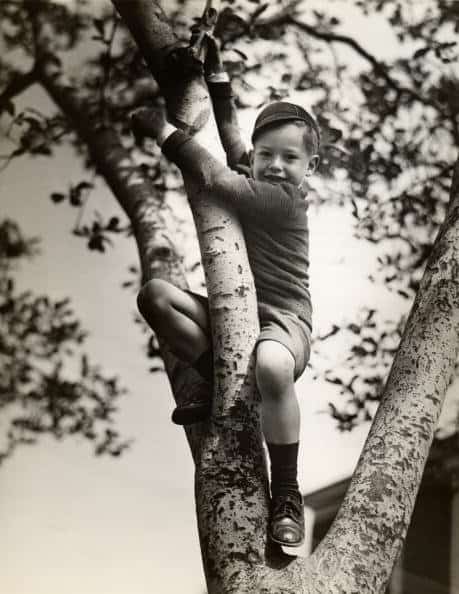
Glancing out of the window, I can see the subject–and eventual victim–of this inquiry, dangerously perched in the crotch of an old chestnut tree, about fifteen feet above the ground. Should I rush out and tell him to get down? Or should I let him be, hoping that he won’t climb any higher, or, if he does climb any higher, hoping that he will not fall?
It is probably all right, so I shall not bother him. Tree climbing is one of the things he has learned all by himself. There aren’t many things he will have the fun of learning all by himself. Most of the things he is going to learn will be hammered into him–Latin and history and grammar and mathematics up to the binomial theorem.
I’m not worried about this progress up the ladder from high school or boarding school to college and from college to law school or medical school. It seems incredible that the young biped now perched in the chestnut tree will someday, without stupendous effort on my part or on his, eventually graduate from college or even become a Ph.D.–but he will almost certainly. The strictly educational side of his life, once he gets his hands firmly on the lowest rung of that ancient ladder, will take care of itself.
What concerns me is something entirely different, a good deal more like tree climbing. I have never heard of a school or college that gave a course in tree climbing. And human life is full of useful accomplishments and rewarding experiences, like tree climbing–like making a speech, for example, or being able to take care of oneself on a camping trip: abilities that seem to me at least as valuable as a knowledge of conjugations and the dates of battles–perhaps (if one is to become a self-sufficient well-rounded human being) much more valuable. What are those abilities, skills, or accomplishments, those extra-curricular proficiencies that every man should have in order to be rounded and self-sufficient, and when can he acquire them, and how?
Let me return–without looking at him, for he is probably by now thirty feet above the ground–to the seven-year-old imp in the chestnut tree. Impartially adding up to myself his skills other than tree climbing, I find that he cannot count money or give change, that he is unable to tie his own shoelaces, that he would most certainly starve if left alone in a well-stocked kitchen, but, on the other hand, that he can perform a rather startling back somersault off a diving board, that he speaks and understands elementary German, and can sit down at the piano and play, with only a few mistakes, a Mozart minuet.
Clearly, to this handful of skills and accomplishments, he must add others, many others, before he is even on the road to becoming a self-sufficient and well-rounded young man. Leaving all formal subjects out of consideration, he should learn how to:
- Swim
- Handle firearms
- Speak in public
- Cook
- Typewrite
- Ride a horse
- Drive a car
- Dance
- Drink
And speak at least one foreign language well
The list does not end there. There are several dozen mental and physical skills that I should like him to acquire. He will acquire some of them in the mere course of growing up; he will acquire some of them more painfully, as the result of adult pressure; there are others that he will avoid, and he will eventually be punished for their omissions with not a little discomfort and social misery.
Ordinary education, even high-priced education, will not guarantee him the essential skills, and some of them are better learned after “education” is over. It is up to me to set about making a list of those skills, it is up to me to see to it that he gets them, because they are skills of hand, eye, ear, or brain which will enlarge, deepen, and ripen him as a human being.
But how, you may ask, can a young man be enlarged by learning how to handle firearms? In what conceivable way will he be ripened by knowing how to cook or drink?
Patience… In asking what these things are that every civilized, intelligent, educated young man should know, remember that I am thinking of skills, not contents, of outside interests and non-scholastic activities rather than of the stream of Latin, Greek, physics, social sciences, Jacobean poetry, and elementary bee-keeping which, from kindergarten to senior year, will moisten, but not clog, the sieve that is his mind.
And so let me hasten to turn away from the mountain range of modern education which threatens to cast its shadow over this discussion; let me mention once, and then not mention again, the project method, John Dewey, intelligence quotients, and the Dalton plan.
The average high school or boarding school is not modern and will give your son and mine little beside formal education and even more formal sport: one will get him into college and the other may leave him with a peculiarly atrocious form of high-athletic patriotism. If we parents do not supplement what is given by the usual schools, our sons will come out of them mere Christian stockbrokers with an abnormal craving for bodily exercise.
If we want our sons to be able to drive a car, speak French fluently, play the piano, set a broken leg, and make horses do their bidding we shall have to look outside of the schools and colleges. And I submit that he who cannot do these things is not completely educated.
The list of skills, as distinct from book learning, does not include mere parlor tricks, such as playing the ukulele, fortune-telling, a startling acquaintance with the insides of the Encyclopedia Britannica or other accomplishments whereby the fear-psychology advertisements promise to make their victims the life of the party or a successful salesman in ten lessons. And the list does not include the special aptitudes necessary to a man in this profession or the accomplishments which aim at the development of his character.
The skills I have in mind may fortify character, but chiefly as a by-product. They will make life richer and, therefore, happier (though happiness itself is usually a by-product). They are tools which will help a man to mine his own vein of gold and some of the gold in the world about him. Some of them will save him discomfort, some of them will bring satisfaction and pleasure, some of them will help him avoid danger, and give him the joy of mastery over animal fears. Some are elementary and taken for granted; others are rarer accomplishments not always striven for.
II
It seems obvious that our young man should know how to swim. More specifically, he should know how to swim at least a mile, dive creditably, and not feel panicky under water. No parents will disagree on this point, since anyone who does not know how to swim stands in some danger of being drowned.
Swimming is valuable not only to preserve life but because the fear of water is instinctive, and the most civilized man is the one who has conquered all that makes him afraid and that can be conquered. Not only should our young man be able to dive courageously and neatly, but he should be able also to revive those less skillful than himself by rolling them on a barrel and pumping their helpless arms; though I do not insist that every young man should be a lifeguard–if he learns all the other accomplishments expected of him he will have little time left for that.
He should be able to drive an automobile well. By well, I mean far better than most people do now. Of all our conveniences the automobile is the most docile, and the most dangerous. It seems to encourage a perilous discourtesy. People who always answer letters, smile when spoken to, and rise when ladies enter the room think nothing of hogging the road or passing on a curve. Our young man should drive safely or not at all. He must know how to change a tire and offer some sort of diagnosis when the engine sputters and dies.
My list does not include a knowledge of how to pilot a plane. Good pilots are born, not made. A man should stay on the ground unless peculiarly fitted for the air. He may be as air-minded as you please, but unless he is air-bodied and air-reflexed, this modern skill should be left severely alone.
He ought to know how to clean, load, and shoot a revolver or a rifle. Someday he may have to, in self-defense. And shooting at a target is also good fun, and an excellent discipline for hand and eye. I should like my son to be able to hit a silver dollar at fifty yards.
And I should insist that he be able to manage a gun so as to injure no one but the target. He must not be the kind of duffer who makes bystanders nervous. I do not advance shooting as valuable for reasons of citizenship or military training. I prefer that what he shoots at be inanimate. He may develop a passion for shooting duck, grouse, and deer–without my blessing; for it seems to me that the longing to assassinate wild animals is a barbarous and childish method of asserting the superiority of the human race, and considerably less civilized than dueling.
As for self-defense, a man should certainly be able to take care of himself in a scrap. He need not learn jujitsu–old-fashioned boxing will be enough. He will get some of this in school. He should get enough of it so that he can give, and take, a good smack on the jaw, whether in friendship or anger. No matter how short the list of his accomplishments, this should be one of them. The Soviet Russians, who have seldom hesitated to use firearms against those whom doctrine forces them to consider enemies, hold boxing to be brutal, and forbid it to their young men. Let us register our disagreement and pass on.
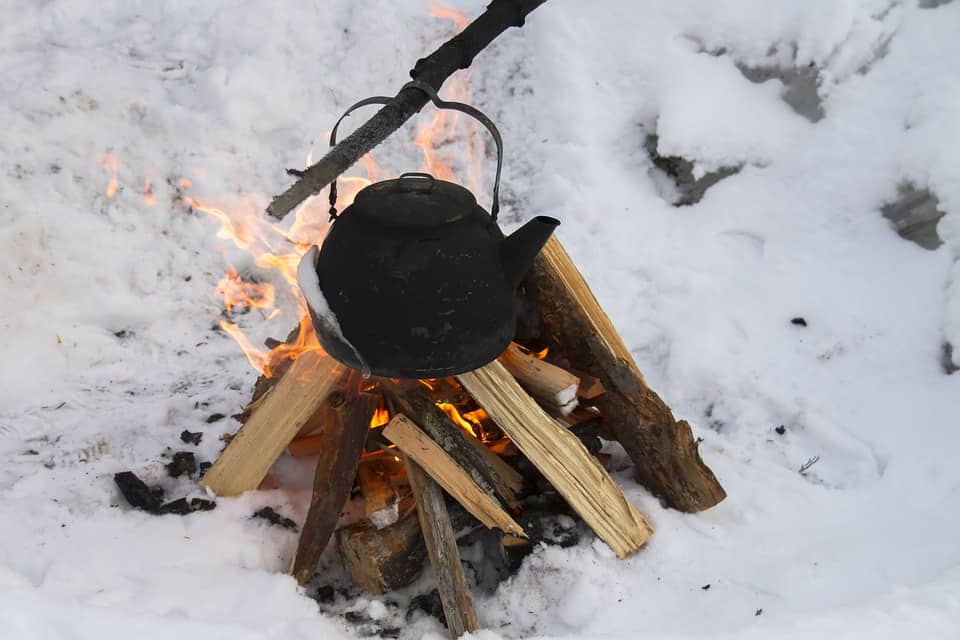
He should learn how to take care of himself in other ways. He ought to know the rudiments of camping, how to build a fire, how to chop wood, how to take a cinder out of his eye, how to deal with a severed artery, how to doctor himself for ordinary ailments. He should also be able to take care of other people in emergencies, to apply first aid, set a broken bone, revive a drunk or a victim of gas, deal with a fainting fit, administer the right emetic or antidote for a case of poisoning.
And he should be able to feed himself, to cook, not only because someday he may need to, but because cooking is one of the fine arts and a source of infinite pleasure. He should be able to scramble eggs, brew coffee, broil a steak, dress a salad, carve a chicken, and produce, on occasion, one first-class dish, such as onion soup. The more he can do, in these days of the delicatessen store and the kitchenette, the better. It is not effeminate, it is not beyond him, and the best chefs are all men.
Our hands, originally the keys used by man’s brain to unlock the whole wide world, are in this age of patent appliances in some danger of withering through disease. A man may go through life without using his hands for anything more difficult than gripping a golf club, signing letters, fumbling coins, lighting a cigarette, opening a bottle, and holding a telephone receiver. When the furnace goes out, or the radio goes dumb, or a door won’t close, or a pipe leaks, he has to send for an expensive expert.
Therefore, our young man should learn to be handy in repairing the trifling faults of his home. Of course, he may live all his life in apartment houses and be spared such attention to trifling faults; but if he must live in apartment houses I had rather have him do so from choice than from incompetence. He should know how to use paint brushes, a saw, a hammer, and other common tools. It is much more fun then he might think; it adds to his self-respect; it satisfies the throttled manual ape, and it supplies one of his few contacts with the remote world of physical labor.
One of the best tools he can use is practically unknown among those who have not spent some time in a newspaper office: the typewriter. Our young man should also have a beautiful and distinguished handwriting. He will not learn this in any school–schools are as likely as not to ruin whatever handwriting he might have had. But handwriting should be reserved for special occasions. The bulk of his writing, particularly if he is a professional man who has much of it to do, should be done on a typewriter.
I do not mean poking at the machine with two fingers, but full-fledged touch-system, capable of turning out three thousand words an hour. This talent will be enormously useful. Spread widely enough, it might even revive the lost art of letter writing and undo some of the harm, the laziness, the mental as well as verbal sloppiness induced by the appalling habit of dictating to a stenographer.
III
He should play one outdoor game well and have a workable smattering of several more. To my eye, an American who cannot throw and catch a ball seems pathetic and grotesque. Perhaps I am prejudiced. And baseball, except for boys and a small band of professionals is a lost cause.
The usual American game is golf. So let him learn, for the sake of human contact and outdoor recreation, to go around the course in at most a hundred and ten. If it were a question of my own son, I should try to steer him toward tennis, a livelier game and prettier to watch, and one with more possibilities of mental release than golf, which often undoes in discouragement, obsession, and emotional strain the good it does as an exercise.
A game should not be an end in itself–as is often true of golf–but a relaxation and a complete contrast to the sedentary. There is something a little sedentary about golf.
The bicycle has gone, yet every boy should know how to ride one. Don’t ask me why. He should also be able to skate, sail a boat, and handle a canoe passably. Fishing is a specialty, like chess: those who have it in them will eventually find themselves doing it; those show do not feel the call need not bother.
It is a singular commentary on college athletics to realize how few sports a man can get along with quite happily after graduation; how quickly the vast array of football, soccer, pole vaulting, basketball, water polo, lacrosse, hurdling, handball, rowing, wrestling, fencing, shrinks in afterlife to golf or tennis, or, surprisingly often, to occasional sweat in the steam cabinet.
Walking is a noble but neglected sport. Americans “hike” once in a long while but seldom walk. And hiking easily becomes hitch-hiking. The automobile, organized athletics, and the fact that American cities and American suburbs are dismal places to walk in have caused American feet to abandon the roads.
For every climber in an American national park–some of which are quite as beautiful as any Alps–there are ten “hikers,” fifty who “pack” on horses, and ten thousand who survey the wonders of nature from the windows of a sedan. Walking in this country is a lost cause, yet walking is one of the habits I should wish my son to acquire.
No other exercise, if indulged in several days at a time in pleasant, moderately wild country, has greater power to remake a man, to iron out his creases, to produce deep health and spiritual calm. The first steps in this elementary course had best be taken in Europe, where the natives do not look upon people with heavy shoes and knapsacks as slightly cracked.
Everyone should know a great deal about animals. It is natural for boys to collect stray dogs, and all children seem instinctively to be much more interested in every other branch of the animal kingdom than their own. It is equally natural for the the city and suburban boy to grow up with no more contact with animals than Mickey Mouse and an occasional trip to the zoo.
Kindness to animals and an understanding of them has become in modern life a skill that must be nourished and artificially trained. I do not expect my son to become a Raymond Ditmars or a William Beebe. But I shall think him lacking unless he has much to do with animals and gets on well with them.
Civilization has hustled us all horribly fast and horribly far away from our primitive state, from the time, biologically not very long ago, when man’s life depended a great deal on animals. A certain return to nature is healthy and desirable.
The best animal for the purpose of the return to nature is the horse. I insist then that a boy should have many horses in his life, and should learn how to stay in a saddle with pleasure to himself and a minimum of annoyance to his mount. Riding is one of the required studies in my curriculum, valuable both as one of the possible victories over physical timidity and as a source of pleasure.
With riding should go some knowledge of how to take care of a horse. But I should not like my son to become horsey. Horsey people are victims of an obsession even worse than golf. They lead, mentally, four-footed lives, and the spiritual aroma of the Noblest of Beasts clings to them as the smell of straw and manure clings to the stables. It is a clean, time-honored smell, but a bit too pervasive. I have three fears for the future of my son: that he will join the Army, enter the Church, or become horsey.
IV
Trivial, but important because one can be so uncomfortable if one does not know them, are the parlor amenities. A boy should learn how to dance. Good dancers, like aviators, are born, but anyone can learn to do modern real-estate dancing– that form of rhythmically bumping into other people in a small space with a technic dictated by the high land value of the places where dancing is usually found.
The kind of dancing that is really fun is extinct in America. Social dancing is no great art, but essential if one wishes between the ages of sixteen and twenty-two to become acquainted with more than a few specimens of the opposite sex.
As to card games, I play bridge so badly myself that I am prejudiced against it. If one plays bridge well enough to enjoy it, one probably plays too much of it to the exclusion of better things. As a refuge from a boring conversation, it is without equal. Backgammon, though useful for the same purpose, is a monotonous blind alley.
Pool and billiards are specialties. From these indoor pastimes, our student can pick one optional elementary course, which will be given at the pleasure of the instructor.
Even more trivial, but infuriating if one is clumsy at it: tipping. It would be very pleasant to go through life with a knowledge of how to tip naturally, justly, without fear and without reproach.
American social habits being what they are, there is one indoor skill which seems to me not only far more important than bridge or dancing but actually compulsory–drinking. A young man who could convince me that his lips would never touch liquor might be let off by my required course in drinking.
But he would be an exceedingly rare bird, and alcohol is so much more evident a liquid in the United States than water that it is probably quite as necessary for a young man to learn how to drink as it is for him to learn how to swim. If the youth of the country had been taught how to drink, just as they were taught not to eat between meals or swallow before they had chewed, we should never have had Prohibition.
It is a more difficult art than most, for every man should know, long before the time when (according to our customs) he indulges in his first collegiate binge, whether liquor goes to his head, his legs, or his morals, whether he is the type that sings, fights, weeps, climbs lamp-posts, or pinches the girls.
Furthermore, he should learn his capacity and stick within its limits; he should know something about the different kinds of drink, and which drinks produce chaos within him when mixed. By all means, let him leave drink alone if wants to. But since, nine times out of ten, he will drink, let him do so sensibly.
I have omitted from this list all the mention of women, not so much because it is a subject of appalling breadth, leading to endless discussion of chastity, frustration, fulfillment, birth-control, curiosity, mate hunger, and other less printable but even more important topics, but because, in regard to the other sex, the fairly well-educated seem to be at as great a disadvantage as the rest of mankind.
What every high school, boarding school, and college graduate should know is no different from what every man should learn in this darkest and most unteachable province of human conduct. I shall not be the one to tell students of this course what acquired skills can prevent mistakes and heartache. Where sex is concerned, nature clearly intended us to make many mistakes in her hope that some of them would be productive.
I shall certainly be in a minority in suggesting that our sons should know the rudiments of gambling. Gambling might be placed on the same plane as drink–the less use one has for it the better. And the sooner America gives up gambling, not only at card tables, roulette wheels, and slot machines but in stocks and bonds of equally mysterious and unpredictable corporations, the better also.
But gambling in one form or another seems to be a national habit of mind. Almost every American gambles at some time in his life. And there are things valuable in other departments of life which gambling can teach: to be a good sport, to be a good winner as well as a good loser, especially when games are played for money; not to brood over the irrevocable, not to give way to retroactive daydreams and say, “if only I had put a big stack on double zero, if only I had sold out in August 1929.”
October of that year was the rout of the amateur gambler, and the crash revealed this country to be singularly full of poor losers. Important as it is to be a good loser in public, it is even more important to learn not to try to turn the hands of the clock backward in the privacy of one’s own soul.
V
Higher than almost any other accomplishment on the list do I place music. There is no reason why any boy who is not absolutely tone-deaf should not learn how to play one musical instrument well enough for it to be a self-resource and a tolerable pleasure to others. If it were not for the certainty that our educators would make it as deadly during school and as shunned in afterlife as that badly embalmed language, I should advocate the substitution of music for Latin as a required subject.
Music is, or ought to be, an essential part of every civilized human being’s life. Economic necessity, the radio, and the phonograph have put the playing of music beyond most Americans. Our children should bring this back. My choice would be the piano–the violin is far more painful in incompetent hands, and most other instruments are not meant to be heard singly.
The saxophone and the ukulele should be placed on a par with the taking of drugs. There is much to be said for being able to sing parts decently, and any amateur who know the words of even the commonest songs is a phenomenon. I realize that even this is asking a great deal. Perhaps I expect too much. My students will receive a passing grade if they can sit and listen to good music intelligently, and moderately often without pressure.
A civilized man should know how to read. The ability to read, or rather the habit of reading, is a very rare even among intelligent people and has to be taught and kept up if it is not to become rust. The educators tumble over one another with new methods of teaching children how to make sense out of print, but not a single pedagogue, so far as I know, has successfully tackled the problem of how to keep people reading books once they have learned that it can be done.
Incidentally, if someone were to write a little book called How to Read the Newspapers he would earn the undying gratitude of those who search hurriedly for the sports, the market, the obituaries, glance at the headlines, and then throw all of the newspapers on the floor.
If the young man over whose head hangs this list of accomplishments could not find time, because of the necessity of healing for the News or keeping dates with co-eds, for more than a few of these skills, let a fluent reading and speaking knowledge of at least one foreign language be among them, French or German, preferably both.
A parent must expect no help from schools in the teaching of foreign languages–or rather (such is the impression of the student who goes to the average school) in the teaching of irregular verbs. Governesses and tutors, little trips abroad in adolescent summers, can start a false spring which withers and dies as soon as the child goes to a regular school. Everyone learns one’s language as he learns to walk–the learnings of one more ought not to be so hopeless.
But hopeless it is for Americans. Parents should form a foreign-language study association and devise ways to supplement, and combat, the schools. German children learn an amazingly good brand of English without ever crossing their borders. Why can’t we? For one thing, we don’t really want to. Yet we should. An American who knows only English is blind in one eye.
Corollary to this are the skills and experiences that come from travel, and the tolerances and curiosities about other sorts of people that only travel can produce. To travel well, efficiently, without fuss or complaint, without asking why porters are so stupid or blaming the Italians for speaking their own language is no small accomplishment.
But what I have in mind is a wider mental habit, an ability to think like a citizen of the world, to meet foreigners upon their own terms, to circulate freely and receptively in London without giving in to that curious chameleon temptation to be at the same time a little ashamed of one’s own country and to imitate the British.
The British have it over us in two particulars: their educated men talk well in public and handle their own language, in speech and in writing, as if it were a familiar object. Our young man should be able to express himself clearly before a crowd of strangers, without shyness, muddle, or a pathetic resort to “so much as been said and well said” or “I did not expect to be called on.”
Children somehow get over the terror of saying “how do you do” to strangers, but the American adult who can get to his feet, propose a toast, introduce a stranger, voice a civic protest, heckle a windbag politician, and give utterance to an unembarrassed thought is a museum piece.
And a man should command the elementary tool of written language, and be able to put simple things on paper in clear words; for in its essentials writing is not a mysterious art, but a human function, as possible to learn as walking or eating.
On the borderline between the skills like these and book-learning are all such things as a sound smattering of the theater, painting, opera, a good workable understanding of the structure of a business, investments, and banks (which in real life are not quite as they seem in the textbooks of economics).
To these skills and knowledge, I would emphatically add certain experiences. The educated young American male is in peril of too much shelter, too little danger and privations, and would be the richer if he had at some time in his life been without money and gone hungry for several days, been lost or shipwrecked, been robbed, been in jail, and spent a few months working as a common laborer.
This last I place high on the list. Let every educated man, as a necessary part of his education, be thrown into the muddy stream of American industry and see what it is like to swim alone on daily wages.
The list of extra-curricular accomplishments must come to an end, or our young friend will not pass his board examinations. One more desideratum: he should before reaching twenty-two have done something because he wanted to, whether other people wanted him to do it or not–sailed a boat on a perilous course, or shipped as a common seaman, or taken a job on a newspaper, or motored across the continent, or gone off to Europe on his own, or learned boiler-making.
Anything, so long as it was his own idea. And how does one make healthy young middle-class Americans want to do something if all they want to do is enjoy themselves? Ah, if I knew that…
And into the young man’s bag of tricks I should certainly insert the accomplishment of not acquiring property unless he needs it. The other skills I have proposed for him will not cost much money, so that he will be able, and also tempted, to record the increase in his standard of living by adding to his furniture, by buying a better car or an oil furnace, by going in for collections of medieval armor or ancient coins, and similar surrenders to the magpie streak in all of us.
Property quickly crowds out and preys upon less tangible pleasures, and is so often preferred to the fun one can have with one’s body or one’s mind because the joy of its acquisition is so immediate and keen. Property of a decorative or useless nature is, indeed, often more fun in anticipation and at the moment of its acquisition than it ever is again.
Insensitiveness to his personal property, unless of course, it is extraordinarily beautiful, is a desirable skill for any man to have. And, like swimming, bridge, or German, it must be learned and worked at.
VI
What a ferocious program, you may say. And how in the world is it, or even a quarter of it, to be put into effect, granted a normal male specimen of the race? Only a fraction of it will be acquired in school, we all admit. Parents are busy, and except in rare cases parents are the worst possible teachers of their own children, who know them far too well.
Summer camps can do some of it. American schools grant long holidays to their pupils from June to October, and the pupils, if left to themselves, use the holidays to wipe out as much education as possible with a useless, unsystematic, healthy good time.
For this idle summer, the camps substitute a schedule of outdoor skills, and the boy who goes to summer camp usually comes back knowing how to swim, fish, paddle a canoe, toss a flapjack, and not cry too much when hurt. The skills taught by the summer camp end with outdoor sports. Yet parents are dimly aware of how little school teachers really teach, and cling to supplementary education like that of the summer camps when they can get it. Why not enlarge the camps and to their outdoor curriculum add German, taught as thoroughly as they teach canoeing?
Why not, in fact, apply the basic principle of Americanism and have two systems of education competing against each other? On one side, the formal schools, pouring contents into rebellious minds; on the other, summer camps where the children are taught definite humane skills, some of them much better taught than the schools can ever expect to do? Who knows–in course of time the competition might be too severe and the schools might go into receivership.
Ah, I thought so – there is one skill I have forgotten. When, as the result of some trips to Europe, of much prodding on my part, and of summers spent at the kind of summer camp that does not yet exist, I am eventually confronted with a son who can make an onion soup like Savarin, ride a horse like an Indian, play a difficult sonata, speak French and German like a native, and repair a leak in the roof–will not there be something missing? Yes–an accomplishment vitally necessary to an American.
Unusual though this young man should be, he should not seem so. For his own comfort, for mine. Is not a parent’s basic ambition for this child that he be very different from other people, yet manage to seem almost exactly like them?