• Skip to primary navigation
  • Skip to main content
  • Skip to primary sidebar
  • Skip to secondary sidebar
  • Skip to footer

M.D. CREEKMORE

  • Blog
  • Books
  • Newsletter
  • Gear I Use
  • About
  • Contact
  • Facebook
  • YouTube
You are here: Home / Archives for Power Generation

Power Generation

Here you will find information on living off the grid including solar power and detailed information on other alternative and off-the-grid power alternatives.

Hiluckey Solar Charger Review

October 4, 2018 Jesse Mathewson

solar charger review

Legally I have to tell you if I have received the product or any compensation for writing this review. As with the large majority of products I review, I have not received this product or any compensation. There may be affiliate links in the material that utilize Amazon as a platform. However, unlike other blogs, we follow the laws here, even if the laws are intrusive.

Additionally due to recent comments and emails received, I want to remind everyone that the vast majority of products on the market today are not made in one country alone.

When it comes to GPS, communications, national weather service radio, electronic reading devices and more having extra power and or the ability to charge using the sun is an essential prep. Over the years I have tested and used several different battery backup systems.

All of them have worked, but some have worked far better than others. The Hiluckey 10000mAh Solar Charger has worked very well. Sadly, Elon Musk does not have an easily affordable version yet!

This charger/ battery pack comes with extra features that are fun but ultimately not why I purchased the unit. For your benefit, the extra features are as follows, 2 LED flashlight diodes with 3 modes (Bright/ SOS/ strobe), small compass (it works though I wouldn’t rely on it), and a solid well made silicone rubber case that protects it from shocks and dust and splash damage.

The best features are the addition of a new generation solar panel for charging and a well made 10000mAh battery with an IC chip for easy battery evaluation and limiting to prevent overcharging and promote the best charging depending on the drain.

With indirect (cloudy days/winter) sunlight in Arizona, the unit charged from 25% all the way through 100% within 6 hrs. On a nice clear day with direct sunlight in early spring, it easily charged through 100% within 4 hrs. Again this was in Arizona, the important thing to recognize is that Arizona is at a nearly perfect latitude for the use of solar energy.

We have in fact one of the best overall climates for the use of solar year round with an average of 270 days a year of sun and easily over 175 days annually with full sun. This unit would work well in most areas across the United States and while it may take an extra day to recharge on just the sun alone in less sunny areas, its ability to hold a charge for over a month makes it an easy addition to my pack.

Its storage capacity maintains 100% for over 3 weeks and for myself did not drop below 4 lights for well over 4 weeks.

For the various natural disaster seasons across the United States I would suggest having one or more of these on standby, with a quick check and top off every month or so you should have the power you need when you need it.

solar charger review

For instance, if you live along the East Coast or on Islands across the Atlantic and or Pacific rim having additional chargers for your electronic needs can mean the difference in a Hurricane, Typhoon, or severe tropical storm.

For those of us in flood, fire or tornado areas having additional power for our small electronics could make it easier for help to get here. At an average of $22 apiece, these are worth every penny invested and will quickly repay the money spent after the first camping expedition you take with your children or grandchildren.

When it comes to batteries for GPS, modern cell phones, electronic books and many other small items the standard is between 1000 and 3000mAh in size. This means that the backup battery which weighs just slightly more than an Amazon Kindle Fire or the same as a modern cell phone or GPS unit will charge most of those units several times over before needing to be recharged itself.

It is my suggestion that you setup check-in times as standards for immediate and extended family members and friends; in the times between check-in and use simply power the units down to conserve energy. You will find that most modern batteries will easily hold their charge for up too 2 weeks when this approach is used.

So in review, what are the pros of the Hiluckey 10000mAh Solar Charger?

  1. 10000mAh battery size allows for multiple charging events for most modern small electronics.
  2. It is a small size in comparison to many other units for the ability it has, this makes it easy to store and efficient.
  3. The solar panel is a newer generation and works very well allowing for multiple options from plugging it in through using the sun when available.
  4. Solid construction with shock-resistant silicone armor and dust cover help keep it dust free and resistant to splash damage. (I put it in an industrial grade zip-lock bag for full water protection)
  5. Lights are very bright and work very well, strobe is a great setting and is the last click allowing an easy one-touch on approach.
  6. Compass works, while I do not rely on small compasses like this, having them and knowing how to use them really do benefit your kit.
  7. Pricing is reasonable for the quality of the product you are getting, $20-25 will get this shipped right to you. Two of them are less or the same as most other units being currently advertised with similar attributes.

At this time I have not found any real cons to owning this unit. I understand that many of you probably have similar setups, I would suggest that the added benefit of a working solar panel and modern IC chip for better control makes it an invaluable addition. As with all my reviews, it is important to remember that my goal is not to sell it but rather just show you if it works or does not.

Free the mind and the body will follow

Filed Under: Gear Reviews, Power Generation

Installing a Tankless Propane Water Heater for Home or Off Grid Cabin

September 21, 2018 M.D. Creekmore

tankless-water-heater for off the grid showerby Patientmomma

When I purchased my country property several years back it was in dire need of updating.  Over the last few years, I have gradually replaced many items which were hanging on at their end of life!  The conventional, tank water heater was approximately 15 years old and while it worked, it took between 5 to 7 minutes to get hot water to the master bathroom, depending on outside temperature.

I knew it needed to be replaced so I began researching tankless water heaters.  I have no connection to any brand mentioned other than being a happy customer.  I had already decided to use propane gas as a fuel source as I did not want electric and I don’t have access to natural gas.

This article describes my research and choice of a water heater.

I lived in Europe for five years and most of the housing had tankless water heaters so I gained some valuable experience with on-demand water heaters; both good and bad.  Fast forward a bunch of years and the on-demand heaters were becoming the rage in the USA because of the high utility costs of conventional tank water heaters.  But I stayed with my 50-gallon tank and paid the price of heating water 24/7/365.

About 8 years ago I was faced with replacing water heaters in a large house. I had a choice to replace three 50 gallon tank heaters with newer models or go tankless.  About that time a friend of mine had her 50-gallon tank water heater, located in her attic, fail and the water damage was significant.

She had to move out of her house for six weeks while ceilings, floors, carpet, drywall, etc., were replaced.  Her experience was a motivator for me!  I did my due diligence and researched all types of water heaters; both tank and tankless.

The tank type was much cheaper to purchase and install but the utility bill is what made the difference.  The tankless heaters had higher upfront costs but saved on the utility bill the rest of its useful life.

After going back and forth for months, I made the decision to go tankless.  While the research you must do is the same for any type of tankless water heater, your family lifestyle, location, how long you think you will stay in the house, the availability of desired fuel, and maybe Home Owner Association (HOA) rules will influence your decisions.

I also considered the improved resale value of the home by having energy efficient tankless water heaters.

So what’s the difference?  Basically, the tank heaters hold the water at a constant temperature 24/7/365.  When you turn on your hot water faucet the hot water in the tank mixes with cold water from the house water system and gives you warm water.

You pay your utility provider a fee to keep that water hot all the time.   In a tankless system, the water heats only at your demand.  When you turn the hot faucet on, the heat exchanger in the tankless unit turns on and provides you hot water, then stops heating water when you turn the faucet off.  Below is a diagram I copied from the Navien website on the components of a tankless water heater.

Choice of Fuel Type:

One of the first decisions you have to make is the type of fuel for the water heater; the choices are electric, natural gas (NG) and propane gas (PG).  If your house is all electric that may influence a decision to install an electric heater, but there is always the possibility of running NG to your house if you are close to an existing line.

Some city/communities/HOA will not allow a propane tank in the yard, but you must ask the HOA and city ordinance folks.  They might allow a buried underground tank, but not an above ground tank. Do a cost comparison of fuel types (if all are available to you); the cost of electric, NG or PG.

How big a tank do I need?

Another research and decision to make is sizing; how large of a water heater do you need?  Basically, the larger the heater, the more expensive the heater, no matter what brand it is.  The following general information comes right off the internet and you can query “tankless water heaters” and find a lot of data. Now down to the details you need to know…

Maximum Flow Rate:

This is the measure of how much water passes through the water heater at a time, in gallons per minute (GPM). For NG/PG tankless water heaters, it averages between about 6 GPM and 10 GPM but some go higher.  I was told an average shower or faucet has about 2 GPM flow rate; so you can get an idea of how much water flow you use.

If you have two adults, two teenagers and 2 younger children, think about the number of water fixtures that will be used simultaneously and how long the water will run if you have teenagers in the bathroom. Will you have people in the shower at the same time you are running the washing machine and your dishwasher?

If your family is two adults and some fur babies, your demand will be different.

The important point is not to confuse the flow rate value with the water heater’s heating capacity. Water flow capacity is NOT how hot the water will be if it’s flowing at 10 GPM. For example, a tankless water heater listed as providing 10 GPM will give you water at that rate, BUT how hot that water can rise to depends on the energy input of the unit.

That is why when choosing a NG or PG tankless water heater you need to pay attention to its energy input per hour, or BTUs per hour.  Now here’s where the info gets more complicated.

Heating Power:

There is a whole complex discussion of British Thermal Unit (BTU), joules and temperature explained on many different websites on the internet.  I am not an expert on this so I just used the common knowledge I read on several internet sites.

Basically, about 500 BTU/hr is enough to heat water flowing at 1 GPM by 1 °F. If you know what the incoming water temperature is, it is possible to estimate how many BTUs per hour you need from a tankless water heater. You can ask your plumber to figure this out for you.

Water temperatures can vary by season and by location; e.g., New York is colder than Mississippi in the winter so the groundwater temperatures will be different.

From my experience,120 °F is the maximum temperature I wanted, because higher temperatures create a scalding risk. You should also know that the BTU number in the product specification sheet is not the actual heating capacity. T

o calculate how many BTUs are actually used to heat the water, you need to use the energy factor.

Energy Factor:

The energy factor for water heaters means the part of the heat energy actually applied to the water and to the total energy input which is delivered to the heater. I wanted an energy factor of at least .9.5.  If you have a four-person family, you will need at least 160,000 BTU, higher would be better.

The energy factor needs to be about .9.   For natural gas and propane tankless water heaters, the energy factor varies between 0.8 and 0.95, depending on whether it is a condensing unit or not.  So what is the difference between condensing or non-condensing water heaters?

Condensing Water Heaters:

Simply put, a condensing water heater uses the heat of the expanded gas, which would normally be expelled through a vent, as an additional heat source. The waste gas released from the exhaust vent of a condensing water heater is cooler and in the cooling process, the water vapor often condenses back to the liquid state, which is why it is called a condensing water heater.

Non-condensing tankless gas water heaters have an average energy factor of 0.82; condensing water heaters have an energy factor of up to 0.95. Guess what? Condensing units cost more money, but I think they are worth it.

Activation Flow Rate:

One of the things you need to realize is tankless water heaters only start heating when their sensors confirm a certain amount of water is flowing through the system. If the water use does not reach that minimum flow rate, the unit will not be activated and you get cold water.

This means if you don’t turn the faucet on full open, the water heater may not turn its heating element on.  Look for a water heater that has a .4 to .6 flow rate.  You do NOT want a 1 GPM flow rate.  Do your homework and check out the product specification sheets and make sure you get a unit with a LOW number minimum activation rate.

Brand and Build Quality:

I am very opinionated on this topic so bear with me.  I like hot water; that is why I purchased tankless hot water heaters.  In a former house, I had a whirlpool tub that I could not use because the tank water heaters could not provide enough hot water.

After I installed the tankless water heater, I was able to fill the big whirlpool tub and enjoy the experience with HOT WATER.  Sorry, I digressed.

The old saying “you get what you pay for” is true and especially with tankless water heaters. I won’t demean various brands, but I say, do your homework.  If you are on city water your brand choices are wide. Talk to people and quiz your plumber and friends on their opinions of different brands.

Check out websites which compare brands and prices but examine the specification sheets in detail.  Look at:

  • Energy factor: Over 160,000 BTU; Desired 180,000 to 199,000
  • Minimum flow rate: Desired: over 0.26 GPM
  • Minimum activation flow rate: Desired: 0.4 GPM
  • Maximum flow rate: 7.5 to 11.5 GPM/min — this depends on the model and your need

Other Things to Know:

  • Tankless water heaters can be indoor or outdoor, vented or non-vented; depends on what you want/need.
  • Outdoor units should have ALL pipes insulated; some indoor units should also be insulated, depends where you have it installed. I have had both indoor and outdoor units insulted, even though I live in the South. Northern folks MUST have insulation!
  • Tankless water heaters require a minimum of ¾” pipes while conventional tank water heaters only have ½” pipes; this should be included in your install price; everything is negotiable.
  • Water heaters need some annual maintenance so put them where you can get to them.

Oh By the Ways:

  • It will take a minute for the hot water to get to your faucet, depending on where you place your water heater. I had to wait 6-7 minutes for my conventional tank electric water heater to get hot water to my master bath shower.  Now with the new tankless one, it takes 1-2 minutes to get to my shower.
  • Before you turn on your dishwasher, turn your kitchen faucet hot water full open and let it get hot; then start your dishwasher.
  • It will take a few seconds for the tankless water heater to adjust temperatures from hot to warm or warm to hot. Depending on the type of faucet you have, once you get used to the tankless water heater, you’ll know where to turn the faucet the first time to get the temperature you want.

If you live in the country and are on well water your choices are more limited.  Unless filtered at the entry point, most well water contains a lot of minerals and will corrode any water heater.  Navien brand water heaters have stainless steel innards and will hold up better when connected to well water.

Other brand heaters are less expensive; but they usually have cooper innards, which corrode more quickly.

At my place, the well pumps water to an underground holding tank. Occasionally, there is low water pressure between when the well pump kicks on and the pressure pushes the water to the faucets.

This causes a lower flow rate to my faucets, which delays the water heater kicking on.  To me, this is just part of having well water so it does not cause me any concern; I just patiently wait until the well pump does its thing. But it is something you should be aware of if you are on well water.

My Choice:

Because I live in the country, have a set income and I really like hot water, I decided to purchase and install a propane tankless water heater.  It is an outdoor condensing unit.  I choose Navien (click here to check price and availability on Amazon.com) because I use well water and Navien is the only brand (that I researched) which has stainless steel innards.

The picture below is of the installed tankless water heater on the exterior of my house. This is the largest residential unit Navien makes and the insulation is protected by the unit cover. Other brands will work but they will corrode faster from well water.

With Navien’s 15-year heat exchanger warranty, the water heater may outlast me. I am not affiliated with Navian, I am just a happy customer.

I have purchased three Navien tankless hot water heaters for various houses and I have had no problems with them providing hot water when I wanted it.

That said, Navien requires a licensed plumber to install the unit to receive their 15-year warranty.  A good DIYer could probably install the unit, but again, Navien will not warrant it unless installed by a licensed plumber.

The only thing I am unhappy about is I cannot independently light the water heater because it has a closed, self-contained ignition.  That means I cannot take a match to a pilot flame like we could in the old days.

But, I have a propane generator so unless manufacturers stop making propane, I’m good!

tankless-water-heater

The Cost:

Tankless water heaters will cost you more up front; there is no getting around that. But…your utility bill will go down.  In my former city house, the three conventional tank water heaters were NG.  After the Navien tankless NG heater was installed my gas bill reduced by 45% the first full month and after a year the bill was down by 52%.

Currently, my conventional electric 50-gallon water heater cost about $700/year to operate.  Since I have only had this tankless water heater a short while I don’t have statistics to give you; but I anticipate about 4.5-year return on investment (ROI) for the tankless water heater.

The cost will vary around the nation; your location makes a big difference in the price. Your cost reduction and ROI will be different depending on the brand, size of tankless water heater you choose and your family size and use.  You can see most of the retail prices on the internet but remember, your plumber can get a discount.

Installation charges could vary from $800 to $2000, depending on your location, codes and ordinances, how much ¾” piping is used and your plumber’s profit margin. One last plus for tankless water heaters: In 2016 the IRS is allowing a $300 tax credit for installation of energy efficient tankless water heaters.

I’m sure there are some really knowledgeable readers that can talk technical specs better than I can, so please pitch in and clarify if you can.

My need was to have hot water and my desire was to save money so I decided to switch to a propane tankless water heater.  I cannot put a price on my peace of mind.  I hope this information is helpful.

Filed Under: Power Generation

Long-Term Fuel Storage: Where and How To Store Fuel for Emergencies?

September 18, 2018 M.D. Creekmore

By R. V. Zeigler

In any survival situation, some type of fuel is necessary be it liquid, vapor, or solid. Fuel will be used for heat, light, transportation, and cooking. Each fuel has its good and bad points. You do not know when you will need this fuel so the effects of long-term storage are a primary consideration.

Solid Fuel:

The most common solid fuel is firewood. Different woods give different amounts of heat for the same amount of space. I have used softwoods like cottonwood, which give off little heat, burn fast, and leave a lot of ash. They also have a pungent smoke that could travel a good distance and alert others to your presence.

I have also used hedge (Osage Orange) which is an extremely hard wood, burns slowly and leaves little ash. Its smoke has fewer odors as well. The tradeoff? Dry, standing cottonwood is plentiful and easy to find. A dry hedge is more difficult to find in many parts of the country, and is extremely difficult to cut, especially with hand tools.

Sparks will come off of this wood when cutting with a chainsaw.

Cottonwood will deteriorate faster than hedge too. No matter what wood you have in your part of the “woods”, cut it to length, split it to a usable size, make sure it is tightly stacked, and cover it for a year before use. If not, you will create much more smoke than necessary, it will not give you the maximum amount of heat, and if it is used in a stove or fireplace, it will cause creosote buildup that can lead to a chimney fire.

Chimney fires are not something you want to have to deal with, ever. There are many other kinds of woods between cottonwood and hedge. Find out what is available in your area, and talk to some of the “old-timers” that have used them. Find out which have the most heat for the least work. In a survival situation, the most bang for your labor buck is what you are after.

There are other solid fuels such as charcoal, and “faux” fireplace logs, and some chemical fuels. Use each in accordance with the instructions provided by the manufacturer. I am personally a bit skittish about cooking directly over the flame of some commercially-produced products such as the fireplace logs.

I am not really sure of what chemicals were used in the manufacturing process and would rather be safe than sorry. As with all fire, be careful of heat impinging on other surfaces in the area, and be careful that you are not using fire in an enclosed space.

It can lower the oxygen content to a fatal level, such as leaving a fire going while you sleep. NEVER leave a fire unattended under any circumstances.

Liquid Fuels:

Liquid fuels are for the most part hydrocarbon-based such as gasoline, kerosene and diesel fuel. There are also alcohol and Sterno type of chemical fuels.

Alcohol can be stored for a considerable time as long as it remains sealed. Once alcohol is unsealed it absorbs a small amount of water from the air. The more water the less effective the fuel becomes.

Alcohol is a good liquid fuel for small, fast cooking fires, but be warned, you cannot see the flames of an alcohol fire. They are there, but a sleeve or part of your body could be exposed with no warning. Keep alcohol fires small and well supervised.

Sterno type fuels are used for small cooking fires like alcohol. There are accessories for them that make them more useful and they are easily transportable. Do not use them in tightly enclosed spaces and follow all directions.

Gasoline, as used for internal combustion engines, is not the best choice for long-term storage. It has a short shelf life (less than a year) and can harm an engine once it becomes old. Gasoline is also very volatile and has explosive vapors.

Follow all gasoline handling safety instructions to the letter. An uncomfortable burn in normal times can become a fatal burn in a survival situation. Storage of gasoline is also something to be very cautious about. Venting vapors can build up in enclosed spaces, so well ventilated areas, and approved containers, are the only place to store gasoline.

Kerosene is a bit more stable than gasoline and only has flammable vapors. It can be stored a bit longer and is much more “user-friendly”. It is generally used for heat and light which makes it more likely to be used in living spaces. It does produce carbon monoxide when burned and should be used in spaces where there is ventilation.

Nothing with an open flame should be used in an enclosed area at any time. Why take the time and trouble to prepare and then die because you slept with an increasing carbon monoxide level? Doesn’t make a lot of sense does it? When our ancestors used “coal oil lamps” they lived in very drafty houses. For the most part, we don’t. What worked for them might very well kill us. Be safe!

Diesel fuel, or as is most likely encountered today Ultra Low Sulfur Diesel Fuel (ULSD), is not our granddads’ diesel fuel. The “old days” diesel fuel was good for a number of years and was quite easily stored. Not so much today. ULSD is an extremely fragile fuel that is only good for about 6 months without additives or extreme measures of storage.

If you have a supply of diesel fuel for a generator (the most common reason for long-term storage) either have it tested or have it “recycled” by your vendor, if possible.

There are additives available that will extend the life and there is a technique called “nitrogen blanketing” which, in theory, can extend the life of the fuel indefinitely. Blanketing requires the injection of external nitrogen gas into the storage tank as the fuel in the tank increases and decreases by either use or temperature change. The idea is to replace any empty space in the tank with nitrogen instead of atmospheric air which has water and oxygen.

Oxygen and water are the two most detrimental elements to ULSD. These are what cause fungus to grow in the tank and clog filters and injectors in the diesel engine. Diesel fuel is made to be used and used quickly. Long-term storage is a small percentage of fuel use, and not really taken into consideration by the industry.

It is up to you, the end-user, to do whatever you can to preserve your fuel supply. Bio-Diesel, which is a mixture of hydrocarbon diesel fuel and organic oil, is meant to be used almost immediately as the organics and hydrocarbons will separate over time. They cannot be re-combined by the end-user. Unless you are going to use it soon, do not get Bio-Diesel for long-term storage.

Vapor Fuels:

This is somewhat of a misnomer as most of these are derived from a liquid such as propane and butane. I am not going to delve into natural gas as storage of this fuel by the average citizen is not easily accomplished nor is it readily available in a portable and storable form in most areas.

Propane is possibly the best long-term storage fuel for the average person. It does not deteriorate over time and is relatively safe. There are also many appliances that will work on it such as stoves, refrigerators, water heaters, and lights.

Propane can be stored in large and small quantities (as allowed by law) and can be transported easily in small to medium-sized quantities. Extreme amounts can be stored in certain locations, but these large tanks are rather hard to hide and virtually impossible to move once installed. Propane can lose its vapor characteristic when exposed to extremely cold temperatures. Be cognizant of this in colder climates.

Check with your propane supplier as to the size, and number, of tanks you can personally store in your area. Propane is a very clean fuel for generators and vehicles. While it does not have the energy output of diesel fuel, it has few of the drawbacks.

A propane-fired engine is just like a gasoline-fired engine as far as the way it works, not so with diesel. Most people can, with study, or mentoring, do minor repair and maintenance on a propane or gasoline engine. Diesel engines take specialized training and tools the general handyman is unlikely to have. Like any fuel, it can be dangerous so follow all safety precautions to the letter.

Safety First and foremost FOLLOW THE INSTRUCTIONS TO THE LETTER. The safety instructions on fuel-fired appliances are from years of experience and not always from the legal departments of the manufacturers.

Even if you have experience with any of the above-mentioned items not everyone in your party may have the same familiarity. If you set a good example, they will follow.

Remember, a survival situation many times becomes one long learning, and teaching, event. There will be enough things to worry about along the way, pulling a stupid stunt with a flammable item should not be one of them.

Preparing means getting ready BEFORE an event, otherwise, we would call it Postparing!

Practice, practice, practice. Cutting and splitting wood before the balloon goes up will be good exercise, and teach you some of the little things that can save you time, or body parts, now.

It will also introduce you to the labor/benefit ratio in a way that you will remember. Spending a lot of time getting wood that is going to burn as fast as you cut it is counter-productive. Burning wood is a science and art all by itself.

Read what you can, and buy a book or two on the subject. Try some of the different fuels for cooking to see what works best in your climate and what does not. Better to find out now that the chemical fuel cans you bought will not boil water, except for small amounts, in your area.

It is also better to find out now that your appliances and engines will work for extended times. Learn what you need to regarding maintenance on everything you expect to use.

Practice this maintenance and stock up on the items you will need for maintenance. Filters, oil, hoses, belts, and fuses will be difficult or impossible to get should things go all the way south. Know how to sharpen an axe, hatchet, saw, and knife and have the items needed to do this.

A dull axe will tilt your labor/benefit ratio too far towards the labor side. I expect to use these items a whole lot more than my firearms should that day come.

Filed Under: Power Generation

Do It Yourself Off The Grid Solar Power System

September 14, 2018 M.D. Creekmore

EMERGENCY-SOLAR-POWER-SYSTEMby Robert B

Building an off-grid power source for your home or “Bug Out” location is not as difficult as you may think. Having power can drastically improve the quality of life during a long or short-term power outage. After losing all of our food during a three-day power outage after a severe storm, we learned quickly that taking the power grid for granted was not a good time.

Please keep in mind that we are not experts and there are always dangers when dealing with electricity.

The solar generator constructed at our home is basically the same as the generator constructed at our bug out location.

EMERGENCY-SOLAR-POWER-MADE-SIMPLE
HQST 100 Watt 12 Volt Monocrystalline Solar Panels

First, determine what it is you wish to power and determine how many watts you’re going to need. As an example, I use eight 100 Watt panels and five large RV batteries to run my full-sized Maytag refrigerator. My set up allows me to run the refrigerator throughout the night if I turn the ice maker off and settings down on the fridge and freezer sides. I turn them to setting “two.”

There are four major components to our 12-volt solar generator:

  • Solar Panels
  • Charge Controller
  • Battery Bank
  • Power Inverter

Solar Panels

Solar Panels generate power during daylight hours to charge your battery bank. I use eight 100 watt panels to provide up to 800 watts of power to my battery bank. Generally speaking, the power generated by the panels is less than the advertised or rated watt output meaning eight solar panels probably put out 10 percent less power than the full 800 watts as advertised.

While the panels do in fact still provide power on a cloudy day, they will not be quite as efficient as full sunlight.

The solar panels I used are found on Amazon for about $114.00 each seen above.

I have been impressed with them but keep in mind the technology improves almost daily so do your research and read reviews.

These panels are very easy to connect. The male and female connections are clearly marked (+) and (-) for positive and negative respectively. You will also need Y branch connection cables to connect more than one panel for your system. You will need a long set of cables run power to the controller.

I used a 100-foot cable with a male connection at one end and a female at the other end. Cut the cable in half and expose the wires. This will give you 50 feet of wire. Of course, depending on your situation, you may need a longer cable or shorter cable. The shorter the cable the better.

The longer the wire, the more electricity you will lose in the transmission of the power going inside to your charge controller.

Battery Bank / Power Inverter

battery-bank-for solar power set up and systemThe battery bank is the most important component of your system. Once the sun goes down, the battery bank will provide electricity throughout the night if built correctly. The trick to the battery bank lasting throughout the night is to obtain the correct ratio of solar panels to the number of your batteries in your battery bank. It’s equally crucial to have the correct number of batteries in your battery bank. Your battery bank should provide enough power storage to run your refrigerator overnight until the sun returns to fully charge your batteries during the day.

Building the battery bank is the most intimidating part for most people, but it’s really not that difficult. There is plenty of information on how to build a 12 volt, 24 volt, or 48-volt system, but I will be illustrating how to build a simple 12-volt system.

Types of Batteries

There are several different types of batteries on the market that will work with your system. These batteries range in price and efficiency, so it’s best to find the right balance between your budget and your power needs.

The batteries used in any solar or wind generator must be deep cycle type batteries. Regular car batteries are not made to charge and discharge like a deep cycle marine, RV, wheelchair, or golf cart batteries. Regular car batteries are not designed for this purpose.

Lead Acid Batteries (Pictured above) – Lead Acid batteries are probably the most inexpensive but are not the most efficient. I am using five Lead Acid batteries for the battery at my home. While they do work just fine, when they start losing their efficiency, I will replace them with AGM batteries such as the batteries at my bug out location.

Vmaxtanks Vmaxslr125 AGM Deep Cycle 12v 125ah SLA rechargeable battery for use with Pv Solar Panels

Absorbent Glass Mat (AGM) batteries (Pictured above), in my experience so far, has been the most efficient. However, they do cost significantly more. While the AGM is still considered a Lead Acid battery, the construction of the battery is superior to a regular Lead Acid battery and tends to be more efficient. The Lead Acid RV batteries cost approximately $100 each while the AGM batteries cost approximately $250 per battery.

You will have to do your research and determine your budget for your batteries.

Wiring Your Battery Bank

First, you will need battery cables that will run from your charge controller to your battery bank. I recommend using two gauge battery cables or lower for this purpose and zero gauge cables (The largest cables available) to run from your battery bank to your power inverter,

I wired my battery bank in parallel meaning that the positive cable from the charge controller goes to the closest positive terminal on the first battery in your bank. The next cable runs from that first positive terminal to the next positive terminal on the next battery and so on.

The negative cable coming from the charge controller will run to the negative terminal on the LAST battery in your battery bank. The cables running from your battery bank to your power inverter will be connected just the opposite.

The positive cable from your battery bank will be connected to the positive terminal on the last battery in your bank and the negative cable will be connected to the negative terminal on the first battery in your battery bank (Closest to the charge controller).

The ground wiring will attach to the same negative battery terminal where the negative power inverter cable is attached. It’s best to run that cable to a grounding rod obviously outside your home.

wiring-your-battery-bank-photo

By wiring your battery bank together as described above, this will cause each battery in your bank to charge and discharge evenly and maximizing the efficiency and life of your battery bank.

Pictured above is my battery bank prior to adding a fifth battery and purchasing a cabinet to put them in.

If you place your battery bank inside an enclosed cabinet or container, make sure that the batteries get proper ventilation.

Note: Do not let your batteries fall below 11.9 volts as to keep them from discharging too much which could possibly damage them.

Power Inverter

power-inverter for DIY solar system3000W Pure Sine Wave Power Inverter 6000W Peak 12VDC to 110VAC

When choosing your power inverter, I would recommend purchasing at least a 3000 Watt (6000-watt peak) Pure Sine Wave inverter. The pure sine wave inverters along with the MPPT charge controller will provide a much more stable current for running sensitive electronics and appliances.

Unfortunately, like the MPPT charge controller, the pure sine wave power inverters are more expensive, but again, you’ll thank yourself later.

Do your research and read reviews on all of the components. I haven’t had any trouble with the one I use at my home (pictured above).

Volt / Amp Meters and Fuses

There are all kinds of other things you can attach to your system such as meters and fuses. I have a simple voltmeter attached to my battery bank to make it easier to read the voltage of the battery bank. I simply disconnect the cables from the solar panels if there is a thunderstorm coming as to not take the chance on frying my entire system.

There are plenty of different types of systems out there from all-inclusive, to pieced together the way I built my system. I like my system because I can purchase the components a few at a time, and I can expand the system as needed very easily.

Plugging in your refrigerator

Once you’ve completed your system, watch your voltage either on your meter or on your charge controller if you have a meter built into the controller. During the charging phase, you will see your voltage reach upwards of 14.5 volts. This is normal and the voltage will level out around 13.5 volts during the day.

On your first attempt at this, you will be a bit nervous, so do it when your bank has a good charge coming in from the panels. I highly recommend doing this at least around noon or so after a few hours of sun.

Turn your ice maker off (ice trays work just fine) and turn the settings of your refrigerator and freezer down. I turn mine to about “two” and it still works just fine. Once the sun goes down and you’re totally running off the battery bank, limit opening and closing the freezer or refrigerator. This is where common sense comes in. During the day, with continuous power coming in, you can use it normally.

Before unplugging your refrigerator, wait for the current cycle of your fridge to complete itself so you’re not interrupting the cycle.

Next, unplug your fridge and using a low gauge extension cord (much thicker than your normal extension cords), plug your fridge into one end of the cord. I used a 25-foot cord that is professional grade. Common cheap thin extension cords are NOT good for this purpose as they do not transmit the power from your inverter as well. Spend the money on a good extension cord. Also, the closer your battery bank is to your fridge, the better.

Turn your power inverter on and check the voltage. The display on my home inverter tells me the available voltage of the battery bank, but the inverter at my bug out location displays the voltage of the battery bank and the optimal voltage to run a device.

Once your inverter is on and your voltage is up to speed, plug the extension cord into the inverter. This is where the magic happens. Even if your fridge is not currently running, you will see your voltage drop a bit. This is normal and if you have enough battery power, you’ll see it level out. Mine levels out around 12.5 volts. This will last several minutes.

When your fridge compressor comes on, you’ll see the voltage come back up. Not sure why and perhaps someone out there can explain why, but I’ve only seen this huge draw that one time after plugging the fridge into the inverter. After that, the compressor coming on barely drops the voltage at all. After that initial draw, even overnight, I only see the voltage drop approximately .2 volts mean if the voltage level of the battery bank is 13.5 volts, it only drops to 13.3 or so.

In the morning, my voltage usually reads around 12.6 volts dropping only to 12.4 volts during operation.

As long as your voltage doesn’t drop below 11.9 volts, you’re good to go.

Bio: Robert B has his own site called Keeping Up With The Preppers – however, it looks like the site hasn’t been updated in over a year.

Filed Under: Power Generation

Best Generator for Campers and Emergency Backup Power

May 25, 2018 M.D. Creekmore

Honda eu2000 generator

You never know what life is going to throw your way. Whether your property runs on solar power, wind power, water power, the power company grid, or a combination you should expect something to happen regardless of how well you design your power system or how well the power company has provided power in the past.

That is why you need a backup power system. You don’t want to be without power whether your loss of power is due to strong storms that came through the area or as the result of a major long-term disaster or complete collapse TEOTWAWKI type collapse. Just look at it as another insurance policy.

What should you use? A backup generator provides peace of mind when living off-grid and during emergencies. And today’s generators are lighter, quieter and more efficient than ever.

Why you need a generator

We’ve all seen the stories of people rushing to hardware stores the moment a hurricane or some other natural disaster is on the radar. For many who never pictured a life off-grid, that quickly becomes a reality and they are scrambling.

That is not what you want. When you are homesteading and when you are living off-grid, everything should be outlined, and you should have preparations in place. Preparations in place for ‘what if.’

By purchasing a generator now, it will be ready when you do need it.

How do you choose the right generator

We’ve established that it is in your best interest to have a backup generator. But before you simply go to the store to buy the first generator you see, there are several questions you should ask to make sure you have the right generator for your property. Especially if you are purchasing a generator for the first time.

This is a significant investment, so let’s make sure it’s the right decision.

  1. Does it provide the power you need?

If you have already constructed your off-grid power system, you should have a pretty good idea of how much power you use. If you haven’t done that yet, this is a great time to start.

But for your generators, you can determine what you need, rather than just want, to keep running. This means the wattage will likely be less than what you are used to with your power system. Go through your house, look at the labels detailing wattage for each item you want to keep running (if they have it). If you can’t locate that information, here is a good chart to help you get started.

When you’ve calculated the wattages, multiply it by 1.5 and that’s what you need. With that information, you can begin looking for a generator that can provide the necessary wattage.

  1. Is it easy to operate?

I will always prefer easy over hard. And that certainly includes generators. So what makes something easy to use? I would look into how easy it is to maintain with prior knowledge. Is it easy to start with little force? Is it fairly automated? That can be something as simple as a fuel shutoff valve when the engine is low on fuel? it portable and easy to move if necessary?

These are just a few of the questions I would ask in determining how easy (or difficult) a generator is to operate.

  1. Is it durable?

While we want something that is easy to operate, we can’t sacrifice performance.

The quality of a generator can vary greatly. It often has to do with price, but there are just certain engines you know you can trust. You aren’t just buying a generator to last a few months or maybe a year or two. You want it to last.

Look for a generator that has a strong engine and is built using high-quality materials. Because you don’t want to be wondering if your generator will be there when you need it.

I chose the Honda EU2200i

Honda EU2000i My favorite generator for backup powerIf you are ready to purchase your generator, I recommend the Honda EU2200i (check current price and availability at Amazon.com) And here’s why.

First, the quality. I want something that I know I can count on. You can trust Honda. The EU2200i is a generator that was introduced in early 2018 and replaced the legendary EU2000i. That’s not always an easy thing to do, but Honda’s generators are better than ever. Between the engine and the build, the quality of this generator is tough to beat.

The engine is 2200 watts, about 10 percent more than the previous model. And one great feature is that you can pair this generator with another EU2200i or the EU2000i model for more power when necessary.

At the same time, you also get Honda’s noise reduction. I know many people think generators are just going to be obnoxiously loud. The EU2200i has a maximum of 57 decibels at full power which is about the normal noise level for conversational speech. So you get the power without the noise.

You will also enjoy great fuel efficiency. It can run for up to nine hours on less than one gallon of fuel.

It has the performance you need and it’s built to last. It has other great qualities that make it easy to use: It is lightweight, weighing less than 47 lbs. so moving it won’t be difficult, and it is pretty small at 20” x 11.4” x 16.7.” These are little things you need to keep in mind.

The engine and durability make the EU2200i or EU2000i. are both great choices. The ease of use, noise reduction, and portability make it even better.

When you are living off-grid, you need to be prepared for life to happen. For the unexpected. But with the right backup generator, you will be ready and what could have been a disaster will just be a small inconvenience at worse…

Filed Under: Power Generation

Alternative Energy Sources For The Homestead Part Three – Water Power

May 23, 2018 M.D. Creekmore

water power off grid

Off-grid living will give you a life of security and freedom that few experience today.

You will be living a sustainable life; a life where you are producing more than you consume. A life where you are not dependent on outside resources because you create your own resources. An environmentally responsible life that uses renewable sources to create energy.

But when you’re not getting your electricity from a power company, or the ‘power grid,’ where do you begin?

For many, this might seem daunting. But you have options. Solar and wind power are an option many choose, but they can often be inconsistent. With micro-hydro systems or water power, you don’t have that volatility. Water generally runs throughout the day, regardless of the time of day or weather conditions outside. If you have the right resources on your property, you can produce large quantities of electricity.

Perfect for off-grid living. Ready to get started?

What you need to know about water power

  1. You need to start by understanding your energy needs. This means you need to assess the amount of power you use in a day. You can do this by going through your house and looking at the labels detailing wattage for each item. If you can’t locate that information, here is a good chart to help you get started. Make sure your numbers are right because you don’t want to waste any energy.
  2. A word of caution: Check with local authorities to ensure you have permission before you get started. Even if this is on your own land it’s better to be safe.
  3. Now, to get started, you obviously need a source of water. But not just any water. Water must be moving and or falling to generate power. You don’t want ‘flat’ water. This would ideally be water falling down the hillside. Because there must be enough volume and elevation drop to create the pressure that will spin a turbine and generate power. If the water volume decreases, the power will go down. You also need to be mindful of seasonal changes. It is natural to see water flow lessen depending on the seasons. Just be aware of that. You can design a system to handle varied flow rates.
  4. You can run your system on as little as two gallons of flowing water per minute. However, you will need a lot of drop. The same is true for your drop. If you have just two feet of drop, you will need 500 gallons of flowing water per minute.
  5. There will be some maintenance required for your micro-hydro system. This means bearings must be checked, lubricated and occasionally replaced. Intake systems must be cleared of debris and the pipeline needs to be free of damage. A little regular maintenance will go a long way to ensure your system is running well.

And while the best location is not always the location closet to your house, it should be a spot with easy access if you can help it for when you are performing maintenance.

What you need to get started

After you’ve evaluated your water resources and determined your site, you need to identify the components you need to get started.

  • Turbine: The turbine serves as the ‘engine’ of your system by converting water into electricity. There are numerous types of turbines, but make sure yours matches your specific head and flow. The smallest differences in specifications can significantly impact your energy.
  • Intake: The intake is usually the highest point of your system where water is diverted from the stream to your pipeline. This will allow for a deep enough pool of water to provide a smooth inlet to your pipeline. It will also remove debris from the system.
  • Pipeline (or Penstock): The pipe is effectively a ‘fuel line’ that brings water to your system. It moves water through the turbine and creates head pressure as the vertical drop increases.
  • Generator: The generator converts rotational energy from the turbine into electricity.
  • Powerhouse: This is the building that houses your turbine, generator, and other controls. There is no one design for this. It is simply there to protect the components of your system from the outside elements.

With each of these items, you will have choices. It’s important to make the right choice based on the individual needs of your water system.

For an off-grid system, there will be two types of system configurations.

  • Off-grid without batteries: This is generally for larger systems that have enough power to run all loads.
  • Off-grid with batteries: This is your more common system that you will probably utilize. Similar to other alternative energy systems, the charging source puts energy in the battery while the battery runs the loads either directly or via an inverter.

Can I do this myself?

For many people, the reasons behind alternative energy sources like water power are to save money, have independence or environmental concerns. Or maybe all of the above. Whatever your reasons, a water power system is a great option.

For most, the first question they will ask is ‘how much does this cost?’ That is certainly understandable. But the good news is that it is the least expensive way to generate power off-grid and it is something you can do yourself. It will take preparation and planning before you can even begin. And you will need to make sure you are selecting the right components for your operation.

If you want more information, I suggest you start with this book which will guide you through the process of building your micro-hydro system.

And because this is a renewable energy project, you can qualify for a federal tax credit. Even if you do the work yourself. The credit is equal to 30 percent of the cost and since this is a credit and not a deduction, you take the amount directly off your tax payment. So a nice little bonus.

If you want to live off-grid, you have many options for harvesting energy. Water power is a reliable, inexpensive option that could be just right for you.

Also, read:

  • Alternative Energy Sources For The Homestead Part Two – Wind Power
  • Alternative Energy Sources For The Homestead Part One – Solar Power

Filed Under: Power Generation

Alternative Energy Sources For The Homestead Part Two – Wind Power

May 18, 2018 M.D. Creekmore

wind power off grid

This is part two of a four-part series on alternative energy sources for the homestead – you can read part one Solar Power here.

Wind can provide a great source of energy for you and your family when you are living off-grid or for a backup power source.

By choosing a life off-grid, you are choosing a life of independence, a life of self-sufficiency. It is a life where you use the resources the Earth provides and only take what you need. The grocery store doesn’t provide your food, your backyard does.

But it’s not the easiest life. It’s much simpler to just flip a light switch and not even think about where that electricity came from. Because for most people, that electricity just came from some power company that you are vaguely familiar with.

But when you live off-grid, you harvest the energy.

One of your options for energy when you live off-grid is wind power. This invisible mass of air that we often complain about can provide energy to your home. And you can get started yourself. But what does that entail?

What is the off-grid wind system?

There are four different types of wind power systems. One is the off-grid wind power system that uses batteries to store power that is produced by the wind generator for later use.

Another common system is wind-electric water pumping. This couples a wind generator to an electric pump.

Do you have a good location?

As you would imagine, wind power systems take space. Particularly if you want a tall tower that is more efficient. If you need, or just want, something smaller the GOWE small wind generator is an excellent option and good place to start. This turbine might be small but has a high-efficiency motor and can produce up to 600 watts and is available in either a 12 or 24 volt. So I highly recommend this if you are conscious of the size and or on a budget.

Unfortunately, you may also face legal hurdles in some locations, especially if you are close to a city. The most common restrictions are height limitations and mandated distance between a tower and a building or property line. In some instances, you might even need to get consent from your neighbors.

If nothing else, these laws provide a great reason to move out on to a homestead a little further from the city lights. But as a word of caution, I would suggest anyone check with local ordinances before putting in a system.

Does your location make sense?

So you have the space and the green light from local authorities to move forward, but do you have the necessary wind resources on your property. If you don’t, obviously it doesn’t make sense.

To begin, you should find the strength and quality of your wind. That will be an early test in how well your wind power system will work. So how do you do this? You need to determine the average wind speed of your site. To do this, you can reach out to a professional for help. But wind mapping data is available to give you the insight you need.

Your wind speed will likely vary greatly depending on where you live. As this map shows, different parts of the country are better suited for wind power. Areas with a wind average above six miles per hour is usually considered at least doable for off-grid systems.

How much energy do you consume?

A good idea for anyone who is moving off-grid is to have an idea of your energy needs. This means you need to assess the amount of power you use in a day. You can do this by going through your house and looking at the labels detailing wattage for each item. If you can’t locate that information, here is a good chart to help you get started. Make sure your numbers are right because you don’t want to waste any energy.

When you have that information, you will be able to purchase the right turbine and tower for your system.

You will need to perform maintenance

A wind power system requires maintenance on your end. Usually once a year. If you do this, good equipment can last more than two decades. Most of the maintenance is centered around inspections to the turbine and the tower.

So just follow the basic maintenance suggestions and you’ll be fine.

Can I combine wind power with solar?

The wind and solar power combination are relatively common in off-grid living for a few simple, but good reasons. The first is the ability for one type of energy to serve as a backup. When one source isn’t providing energy, you have the opportunity to receive energy from another source.

And think about. When it is a clear, sunny day, you traditionally have less wind. On cloudy or overcast days, or days when the weather is just ugly, you are more likely to have wind. It’s just nice how they cancel each other out.

The two working together will also charge the batteries even faster.

Wind power can be a great option for off-grid living. You will find wind power is able to power most loads depending on the size of the wind turbine and your resources available. If you are wanting to live a life of independence, and you are doing it on a budget, a DIY wind power system will be a great start for you.

Filed Under: Power Generation

Alternative Energy Sources For The Homestead Part One – Solar Power

May 16, 2018 M.D. Creekmore

Moving off the grid doesn’t mean that you have to give up every modern convenience you enjoy today. If you don’t want to. And you don’t need to rely on having gas for your generator.

Solar power has become a popular option for many people in cities and suburbs hoping to save money. But it can also be a great option for those who don’t want to be connected to a traditional source of power.

Those who truly want a life of self-sufficiency away from the power grid can enjoy it with solar power in many locations.

This is off-grid living

And while solar power can be a great option and prices have generally been going down, it is still pretty expensive for most families. Depending on the size of the system, it will cost between $15,000 and $20,000 before any state or federal tax credits or rebates.

If you want to live off-grid and save money, you can get started with do it yourself solar power. Is that really possible? You might be thinking solar power sounds pretty complicated. But with the right planning in place, you can create a DIY off-grid solar system that will give you the self-sufficient off-the-grid lifestyle you want.

However, if you want a smaller system for backup and emergency power or if your power needs are relatively small then you can set up a system for under $5,000, which is what I did.

You can even buy a portable system like the Genex Nature’s Generator or a Humless for portable power which is what I have. These portable solar systems are great for extended fishing, hunting, and camping trips and are also an option if you have a remote bug out location but can’t set up a larger system at the site because of the possibility of theft or vandalism.

Ready to begin? Here are seven steps to getting started with do it yourself solar power for your home, homestead, or survival retreat…

Your needs are unique

The first step is more of a warning. When it comes to the solar power that your house will need, there is no one size fits all solution that will work for every house. You can’t just go to Amazon and buy a solar power kit and expect that it will work for you before doing any other research.

The system that you will need will vary depending on your location, the size of your house and how much energy you will be using. So as you begin this process, make sure you know that you will need to customize your projeMDCreekmore.comct to your individual needs.

Power

The first part of that process is the calculation of how much power you will use. What does that mean? Think of every item that will be powered by solar power in your house. And know that any little change or anything you forgot can make a big difference.

You can utilize a load evaluation calculator to help you get started. There you will enter your appliance, quantity, watts and hours on per day. To make sure you have the right data an electricity usage monitor will be a valuable tool. You can find more general data on individual appliances here.

If you’ve had electricity in the past, you can refer to past bills to find the kilowatt-hours (kWh) used. I suggest going with the highest usage seasons depending on the climate in your area. That will be easier, but it’s not going to be an option for everyone.

Either way, just remember it is very important that your numbers are right.

Batteries

Once you know how much power you need, you can then figure out how many batteries are needed to store it. You don’t want to run out of battery capacity and be forced to use a backup generator. But you don’t need to waste your money on batteries you aren’t using that will just require maintenance.

To make this determination, there are a couple questions to ask. How many days worth of energy do you want to store in your battery bank?  Is it a day or two or more like four or five? Are you storing the batteries in a cold location? Generally, the colder the room the bigger battery bank you will need. Do you have a power source for days you go without sunshine? This will certainly be impacted by where you live. What voltage battery bank do you need? Your battery will be 12V, 24V or 48V and a large system usually requires a higher voltage.

You can use this battery bank calculator to get started.

One other consideration is cost and maintenance. The two batteries most commonly used for off-grid solar power are Lead Acid and Lithium. Lithium will be the most efficient, have the longest lifespan and will not require maintenance or venting. However, it will come at a cost. Lead Acid batteries, on the other hand, will cost less. But they may also require maintenance and have a shorter lifespan.

Sunshine

By knowing how many hours of sunshine you receive each day, you will be able to determine the number of solar panels you need.

Your sun hours will tell you how much sunshine you will be able to harvest. Now, all sun is not created equal. Sun will hit your panels at different angles and will be brighter at certain times of the day. Since you don’t want to be overly optimistic on this calculation, use the season that will give you the least amount of sunshine so you don’t run out of solar energy.

This calculator will help you find the average hours of sun in the city closest to you.

Once you’ve determined the number of sun hours your panels will receive, you will be able to calculate how many panels you need to purchase using this calculator.

Solar charge controller

Your solar charge controller will properly charge your batteries so they will enjoy a long life. Therefore, you will need to make sure you have chosen the right controller. You can do this by taking the wattage of your solar panels and dividing it by the battery bank’s voltage. This will give you a calculation of your needs.

One other important point to note is that controllers come in two types of technologies: PVM and MPPT. If the voltage of the solar panel matches the voltage of the battery bank, you can use PVM. If they are different, you need to go with MPPT.

Inverter

An inverter is basically the “brains” of your solar panel system. It will direct current from the batteries into alternating current for your appliances.

To select the right inverter, you need to start by knowing what type of AC power you have. Once you do that, you need to know how many watts you will be powering (which you’ve already done). And then pay attention to your voltage battery bank as the inverter is designed for a specific voltage.

Tax Credits

Now that you’ve invested in your solar power system, there is some good news. A federal tax credit is available for solar power.

You can talk with your tax pro or find more details here, but this is a quick rundown. You can qualify for a credit equal to 30 percent of your total cost. This credit is currently available through the end of 2019. Then, the percentage will decrease each year and stop after 2021.

Because this is a credit, and not a deduction, you take the amount directly off your tax payment.

And yes, this credit is available for a DIY system.

By following these steps, you will be able to build the off-grid solar power system that is right for your specific needs. And you will finally be able to enjoy life where you would like without a reliance on the power grid.

It’s a great feeling.

Filed Under: Power Generation

DIY Solar Projects Made Simple – Even Forrest Gump Could Do This

May 9, 2018 M.D. Creekmore

by Michael C

DIY Solar ProjectsMost folks have the “idea” that solar costs lots of big bucks. But the truth of the matter is – solar energy is an investment. Like big power company’s that buy a nuclear power plant. There is a big (one time) upfront investment for the company that will usually pay off later.

You would do the same thing – invest in a pile of components that will become your personal utility. The cost of taking care of your utility is minimal – after the initial purchase. You don’t have any monthly bills – it is YOUR utility. Why is solar worth having? Because it gives you power. The power comes from the sun and goes into your pocket – if you got it. Solar power is nice and quiet – use a night-light to go to the bathroom.

A few people can tell you how to build a solar energy system. But, going into wire sizes, battery sizes, panel sizes and everything else is sure to confuse you to the point of “puttin’ it off”. So, I am going to just describe systems that I made. I am going to describe 3 different sized systems – that you can copy – for your own use. You should copy – but, keep in mind that you can adapt your system to the materials you have. If you have a 100 Watt panel lying around – use it – instead of the 80W panel I used in my medium system.

Small system

A small system for me is just some thin-film panels, taped to a piece of stretch proof plastic sheet (from the post office plastic mailer) with wires soldered on. Most productive for recharging batteries or powering a small device. A common connector is style “M” which can be found at Radio Shack.

solar projects diy

I added diodes (…N1001) to each solar panel (since they are all in parallel) to block all reverse current – I did not want any panel to “leak” power backward. At this size of alternate energy system – most of your connections would be soldered. The cost for each thin-film sheet was about $17 (USD) and the wire was cheap speaker wire (24 gage).

The solar panels can be soldered together in parallel, series or both for the voltage/amperage needed. (The thin-film panels can be bought in various sizes too.) At about 12 volts you might consider a 12V solar panel to avoid all the soldering. Thin film panels work great in this case because they are very lightweight and portable. You could have these in your BOB, GHB or with your GPS.

Medium System

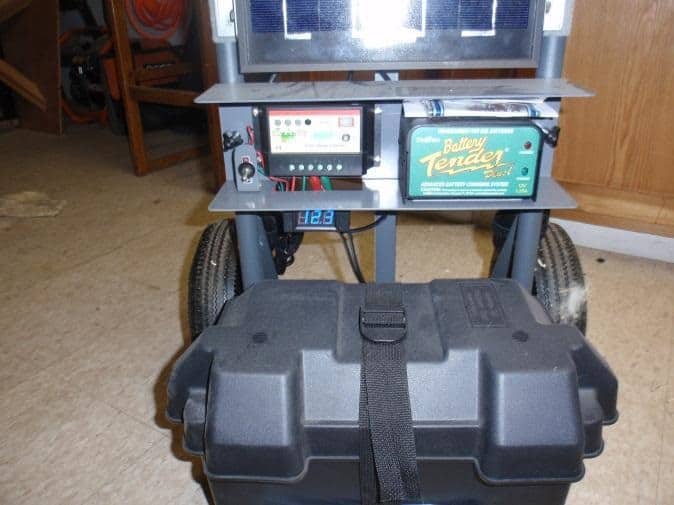
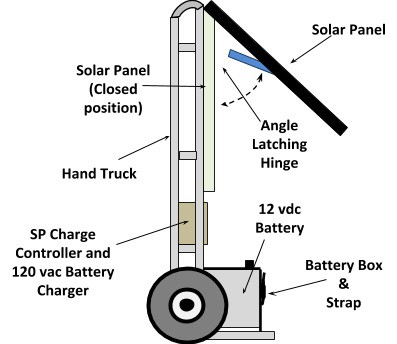
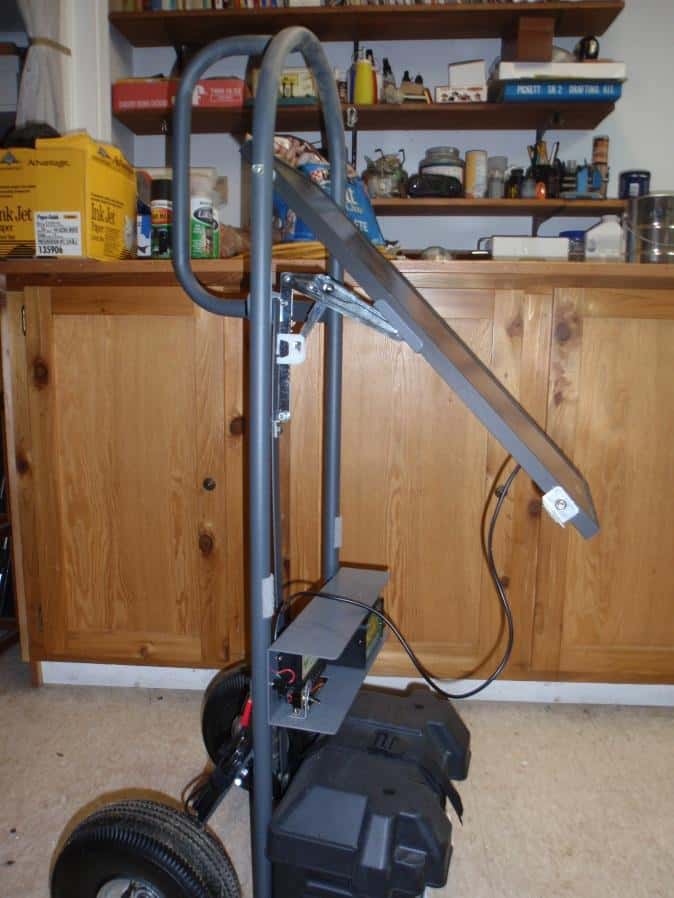
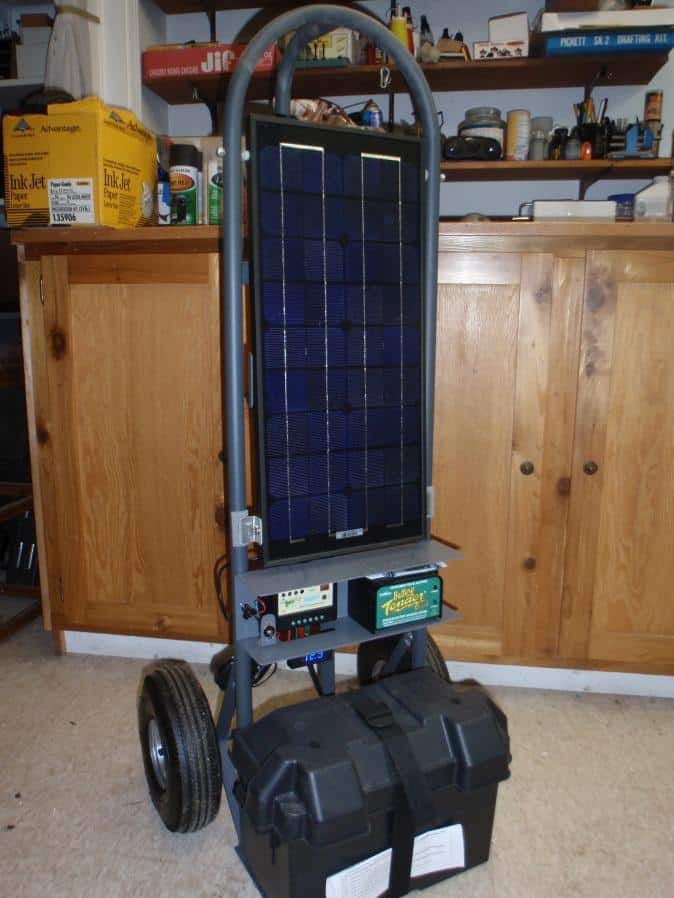
This alternate energy system is larger, uses regular components like a framed solar panel. This system is still portable – if you have an electric chainsaw, you can roll into the woods and use it. I use a $30 (USD) hand truck from Harbor Freight to “mount” the parts.

The parts consist of an 80W solar panel, Xantrex C30 charge controller, 2 – 6 Volt 225 Amp hour batteries, 2 – inverters (400 & 1200 Watt), desulphator and a 12V car outlet. The batteries are inside the wood box, the inverters, desulphator, and outlet are on top.

solar projects diy

The components of this system can be separated – the battery box is strapped to the hand truck and the solar panel is mounted on the handle with 2 U-clamps. Mounting the panel this way allows me to “swing” the panel up into the sun, I use a stick to keep it there. I used a short extension cord (cut in two) to connect the panel to the battery so I can “unplug” the panel.

Connections from the battery to charge controller (and from the solar panel to charge controller) are fused using common automotive blade style fuses. The inverters and power outlet have their own (blade style) fusing. The battery and solar panel are the biggest cost in this system. The cost for the panel was $400 (at the time) and the batteries were $150 each.

This system does have 120V AC output but, if you’ll notice – you’re not going to touch it, at all. All components that you handle are only 12 volts, the inverter will be connected to the battery with the cables that they give you.

This system has an 80 Watt solar panel so the output is 80 Watts per hour or 80 Whrs. In a 10 hour sunny day, you would get 800 Whrs – enough for 5 – 24W CFL’s for over 6 hours. (This system is bigger then MD’ Creekmore’s system that’s in his book Dirt Cheap Survival Retreat.)

Large System

The large solar power setup is just like you see in magazines with solar panels on the roof, a wall full of components and kids playing in the yard. I have 3 – 90W and 6 – 80W (total 750W) solar panels on top and a Solar Boost 50 (charge control), Prosine 2 (2 kW inverter), Xantrex breaker box, Link 10 battery meter (fuel gauge), 8 – Trojan L16 batteries (20 kW storage). All components except batteries and panels are mounted on 3/4″ plywood. This means that I have 3 major connections: solar panels, batteries and AC output from the board.

solar projects diy

This type of system is best bought as a kit – I bought the first 3 panels with an inverter and added the other solar panels and charge controller later. You get almost all the pieces – including roof mounting hardware for the solar panels and the right size wires.

The trick with building this system is to put most of the stuff on a plywood board. I set the parts on plywood and arranged it to my liking. The breaker box should be located close to all the other stuff to minimize wire length. I had my panels mounted on the ground for good snow removal but, after thinking about theft (nice shiny blue panels) I mounted them on the roof. I use a snow rake and angle the panels steep (70 degrees).

The best feature of this kit was the inverter. The inverter has an automatic transfer switch (the thing that goes click in a UPS when the power goes out) and 3 stage battery charger built-in. It is true sine wave (yes, had it hooked up to my scope meter). I added the breaker box because you just can’t get 300 amp DC rated fuses from the electric store.

solar projects diy

I normally use cheap grid power for running everything but, when the power goes out – its solar time. If you have heard neighbors say something like “I have 100 amp service” then this inverter gives you 15 amp service. You can run up to 15 amps at 100% duty, it will surge to 30 amps (4 kW). This inverter is not grid tie but, UPS (Uninterruptable Power Supply) tied. I have my fridge on this inverter in case of power outage.

Here is my little lead in on efficiency. My fridge (19 cf. Kenmore side by side) uses 1.12 kW a day, in 2 hours of sun – my panels will generate 1.5 kW – enough to cover my fridge power (and inverter overhead) use for a day. This fridge is 20% more efficient than every other fridge in its class (19-21 cubic foot). It cost $700 (USD) when I bought it. In the years that I have had it (about 8) it paid for itself in lower electric costs. It will always “pay you” to buy a new fridge.

Final Notes

Try to place the panels where they get sunlight, I should say “where they get the most sunlight”. If you have a tree that shades your panels at 2 pm – move the panels so that the tree shades them at 6 pm. I know that my roof space is limited but, I plan on getting the “best” light (10 am-3 pm) that I can. Losing energy in the winter because the tree shades at 2 pm is very costly (especially after all the money you paid for solar!)

SAFETY for the small system consists of not burning yourself with the soldering iron. The medium system has batteries that could weld your tools to the posts, wrap electrical tape around “good” tools used near the battery, have a tap for the post threads.

The batteries in my medium and large systems are flooded lead acid which means that I have to fill them with pure (distilled) water, I wear rubber gloves for this task and goggles. I also keep the family sized baking soda bucket nearby in case a mouse chews the corner (for water) – a lot of solution (more than a gallon) in a 120-pound battery. Lead acid batteries generate hydrogen gas which is explosive, a vented battery box is recommended.

The medium system uses a (cheaper, easier to find) flooded lead-acid battery, not the best type (AGM Absorbed Glass Mat or Gel Cell) for this application. Since it could tilt past 40 degrees (max fluid to cap angle) the solution can leak. I installed plastic inside the box to contain any fluid and am aware of this limitation in my system. The box is strapped to the hand truck for quick release to move into a truck bed.

The lead acid batteries that I used were bought before I found out about Edison batteries. Admittedly, the lead-acid battery has more power per pound than the Edison (Alkaline based Nickel-Iron) battery but, have become the “throw away” part of every solar power system. Edison batteries will (have) last for a hundred years, don’t sulfate, don’t break down (lead plate flaking) and if they run dry – simply refill. In fact, replacing the alkaline solution would only take Berky water and wood ash (lye is alkaline) solution. Last but not least – no chance for an explosion, does not generate hydrogen.

If you have read “31 Days to Survival” then you know that there is a chapter on alternate energy. I think that any of these systems will count for that day. Please share your comments and thoughts in the comments below.

You might also like:

K-Tor hand crank generator (pocket socket 1 amp usb) : Weekly Product Review

Filed Under: Power Generation

  • « Go to Previous Page
  • Page 1
  • Page 2

Primary Sidebar

About the author

I’m M.D. Creekmore, and I’m all about simple living, financial freedom, and life here in Appalachia. I grew up poor in these mountains and built a life around doing more with less. Read more→

  • Amazon
  • Facebook
  • Substack
  • Twitter
  • YouTube

Subscribe to my newsletter

Join the thousands of readers who get it delivered free to their inboxes every week

“Do more with less.”

– Minimalist proverb

Secondary Sidebar

Read My Books

Paperback and Kindle

Footer

Recent Posts

  • Weather Update for My Corner of Appalachia
  • Why I’m Ordering Ivermectin + Mebendazole Every Year
  • The Website’s Shutting Down (But Here’s the Plan)
  • You Are Hated! Start Training Like It!
  • I don’t really give a damn anymore.

More about me

Books I’ve written

Books I’ve read

Follow Me on YouTube

Follow Me on Facebook

Gear I Use and Recommend

Newsletter

Search this site

Follow me elsewhere

  • Amazon
  • Facebook
  • Substack
  • Twitter
  • YouTube

© 2008–2025 M.D. Creekmore · As an Amazon Associate, I earn from qualifying purchases.

  • Blog
  • Books
  • Newsletter
  • Gear I Use
  • About
  • Contact
  • Privacy Policy