• Skip to primary navigation
  • Skip to main content
  • Skip to primary sidebar
  • Skip to secondary sidebar
  • Skip to footer

M.D. CREEKMORE

  • Blog
  • Books
  • Newsletter
  • Gear I Use
  • About
  • Contact
  • Facebook
  • YouTube
You are here: Home / Archives for Homesteading

Homesteading

Here you will find articles on small acreage homesteading and farming topics such as homestead setup and how to buy a cheap homestead. You'll also find articles on topics such as gardening, DIY projects, raising livestock etc.

How To Raise Baby Chickens: How To Get Hens To Adopt Mail Order or Feed Store Chicks

October 31, 2019 M.D. Creekmore

raising baby chickens

by Christine M

If you have ever raised day-old chicks from the feed store or by mail order you know that it is a hassle. You have to monitor them all the time, check the temperature of the brooder and in general be their mommy until they are old enough to go in with the adult birds. Not to mention heat lamps are notorious for starting fires!

In contrast, a mother hen does all that and more! She keeps the chicks at a perfect temperature all the time, babysits them to perfection, teaches them how to find food and what to eat, and defends them aggressively against any threat, including other chickens!

But what if you want to order certain chicken breeds without the hassle of having to raise the chicks. Is there another way?

Yes, there is! You can have one of your broody hens adopt the store-bought chicks as her own and raise them with her own hatched out eggs.

It’s not a guarantee that it will work every time but I have had great success with this method and had broody hens take over as mommy to day-old chicks from the store. This method takes a little work at first but cuts down on me having to raise chicks for months apart from the adult flock.

Preplanning is key here. And be prepared that you may have to take the chicks back and raise them yourself if they are rejected. First, you will need a broody hen from your own flock that has been happily sitting on her eggs for at least 10 days.

The 10 days will show you if she is serious about it. Try not to bother her or move her. It will upset her setting. Also, the best breeds I have found for adopting chicks are the calmer, less nervous breeds. So if you have several broody hens sitting pick the ones that you have noticed are the calmest.

Note: If you want a hen to adopt chicks that are not her own she HAS to have gone broody first. If you put chicks into a coop with a bunch of adult chickens they will be killed or harassed all the time.

First I do recommend that you try to get your broody hen into her own pen away from other chickens. Yes I know I just said not to move her, and rarely does a broody hen choose a good spot. The best way I have found to move a broody hen without causing her to give up her nest is to wait the 10 days and then move her at night with all her eggs and some of the bedding material from her nest to a secure place.

Having a good little area for her that is away from her flock sisters keeps the other hens from coming in and pestering her (they will come in and lay eggs in her nest thus mixing half-developed chicks with newly laid eggs) and also once her chicks are with her they will be safe from attack from adult chickens. She will get up from the nest once a day to eat, drink, and defecate and then hurry back to her nest, so provide food and water near her.

So here is how you get a broody hen to take other chicks:

First, the chicks you want to have adopted must be just hatched or very close to only a few days old. Not only does this make the hen more likely to take them, but when the chicks are too old won’t bond as easily with the hen and stay close to her protective body.

If you are ordering chicks for this purpose it is best to get a delivery date as close to your hen’s eggs hatching date as possible. This is entirely doable with most hatcheries as they have the ability to ship chicks all the time from spring through fall.

The first method and most effective:

Wait until her own chicks have hatched or at least a few have hatched out, it can take sometimes 3 days for all chicks to hatch from a clutch of eggs. So if she already has hatched out at least one chick wait till well after dark before you approach her. She still might fuss but will be much more likely to calm down right away.

Approach the hen as quietly as possible and try not to use any lights. Slip the chicks one at a time under the hen, If she starts getting too upset stop for a while, move away, and leave her be. Then try putting the rest under her after about an hour. Once you have got all the chicks under her leave her be. She should be clucking to them softly and getting them under her body for warmth.

Note: If a setting hen has a bunch of chicks that have hatched (or she has adopted) running around she may abandon the rest of the eggs in the nest yet to hatch to follow and protect them. If that happens you can brood them under another setting hen the rest of the way, or if you have an incubator use that to hatch them out.

Second Method:

Let your hen sit on eggs until she is very close to the hatch time and don’t worry if she abandons the eggs she has been sitting on once she has live chicks to look after. Use the same method as above. The only difference is that once she has accepted the new chicks take out the eggs she has been brooding and throw them away. I personally don’t like this method because I don’t like killing something that can live.

Third Method:

You can graft chicks onto a broody hen that has only been setting a few weeks, but it’s not as sure as letting her go the full 21 days. Follow the second method if you need to do this, such as your delivery date wasn’t as close as needed or the broody hen you intended to use gave up sitting and you have to use a different girl who hasn’t been setting as long.

After Grafting:

Check on the mom and chicks the next morning at dawn. You will know if she has adopted them because she won’t be attacking them and they will either be under her for warmth or close by scratching around for food. Make sure to have a chicken waterer and food available for them.

Check on your little family as frequently as possible without upsetting the hen too much for the first few days. You need to watch for rejected chicks. They will be often hiding in a corner so the hen won’t peck them.

If she rejects some or all of the chicks you will have to take them out and rear them yourself with a heat lamp. If you see the hen actively attacking the chicks then get them out immediately!

Chicks that are raised by a hen have many advantages over those raised in a brooder. They learn how to find food, when to run for cover, can be put in with the adult flock much sooner, and are more likely to become good mothers themselves.

Filed Under: Homesteading

How to Live in a Travel Trailer Full-Time

October 21, 2019 M.D. Creekmore

Most people don’t know that I’ve lived in two different travel trailers… this is the second one.

Can you live full-time in a travel trailer? Yes, you can. The main drawback is limited space but with a few simple hacks and downsizing, you can definitely live full-time in a camper trailer or RV. How do I know… I know because I’ve done it and even wrote a book about how I did it and how you can too.

While this article will cover the basics of what you need to know to successfully live full-time in a camper trailer or RV my book goes into greater detail and I suggest that you get yourself a copy of that book as soon as possible. You can click here to see it and read the reviews on Amazon.com.

Why Live Full-Time in a Travel Trailer?

Or course different people will have different reasons for living or wanting to live full-time in an RV or camper trailer, but the most common reason given by people I’ve talked to is to save money by not paying rent. And with the rates for rent going up and the size and included amenities going down choosing to live full-time in a travel trailer makes a lot of sense.

For me, it was out of necessity after a divorce. I already owned the land and the 26-foot travel trailer and it made sense to put the two together and have a paid-for place to live. It worked out great and I lived in that one for over two years.

Living there allowed me to save enough money to pay cash for another property, that was larger at almost six-acres. I sold the other property and camper and bout the one that you see in the photo above for $4600. It was one of the FEMA trailers that had never been used and was in like-new condition.

I don’t think that $4600 for a home is a bad deal at all… do you? Nope! I lived in that trailer for over a year while I saved money and then bought a two-bedroom mobile home and moved it to my property and then sold the FEMA trailer for $4000!

You can do the same. You just have to overcome the stigma associated with living full-time in a travel trailer or RV and learn to downsize your belongings or set up a storage building on your property to keep the things that you don’t have room for inside your trailer.

Choosing The Best Travel Trailer For Full-Time Living

Travel trailers are a lot like automobiles—they depreciate in value over time. From the moment you pull the trailer off the lot, it starts to lose value. In fact, recent research has shown that new travel trailers can depreciate as much as one-third over the first three years of ownership.

I bought my travel first trailer from a local man for $3,500. By comparison, he had paid $28,000 for it 11 years earlier. Folks, that’s a savings of more than $24,000. Buying new is a fool’s game and best avoided. Fortunately, finding a good used travel trailer isn’t difficult if you know where to look.

first travel trailer homestead
My first travel trailer full-time “homestead”. Note the solar panels…

It is amazing what you can find by driving the backroads. Many people who have travel trailers for sale will park them beside the road in front of their houses and tape a for-sale sign in the window. In fact, I spotted two trailers with for-sale signs attached yesterday on my way to the hardware store.

Keep in mind that these people are typically motivated sellers and will usually take less than they initially ask, sometimes a lot less. It doesn’t hurt to make an offer. Who knows? You could get lucky.

Simply let the seller know that you’re interested but your budget doesn’t quite cover the asking price. I often see used travel trailers listed in the classified section of the local newspaper or community shopper.

Again these are motivated sellers, who will usually sell far below their original asking price. Sometimes it is amazing at the price reduction you can get by making an insanely low offer. Sometimes travel trailers are listed on such Internet sites as eBay and craigslist.

Over the years, I’ve seen some nice ones listed for $2,000 to $3,000, but most are newer models that are out of your price range. As with buying properties online, never buy a travel trailer or RV sight unseen

Be sure everything in the trailer works properly before buying. The last thing you need is to expend all your resources on the land and the trailer only to find out later that your electrical system, plumbing, refrigerator, cookstove, hot-water heater, or furnace doesn’t work.

While some sellers are inherently honest and will tell you about known problems, needed repairs, or other surprises, many are not and have no compunction about ripping you off. The only way to be certain you are getting what you are paying for is to do your own inspection and tests of the essential components.

Start with the 12-volt lights. Simply flipping on the switch can check these devices. If the seller tells you the lights don’t work because the batteries are dead—charge them up. If the trailer doesn’t have any batteries at all in the battery compartment, use the one from your truck.

Next check the cookstove, furnace, water heater, and refrigerator to make sure everything works off propane. If the trailer’s propane tanks are empty, you could take one of the tanks to a propane distributor to have it filled, but preferably you have brought your own full tank to use if needed. Whatever you do, don’t buy without doing your due diligence.

Batteries that charged by solar and fed the power to the inside of the trailer.

The seller could have used the propane on his last camping trip, but then again he could be trying to hide the fact that some or all the propane appliances don’t work. Don’t forget to check the propane lines and appliances for leaks. You can do this with a spray bottle filled with water and soap. Spray the lines and look for air bubbles to form, indicating leaks.

After you are satisfied that all the propane appliances work, it is time to check the plumbing and water systems. Fill the holding tank and check for leaks. Turn on the 12-volt water pump to pressurize the system and check the sinks, shower, and toilet.

Don’t forget to check for leaks in the water lines, as well as under the sinks, pump, and tanks. Some of the lines can be in difficult- or impossible-to-reach places, such as behind walls, under floors, and inside cabinets, but check the best you can.

While you are checking for leaks, feel the floor and areas around and under the sinks, holding tank, shower, toilet, and water heater for soft spots and rot. Also, inspect the areas around windowsills and doors. Look for dark spots on the ceiling indicating leaks.

Be sure to double-check around rooftop air-conditioning units. Once you are satisfied with the interior, it’s time to look underneath the trailer. Check for rot, especially where the walls and floor meet the underneath area.

Problems here can often be fixed by replacing rotted wood, but if prevalent throughout, I would pass on this trailer. Inspect the condition of the insulation and weather barrier, but don’t be overly concerned if it is not perfect, as most of this can be easily fixed by adding more insulation and covering with 6-mil plastic sheeting stapled underneath.

Contrary to what you may have been told, size matters. You’ll obviously be spending a lot of time between those four walls, so the bigger the trailer the better. Just be sure you have a way to tow it to the site. Personally, I would not consider a trailer less than 21 feet in length.

Finding Cheap Land to Live On

Some of the best opportunities for buying cheap land come from individual sellers who no longer have use for the land. Heirs, retirees, farmers, timber and mining operations, and other types of owners may have land that they no longer need and are willing to sell for a reasonable price.

You never know unless you ask. “Fragment” properties held by states, counties, municipalities, or corporations are a good option to explore as well. They can sometimes go begging at an auction and be had on a negotiated sale.

After deciding where you want to live, get the word out that you’re looking to buy a small amount of acreage in the area for use as a campsite. No one needs to know that you plan to live on the property full time or use it as a survival retreat.

An RV park or rented lot is one option…

Run ads in the local paper and place notices at the local post office and area businesses. You might even consider running an ad on the local radio station or TV station. Try craigslist or other online sites. Perhaps the most productive way of finding land is to ask.

If you spot a parcel that you’re interested in but don’t know who owns the property, find the nearest neighbor and ask. This neighbor may own the property, or he probably will know who does. In my area, there are several small logging operations that purchase tracts of property for the timber, and after the timber has been cut they move on to the next tract.

They have no further use for the property after cutting and are happy to sell.

Since most of this land is in remote areas, you can often buy land at a ridiculously low price. And since it has been logged, if you replant some states will give you a tax break as a “tree farm.”

I found my first property by placing an ad in the local newspaper classifieds.  After running the ad for several months, I heard from the owner of a small logging operation that had operated in the area. The voice on the other end of the phone explained that he had several hundred acres of land that had recently been clear-cut that he no longer had use for and would sell for a reasonable rate.

I explained that I only had $2,000 and could not afford the entire property. We agreed that if I paid to have the parcel I wanted to be surveyed, he would sell me two acres for $2,000. After paying the surveyors, filing fees, and $2,000 to the seller, I was a landowner.

I haven’t had much luck finding cheap land through real-estate agents. Most make their income through commissions and generally aren’t interested in selling lower-priced properties, but then again, what do you have to lose but a few minutes of your time?

Tell the real estate agent that you are looking for a suitable partial of land to use as a campsite and weekend getaway. Explain that electricity, sewer, and water hookups are a plus but not necessary. Real-estate agents in my state can show and broker any property listed in the state where they are licensed, regardless of the original listing broker.

On the surface, buying land through a land contract arrangement with little or nothing down sounds like a great idea. It’s not. The purpose of buying cheap land is staying out of debt by paying cash, which is easy enough to do because of the quality and measure of the property being discussed here.

The standard land contract allows the seller to hold the title until you make all the payments. If you are late with a payment, even one time after paying on time for the past 19 years of a 20-year contract, the seller can have you removed by court order and take back the property while keeping all your money from past payments.

Another potential land mine with the seller holding your title is that he could have a mortgage himself on the property or he could lose it through a divorce or other court proceedings, in which case you could lose the property and any previous funds invested.

All land contracts are best avoided, as is any kind of mortgage debt if possible. One option, which might work if you would have a seller willing to work with you, is to buy the land incrementally. As in: “I have $2,000 and want two acres now; next year (or whenever) I want an option to buy XXX more adjoining acres for $x more cash.” This is subject, of course, to local ordinances regarding subdivision, etc.

Taking Care of Water and Sewage

When living full-time in a travel trailer providing for your water needs can the most difficult tasks to figure out and the solution depends of course on where you decide to set your trailer up for full-time living. Travel trailers and RV’s have a water holding tank and pump to pressurize the water that makes it a little easier to get the water into your trailer where you can use it.

If your property or rented lot has water on tap from the utility company or you are lucky enough to have talked a family member or friend into letting you park your travel trailer on their property then you’re in the catbird seat. Simply run a hose from the water source to your trailers intake to fill your tank turn on the trailers pump to pressurize the water and you’ll have a working sink, shower, and commode.

As for sewage, you might be able to empty your holding tank directly into your family member’s or friend’s septic tank system. If not then you’ll probably have no other choice but to hook to your trailer and pull it to a proper and legal location to empty your holding tank.

If you’re off the grid (away from public utility hookups), then things get more complicated in a few areas but it can be done. You might have to haul water in to fill your freshwater tank or if you have a suitable water source then you might be able to pump or use a gravity-fed system to keep your water tank full.

You could set up a rain-water catchment system and cistern set up in such a way that rainwater could be fed via gravity directly into your freshwater holding tank. Or you might be able to pump it from a nearby source such as a stream or spring, but this water would need to be filtered and purified before drinking.

Taking care of sewage when “off the grid” can be done by digging in a small “sepic tank” system using buried 55-gallon to collect waste. As detailed in Brian D. Kelling’s book Travel-Trailer Homesteading Under $5,000.

But keep in mind that this probably won’t be a “legal” setup but there shouldn’t be any problem unless you tell your business to someone and that someone then reports you.  But as a disclaimer, I have to tell you to check and follow all the laws and codes in your area.  

I took a different approach at my first “travel trailer homestead” and I go into detail about how and what I did to take care of waste in my book “Dirt Cheap Survival Retreat” be sure to pick up a copy of that book as soon as possible if you think living in a travel trailer full-time is something that you still want to do.

Power, Heating, and Cooling

Getting power inside your travel trailer can be as simple as plugging into the source or as complicated as putting in a solar setup if you’re going off the grid. While I don’t have the time or space to go into all of the information on setting up an off-the-grid solar power system (whole books have been written on the topic), I will instead point you to an excellent article that keeps it as simple as possible – Do It Yourself Off The Grid Solar Power System.

Propane refrigerator inside my first full-time trailer...
Propane refrigerator inside my first full-time trailer…

You will also find detailed plans about how I did it in my books linked to above and how Brian Kelling did it in his book. There isn’t any certain way to do this… you’ll need to follow the basic principles and safety precautions and figure out what works best for you but that article and those books will give you a great start.

Generators for Campers

One of the biggest mistakes I made was buying a cheap gasoline-powered power generator that after a few months use started giving me trouble and not starting and or shutting off when in use. I suggest that you buy a good power generator from the start.

Two that I recommend are the Honda EU2200i, you can read my full review here, and the Champion 75537i. Get the best that you can afford from the start and you’ll have less trouble and be much better off in the long-term.

propane cook stove
Propane cook stove inside my first full-time trailer…

To keep the inside of the trailer cooler in summer it’s best to park it in the shade… or better yet, under a shed… think about a carport such as this one on Amazon. Parking your trailer in the shade or under a carport such as that will help to keep the sun off it and thus help to keep it cooler on the inside.

The carport will also help to keep your trailer looking new and also it will last longer covered by the carport because there is less of a chance of a leak developing in the roof of your trailer that could cause water damage inside.

For heating, I prefer propane and propane and a propane wall heater such as this one at Amazon.com will keep you warm during the colder months.

Cooking and Refrigeration

This part is actually the easiest because travel trailers are already set up perfectly for off-the-grid cooking and refrigeration using propane. With the correct adapters, you can easily hook your trailer up to the larger 100lb propane tanks if you want to change out the empty tanks for full ones less often.

Legalities of Living Full-Time in a Travel Trailer

Depending on where you are in the country (or the world) laws differ and there could be some legal hurdles to overcome when living full-time in a travel trailer or RV, however, these are typically easy to find a “work-around” that will keep the paper pushers happy and still allow you to live full-time in your camper, travel trailer, or RV.

Conclusion

Living full-time in a travel trailer isn’t for everyone, and there are a few challenges but it is a great way to save money to buy or build a “proper home” later and be debt-free. I’ve done it so I know it can be done. I hope that this article gave you a few ideas and answered some of your questions.

If this is something you’re interested in doing then I suggest that you get my book “Dirt Cheap Survival Retreat” and Brian D. Kelling’s book Travel-Trailer Homesteading Under $5,000. These two books will cover everything else that you could need to know.

Filed Under: Homesteading

Botulism and canning – the whys and wherefores

October 19, 2019 M.D. Creekmore

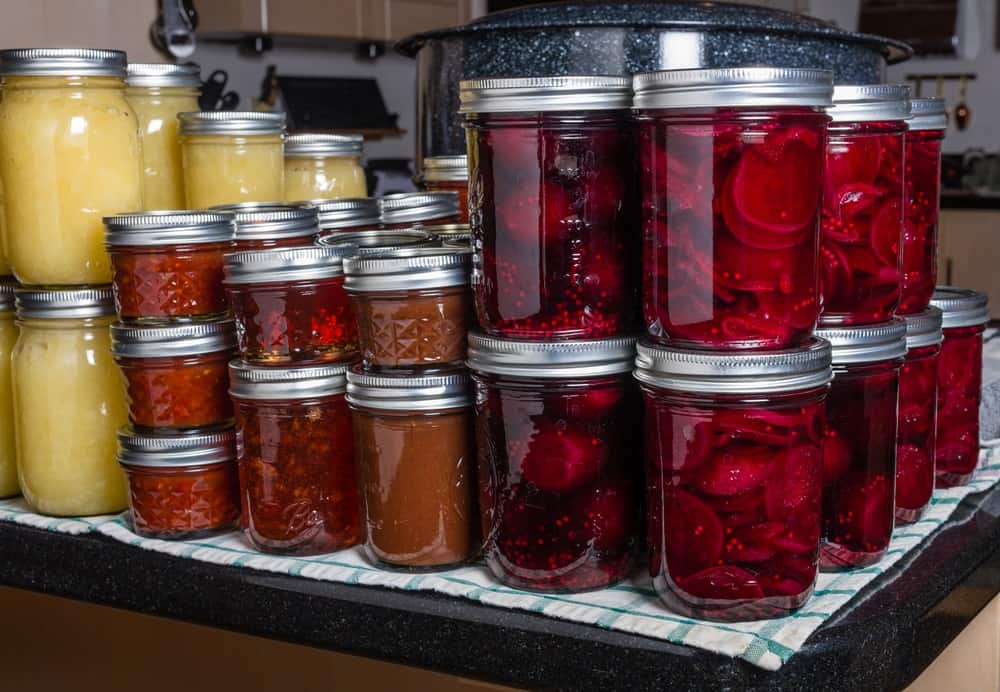
Preserved foods in mason jars on a counter

by OhioPrepper

I’ve been thinking about writing this article for a while, since I’ve explained all of this numerous times over the years, both here and elsewhere; but, when a recent comment on this forum mentioned canning Kale and the response was asking if it could be water bath canned, I knew that folks did not understand some very basic things about canning and botulism. This article will attempt to explain the why of water bath vs. pressure canning; all based on the life cycle of the bacterium Clostridium Botulinum (Cl .Botulinum).

Let’s start with something that everyone probably understands: the common yeast. Yeast is a living organism and like all organisms, it requires food that it digests after which it then excretes waste. In the case of the yeast, the food is sugar and the excrement is alcohol. It’s a simple process that we use to make beer, wine, and distilled spirits.

The bacteria Clostridium Botulinum has a similar life cycle; but, the excrement is one of the most potent and deadly neurotoxins known to exist. To grow, the bacteria requires an anaerobic (low or no oxygen) and a low acid to alkaline (pH greater than 4.6) environment. Since the bacteria covers itself in a spore for protection, it can only be killed by subjecting it to a temperature of 121°C/270°F for 3 minutes.

This leaves us with two options to keep from fatally poisoning ourselves or others.

Kill the Cl .Botulinum, even in its spore form.
This requires the high-temperature pasteurization treatment (121°C/270°F), and since water boils at 100°C / 212°F, a boiling water bath cannot achieve the high temperature required; therefore, pressure canning is required.

Create an environment in which Cl.Botulinum cannot reproduce.
That environment is an acidic environment with a pH of 4.6 or less. This is pretty easy to do when canning most fruits since they have a natural pH that is that low or lower.

Vegetables like corn, beans, and kale, as well as meats, do not naturally have a pH that low, so water bath canning these food items creates a perfect environment for Cl .Botulinum to grow.

This is done by water bath canning fruits with a naturally low pH or by adding acidifiers to the recipe. It’s the reason you may water bath can pickled beets, cabbage, or even meat. While it can be a bit odd to those who haven’t tried it, the German Sauerbraten can be canned this way.

The botulinum toxin itself is inactivated (denatured) rapidly at temperatures greater than 80°C/180°F , so vigorously cooking/boiling may denature/deactivate the toxin in food; but, except in an absolute starvation situation, I would simply discard any suspect food items.

We have probably all heard that we should not give raw honey to infants under 1 year old, and once you understand the life cycle as described above, it becomes obvious. Infants under 1-year-old are generally being fed either mother’s milk or formula and generally have not started eating solid food. The solid food is fed to the child as it develops the Gastrointestinal ability to digest that food, which required stomach acid with a low enough pH to dissolve that food. Prior to this stage of development Cl .Botulinum spores that may be found in raw honey, along with pollen and other things, would find a perfect environment in the GI tract of the young child and would propagate, grow and excrete it’s toxic waste, into that GI tract.

Finally, we have all probably heard of people who talk about water bath canning beans for years with no ill effects, and there are surely people like that who have just been very lucky. Botulism outbreaks still occur with the most recent one I know of being right here in Ohio in April 2015. Here’s the CDC report:

Notes from the Field: Large Outbreak of Botulism Associated with a Church Potluck Meal — Ohio, 2015

Note the table at the bottom of this report that shows numerous outbreaks over the years 1977-2015 all over the country, and perhaps I only knew about this one because it was relatively local here in Ohio.

https://www.cdc.gov/mmwr/preview/mmwrhtml/mm6429a6.htm

Here’s an excerpt from that CDC report:

“The attendee who prepared the potato salad with home-canned potatoes reported using a boiling water canner, which does not kill C. botulinum spores, rather than a pressure canner, which does eliminate spores. In addition, the potatoes were not heated after removal from the can, a step that can inactivate botulinum toxin. The combined evidence implicated potato salad prepared with improperly home-canned potatoes, a known vehicle for botulism.”

The underlined word above is my emphasis since this step is not guaranteed to make the food safe.

Following good practices found in places like documentation from your local county extension agency or the Ball Blue Book should always be done; but, for water bath canning of anything questionable, I suggest a kitchen food pH meter that can be purchased from places like Amazon for around $20.00.

So the basic rules are:

Food with a pH less than 4.6 can be safely water bath canned; but, you should still use proven methods for packing and time from the Ball Blue Book or another reliable source.
Food with a pH greater than 4.6 must be pressure canned to kill the Cl.Botulinum, again using the Ball Blue Book or another reliable source
Any questions, ask away because we all want to be safe.

Filed Under: Homesteading

Raising Pigeons for Meat [What you need to know]

July 12, 2019 M.D. Creekmore

Raising Pigeons for Meat

by Lorenzo

Pigeons are a cheap source of good meat. Pigeons also produce fresh meat during the winter months. The frequency of breeding is dictated by the abundance of food available to the parents. The eggs take 18 or 19 days to hatch with both parents incubating the eggs.

I would like to make the case for raising pigeons for food as an urban livestock. Pigeons have lived alongside man for thousands of years with the first images of pigeons being found by archaeologists in Mesopotamia dating back to 3000 BC.

Throughout human history, the pigeon has adopted many roles ranging from symbols of gods and goddesses to sacrificial victims, messengers, pets, food and even war heroes. A pigeon is about 13 inches in length from bill to tail and weighs a little less than a pound. Males are slightly bigger than females.

The feral pigeon that we see in our towns and cities today is descended from the Rock Dove (Columba livia), a cliff dwelling bird historically found in coastal regions. The word ‘pigeon’ is actually derived from the Latin word ‘pipio’ which meant ‘young bird’.

The word then passed into Old French as ‘pijon’ and from that, the English name ‘pigeon’ was derived and is now used the world over as a common name for the Rock Dove. Other common names include ‘domestic pigeon’ and the ‘feral pigeon’. In 2004 British and American Ornithologists officially re-named the bird the Rock Pigeon.

Since their initial domestication pigeons have been seen as a cheap source of good meat. The Romans kept pigeons for food as evidenced by the fact that they were familiar with the practice of force-feeding squabs in order to fatten the young pigeons faster.

Pigeons were especially prized because they would produce fresh meat during the winter months when larger animals were unavailable as a food source.

The feral pigeon mates for life, (but if one is killed the other will seek another mate) and can breed up to 8 times a year in optimum conditions and will set on two eggs each time. Often older pigeons will lay more than two eggs in a nest. When this occurs the extra eggs should be discarded as two young is all the parents will be able to feed.

The frequency of breeding is dictated by the abundance of food available to the parents. The eggs take 18 or 19 days to hatch with both parents incubating the eggs. Young dependant pigeons are commonly known as ‘squabs’.

A squab is a young pigeon from 1–30 days old. Both parents feed the young with a special ‘pigeon milk’ that is regurgitated and fed to the squabs. Each squab can double its birth weight in one day but it takes 4 days for the eyes to open. At approximately 2 months of age, the young are ready to fledge and leave the nest.

This much longer than average time spent in the nest ensures that life expectancy of a juvenile pigeon is far greater than that of other fledglings. When ready to leave its nest, a squab can sometimes weigh more than its parents.

Ten pairs of pigeons can produce eight squabs each month without being fed by the pigeon keepers. For a greater yield, commercially raised squab may be produced in a two-nest system, where the mother lays two new eggs in a second nest while the squabs are still growing in the first nest fed by their father.

Establishing two breeding lines has also been suggested as a strategy, where one breeding line is selected for prolificacy and the other is selected for “parental performance”. Pigeons are also quite territorial about their nesting area.

Pigeons co-exist much more harmoniously when each mated pair has two nest boxes of its own. Because pigeons are also territorial about their perch, it is best to ensure that every pigeon in the loft has lots of places to perch.

Establishing more than one pen is a strong strategy for raising pigeons. Extra pens allow for the keeping of spare, unmated females and males which can be used to replace mated pigeons which might perish from disease or predation. Because it is sometimes difficult to determine the sex of a young pigeon, it is also handy to have another pen for pigeons that have been weaned but which have not yet given external indications of their sex. Unmated birds, however, should not be released to feed as they may mate with someone else’s pigeon and take up residence at their cote.

A pigeonnaire (dovecote) can be constructed on the urban compound in an area easily accessible to the garden for the use of the manure if care is taken during planting time as pigeons will feed on your freshly planted seeds. Plans for your pigeonnaire can be found at several online sites and in “The Have More” book.

The major points being that it should have an entrance way that can be converted to one way entry only, room to exercise, usually 8×10 with 8 feet of headroom, enclosed with wire mesh or hardware cloth that would prevent snakes from entering, and a small fountain for the pigeons to wash in.

This basin would need to be either removable or coverable to limit use to specific times of the day to keep the pigeons from soiling the fountain…

Pigeons also have an advantage in that most urban dwellers ignore them/fail to see them as a food source. With the properly constructed loft pigeons can be released to forage during the day and they will return to roost and care for their young in the evenings.

Although pigeon poo is seen as a major problem for property owners in the 21st Century, it was considered to be a valuable resource in the 16th, 17th and 18th century in Europe. Pigeon poo was a highly prized fertilizer and considered to be more potent than farmyard manure. It was so prized that armed guards were stationed at the entrances to dovecotes (pigeon houses) to keep thieves from stealing it!

In England in the 16th-century pigeon poo was the only known source of saltpeter, an ingredient of gunpowder and was considered a highly valued commodity as a result. I

n Iran, where eating pigeon was forbidden, dovecotes were set up and used simply as a source of fertilizer for melon crops and in France and Italy, it was used to fertilize vineyards and hemp crops. It can also be used as a tanning agent for certain leathers.

So, self-feeding, easy to raise, with large amounts of fertilizer. Win, win, win!

Filed Under: Homesteading

Can You Paint a Log Cabin? [Please Don’t] Do This Instead!

July 1, 2019 M.D. Creekmore

Can You Paint a Log Cabin?
Can You Paint a Log Cabin? Yes, of course, you can paint a log cabin if you want, but please don’t! Staining in a much better option.

Can You Paint a Log Cabin? That’s a common question among log cabin owners and the answer is yes, you can paint a log cabin of course but you shouldn’t. Let me explain… Painting a log cabin will destroy the wood. You should stain it instead.

If you own a log cabin house then you know the maintenance costs that come with it. From the detergent you use to the frequent inspection of the logs; these kinds of houses require special attention. Wood is a sensitive building material prone to rot, especially when exposed to harsh weather conditions.

Protecting your wood from rot, termites, and mildew is your biggest challenge if you own a log cabin house. But what’s the best way to protect your log cabin from damage and rot?

You can paint a log cabin however, this isn’t the best option and you shouldn’t do it. Painting a log cabin will allow moister to be trapped inside the logs which can cause rotting even if coated heavily with good quality paint. Staining the wood has proven to be a much better method of protecting it from damage.

Why Stain and Not Paint a Log Cabin?

Whether to paint or to stain is a personal choice. After all, paint offers a broad range of aesthetic appeals. Your cabin may look much brighter and livelier when painted with bright colors, but this move will not protect your logs.

It may even do the complete opposite…

Painting a log cabin is likely to cause more harm than good. While paint protects other things like metals and stone, it actually destroys wood. Unfortunately, logs on cabins are exposed to harsh weather conditions which create the perfect environment for rotting to take place, when coupled with paint.

Why Does Wood Rot

Before logs became part of your house, they were part of some trees in the woods. They were then chopped and shaped to create your beautiful haven. Trees are living objects and obviously, when a living object dies, it rots. Therefore wood is prone to rot regardless, but there are ways to slow down or even prevent the rot. It takes these three elements for wood to rot;

  • Fungus
  • Moisture
  • Oxygen

If you eliminate any one of them, wood will definitely not rot. Fungus exists around us and we can, therefore, eliminate it. Not even with a generous coat of paint. Oxygen is also freely available in the air and we cannot control it.

As for moisture, it’s possible to prevent contact between cabin logs and water though it’s difficult. When these three conditions meet, they begin to at’ your logs slowly by slowly. Rot can have a fatal ending if the logs rot to an extent of collapsing.

Why Paint Won’t Prevent Rotting

When people paint their cabin houses, their intention is to block water from getting into contact with the logs. Given that fungus and oxygen will find their way into the logs’ cells, preventing water from sipping through them will save them from rotting. Paint, however, creates conditions perfect for rot to occur.

At first, the paint will prevent contact between the logs and water. However, paint tends to chip off after a while. Every time it rains, you can rest assured that your paint will chip little by little. This exposes the logs to raindrops which in return, are absorbed into the logs.

This then creates a perfect environment for fungus, oxygen, and water to thrive at the same time. Remember, wood is a porous material.

Ordinarily, the wood would dry when exposed to heat or to the sun. However, the paint you’ve splashed your logs with has merely chipped, allowing for raindrops to sip in. Therefore, your logs are exposed but they’re still heavily coated. This means water can pass through and spread from one cell to another, but it cannot leave with ease. The water is therefore trapped inside the logs.

Pros and Cons of Painting a Log Cabin

Maybe you’re yet to choose between painting and staining because you’ve always wanted a brightly colored cabin house. Well, you’re still at liberty to paint but at least read on to understand the pros and cons;

Pros ?

• Paint is obviously visually appealing. You can do so much with the wide range of colors available in the market. While stain is aesthetically appealing too, it does not give you as many color shades as paint.
• Bright colors such as yellow, light green, cream and white can create a warm feel in your house compared to the various brown hues of stain.

Cons ?

• Paint tends to fade when exposed to the sun. Therefore, it’s beautiful appearance may not last long after all
• When the paint begins to chip off (due to rainwater). It has a distressed appearance which may not be what you’re hoping for in the long term.
• It traps everything inside the logs and if they were not completely dried before building, the damage can be extensive since the moisture is trapped inside.

Why Your Log Cabin is Better off Stained

Unlike paint, stain sips through the wood, thus leaving room for breathing. Staining does not coat the logs. It only boosts its natural grained beauty while leaving to breathe. Think of it as the difference between applying lotion to the skin and applying makeup.

Staining your wood is highly recommended because when it rains, the rainwater will be sucked through the logs as expected. However, the water will dry up once the rain stops because nothing is blocking the logs’ outer surface.

Moisture has room to enter and leave naturally. It’s therefore highly unlikely that moisture, oxygen, and fungus will be trapped inside the logs for too long. In a nutshell, staining your logs is less likely to lead to rotting.

Staining your logs is likely to save you some money. You don’t need several layers of stain and neither do you have to prime the logs with an undercoat before staining. In addition, staining takes less energy and time. With painting, you have to coat the logs until you achieve uniformity.

However, staining takes the log’s natural (but improved) appearance. You can apply one or two coats and you’re done.

Finally, the stain does wear off with time, but after a much longer time frame compared to paint. Even so, it does not expose your wood to any dangers. You only need to retouch the stain with a coat or two.

It’s important to note that when repainting your cabin, you’ll have to scrape off all the paint before applying a fresh coat. This is not only time consuming and insanely costly, but it can affect your logs negatively.

Can You Pain Log Cabin Interiors?

Now that we’ve established paint is not good for your outer logs, does that mean you can splash your living room’s ceiling with a white coat of paint? After all, the inner parts of your cabin do not get rained on.

It all narrows down to personal choice at the end of the day. You can choose to paint or stain the interior part of your cabin. Paint may not do as much damage in this area because there is minimal contact with water. However, it may trap moisture if the logs are not completely dry.

Can You Paint a Log Cabin interior?
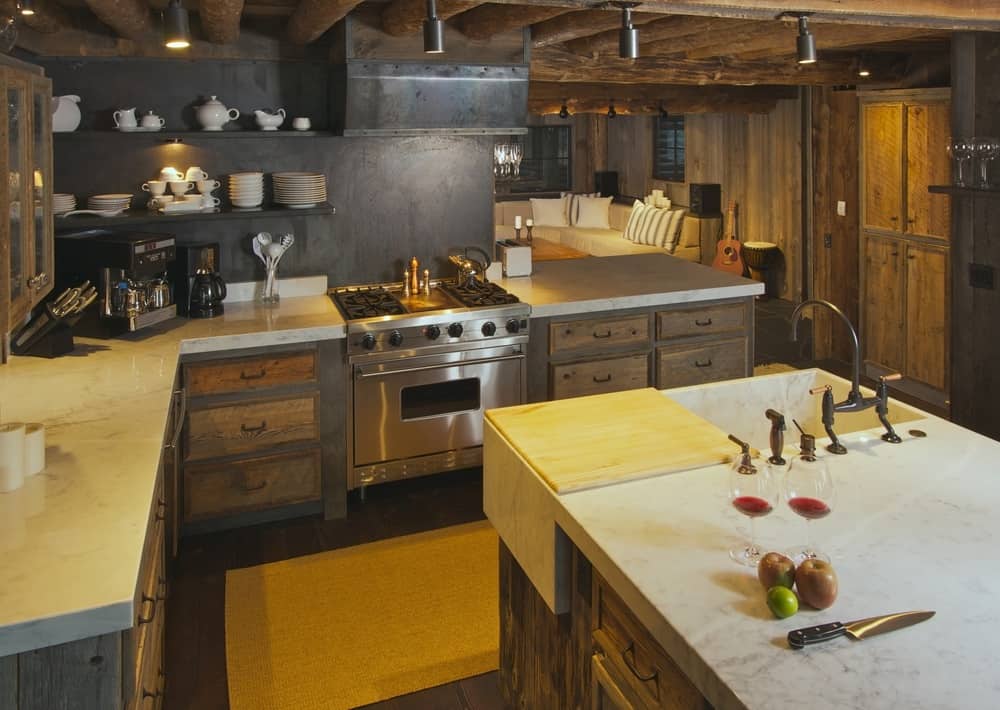
Rustic Fully Equipped Log Cabin Kitchen.

As mentioned above, logs could have moisture inside them before the building process. Maybe they were not dried properly or perhaps they were exposed to water before you purchased them for building. If any of these scenarios is true, you could trap the moisture inside if you choose to coat the wood with paint.

Remember, wood takes a while before drying and the interior environment does not expose it to heat from the sun. It may, therefore, need more time to dry up.
In addition, if the rooftop is leaking the water goes directly to your ceiling, thus creating room for decay.

Log Home Interior Wall Ideas

Another notorious culprit when it comes to hidden causes of rot is the gutters. They often get clogged with dirt, causing water to drip towards your wood rather than through the right channels.
If you can confidently eliminate these sources of moisture, then you’re free to paint the interior bit of your cabin.

Tips for Painting the Interior Cabin Walls

? Ensure the wood is completely dry by checking the roof for leaks. In addition, get rid of humidifiers inside the house and give the wood some time to dry up completely before painting it.
? If you’re privileged to build or supervise the building of the cabin, purchase the logs earlier on and give them time to dry up completely before painting them
? Lastly, paint the house during the summer. There is less moisture during this season and you’re less likely to trap in moisture

Time-Saving Tips for Staining Your Cabin Logs

? Work quickly because stain tends to dry faster than paint. Therefore, you may find yourself painting a second coat over tacky wood.
? Stain in a well-ventilated area. Ventilation is not only good for your lungs (in case you breathe in the stain fumes), but it also aids in drying up the stain faster.
? Choose a good brand of polyurethane. Polyurethane is supposed to give a good finish to your logs. You may go for brands with stain and polyurethane in one can or pick a brand that dries faster.
? Follow the log’s natural grain pattern when staining. Do not go against the grains, otherwise, you’ll have a difficult time achieving an excellent look.

What About Used Engine Oil For Stain?

I remember back when I was 15-years old helping my dad stain a wooden fence with used motor oil that he got for free at a local garage. It worked, didn’t look back, and never rotted the whole time that we lived there. However, I don’t advise using used (or new) engine oil to stain a log cabin.

Use a regular stain that’s made for the purpose. Your log cabin will look and smell better and probably be much healthier and better for the environment too.

Filed Under: Homesteading

Why A “Backyard Homestead” Is All You Need (And Tips For Finding Your Own)

April 7, 2019 M.D. Creekmore

the homestead
View of my Homestead taken yesterday when I was working in my garage.

Having a homestead with a huge amount of land is the dream of most people who get the homesteading itch, they dream of have 20 acres or more of prime land out in the middle of nowhere, and going further still they dream or living off the grid.

They fantasize about how wonderful it would be living on their multi-acre homestead off the grid while sitting on their front porch watching the garden grow and the chickens scratch. Unfortunately, that’s as far as most get… the dream stage.

It’s a fact that the vast majority of people who become interested in homesteading never get past the dreaming and fantasizing stage, and I think that deep down most know that that’s as far as it will ever go. But it’s a fun dream and that’s why so many become swept away by it.

But is living off the grid as romantic as people make it out to be in their thoughts and imagination? No, not really. I’ve been there… I lived off the grid for several years in a camper trailer (I even wrote a book about it – click here to check it out at Amazon.com) and while it’s doable I decided to use that time to save money that I made from blogging to buy another property and then moved a full-sized mobile home on it.

Then after living there a few years and saving more money that I also made from blogging to buy another property with a home already built. The property where I live now is three acres and has a stream running through it and is next to a national forest.

stream on my property
Stream that runs through my property…

It’s amazing what you can do on an even an acre and three to five acres of good land and you can do everything that you need to and can have your own highly productive mini-farm or backyard homestead. Having ten, twenty, or more acres and living off the grid isn’t required to have a happy and productive homestead. 

What I’m saying is if you’ve been waiting to start becoming more self-reliant because you think that you don’t have enough land or because you’re thinking about moving off the grid or think that you have to, stop it. 

Go outside and look around! Do you have a large backyard? Can you till it up and plant a garden or build some raised beds? How about a chicken coop to keep a few hens? Maybe plant some dwarf apple trees. How about a beehive or two? Can you build a workshop? A tool shed? Use your imagination and get started now and do what you can where you are.

Stop putting it off because everything isn’t perfect or because it doesn’t fit in with the romanticism you’ve been fed by Mother Earth News and the countless “off the grid” homesteading books. Do what you can NOW where you are. 

You don’t have to have multiple acres or be off the grid. In fact, you’re probably better off if you don’t and aren’t. Living off the grid isn’t easy, it takes work, and lots of it. Just about everything is harder off the grid and if you try to live by on the grid standards (power wise) then it’s also expensive putting all of those power resources in place.

It’s a lot easier to be on the grid (air-conditioning is great on those hot days when you’ve been out working in the garden) and that’s the reason most people are on the grid and got hooked up to the power grid as soon as it was available in their area when grid power was first becoming available.

However, with that said, you should have alternative power sources in place like a small solar set-up (check mine out on my YouTube channel), and an electrical generator (here is the generator I have) for common weather emergencies and those power blackouts that happen during a breakdown like they are seeing in Venezuela with the power outages there such power blackouts were also experienced in Argentina during the economic collapse there.

For more information on what happened in Argentina and survival tips from a guy who was there – order and read the excellent book by Fernando “Ferfal” Aguirre – The Modern Survival Manual: Surviving the Economic Collapse.

In his book, he also talks about how isolated homesteads, like that many dream about, were targeted by criminals and raiders and how the occupants were tortured, raped and robbed after being targeted and overtaken by vandals. Something to think about. Are you thinking about it? You should be.

But what if you live in an apartment and can’t grow or do anything beyond a balcony garden then if possible you should move to a better (and rural) location as soon as possible. Don’t worry about moving off the grid or to an isolated homestead where your nearest neighbor is two miles away.

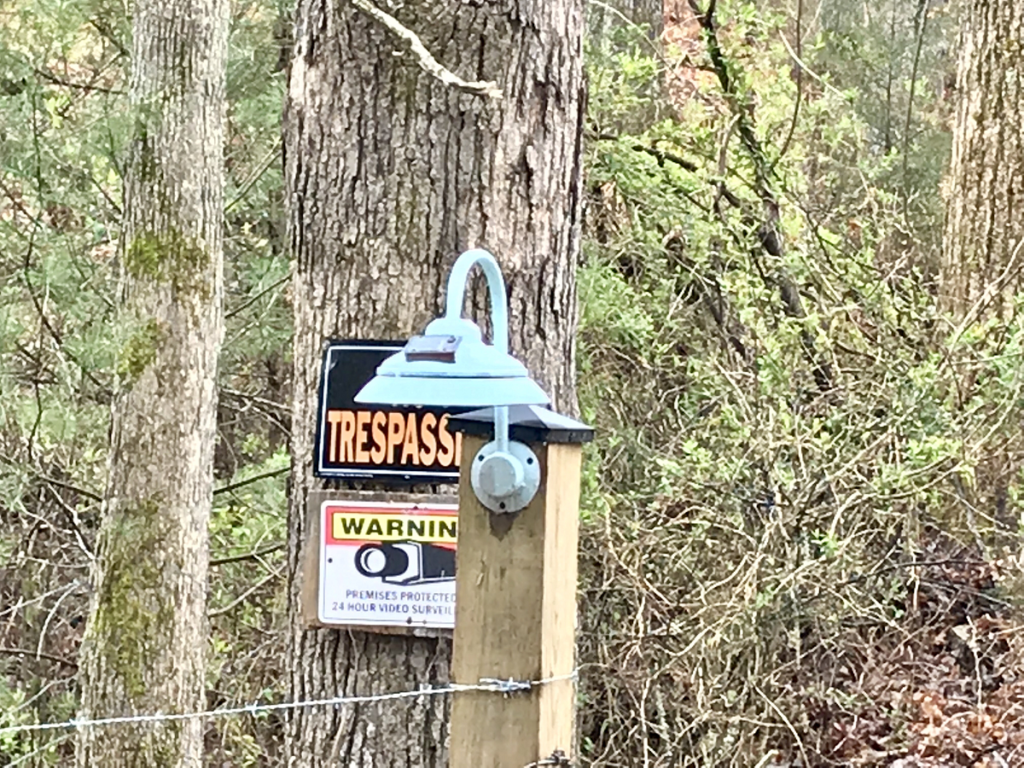
No trespassing

Instead, look for a location that’s in a small town but that also offers some privacy and enough land to grow a large garden and keep some small domestic livestock like chickens, ducks, and goats. Check local regulations to see what’s allowed and if it’s at all restrictive then choose another location because you want to be able to do what you need to do on your own property to become as self-reliant as possible.

It’s best to not choose a subdivision because even it isn’t crowded when you buy it will be in a few years once all of the lots around you are sold and the buyers move onto them. 

Also, before making the move drive around and look at all of the houses… are they well-kept? Does it look like the people living in the area are responsible and care about their homes and property and do what’s needed to keep it looking nice, or do many of the homes and properties in the area look dilapidated and like the residents just don’t care… they probably don’t. Find another location.

Also, look for a property with a water source nearby and preferably on the property that you’re looking to buy. The best water resource is a good water well, unfortunately, newer properties don’t have water wells anymore because most home builders simply hook up to the public water utility because it’s easier and cheaper. 

For example here is a really nice place with three acres that’s private yet has several other homes in the area to offer support and to work together during a disaster. Note: I’m not affiliated with the property in any way and won’t receive a commission or anything if someone from reading this article buys it.

Great Books about Backyard Homesteading

Backyard Homesteading: A Back-to-Basics Guide to Self-Sufficiency (Creative Homeowner) Learn How to Grow Fruits, Vegetables, Nuts & Berries, Raise Chickens, Goats, & Bees, and Make Beer, Wine, & Cider

40 Projects for Building Your Backyard Homestead: A Hands-on, Step-by-Step Sustainable-Living Guide (Creative Homeowner) Includes Fences, Coops, Sheds, Wind & Solar Power, Rooftop & Vertical Gardening

The Backyard Homestead: Produce all the food you need on just a quarter acre!

The Backyard Homestead Seasonal Planner: What to Do & When to Do It in the Garden, Orchard, Barn, Pasture & Equipment Shed

Questions:

  • Do you live off the grid?
  • How many acres do you have?
  • What have you done to increase your self-reliance where you are?

Well, there you have it… please share your thoughts and comments below.

Filed Under: Homesteading

The Complete Guide to Raising Goats for Beginners

January 21, 2019 M.D. Creekmore

Raising goats guideby Millie from KY

Goats are fun, quirky and are great pets!  But we Pack Members are interested in with them for an “off the grid” homestead or SHTF situation.  That being the case, the previous qualities only enhance the fun of having them.  They are a great homestead and often dual purpose animal to raise and enjoy.

And they are fun in spite of what some will say!  Perhaps you have heard that “billies” are stinky, mean, hard to handle.  That goat milk smells funny or tastes funny.  That goats butt people and are unsafe around adults or children.  Or that they will eat your plants and jump on your vehicle, damaging it.

The answer to most of the above questions is “could be”, but only if you realize that most of these problems are from poor management. Because people tend to treat goats as you would dogs, they often are frustrated at the results that they achieve.

Bucks are only stinky during “the rut” which is the time when they start to feel amorous.  This will bring the does into season.  They do disgusting things such as pee on their beards or mount each other.  In other words, they sometimes act like the teenaged version of Jackass… but it is normal.

Once the rut is over, they quit smelling and return to their normal selves and become my buddies again.  I do go and pet and scratch them but make sure I have on an old jacket and gloves.  They can’t help being Jackasses.  And one of the best things you can do when choosing a buck for your herd is to choose one that has been reared on a bottle.

They are much tamer, friendlier and easier to handle.  Now and then one of my boys will refuse to do something during the rut (I want them to go here or there) but when they figure out that sometimes they got to visit the does when I am trying to move them, they become much more compliant when I ask them to do something.

The rut for my breed lasts from about August thru December.  The rut is what causes them to smell bad, and you must keep your does that are milking away from the bucks in rut or it will cause a flavor to the milk

Milk must also be kept extremely clean, the udders/teats cleaned before and after each milking, the milk that is produced gotten into a refrigerator as quickly as possible.  If cared for correctly, you will not be able to tell the difference between goat’s milk and cow’s milk.

Goats are very safe for the most part around people. The secret is to bottle raise your babies.  I let my babies have a few sips for colostrum after birth and then they are started on the bottle.  Bottle raised babies to see you as part of the herd and someone to be trusted.

This is when you can teach them to not jump up (push them down and be not so nice about it) and say NO.  It will take a few times.  NEVER encourage a goat to jump up on you with a treat, you have just taught them how to do it!

Goats are BRIGHT.  They can be taught tricks, or to carry a pack if you are hiking. There is quite a community of goat packers out there.  They can pull carts and help with farm chores.  They can get into trash cans to eat grain and yes, they can get very sick from too much grain just as a horse can.

My goats get very little grain.  It’s bad for the bucks because it causes urinary blockages that CANNOT be fixed and the goat will die.  The girls just get fat on it.  So grain is used to lure them from here to there or as a special treat a few times a year and on Christmas.  Mine also like animal crackers, most any kind of fruit, raisins, and bread.  When I pass by the day old bread store, I get a few loaves for the goats and the horses.

Goats are FUN.  They are very much like a big dog.  I enjoy walking our property with my herd following, munching on everything, finding the oak leaves and acorns that they adore.

Goats will eat almost any plant including poison ivy. This causes problems for the humans because if they are wading through Poison Ivy, it’s getting all over them.  It doesn’t bother them because they have hair but woebegone to the human who grasps the collar to lead that goat somewhere or hugs that goat!  The Goat Manual states that if the goat gets loose, it will eat your most expensive plants first.

Goats are walking fertilizers.  They make little pellets as a bunny does.  But they are harder and take a while to break down. This is actually good because it’s a slow release into the soil of the beneficial things that poop gives to our gardens.  Mine walk about the field and actually since we have been here for three years now, the field has never looked better!

Now that I have convinced you to try out your hand at goat farming, let’s talk about some practical things.

There are three different kinds of goats and you can sometimes use one goat for two or all of these purposes.

The first is for fiber.  Angora goats produce a fabulous fiber that is wonderful for spinning, knitting, and weaving. They are an ancient breed, going back several thousand years.  If you are looking for a post SHTF business and like to create things, this may be the choice of goat for you.  Currently, Angora yarn goes for $ 5.00 to $20.00 an ounce when it is ready to knit.  Angoras are not a meat goat because the focus on breeding them is to produce the fiber.

Angora goats should not get wet because the water goes through to the skin rather than rolling off as would happen with another breed of goat.  Angora/cashmere is highly sought after for the non-felting qualities that this particular type of wool has.  In addition, it is the softest of the wools that are produced.

The finest and softest yarns come from the youngest animals.  Goats are shorn twice a year and produce about 10 lbs of fiber on average, a year.

Angoras generally produce one kid, occasionally there may be twins.   Kids are very delicate as newborns and must be kept dry and watched the first couple of weeks of life.  The low birth numbers mean that your flock will be built slowly.  However, since both sexes produce wool, bucks (males) are as valuable when born as a doe (female) is.  And yes, let us use the correct terms for the sexes.

They are not billies and nannies, the correct terms are bucks and does (or bucklings and doelings when they are young).  They are a medium size goat, from 70-100 lbs for a doe to 180-225 lbs for a buck.

goat-guide

You can butcher a hair producing goat but there is not as much meat on them.  You could attempt some breedings to get more meat on your goats by crossing with a meat goat but the wool production would go down or be of less quality, so probably better to just raise fiber goats on their own for what they are bred to produce.

Meat goats are very popular with many farmers, and excess kids can be raised and fattened for many ethnic groups for their holidays, mostly in the spring.  Goat meat is much like venison, it has a little different taste than beef.  It is a low fat meat and very healthy.

You must add a little fat for cooking or if you are making sausage.  I have had hamburgers with goat meat, they are a little dry but if I had cooked them, I would have done so in a little bacon fat which would have greatly enhanced the meat.  I have also had it as kielbasa which was excellent!

Although you can butcher any goat, the most common meat goat here is the Boer goat. They are very large and beautiful goats, some have a traditional pattern of a white goat with a red or black head and neck.  Some breeders are producing Boers with splash or “moonspot” patterns.

These are big goats, indeed!  Boers average 200 to 300 lbs.  They were developed in the early 20th century from indigenous goats in South Africa along with a sprinkling of some other breeds.  The focus was on meat production, and does may be bred 3 times in 2 years, five months carrying her kids, 3 months raising them, bred again, 5 months/3 months and then again.

They are able to be bred year-round with their cycles.  For the production of meat, medium sized does are best for the raising of meat, they cost less to feed yet produce the same number of kids. After the first kidding, usually one kid, they generally produce twins.

Boers can also be milked although their milk production will not be as much as dairy goats.

You can buy Boers in lower percentages, 50% Boer/50% other breed, etc.  These are usually much less costly in terms of getting started in meat goats.  Then you buy a better buck and breed your way back up to a higher percentage of Boer blood.  The higher the percentage of Boer blood, the more muscular and heavy that goat will generally be, which is what you want, more meat.

The last kind of goat is the dairy style.  Think about a Guernsey cow.  Delicate looking, big wide hips that stick up high, more weight in the abdomen than anywhere else and this describes a good milk goat, too.  There are dozens of breeds of milk goats but I will focus on Nubians for the purpose of this article.

The biggest reason is because Nubians are a good sized goat, and have been bred specifically for milking for many years.  One of the things besides the milk production of the dam of the goat you may wish to purchase and the genetics of the sire (his dam and any sisters he may have, as well as what he has produced in terms of milking does), is to look carefully at the udder.

If you are purchasing a doeling, this will be hard to determine, that is why you look at the dam and any other goats that are related through the sire.  There are two critical things to examine.  One is the length of the teat itself. Short teats, say 1-2 inches long, are difficult to hand milk.

Long teats are better, 3-4 inches.  This is hard to determine in a young doeling.  Compare her to any other youngsters that the herd owner may have in his flock.  The other thing in a milking goat to consider is the “attachments”.

Look at the goat’s udder from the rear.  The udder is shaped like a “U”.  If the “U” is flatter and attached further down the sides of the goat when viewed from the rear, this is considered good attachment.  If it is a longer, saggy “U” (and the doe is not in the process of drying up), that is not good attachment.

This is important because it will affect the animal’s life as well as milk production.  Less attachment means saggier udders.  Eventually, you will run into the problem of a doe getting up from lying down and stepping on and damaging her own teat/udder, or another goat doing so.

Goat Shelter:

Goats need a sturdy shelter.  It should be dry and draft-free.  If you are in the North, make it four sided but make the door big enough that you can get a wheelbarrow in and out. Add a door if you wish, it may be necessary in the most cold climates.  I live in southern Kentucky and our door stays open year round and they stay quite comfy if they are dry.  Make sure the floor stays dry for them.  If you put straw in, they will bed on it but are just as likely to eat it.

Goat Food:

Goats require good pasture/brush to eat.  There is very little that they cannot eat other than the odd poisonous plants and they seem to stay away from those. What they cannot eat is wilted cherry leaves.  So be sure that this is not on your land, or that they cannot get to it.

If you feed hay, good horse grass hay with little or no alfalfa in it is good. No mold, not old, not crappy hay, which a lot of people will tell you is “fine” for goats because they believe goats will eat anything.

I look for hay that has some greenness when you open it up but smells sweet and pleasant.  A little alfalfa is ok for the does to eat but can also cause urinary blockages in bucks and wethers (a wether is a neutered male goat).

Goats can waste a lot of hay. The best way to feed it is in a feeder with small holes so they can only pull out a few strands at a time, or in a hay bag with small holes.  These can be found if you type in “slow feeder hay bags” into your search engine.

Another thing I have seen that works well is to put in a section of hog panel as part of your fence.  Concrete the length of this area, about 2-3 feet wide.  You can spread your hay there and they can stick their heads through the holes in the panel (consider this carefully if your goats do have horns, this may not be practical for them) and eat without walking or pooping on their food. At the next feeding, what is not wanted can be raked up and burned or used as bedding.

Goats prefer to eat brush and branches rather than grazing. They can and will graze but would much rather be turned out to do the bush hogging chores.  You can teach them to be on a strong line with a collar but be aware that many goats get into trouble this way, with a rope wrapped the wrong way around the neck or the leg.  They jump and get the rope hung over things.  Collars can and do break or twist into a death trap for a goat.

Be very careful in thinking about trying out. This might be attempted with an older wiser goat but I would never do it with a youngster.  As a matter of fact, I never tie mine out. I do have a friend who ties hers out to keep the brush down on a steep bank and the girls have mastered just lying down if they are unable to turn around or get out of a tangle of branches.  She uses a heavy cable to tie them with and it works great for her to do it this way.

Goat Fencing:

I have mini Nubians which are not as tall as the standard Nubians.  I have a 4-foot fence around the goat barn, one side for the does, one side for the bucks.  Make sure that the fence between is very sturdy and preferably solid and can take some hits.  When the does are ready for breeding, the bucks will do everything they can think of to get to them.  We do hope in the future to move the boys up the hill to give some space between them for a little more peace.

Goats will walk right through barbed wire.  I prefer smaller mesh field fencing, 4 x 4 inches or 6 x 6 inches.  Garden fencing can often be broken down as it is welded.  You can also use goat or cow panels which run about $20.00 a 16-foot section but that is very sturdy.

If you have babies, though, they may get through the fence to explore.  If there are no predators, it’s probably fine.  I also put a hot wire on top, then out about 6 inches on the outside, and then again, a few inches from the bottom on the outside. This is to keep predators out of the goat yard when I am not around.

If your fencing is poor, if the goats can escape, then your car will get jumped on and your roses will look like they have been run over by elephants…and trust me, they will eat the most expensive plants you have first.  There goes the $50 gorgeous day lily that you just had to have because the color was so rare!

Water for Goats:

It must be clean and changed daily. In the summer they will need more water, in the winter, they LOVE it if you take down warm water for them to drink or put their water in a heated bucket.  They will drink more then.

Salt/minerals:

This is a biggie.  Goats cannot eat or lick enough off of the commercial salt blocks for what they need. Further, they require more copper than most animals.  I will write about that more in a bit.  They must have a loose salt feeder, they make plastic “double” ones that you can get at Tractor Supply.  Mount this higher on the wall and put a step so that they must put their feet on the step in order to reach over and get the salt.  This keeps them from pooping in the holder.  I don’t know why they do this but every goat owner I have ever talked to says the same thing, they poop in it.  There is sweetening in the salt and minerals to encourage them to take more in.  Check this daily, especially in the summer.

Vet Care for Goats:

Your goats must have a CD & T shot each year. These are given subcutaneously and are easy to do if you have someone to hold the goat for you.  Tetanus is a terrible disease and one of mine died from it this year.   There are pneumonia and other vaccinations available but I have not used them.  Any goat coming into your flock must have one CD & T shot and then a second one in 4 weeks.  Thereafter, it is a yearly vaccination.

Kids are vaccinated for CD & T at four weeks and again at 8 weeks of age.  You must do the same for adults that have never gotten their CD & T shots, wait 4 weeks and give a second one to be sure there is full immunity.

If you choose to get the pneumonia vaccination, the same schedule applies as for the CD & T vaccination.  You can order CD & T and pneumonia vaccines online or get them at TSC.

Most vets know very little about goats so I would suggest calling around to other goat people to see who you can find.  It is sometimes worth it to toss a goat in the back of your van and drive an hour or two.  There are some excellent veterinary goat books for purchase, Mary Smith’s Goat Medicine, Second Edition is pricy but invaluable.  Most of us have learned to be our own vets for our goats.

As with all animals, it’s good to have the basics on hand. Goats can bloat, so some baking soda mixed in water and given with a syringe (no needle) into their mouth is helpful.  Some people put in a second salt feeder just to keep baking soda in so they can eat it if they are feeling not so good.  It’s an excellent idea.  Worming medication, you can use goat or horse products. For MOST horse products you will use three times the weight advised, in other words, your goat weighs 100 lbs and you give a dose for three hundred pounds.  Do some research into the products that you can do this with.

First aid items, vet wrap, blue kote, Vetrimycin, some oral banamine for pain or aspirin.  A pill baller is a good item, put the pill in, get down the back of the throat and administer.  If you have babies, a couple of nipples that can be attached to a 20 oz soda pop bottle is a good idea, and always have spares because sometimes they bite them off!

Worming Goats:

Goats are very susceptible to worms. Worms kill a lot of goats.   It has been discovered that a goat that is wormy often does not have enough copper in their systems. Copper helps to keep the worm load down. It is a natural way for goats to fight them off.

You can buy capsules with copper rods in them.  Down the throat, the capsule dissolves in the digestive juices in the stomach and they move on to the intestines where most worms reside.  The rods tend to get stuck there and then there is the slow oxidation of the copper and it’s absorbed into the bloodstream.  Something about the copper getting into the goat’s system helps them to naturally fight off worm and keep the numbers down.

You can use Quest Plus (horse paste wormer) or Cydectin (orally) for barberpole worms.  This does not have to be 3 times the dosage.  For Quest Plus, follow the weight instructions; for Cydectin, you will use 1 mL per 5 lbs.

For other worms, Ivermectin (horse paste wormer) will be used at 3 times the recommended dosage. Or you can use the 1% injectable ORALLY at 1 mL per 50 lbs.

Tapeworms:  Valbezan can be used according to the bottle directions, orally.  Do NOT use Valbezan on pregnant goats.

When you worm, you must not use the milk for consumption for about 2 weeks afterwards, freeze and mark that for when you want to make goat’s milk soap.

A large load of worms will cause anemia, they attach within the organs of the animal and feed themselves by sucking blood. Anemia can be checked by holding the goat’s head and rolling back the lower eyelid.  You want to see a nice healthy pink.

Go look at your dog’s gums to get an idea of the color.  If it is white, whitish, very light pink or just a little pink…you have an anemic goat.  It will need to be wormed, to have plenty of copper, both in mineral eating form and in the way of the copper boluses.

It is a good idea to take in a stool sample and have the vet see what kinds of worms you are dealing with so the right wormer can be used. I wait for the worst looking goat to poop with a plastic bag nearby and take that one in.

Worms can also cause “fishtail” where the tail is partly short and partly long, looking like a fish’s tail, redness to a black coat, a rough coat or a coat that has hair that curves back somewhat like a fish hook.

The anemic goat may also benefit from a B12 shot and some Red Cell, a supplement that is readily available.  Red Cell can be given 1 cc orally per 20 lbs, twice a day for a week and then 1 time a day for a week.

Goat Hoof Care:

You will need to learn about hoof care. This is EASY.  I was surprised by just how stunningly easy it is to do.  You need a pair of trimmers or pruners and someone to show you.  And a third person to hold the goat while this is done.  If you get a milking stanchion that is raised, it will be doubly easy.  I had to do them several times a year when we had sandy soil, now that we have rocks on the land, I do them maybe once a year.

I usually keep collars on my goats all the time, it makes a handle so that you can have some control.  Because I have dairy goats, I do disbud (remove the horn buds) when they are around 3 days old.  If you have meat goats, traditionally they are left on.  However, do remember this is a weapon for the goat and can be very dangerous.

Now for the rest of the story.  You know what to feed, how to house and how to enjoy your goats.  What else?

Goat Breeding:

Well, there is breeding, having kids and raising them up.  There is also butchering, but until I have actually gone through the process and see what can be done better or what was useless to do, I don’t want to write about that right now.

You have a doe.  You have or can get access to a buck. What now?

The goats should have been kept wormed, have loose mineral available at all times, be up to date on CD & T vaccinations.  Both sexes should be healthy, well-nourished (dairy goats carry their fat in their abdomen, not so much over the body, but you don’t want to see ribs).  They should be sleek and shiny and act like they feel good.  Please don’t breed a goat that is not feeling well or is skinny.  You will lose the kids and maybe the doe, too.

Bucks can be stinky.  It’s usually best if they are separated from the does for several reasons.  One is that if a doe cycles, he is going to breed her. This could be a problem in July because you will have January kids.  When you have a newborn, wet kid and sub-degree weather, it’s a recipe for disaster.

If you have a protected barn and lots of straw and some kind of heat source, even if it is just the other does around with the door closed, that will raise the temp a good 30 degrees.

In the north, I used to use a heat lamp but be aware that goats are curious and like to get into things.  A heat lamp that is still on and in the straw will mean dead goats and a burned out barn.  I hung them up over the place where the kids could go to stay warm, which was the bottom of an old plastic dog house.  But the doe still must be watched regularly when she is near her time to kid.

Breeding usually takes place in the late summer or fall.  Count up 5 months for an approximate date of kids arriving.  Bucks will go into rut about mid-summer to late summer.  They will do disgusting things like pee on their faces and sometimes on you, too!

Some people cannot abide the smell, it doesn’t bother me but it is stinky.  If you must do something with your bucks during this time, move them somewhere, give them vaccinations, trim their feet, worm them, then wear old clothes and wash them with double the soap when you are done.

I find plenty of dish soap on my hands and a good scrub removes most of the smell, or you can wear gloves.  My boys are friendly and sweet even when they are stupid with the rut, and like to be petted, so I generally wear gloves just so I can rub them some. Learning to mouth breathe helps.

Being in rut will entice the does to cycle and come into season.  You will see the bucks gather at the fence, rolling their eyes, doing a spitting noise, braying, peeing on themselves.  Pretty much what you see at Bubba’s Bar and Grill on a Saturday night.

The girls will let you know when they are ready, too, standing nearby, walking up and down in front of the boys, sometimes there is a whitish discharge.  The most reliable thing for me to notice is that they wag their tails, quite vigorously.  I watch my does every day to see who is ready to visit their boyfriend.

Now we are ready to accomplish The Deed.

I will not elaborate a lot on the birds and the bees here; I’m hoping that you all understand the basic mechanics of the process!  There are three ways to accomplish this.  One is to leave the buck in with the does.  This will make your milk have an odor if you are currently milking the doe.  It also means that you never know for sure if the deed has taken place and you may wait 5 months for nothing.

The second way is to put the two lovers together and let nature take its course over an hour or so.  Then put the buck back where he lives and the doe back where she lives.  I usually linger nearby during this time, to observe and be sure she was actually bred.  The third way is called “hand breeding” and consists of you holding the doe’s collar/head while the buck mounts her.  This is what I usually do.  It is quick like a bunny.  Very quick.  You will know if he has penetrated because the doe will arch her back and squat almost like she is trying to pass urine.

Just as a matter of information, there is a fourth way to breed with artificial insemination but I could probably write a lot on it and it would go over your heads. For the average goat owner, this is usually not an option.

Make sure your does have access to plenty of fresh hay, good pasture and maybe a handful of grain if it makes you feel good.  They are feeding 2 or more now!

Kids have an average gestation period of around 150 days (5 months). This can vary each way by about 5 days.  If you leave your buck in with your does, you never quite know “when” things will happen and run the risk of losing kids, particularly if it is cold.  Most does have 2 kids, one kid on the first kidding, then two, and some girls have had a litter, as many as six kids!

Signs of pregnancy are not obvious until 1-2 months before kids are due. They will thicken around the waist, and begin to develop an udder.  When they lie down to rest, you will think “battleship” and will pet and apologize to them.

While the rumen is prominent on the right, the left side will fill out, too.  Some are still not as obvious but in that case, I treat them as if they are pregnant because they could have a singleton kid in there, and need the same care.

Some of the signs of kidding being imminent are:  the ligaments around the tail disappear. If you look around on the internet, you can see how to feel for this.  I have not learned the “knack” yet so I only mention it in passing.

I can’t feel the ligaments for 2 weeks before they kid, but people who are skilled at this can narrow it down to 24 hours.  A day or two before, you may notice some white “goo” from the doe’s vulva. This is perfectly normal.

Sometimes you see it a week before, too.  My girls tend to keep to themselves, in the barn, quietly contemplative, just chilling out.  I am thinking of beginning to take their temperatures, in dogs, the temperature drops about 24 hours before a girl will whelp pups, so I wonder if that is true with goats.  I will let you all know if this is so next spring.

Just a note:  the rumen, one of the stomachs, is on the right side of the doe.  It can look quite huge at times and can often be mistaken for pregnancy or more babies inside than there really are.

I have stalls so I fill them with straw, a small hole hay bag (goats waste a lot of hay) and a water bucket.  Hang the bucket up high because 1) they poop in it and 2) they could have a kid in it.  If you have to, put a small step of some kind so they must step up to drink.

My stalls are made of wire panels so they can see each other and that seems to calm them, they are still in a herd situation.  Keep some old towels and a couple of rolls of paper towels down in the barn, along with a bucket of fresh water for you to rinse your hands in if necessary.

Keep your cell phone with the vet’s number in it and it’s always helpful to call the vet a day or two before and tell them that you are a first-time goat kidder and that you may need assistance.  It’s rare that you will have to call them.

Once you have decided that the time is close, stay nearby.  You may see her begin to dig in the straw.  Sometimes they just lie down and wait, chewing their cud.  I check about every 30 minutes.  If I see contractions, I turn a bucket over, have a seat and get ready to help.

Mostly they don’t need much help but I do go in with my does.  You will see a series of contractions and then some hard pushing.  This can take anywhere from an hour or maybe two, to move the kid down into the right position.  You may see a “bubble” presented first and this is normal.  It will break and the baby will follow in a while.

A perfect kidding will have the kid be presented right side up, first two front hooves and then quickly a nose.  A few good pushes and soon the most darling of animals will be on the hay.  I tear open the membrane on the face if it is still intact and push it back.

Then take some paper towels and wipe the nose and inside of the mouth to clean it up.  The baby should be breathing when you wipe them up.  This just gets the gunk and goo out of the way so he can breathe better.

Usually, the umbilical cord will tear and separate, if it does not then DO NOT PULL ON IT!  Take your fingers and tear a little bit a time, as close to the vulva as you can.  The afterbirth will come out in a while.  You don’t want to cut it because it will bleed quite a bit.

You can tie it with a piece of string or even dental floss if it seems to be bleeding more than you are comfortable with.  And I should mention that most does have their babies just fine on their own but I still like to be present.

On occasion, you will have a breech birth.  These are tricky because being presented with the back feet first, the umbilical cord (lifeline) of the kid may be compressed or torn before the kid is completely out.  You have four minutes to get that kid out safely before it dies in that case.

If you feel the doe is having trouble, you must rinse your hand/arm and go inside.  It doesn’t happen often but sometimes kids get mashed together and you must try and push one back and encourage the other to come into the space so it can come out.

At this point I don’t care whether it comes out front or back, I just want it out.  A kid may be presented with the head thrown back and will never be born, so if you don’t push it back a little and then get that head turned around, you will lose the kids and the doe.

If you cannot do this, call a vet to come out and help.  Another malpresentation is with one leg and the head coming out and one leg back along the side of the body.  If there is room for you to get your hand in there, you can often bring that leg forward.

If the doe is having problems, pushing and you have a presentation occurring, wait until the legs appear.  Take about 6 paper towels, wrap them around the middle of the lower part of the legs (like between your wrists and your elbows) and pull steadily, arcing towards the ground.  Only pull when she is pushing.

When she stops, you stop.  I had a very large kid that I had to help this spring, and I wondered that I would ever get him out.  It seemed to take 20 minutes but a friend who was there with me said it only took about 4 minutes.  He would come out about an inch with each push/pull.  Momma was yelling the whole time and she wanted him out.

Once the kid is out and you have cleaned his face, take the towel and rub him dry.  Kick some clean straw over the wettish area and put the kid on a dry area.  Encourage the doe to nose and lick, when she does, you can step back.  If it is cold, though, I keep rubbing and drying.

I am always surprised at how quickly they dry out.  In a few minutes, he will be trying to stand and it’s so sweet to sit in a stall with a new baby, the smell of sweet hay in your nose and the miracle of birth in front of you.  Jesus was born in a barn and I can’t think of a better place to be.  Time for some smiles at the standing lessons and a nice pat for Momma Goat.

If there are more kids, then within an hour or even less, you will see more contractions.

I like to give Momma Goat a bucket of warm water to drink and will freshen up the stall, take out the wet spots of straw and fluff up some new straw for the new family.

Watch to be sure the babies find the teat and drink.  They will just take 2 or 3 sips and then walk away.  They will drink more vigorously as they grow. Watch the little ones, if you have more than two, the big ones will push it away and it will weaken and die in a day if you don’t pull it away from Mom and get a bottle with some formula in it.   If you are going to milk Momma Goat, let them stay with her about 12-24 hours, then move them to a separate stall where she cannot see them.

You can begin to give them a bottle then.  You will have to train them to it and remember they like it quite warm.  Momma Goat should have had stanchion lessons before the birth, be able to stand on the milking stanchion, eat grain, have her head restrained and you touching her teats and udder on both sides.

She may struggle a little on the first milking or two but when she sees that you are relieving the pressure she feels, and she has grain, she will be cooperative and give her milk willingly.  She can then go out with the general herd in a day or two.  Watch her for mastitis, an infection of the teat/udder, redness, swelling, heat, pain.

Also, watch her general demeanor, if she acts off or sick in any way, she may have retained a placenta and you will have to call the vet.  Sometimes a placenta will come out and just hang for a while.  It’s enough to drive someone with OCD out of their minds but do not pull it.  It will come out in a day or so.  I have cut it off about 6 inches away from the vulva just so it doesn’t look so gross.

The first milk is called colostrum and is essential for the kids to have some of this.  If you have a weak kid, you may have to milk her and try to get it down him with a bottle or you can tube feed it.  I do have a tube feeding kid for young kids, I have never had to use it, though.  They usually drink from the bottle.

The milk will be watery looking for a few days, they will become more opaque in a week or so.  Give the kids the milk right along and all that they want.  You will have to milk twice a day if you do this.

You can let Momma Goat raise the kids herself if you don’t want the milk, but the kids must be handled and held every day for a few minutes to keep them friendly toward humans.  I raise all my babies myself, they are friendly and easy to sell this way.

I prefer my babies to go as pets or as milkers because they are dairy goats.  This probably isn’t an issue if you have meat goats but some of them are really big so if you want to be able to handle your goats well, I would advise milking and feed the babies, keeping the extra milk for yourself.

Goats can be milked for nearly a year but most advise to slow down the milking and stop when they are getting close to being bred.  This will allow the doe to have a rest.

I’m sure there is more I can write but will need to think about other subjects on goats that will be important to know!

Filed Under: Homesteading

Strategic Relocation: Finding The Best Place to Live if SHTF

January 19, 2019 M.D. Creekmore

Strategic Relocation Finding The best Place to Live if SHTF

by Sierra Grey

Robert Burns once wrote, “The best-laid schemes o’ mice an’ men gang aft agley.”. Translated—no matter how well we plan, things often fail, turn out wrong, or go awry. Humans have limitations. We possess only fragments of knowledge and limited experience. Pride and emotions cloud our thinking. Only God plans perfectly. We, mortals, are left to hope we have planned well enough to survive what comes. And learn from our mistakes early in the game.

My baby steps as a prepper began in 1991. Talk radio exposed me to the teachings of Larry Burkett, a Christian financial advisor and author of the book, The Coming Economic Earthquake. The truths in that book still apply 23 years later—governments with huge levels of debt eventually fall victim to money printing and hyperinflation.

America becomes another Zimbabwe. He inspired me to forsake debt and avoid risky investments. We got seriously frugal and paid off our home. Got our small nest egg out of the stock market. Maximized our savings. Withdrew everything from our IRA to avoid government seizure in the future.

Larry Burkett did not live long enough to readjust the timing of his predictions. But I remembered his thoughts about the aftershocks that could follow the economic earthquake. Societal collapse. Fascistic government. Social disorder. Widespread violence.

My wife, the eternal optimist, doesn’t agree that the future could turn out that bad. The rest of my family sees me as a lovable, occasionally annoying, conspiracy theorist. So, instead of learning a trade, leaving the clutches of the California government, and moving to the Redoubt, I had to settle for a compromise. An “investment” in California land for my wife and family that would also serve as my desired survival destination when the SHTF. But California was simply too expensive.

One man’s misery is another man’s fortune.

The economic correction in 2008-2009 smashed the real estate market in California. A friend with inside knowledge told us that there was a bank-owned mountain cabin on 20 acres just over 75 minutes from Fresno. It was a foreclosure on the bank’s inventory and they wanted to dump it. Suggested we make a cash offer at 30% of asking price. But we had to act fast. I wasn’t sure what my friend was smoking, but if true, it was too good to pass up.

We quickly toured the property and made the offer. They accepted. Larry Burkett was correct—not everyone suffers during economic depressions. People without debt and who have saved can find incredible bargains. We did. Or so I thought

The retreat was beyond expectations. 4100 feet elevation—just below the snow line. A perfect blend of colossal Ponderosa and Jeffrey’s pines and a variety of deciduous trees. An artesian well, hardly needing the electric pump. Clean water poured out of an overflow pipe 24/7.

Locals couldn’t remember the flow ever stopping. Said there wasn’t another artesian well for miles. But should it ever fail, there was a man-made lake filled with good water. The cabin was heated with a wood stove and had modern facilities. One side of the property bordered King’s Canyon National Forest—a wide mountain expanse void of anything but nature.

My wife and I spent our weekends and holidays removing trash and debris. We painted and patched and learned how to repair fences. I cleared trees and split firewood, dug up broken pipes, and re-roofed the well-house. My income was enough to allow me to start adding supplies and equipment month-by-month.

The cabin was built 40 years ago as a summer house. It is perched on pylons on the side of a hill to allow the wind to cool the house from underneath. Winter was not in the original plans. I insulated under the cabin, not an easy task for an older man on top of a 16 foot ladder. But I was turning my plans into reality. God had blessed me above and beyond my wildest expectation. It was a labor of love.

The flora and fauna became my weekend learning lab. With the help of good books, I learned to identify the berries, edible greens, and avoid the poison oak. Bay trees, yerba santa, white sage, milkweed, chokecherries, and elderberry trees provided spice, sweetness, and medicinal supplies.

And if you wanted a puff, Indian tobacco. Wild apples served up a huge batch of applesauce each fall. The giant oaks provided enormous and abundant acorns as a source of protein and flour. There seemed to be a plant for every need. I learned how to dig 18 inches through rock-hard soil to extract the bulbous root of the Indian soap plant, a source of saponin for a sudsy shampoo. After 20 minutes of digging in the heat, my hair was ready for it. But I was pumped—I finally had a survival retreat!

Mule deer peacefully roamed the property in groups of three to six, and nice bucks were common. Shot the first at less than 50 yards from the comfort of my front porch while having a cup of coffee. Only needed my defense rifle, a Saiga in .308 Winchester that was conveniently close-by. Butchered the deer and learned how to turn it into jerky. I put pemmican on the “to learn” list.

The air was clean and crisp, the skies a deep blue, and the nights full of stars. Quail and rabbits were plentiful. Fox pups played near the porch after dark. My game camera caught black bears, bobcats, coyotes, and even the occasional mountain lion slinking about under the moon-lit night sky.

Wild turkeys visited the lake for their morning dip. Near a seasonal stream was an Indian relic, an enormous granite boulder marked with holes a foot deep where the Indians ground their acorns. The presence of Indians for such a long time assured me I was on the right property.

The prior owner had put up a deer fence to create a 10,000 square foot garden area and built raised beds to avoid gophers. I ran PVC plumbing for drip irrigation. We planted beds of strawberries and raspberries, and some grape vines. They grew happily in between our visits to enjoy the harvest. We planted fruit trees. There was more than enough room to enclose chicken and rabbit coops and grow far more of a garden than we had when we moved in full-time.

What more could we want? A comfortable cabin set among the giant Ponderosa’s. Fresh running water year round. A lake as back-up water supply, brimming with fat-legged bullfrogs. Abundant sources of wild food. I felt confident that my plans were working out.

Who moved the cheese?

Fresno County became a center for “medical” marijuana. We soon had over 500 growers in the foothills and mountains. A group moved onto the property next to mine. I have no issues with growth or use of marijuana.

But the War on Drugs has made it a very high-priced item and created a criminal market, as did Prohibition with alcohol. The growers are generally felons with nothing to lose, seeking easy riches and their own supply of high-grade “bud” and “Reggie.”

The marijuana crops are “medical” in name only. Most care little for their neighbors’ property rights or the environment, killing off local wildlife with poison scattered around the outside of their dwellings and crops. Worse, they brought crime and violence.

Its easier to steal someone else’s weed than grow your own. The first year, a robbery attempt was stopped by a shooting a quarter mile from my property. By the end of the year, six men had been killed in county marijuana-related crimes. Break-in’s of vacation cabins skyrocketed after the growers arrived. Booze and guns seem to be the targets. Some locals have started storing their gun collections in the safes of city pawn shops until they need to hunt.

They brought in a bulldozer and destroyed the natural lay of the land. Unusually heavy rains caused runoff from their property that damaged our road and cut deeply into the dam. Another rainy season could bring the dam down and cut off access to our cabin. When we asked them to have it repaired they promised they would, after they sold their crop in the fall. The crop came and went, as did they, to Mexico for the winter. We reached deep into our pockets and paid $7,000 to have the damage repaired.

The heavy rain was followed by three years of record drought, blistering summers, and record-cold winters. The fat and sleek mule deer turned haggard and worn, fewer in number. A small pond now sits where the lake once did.

Banks of mud that will suck in your foot to the knee and rob you of your boot prevent easy access to the remaining water. Water, if you can call it that. More of algae and moss soup. Nary a bullfrog can be found. The snakes, raptors, and critters are picking them off, one by one.

The lack of water and food at other elevations brought in more bears. Lion sightings increased. We suddenly had real competition for the local game animals and the limited harvest of wild berries. The coyote and bobcat populations increased as well, reducing the rabbit and quail populations to a small remnant.

And our 24/7, “has never run dry” artesian well? The overflow pipe has stopped producing anything but dry rust.

Get to know the neighborhood before moving in.

The area is populated by retirees on pensions and/or Social Security, vacation homeowners, and a handful of local forest and park service workers. Into the mix throw a goodly number of folks that just get by. Most on EBT cards and welfare, happy in their ancient, leaky single-wide’s covered by blue tarps.

That adds up to most of the resident population dependent in some way upon the federal government. Fixed incomes take a heavy hit when times get bad. And times are getting bad. What will happen when the SHTF?

As the economy continues to go down, the property crime has gone up. Two cords of oak that I had cut, split and stacked for the winter, disappeared. A local Hmong immigrant group was caught transporting 51 deer carcasses.

One of my “meth-head” neighbors was caught with five deer carcasses. He told the sheriff he was going to sell them for drug money. I was unaware of the ongoing problems with vacation homes being broken into by locals.

Poaching, thieving, drug-addicted neighbors were not in my planning. Not even close. A call to the local sheriff can take 2 to 4 hours for a response. I faced the reality that the only deputy sheriff available to my property was me.

No longer was it the just bears after my provisions that concerned me. Two-legged predators were now in the mix. Nothing can stop a determined, meth-addicted fellow with a crowbar and cutting tools from getting into a steel storage box. Fleeing a SHTF scenario, the last thing I need is to arrive and find an empty cabin and no supplies. I stopped adding to my supplies and equipment and transferred some back to the city.

Plans can and do go awry. Plan that it will happen.

While we prep, the world keeps on changing. We change. SHTF events are not always cataclysmic. Sometimes small chunks of s*** are flicked on you a bit at a time, more annoying than anything. One day you look in the mirror and realize you are covered in it.

Time to toss out the old plan and learn from mistakes. I learned that a deal too good to pass on is never too good to pass up. Price is not all that matters in survival preparations.

I made a list of my concerns and considered my options. We could sell the retreat for a profit and buy another. But how long would it take? Given the troubled times, we are closer to SHTF than ever before. But failures well-studied can lead to a better plan.

Due to my mistakes in planning, I now knew a lot more about the weaknesses of my retreat. The best option available for survival was to turn a lemon into lemonade. I’ll share some of the lessons I’ve learned, in hopes that someone might profit from my mistakes. And, some of the actions I am taking to modify my plans and survive.

I never considered the loss of regular income before the SHTF. I expected it would happen as we fled the city. Plan as though you could lose yours tomorrow. Not long after buying the property, I was laid off. Then again, and one more time.

Finally, three years of unemployment and I’m still without a job in my profession. My increasing age is an undesirable expense to potential employers, thanks to Obamacare. With much less income, I must reduce expenses. I’m using my now-abundant free time learning how do what I have always paid someone else to do.

Car and truck maintenance and repairs. Plumbing. Electrical work. Appliance repair. (YouTube is a great resource.) Video’s from the American Gunsmithing Institute (AGI) are showing me how to do gunsmithing repairs. Reloading my ammunition. How to use Craigslist to find some bargains and resell them on eBay for profit.

We sold a life insurance policy and purchased a small, underpriced property. Hired a friend to bulldoze a dirt access road and building pad, and resold it for a profit. The profit went to income and the principle into another property that I am currently improving to put on the market.

I wish I had worked on these skills before trouble hit instead of spending too much time obsessing over mastering 88 ways to start a fire or how to pack a bug-out bag.

Just because a SHTF scenario is inevitable, it may not be as imminent as you think. I’m amazed that the world’s central banks have been able to print so much money and put off the collapse for so long. You may be in poor health or have diminished physical ability when it finally occurs.

When did I become so grey? I now qualify for discounted coffee at McDonald’s and senior shopping days at my local drug store. When did arthritis own my hands? One day I realize that I could no longer reliably rack my Browning High Power in .40S&W. The recoil spring is 24#—something for a younger man. Sold it and purchased a used Glock 36, small and light. I noticed that hikes into the national forest are not so easy at this age. Who started making guns, ammo, and water heavier?

I’m buying used synthetic stocks on eBay to replace heavy wooden stocks on my long guns. My carbine had a very heavy metal butt plate I once had made for potential hand-to-hand encounters. Blow to the head stuff, you know. I found a plastic one to replace it. I’m too old for hand-to-hand. I’ll just have to carry more ammo and shoot the fellow. Anybody young whipper-snapper need an 18-ounce butt plate?

I underestimated how much of what I use and need can be made without much skill or knowledge and how much money I could have saved for other prepping needs. I’m a big believer in Lugol’s 5% iodine solution and took it daily before I lost my income. It is an important part of my supplies, as well. $15 an ounce is no longer affordable.

I researched how to cheaply make iodine crystals and produce the solution myself. It’s not rocket science. If you can make instant coffee, you can make Lugol’s iodine solution. Potassium iodide from eBay, muriatic acid from Home Depot, distilled water, dollar store 3% hydrogen peroxide, and a coffee filter. Cost—about $4 per ounce. I produce enough for my own needs and pure iodine crystals for pandemics, nuclear/radiation events, wounds, and decontaminating drinking water.

Colloidal silver is also important to me. My family regularly takes it and increases the amount with any sign of illness. Retail cost—more than $200 a gallon. A better way—two 99.9 silver coins, 2-quart glass pickle jar, orphaned laptop power supply, alligator wires, $10 fish tank air supply, distilled water, and $24 PPM meter from the pool supply store. Cost— less than $2 per gallon.

When the world shifts (and it will shift), shift accordingly. The traditional game animals are fewer and farther between. But there still are bears, foxes, bobcats, coyotes, and lions. And gopher, king, and rattlesnakes. What to do? Prepare to include predators in my food supply when the SHTF.

I bought some well-made snares and my wish list includes a few serious traps to use in the national forest. I’ve been rethinking my hunting guns and ammo to account for larger animals. And ways to hunt opportunistically—carrying enough weaponry to shoot whatever should present itself for dinner. Predator or prey.

But two long guns are just to heavy for an old man. Ideally, a shotgun-rifle combination gun would be best, but not in the budget. When I use a .22LR or shotgun for the intended game, I will also pack my best imitation of rifle at much less weight, my .44 Remington Mag Super Blackhawk with a 7 1/2 barrel.

That means increased practice at longer ranges and no more “cowboy” loads. I’m currently toying with homemade shotshells for the .44 to make it a pseudo-shotgun when I head out with a large caliber rifle.

A small powder load in the standard brass case leaves room to place shot. Disks of cardboard make a workable wad and a disk of styrofoam, a good seal. I considered making a snake-handling stick. And that was the end of that. If I have to eat snakes, I’ll shoot them.

Rethink scenarios that you thought you were fully prepared for. Who anticipates everything? I didn’t, and now it’s late in the game. What if an unlikely event happens? I’ve learned that my artesian well AND the lake cannot be relied upon as sources of water. I’ve added a solar well pump to my wishlist and moved water containers to the cabin and filled them.

I’ve constructed 3” PVC “buckets” that can be lowered down the wellhead by rope to retrieve water if electricity is lost. I’m dragging old wooden planks to the lake. Laying them on the mud, they will allow access to the water.

Next on my list is making a 5-gallon bucket sand-filter to take enough grossness out of the remaining water to allow filtering through a ceramic filter. After that, I’ve got to erect some sort of simple rainwater catchment system, and soon, before the winter rains start.

We, humans, are a worse lot than we think. Having grown up, worked, and lived most of my life in the nice parts of town, I never understood the true prevalence of crime. Or how much more it will be an issue after SHTF, even in the rural areas. Storing supplies at my treat in bolted-down construction boxes is no longer an answer.

I’m starting to locate possible caches in the walls and under the cabinets of the cabin for stashing ammo and other small supplies. Many of the smaller tools now go into my truck, as do some other of the small-sized, pricey or hard-to-replace supplies.

But I have yet to find a good answer for large supplies such as food, water, tools, and reloading equipment. Much less some way to prevent theft of firewood.

Full-size shipping container? There isn’t a lock that can’t be removed. And thieves out there have all the time in the world if I’m not there. The only acceptable solution may be to move to the retreat now, not when the SHTF.

It’s not like I have a job holding me back. With my reluctant wife staying in our city home, we’ve both considered that it may be wise for me to spend 5 or 6 days per week. It would make my presence known in the community as a full-time resident, not the owner of a vacation home/retreat. She and the family would make their exodus alone if need be. Sometimes botched plans are hard to smooth over.

Don’t forget that Indians dwelled in this land long before we did, wherever you happen to live. What did the local Indians do when times were tough? I met a very old man who is one of the last pure Indians in the area. He was happy to talk and to answer my questions.

He remembers foods that his grandmother made during the hard times of his childhood. Turns out that the abundant but poisonous local buckeye/horse chestnut is edible in a pinch. Just pulverize them finely and leach them thoroughly, several times.

Raw, crushed buckeyes mixed into the waters of a rock-damned stream stun the fish for easy collection. And…goats. Goats eat poison oak, which there is always plenty of. And the milk isn’t tainted by the poison oak. I need to locate local goat owners that I could buy or barter goats from after the SHTF. For anyone interested, he told me that the tastiest part of the goat is the tongue. I think I’ll save that for last.

Laws get enforced only when there is an enforcer. Anticipate less law enforcement in rural areas. And deputize yourself. I put on my big boy britches and cracked down on the marijuana growers next door. Slapped a new lock on my gate to prevent access through my property.

The very next day they visited my house and asked what was happening. I told them that further access was dependent upon payment for the damage. They protested and said they had a right to the easement. I told them to call the sheriff if they wanted, but I wasn’t opening the lock without payment.

Two thousand dollars in twenties hit my palm and they came up with the remaining money over the next few weeks. I’ve learned that when it comes to growers, the thing they fear the most is not making it to harvest. $7000 to these fellows is chump change. And, they treat me with a lot more respect.

Folks in your rural location are more citified than you may think. They fill their pantries when they go to the city twice a month. Can’t recognize edible wild plants. And don’t know how to garden. I’m now anticipating that I might have to deal with folks at my door looking for food, just as in cities. I need to improve my knowledge in that area by studying urban survival. On the bright side, I have skills in gardening and foraging and may have enough produce to barter.

Consider that your plans may fail utterly—your retreat may become unusable before SHTF. FUBAR. Total failure. In my case, it could be due to continued drought, a forest fire, or advancing age. I may have to remain in the city. And frankly, I’m not well-prepared for bugging-in.

My plan has been centered on an exodus to the mountains. Back to the drawing board. Add “Option B” to the master plan—survive in place. I recently purchased the Urban Survival course from surviveinplace.com and am finding it to be an excellent collection of materials. I’ve got real work ahead of me, at a late hour.

Perhaps the biggest problem with my plan was that I did not spend serious time choosing my retreat. I chose by price and opportunity. In the end, an impulse purchase. As realtors say, it’s all about location, location, location. Not once-in-a-lifetime deals or large properties with lakes and nice cabins.

As you may have read in Dirt Cheap Survival Retreat, by M.D. Creekmore, it can be done successfully with much less. (I have an excuse—it had not been published yet.) In addition to M.D.’s book and the solid material on MDCreekmore.com, the last several years have brought extensive information all over the Internet.

Most of the largest survival websites have helpful information. Visit the county assessor to research income demographics, tax rolls, and maps. Check with the county planning division or department to see if any major changes are scheduled to take place in your area of interest. Talk to the sheriff about problem areas and crime rates, and types of crime. Put boots on the ground. The only business establishment near me is a very old, tattered tavern.

I’m starting to eat there occasionally, just to listen to the old timers that spend so much time talking about what is going on in our tiny piece of California. They are a wealth of info. I’m driving the backroads to learn more about the lay of the land and the people and their properties. You know, the sort of things I should have done BEFORE buying.

My well-laid plans turned out to be seriously off course. Partly because of a lack of research and an impulsive purchase. Partly because life just happens. But isn’t survival more of a spirit and attitude than any specific action, skill, or equipment?

Experts in wilderness survival all emphasize that attitude or mindset is the most important element of any plan. That’s why so many tiny survival kits give up precious space for a bag of tea and packet of sugar. The first thing you do when you realize that things have gone wrong is to calm down, make a cup of warm tea, mentally regroup, and commit yourself to survival.

Not panic. Not despair. The other supplies in that kit are important, but useless without the will, determination and spirit to endure. I’m older than I want to be. My income has changed drastically. My retreat plan has serious flaws. Let me rephrase that — my retreat plan has serious challenges. But I’m going to make it. I will make it.

Filed Under: Homesteading

How to Make a Rabbit Cage

January 18, 2019 M.D. Creekmore

how to make a rabbit cageby Anthony Purpura

For the longest time, I was toiling with the idea of getting rabbits for my homestead.  As we all know they grow fast, the feed to finished meat ratio is the best of almost any animal, they don’t require a lot of space and they are easy to raise and you can do it almost anywhere.

So what was stopping me from starting the adventure?  Well, like you guys and gals I didn’t have a lot of money for the initial equipment.  Like everyone else on this site, we try to provide for our families with high-quality food for as little money as possible.  BUT unlike some of our urban counterparts, we don’t have a problem with raising our own meat and processing it for food.

So one day I finally decided to get off my butt and start making my cages so I can raise rabbits. Below is the finished product. (Fig 1)

how to make a rabbit cage

After a lot of research on how to raise rabbits, house them and then ultimately breed them I determined what type of cages would fit my needs.  I decided this was going to be a two-part adventure for me. The first part was seeing if I could actually make my own commercial type cages a lot cheaper than store bought cages, and secondly, could I raise the rabbits and ultimately breed them successfully in the cages I made.

My plan was to make the cages 24” deep by, 24” tall by 36” across the front. I wanted to make three cages initially because according to my research once the baby rabbits (kits) get bigger the mom needs her own room. Plus it will be easier to wean the Kits off of mom if they were in different cages.

So I went to several stores to get my supplies, I purchased the wire 48” x 50’ (1”x 2” holes), hog rings 3/8” (1/2lb), hog ring pliers and hardware cloth (1/2” x 1/2”) to make my cages.  Man was I excited, I was finally doing it, I was going to make cages and raise rabbits.

I quickly learned I should have planned a little better.  The wire I bought was “ON SALE” and it turned out to be not such a great deal after all. They had wire that was 24” x 50’ for a couple bucks more, but NO I decided to get the 48” wire that was on sale and save $10.  I was figuring I would cut the wire in half to the size I needed, after all, how hard can it possibly be to cut that thin wire?

Well, cutting the wire was easy enough.  The problem was I had to cut each and every little square across the wire.  I figured I must have cut about 500 squares throughout the project.

After all that cutting of the wire my right hand was like the incredible Hulks hand. I wanted to go around shaking peoples hand just because.

The Cages

The original plan was to make the cages 24” x 24” x 36”.  After flattening my wire I quickly realized my cage was going to be a little smaller than I had planned.  My 48” wire cannot be directly cut in half to make two 24” sides and cut half of a square.

So they ended up being about 23” instead.  My 36” measurement fell in the middle of a square as well and ended up being 35”.  The 1” difference did not affect the overall construction all that much.

It did make the corners not exactly perfect, or as perfect as I would have liked them to be. I used some scrap pieces to make a straw feeder holder on the side.  I originally used the hog rings with just the crimping tool I purchased to crimp them together.

I did not like that they did not hold very tight.  I had to go back and really crimp them down with a pair of needle nose pliers.  I found out that if you crimped them down tight the cage had a more rigid feel to it and in my opinion, it made for a much stronger cage.

A funny side story to show how strong the cages are. My neighbor’s pony escaped in the middle of the night and it decided to come by and visit my rabbits.  In the morning I noticed hoof prints on the ground and all the rabbit food was empty from the feeders and one cage was on the ground.

That cage was pretty banged up.  I simply took the rabbit out, got a big rubber hammer and banged it back into shape.  Not perfect but not bad for a rabbit cage.  Other than the rabbit not wanting to watch Mr. Ed with me no harm was done and the cages stood up to the vicious pony attack.

The Door

OK now, this is where you really need to pay attention.  I was totally bliss to the actual size of the nest box and got into a jam.  The door opening is 1” smaller than the size of the nest box.  I was able to use another cage with a bigger opening but if you are going to use a nest box make sure you measure it prior to cutting the door and actually building the door.

I wanted to use the leftover pieces from the original 36” cut that’s why I didn’t really measure the nest boxes.  I simply said I have a piece this big and therefore this will be my door.  Also, notice how I left the cut sides longer. That way I was able to bend the wire back on to itself to make a hinge for the door.

make rabbit cage

The Base

My last step was to make the base, I decided to use wood because I had a lot of it left over from some pallets that I broke up several months ago.  I used six 2×4 for the legs and two long 1×4 for the rails and center supports.

I bought some oops paint at Home Depot for $5 and wow it almost looked like a pro built it. I came up with the measurements by lining up the finished cages and measuring them and adding a couple of inches in the event I made a mistake somewhere.

Conclusion

Can you make rabbit cages for a low or near nothing cost?  Well, YES.  But I will say they are not even close to commercial grade. The cages I made are strong durable, wash easily and I have used them every day since I built them.  But they do need a support underneath which adds to the cost. (I was not able to buy commercial grade materials locally.

Buying them online would have been too expensive once shipping was added). The three cages I built ended up costing me about $65. That included the crimping tool and all the materials.  The cages cost about $21 each to make. A huge savings compared to commercially purchased cages that run around $80 each.

Can you make commercial grade rabbit cages cheaper than you can buy them?  No, or at least I couldn’t. By the time I bought the commercial grade materials and equipment to cut it and put it together the cost would have been $15-$20 more per cage then I can buy it locally.

The company’s buy the materials in such bulk that we as consumers cannot compete. Commercial cages are very strong because they are made using thicker gauge materials, they will hang easily with the rabbits in them and not fall apart or need any extra support. But you do pay for that.

Should you at least try to make your own cages?  Absolutely YES.  If/when TSHTF there will not be any companies to buy cages from.  You either make them or you go without.  I chose to try and see if I could make them now while I still have the option of buying them locally if I couldn’t make them.

Kind of practicing what I preach to my friends, learn something now while we have the time so we don’t starve later trying to figure it out.

The best place to buy cages? For me, I looked in Craig’s List and found a guy that was getting out of the rabbit business and sold me two commercial cages for $30 each. The guy was nice and he included two nest boxes and two feeder trays already clipped to the cages.

I looked up the cages online and new they cost $80 each shipped, nest boxes $15 each, feeder trays $15 each, total per cage new $110.  So basically I got $220 worth of equipment for $60.  Which ironically ended up costing me about the same as the three I built at home.

Before I leave I will say one thing, OUCH, my hands still hurt from all that cutting to make my three cages.

I hope this article gives you a little guidance and insight if you are thinking of getting some rabbits and building your own cages.

Filed Under: Homesteading

How to Make a Seed Starter Box

January 18, 2019 M.D. Creekmore

how to make a seed starterBy Juleigh Howard-Hobson

Mirrored flush-mounted bathroom medicine cabinets are easily one of the most non-upcycled objects out there. They are short and shallow. They don’t stand by themselves. And, frankly, they aren’t very nice to look at once they are out of their recessed wall enclosure.

But, the thing is, just about every house has one…sometimes two or more. You can pick them up for a song at garage sales, rebuilding centers or CraigsList. Sometimes they are free at all these places because very few people actually want old medicine cabinets. New ones are cheap. Also, old ones are frequently….um….not as fastidiously clean as one would prefer.

All to the good, my friends.

You see, old medicine cabinets may seem useless if you look at them as cabinets, but if you look at them as hinged lid boxes….well….the possibilities to use them for are vastly improved.

One of the things they are great for, once you see them as a box, is as a seed starter box.

First, you must take all the shelves out. If you are lucky, they are clear glass shelves that you can tape together to make a nice glass sheet out of. Most medicine cabinets seem to have these sorts of shelves. If yours doesn’t, don’t despair,  use a piece of window glass or clear plastic or even cling wrap instead of the taped glass sheet.  Put the glass away for now.

how to make a seed starterSecond, you have to rehang the door of the cabinet. The mirror needs to face into the opening. I’ll get to why this is so later in this article.  Pull the pins out of the hinge, separate the two pieces.

Take the mirror out of its housing, then mount a door hinge to the mirror housing, put the mirror back in, and mount the other side of the door hinge to the metal frame of the cabinet.

It doesn’t have to shut like a lid or a door, it just has to move back and forth.

Third, take the wood and cut the middle out of it. Basically, you are making a frame. Now, tape or glue the glass(or plastic)  to this.

Line the interior of the cabinet with the aluminum foil. Top with the glass/wood frame.

Now, angle the mirrored door above the open part of the cabinet so that the most light possible enters the box. This is how the box will get warm enough to germinate seeds.

You can move this anywhere you want, because it is light and portable, making it a very handy sun catcher.

Put starter pots of seeds in it, water them. Set the glass frame in place. Then angle the mirror to catch the most light and there you have it. A seed starter you can use in any climate. We just used ours to germinate kale and cabbage seeds in early November.

how to make a seed starter

An added bonus to this is that you can also use it to cook some foods. It’s a little small to be a powerful solar oven, and it is much slower, but it got a lentil dish cooked in time for dinner when we tried it out. (We used a sweet and sour lentil recipe adapted from Jay Solomon’s Lean Bean Cookbook)

Supply list:

  • 1 Medicine cabinet
  • 2 Old hinges (old door hinges work well)
  • As many screws as needed for the hinges
  • 1 Piece of wood the same size as the cabinet
  • Packing tape (or a piece of glass/clear plastic smaller than the piece of wood above, or cling wrap)
  • Aluminum foil
  • Saw, hammer, screwdriver etc
  • Seeds, seed starter pots, water
  • Sunlight

Filed Under: Homesteading

How to Properly Take Care of Egg Laying Chickens

January 18, 2019 M.D. Creekmore

How Properly Take Care of Egg Laying Chickens

by Jane W

My interest in chickens began at age three when my grandmother would allow me to gather eggs from the nests in the chicken house at their farm. I learned from her to be observant and gentle with animals. When my own child reached that age, I wanted to share some of that magic with him and began considering raising chickens.

As an avid reader of Mother Earth News, Organic Gardening magazine and other Rodale Press publications (click here to see a full listing of Rodale Press books at Amazon.com), I felt I had enough information to begin.

I knew I had to protect the chickens from the weather and predators so I purchased a large roll of one inch chicken wire and 1 X 4 X 8 boards to fence a small area outside an old building that had previously been used as a chicken house on our “postage stamp sized” farm in the mountains of Virginia.

When the outdoor ” cage” (it was covered with wire also, so hawks could not fly in and so the chickens could not fly out) was finished, I built nest boxes out of scrap 2 X 4s and plywood and filled them with hay, and built a small ramp for the chickens to use to enter and exit the building through a 8 X 8 inch hole in the outside wall.

A heat lamp was hung from the existing light socket, automatic feeder (this automatic feeder at Amazon.com is awesome), and waterer, and the four chickens I purchased from the local flea market were added. I realized after a few days that chickens do not pick a nest as their own and use that one for themselves. They pick a “community” nest or two.

It is not necessary to have a nest for each chicken which can save a lot of work and money if you have a large flock of chickens. It pays to spend some time in the chicken house in the mornings when the hens are laying to see how many nests are being used at the same time. Some chickens will wait their turn for a chosen nest if it is busy instead of using another nest.

I would wear a mask ( you can get seriously sick from breathing dust from chicken droppings) and gently rake and sweep up the hay, shavings and droppings on the floor (this was composted along with the horse and cow manure from the barn and later used on the garden as “organic fertilizer”) , wash out and refill the waterer and feeder and observe the chickens.

I got the hens used to me reaching under them to gather the eggs and I never got seriously pecked. Some would gently peck at my hand but I never got injured. One hen would even hop on my lap to be petted if I squatted down.

The chickens settled in pretty well. However, I soon realized, all I needed to know about them wasn’t in the neat little articles I read in magazines. A few days after settling the chickens into their home, my son left the gate open to the fenced outside area and the chickens all got out. The herding dog we had, thought it was great fun to chase them and the chickens ended up in a tree.

Who knew chickens could fly! I put the dog in the house and used a broom to encourage the chickens to come down out of the tree and back in their yard. This took at least an hour and I began to realize “chicken training” and “dog training” were both in order.

On another day later that week, the dog was taken in the chicken yard on a leash and properly introduced to the chickens and not allowed to chase them or be aggressive toward them. Over the next week, they became used to each other and the “chasing game” never happened again. My neighbors, all over 80 years of age, had first-hand experience with chickens and suggested clipping the wing feathers on only one wing of the hens.

This created an imbalance so the chickens could not fly easily. The chickens could still run and escape any threat when outside their area, but not get 12 feet up in a tree. To do this you hold the chickens upside down by their feet. They essentially “go to sleep” and are easy to handle this way.

If you run after a chicken, it will outrun you and unless you have a net (which I did have later to catch the roosters). The easiest time to catch them is when they are on a nest after laying. Just slide your hand under them and grab both feet at the same time, They will flap their wings and try to get away, but holding them by the feet with their heads hanging down will stop this readily and you are ready to work on a calm chicken.

It is best to have a helper to do this. One person holds the chicken and the other cuts the feathers. Take one wing, spread it out and using scissors, carefully cut the feathers a few inches from the wing itself. Chickens do get mites and this is a good time to dust them with organic insecticide to prevent them. This process has to be repeated every few months, as the feathers do grow back.

I also began scattering feed in the chicken yard while clucking and calling to the chickens instead of just using the auto feeder and waterer. This both encouraged the chickens to scratch and eat natural feed, such as bugs and worms and weeds, but to also eat small grains of sand and dirt which they need to process their food.

Chickens that are only feed chicken feed have to be provided something like oyster shell which not only helps with their digestion but also provides calcium which helps them form hard egg shells. Chickens that naturally forage for food, better meet their nutritional needs without supplements. Being able to call the chickens to me instead of having to chase and herd the chickens back into the chicken yard saves a lot of time and work.

Eventually, at the urging and help of my neighbors, I was able to allow the chickens to free range in the garden and barnyard during the day and call and gently herd them into the chicken yard before dusk… chickens really do go to bed just as the sun is setting and it is best to get them into their area before then.

They will roost (sleep) wherever, but once they are allowed to sleep outside of their nesting area, they will lay eggs elsewhere also.

Finding an egg in the barn in the haystack, possibly weeks after it was laid, is not a good thing. I was careful to not let the chickens out until all eggs were laid for that day, so early afternoon until about an hour before dusk was long enough. Also, eggs need to be gathered each day and not left in the nests for long periods of time as some chickens will peck at the eggs and once a chicken cracks and eats some of it, it is almost impossible to stop this.

Many animals will eat eggs and eggs can draw animals such as fox, raccoon, snakes, opossum, and hawks to your area and potentially put your flock at risk. Chickens in the garden need to be supervised to be sure they are not eating the vegetables and fruits themselves.

I was usually hoeing weeds, loosening and bringing fresh soil up around plants, or picking vegetables while the chickens were enjoying their time in the garden. If I saw a chicken eating something it shouldn’t I would simply correct that behavior and encourage the chicken to move away from that area.

I found the chickens would follow me and “work” where I was working. If I was in the barn cleaning out a stall, the chickens were there, because I was uncovering bugs and worms for them!

I had read that modern chickens did not have a nesting instinct anymore because they had been caged and not allow to raise chicks for generations. By this I mean, they did not lay a number of eggs and sit on them and keep them warm until they hatched into chicks. Grandma called this “being broody”. I did not have a rooster, so the eggs my hens were laying were not fertilized.

I could not add to my flock by this method, so I decided to buy an incubator with an automatic egg turner and buy fertilized eggs from the flea market to incubate. This was a fun experience and was not too labor intensive. If I had not had the automatic egg turner I would have had to manually turn the eggs once or twice a day which was more time consuming than anything.

Keeping the temperature and moisture levels correct was relatively easy; waiting for the 20 some days till the eggs started hatching was the hard part! Once the chicks starting hatching young and old would spend hours watching and listening to a chick peep while still in the eggs and peck a hole in the eggs shell large enough to get out. It was tempting to try and help a chick get out of the shell, but it is better to leave it up to nature in this case.

Don’t expect all of the eggs to successfully hatch. That is not natures way, hard as it is to see an animal perish before it actually lives. Once the viable chicks have hatched, keeping them fed and watered in a cardboard box with a heat lamp (or old fashioned light bulb that gives off heat) until they started sprouting their big chick feathers.

At this time they could be put in a small bottomless cage on the ground during the day for several hours at a time. They need to be back in the box and under the heat at night even in summer.. Some people advocate clipping the beak of young chicks so they will not peck and injure each other. This can be done with fingernail clippers but I never had to do it to my chicks.

I think overcrowding and not handling the chicks could possibly be contributing factors. I handled all the chick by picking them up and cupping them in my hands and never had any aggressive chicks to deal with.

One thing I did not know is that day-old chicks get very tired very easy and will fall asleep and spread out like they are dead. I had a couple fall asleep with their head in the water tray and felt like I saved a few from drowning by picking them up out of the water. They do stop this after a couple of days after hatching, but it pays to keep a close eye on them or remove the water when you cannot watch them the first couple of days after hatching.

The box itself should be large enough so the heat lamp or light you have over the cardboard box will not heat the entire box. The chicks will move toward and away from the heat as they need it so be aware of whether or not your chicks are getting too hot or cold.

Once the chicks are losing their “baby feathers” and growing their larger feathers I introduce them to the other chickens by putting them in a wire box in the chicken yard. Chickens have a pecking order and you don’t want to risk a small chick being injured by a big chicken by just turning them loose to defend themselves.

After a few days of their being in the chicken yard for a few hours protected by their wire box, I release them in the chicken yard with the other chickens. By this time they have long legs and heads nearly as large as adult chickens. I have never had a problem with a chick being caught and injured by a larger chicken.

I did find that after a year of being “free range” chickens that natural instinct kicked in with one of my hens. She was sitting on about four eggs one morning and was a little more bothered than usual when I went to get the eggs.

I had kept one rooster from the chicks I had hatched and wondered if he was doing his job. He was certainly a good alarm clock, crowing and flapping his wings while on the highest spot he could find in the chicken yard every morning. I left those eggs for the “broody” hen and she successfully hatched 8 chicks. I was very happy to see that natural instinct would take over if given the chance.

I failed to mention the wonderful eggs we got from our chickens. I learned to make many things I would not have learned to make without them. Everything from mayonnaise to angel food cake to quiche became things enjoyed by my family as well as by the helpful neighbors. I was able to barter eggs for butter with one neighbor that had a milk cow.

I no longer have the chickens, that farm or the neighbors but still, have the incubator. I thoroughly enjoyed learning about chickens and maybe someday soon I will start another flock. In the meanwhile, I hope my experiences will be helpful to any of you with chickens or thinking about getting started with chickens.

Filed Under: Homesteading

  • « Go to Previous Page
  • Page 1
  • Page 2
  • Page 3
  • Page 4
  • Interim pages omitted …
  • Page 6
  • Go to Next Page »

Primary Sidebar

About the author

I’m M.D. Creekmore, and I’m all about simple living, financial freedom, and life here in Appalachia. I grew up poor in these mountains and built a life around doing more with less. Read more→

  • Amazon
  • Facebook
  • Substack
  • Twitter
  • YouTube

Subscribe to my newsletter

Join the thousands of readers who get it delivered free to their inboxes every week

“Do more with less.”

– Minimalist proverb

Secondary Sidebar

Read My Books

Paperback and Kindle

Footer

Recent Posts

  • Weather Update for My Corner of Appalachia
  • Why I’m Ordering Ivermectin + Mebendazole Every Year
  • The Website’s Shutting Down (But Here’s the Plan)
  • You Are Hated! Start Training Like It!
  • I don’t really give a damn anymore.

More about me

Books I’ve written

Books I’ve read

Follow Me on YouTube

Follow Me on Facebook

Gear I Use and Recommend

Newsletter

Search this site

Follow me elsewhere

  • Amazon
  • Facebook
  • Substack
  • Twitter
  • YouTube

© 2008–2025 M.D. Creekmore · As an Amazon Associate, I earn from qualifying purchases.

  • Blog
  • Books
  • Newsletter
  • Gear I Use
  • About
  • Contact
  • Privacy Policy