• Skip to main content
  • Skip to secondary navigation
  • Skip to primary sidebar
  • Skip to footer

M.D. CREEKMORE

  • Blog
  • Books
  • Newsletter
  • Gear I Use
  • About
  • Contact
  • Facebook
  • YouTube
  • Blog
  • Books
  • Newsletter
  • Gear I Use
  • About
  • Contact
  • Privacy Policy
You are here: Home / Archives for M.D. Creekmore

M.D. Creekmore

Hello, I’m M.D. Creekmore. I’ve been interested in self-reliance topics for over 25 years. I’m the author of four books that you can find at Amazon.com as well as Barnes and Noble. Over the years, I’ve learned a lot about prepping, homesteading, and self-reliance topics through first-hand experience and now I want to share what I’ve learned with you.

Worms for Fishing and Vermicomposting

January 13, 2019 M.D. Creekmore

How to Use Worms for Vermicomposting

by Brian Ford

Well yes, in a sense worms can be farmed. Just as you would keep a few chickens or rabbits. My interest in worm farming (vermicomposting) goes back a few decades. Back then I would often hit one of my favorite fishing spots on the way home from work. Worms were quite expensive, two dozen red wiggle res or a dozen night crawlers for two bucks. It did not take long for my bait budget to be depleted.

I had an old defunct deep freezer in my garage. Remembering back to my childhood, an uncle had filled one with dirt, leaves, sawdust, and food scraps. There was always loads of worms in the bin.

I set out to replicate his “farm”, shredded paper, cardboard, sawdust, leaves, and some rabbit litter all went in the bin (freezer). Holes were drilled in the door for air flow. I carefully added water till the contents were damp. Now to point out this was pre Internet, I quizzed my uncle and read through the local library’s meager selections about worms.

Once I decided the bin was ready I started dumping the leftover worms from each fishing trip in the bin. All in all the endeavor went well. In a few months, I was finding juvenile worms and egg pods! I started to lightly harvest worms, my fishing habit was becoming sustainable!

During this time I noticed that the two largest sources of household waste was paper and food scraps. The worm bin reduced the flow off these two from the house to the landfill to zero! However, there are some things that should not go into the bin. Citrus waste, as the acid will burn the worms, meat and fat products as they draw pest and vermin. No cat or dog waste, as that might carry harmful microorganisms.

So practically all other food waste can go in the bin.  I had an old food processor, I would put the scraps in it with some water and pulverize the food waste before putting in the bin then covering with shredded paper. The scraps and bedding decomposed quickly and the worms were doing quite well!

How to Start Vermicomposting Video

The next spring I needed to empty the bin of castings, also I found quite a few small volunteer seedlings growing in the bin.  I moved the various seedlings out to beds in the yard and then removed and bagged about three-fourths of the castings. Just to note this took several days around my schedule.

After the clean out of the bin, I went back to adding bedding and pulverized foods. I believe I had about 8000 worms in the bin at clean out!  I have read that the population will double every 90 to 120 days.  I was at the point of being overrun with worms!

Back to the volunteer plants, there was tomatoes, peppers, cucumbers, eggplant, and melons along with other types of plants. Since I bought most of my produce from local growers the majority was heirloom produce. I gambled on a good return from setting out those seedlings.

And I got a great return! I did side dress the garden with castings. That summer and fall my dehydrator was working 24/7 to keep up. I had so much fresh produce I was making runs to the local farmers market selling the excess, plus bags of castings and boxes of worms.

In order to save me some bait money, I used items that normally would go to the landfill and in turn ended making a fair amount of money, and saving quite a lot of money.  Some of the seedlings turned out to be fruit trees, like apple, peach, and pear.

No, they did not bare true, but good scions could and was grafted to them to provide fruits.  Same with some grape seedlings, they were transplanted and then later grafted with more desirable cuttings.

If you have more worms than you can use, sell, give away, they can be used for chicken food. I have started a new smaller bin recently, so I expect by spring I will be swimming in worms and castings!

Should you want to try worm farming there is a lot of info on the webs, a little bit of reading and you should find answers to any questions you may have. The savings and earning potential will take a few months but it is defiantly doable.  Have fun if you tackle worm farming.

Filed Under: Homesteading

Advantages to Living and Homesteading in Mexico

January 12, 2019 M.D. Creekmore

moving to mexicoBy BS Garrison

“Note: This article was sent to me back in 2016 and was first published on my old blog, however, with everything that is currently going on at the southern border and all of the back and forth in Washington DC about building a wall I thought it would be interesting to repost this article again… M.D. Creekmore.”

In the early 1990s, we took our homeschooled children and headed to the Ozark Mountains of Missouri. Things looked bad for the USA at the time. We worried about an economic collapse, failing schools, dangerous cities and the eroding values of our society. So, we bought a 23-acre farm just a few miles from the headwaters of a spring-fed river and began our homesteading life, planning to become as self-sufficient as possible.

We raised our own vegetables, berries, and fruit. We had chickens for eggs and chickens to eat and 4 dairy goats for milk. Our 100 ft. deep well supplied the clearest, best-tasting water you can imagine.

Our neighbors were self-sufficient long before we arrived and together we bought grass-fed beef and organically raised hogs, sent them to the local butcher shop for slaughter, then gathered in our neighbor’s basement where they set up stainless steel tables, electric saws, and meat grinders and we processed the meat and readied the hams and bacon for curing.

Later, we smoked the hams and bacon with apple wood, passed through a long pipe into 50-gallon barrels we turned into smokers. At the end of the day, we ate chili and drank homemade elderberry wine and played music with our friends.

It was a great life – the best. We acquired practical homesteading and survival skills. The children grew up, got married and left for jobs in the city and we found ourselves alone, managing a large operation by ourselves. Exhausted, we reluctantly sold the homestead.

Fast forward a few years and things look much worse for the USA than I had ever imagined. We have a government that actively works against the very people who put them in power. Taxes are so high that ‘we the people’ are enslaved to the government for life.

Our leaders believe that laws are for the little people, not for them, and they enrich themselves while using the law to harass and persecute their political enemies. There seems to be no escape. Maybe the answer is to leave the USA.

Three years ago we decided to visit Mexico and several other Latin American countries that we had heard welcomed expatriates. We wanted a life that was free from government interference and oppression, but that allowed us to practice some of our homesteading skills.

Our first stop was Jalisco, Mexico, where people from north of the border are encouraged to settle and where there is an existing infrastructure that supports expats. We had planned to stay only a short time, but we ended up staying for three years, so far. Here are just a few reasons why life in Mexico appeals to us and may appeal to you:

Lower cost of living

Everyday life is a lot cheaper in Mexico. Our electric bill arrives bi-monthly and comes to about $10. You read that right. We use propane to cook and heat the water. Electricity runs fans in the summer, refrigerator, washing machine, and a water pump.

We shop in the local markets where the food is fresh and cheap. I can buy 2 kilos of tomatoes (4 ½ pounds) for 15 pesos, about $.80. Public transportation is efficient and runs often, taking you from the village, forty miles into the city of Guadalajara for about $3.00. You don’t need a car to get around in Mexico. Because so few of the local people have vehicles, the towns are compact and walkable. We live on $1700/month and figure we could easily cut that cost by $500/month.

High quality medical and dental care

If you become a permanent resident, you are eligible for the state-run medical program for about $300/year, or you can pay for the reasonable doctors’ visits out of pocket. Dental services cost about 25% of the cost of similar services in the USA and the quality of care is equal to, or superior, to what you can find north of the border.

Year-round growing season and rich soil

We live in the area known as the volcanic axis so the soil is rich. This is an agricultural area that produces every type of vegetable. Major growers like Dole and Driskoll’s have established large farms here, producing raspberries, strawberries, and blueberries for export.

You can buy the berries at a fraction of the cost you pay in the supermarket in the USA. Because of the abundance of fresh vegetables and fruit, you will eat healthier in Mexico than you ever did in the USA.

We drink coffee a local vendor brings from Vera Cruz and then grinds to order from the back of his truck. At home, we grow an abundance of herbs and vegetables in our container garden and have fresh lettuce, basil, and spinach for salads year-round.

An environment that welcomes self-sufficiency and entrepreneurship

If you become a permanent resident, you may work in Mexico or start a business. There are many expatriates from all over the world who have opened restaurants or created businesses to meet the needs of expatriates, or who sell services that cater to tourists. Some home gardeners sell their organic produce or at home-prepared foods and cheeses, honey, from beehives and health-related products at one of several markets in the area.

Better quality of life

Living in Mexico changes the way you look at life. The people are less materialistic and pretty soon that attitude rubs off on you. You worry less, spend more time over lunch, in conversation with family and friends instead of staring at a cellphone.

You will build relationships with like-minded people who have also decided to escape from the oppressive, constantly monitored rat race that has become our lot in the USA. Is it safe? When we first arrived I asked the same question and a man who had lived here for two decades advised us not to start a brothel or become engaged in the drug trade and we would be fine.

After three years of living in Mexico, I have found his advice to be true. We have never had a problem with our neighbors, who have been kind and welcoming.

living in mexicoI am proposing a different way of achieving a more self-sufficient and freer lifestyle, especially for those who do not have the ability or desire to live on a remote homestead. I know from experience that it is a hard life for those who do not have children to help, or who are older and no longer have the physical stamina to begin homesteading. Your survival skills can still be put to use in a life that is easier, less stressful.

We have friends who have acquired every piece of survival equipment available. They have stockpiled non-GMO seeds and freeze-dried foods, canning equipment and canning jars, and a large library of books about every topic regarding self-sufficiency and survival.

Yet, they have never planted a seed, never killed a chicken to eat, never canned tomatoes or made a jar of jelly. They have the stuff to survive, but not the skills or experience to live the life if it becomes necessary.

The truth is that not all of us are capable of beginning from scratch to build a self-sufficient homestead. Either we don’t have the money or the skills, the physical strength or help from younger, stronger family members.

One way to survive – and even thrive – is to move to a place that makes it easy to live a better life, one that requires less money while providing some distance between you and the mess that has become the USA.  Who knows? Your place in Mexico may even become the refuge for loved ones when times get difficult.

Filed Under: Homesteading

Foods That Last Forever (and Preserving Others for Almost Forever Too)

January 11, 2019 M.D. Creekmore

foods that last foreverby Mary in GA

I’m sure that most of the readers here are already aware of the foods that are called “Forever Foods”.  You can find the list many places, but for anyone who isn’t aware of them, they are:

Sugar, pure vanilla extract, white rice, corn starch, honey, hard liquor, salt, corn syrup, maple syrup, and distilled white vinegar.

The problem with this list is that other than rice, none is a stand-alone, substantial food.  I’m not discounting the importance of the other items.  We all know that vinegar and salt are priceless for helping us preserve foods such as pickling cucumbers and other vegetables, or salt for curing pork and storing fish.

I use corn starch in gravies and count on it as a thickener.  For baking; sugar, honey, corn, and maple syrups are vital and vanilla extract adds much too.  Hard liquor has its place, but each person can decide if it’s for stress relief or barter, LOL!

Many of us store rice and dried beans as the mainstays of what our after TSHTF meals would be.  Even though beans didn’t make it on the list, if stored properly, they will last for many years.  Most of us also have long-lasting condiments, ie:  Tabasco sauce, soy sauce, and other seasonings to help break the monotony of endless meals of rice and bean dishes.

Most of you, like me, have probably stored freeze-dried vegetables to further add to and give diversity to bean and rice dishes.  With all of that being said, many people would crave proteins that aren’t from beans (and other legumes) and that aren’t dependent on hunting and fishing skills.

A while back, while having lunch with a great friend and fellow prepper and blog reader GA Mom, we were brainstorming about additional food storage.  Imagine that!! I relayed something that I had thought about, but just never saw through.

I was at a local grocery store, about 2 years after I had started prepping, when I noticed some country smoked hams.  Having worked at food storage very hard for 2 years, I had accumulated most of the typical items.  I had canned goods, aforementioned rice, legumes, and freeze-dried vegetables, ditto for Ramen Noodles, coffee, sugar, condiments, etc.

I was at the point of looking to expand.  I had read about food fatigue, picky eaters and knew that I would need more variety than what I could grow, or my husband could shoot.  I noticed that these hams were not refrigerated, just out on a table in a wide aisle.

I remembered things I had read about the pioneers and old-timers who didn’t have refrigeration smoking and curing hams.  Actually, one better, when I was a child we lived on a mini farm for a while that still had the original old smokehouse.

My Dad always wanted to learn to use it, but sadly, never did.  I picked up one of the hams and started looking for an expiration or sell-by date, and there were no dates on it at all.  I asked to see the Manager of the Meat Department and when he came out he knew about as much as I did, in other words, he really didn’t know how long you could store them.

He was middle-aged like me though and said, “Didn’t people used to store them for years, hanging in their cellars?”  I told him that was my understanding, but neither of us really knew, so I bypassed them, thinking I would go home and do some research.

The fact that this happened between Thanksgiving and Christmas ended up with me just never getting around to following up.  I recounted this to GA Mom at lunch and she made a note, promising to look into it and let me know what she found out.

Later that night she emailed that she had looked online and contacted a couple of companies that sell country hams.  She at first got an answer of 2 years, I believe, but after pursuing the question, was told that it was probably much longer, but they guaranteed two years.  She and I both ordered some right away.  Before I wrote this article, I felt that I should look for some references and did find a few.

One company is in Tennessee, so M. D. may be aware of them,

http://www.countryhams.com/ediblememphis.htm

Two quotes from this site are worth mentioning.  One is “Mold-ham’s badge of honor-just wash or trim it away.”  I have read this other places as well, sort of like cutting mold off cheese which I’ve done many times.

The other notable quote was, “Such preservation makes the shelf life of a country ham practically unlimited…”  I have read that it is important to leave them in their original wrapping, keeps insects off them and to hang them so that rodents can’t get them.

I also found a site with very simple directions for curing a country ham at home.

http://www.ehow.com/how_8116489_cure-country-ham-home.html

In the email from GA Mom, she asked a great question, “How about fruitcakes, don’t those things last forever?’  Actually, they pretty much do.  I accept that you can’t discuss fruitcakes without the typical frowns and “ughs”.  That goes for me too.

My grandmother made these things for years and I hated them.  Fruitcakes are definitely like Martha Stewart, people love or hate, no in between!  Still, it was worth some research, and I found some interesting facts.  Fruit cake aficionados will NOT consider eating a fruit cake until it has aged for at least four years.

Some people eat fruit cakes twenty-five years after they were baked.  Wow, this gave some respect for the old red-headed step-child when it comes to long-term food storage.  I researched how to store them to get that 25-year shelf life and it is like most things, how you store it. 

For the longest storage, you simply wrap it in liquor-soaked cheesecloth, then coat it with powdered sugar, put it in a cake tin and store in a cool, dry place.  Every 3 or 4 months, take it out and re-soak the cheesecloth with liquor, recoat with powdered sugar and put in the cake tin and restore in cool, dry place.

I received the 4 fruitcakes that I had ordered yesterday and picked up more cheesecloth and powdered sugar today.  Most people soak them in brandy, rum or bourbon.  I intend to soak 2 in some of my husband’s Jack Daniels and 2 in Grand Marnier.

I think soaking them in Grand Marnier will give some added flavor and I may actually like them!  At any rate, I figure they’ll last a long time, and if they don’t, I won’t be the first person who ever snuck one to the trash can!!  Some references for the fruitcakes:

http://www.eilenbergerbakery.com/Articles/Tips-for-Storing-A-Fruitcake-25.cfm

http://www.ehow.com/how_6961512_age-fruit-cake=brandy.html

The last thing I’m going to mention is bog butter.  I just don’t know about this one, but felt it was worth mentioning.  Apparently before refrigeration people made and stored butter in bogs to make it last.  It apparently does last, and last, and last…..

This butter has been found and eaten many years after it was stored.  Some scientists say it is between 2000 and 3000 years old.  People would wrap the butter in burlap, animal skins, or store it in hollowed out wood and bury it in a bog.  Students at a school were given some that were ancient and the students tried it.

They said that it looked and smelled like butter but didn’t taste very good. Please share your thoughts, comments, and suggestions in the comments section below… Thank you all…

http://www.show.me.uk/site/news/ST0269.html

Filed Under: Prepping

How To Make Saving Money Fun – Practical Tips for Saving More and Having More!

January 11, 2019 M.D. Creekmore

saving moneyby Lynn (aka The Thrifty Prepper)

Unfortunately, I am a lot newer to prepping than I would like to admit. That feeling in your gut that something just isn’t right has been there for a while before I finally listened.  Now my family struggles to make up for lost time.

I have become like a machine in the last years attempting to streamline and speed our progress to feeling like we at least are somewhat “set”. My husband asked me what I wanted for Mother’s Day and I told him an AK-47 clone was what I wanted the most. He delivered after selling, scrimping and saving.

I was surprised and thrilled. I have gone from being someone who was nervous even having a loaded gun in the house, to someone who is very capable with my weapon.  A bad experience with firearms in my late teens made me a little gun-shy (pun intended) even though I grew up in a family that would target practice once a week. Thank god for muscle memory.

I realize that I am far behind most of you as wisdom goes but can offer some information.  I have rapidly been reading, watching and gathering as much knowledge as fast as possible. One thing that I have a gift for that may be of some use to readers are my skills with shopping.

By utilizing coupons (click here to read MD Creekmore’s article on using coupons) and watching sales, I have been able to rapidly build up a stockpile. Why I realize many of us may be skittish when it comes to social media, I also know what an excellent tool it can be when it comes to saving money.

On Facebook, I have liked sites such as The Frugal Family, Motherhood on a Dime and Thrifty Wifey and when the deals are posted, they scroll across my news feed. For instance, today I was able to score 6 -24 packs of Crayola Crayons for .29 each.  Less money on school supplies, stocking stuffers, birthday presents equals more money in the pocket for preps. Kroger’s this week has a buy 10 save 5 this week. I will purchase 10 gallons of water for 4.90!

Take advantage of the programs that many drug stores offer. I used to just assume drug stores were too expensive to shop at.  CVS and Walgreens (the two main drug stores in my area) are like gold mines. They both offer reward programs with Extrabucks being at CVS and Register Rewards available at Walgreens. The websites I mentioned above are excellent sources that basically spell out which coupon is needed to get the deal you are after.

Sometimes a coupon is not even needed. For example, CVS and Walgreens both will offer contact solution for 8.99 with 8.99 EB or RR back. That equals free! You pay for the product and then upon check out are issued the 8.99 back to be used in the store.  I haven’t bought a contact solution in two years but have 5 boxes sitting in our pantry/store in the basement.

Start looking around to find your favorite sites that fit your situation the best. I have used coupons/store deals to build up three impressive first aid kits (read MD Creekmore’s review of Survival MD by clicking here) for virtually nothing.

I even got the actual first aid kits for free by purchasing two Johnson and Johnson products (at a great discount + coupons).  Study sales cycles and get a feel for when things will go on sale next. Walgreens frequently has baking soda and salt on sale for .59 each approximately one a month.

Buy the limit and build your pantry up.  You can easily search “Sale Cycles” on the net and find when the most optimal time to buy any given item is. I am on a first name basis with the manager at several stores in my hometown. They help me out so much by pointing me to deals I may have missed and making sure I get a rain check for any items they may not have in stock.  I am always polite and thankful and they appreciate it and in return, they look out for me.

So get that Sunday Paper and pull those ads/coupons and sit down and make the deals work for you! There are also excellent coupon sites on the web where you can print out coupons as well. Couponmom.com and coupons.com are two of the best.

Also, even Sam’s club has jumped in with the preppers.  They now sell Auguson Farms products at great prices and allow us to build up our stores quickly (you can also find Auguson Farms products on Amazon.com).   Less money on beans and more money on ammo is working out pretty well for us.

Amazon is another great asset. While of us may not have a “Kindle”, you can download the Kindle for PC free and those sites I mentioned above are always alerting me to free books. I have gotten books on how to make soap, can, garden, survival medicine, you name it! While I realize these tools would not be available in a grid down situation, I print or write out the most important information and put it together in a grab and go form.

I have a young daughter and she outgrows shoes and clothes as fast as we buy them. Yard sales, Thrift stores, and Goodwill are a godsend in these times. When I find something at a yard sale that is three sizes too big but in great shape for the right price, I snatch it up and put it a labeled bin with the size on the side.

We have picked up brand new camping cookware set at a yard sale for only 5.00! Our major scores have also been hand crank grinders, old-fashioned washboards, iron skillets, and camping gear. We have been able to accelerate the rate of our prepping by utilizing these sales to gather things that we could never afford to pay full price for.  Keep a list of things you are looking for and carry it with you. I almost believe it wills the item to you.

Several times I have set out thinking, I hope I can find some shoes for our girl only to happen upon a yard sale with shoes in her size or one size bigger to get us through the school year that is in fantastic shape! I have happened upon a nice dehydrator in this same fashion as well as affordable second-hand tools.

In part of my education, I follow my grandma and grandpa around as they can and garden and they patiently explain to me exactly what they are doing and why. I have also taken to watching documentaries that have changed and challenged me in ways I can’t even explain. If you have not already viewed the documentaries below, they are what shook me awake and I am in complete awe of what our great country is coming to.

  • Zeitgeist: The Movie
  • Independent Intervention
  • Food, Inc.
  • 911 In Plane Site
  • Loose Change 9/11 An American Coup
  • Ethos
  • The End of America

Highly recommended and if you are a Netflix customer, free to watch.

We are working on a plan to acquire land and unfortunately, that is a slow process. My biggest fear is looking into my daughter’s eyes and not being able to help her. I know that is not something that needs to be explained to most parents. I learn daily from you all here on this blog and am so thankful for the valuable information that you all share. Thank you for reading.

Filed Under: Uncategorized

The Best Way to Secure Your Home by Scott the Cop

January 11, 2019 M.D. Creekmore

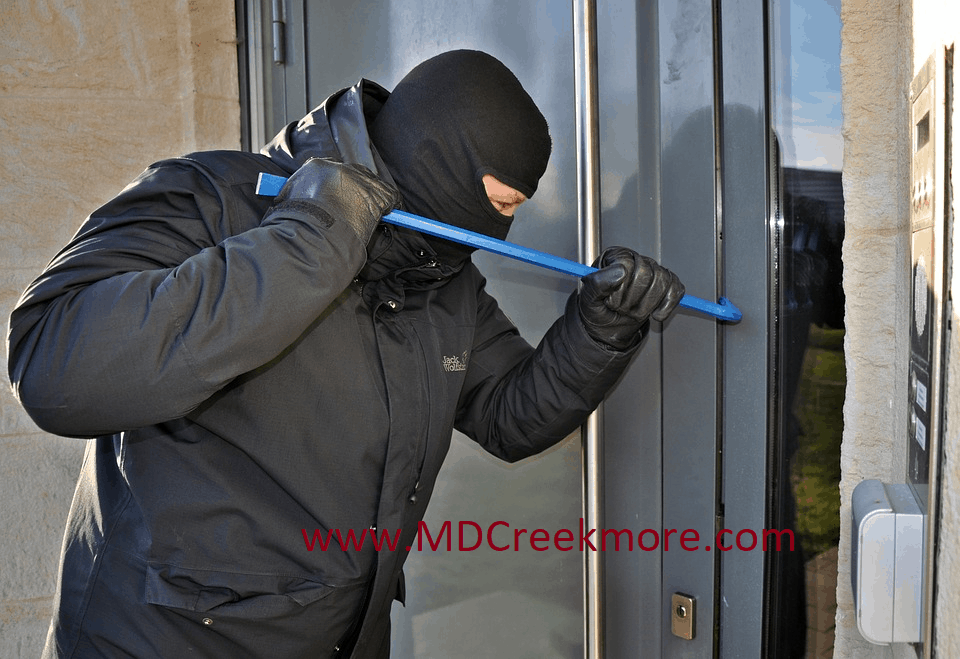
burglar home defense tips

by Scott the Cop

If you are truly serious about issues of self-defense then you might be interested to know that the police are not required by law to protect you.  The U.S. Supreme Court ruled that the police have no constitutional requirement to provide anyone protection even if that person has a protection order from a court.  Going one step further, the police cannot protect you.  I should know since I’m a former police officer.

Quite simply, the police are not much more than the clean-up crew.  They clean up the mess after the crime, do an investigation and hopefully get lucky.  Eventually, they even may catch the perpetrator.  In nearly fifteen years of experience, I can count the number of times I happened upon a serious crime in progress on one hand.  As for arriving in time in response to an emergency call, I can count them on both hands.  The overwhelmingly vast majority of the time I caught the perp after the crime was committed.

In other words, you are on your own until the police get there.  To make matters worse, in 2011, every single state in the Union cut back funding for emergency services an average of 48%.  One state cut its funding a whopping 93%!  So, where does this leave you?  Basically, you’re caught between a rock and a hard spot.  Since you cannot rely on the police for protection, you’ve got to take matters into your own hands.

Self-defense is defined as the right to prevent the suffering of force or violence through the use of a sufficient level of counteracting force or violence.  To start off, you need to know the laws in your state regarding self-defense.  Knowing what you can and cannot do lets you know your limits.

No two states have the same laws regarding self-defense and some require you to try and retreat from your attacker if possible, even if you are in your own home.  However, this comes with some caveats:

  1. The threat of violence must be immediate.

You’ve got to be in immediate danger to use force against another person.  Since you aren’t the government, you can’t do a pre-emptive strike on someone.

  1. The fear of harm must be reasonable.

The courts use the “reasonable man” test.  What would a reasonable man do in the exact same circumstances?  The interpretation of this test varies from state to state.

  1. The force you use must in proportion to the force used against you.

This is really subject to interpretation and according to the laws of your state.  What you can do in Texas, you can’t do in Rhode Island.

So, you know the laws of your state and now you’ve decided that no way, no how you are going to be a victim.  Good.  This is the right attitude.  What’s next?  Plan out what you will do in different situations.  Your mental preparedness is vital.  Let me repeat that, “Your mental preparedness is vital.”  Can you actually shoot a person?  It really is a big deal, but being mentally prepared ahead of time will help you through the ordeal.  When the time comes to pull the trigger and you hesitate, you might as well give the perp your gun.

As a cop, I played the “What If” game.  Whenever I had some mental free time, I made up a scenario and then decided what I would do in a given situation.  How would I react if a person pulled a gun on me during a traffic stop?  What would I do if confronted by a man with a knife?  I would go through several specific responses to a situation several times until it became ingrained.

What will you do if a perp breaks into your home?  Where do you draw the line as to how far he comes before you shoot?  What will you do if he decides to turn tail and run, but he’s got your laptop?  Do you have family members in your home and can they protect themselves?  You’ve got to think up as many questions as possible then come up with a reasonable answer to each of them.

Let me say something about burglars.  Believe it or not, if committed during the day time, as a general rule burglary is not a crime of violence.  It becomes a crime of violence when the perp knows you are home. Many daytime burglars don’t carry weapons and don’t want to confront the homeowner.  They want to get in and out without being seen.

The night-time burglar is a whole different story.  He knows that someone probably is home and he does it for the thrill.  He wants the confrontation and to instill fear.  The power trip from this is what the home invader is after.  You can rest assured that this type of criminal will hurt or kill you if you give him half a chance.  In this situation, I would be more willing to shoot sooner than later.

Preparing your home is the next step.  The question isn’t if you are being paranoid.  What you should ask is, “Are you being paranoid enough?”  If you’ve got shrubs or bushes that block a clear view of your windows, cut them to about six inches below the window sill.

You need to see in or out of your home.  Don’t leave ladders near your home.  This gives the burglar a convenient tool.  The same thing goes for objects he can use to toss through your window.  Don’t give a burglar a tool to use against you.

Don’t forget the inside of your home.  Place objects to defend yourself that you can use in a pinch in convenient and not-so-convenient spots throughout your house.  Your utility draw is a great spot to stick a big screwdriver or a box cutter.  Your kitchen is a wealth of weapons.  Bottles and cast iron pans will do a number on a burglar’s head.  I won’t even go into knives.  If you can afford it, have a couple handguns stashed in strategic places.

Speaking of guns, handguns are all well and good, but a shotgun is best.  The psychological impact of a shotgun is priceless.  The muzzle of a shotgun looks like a train tunnel when pointed at you.  No one in their right mind wants to face an angry homeowner armed with this type of weapon.  I’ve known suspects to defecate in their shorts when a shotgun was pointed in their direction.

If you can legally possess it, I strongly recommend the Mossberg Blackwater Series 930™ Special Purpose shotgun.  Hands down, this is your best bet for home defense.  It has an eight round magazine plus one in the pipe for a total of nine rounds.  It is semi-automatic, has a pistol grip with rifle sights.  These features are important.  You can hold and fire it with one hand while you use the other to hold your phone while calling 911.  Plus, you can use it for hunting.

Let me also say something about ammunition for the shotgun.  To begin with, I’d start out practicing with skeet loads.  You can get used to the idea of the big monster in your hands without becoming gun shy.  For your down-and-dirty loads, I would load it with alternating rifled slug and double-aught buckshot.  Although an express magnum round kicks worse than a mule, you won’t feel it if you need to shoot.  Your adrenalin will be pumping and you won’t notice to recoil.

Many people think that you can just point a shotgun and shoot from the hip.  Sorry folks, but if you think this, you’ve been watching too much TV.  A shotgun needs to be aimed just like a rifle.  Buckshot disperses in a shot pattern radially about 1½ inches per linear yard of travel from an 18” barrel.

That means that at three yards, the buckshot pattern is only 4½ inches in diameter.  Considering that your average gunfight is from a distance of only seven feet, this means you’ve got a real chance of your first shot missing if you shoot from the hip.

Since you’ve got to aim the shotgun anyway, alternating first with a rifled slug then buckshot gives you a guaranteed knockdown with your first shot.  A rifled slug is ¾” in diameter and weighs a whopping one ounce. That’s huge!  Plus, some companies load them up hot and the slug travels at more than 1600 fps!  That’s like a Mack truck hitting you at 200 mph.  When the slug hits your attacker center mass, it’s all over but the crying.

The aftermath is the worst part of what you’ve got to deal with, mentally, physically and legally.  If you’ve prepared mentally ahead of time, this won’t be too much of a problem.  If you do shoot someone, don’t try and rearrange the crime scene to make it look better.

I guarantee you that the police will figure it out.  I won’t go into the science of blood spatter and powder burn patterns; just trust me, you won’t get away with it. If you are justified in shooting an intruder, the truth will set you free.

You never, never, ever shoot to kill.  You shoot to STOP the threat of death or serious bodily injury.  It may sound like legal mumbo jumbo, which it is, but it is important legal mumbo jumbo.  The whole purpose of you shooting in the first place is to stop an attack involving serious bodily injury or death against you or another person. So, when the police ask why you fired, explain the situation and tell them you were in fear of your life.  Make sure you express regret and look remorseful, even if shooting the perp felt more like stepping on a cockroach.

Self-defense is a deadly serious business with deadly serious consequences.  I once shot a person and while I didn’t feel any remorse, I did have nightmares for years to follow.

Filed Under: Security

What to Look for in a Survival Retreat Property

January 11, 2019 M.D. Creekmore

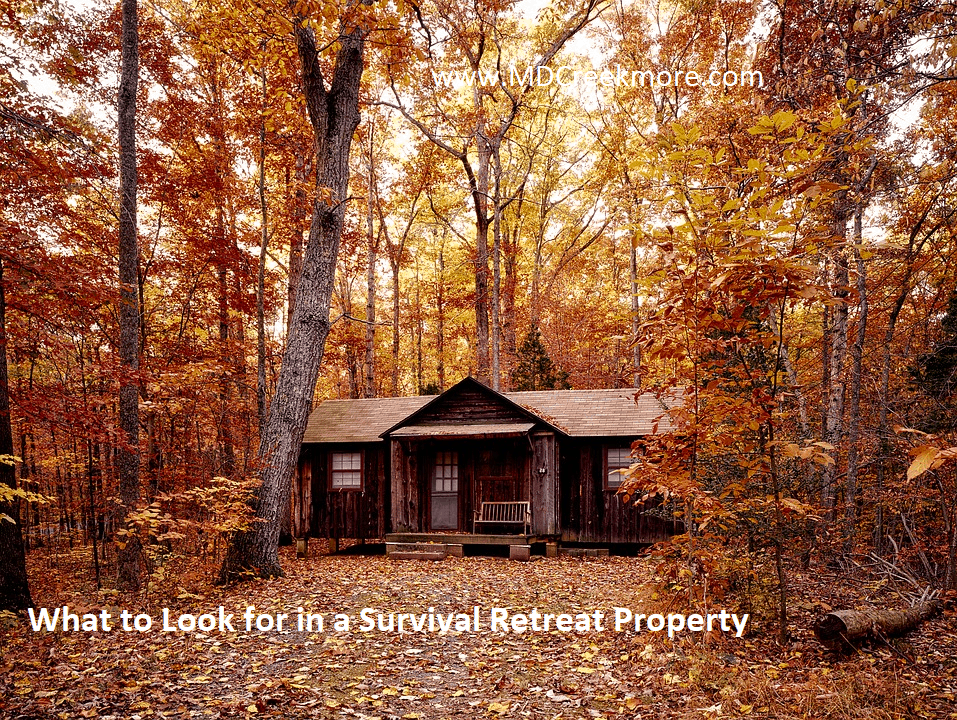
prepper retreat locations

by Biff Brannon

There is some good literature out there regarding setting up a survival retreat location.  In fact, if you were not aware, MD Creekmore, the owner of this blog site has a book out called “Dirt-cheap Survival Retreat: One Man’s Solution” (click here to find out more about this awesome guide) that goes into some detail regarding setting up a survival retreat location for very little cost.

I do go into some of that in this particular blog post as well, but mostly this article is about the importance of having a retreat location to fall back to.  Especially for those who live near cities.

We should consider ourselves lucky that large scale disaster events are few and far between.  Most survival situations run for a short duration with many lasting less than ten days and are what I refer to as ‘green’ events (a disaster lasting 1-10 days). Most green events can be handled by hunkering down at home with an ample supply of survival food and water and some alternative cooking means such as a camp stove or even your back yard gas grill.

Throw in some other basic survival gear (here is a link to MD Creekmore’s favorite gear) that can be easily found at any outdoor camping store, some common sense thinking regarding prepping, and you will be set to face a green event.  However, larger disaster threats are out there, and such events that fall into the ‘yellow’ and ‘red’ event category (yellow event 10-90 days, red event 90+ days into years) typically spell bad news for entire regions and sometimes entire countries.

You can pretty much count on a yellow or red event having a complete breakdown of society at some point.  Water service might not be operating, electrical power may not be available, stores will not be getting resupplied from distribution centers, people will start to starve and panic, looting, and rioting will take place, people will die, people will get sick from poor hygiene, some will contract otherwise controlled diseases, the government will not be able to keep control…  it will be basically everybody fending for themselves.  And the worse place you will want to be is anywhere near a city or large town.

Hunkering down at your apartment or home is not always going to be a good idea in the case of yellow or red events, as bands of looters will eventually end up going from house to house or apartment to apartment.  This is where the survival retreat location comes into play for people who are serious about being preppers.

Some of us are lucky enough to already live far away from cities, however, most of us are not.  Those of us who are not that lucky will need and want to have a retreat location.

When it comes to survival retreat locations, like any other piece of real estate, the mantra is location, location, location.  A thirty-minute drive from the outskirts of a city to a friend’s farm is not going to be a good retreat location, but nor is it necessary to buy a place in rural Idaho where the population is as low as two people per square mile.

The Golden Horde Theory

When looking to set up a retreat site you want to try and be at least one full tank of gas plus a minimum of another fifty miles away from any major city/suburb center.

That comes out to about 300-350 or more miles.  And you certainly want to also be at least fifty miles away from any major highway or interstate.  The reason for this is because when things really start to go bad in the cities people are going to start to leave them in a massive exodus.

Once people notice other people loading up their cars to leave town there is going to be a domino effect.  When exactly that will happen is hard to say.  Some people will have enough smarts to see where things are headed and get out ahead of everybody else.

That is the kind of person you need to be.  Others will keep on thinking things will get better and try and ride it out, only deciding it may be better to leave the city once they are down to having hardly any food or water and no way to get more.  By then it may be too late to safely leave.

Those roads and various other travel routes such as railways and river-ways are called ‘channelized areas’.  You can expect these channelized areas to be jam-packed with people fleeing the cities.  The highway, in particular, will be a very bad situation as people stop to try and get supplies along their route.

Eventually, gas stations, other retail centers, and even small communities along the major roadways will run dry of gas and supplies.   Cars will run out of gas or just breakdown along these channelized areas.

This will clog the highways and bring travel to a stop.  People who fled the cities will get out of their cars at that point and load up as much of their belongings as they can carry and start walking on foot.

At that point, they may stop following the highway and just spread out from their location in all directions.  People are either going to have what they need to survive for a few days or they are not.  The people who don’t have what they need and do not have skills to find food and water in rural zones are going to prey on those that do have food and water.  It will be a very dangerous situation.

People leaving in the mass exodus will probably think to go as far away as possible hoping that things will be better in another part of their state or region in the country.  However, in a red level event that affects the entire country or the world, things are going to be bad everywhere, and probably for some time.

Some will try to head to a relative’s home far away.  Others may think they should head towards where there is lots of water.  Some will want to head to farm country.  Other may decide they will head to the wooded and forest regions to try to lay low by camping.

It is safe to assume that people spreading out from the cities will not get very far without food, water and survival gear, and skills.  That is the reason why you want your retreat location to be as far away from cities and their channelized areas as possible because the refugee situation will be devastating.

Anything within sight of a group of desperate refugees, be it a house, store, landmark, barn…anything, will be traveled to and searched for supplies.

The more desperate the refugees, the more dangerous they will become.  Starvation and thirst will make people do things they would not normally do, not only for themselves but especially for a loved one.  So you need to be far away from such threats as possible.

The further away you are from channelized locations the less interaction you will have with desperate people.  But still, count on having such interactions, and be prepared for when they do occur.

So when looking for a retreat location what kind of place do you want to search for?  Some people will look for real estate such as a cabin on a lake or a secluded hunting cabin in the woods, others will look to purchase property in farm country and perhaps buy a small hobby farm, others may think to load up their camping gear and head into the backwoods where they have gone camping before.

And there are others that will look for an in-town retreat, meaning a small community of less than a few thousand people. All are viable options, and some may be better suited for certain regions of the country.  Of course, it also depends on what you can afford.

Of the few options, I mentioned above let’s take a look at the two defining differences: Secluded survival retreats and in-town survival retreats. Both have their own pros and khans.

Survival Retreat – In Town:  Pros

  1. You will be part of a community, hopefully where people help people.
  2. You will benefit from having lots of community people you can barter with.
  3. You may benefit from the security precautions the community takes, especially if law enforcement remains intact.
  4. You may benefit from any local hospitals or clinics.
  5. You will benefit from a greater skill pool off all the people in the community

Cons

  1. Greater risk of being burglarized.
  2. Increased risk of communicable diseases.
  3. Greater risk of your prepping lifestyle being noticed and your supplies confiscated for the “good of the community”.
  4. Limited privacy.

Survival Retreat – Isolated:  Pros

  1. You will have better privacy.
  2. Easier to hunt from right outside your door.
  3. More room for gardening.
  4. More control over your own supplies.
  5. Better control of overall sanitation.
  6. Batter able to keep livestock close and easier to feed.
  7. Much lower risk of communicable disease.
  8. Lower land and house prices.

Cons

  1. The more isolated you are the fewer opportunities you will have to barter for needed items.
  2. Probably will require more than one family unit to provide adequate security.
  3. You should not depend on much help from neighbors or whatever law enforcement may be left if attached by looters.

Personally, for my own retreat planning I have two locations; a primary location and a secondary location that is about a 2-day walk from the first.  Both I would classify as isolated, though they are located less than a day’s walk from small communities of 400 or fewer people where I and my family are well known.

A few other things to think about when choosing a retreat location:

  1. It should be 350+ miles from major cities.
  2. It should be located 50+ miles from major interstate freeways and other channelized areas.
  3. Good local resources for wood, wild game, crop growing, and of course water.
  4. Good source of surface water (saying this again a different way because water is important) and year-round precipitation.
  5. No risk of flooding, major earthquakes, hurricanes, forest fires that would burn your retreat home, etc…
  6. Some natural defenses like hills or berms that make prepping for defenses would be preferable.
  7. Low population, as fewer people around will mean fewer problems.

Now that we have broken down the isolated retreat against the in-town retreat, lets take a look at the preppers who want to head off into the wilds all alone and survive on bugs, chipmunks, deer, and living in man-made stick shelters under a blown down tree versus a prepper who plans to hold up with family or friends.

As for the lone prepper, personally, I do not think that is a very good idea.  I have the utmost respect for people like Les Stroud (read this article written by Les Stroud for M.D. Creekmore.com).  The skills of the man are amazing, and while such skills will keep you alive for a few weeks and possibly a month, surviving in the wilds like that long term can have devastating effects on a person.

Trying to survive on such skills as demonstrated by the TV show survivalists for many months to a year or more is going to be very difficult.  Even if you know how to build a log cabin and sustain yourself with food and water and scrounging wild roots and veggies, you are taking a big risk just by being alone if you get hurt.

If you get hurt or even sick bad enough to keep you from maintaining your food and water stores you are going to die.  If you break your tools that you brought with you and have no way of fixing them or bartering for new tools you are going to die.

If your hunting rifle breaks or you run out of wire or thread suitable for snaring or hunting game, you are going to get very hungry and could die.  For me, going out alone into a survival situation for extended periods like a yellow or red event is just asking for trouble.

You need to know how to do everything for yourself, you need to know how to do it well, and you need to make sure you are always healthy enough to maintain camp and supplies to be able to keep alive.

Being part of a family unit or a group of like-minded friends, or a combination of the both is a safer way to prepare when planning a survival retreat location.  For example, I am part of a small group of like-minded family and friends.

Some of us have paramedic and nursing work experience, some of us are former military including military police, combat medic, and a force recon marine.  Some are avid outdoors-men who can hunt and are familiar with woodland survival techniques, others know how to plant and grow food and how to preserve food for storage…  the knowledge and skills spread out over ten different people are not only diverse but amazing.

Also, think about all the knowledge that can be cross-trained from members of your survival retreat group.  If somebody takes a class on soap making or maybe animal trapping and all you need to do is hold a class for the group and cross-train that new knowledge.

Another good thing about being part of a group of preppers is that it can really help bring costs down.  Think of a retreat location more like a vacation spot out of the hustle and bustle of city life, and maybe go a step further and look at the retreat as a timeshare property or a membership managed LLC that owns a lodge open to use by members only.

Of course, it may be easier if just one person owns the property and is open to work and tools contributions from the group.  Either way, if you set up a prepper group you need to know you can absolutely trust the people you are forming up with.  This may be less important when dealing with just family members.  Either way, there will be arguments over things.  Be prepared for that as well.  But remember the ultimate end goal you are trying to achieve.

The fact is that if you are facing a yellow or red event than you can almost certainly expect the power grids to be down and then eventually everything else that society provides is going to fail as well.  You retreat will need to be ready for the kind of living our forefathers experienced before electricity and motorized equipment.

You need to be ready to get back to the basics such as growing your food in a garden, using an outhouse, digging a well, patching threadbare clothing, making your own soap, tending to livestock, sharpening axes and saw blades, canning preserves, making candles, smoking and salting meat for storage, etc…

Not only does a retreat location require money for equipment and tools you may need, but it will also require to you to be prepared with a whole new set of skills to be able to live comfortably, or at least as comfortably as you can.  Depending on the climate your retreat is located in will largely depends on some of the tools and skills you will need to have, but mostly I think you will find that most skills and tools will apply in most regions.

Of course your retreat is going to need to be stocked with the usual items such as eating utensils, plates, glasses, furniture – it is a second home, after all, assuming you are not able to relocate and live at your retreat location year round, so you will want to make things as comfortable as possible and get enjoyment out of it even if it never needs to serve its purpose as a survival retreat.

But let’s take a look at some suggested things in the list below that you may want to consider having or planning for.

Survival Retreat Prepper List:  Above and Beyond the Usual

Water:  You will need to know how you will be able to get water for survival at your retreat.   There are many different ways to secure water.  Once you have it, you will need to be able to store it safely for short periods of time until consumed. (click here to read MD Creekmore’s detailed article on water).

Food:  Store more canned foods, MREs, bulk rice, bulk wheat, bulk beans, bulk salt.  Learn to can and preserve your own foods that you grow or harvest from wild plants.  Your canned and stored foods may not last as long as the disaster event does, so be prepared to learn some skills such as farming, hunting, fishing, and foraging for wild foods. (click here to read MD Creekmore’s detailed article on prepper food storage).

Fitness/health:  Before a major survival event strikes you should seriously think about getting done any elective surgery procedures you have been putting off.  Take care of any dentistry work.  Stay in shape.  If you are not in shape, get in shape or at least better shape. (click here to read MD Creekmore detailed article on medical preparedness for preppers).

Personal Items:  You should make a separate list for each member of your family or person who is expected to stay at your retreat during survival event.  Things to think about; spare glasses, prescription medications, birth control, and feminine products all come to mind right away.

Chemical and Nuke Defense:  Geiger counter, HEPA filters, potassium iodate, means to shower outside your retreat.

Pandemic Defense:  Hand sanitizer, disinfectants, antibiotics, and antiviral medications, N95 masks, expectorant.

First Aid:  It would be a good idea to get advanced first aid training, possibly EMT or Paramedic level if possible.  Have a first aid kit on hand equal to or greater than your level of medical aid ability, and have extra supplies of everything.

Hygiene: Soap – lots of it.  It would be a good idea to learn how to make it.  Suggest that you have bottles lye on hand to help you make soap.  Toothpaste or powder, floss, toilet paper, sunscreen, alternate toilet paper for when the good stuff runs out.

Gardening:  Learn to garden and look into buying and storing non-hybrid seeds.  There are so many numerous gardening tools out on the market that to list them all here would take up too much space.

Start out by keeping it simple and buy the basic rakes, hoes, shovels, tillers and hand garden tools.  If you don’t know a thing about gardening you better find out right away and start learning.

Being able to plant your own garden and raise your own crops could mean the difference between starvation and living.  Aside from learning how to grow food to eat, you should also look into growing your own medicinal herbs.

Livestock:  It wouldn’t hurt to have a dozen chickens, a couple of cows, and some goats.  Being able to have some fresh eggs, milk, and make your own butter would be a great benefit to any survival retreat.  Of course, having such animals will take some work and possible new skills.  How far you want to go with keeping livestock is up to you.

Hunting and Fishing:  Being able to hunt and fish could help greatly towards keeping you well fed.  Look into what wild game is located in your region and learn how to hunt and trap it.  Learning to smoke meat can help in long preservation in any large game animals you harvest.

Fuel:  Buy plenty of extra fuel.  Gasoline, kerosene, propane, diesel…whatever.  If you have something that runs on fuel, make sure you have extra of it and don’t let your primary tank fall below half full.

Gasoline does not keep for a long time, but diesel stores better than gasoline – either way, keep some additives such as STABIL that will help extend the life of gasoline and diesel fuels.  Rotate out any old fuel you have stored when you buy new fuel.

Security:  Fences, locking gates, locking road cables, reinforced doors, night vision gear, guns and ammunition, razor wire, black plastic to cover windows (keeps light from inside being seen outside at night), security patrols. (click here to read MD Creekmore’s detailed article on retreat security)

Firefighting:  In a green, yellow or red event the fire department may not be able to respond.  So be ready to fight your own fires as best as you can.  Keep fire extinguishers inside your retreat, replace your roof with a fireproof metal roof, keep trees, hedges and brush at least fifty yards away from your retreat house.

Maintain smoke and carbon monoxide detectors inside, and have fresh batteries on hand to make sure they are always working.

General Tools:  For gardening, gun-smithing, auto-mechanical, woodworking.

Communication:  Having a handful of two-way radios is a great way to stay in contact with people who are out working in the yard or field with those that stay behind at the retreat house.  Communication is actually a part of your security list as well.

Don’t have the means for a hardcore survival retreat location?

Now, not having a good retreat location can be a problem depending on the type of event you are facing.  A green event is probably not going to be a problem where you need a retreat location, but then again it may be easier on your life and that of your family to still leave home for a while.

Depending on the type of yellow event; perhaps a tornado, earthquake, massive flood, or thermal nuclear terrorist event to name a few possibilities that affect only your immediate area, you may be able to go live with extended family 500 miles away for a few months.

A red event is truly the worst-case scenario, and more than likely it is going to involve something on a grand scale that not only affects the country but could affect the world and certain to involve a total collapse of society.

As mentioned before cities are going to be something to avoid, and the suburbs would be overrun with looting and scavengers as people flee the cities.  Having a good retreat location is going to help any prepper survive that normally lives near or around a city.

So what can a prepper do if they do not have the means for a secluded hobby farm, hunting cabin, or even just a second piece of vacant property out in the middle of nowhere away from channelized areas?

My first suggestion is to possibly try and meet like-minded people with the prepper mentality.  There is certainly better security to be found with good people and forming a ‘prepper group’.  Perhaps somebody in the group has a retreat location that everybody can use.

It may mean helping out with chores around the property to help keep it at the ‘ready’.  It may mean helping secure provisions and cross-training skills with the rest of the group.  Maybe it even means helping pay taxes or insurance on the property.

The key thing to remember is to be very selective with any such group you may look to join or form on your own.  Make sure you are 100% comfortable with the people and your interactions before getting involved too fast.

Another suggestion is to find a remote campground run by private mom & pop owners.  These campgrounds tend to be off the beaten path, so to speak, and are more than likely used by ‘regulars’ throughout the year.  Avoid the larger campgrounds like State Parks and KOA campgrounds, as these are at the foremost of people’s minds and are more commonly known and thought of, and are more than likely to be flooded with refugees from nearby cities and suburbs.

Possibly get familiar with a couple smaller campgrounds and find one that is a good fit for you and the family by going there to camp a few times or more a year, preferably one that has good pit toilets already in place and has water sources close at hand.

Get to know the people in the community around the campground.  You can be sure that other people will show up at a campground during a yellow or red event.  But the odds that the people that do show up are going to be people who are regulars at the campground and there will possibly already be a sense of community at such a location.

Now, if deciding to use a small remote campground as a retreat, the key to survival will be learning a variety of camping skills, having extra camping gear that is made of good quality materials and possibly even having extra backups of things like tents and clothing.

You also want to be able to organize with the other people who show up at the campground.  Organization means getting the group of campers together to work towards the greater good of the larger group by forming a solid community.

That means taking care of sanitation requirements for a large group, managing water sources for a large group, finding food either by hunting, foraging or maybe battering with nearby farms, growing food, and generally the sharing of some resources.

As for growing food, it would be a good idea to have a wide variety of seed bank seeds available, not only to meet your family’s needs but also extra to help provide for the larger needs of an entire campground.

An extremely negative reason to retreat to a campground is if the event that is forcing you away from the city is a deadly pandemic.  In the case of a pandemic, you will want to try and limit the amount of contact you have with people until the pandemic burns itself out, which the CDC (Center for Disease Control) says could take 90 to 120 days during the first outbreak.

By limiting contact with people outside your family or prepping unit, you will also want to keep anybody you come across at least several yards away from you just in case they are carrying whatever pandemic bug is out there.  Of course, limiting yourself and your group from people would be hard to do if retreating to a campground.

Of course, don’t forget to read the book “Dirt-cheap survival retreat: One Man’s Solution” written by the host of this web blog page.

Filed Under: Prepping

  • « Go to Previous Page
  • Page 1
  • Interim pages omitted …
  • Page 47
  • Page 48
  • Page 49
  • Page 50
  • Page 51
  • Interim pages omitted …
  • Page 79
  • Go to Next Page »

Primary Sidebar

Subscribe to Blog via Email

Enter your email address to subscribe to this blog and receive notifications of new posts by email.

Join 7,202 other subscribers
  • Amazon
  • Facebook
  • Substack
  • Twitter
  • YouTube

“Do more with less.”

– Minimalist proverb

Recent Posts

  • Just so you know
  • Weather Update for My Corner of Appalachia
  • Why I’m Ordering Ivermectin + Mebendazole Every Year
  • The Website’s Shutting Down (But Here’s the Plan)
  • You Are Hated! Start Training Like It!

Footer

Recent Posts

  • Just so you know
  • Weather Update for My Corner of Appalachia
  • Why I’m Ordering Ivermectin + Mebendazole Every Year
  • The Website’s Shutting Down (But Here’s the Plan)
  • You Are Hated! Start Training Like It!

More about me

Books I’ve written

Books I’ve read

Follow Me on YouTube

Follow Me on Facebook

Gear I Use and Recommend

Newsletter

Search this site

Follow me elsewhere

  • Amazon
  • Facebook
  • Substack
  • Twitter
  • YouTube

© 2008–2025 M.D. Creekmore · As an Amazon Associate, I earn from qualifying purchases.