• Skip to main content
  • Skip to secondary navigation
  • Skip to primary sidebar
  • Skip to footer

M.D. CREEKMORE

  • Blog
  • Books
  • Newsletter
  • Gear I Use
  • About
  • Contact
  • Facebook
  • YouTube
  • Blog
  • Books
  • Newsletter
  • Gear I Use
  • About
  • Contact
  • Privacy Policy

Blog

Mountain House Classic Assortment Bucket Review

June 11, 2019 Jesse Mathewson

Mountain House Bucket From Amazon.com

Over the last few decades, I have been more invested in long-term supplies for survival and prepping. After all the evidence shows that it is not a matter of if an event will occur but rather when. By event I mean; flooding, wildfire, home fire, windstorms, hurricanes, earthquakes, mudslides and even the dreaded fabled collapse of our current society. ¹ Now it should be noted that I have invested many thousands of dollars over the years in long-term storage foods, specifically Mountain House. I was contacted to review Mountain House brand foods and sent two packages of food recently. So this review is a mixture of paid and not, the latter being far greater in quantity.

Facts and data, regardless of what we want to believe facts and raw data is always what it is. It is only when we interpret these things that they become “evil or good”. My goal with the reviews I have done is simply to interpret the data and facts I have regarding products I use and either like or dislike.

Mountain House brand foods are hands down the best I have personally tested.
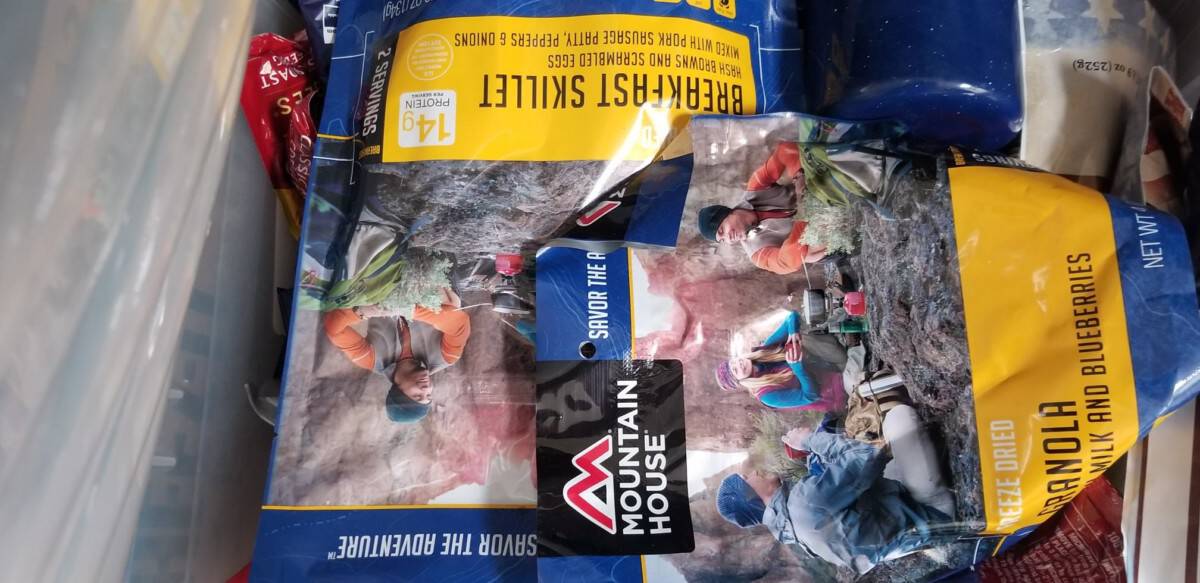
It should be noted that I have tasted and tested several other brands as well, from Wise through Augason Farms and have always come back to Mountain House foods for my personal and family use.

So why do I choose Mountain House foods for my family and self,

  • Ease of preparation (each container is effectively its own serving or dinner dish just add hot or cold water and mix)
  • All of their products are peanut free in fact, entirely nut free (except for coconut which is an ingredient in some meals)
  • Mountain house offers a vegetarian menu as well!
  • Each meal is set up to provide a maximum amount of beneficial calories for the ACTIVE individual, if you are eating these while hiking, camping, and “surviving” they will be quite healthy for you!
  • Cost per meal is actually very good considering what it is you are buying and getting as a benefit!

What are the drawbacks of Mountain House foods and other similar freeze dried meals and long-term food options?

  • High in carbohydrates, unless you are active I would not suggest eating these as a regular meal!
  • Cost per meal is around 50% to 100% higher than meals you could prepare yourself depending on where you shop.

Why do I prefer Mountain House foods over the others, it is simple for me personally. Some of the others do not offer REAL MEAT in their meals, Mountain House does. Taste is also an extremely large concern as well as serving size and amount per sealed container.

I have a family of four with between 2 and 4 other people always joining us. Other manufacturers make much smaller size portions, Mountain House packages full meals for 2 – 4 people per package and the overall package size is still similar to the sizes offered by their competition. Taste of these is considerably better in my opinion than Wise foods for instance. While I carry spices and at a minimum salt and pepper, I prefer to not season my pre-packaged survival/ camping foods.
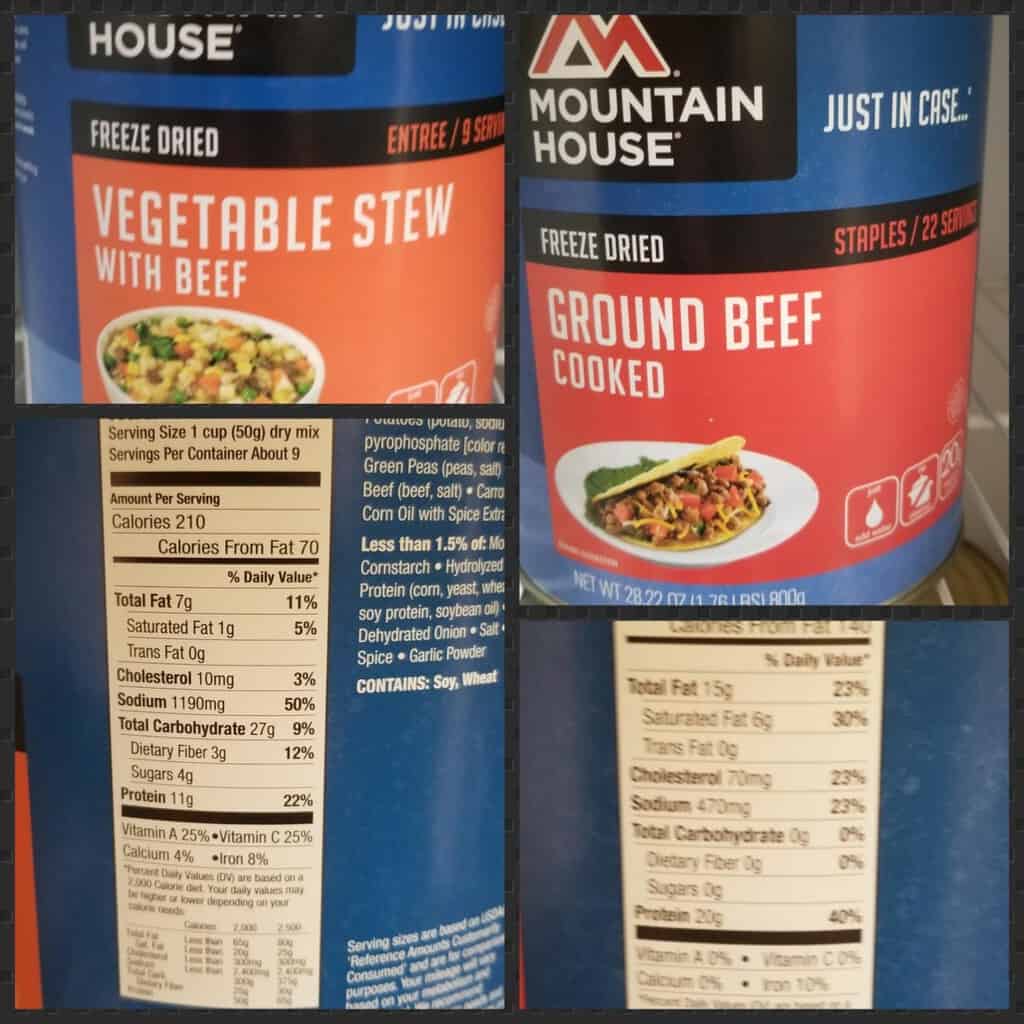
As with Augason Farms, the large cans of food from Mountain House must be used within a week to 2 weeks after opening. For myself this is never an issue as again, we have 4 – 8 people at all times in and around our house and or campsite! If you are an individual or person preparing for yourself and one other the smaller meal packages will be your best approach to long-term storage and use.

They are easy to use and work well for one or two people! I find that when camping (and yes I have tested and tasted many brands while camping and while at home) Mountain House individual meal packages work great for me and my daughter. We rarely need more in a single sitting meal. As we are relatively active, for instance, we have learned gold panning, trapping, shelter building and much more on our expeditions, higher carbohydrates do not pose a great issue. Again, I would not suggest eating these if you are sedentary (not extremely mobile or active).

Would I recommend these to my friends and family?

Absolutely and without reservations, I highly recommend purchasing one of their Classic Buckets for one person which will work great for two people for 36 to 48 hours if you stretch it. The bucket runs $77 on Amazon and I personally purchase one every 3 or 4 months to continue adding to my selection and replenish used materials. Use my personal approach as someone on a fixed income for prepping your homestead!

Also, be sure to take a close look at the “Recommendations Page” for M.D. Creekmore’s most recommended items and gear…

Free the mind and the body will follow!

¹ Letzter, R. (2016, August 29). This is what it looks like when society collapses. Retrieved from http://www.businessinsider.com/what-happens-society-collapses-2016-8

BJ Campbell. (2018, June 08). The Surprisingly Solid Mathematical Case of the Tin Foil Hat Gun Prepper. Retrieved from https://medium.com/s/story/the-surprisingly-solid-mathematical-case-of-the-tin-foil-hat-gun-prepper-15fce7d10437

Filed Under: Gear Reviews

How to Tie a Knot That Won’t Come Undone

June 7, 2019 M.D. Creekmore

how to tie a knot

Do you know how to tie a secure knot? Well, every man should know how to tie a knot and you’re a man, right? Okay, then let’s get to it. Below are ten knots that every man should know how to tie. I suggest that you get some rope and tie each of the ten below twenty or more times each. Tie and repeat until you’re 100% sure that you know how to do it right the first time… even if you’re under stress.

These knots are great for everyday use at home and at work (depending on your job) and are also great to know for camping and survival purposes. You’ll be able to construct shelters, traps and snares, weapons and tools, and other devices, you should have a basic knowledge of ropes and knots and some of the terminology used with them.

The terms are as follows:

Bight. A simple bend of rope in which the rope does not cross itself.

Dressing the knot. The orientation of all knot parts so that they are properly aligned, straightened, or bundled. Neglecting this can result in an additional 50 percent reduction in knot strength. This term is sometimes used for setting the knot, which involves tightening all parts of the knot so they bind on one another and make the knot operational. A loosely tied knot can easily deform under strain and change, becoming a slipknot or, worse, untying.

Fraps. A means of tightening the lashings by looping the rope perpendicularly around the wraps that hold the spars or sticks together. Lashings. A means of using wraps and fraps to tie two or three spars or sticks together to form solid corners or to construct tripods.

Lashings begin and end with clove hitches. Lay. The lay of the rope is the same as the twist of the rope. Loop. A loop is formed by crossing the running end over or under the standing end to form a ring or circle in the rope.

Pigtail. That part of the running end that is left after tying the knot. It should be no more than 4 inches long to conserve rope and prevent interference. Running end. The free or working end of a rope. This is the part of the rope you are actually using to tie the knot.

Standing end. The static part of the rope, or the rest of the rope besides the running end. Turn. A loop around an object, such as a post, rail, or ring, with the running end continuing in the opposite direction to the standing end. A round turn continues to circle and exits in the same general direction as the standing end.

Whipping. Any method of preventing the end of a rope from untwisting or becoming unwound. It is done by wrapping the end tightly with a small cord, tape, or other means. It should be done on both sides of an anticipated cut in a rope before cutting the rope in two. This prevents the rope from immediately untwisting.

Wraps. Simple wraps of rope around two poles or sticks (square lashing) or three poles or sticks (tripod lashing). Wraps begin and end with clove hitches and get tighter with fraps. All together, they form a lashing.

how to tie a knot

The 10 basic knots and methods of tying them that you should know for survival purposes are as follows:

1. Half-hitch.

This is the simplest of all knots, and it used to be the safety, or finishing, knot for all U.S. Army knots. Because it had a tendency to undo itself without load, it has since been replaced by the overhand. 2. Overhand. This is the simple knot that most people tie every day as the first step in tying their shoes. It can also be used to temporarily whip the end of a rope.

This knot should replace the half-hitch as a finishing knot for other knots. This knot alone will reduce the strength of a straight rope by 55 percent.

how to tie an Overhand knot

2. Square.

A good, simple knot for general-purpose use, the square knot is basically two overhand knots that are reversed, as in right over left, left over right. It is used to tie the ends of two ropes of equal diameter together (just like your shoelaces) and must be secured with an overhand on both ends. It is easy to inspect, as it forms two loops and is easy to untie after being loaded.

how to tie a Square knot

3. Round turn and two half-hitches.

This is the main anchor knot for one-rope bridges and other applications where a good anchor knot is required and high loads would make other knots jam and be difficult to untie. It is used most frequently to anchor rope to a pole or tree.

Round turn and two half-hitches knot

4. Clove hitch and end-of-the-line clove hitch.

These knots can be used to fasten a rope to a tree or pipe, and they put little strain on the rope. They are easy to anchor knots, but tension must remain on the knot or they will slip. This can be remedied by making another loop around the object and under the center of the clove hitch.

how to tie a clove hitch

5. Sheepshank.

A method of shortening a rope, a sheepshank may also be used to take the load off a weak spot in the rope. It is a temporary knot unless the eyes are fastened to the standing part of the rope on both ends.

how to tie a Sheep shank knot

6. Double sheet bend.

This knot is used to tie together the ends of two ropes of equal or unequal diameter. It will also join wet rope and not slip or draw tight under load. It can be used to tie the ends of several ropes to the end of one rope. When a single rope is tied to multiple ropes, the bight is formed with the multiple of ropes.

 Double sheet bend knot

7. Prusik.

This knot ties a short rope around a longer rope (for example, a sling rope around a climbing rope) in such a manner that the short rope will slide on the climbing rope if no tension is applied and will hold if tension is applied on the short rope. This knot can be tied with an end of rope or bight of rope.

When tied with an end of the rope, the knot is finished off with a bowline. The non-slip nature of the knot on another rope allows the climbing of ropes with footholds. It can also be used to anchor ropes or the end of a traction splint on a branch or ski pole.

Prusik knot

how to tie a knot

8. Bowline and bowline finished with an overhand knot.

The around-the-body bowline was the basic knot used for rescue for many years, as it provided a loop to place around a body that would not slip or tighten up under strain. It has been replaced by the figure eight in most applications because the latter does not weaken the rope as much.

Bowline and bowline finished with an overhand knot.

Figure eight and retractable figure eight.

9. Figure-eight and retractable figure eight.

This knot is the main rescue knot in use today. It has the advantages of being stronger than the bowline and easier to tie and check. One disadvantage is that when wet it may be more difficult to untie than the bowline after being stressed. The figure-eight (or figure of eight) can be used as an anchor knot on fixed ropes. It can also be used to prevent the end of a rope from slipping through a fastening or loop in another rope when a knot larger than an overhand is needed.

Filed Under: Bushcraft

Why A “Backyard Homestead” Is All You Need (And Tips For Finding Your Own)

April 7, 2019 M.D. Creekmore

the homestead
View of my Homestead taken yesterday when I was working in my garage.

Having a homestead with a huge amount of land is the dream of most people who get the homesteading itch, they dream of have 20 acres or more of prime land out in the middle of nowhere, and going further still they dream or living off the grid.

They fantasize about how wonderful it would be living on their multi-acre homestead off the grid while sitting on their front porch watching the garden grow and the chickens scratch. Unfortunately, that’s as far as most get… the dream stage.

It’s a fact that the vast majority of people who become interested in homesteading never get past the dreaming and fantasizing stage, and I think that deep down most know that that’s as far as it will ever go. But it’s a fun dream and that’s why so many become swept away by it.

But is living off the grid as romantic as people make it out to be in their thoughts and imagination? No, not really. I’ve been there… I lived off the grid for several years in a camper trailer (I even wrote a book about it – click here to check it out at Amazon.com) and while it’s doable I decided to use that time to save money that I made from blogging to buy another property and then moved a full-sized mobile home on it.

Then after living there a few years and saving more money that I also made from blogging to buy another property with a home already built. The property where I live now is three acres and has a stream running through it and is next to a national forest.

stream on my property
Stream that runs through my property…

It’s amazing what you can do on an even an acre and three to five acres of good land and you can do everything that you need to and can have your own highly productive mini-farm or backyard homestead. Having ten, twenty, or more acres and living off the grid isn’t required to have a happy and productive homestead. 

What I’m saying is if you’ve been waiting to start becoming more self-reliant because you think that you don’t have enough land or because you’re thinking about moving off the grid or think that you have to, stop it. 

Go outside and look around! Do you have a large backyard? Can you till it up and plant a garden or build some raised beds? How about a chicken coop to keep a few hens? Maybe plant some dwarf apple trees. How about a beehive or two? Can you build a workshop? A tool shed? Use your imagination and get started now and do what you can where you are.

Stop putting it off because everything isn’t perfect or because it doesn’t fit in with the romanticism you’ve been fed by Mother Earth News and the countless “off the grid” homesteading books. Do what you can NOW where you are. 

You don’t have to have multiple acres or be off the grid. In fact, you’re probably better off if you don’t and aren’t. Living off the grid isn’t easy, it takes work, and lots of it. Just about everything is harder off the grid and if you try to live by on the grid standards (power wise) then it’s also expensive putting all of those power resources in place.

It’s a lot easier to be on the grid (air-conditioning is great on those hot days when you’ve been out working in the garden) and that’s the reason most people are on the grid and got hooked up to the power grid as soon as it was available in their area when grid power was first becoming available.

However, with that said, you should have alternative power sources in place like a small solar set-up (check mine out on my YouTube channel), and an electrical generator (here is the generator I have) for common weather emergencies and those power blackouts that happen during a breakdown like they are seeing in Venezuela with the power outages there such power blackouts were also experienced in Argentina during the economic collapse there.

For more information on what happened in Argentina and survival tips from a guy who was there – order and read the excellent book by Fernando “Ferfal” Aguirre – The Modern Survival Manual: Surviving the Economic Collapse.

In his book, he also talks about how isolated homesteads, like that many dream about, were targeted by criminals and raiders and how the occupants were tortured, raped and robbed after being targeted and overtaken by vandals. Something to think about. Are you thinking about it? You should be.

But what if you live in an apartment and can’t grow or do anything beyond a balcony garden then if possible you should move to a better (and rural) location as soon as possible. Don’t worry about moving off the grid or to an isolated homestead where your nearest neighbor is two miles away.

No trespassing

Instead, look for a location that’s in a small town but that also offers some privacy and enough land to grow a large garden and keep some small domestic livestock like chickens, ducks, and goats. Check local regulations to see what’s allowed and if it’s at all restrictive then choose another location because you want to be able to do what you need to do on your own property to become as self-reliant as possible.

It’s best to not choose a subdivision because even it isn’t crowded when you buy it will be in a few years once all of the lots around you are sold and the buyers move onto them. 

Also, before making the move drive around and look at all of the houses… are they well-kept? Does it look like the people living in the area are responsible and care about their homes and property and do what’s needed to keep it looking nice, or do many of the homes and properties in the area look dilapidated and like the residents just don’t care… they probably don’t. Find another location.

Also, look for a property with a water source nearby and preferably on the property that you’re looking to buy. The best water resource is a good water well, unfortunately, newer properties don’t have water wells anymore because most home builders simply hook up to the public water utility because it’s easier and cheaper. 

For example here is a really nice place with three acres that’s private yet has several other homes in the area to offer support and to work together during a disaster. Note: I’m not affiliated with the property in any way and won’t receive a commission or anything if someone from reading this article buys it.

Great Books about Backyard Homesteading

Backyard Homesteading: A Back-to-Basics Guide to Self-Sufficiency (Creative Homeowner) Learn How to Grow Fruits, Vegetables, Nuts & Berries, Raise Chickens, Goats, & Bees, and Make Beer, Wine, & Cider

40 Projects for Building Your Backyard Homestead: A Hands-on, Step-by-Step Sustainable-Living Guide (Creative Homeowner) Includes Fences, Coops, Sheds, Wind & Solar Power, Rooftop & Vertical Gardening

The Backyard Homestead: Produce all the food you need on just a quarter acre!

The Backyard Homestead Seasonal Planner: What to Do & When to Do It in the Garden, Orchard, Barn, Pasture & Equipment Shed

Questions:

  • Do you live off the grid?
  • How many acres do you have?
  • What have you done to increase your self-reliance where you are?

Well, there you have it… please share your thoughts and comments below.

Filed Under: Homesteading

Camping In Winter? Here’s What You Need to Know!

April 6, 2019 M.D. Creekmore

(The Following is a sponsored post).

by Billy

Cold temperatures and shivers can be an added challenge to the already challenging and adventurous activity of camping. The winter weather conditions can make it difficult for campers and hikers to tread the path, pitch their tents, source food, etc. But, if you’re still determined to experience camping in winters, then here are some important tips for you to keep in mind.

  1. Hydration and Nutrition

In winters we don’t feel very thirsty but that doesn’t mean that our bodies don’t need water. Remember to stay hydrated in the winters and keep taking sips of water at regular intervals. Eating proper meals or taking snack breaks regularly to give yourself sufficient calories is also important in winter camping. Drinking plenty of water and eating regularly will help you stay warm.

  1. Clothing

Don’t try to manage your winter camping trip with just multiple layers of clothing. Purchase winter-specific, camping clothing because those are designed for camping or hiking in the cold. Invest in fleece pants, a puffy coat, waterproof jackets and pants, socks, gloves, hat, earmuffs, etc. Keeping yourself warm in the winter weather is very important, so make that a priority.

  1. Health and Fitness

You should be careful about getting any cold-related injuries like frostbite, hypothermia, and others. It’s very important to keep yourself dry and warm in the winter weather. At any point of time if your feet or any other body part gets wet, change your clothes and get yourself warm immediately. So always make sure that you are carrying an extra pair of each of your clothing.

  1. Camping Gear

For winter camping and hiking, you will need extremely sturdy and durable gear. Ensure that your tents are sturdy enough to withstand the winter winds and temperatures, carry warm sleeping bags, two sleeping pads and most importantly, a stove which is suitable for cold weather conditions. Don’t forget to shop for the usual camping essentials which would include a tough UK pocket knife, ropes, tarps, flashlight, maps, compass etc.

  1. Gadgets

Remember that in winters gadgets lose battery very quickly so you might want to keep them warm and cozy. It would be best to keep them packed in your backpack until you need them. Take them out to use them, try to keep them warm and cozy while using them and then pack them away when you’re done.

  1. Campsite

It’s important to choose the right camping site for your winter camping adventures. You should avoid camping sites that are located at the bottom of the hills because of the formation of cold- air troughs and also the top of the hills because of the cold wind. If possible, choose a site which is flat and if there’s snow, you can suppress it by walking on it. Remember that snow which is packed will insulate heat better than snow which is left loose.

  1. Pee Bottle

Cold temperatures can cause you to pee more often than usual and it can also be very difficult to be able to pee out in the open during winters. So, mark a bottle with your name and create your own pee bottle for any urination requirements at night. You can also wrap it in duct tape if you would not like your pee to be visible to other campers

Conclusion

Camping in winters is a great adventure and an even greater challenge. However, nothing is impossible. If you’re well prepared, ready with your gear, aware of your surroundings, dare to take on the challenge and know your do’s and don’ts, this too can be an equally fun activity.

Filed Under: Bushcraft

Wisconsin Knife Laws: A Simple Cheat Sheet With All You Need To Know

January 24, 2019 M.D. Creekmore

wisconsin flag - knife lawsEven for a legal expert trained in understanding weapon laws, Wisconsin knife laws are often difficult to understand. The primary reason for the confusion stems from the ambiguous wording of statutes that lead to protracted legal battles inside civil and criminal courts.

Legislative leaders in Wisconsin have made an effort to clear up the ambiguous language by passing laws defining the meaning of a number of knives, as well as clarify the intent of unclear knife statutes.

[ Note: Out of all of the pocket knives available on Amazon.com this one is my favorite everyday carry knife – click here to see what it is on Amazon.com. I love this knife! It’s built like a tank and holds an edge better than any other knife that I’ve owned…]

A thorough review of Wisconsin knife laws leads to the conclusion the state does not consider knives to be labeled as “dangerous weapons” as defined by state law. Let’s review the important components of Wisconsin knife laws to determine where residents and visitors stand.

Recent Changes in Wisconsin Knife Laws

On April 14, 2015, the Badger State passed a law that provides visitors and residents with more legal freedom to own and carry knives. Senator Terry Moulton and representative Kathleen Bernier sponsored the landmark knife law, with Governor Scott Walker a persuasive supporter of the new law.

Governor Walker played an instrumental role in lobbying legislators that sat on the fence during the extended debate that at times turned confrontational.

The governor made a statement that tied the new law to the fundamental meaning of the Second Amendment to the United States Constitution. “Wisconsin citizens have the fundamental right to defend themselves and feel safe and secure in their homes and we remain committed to protecting those rights,’ remarked Governor Walker during an emotional speech.

AB 142 removed every restriction placed on switchblade knives, which the state categorizes as a type of automatic knife. The lifting of restrictions includes the concealed carrying of a switchblade.

State lawmakers made an exception to the new switchblade rules by stating “person who is prohibited under state law from possessing a firearm may also not go armed with a concealed knife that is a “dangerous weapon.”

In February of 2016, legislators removed additional restrictions when it comes knives, concealed carry, and how the state views municipalities that pass more onerous knife laws that what is mandated by the State of Wisconsin.

With myriad lakes and plenty of wilderness to provide homes for wildlife, the reform of Wisconsin knife laws came about primarily because of the strong support demonstrated by the anglers and hunters living in or visiting the state.

Here are the types of knives that are legal to own in Wisconsin:

  • Dirk
  • Bowie
  • Ballistic
  • Dagger
  • Disguised
  • Switchblade

Wisconsin Defines the Meaning of Concealed

In a monumental 1993 Wisconsin Court of Appeals case, State v. Keith ruled there are three criteria for defining what is a concealed weapon. First, the weapon must be completely hidden, Second, the defendant in a criminal case must be aware of the presence of the hidden weapon.

Finally, the weapon is within the defendant’s reach, attached to a part of the body, or stored in a clothing pocket.

Another case litigated by the Wisconsin court of appeals ruled a person was guilty of carrying a dangerous concealed weapon in situations where all the three of the following criteria are met:

  • Defendant was aware of the presence of the weapon
  • The weapon was located inside a car and within the defendant’s reach
  • The weapon was hidden from ordinary view

Subsequent court rulings defined the ambiguous term “ordinary view” to mean a person could not see the weapon standing outside a vehicle or within a vehicle.

Concealed Carry Knife Law in Wisconsin

Knife laws in the Badger State allow residents and visitors to conceal carry a legal to own knife.

“Unless other facts and circumstances that indicate a criminal or malicious intent on the part of the person apply, a person is not in violation of, and may not be charged with a violation of, this section for loading, a firearm, or for carrying, or going armed with a firearm or a knife, without regard to whether the firearm is loaded or the firearm or the knife is concealed or openly carried.”

AB 142, Act 149, Section 11 prohibits a person from possessing a firearm, if the person is also prohibited from conceal carrying a legal to own knife.

Additional Wisconsin Knife Laws Information

State preemption language for Wisconsin knife laws is highly ambiguous.

“With regard to state preemption of local regulations, political subdivisions are prohibited from enacting or enforcing an ordinance regulating the sale, purchase, purchase delay, transfer, ownership, use, keeping, possession, bearing, transportation, licensing, permitting, registration, or taxation of any knife, unless the ordinance or resolution is the same as or similar to, and no more stringent than, a state statute.”

AB 142, Act 149, Section 2 also prevents local regulations from prohibiting a person’s right to open or conceal carry a legal to own knife.

Here is where the state preemption statute for Wisconsin gets muddied.

Although there is a state preemption provision written in AB 142, local governments can forbid the possession of knives carried into a building that is owned, occupied, or controlled by the local political entity. Note the Wisconsin legislature uses the word “building” instead of the term “real estate” to create a narrower restriction for knife prohibition. Knives remain outside the definition of a “dangerous weapon.” However, Wisconsin law has not changed the law that forbids dangerous weapons on school property.

Other Important Provisions of Wisconsin Knife Laws

In the Badger State, minors are not allowed to own a weapon or receive a weapon that was transferred to a minor by an adult. Wisconsin does not place a restriction on the length size of a knife blade. The lack of a blade size restriction is relatively rare among American states. Most states place blade restrictions that range from three to five inches.

Where Do Wisconsin Knife Laws Go from Here?

In a show of unity, both prominent Democrats and Republicans in the Wisconsin statehouse have publicly stated the importance of further clarifying state weapons statutes. State preemption language especially needs more work to unify state and municipal knife laws. Expect some type of law to pass in 2019 that merges state and local knife ownership interests.

Please note: None of the material in this article should be interpreted as legal advice.  I am not a lawyer.  Never take any action with legal consequences without first consulting with a lawyer licensed in your jurisdiction.  This article should not be relied upon for making legal decisions.  This information is provided for scholarship and general information only.

You can read my other knife law articles for other states here…

And check out these related articles:

  • What’s The Best Multi-Tool to Buy For EDC
  • Best Survival Knife of for Under $100
  • Best Folding Knives For Self-Defense
  • Work Sharp Pocket Knife Sharpener Review
  • SOG Tactical Tomahawk Review

Filed Under: Knives and Blades

Missouri Knife Laws: A Simple Cheat Sheet With All You Need To Know

January 24, 2019 M.D. Creekmore

missouri-flag-knife-laws

As one of the leaders in preserving constitutionally guaranteed rights, the Show-Me State not only recognizes the right of residents and visitors to bear arms, but the state also preserves the rights of residents and citizens to own and bear all types of knives. The Missouri Constitution closely resembles the language written into the Second Amendment of the United States Constitution.

  • 23.
    Right to keep and bear arms-exception

“That the right of every citizen to keep and bear arms,  ammunition, and accessories typical to the normal function of such arms, in defense of his home, person, family, and property, or when lawfully summoned in aid of the civil power, shall not be questioned.

The rights guaranteed by this section shall be unalienable. Any restriction on these rights shall be subject to strict scrutiny and the state of Missouri shall be obligated to uphold these rights and shall under no circumstances decline to protect against their infringement.

[ Note: Out of all of the pocket knives available on Amazon.com this one is my favorite everyday carry knife – click here to see what it is on Amazon.com. I love this knife! It’s built like a tank and holds an edge better than any other knife that I’ve owned…]

Nothing in this section shall be construed to prevent the general assembly from enacting general laws which limit the rights of convicted violent felons or those duly adjudged mentally infirm by a court of competent jurisdiction.”

Are Any Knives Prohibited in Missouri?

Since 2012, state law § 571.010 does not include a switchblade on the list of prohibited knives. However, anyone that uses a switchblade to commit a crime is in violation of a long-standing federal law. The United States Congress passed the Federal Switchblade Act in 1958 to regulate interstate commerce. Confusion as to which switchblade law applies to each case has bogged down court proceeding involving the ownership of switchblade knives.

Concealed Carry of Knives in Missouri

Missouri knife laws forbid the concealed carrying of any type of knife, except for “an ordinary pocketknife” that does not measure more than four inches in length. As with many legal definitions, the meaning of “an ordinary pocketknife” has undergone intense judicial scrutiny in several highly publicized civil and criminal cases.

The state law applying to concealed carry reads like the following:

  • Carries concealed upon or about his or her person a knife, a firearm, a blackjack or any other weapon readily capable of lethal use.

In summary:

  • You are not allowed to conceal carry a pocketknife that is more than four inches in length
  • You are allowed to open carry any type of knife that state law mandates as legal to won
  • You cannot conceal carry any other type of knife outside of a pocketknife measuring fewer than four inches in length

As one of the legal pillars of Missouri precedent law, the case of State v. Dowdy rules that a paring knife Dowdy had concealed qualified as a banned conceal carry knife as written into state knife laws.

Concealed Carry Further Defined in Missouri

Missouri law considers the meaning of concealed to be a knife that “is not readily and practically visible to approaching persons under ordinary circumstances.” As another case that set Missouri knife laws in stone, State v. Rowe declared a six-inch bladed knife hidden in the driver’s side door of Mr. Rowe’s vehicle met the legal definition of concealed.

Although Mr. Rowe’s knife handle was easy to see, state court ruled the knife was concealed and thus, a banned knife under Missouri knife laws. Moreover, the court’s decision in State v. Rowe states that in order to convict a defendant for the concealed carrying of a knife, the person owning the knife must have easy access to controlling the knife.

A Few Exceptions to Missouri’s Concealed Carry Provision

Missouri knife laws when it comes to concealed carry do not apply to government employees, as well as professionals that serve legal papers to Missouri residents. Hunters that legally carry an exposed bow and/or firearm also are allowed to conceal carry a knife in the Show Me State.

Anyone “peaceably” traveling through the state are allowed to carry a concealed knife. Numerous defendants have submitted legal challenges in court to request definitions for the terms “peaceably traveling” and “continuous journey.”

Here are a few of the cases:

State v. Mason ruled in 1978 that you do not have to travel entirely through the state of Missouri to be considered on a “continuous journey.” The ruling opened the door for residents that concealed carry certain knives from let’s say Rolla to St. Joseph.

Not surprising, a court ruled in 1990 that transporting a “considerable quantity” of narcotics violated the “peaceable traveling” clause of Missouri knife laws.

Eleven years later, a Missouri Appellate Court rules in State v. White that possession of a small quantity of marijuana does not exempt a defendant from the meaning of “peaceably traveling.”

Missouri Statutory Definition of a Knife

 (12) ‘Knife’, any dagger, dirk, stiletto, or bladed hand instrument that is readily capable of inflicting serious physical injury or death by cutting or stabbing a person. For purposes of this chapter, ‘knife’ does not include any ordinary pocketknife with no blade more than four inches in length;

Remember the term “ordinary pocketknife remains a contentious topic among both defense and prosecuting attorneys.

Miscellaneous Missouri Knife Statutes

Missouri represents one of the few states that does not place any restrictions on the minor age ownership of knives. There is not a statewide preemption allowed for Missouri knife laws. The lack of statewide preemption has given major cities such as St. Lois and Kansas City more legal wriggle room to enact stricter knife laws. The critical dimension mandated by Missouri knife laws is four inches. No blade on any type of knife can exceed four inches.

Missouri Knife Laws Moving Forward

In 2019, Missouri appears to be a state that will address legally ambiguous language written into the state’s knife laws. Lawmakers are also poised to address the legal conflict between allowing minors to own knives and the tough knife laws passed by a few cities that prohibit the carrying of any type of knife on school property. Nonetheless, Missouri should remain one of the most knife-friendly states in the country.

Please note: None of the material in this article should be interpreted as legal advice.  I am not a lawyer.  Never take any action with legal consequences without first consulting with a lawyer licensed in your jurisdiction.  This article should not be relied upon for making legal decisions.  This information is provided for scholarship and general information only.

You can read my other knife law articles for other states here…

And check out these related articles:

  • What’s The Best Multi-Tool to Buy For EDC
  • Best Survival Knife of for Under $100
  • Best Folding Knives For Self-Defense
  • Work Sharp Pocket Knife Sharpener Review
  • SOG Tactical Tomahawk Review

Filed Under: Knives and Blades

  • « Go to Previous Page
  • Page 1
  • Interim pages omitted …
  • Page 44
  • Page 45
  • Page 46
  • Page 47
  • Page 48
  • Interim pages omitted …
  • Page 87
  • Go to Next Page »

Primary Sidebar

Subscribe to Blog via Email

Enter your email address to subscribe to this blog and receive notifications of new posts by email.

Join 7,202 other subscribers
  • Amazon
  • Facebook
  • Substack
  • Twitter
  • YouTube

“Do more with less.”

– Minimalist proverb

Recent Posts

  • Just so you know
  • Weather Update for My Corner of Appalachia
  • Why I’m Ordering Ivermectin + Mebendazole Every Year
  • The Website’s Shutting Down (But Here’s the Plan)
  • You Are Hated! Start Training Like It!

Footer

Recent Posts

  • Just so you know
  • Weather Update for My Corner of Appalachia
  • Why I’m Ordering Ivermectin + Mebendazole Every Year
  • The Website’s Shutting Down (But Here’s the Plan)
  • You Are Hated! Start Training Like It!

More about me

Books I’ve written

Books I’ve read

Follow Me on YouTube

Follow Me on Facebook

Gear I Use and Recommend

Newsletter

Search this site

Follow me elsewhere

  • Amazon
  • Facebook
  • Substack
  • Twitter
  • YouTube

© 2008–2025 M.D. Creekmore · As an Amazon Associate, I earn from qualifying purchases.