• Skip to main content
  • Skip to secondary navigation
  • Skip to primary sidebar
  • Skip to footer

M.D. CREEKMORE

  • Blog
  • Books
  • Newsletter
  • Gear I Use
  • About
  • Contact
  • Facebook
  • YouTube
  • Blog
  • Books
  • Newsletter
  • Gear I Use
  • About
  • Contact
  • Privacy Policy

Blog

Bug Out Vehicle Tips And Gear Checklist

September 15, 2018 M.D. Creekmore

bug out vehicle setupBy Brian D.

The world we live in today is unstable.  We face the possibility of terrorist attacks, natural disasters, viral outbreaks, power outages, water shortages, the list goes on and on.  Hurricane Katrina showed proved that the government cannot protect everyone in the aftermath of a large-scale disaster.

This was a wake-up call for many that in order to survive you must take your fate into your own hands.  Regardless of personal feelings about what may be coming or ending, it is growing more and more important to maintain a basic level of readiness for whatever may disrupt life and interrupt the ability to acquire a supply of water, food, and shelter.

Whether you are a hard-core, end of the world “prepper” or just take the Boy Scout motto seriously, there is no shortage of good information on prepping for disaster.

If you plan to “bug out” or “bug in” or just learn what items are best to carry every day, you can find numerous resources and opinions on what gear to buy and what skills are necessary, but one area that often fails to get enough attention in preparedness discussions is preparing and maintaining your vehicle for emergencies.

When disaster strikes, whatever the disaster may be, you might be lucky enough to already be in your safe zone, your “bug-in” site.  But what if you’re not?

What if you’re caught out and need to get home?  Many people focus on what makes up a good EDC or a bug out bag, but your vehicle is capable of handling so much more!

By all means, maintain a solid bug out bag and keep your EDC updated so you have the best tools for whatever you encounter every day, but take a good look at the vehicle that may be your best hope of getting where you need to be to survive.

Some of what is suggested here may be redundant with what you already have in your bag or on your person, but redundancy is a good thing in a survival situation.  You can recreate most of what you’d normally have in a bug out bag or a “get home bag” in your vehicle.

Every vehicle should have some basic safety/maintenance items on board.

These include, but are not limited to:

  • Spare Tire/lug wrench/bottle jack
  • Toolkit
  • Can of Fix-a-Flat
  • Tire pressure gauge
  • Jumper cables
  • Flashlight w/ extra batteries

Now we take this list a step further and add items that will aid in various situations.  For example, inclement/winter weather, treating an injury, or just stuck for an extended period of time.  A few basic items can increase survivability and comfort in most situations.

Here are some suggested items to store in your vehicle:

  • Umbrella
  • First Aid kit
  • Tarp
  • Knife
  • Length of paracord/rope
  • Hat (ball cap and wool watch cap/beanie)
  • Glow sticks
  • Duct tape
  • Cell phone charger
  • Hand warmers
  • Ice scraper
  • Gloves (winter, work &surgical)
  • Leatherman type multi-tool
  • Bottled water
  • Lighter/fire starter
  • Granola bars/snacks
  • MRE/dehydrated meals
  • Blanket/Mylar emergency blankets
  • Rain poncho
  • Heavy duty trash bags
  • Sunscreen
  • Hand sanitizer
  • Fishing rod & small fishing kit
  • Firearm and ammo
  • Extra jacket
  • Daypack/small backpack
  • Maps of the area

This is by no means an exhaustive list, but rather some basics to work from.  You will want to tailor your list not just to your environment/climate, but to any specific needs you may have.  Most of these items you probably already have laying around in duplicate or can pick up fairly cheap.

Several of these items are seasonal in their usefulness and can be rotated in/out according to the weather, but it’s easier to keep them all in the vehicle so you don’t forget to add them back as needed.  A few of these items are worth paying a bit more attention to.

I won’t go into great detail on many of these because there are plenty of reviews and resources out there already. Instead, I’ll touch briefly on items worth a little more thought than just something to toss into your glove box.

Your first aid kit should be stocked according to your level of first aid training and knowledge.  For example, don’t invest in a field surgery kit if you have no idea how to perform any of the functions the kit was designed for.  Rather stick to what you know how to use.

You can start with a store-bought first aid kit, but you’re likely to end up with tons of band-aids and little of the other items you may need.  Stock useful items like ibuprofen, anti-diarrhea meds, allergy meds, anti-bacterial ointment, and cold/flu meds.

Be sure to have a selection of band-aids, gauze, tape, with scissors and tweezers.  Add a small mirror and a magnifying glass for those hard to get splinters. The magnifying glass can even double as an emergency fire starter. Some instant cold paks are a good idea, as well as Quick Clot for larger wounds.

Include a snake bite kit as well. Sawyer makes a good venom extractor kit for around $15.  Obviously, it’s always a good idea to expand your knowledge, so sign up for a first responder class or a rescue first aid class with your local Red Cross and add items to your kit accordingly.

When it comes to firearms obviously you’re going to spend some cash and quality items will set you back some, but this is not the kind of thing you can afford to have fail if you really need it, so select carefully.  This weapon should be in addition to your normal conceal carry weapon, so you aren’t as limited by size.

This is totally a personal choice and you can find endless discussions and arguments over what’s the best weapon to have in any given situation.  The important thing is to choose a weapon you are familiar with, practice with, and can rely on.  Of course, when it comes to carrying any weapon, be sure to check your state’s laws and act accordingly.

In addition to the basics, some other items worth investing in are a portable jump starter and a portable air compressor.  You can buy units that have both in one, like the Stanley J5C09 that is a best seller on Amazon. It has 500 Amp/1000 Peak Amp capability, a 120 psi compressor, and the ability to charge USB devices.

The unit is heavy, weighing in at around 18 pounds, but should be enough to jump-start even a V8.

Another good option is the Clore Automotive Jump-N-Carry JNC660, also an Amazon bestseller.  This unit is a professional grade jump starter and while missing the bells and whistles of the Stanley model, it boasts 1700 peak amps.  It also weighs in around 18 pounds.

This is a no-frills model, but might be your best bet if you’re in an area with long-term freezing temps that typically wreak havoc on vehicle batteries.  Both of these items come in between $80 and $130.  You can find a cheaper, lower amp model but if you have anything bigger than a 4 cylinder in warm weather, you may find that your unit doesn’t have enough “umph” to get you started.

As for emergency tire inflators, there are several good ones on the market.  Stick with something in the mid-priced range, somewhere between $40 and $60.  Viair, Kensun, and Q Industries are some names to look for.  Just be aware that much like the jump starters, you often get what you pay for.

If you have a big truck with big tires, you may not get much use out of a bargain mini compressor other than pumping up pool toys for the kids.

Now we’ve talked about the items to have in your vehicle, what about maintaining the vehicle itself?  After all, the real goal of the vehicle is to get from point A to point B in as efficient a manner as possible.  If the vehicle won’t go, it’s just an expensive shelter.

You know to get an oil change when the little sticker from the lube place says so, or the “Maintenance Required” light comes on.  You replace tires when someone points out the steel showing, but beyond that put little thought into vehicle maintenance until something goes wrong.  This could prove deadly in a survival situation.

You may not be a mechanic and may know little about the magic happening under the hood that makes your cargo, but here are a few tips for keeping the vehicle on the road and available for use during an emergency.

At least once a month take the time to do a detailed inspection.   Start out by just cleaning up.  Get rid of the fast food wrappers, old drink cups, and bits of paper.  Go through your console and toss out anything you don’t need and reorganize the things you use the most frequently so they’re closer to hand.

In the warmer months items like ice scrapers, wool hats, hand warmers, etc., could be placed in a bag in the trunk and vice versa when the weather gets cold.  Rotate your unused snacks, MRE’s, and bottled water for fresher items.  Check to be sure you have copies of your current insurance card and vehicle registration.

Check your license plate to be sure it hasn’t expired.  These aren’t survival items, but a couple of minutes could save you a traffic stop.

Now check the head, tail, break, and reverse lights.  Check the turn signals.  Take a look at your tires and use a tire gauge to check air pressure.  Air pressure can vary with the temperature, so even if you don’t have a leak you could be a little low.

Remember that you can find the manufacturer’s recommended tire pressure in your owner’s manual or on the tire placard on the vehicle door’s edge.  Check the tread wear of your tires.  A good way to test this is with a penny.

Insert the penny into your tread with Lincoln’s head facing you and upside down.  If you can see all of Lincoln’s head then you are below the recommended tread depth and should prepare to replace the tire as soon as possible.

Look under your car where you normally park.  Are there any signs of leaked fluid?  Pop the hood.  Check your oil, power steering fluid, brake fluid, and antifreeze with the vehicle off and on a flat surface.  Look over your hoses and belts for any thin places, bulges, or other signs of wear that may need to be addressed.

If you’re unsure how to do this, take a few minutes to read through your owner’s manual, check out some YouTube videos, or maybe look into a basic auto repair class at your local community college. You’ll never regret having those basic skills.

If you have your car maintained periodically at a lube place or dealership, odds are they will check these items and more, but verify that with your particular servicer and don’t count on a periodic oil change service as your only problem detection.

Check things out with your own eyes.  In addition, be aware of changes in the way your vehicle handles.  Listen for different sounds.  For example, squealing when you stop is a good indicator that it’s time for new brake pads.

If you aren’t a mechanic yourself, find someone you trust to handle any repairs and remember that typically the earlier you discover and address a problem, the easier (and cheaper) it may be to repair.

Your vehicle may be your lifeline in an emergency situation.  Whether it gets you out of town when the world falls apart, or just gets you home from work, you never know what you might encounter along the way.

It pays to be confident in your ability to safely get to your destination, wherever that may be, so prep your vehicle just like you would your other gear and multiply your odds of survival!

Filed Under: Bugging Out

Best Water Filters For Camping & Prepping

September 15, 2018 M.D. Creekmore

hiking clean drinking water filtersby Kirk S 

Everyone agrees that you should have an emergency supply of water. Most experts advise that you should have a minimum water supply for 72 hours and the CDC recommends that you have 1 gallon of water for each person in your family for each day.

If you have a family of 4 you will need 12 gallons of water for those 72 hours. This is pretty easy to do with bottled water. Bottled water is pre-packaged and has clear expiration dates so you know that the water is still safe to drink.

Acquiring safe drinking water becomes a little more difficult if you need to abandon your home or if the emergency lasts longer than 72 hours. Each case requires an understanding of water safety, contamination, and treatment.

Choose the right water source

Water from flowing streams and rivers is always preferable to the stagnant water in ponds or lakes. Always try to choose water as close to the water source as possible. In many cases, spring water coming out of the ground will be the safest for drinking.

As much as possible, try to avoid water that is down river from towns and industry. Waste and pollutants often find their way into the water systems. Likewise, water near to agricultural land can be a problem. Fertilisers and pesticides soak into the land, and through rainfall and runoff, will get into the streams and rivers.

Avoid water in marshes and swamps or where algae is growing. Trying to find the cleanest water will make your life much easier. With the being said, there are times when you do not have any choice about the water that is available to you.

This is where it is best that you understand the potential contaminants in the water and the technology needed to remove them.

Water Pollutants

To make water completely safe to drink, five types of contaminants need to be eliminated:

  • Turbidity: visible dirt – sand, silt or mud
  • Chemical pollutants: from heavy metals to pesticides – often associated with mining, agriculture, and forestry
  • Viruses: a biological agent that reproduces in the cells that they infect
  • Bacteria: single-cell organisms found everywhere. Some of them cause infectious diseases. These include E. Coli, cholera, typhoid, etc.)
  • Parasites: waterborne parasites are single-cell organisms (such as protozoa, Cryptosporidium and Giardia) or multi-cell organisms (such as worms) that live in or on other living organisms.

How Do We Make Water Safe To Drink?

Depending on the level of contamination that you are dealing with, there are a variety of methods you can choose. Water purification technology has advanced quite a bit over the last few years and there are numerous methods for getting rid of the nastiness in contaminated water.

Unfortunately, getting clean, safe, good tasting drinking water requires more than one filtration medium. Below are different filtration methods and what they remove.

Boiling Water

Boiling water for at least one minute will kill or deactivate all viruses, pathogens, bacteria, and protozoa. This is an easy way to filter water with no special equipment and you can treat a lot of water at one time so it is good for large groups or families. Boiling does not remove chemical pollutants or clarify turbidity in the water. Boiling also requires a fuel source to burn which is sometimes difficult to come by.

Water Filtration

A water filter is generally a device that blocks impurities or particles from passing through it. This works through size exclusion where the holes in the filter are so small that the bacteria cannot fit. Most filtration of this kind is called Hollow Fiber.

Adsorption

Adsorption normally refers to a product like activated carbon. There are a few forms of activated carbon (granular, powder, and fiber). The small pores in the carbon increases the surface area of adsorption. Activated carbon is ideal for removing chemicals, metals, and turbidity of water.

It also improves the taste of your water and has faster flow rates. Activated Carbon Fiber is a fibrous adsorbent that has 10x higher adsorption than traditional activated carbon and gives you faster flow rates.

UV light purifiers

This method uses UV rays to blast microbes and organisms in the water. This neutralizes them and renders them harmless to humans. UV purifiers require a power source (generally batteries) and are potentially fragile, leaving you without filtration.

Water Filtration Products

LifeStraw

One of the most popular filtration straws on the market. Originally designed as an emergency water treatment method, straws are also well suited for time in the backcountry and are cheap to throw in an emergency pack.

The LifeStraw has a hollow fiber membrane filter that cleanses the water as you sip it straight from the source. LifeStraw does not remove viruses and it can only be used directly from the water source.

Hand Pumps

Hand pump filters are common for backpackers and have the ability to filter large amounts of water. Hand pumps are generally reliable and easy to use. Hand pumps have small filter pore sizes so they can remove more particulate, but this reduces the flow rate of water.

Most hand pumps are heavy and have multiple pieces that can get lost. Also, very few hand pumps can remove viruses. There are a few lately that have been released on the market that gives you complete viruses protection.

Gravity Filters

Gravity filters are a three-step process that are great for groups of people at a campsite or have time to set up a semi-permanent installation. Most gravity filters have a large water reservoir that is filled with dirty water.

It will have a tube that is connected to the filter medium and another tube attached to the clean water receptacle. Most gravity filters are made of hollow-fiber which allows for fast flow rates. Gravity filters are hassle-free, light-weight and can collapse down to save space.

These systems do not protect against viruses and you need quite a bit of water to make the system work.

In-Line Filters

Another very common filter is an in-line filter and most people are aware of the Sawyer Mini. It is one of the lightest filters on the market. It is economical to use and can be used with a water reservoir, a collapsible canteen, as a straw and can be threaded onto a water bottle.

This type of filter will filter up to 100,000 gallons if you continue to backflush it and take care of the filter. The filter is great for a single user, but not very good for larger groups. This type of filter also does not remove viruses and does nothing to remove chemicals and metals.

Chemical Treatment

Chemical water treatment methods, most commonly contain iodine or chlorine dioxide. This is a lightweight option, is good for treating large amounts of water and kills viruses found in the water. The downside is it takes a few hours to treat the water and leaves a negative taste in the water. This treatment does not remove the turbidity of water.

safe drinking water
This Photo was taken by M.D. Creekmore…

MUV Water Filter

A small company out of Utah recently released an adaptable water filter that they believe fixes many of the problems with single-use water filters. The MUV Adaptable Water Filter is a multi-stage water filter that can be modified and used based on the water contamination that you are dealing with.

Not only does it remove all of the water pollutants covered above, including viruses, but it is also versatile in the way it can be used. You can easily modify the filter to work in a water bottle, as an in-line filter, as a gravity system, as a straw, threaded onto a 28mm soda bottle, and as a pump.

With the different MUV filter modules, you are able to completely control how your water filter works and what it removes. Using the chart above you are able to determine which module is right for you given your current water situation. You can easily combine one or more of the modules to get superior filtration.

MUV can adapt to your lifestyle or your needs. With a few simple adapters, you can go from using MUV in a water bottle to a hydration system to a pump. No longer do you need to buy a variety of separate water filters that are incompatible with each other. Now you can easily buy one system that covers 99.9% of all your water filtration needs.

Check out the MUV Adaptable Water Filter and get in on one of the most innovative products to hit the water filter industry in years.

Filed Under: Bushcraft

CRKT Folding Knives – Kommer Free Range Folding Knife Review

September 14, 2018 Jesse Mathewson

free-range knife review

From the many manuals I have collected over the years, a truly solid hunting knife/ skinning knife is many things. Here are a few quotes from some of my favorites.

“Use a knife with a blade at least four inches long, a guard, and a large handle. A small knife can turn sideways in your hand when it hits bone. A butcher’s skinning knife is ideal.”

“A sharp knife will actually reduce bad cuts and will make the entire procedure easier. Take your time when dressing a buck, mistakes due to haste will often require you to make a trip to the hospital to get stitches.”

“A gut hook is a great way of opening the body cavity without cutting the intestines. If you do not have a gut hook, you can use one finger next to the knife to lift up skin giving you space between the knife blade and the intestines.”

Anyone who has dressed out a game mammal has learned valuable lessons in what works, and in my strict opinion, the following three rules apply.

Own a knife that will hold an edge, learn to sharpen your knives, carry a small set of stones or diamond hones and a strop, always. Learn what angles work best for which situations, shallow angles for flesh and light tasks, more intense angles for chopping and the like.

Know your knife, understand exactly how it will cut flesh before ever taking it into the woods, buy a steak or really BIG pork chop. And cut it, trim the fat, work it and use learn it.

Know your knife, understand exactly how it will cut flesh before ever taking it into the woods, buy a steak or really BIG pork chop. And cut it, trim the fat, work it and use learn it.

Stop thinking the only knife that will work is the one Bear Grylls or some other big-time boob tube star owns will work. There are literally hundreds of knives, I own over a thousand different brands, types, and sizes. Knives are purpose-built, if I could get away with it, I would carry 4 or 5 knives all the time. A fighter, a hunter, a woodsman and two solid folders (and that’s in addition to a primary handgun, backup and carbine at a minimum.)…but, that would make me the crazy guy on the block…not that I don’t already have that title. For the time being, get a solid knife that will do the job needed. Grow from there.

This review is on the Kommer Folding series from CRKT, a series of knives designed specifically for hunters. Russ Kommer has been a hunting guide in Alaska and the great North. His designs are based entirely on his observations and needs inherent. An amazing lineup designed by an American hunter from an American company.

CRKT KNIFE REVIEW

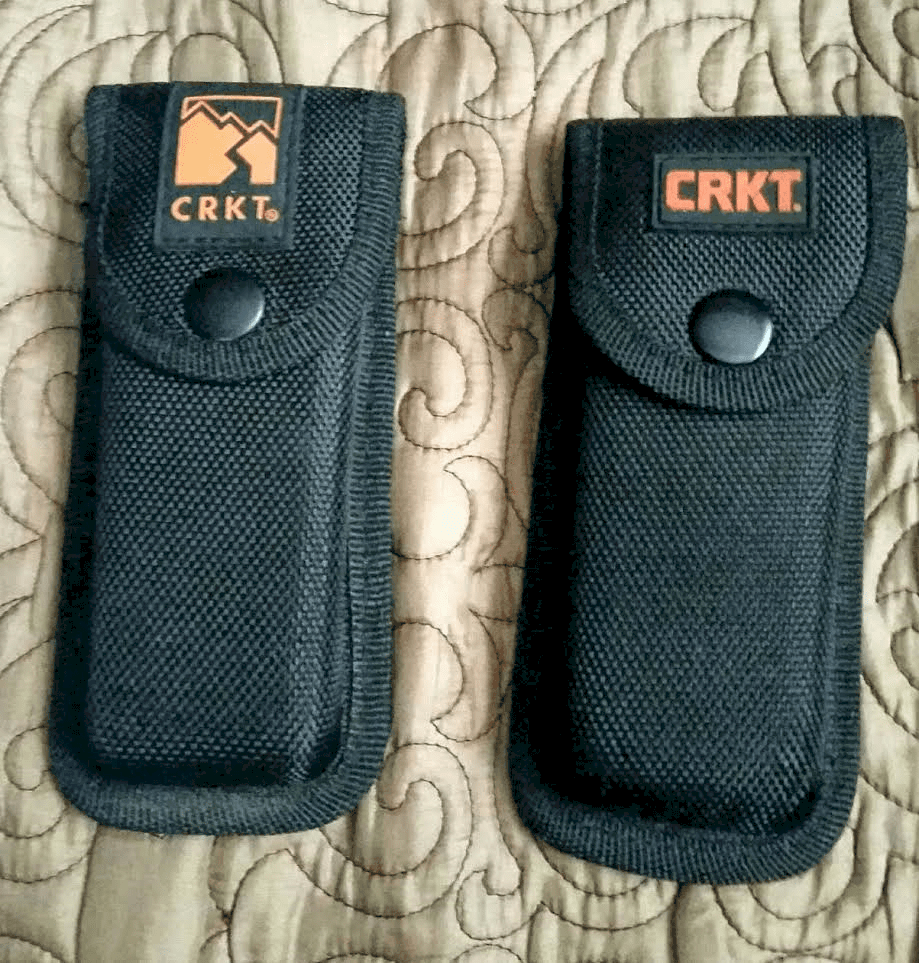
My versions of these are the Kommer Free Range Gut Hook folder and the Kommer Free Range Hunter, both blades are 3.75” in length, though the suggested length is 4” these have been used on big game by Kommer himself and several varieties of medium game by myself. The handles are a mixture of grippy double injection molded materials, one hard and the other where the palm of the hand and the fingers rest are softer and very grippy. These are designed for hunting, NOT every day carry or use, they do not have belt clips, and come in nicely molded nylon over hard plastic cases.

A quick list of pro’s for these knives follows.

  • A quick list of pro’s for these knives follows.
  • The steel is 8Cr13Mov, with an average hardness between 58-60.
  • They hold an edge very well, I have not seen one chip yet, however, given that bone is often apart of the cleaning process, I expect someday to see it happen.
  • They are moderately priced for such an amazing package, at $40-$50 apiece on Amazon.
  • After abusing one using the cold steel wack the back of the blade while it is locked in place method, I was unable to dislodge the locking mechanism, they are solid, three years of active use I have had the knives pictured, and there is NO blade play and I have not had to tighten anything.
  • They are relatively lightweight, at 3.5 to 4 ounces per knife.

Now for the con’s, and there are always con’s in honest reviews. If you can find them.

  • They are made of 8Cr13Mov steel, while a superb steel and one I own in many knife formations, I would have chosen VG10 or something similar because overall edge retention is paramount in hunting knives.
  • The sheaths close and open with an audible SNAP, if you are good with leather or Kydex I am sure you can find a way around this small issue.
    And last but not least, they are too expensive for me to own a dozen of each, like I do with my Opinels, Moraknivs, and a few other fun blades. So, for now, I only have the three, well two, my daughter has one!
  • As always, comments welcomed and responded to as possible. I have enjoyed writing reviews and being able to share with you all and hope to continue doing so for the discernible future. Be safe, prep wisely and remember, always, be willing to change your mental approach to what you know now.


Filed Under: Knives and Blades

Will Pacemakers Survive an EMP?

September 14, 2018 M.D. Creekmore

Pacemaker survive an EMPby Arthur T. Bradley, Ph.D.

A surgeon recently wrote to ask whether a modern pacemaker would survive an EMP. It would have been easy to provide a gut reaction and say, “No way!” After all, an EMP might generate fields on the order of 50 kV/m. But is that answer correct?

The surgeon went so far as to ask the pacemaker manufacturer (Medtronic) if they thought the device would survive. The company didn’t have an answer, but they did provide a set of known conditions that the pacemaker would survive (see Table 1). That information proved crucial to dialing in on what I hope is an educated answer.

Table 1: Medtronic provided max power levels vs distance

Field Strength (watts) Distance Required (feet)
< 3 0.5
3-15 1
15-30 2
30-50 3
50-125 6
250-500 10
500-1,000 20
1,000-2,000 30

From literature (IEC E1 HEMP Signal), we can assume that a 50 kV/m E1 pulse would generate a total energy of about 0.1 Joules per square meter. Converting that to watts requires assuming both a pulse width and an area. For this back of the napkin calculation, let’s assume a pulse width of 5 nanoseconds and that the pacemaker, including wires, measures 0.1 square meters. Neither are exactly right, but they’re close enough for this first-order estimate.

Converting the energy to watts is done by:

Equation emp

The Medtronic table obviously doesn’t go this high, but we can assume that power rolls off based on the inverse square law (i.e., 1/d2). In other words, for every doubling of distance, the power drops by 4. Therefore, if we assume that the pacemaker will survive 2,000 watts at a distance of 30 feet (per the Medtronic table), we can extrapolate safe ranges for higher power levels, as shown in Table 2.

Table 2: Extrapolated max power levels versus distance

Power (watts) Distance (feet)
2000 30
8000 60
32,000 120
128,000 240
512,000 480
2.05×10⁶ 960
8.19 x10⁶ 1,920
32.8 x10⁶ 3,840

This would suggest that Medtronic’s pacemaker could survive (without resetting) an EMP detonation that occurred at a distance greater than 960 feet. For simplicity, let’s round up and say that it would survive if the detonation occurred at >1/4 mile.

Given that a nuclear EMP will be most effective if it is detonated at least 25 miles in the atmosphere (above the Source Region) and will likely be at altitudes 10 times that height for greater coverage, it suggests that Medtronic’s pacemaker would easily remain operational.

The disclaimer, of course, is that all these calculations are back of the napkin. There are numerous sources of possible error, including the frequency content that Medtronic assumed when creating their table, the non-ideal roll off of power versus distance, the energy density of the E1 pulse, etc.

With all that said, the safe distances calculated are so much smaller than the actual detonation height (i.e., 1/4 mile vs 250 miles), I think it’s certainly reasonable to argue that such non-idealities won’t change the final conclusion.

In short, these calculations suggest that modern pacemakers, assuming that they perform similar to Medtronic’s, would have a very high likelihood of surviving a high-altitude nuclear EMP.

If you’re interested in learning more about EMPs and solar storms, kindly check out my book, “Disaster Preparedness for EMP Attacks and Solar Storms.” Exhaustive family preparedness information can also be found in my “Handbook to Practical Disaster Preparedness for the Family.” Finally, if you’re looking for an exciting post-apocalyptic saga, check out “The Survivalist (Frontier Justice)”.

Here are some of my favorite prepping gear

Thank you for investing your time in this article, and I sincerely hope it has provided valuable insights to strengthen your survival preparedness. As a survivalist, I make use of a variety of tools and gear, many of which have proven to be indispensable in my journey. Here, I’ve compiled a list of some of my favorite survival gear, which I believe you will find beneficial as well.

These are affiliate links, meaning if you decide to use any of them, I’ll earn a commission at no additional cost to you. However, I assure you that these recommendations come from personal experience – these are the exact tools I trust, use, and confidently recommend to everyone, including my own family.

  1. Long-Term Food Storage: ‘My Patriot Supply‘ is my top choice for emergency food supplies. Their selection caters to long-term storage needs, ensuring you’re always prepared.
  2. Water Filter: Clean, safe drinking water is a priority in any situation. This water filter has served me well, and I trust it will for you too.
  3. Versatile Cooking Solution: The Zoom Versa Cook Stove is a reliable, versatile cooking solution perfect for outdoor and survival scenarios.

I’ve compiled an extensive, frequently updated list of my top survival gear recommendations for your convenience. Equip yourself with the best and latest gear here.

Remember, true survival isn’t merely about making it through – it’s about effectively navigating and thriving in challenging circumstances. Equip yourself well, stay informed, and always be prepared.

Filed Under: Uncategorized

How To Collect Rainwater For Home Use

September 14, 2018 M.D. Creekmore

water-barrel-system-completedby Chuck H

Water has always been an afterthought for me and my prepping. It’s so easy for me to take it for granted when all I need to do is turn a faucet handle and fresh, clean water is made available. But what if the power goes down for a significant amount of time and eventually the water stations with it?

So I finally decided to store some water for just such an occasion. The most efficient way I could find to do this was by rain collection in rain barrels.  I tell the neighbors it’s for watering the garden and yes we use it for that as well. But if the SHTF I have 220 gallons of water available for my family to use.

That’s right, four 55-gallon, food-grade barrels collect rainwater. This was quite a process. I Googled it, YouTubed it, and overall did a lot of research. I combined what I thought to be the best way to do it for what I had available. The first step was to acquire the 55-gallon plastic barrels which I got from a local, large-scale food distributor.

You’d also be surprised who has these with just a simple Facebook request. You would also be wise beyond your years to purchase a bung wrench to unscrew the caps on these bad boys. It just makes life a lot easier.

fitting for barrel and rainwater catchment system

Anyhow, the barrels contained salted vodka (not any good…I tried). So I definitely needed to clean them out. It was a matter of putting some hot water and soap in them and screwing the cap back on. Then just have the kids roll it around the backyard a bunch of times, rinse, and repeat as necessary.

Once cleaned I chose to spray paint them a color similar to the siding on my house in the hopes it would blend in a little better than the bright blue plastic it was made of. After they were cleaned and painted I moved on to the deck I would build for the barrels.

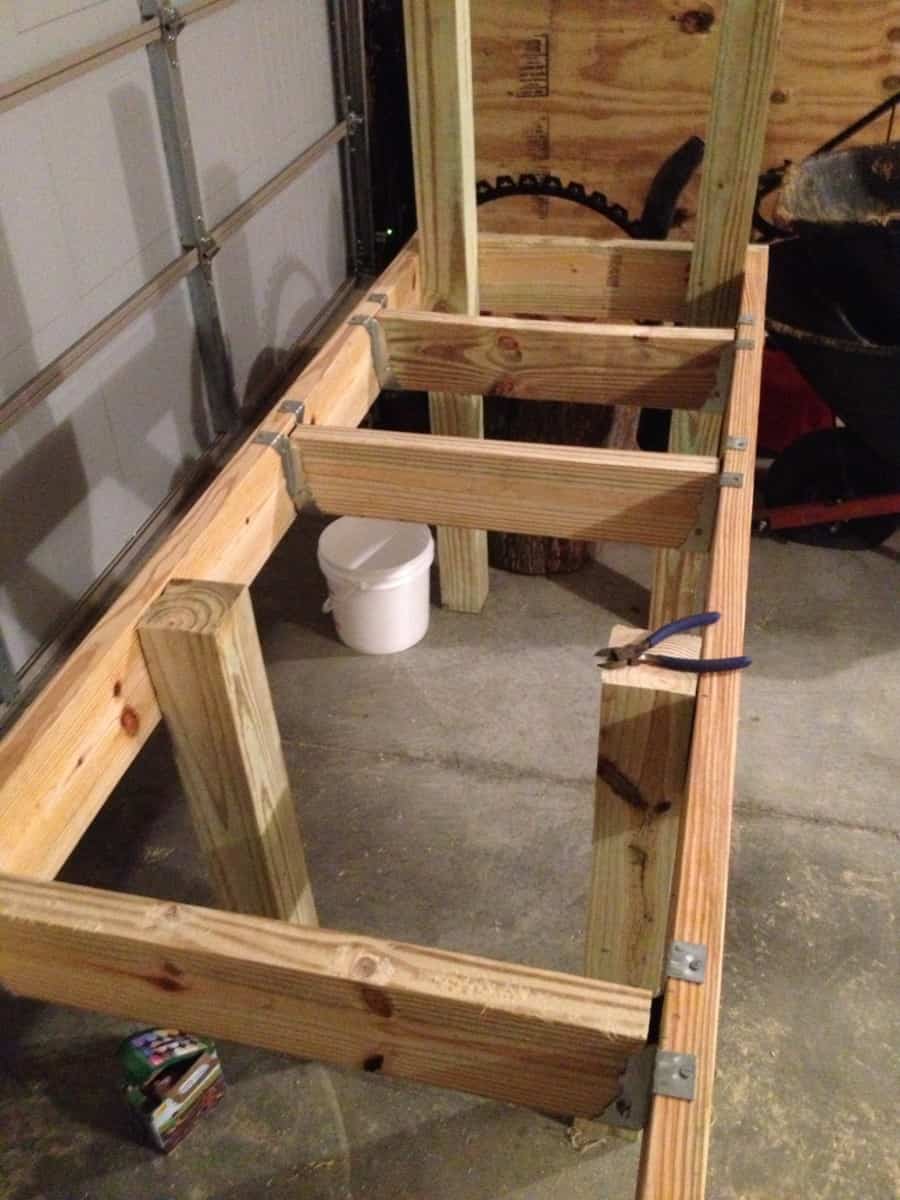
I read in my research that the higher up the barrels the greater the flow of water due to an amazing scientific discovery called…gravity. So my deck would end up being high enough off the ground for me to fit a watering can or 5-gallon bucket under the spigot (about 4′ off the ground). Using treated lumber I ended up with six 4×4 posts as the legs.

They were cut to the appropriate height. Next, I used treated 2x4s and framed out the legs as you see in the pictures.

I basically framed a wall around the legs like you might frame a wall in your house (header, footer, studs, etc.). Once the frame was fixed to the legs I put the deck on which consisted of a treated piece of plywood cut to the dimensions of the frame. This is what my barrels would sit on. Since my plumbing would be under the deck I also cut a hole for each barrel to be plumbed underneath.

Building a wooden frame for water-barrels

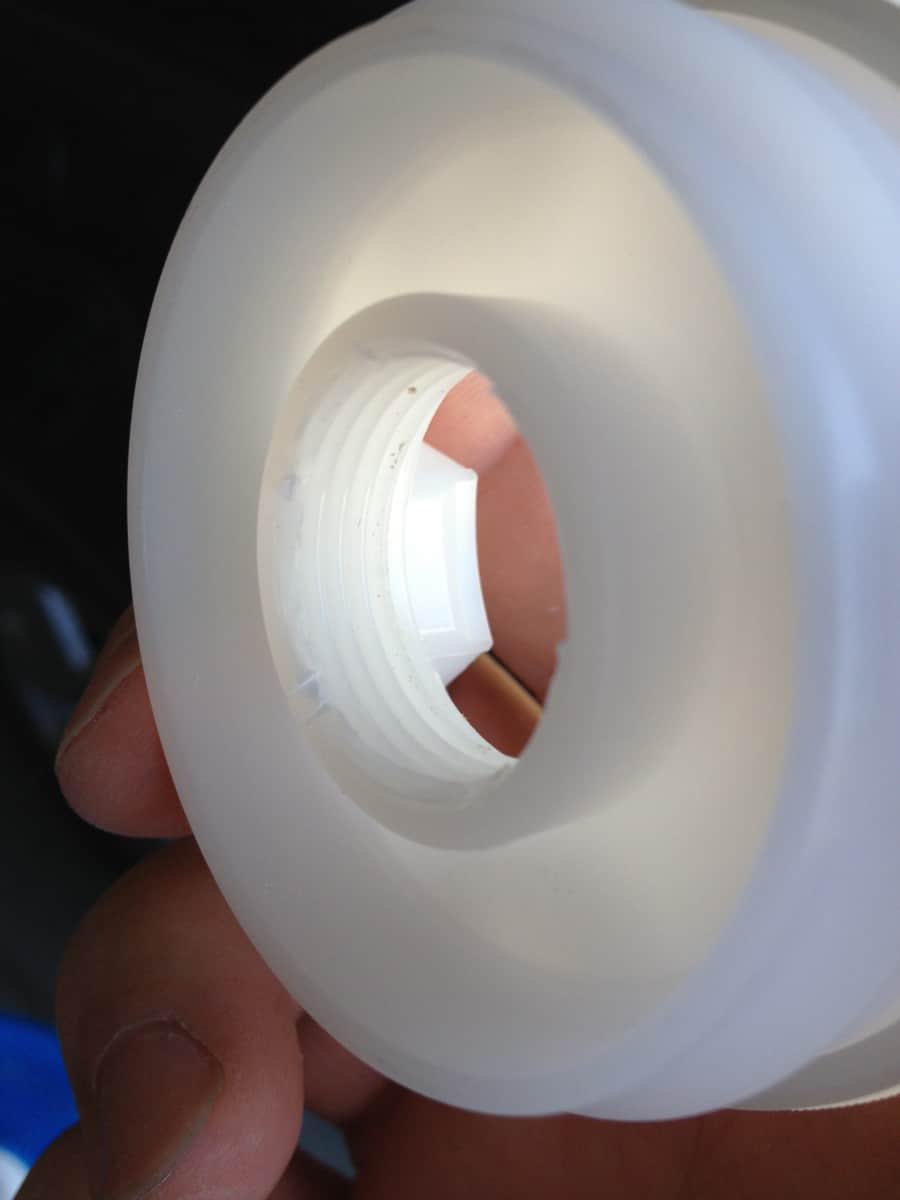
My deck was basically complete for now, so I turned my attention to the plumbing. Now I either got extremely lucky with these four barrels or all barrels are like this, but you’ll notice that one of the bungs is threaded in the middle. A threaded PVC adapter will fit this perfectly.

I planned to store rain in my barrels upside down. Since the hole would be at the bottom of the barrel I was all but assured every last drop of water from the barrels. Water will naturally self-level itself so by plumbing all of the barrels underneath the water would enter the first barrel (from the downspout) go to the bottom of the barrel and into the PVC pipes and then rise up into the other barrels.

That is how I planned to fill all of the barrels without extra holes in the top, just let water and gravity do the work for you. It is VERY important that you dry fit all pipes before permanently affixing them to the barrel and each other. So I set my barrels upside down on the deck and began measuring and cutting the PVC pipes.

I planned for a shutoff valve at each barrel and another at the spigot (5 total) in case anything needed replacing or isolation it would be easier to shut off the water from that barrel. Once everything was dry-fitted I used some clear, silicone caulking and applied it liberally to the two bungs in the bottom of the barrel.

This is where the bung wrench comes in handy to tighten the bungs completely. Next, I applied the same caulking to the PVC adapter that conveniently threaded inside the one bung. I tightened it all the way thus making a leak-proof seal on all my barrels. I waited to permanently affix the plumbing until everything was in place. So now I had to prepare my yard for the deck and barrels.

preparing the ground for rainwater catchment home use

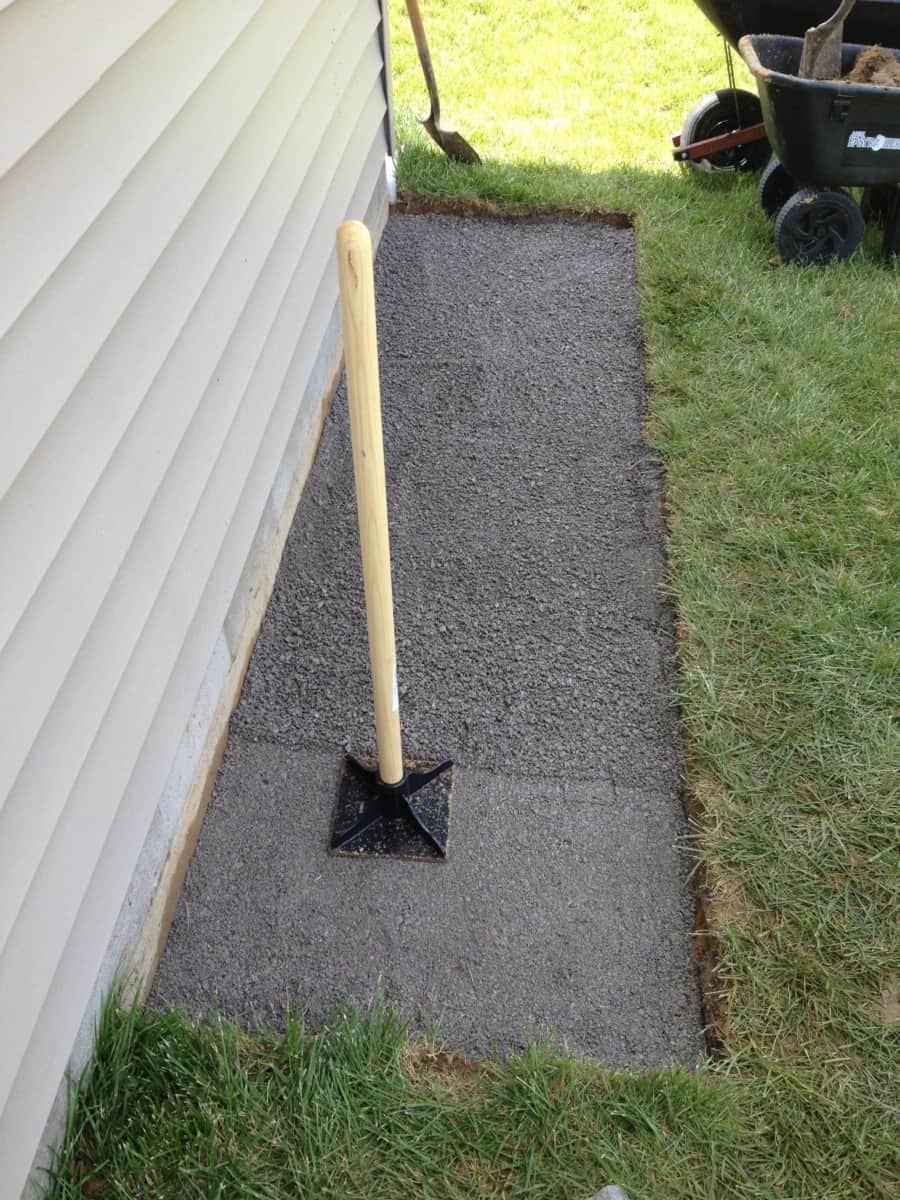
With the help of my wonderful wife, we dug up the sod in the backyard closest to the downspout we wanted to use. We dug a 32” x 115” section of the sod out, about 4” deep, and filled it with crushed rock. Here is where the hardest part of the project comes in.

Using an 8” x 8” tamper I tamped down all of the crushed rock making it about the density of cured concrete. Next, I placed six concrete piers on the crushed rock and, with the help of a friend, set the deck in the piers.
It was time to put the plumbing together permanently. I sanded the rough edges off the cut ends of the PVC pipe and applied the purple primer to the end of the pipe and inside the pipe, I would attach to.

I went a little farther up the pipe with the primer than what I would need so it would be a complete seal. After applying the primer I put PVC cement on the purple primer. Then you push the pipe in the adapter and twist a quarter turn. Hold this in place for 30 seconds and then test your work.

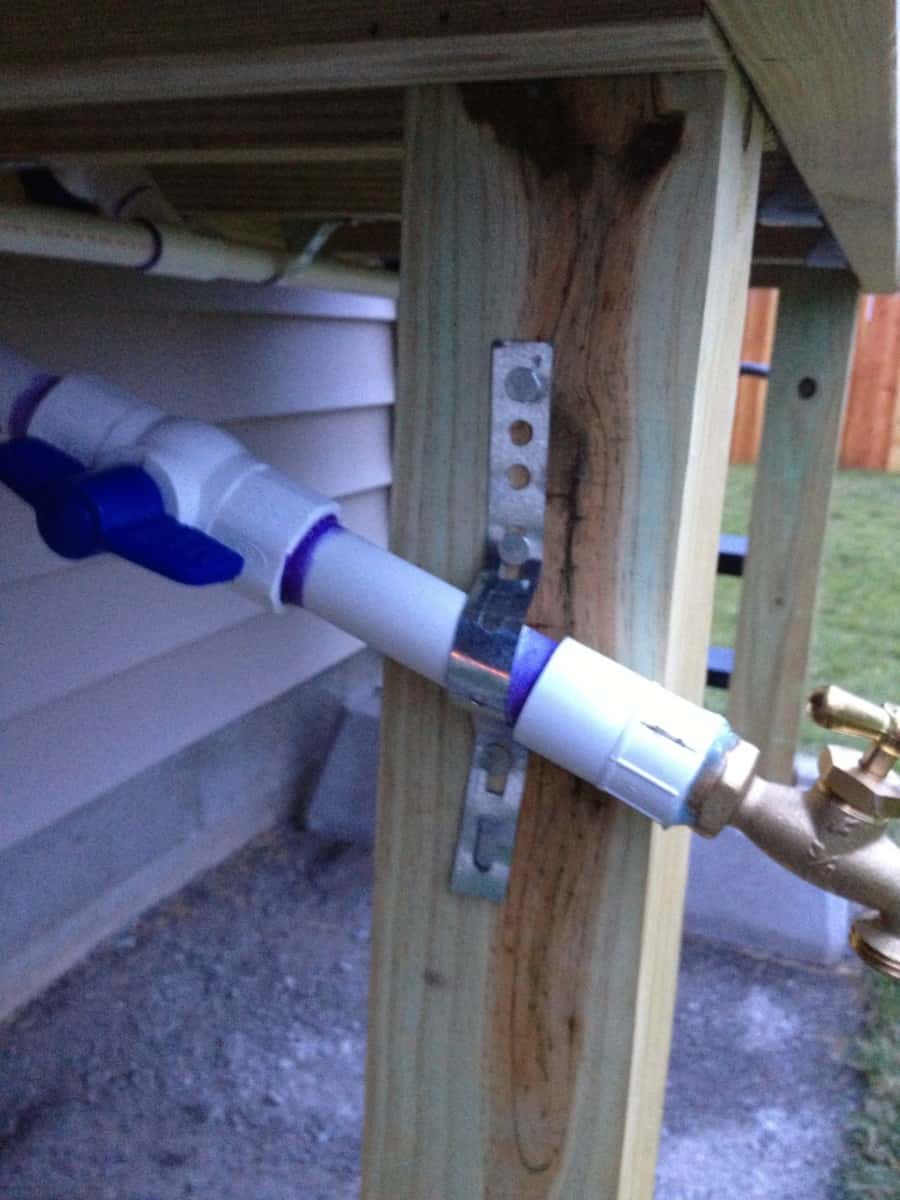
This “twist and hold” method is really important because you’ll notice the pipe wanting to push out of the adapter if not held in place. When done correctly it will be pretty solid. Once I plumbed everything together I used metal, nail-on straps to hold them in place (especially at the spigot). I also angled the spigot down a bit to make sure water wouldn’t sit in one place forever.

Now that the barrels were in place and the plumbing secured I built a small fence around the barrels. If you haven’t noticed by now I did a lot of overkill. The decking, the crushed rock, the concrete piers, etc. I wanted to make sure this much weight would hold (220 gallons of water weighs almost a ton!). So the fence keeps the barrels from blowing off the deck when empty.

At this point, I’m almost finished with the project. I used flexible downspout extenders to route the water from the downspout to the top of the far right barrel. Then another flexible downspout was used as an overflow.

finshing the platform for rainwater system

I put them in place and traced around the end where it met the barrel on one end and the downspout from the house on the other end. I cut the barrel and downspout and installed the flexible downspout to the top of the barrel and the downspout from the house.

Since mosquitos love standing water I placed a cut section of window screen around the opening in the barrel (sealed around the edges with the leak-proof caulking mentioned earlier) and around the end of the flexible downspout (attached with an adjustable ring used for dryer vents) to catch particles that washed off the roof. Now water will enter my barrels!

As I mentioned I did a lot of research before attempting this project. Part of that research mentioned drilling a small hole in the top of the barrels because of pressure that may build up in them would reduce the flow of water. I was skeptical about this but it didn’t hurt to drill a small hole in each and place more window screen over them. I sealed these with the same caulking.

The overflow spout is a necessary part of the project. If the barrels continued to fill past capacity then the plumbing could be damaged and that would be a nightmare. So at the very top of the same barrel the water entered, I measured and cut a hole to install another flexible downspout that would return to the original downspout from the house and flow away from the house.

This part was tricky because I wanted a watertight fit and not to have water spilling out of the hole down the barrel and all over the deck/ground. So I got a large diameter PVC adapter and put it in the hole I had cut. I made it watertight using a metal flange and some all-purpose bondo to seal it to the barrel.

Now the flexible downspout fits perfectly around the PVC adapter and overflows to the original downspout on the house and away from the house.

water catchment system for home useI failed to mention that I also have a small retention basin in my backyard. I drain the barrels before winter so they won’t turn into huge ice chunks. The plan is to use water from the retention basin during the winter if needed. While doing my research I read that rainwater off a roof is not potable.
So if the need arises we will be filtering and boiling any water used from the barrels (and retention basin for that matter). Also during the winter, I take the piece of the downspout from the house that I removed and put a couple adapters on each end, remove the flexible downspouts from the barrels, and place the original downspout back in place. This allows melting snow to flow through the downspout like it’s supposed to.

When spring rolls around I just switch back to my flexible downspouts and I’m refilling the barrels with May showers. It took about 2-3 days to finish the project, a little bit of sweat, and a lot of cuss words, but it was finished. What I like most about the rain barrels is the capability to have 220 gallons of water available to me at almost any time.

A body can survive longer without food than without water so knowing we have this stored away gives me peace of mind. In the meantime, my garden loves the water and occasionally my lawn does too. It’s tucked away behind my house and not many people know it’s there.

You could add some lattice fence-work around the deck frame to hide it even more if privacy is a concern for you.

Hopefully, you’ve learned a little bit about how to make a rain barrel system and its benefits. And that’s really what this blog is all about… learning new things to help us stay prepared.

Filed Under: Homesteading

Do It Yourself Off The Grid Solar Power System

September 14, 2018 M.D. Creekmore

EMERGENCY-SOLAR-POWER-SYSTEMby Robert B

Building an off-grid power source for your home or “Bug Out” location is not as difficult as you may think. Having power can drastically improve the quality of life during a long or short-term power outage. After losing all of our food during a three-day power outage after a severe storm, we learned quickly that taking the power grid for granted was not a good time.

Please keep in mind that we are not experts and there are always dangers when dealing with electricity.

The solar generator constructed at our home is basically the same as the generator constructed at our bug out location.

EMERGENCY-SOLAR-POWER-MADE-SIMPLE
HQST 100 Watt 12 Volt Monocrystalline Solar Panels

First, determine what it is you wish to power and determine how many watts you’re going to need. As an example, I use eight 100 Watt panels and five large RV batteries to run my full-sized Maytag refrigerator. My set up allows me to run the refrigerator throughout the night if I turn the ice maker off and settings down on the fridge and freezer sides. I turn them to setting “two.”

There are four major components to our 12-volt solar generator:

  • Solar Panels
  • Charge Controller
  • Battery Bank
  • Power Inverter

Solar Panels

Solar Panels generate power during daylight hours to charge your battery bank. I use eight 100 watt panels to provide up to 800 watts of power to my battery bank. Generally speaking, the power generated by the panels is less than the advertised or rated watt output meaning eight solar panels probably put out 10 percent less power than the full 800 watts as advertised.

While the panels do in fact still provide power on a cloudy day, they will not be quite as efficient as full sunlight.

The solar panels I used are found on Amazon for about $114.00 each seen above.

I have been impressed with them but keep in mind the technology improves almost daily so do your research and read reviews.

These panels are very easy to connect. The male and female connections are clearly marked (+) and (-) for positive and negative respectively. You will also need Y branch connection cables to connect more than one panel for your system. You will need a long set of cables run power to the controller.

I used a 100-foot cable with a male connection at one end and a female at the other end. Cut the cable in half and expose the wires. This will give you 50 feet of wire. Of course, depending on your situation, you may need a longer cable or shorter cable. The shorter the cable the better.

The longer the wire, the more electricity you will lose in the transmission of the power going inside to your charge controller.

Battery Bank / Power Inverter

battery-bank-for solar power set up and systemThe battery bank is the most important component of your system. Once the sun goes down, the battery bank will provide electricity throughout the night if built correctly. The trick to the battery bank lasting throughout the night is to obtain the correct ratio of solar panels to the number of your batteries in your battery bank. It’s equally crucial to have the correct number of batteries in your battery bank. Your battery bank should provide enough power storage to run your refrigerator overnight until the sun returns to fully charge your batteries during the day.
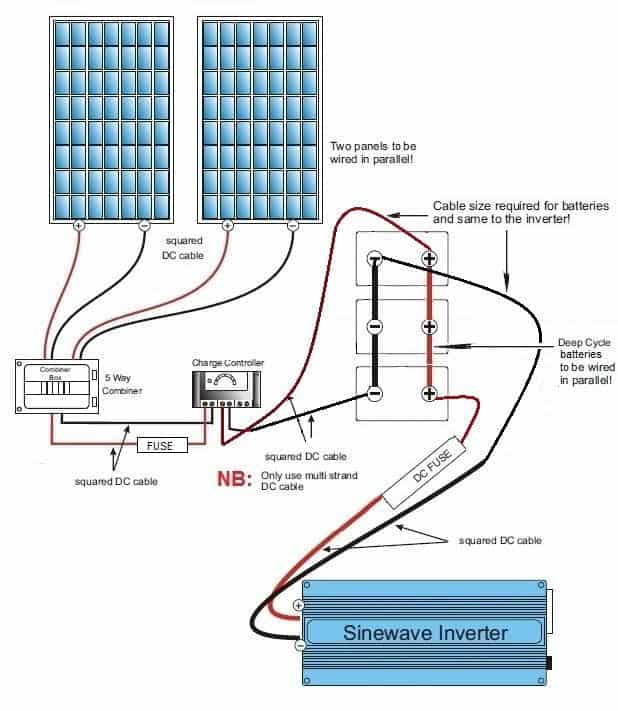
Building the battery bank is the most intimidating part for most people, but it’s really not that difficult. There is plenty of information on how to build a 12 volt, 24 volt, or 48-volt system, but I will be illustrating how to build a simple 12-volt system.

Types of Batteries

There are several different types of batteries on the market that will work with your system. These batteries range in price and efficiency, so it’s best to find the right balance between your budget and your power needs.

The batteries used in any solar or wind generator must be deep cycle type batteries. Regular car batteries are not made to charge and discharge like a deep cycle marine, RV, wheelchair, or golf cart batteries. Regular car batteries are not designed for this purpose.

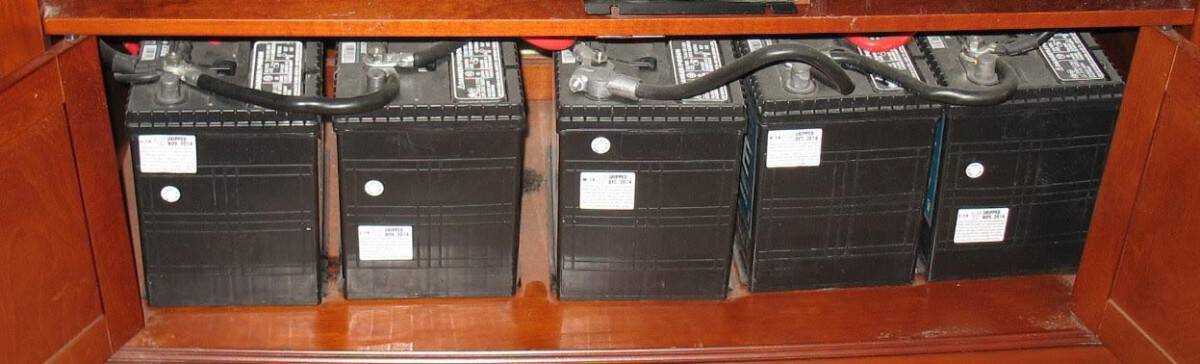
Lead Acid Batteries (Pictured above) – Lead Acid batteries are probably the most inexpensive but are not the most efficient. I am using five Lead Acid batteries for the battery at my home. While they do work just fine, when they start losing their efficiency, I will replace them with AGM batteries such as the batteries at my bug out location.

Vmaxtanks Vmaxslr125 AGM Deep Cycle 12v 125ah SLA rechargeable battery for use with Pv Solar Panels

Absorbent Glass Mat (AGM) batteries (Pictured above), in my experience so far, has been the most efficient. However, they do cost significantly more. While the AGM is still considered a Lead Acid battery, the construction of the battery is superior to a regular Lead Acid battery and tends to be more efficient. The Lead Acid RV batteries cost approximately $100 each while the AGM batteries cost approximately $250 per battery.

You will have to do your research and determine your budget for your batteries.

Wiring Your Battery Bank

First, you will need battery cables that will run from your charge controller to your battery bank. I recommend using two gauge battery cables or lower for this purpose and zero gauge cables (The largest cables available) to run from your battery bank to your power inverter,

I wired my battery bank in parallel meaning that the positive cable from the charge controller goes to the closest positive terminal on the first battery in your bank. The next cable runs from that first positive terminal to the next positive terminal on the next battery and so on.

The negative cable coming from the charge controller will run to the negative terminal on the LAST battery in your battery bank. The cables running from your battery bank to your power inverter will be connected just the opposite.

The positive cable from your battery bank will be connected to the positive terminal on the last battery in your bank and the negative cable will be connected to the negative terminal on the first battery in your battery bank (Closest to the charge controller).

The ground wiring will attach to the same negative battery terminal where the negative power inverter cable is attached. It’s best to run that cable to a grounding rod obviously outside your home.

wiring-your-battery-bank-photo

By wiring your battery bank together as described above, this will cause each battery in your bank to charge and discharge evenly and maximizing the efficiency and life of your battery bank.

Pictured above is my battery bank prior to adding a fifth battery and purchasing a cabinet to put them in.

If you place your battery bank inside an enclosed cabinet or container, make sure that the batteries get proper ventilation.

Note: Do not let your batteries fall below 11.9 volts as to keep them from discharging too much which could possibly damage them.

Power Inverter

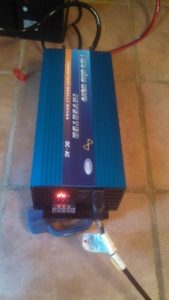
power-inverter for DIY solar system3000W Pure Sine Wave Power Inverter 6000W Peak 12VDC to 110VAC

When choosing your power inverter, I would recommend purchasing at least a 3000 Watt (6000-watt peak) Pure Sine Wave inverter. The pure sine wave inverters along with the MPPT charge controller will provide a much more stable current for running sensitive electronics and appliances.

Unfortunately, like the MPPT charge controller, the pure sine wave power inverters are more expensive, but again, you’ll thank yourself later.

Do your research and read reviews on all of the components. I haven’t had any trouble with the one I use at my home (pictured above).

Volt / Amp Meters and Fuses

There are all kinds of other things you can attach to your system such as meters and fuses. I have a simple voltmeter attached to my battery bank to make it easier to read the voltage of the battery bank. I simply disconnect the cables from the solar panels if there is a thunderstorm coming as to not take the chance on frying my entire system.

There are plenty of different types of systems out there from all-inclusive, to pieced together the way I built my system. I like my system because I can purchase the components a few at a time, and I can expand the system as needed very easily.

Plugging in your refrigerator

Once you’ve completed your system, watch your voltage either on your meter or on your charge controller if you have a meter built into the controller. During the charging phase, you will see your voltage reach upwards of 14.5 volts. This is normal and the voltage will level out around 13.5 volts during the day.

On your first attempt at this, you will be a bit nervous, so do it when your bank has a good charge coming in from the panels. I highly recommend doing this at least around noon or so after a few hours of sun.

Turn your ice maker off (ice trays work just fine) and turn the settings of your refrigerator and freezer down. I turn mine to about “two” and it still works just fine. Once the sun goes down and you’re totally running off the battery bank, limit opening and closing the freezer or refrigerator. This is where common sense comes in. During the day, with continuous power coming in, you can use it normally.

Before unplugging your refrigerator, wait for the current cycle of your fridge to complete itself so you’re not interrupting the cycle.

Next, unplug your fridge and using a low gauge extension cord (much thicker than your normal extension cords), plug your fridge into one end of the cord. I used a 25-foot cord that is professional grade. Common cheap thin extension cords are NOT good for this purpose as they do not transmit the power from your inverter as well. Spend the money on a good extension cord. Also, the closer your battery bank is to your fridge, the better.

Turn your power inverter on and check the voltage. The display on my home inverter tells me the available voltage of the battery bank, but the inverter at my bug out location displays the voltage of the battery bank and the optimal voltage to run a device.

Once your inverter is on and your voltage is up to speed, plug the extension cord into the inverter. This is where the magic happens. Even if your fridge is not currently running, you will see your voltage drop a bit. This is normal and if you have enough battery power, you’ll see it level out. Mine levels out around 12.5 volts. This will last several minutes.

When your fridge compressor comes on, you’ll see the voltage come back up. Not sure why and perhaps someone out there can explain why, but I’ve only seen this huge draw that one time after plugging the fridge into the inverter. After that, the compressor coming on barely drops the voltage at all. After that initial draw, even overnight, I only see the voltage drop approximately .2 volts mean if the voltage level of the battery bank is 13.5 volts, it only drops to 13.3 or so.

In the morning, my voltage usually reads around 12.6 volts dropping only to 12.4 volts during operation.

As long as your voltage doesn’t drop below 11.9 volts, you’re good to go.

Bio: Robert B has his own site called Keeping Up With The Preppers – however, it looks like the site hasn’t been updated in over a year.

Filed Under: Power Generation

  • « Go to Previous Page
  • Page 1
  • Interim pages omitted …
  • Page 68
  • Page 69
  • Page 70
  • Page 71
  • Page 72
  • Interim pages omitted …
  • Page 87
  • Go to Next Page »

Primary Sidebar

Subscribe to Blog via Email

Enter your email address to subscribe to this blog and receive notifications of new posts by email.

Join 7,202 other subscribers
  • Amazon
  • Facebook
  • Substack
  • Twitter
  • YouTube

“Do more with less.”

– Minimalist proverb

Recent Posts

  • Just so you know
  • Weather Update for My Corner of Appalachia
  • Why I’m Ordering Ivermectin + Mebendazole Every Year
  • The Website’s Shutting Down (But Here’s the Plan)
  • You Are Hated! Start Training Like It!

Footer

Recent Posts

  • Just so you know
  • Weather Update for My Corner of Appalachia
  • Why I’m Ordering Ivermectin + Mebendazole Every Year
  • The Website’s Shutting Down (But Here’s the Plan)
  • You Are Hated! Start Training Like It!

More about me

Books I’ve written

Books I’ve read

Follow Me on YouTube

Follow Me on Facebook

Gear I Use and Recommend

Newsletter

Search this site

Follow me elsewhere

  • Amazon
  • Facebook
  • Substack
  • Twitter
  • YouTube

© 2008–2025 M.D. Creekmore · As an Amazon Associate, I earn from qualifying purchases.