• Skip to main content
  • Skip to secondary navigation
  • Skip to primary sidebar
  • Skip to footer

M.D. CREEKMORE

  • Blog
  • Books
  • Newsletter
  • Gear I Use
  • About
  • Contact
  • Facebook
  • YouTube
  • Blog
  • Books
  • Newsletter
  • Gear I Use
  • About
  • Contact
  • Privacy Policy
You are here: Home / Archives for M.D. Creekmore

M.D. Creekmore

Hello, I’m M.D. Creekmore. I’ve been interested in self-reliance topics for over 25 years. I’m the author of four books that you can find at Amazon.com as well as Barnes and Noble. Over the years, I’ve learned a lot about prepping, homesteading, and self-reliance topics through first-hand experience and now I want to share what I’ve learned with you.

Why Are Compound Bows Better Than Traditional Bows?

October 10, 2018 M.D. Creekmore

Compound Bow vs Recurve Bow for Beginnersby Brandon Cox

If you’re in a survival situation or planning to live off the grid, you are probably interested in weapons. Specifically, what weapon should you take with you. Guns are a logical choice, but they’re hard to maintain over long periods of time because they require ammunition.

Once you run out of ammo, the gun will be useless. A better choice for survivalists is a bow. But, there are choices there as well. Here, we will compare a compound vs. recurve bow, which one is best for survival?

What’s the Difference between a Compound or Recurve Bow?

Many people have an opinion about which is better but don’t have any evidence to back it up. To help you make the best choice for you, we’ll go over the differences between a compound bow and recurve bow. Bows have some similarities. Both a recurve and a compound bow use leverage as a mechanical advantage.

Also, these weapons depend on stored energy to cast an arrow fast and far. In both situations, the arrow will travel much further than a person could throw it.

Recurve bows store energy as it is drawn. As more energy stores, it gets harder to pull the string. Compound bows are different because they use their mechanical advantage through cables and cams. Cables and cams let off some of the weight used to draw the string back.

A compound bow will through an arrow farther than a traditional bow. The differences between compound bows and traditional models like a recurve have several other differences including price, accuracy, weight, power, and speed.

Price Differences Between Recurve and Compound Bows

Just looking at a recurve and compound bow, you can tell there is a price difference. A top of the line recurve bow can cost as much as $1500. However, most traditional archers can get a great model for around $200. Any archer interested in a compound bow should expect to pay around $250 for an entry-level model.

But, most compound bows fall in the $500 to $600 range after they are all set-up. If you are trying to decide what type of bow would be ideal for a survival situation, the prices for each model are similar.

Which is more Accurate Compound or Recurve?

When set up right a compound bow is extremely accurate. A peep, release, and other shooting accessories help make an average archer a great shooter. With the help of cams and other mechanisms, a recurve bow is harder to draw and increases the possibility of the shooter shaking or quivering.

The movements can make shooting less accurate because of poor alignment. If you take an average shooter and give them both choices, they will likely be much more accurate with a compound bow. Since accuracy can be the difference between eating or starving in a survival situation, a compound bow makes a better choice.

Recurve Bows are Much Lighter than Compound Models

Another consideration to make for a survivalist is whether weight makes a difference. If you are going to carry your bow with you always, it might. A compound bow can be heavy. In comparison, a recurve bow is extremely light.

In fact, a recurve bow could weigh just a fraction of a compound bow. Even compound bows made of super light material weigh more than a rifle, which still makes it pretty heavy. If you have a ton of ground to cover, will be climbing, or running, a recurve bow is a better choice because it won’t slow you down.

Not convinced? Think about this as well. A bow isn’t the only thing you’ll be hauling on a daily or regular basis. Likely, you’ll also have a canteen, hunting light, knives, and much more. With so much to carry, it doesn’t make sense to weigh yourself down with a heavy weapon too.

Compound Bow vs Recurve Bow for Beginners
Ready for the hunt…

A Compound Bow has More Speed and Power than a Recurve Bow

We talked about it earlier, but it’s worth going over again. Not only is a compound bow more accurate than a recurve, but it also tosses arrows faster and further. Compound bows can do this because of their mechanical advantage. For even better results, archers can use a heavy arrow, which will go far fast and penetrate deep.

Does Shoot Ability Matter?

Now, it’s time to talk about shoot ability. It’s a controversial topic and those that favor either the traditional or compound bow may never agree completely. However, there are still a few topics to highlight for consideration.

When shooters aim and fire a recurve bow there it’s silky smooth. There’s no jerks or unexpected hand movements. For this reason, recurves are often considered more shooter friendly. But, it’s important to consider whether losing some accuracy is better than a smooth shot. Other factors to consider include noise.

Compound bows are noisier than a traditional bow. Some older bow models make sounds like rifles being shot when the string is released. There’s also a ton more hand vibrations when shooting, which makes it difficult to repeat repeatedly.

The Perfect Bow for Bushcraft and Survival

When it comes to survival situations, the best bow choice may be one that is made of raw materials. Arrows and fletchings can be made with natural materials. Broadheads can also be made or be made of stone. If you have a traditional compound bow and run out of arrows, it’s not easy to make arrows for this type of bow.

A wooden arrow in a compound bow could cause the arrow to explode and become dangerous. With all things considered, a traditional bow is a better choice for survival situations because the resources used to create are readily available in nature.

In conclusion, the best choice for survival situations are whatever you feel most comfortable using. If you are comfortable shooting a compound bow before you found yourself in a survival situation, you’ll still be most comfortable with that choice afterward. The same goes for a traditional recurve bow.

Both weapons have relatively the same costs associated with them. As far as accuracy goes, the best compound bow has some advantages. But, in terms of weight and the ability to move while carrying the weapon, a traditional bow has the compound bow beat.

What this means is that it’s really a personal choice as to what type of weapon you want to use in a survival situation. But, because of sustainability and the ability to reproduce arrows and even the entire bow if possible, we recommend relying on a recurve bow first with compound bows as a close second.

Filed Under: Archery

How to Make Your Rural Home Safe From Intruders

October 9, 2018 M.D. Creekmore

by Patrick F

Alarms are usually one of two types, audio, or visual, although some can be a combination of the two. Alarms are also a great resource if used effectively and acted upon when triggered. They allow an extra layer of protection/defense especially if one is short of personnel. Placed effectively alarms can enable a single person to monitor a much larger area than would normally be possible.

While there are many types of alarms and alarm systems available, many are expensive and often require a power source to run and operate. Some systems can even be custom designed and built for an individual’s specific situation and needs.

If you have the resources to obtain one of these systems that’s great. I, however, do not. So I have found and/or made other less expensive, yet still reliable setups. Now please don’t assume these less expensive or homemade setups are useless.

I have personally used these on my own property as well as using them in paintball and other more specific simulations, and I assure you they are reliable and effective.

So with that in mind let’s start off with some inexpensive alarms that can be easily purchased and then I will detail some homemade alarm systems. With both, I will begin with systems that can be used at a distance and then we can move to a shorter range setup. Also, I am going to make the assumption that you will be in a position to observe or hear the alarms when they are tripped.

One unit I particularly like is the wireless driveway alarm manufactured by Bunker Hill as well as others. These units run on batteries and usually cost around twenty dollars or less. The sensor unit takes a nine volt while the receiver unit takes three C Batteries.

The range for this unit is listed at 400 ft. with both of the units being weatherproof. The range is variable depending upon terrain although I have used these units at several hundred feet both insight and out of the line of sight.

Besides the advantages of the unit being wireless and weatherproof, they also work well at night and during the day. Also since the sensor and receiver are two separate units, anyone tripping or activating the sensor does not know that they have d0one so as the signal is sent to the receiver.

Although the sensor unit usually comes in white it can easily be spray painted to allow for better concealment. Although this next piece of advice is most likely unnecessary I add it just in case. When painting be sure to tape over the motion sensor before painting so that you don’t block the functionality of the sensor, and of course also remember to remove the tape afterward to let the unit function properly.

Additionally the box set, of one sensor unit and one receiver, function together on one channel which is often listed on the box and/or the units themselves. The advantage of this is that one is able to buy a different unit with different channels for use in covering separate approach routes.

For example, one unit (on channel 9) could be located on the driveway while another unit on another channel (on channel 17) could be placed on a walkway or trail. Depending on which alarm sounds, you would know which approach route the intruder was taking.

Another advantage I have often found useful is that the sensor unit is set off every time someone passes it. This allows anyone with the receiver unit to count how many intruders are approaching by that route.

I have only two drawbacks that I have experienced with these units. The first is when the receiver is first turned on it beeps to inform you that is on and active. This is normal and only happens when the unit is first turned on. So be sure to set up these units and have them on in advance of any needed situation.

The second is that one needs to understand that the sensor will pick up anything that passes within its range. This can be animals as well as humans depending on sensor placement.
On the positive side, these units are compact and can easily be deployed quickly as needed in almost any location or situation.

I have often used them when camping for a reliable early warning system. Also, I have had the units at my home run continually for a minimum of six months straight before a battery change was needed.

Another type of alarm that I have purchased and use regularly is the battery operated outdoor wireless motion sensor light. There are several companies that manufacture these although I have only used Mr. Beams brand. These units are almost all strictly visual alarms in which the light comes on when anything gets within range and triggers the motion sensor.

By being battery operated (usually three C Batteries) they can be placed anywhere, and the light they put out can be seen from a good distance away. Most also have a time setting for how long the light remains on usually as short as 30 seconds up to 10 minutes.

Some of the disadvantages of these units will be obvious. Such as requiring batteries, although how often they need replacing is dependent on often they are tripped and how long the light stays on. Another is although they light up once tripped allowing you to be alerted and possibly to also see the intruder, anyone who activated it will also know.

Finally, since it is a light that activates, the unit’s effectiveness is seriously reduced during daylight hours. Along with that is the fact that most of these units have a sensor that keeps them from operating during the day when the sun is out. Yet even with these disadvantages, I have found these units to be effective if properly placed.

Another type of alarm that I have purchased involves some type of motion sensor located in garden statuary. These could be visual in that they light up or audible in that they make various noises. They come in various styles and types; from flowers to animals. I have even seen some that were made to look like fake rocks. One of my favorites was a frog that croaked when someone passed within sensor range. Some, like said, were made to function during the day or at night, so if you’re considering purchasing one of these try to get one that will work during the day as well as at night.

Some advantages to these are that some are solar powered, so they need little maintenance and are almost always ready. Another is that they can be placed in more open locations, even inside homes, requiring little concealment. This is advantageous in the event that an intruder activates the unit it doesn’t necessarily mean that they are aware of its significance as an alarm.

The major disadvantage is that they need to be placed somewhat close for an observer to see or hear them clearly. Although some, like my frog croak, can be heard at a distance it is still closer than one would like, especially if one is hoping to be alerted in advance.

Wireless widow alarms are yet another inexpensive system available for purchase at most hardware or retail stores. While specifically designed for use on windows, with a little imagination they can be adapted for other locations. Constructed of two pieces, they are designed to alarm when the pieces are separated, like when a window is opened. Knowing this, with a little imagination, you can easily adapt the unit for use in other locations. Although small they do emit a loud alarm.

The major disadvantage of these small units is that once activated, or separated, the unit will continue to sound until manually turned off or the pieces placed together again. This, of course, requires that someone to physically do this task. Not the ideal situation if you are still dealing with intruders.

The other type of widow alarm operates by “hearing” glass break and emitting an alarm. I feel that this is a major drawback for two reasons: one most people would hear any glass breaking and two if an intruder is breaking the glass they are already breaking in. These are the major manufactured units that I have purchased and used effectively as early warning and alarm systems.

Now let me talk about some effective and often inexpensive homemade systems, again first discussing alarms that will work or be heard/seen at a distance and then moving closer. Once again I am going to make the assumption that you will be in a position to observe or hear the alarms when they are tripped.

Please note that the following alarms I will describe to you are single-use systems unlike most of the purchased alarms discussed above. This means that they will alarm once and then they need to be reset manually to be used again. Although this may seem a drawback at first, if they successfully alert you in advance of danger or intruders then they have fulfilled their purpose.

Also, most of these systems, when set off, will alert the intruder to the fact that they have set off some type of alarm or early warning system.

Let’s start with Rat Traps. Yes, you read that right Rat Traps.

With a little modification rat traps can be effectively used as an alarm system in a variety of ways. I must warn you though when using rat traps they are very sensitive as well as somewhat dangerous as they have the strength to easily break a finger or two. So use extra caution when setting. As a safety suggestion, attach the trip line to the trap trigger prior to arming the trap.

When using and setting rat traps I prefer to use thread as the trip or trigger line, rather than wire or fish line. Wire I find is too stiff, while fishing line is often hard to work with, especially when tying knots.

Thread is easy to use and easily strong enough to act as the trip line. If you feel you need to use something stronger you can also use upholstery thread. The thread has the advantage of being hard to see, or find before and after the trap has tripped, especially at night.

If you don’t believe that thread is strong enough to act as a trip line to trigger a Rat Trap, try it for yourself. I assure you that it doesn’t take much to trigger a Rat Trap. Also while you’re at it, set one and then trip it with a stick or something similar. You will see (hear) that when the trap goes off it is sufficiently loud enough to hear and distinctive, even at some distance, and especially on a quiet night.

There are many ways to set/secure the rat trap, limited only by your imagination. One of the best I have found is to attach the rat trap to a stick, or tent stake. Then you can stick the trap in the ground, which helps keep it secure while you run the trip/trigger line across the designated trail/path.

For use as a visual alarm, try attaching a light stick better known as a glow stick, to the trap. When triggered the rat trap is strong enough to break the internal capsule and activate the light stick. As an added benefit there are many types of light sticks in many different colors and sizes. Separate colors can be used to mark distances from the triggered traps to one’s position.

Also available are Infrared glow sticks, which cannot be seen by the naked eye but can be seen with Infrared or Night Vision devices. My personal favorite is the Ultra High Intensity orange five-minute glow stick. These are visible at a good distance and effectively light up a good area around the trap revealing any intruders.

Another easy to use alarm system makes use of pull string fireworks or pull string poppers. These are also sold under the name pull string perimeter alarms. They are relatively cheap and come twelve poppers to a box. Basically, these are small firecrackers but are not under restricted shipping, so they can be purchased and shipped by mail.

How these poppers work is when the string, which comes out of both ends, is pulled it creates friction inside the popper which sets off the small amount of gunpowder inside the popper itself. To use these effectively one will need to attach a longer string or better yet thread to the popper as the original strings are too short for most uses.

The best way to use these is to attach the thread to the string on one end and anchor this end to a secure location.

Then with thread attached to the other end string, run this as a trip line across the trail and secure it to an anchor. When setting these, the tighter or tenser the trip line/string is the better, although they will still work if somewhat slack, just not as well. They are set off when an intruder walks through the trip line pulling on the popper’s string and setting it off.

For added security, I would often place two or more of these popper alarms close to one another on the same trail. This is because due to the uncontrolled manufacture of the poppers they sometimes fail to go off or pop. By placing several on the same trail one increases the odds of the poppers working as designed.

Another nice place to locate these popper alarms is on a door. Simply attach one end of the popper to the doorknob and the other end to the doorframe. When someone opens the door the popper will go off alerting you.

The major drawback of these string poppers is that they are only made from cardboard and paper and so are easily affected by the weather. Wrapping the popper with a small amount of dark duct tape helps keep them somewhat dry. However be careful not to accidentally duct tape the strings, as this will render the popper useless. Also, the original strings that are attached to the poppers are white and will need a little camouflage help.

Now let’s discuss using trash as an alarm system. Yep, that’s right trash or more specifically empty soda, beer and/ or other aluminum cans. Don’t discount this system because of its simplicity. Empty cans, filled with small rocks or pebbles were often used and are sometimes still used in combat situations attached to concertina wire in defense situations. Enemy personnel would often end up rattling the cans as they tried to get through the wire, thereby alerting the defenders.

So the simplest system is placing some small rocks or pebbles inside the empty can, attaching thread to the pull tab. Secure the end of the trip line thread and then place the can on the other side of the trail. Preferably on something raised up, so that when the intruder hits the line the can will fall and rattle.

The can will still rattle if on the ground, but I find it better if on some type of raised surface. Placing the can in a small tree or bush with the line running down diagonally across the rail also works.

A great advantage to this “can” alarm system is that the intruder may assume they have accidentally kicked a can rather than tripping some type of alarm. Experiment in advance and see what works best for your specific application and terrain.

A nice one that I learned from some good friends is to connect two cans with thread and then hang them from tree branches. One can on one side of the trail and the other on the opposite side of the trail. This can be placed at any height with the trip line across the trail. When an intruder walks into the line the cans will rattle.

Read this article for details on how to set a tin can trail alarm…

Finally, one of my favorites which may seem silly but it has always worked for me when placed properly is the use of a whoopee cushion as an alarm. A dark-colored whoopee cushion works best, but the lighter colored ones can easily be spray painted.

Placement is the most important part of this alarm because in order to operate effectively the whoopee cushion needs to be on a hard surface or hard ground. Also, you need to study the area and determine approximately where someone walking along would put their foot.

If you’re inventive you can alter the terrain in a way to make someone place their foot where you want them to. This is where you would place the whoopee cushion and cover it with some debris. Then when stepped on the cushion will expel its contained air and alarm you to someone coming. I can assure you that the sound from this alarm is sufficiently loud as well as being distinctive.

Well, that’s it for now; there are some easily affordable alarm/early warning systems for you to experiment with if interested. If you can afford and maintain better systems please feel free to do so. I just wanted to offer everyone some alternative systems.

As with any alarm system redundancy often adds an extra layer of protection. I would recommend using several different types of alarms with backups to be sure that you have enough warning in advance, in the event one system fails.

Also, understand that if an intruder manages to detect or trip one alarm then they will be wary of the possibility of others in the area. This could be either good or bad depending on your intent.

Experiment and play with these alarms now while you have the time before they are needed. If you come up with more ideas on some inexpensive and easy alarms or early warning devices please write them up and send them in for all of us to try and have in our toolbox.

Filed Under: Security

How Much Food Should a Prepper Have?

October 8, 2018 M.D. Creekmore

How Much Food Should a Prepper Have?by SW

A prepper should have at least a three month supply of food in storage at all times. Keep in mind that a three-month food supply is a bare minimum, with a years supply or more being ideal. When striving for a years supply it’s best to build your food supply in smaller increments of one month at a time to avoid making mistakes and feeling overwhelmed.  

Here’s the deal

We all come to this journey our own way. For me, I started in gardening, then moved into homesteading, and on one of the homesteading sites, I got introduced into prepping. I will be the first to tell you that I’m not a prepper. I consider myself more of a homesteader with prepper tendencies. As such…, this article will probably reflect some of those thought processes.

When I started down this road I kept looking for blog posts or videos that would tell me I need to store XXX number of whatever item. No matter how hard I looked I could never find what I was actually looking for. Then it finally dawned on me. I’m looking for the answer in the wrong place and the wrong form.

If you have spent (or will spend) anytime on prepper/survivalist type websites you will see a phrase that comes up time and time again and that’s to store what you eat, and eat what you store!

I don’t know who coined the phrase but it is exactly true. Let’s, however, take it to the next level. Not only should you only store what you eat – but you should also only store what you use.

Don’t buy something just because it’s on sale… especially if you know you will never use it. Most things have to be rotated to maintain their freshness, or usefulness (like batteries). If you’re not using it, then it’s kinda hard to rotate it.

I could tell you that you need to store 600 pounds of rice, but I wouldn’t be doing you any good in saying that. So instead I’d like to use this article to help you figure out what you need to store and how much for your situation. Maybe you don’t like rice… so storing 600 pounds would be a waste.

What’s the bottom line?

I will say this… this article is not going to be the magic bullet all by itself. You will have to put in the work but I can promise you, it will be time well spent for your future peace of mind. I am also going to use this article to teach you how to figure out what you need for a years supply.

Let’s go back to the 600 pounds of rice. Do you like rice? Do you know how much rice you normally eat? Do you know how much rice it takes to make a serving? To further this rice discussion I’ll use myself and what I have found that works for me.

I have decided that for me a serving is a ¾ cup of rice and I can fit 5 servings inside a quart mason jar. There are about 2 1/2 cups of rice in a one pound bag. That would give me around 3.33 servings per 1 pound bag. Now.. I have a baseline to work from.

Let’s assume that if and/or when the SHTF you don’t really want to upset your culinary applecart. You want to hopefully have that aspect of your life somewhat intact. Currently, you eat rice three times a week. With that in mind, you’d need three servings a week (or one pound of rice). To continue that menu for a full year, you’d need 52 pounds of rice put back.

Granted.. this will give you a little extra because you can actually get 3.33 servings out of a pound of rice. Now that 52 pounds are just for one person. If you have a family of 4 then you’d need to store 208 pounds of rice to maintain your three meals a week routine.

I’d also be willing to wager that you don’t particularly like just plain rice. Me personally… I like to dress mine up with either chicken, beef, or ham. So with that in mind… I’d need 52-pint jars of each of those to go with my rice for the meal.

A pint jar can hold about a pound of meat. I can say this… with ¾ cup of rice and a pound of chicken, you could actually feed two people… they won’t be busting at the seams full, but they won’t be hungry anymore.

My best advice would be to make the meal and see how you and your family do on that ration. What about spices and salt? You need to figure out what you like and then how much you use per recipe.

Using the 3 meals of rice per week, we have figured out that we need 52 pounds of rice, 52 jars of chicken, 52 jars of beef, and 52 jars of ham. This will feed 1-2 people each day for that meal. What are you going to eat the other 4 days of the week, or the other meal or two in the day?

Look

What I am trying to show you is how to figure out what you need to store by making a menu of what you like to eat and that is easily stored. When I say easily stored, I don’t mean just rice and beans. There is very little that can’t be canned or dehydrated for easy storage.

Have you thought about canning up your own meals? It could either be a dehydrated meal in a jar, or something fresh like chili, soup, or something else. Just think… If there are only a couple of people you’re trying to feed, a quart jar of chili would fit the bill for a meal. If you’re doing chili one day a week, then 52 quarts of chili would last you a year.

The key is to figure out a menu that you can live with, and then figure out what it will take to create that menu for a year (or whatever time frame you decide on). Now that you have a menu, you have your goals for what you need to store, and you can work towards those goals. There is nothing that says you have to eat rice and beans the whole time.

Maybe you want to mix it up and have a two-week revolving menu. Basically, have something different every day for two weeks then start over again. The choice is yours and is up to you and your family on what you like to eat.

One of the websites I visited took the revolving menu to a new level. Instead of just staying with those 14 meals they had theirs set up for a 10 or 12 meal menu. Once or twice a week they had an open day to try new recipes. Sometimes it was completely new, and sometimes it was utilizing their stockpiles in a new way to create something different.

Those extra days will give you a chance to experiment and not become bored with the menu. If you trying new things with your stockpiles then you’re never really off course. That extra day also added some spice to the weekly meals.

Maybe in a SHTF scenario, you can’t have lamb chops or whatever else you really like, but why not indulge in them while you can.

As I mentioned above… another reason for creating a menu is to see what you need to have in your food preps. How many meals use salt? Do you know how much salt it will take to create just one meal for a year? What about using salt after the meal is cooked?

By having your recipes printed out and placed in a binder, not only will you be helping yourself, but you’ll be helping others that may be going thru the situation with you. With those recipes printed out (even if it’s something you came up with in your head) you will be able to sit down and calculate just how much of a single ingredient you need to prepare that meal for a year, or whatever time frame you’re shooting for.

It would also help someone else prepare the meal if you happen to be injured or engaged in another task when it came time to cook the meal. With the recipe printed out then no matter who cooks it, it will come out somewhat the same (providing they don’t burn it). This will most likely help with the overall morale of the folks in your group. It will be one less thing that changes when everything else around them is going to crap.

Now you can see why I stated at the beginning of the article that “this article is not going to be the magic bullet all by itself … you will have to put in the work but I can promise you it will be time well spent for your future peace of mind.” Hopefully, this will give you some idea on how to figure out what you need to store for your food preps. Each and everyone is different. What I store you may not like and vice versa.

It gets better

Let’s move from food to other home goods that we use. When I started doing this.. it was an eye-opener to me.

Do you actually know how long your bar of soap lasts? What about that stick of deodorant? How about that tube of toothpaste? Or that roll of toilet paper? Have you thought about how long it takes your cat or dog to go thru a bag of food? What about kitty litter, or flea collars?

All of these things will dictate how much you need to store. When I started trying to store extra of the things mentioned above I used a baseline of one item per month (not including the TP). Then I actually started tracking my usage and found some things that were off. Some for the good… some for the bad.

Here are some of the things that I found when I started tracking my usage. Of course, this is just a baseline for you because your mileage may vary.

Let’s start with our loveable pets first. I had figured I could manage a month on a 50-pound bag of food. I was wrong! I actually went thru that bag in about 25 days. That info is nice to have because now I know I don’t have as much stored up as I thought. As for my kitty… she’s still going strong on a 6.3-pound bag of food. It’s been a month and nine days and she might have about a week’s worth left. So I can figure about a month and a half on her food.

As for a bar of soap… that all depends on the variety of soap you use. I have found that a bar of Dove lasts longer than Irish Spring or Lever 2000. I can get around a month and a half out of a bar of Dove and IMO is a better soap than the other two.

My remaining Irish Spring & Lever 2000 will be set aside for barter if the need arises. I’ll fill up my stores with Dove. Keep in mind, if you have more than one person using that bar you’ll have to divide the time down according to the number of folks using it, or you could take the easy way out and say a bar of Dove per person per month.

Just like the soap… the size of your deodorant plays a factor in how long it will last. When I initially started, I made the assumption that a stick would last a month. Well… I was right, and I was wrong. If I am using the 2.7 oz stick of Degree I can make it just barely over a month. However, if I am using a 2.6 oz stick of Sure…

I am a little under a month. This just goes to show you that you really need to figure out how long whatever you use lasts. If I would have stayed with the assumption that 12 sticks of Sure would have lasted me a year then at some point before that year was up I’d be a little stinky.

While I currently don’t know how long a tube of toothpaste or shampoo will last, it won’t be long and I’ll be tracking them due to opening up a new one.

Put this thought process towards everything you use on a daily or weekly basis. Do you plan on washing dishes? How long does your bottle of dish soap last? What about that box of laundry detergent? How long does a bottle of toilet bowl cleaner last? Why am I harping on cleanliness?

Let’s think about this for a moment. There is a myriad of reasons we prep. Like most of us… I’m not concerned about just one event… I am thinking about multiples that could happen. IMO the most likely is a financial collapse which will eventually lead to a societal collapse.

Both of which will end up with martial law and a possible second civil war. In either case… uncleanliness leads to disease and sickness and we really don’t want to face that possibility when it might be hard or impossible to get to medical care.

If the S really does HTF then we will have enough to worry about. Why not plan for ways to help keep yourself from getting sick in the first place? An infected cut could be very dangerous when there is no medical care available. You are storing basic medical supplies, aren’t you?

At some point during this journey, your preps will grow to the point that you may not remember how much of a particular item you have compared to your goal for that item. This is where an inventory plan will come in handy. This is something I have been working on and I think I have it finally figured out. I utilize two different types of inventory methods.

To start off with… let’s assume that you have decided you need 96 cans of corn for your yearly meal plan. Considering that you should already be rotating your stockpiles, how do you keep track of the cans that are on the shelf without having to physically take the time to count each and every one… every time you do an inventory?

The simplest way I learned was from another site (I can’t take credit for this one). Take a piece of graph paper and make a column on the left-hand side.

Make it wide enough so you can list your supplies. Then for each and every can you have in stock make a “/” mark in the graph squares. You’ll want to leave several lines between the various suppliers. Then once you remove a can from the shelf converts the “/” on the far left to a “X”. Whenever you add to your supplies just add more “/” on down the line.

Now you can see at a glance (by a quick count of the “/”) how many of a particular item you have on hand. If you’ll keep these inventory forms hanging from a clipboard in your pantry or storeroom it won’t take long at all to keep it up to date.

If you’re storing home canned goods or vacuum-sealed jars, you really should check the seals once a month. I have had some jars that were sealed with oxygen absorbers lose their seal after a while. Thankfully I was able to catch them pretty quick and properly vacuum seal them with the food saver and jar attachment (these were done before I got that wonderful device).

As such I am physically pressing down on every lid, and I can count every jar of a particular item at that time. If I didn’t want to keep a running total on the graph paper I could always update the sheet once a month. You just have to figure out what works best for you and your situation.

The other inventory method I use is a custom sheet I made up in my spreadsheet program. It is used for those items that I don’t want (or it would be impossible) to track each and every item using the graph paper method. This sheet is still a work in progress, but I’ll give you basics behind it. Maybe you can give me ideas to finish it out and make it better.

The column on the left that has the item I am tracking, and along the top, I have the month and year as a header for each additional column. Then each month I just write down the quantity of the item on the left in the appropriate month/year column. So far I am using this type of inventory form for my ammo/reloading supplies. Can you imagine using the graph paper method to track each and every bullet in 3 bricks of 22LR. You’d be marking hash marks for a very long time.

This sheet works out pretty well, but I am trying to come up with a way to improve it. In any given month I may purchase more ammo, shoot some ammo, or reload some ammo. Or all of the above.

As of current… this takes another sheet to keep track of the amounts on hand in order to accurately update the main inventory form. I would love to figure out a way to merge the two. As it stands… my main inventory form will allow me to keep track of 10 months worth of numbers on a single page.

If I was just counting cans of stuff, or rolls of toilet paper this sheet would be great for a monthly inventory sheet. But when you’re counting loose rounds it’s best to only do a major count once they have a form to add and subtract as needed each month.

I have found that these two methods of inventorying my supplies work best for me (until of course, I find a better way LOL). They are easy to keep up with and for the most part, you can tell at a glance how much of an item you have on hand. I know that there will be some that say… I don’t need inventory forms, I have a good memory. All I can say is… must be nice. Seriously though. Think about this.

Let’s say you have five different calibers of weapons and your initial goal is 500 rounds for each weapon. You’ve got 320 rounds for your AR, 525 rounds for your 12ga, 480 rounds for your 45, 1575 rounds for your 22LR, and 489 rounds for your 30-06 thanks to a recent target practice round. Having the inventory forms would make it easy for you to see just how many boxes of what caliber you need to buy (with the funds available) to work your way back up to your goals.

There will be no guessing and your money will be best spent where it is needed. Maybe your ’06 is close enough and you’d rather spend your funds to help bring up the numbers for your AR? With the inventory form, you can make an informed decision about your purchases.

The same goes for any other item that you’re tracking. Let’s go back to some of what we have discussed so far in this article. I know I want to have a years supply on hand, so on the inventory form in the supplies column, I’ll have something that looks like this.

  • Deodorant (14 sticks)
  • Dove Soap (8 bars)
  • Dog Food (15 sacks)

You get the idea… so now when it comes time to make out my shopping list I can use my inventory form (instead of physically going and counting my supplies each time I want to go shopping) to help create my list. I can see from the “/” marks that I’m 2 bars shy of my goal for soap, or I’m actually over on the amount of deodorant I need thanks to a recent sale and extra being purchased last time.

With time… Inventorying your supplies will make your life and shopping list easier. There will be no more guesswork and spending money on things that you really didn’t need to complete your goals.

I know I’m getting long winded so I’ll try to cover this next section quickly. The last thing that I feel is crucial to how much you need to store is your resupply plan. I don’t mean to step on any toes, but with this next statement… I fear there is no way around it. Most preppers won’t survive a long-term event. Now quit hollering at the computer monitor… I can’t hear you.

Before you break out the rope to string me up… hear me out. From a lot of the video’s I have watched on YouTube and some of the websites I have visited, most think that if they have cases upon cases of whatever they will be good to go. Their plan is to ride out the event and then restock once it’s over. For most things… that’s a pretty good plan, and you’ll be better off than 90% of the population.

But what if the event turns out to be like Syria? Their civil war has been going on for over two and a half years now and there really doesn’t seem to be an end in sight. Your cases upon cases will only last for so long, and if we are in the middle of a civil war then do you really think you’ll be able to get more cases from your favorite freeze-dried or dehydrated food supplier?

IF this country ends up going to war with itself then there is no doubt in my mind that it will be a long drawn out ordeal. The feds aren’t gonna give up power easily, just like the Syrian govt isn’t giving up easily.

Besides… isn’t that what prepping is all about. Trying to prepare for the worst. Aside from nukes on our own soil or an EMP that puts us back in the stone age… the worst thing I can fathom is a civil war. It will ugly and drawn out.

Thus you need to have a resupply plan. I have had folks tell me… I have several seed vaults, and I’ll just plant a garden when the SHTF. Well… I hope you like being hungry! There is a definite learning curve to gardening successfully, especially if that gardening successfully entails having to completely feed you and your family. Yes, there are some that have a green thumb, but for the majority of us, it is a learned skill… just like anything else.

This is why I consider myself a homesteader with prepper tendencies. My main goals in life are not to amass cases upon cases of whatever product. My main goal is to become self-sufficient so I don’t have to rely on products from other locations to survive. Some will say… I live in the great white north, or in a subdivision so I can’t homestead. Horse hockey!

I’ll give you the knowledge you need to start your research and prove that you CAN do it.

For those that just have a small backyard and think they can’t make a difference in their self-sufficiency, I’d like you to do a little research on the Dervaes family in California. They have a 1/10 acres lot and they produce 7,000 pounds of organic produce annually (as of 2010). Some of the ways they achieve this is thru succession planting and square foot gardening.

They also utilize vertical gardening to reach the lot’s full potential. Here is a short 15 min video on YouTube showing their urban homestead. It’s an inspirational video and worth your time.

For those that live in the great white north that think they can’t raise a garden that will provide food all year long. I’ve got news for you… You can. Eliot Coleman lives up in Vermont and raises food year round in his gardens.

He is the pioneer of the Four Season garden and you can find his book Four-Season Harvest: Organic Vegetables from Your Home Garden All Year Long on Amazon (click here to check availability and current price). It is chocked full of good, practical information to help you become more self-sufficient by raising your own garden produce… even in the dead of winter.

Guess what I am trying to say is this. Formulate a resupply plan and then stock up in bulk on those things you can not grow or produce yourself. That will save you space and money, plus ensure that you have food when you really need it.

Even if you’re not able to completely feed yourself or your family on what you can grow… every little bit helps. If you’ll start gardening now or raising chickens & rabbits, you might be surprised at how much you can grow when the time comes.

One last thing to think about… and then I’ll hush. IF it goes south… here are a couple items you may have not thought about stocking up on.

Hiking boots & leather gloves. Considering the Syrian civil war is moving towards 3 years… I’d have at least 3 pairs in reserve. If you are staying home to either protect the fort or out doing manual labor trying to provide for your family then you’re gonna go thru some footwear.

You don’t want to be without when you really need them. If you’re not used to manual labor… gloves can save your hands. After 15 minutes of hoeing my corn this spring I had blisters, so they are worth the investment.

Ziploc bags. If you have a plan to share with others in need… you need to have a supply of Ziploc bags on hand. You don’t want to hand them a Mylar bag of goodies. This just screams.. I have a stockpile. Instead, have them wait outside and transfer the goodies into a Ziploc bag that way it looks like your sharing what little bit you do have.

Blank paper. Paper can be used for all sorts of things… but have you thought about using it as a safety signal. Let’s say half your group goes out to hunt or patrol. The half left at home is faced with a fight or flee situation and they decide it’s safer to flee and regroup to take the house back.

On your way out… grab a piece of paper and wad it up and throw on the ground. Then the returning party can scope out all entrances to the house upon returning. If they see paper then they know to meet at a predetermined area. This way they are not walking into a bad situation. If the raiding party picks up the paper they are most likely to toss it back down because there will be nothing on it to interest them.

In closing… I hope that I have given you some things to think about when it comes to figuring out what and how much you need to store. If you’ve got any tips on figuring out what & how much to store, or how you track your inventory… then please share down in the comments below. Thanks for taking the time to read my long-winded ramblings.

Authors Edit

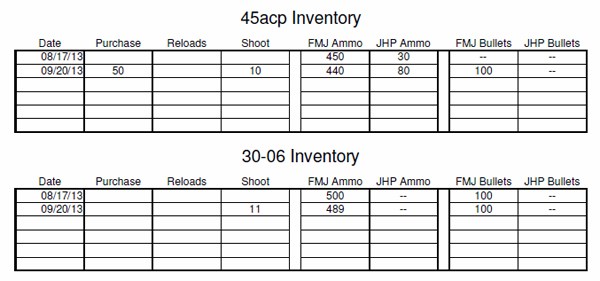
I had written this then decided to mull it over for a couple of days to see if there was anything I wanted to add or change. During that time I came up with a new way to inventory my ammo and reloading supplies. I have included a graphic so maybe it will help others.

Instead of being able to log 10 months worth of data, I am able to log 6 months, but I get everything on one page. I used the numbers and calibers from this article for the graphic. (you didn’t think I’d actually show you what I have do ya?)

Article-Graphic

Resources:

  • Food Checklist – What Foods Should A Prepper Store?
  • 21 Point Prepper’s Checklist For Stocking Up at Walmart

Filed Under: Prepping

How to Make Trees Grow Faster [and healthier]

October 8, 2018 M.D. Creekmore

The Grandma White Method – From “The Complete Book of Composting” Copyright 1960 by J. I. Rodale

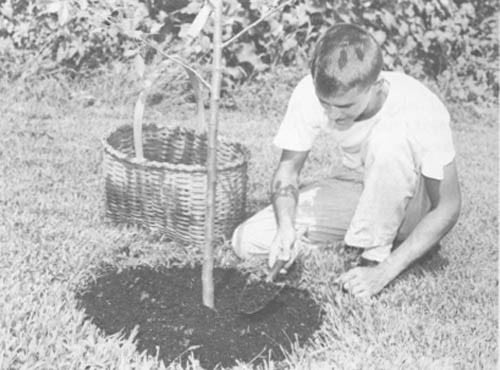
how-to-grow-trees-fast
Fruit trees will get off to the best start if fed a steady diet of compost. Humus is important if trees are to be productive, disease-free and fast-growing. Use your compost as a mulch as well as a steady source of nutrients to your growing trees.

Using Compost For Tree Growth

Start right from the very beginning. Use compost to start and nourish your tree. We cannot recommend commercial, chemical fertilizers which do not add humus to the soil. You must add organic matter to the soil if you want productive, disease-free trees. Soil that is well supplied with humus retains moisture and has good drainage and aeration.

As humus decomposes, it releases a continuous supply of plant food in contrast to the “flash” action produced by chemical fertilizers. It encourages the existence of beneficial bacteria and earthworms. It fights erosion and over-compactness of the soil.

Every tree grower must have a compost pile. Use your compost as a mulch around each tree. Your trees need nitrogen, phosphorus and potash and your compost pile should contain these nutrients in good proportion.

When organic expert Herbert Clarence White of Paradise, California, plants a tree, he doesn’t even glance at the little instruction sheet that the nursery sent with the stock. He proceeds to plant the tree using an unusual method handed down to him by his grandmother years ago.

Grandma White’s method has worked so well for Herbert over the years that he has used it to plant hundreds—possibly even thousands—of trees. He has seen fruit trees planted by Grandma White’s method show 3 or 4 feet of new growth in a year, and start bearing crops in only a couple of seasons.

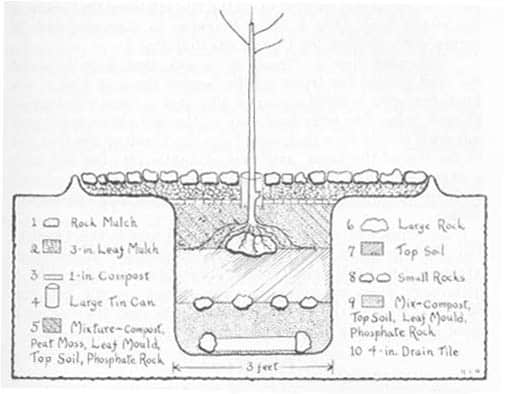
You start out by digging a hole 3 feet wide and 3 feet deep in which to plant your young tree. That size hole is much bigger than is usually recommended, but a big hole is the heart of Herbert’s method and he insists on it.

Separate the topsoil from the subsoil that is dug from the planting hole. In the bottom of the hole place, a couple of pieces of 4-inch drain tile and plug up the ends with stones. Fill up the bottom foot of the hole with a mixture of equal parts of topsoil, peat moss and finished compost, plus about five pounds of phosphate rock or colloidal phosphate.

The top 12-inch layer—consisting of a mixture of compost, thoroughly soaked peat moss, leafmold, colloidal phosphate, and rich topsoil, is most important. This is the immediate “seedbed” where the tender young feeder roots will be working.

No raw manure or chemical fertilizer should ever contact this area. Such materials will seriously burn the roots, and perhaps even kill the tree outright. Even raw manure, used as a mulch at the top has often proved disastrous to newly planted trees. So go slow on the manure!

On top of that mixture place a layer of small rocks. The next one-foot layer consists of pure topsoil. Now put into the hole a large stone. Spread the roots of the tree over that stone, then fill the rest of the hole with the compost-topsoil-peat-phosphate-rock mixture.

As mulch over the planting, place one inch of compost, 3 inches of leaves, plus a layer of stones if desired. White also advises putting 250 to 500 earthworms in the top compost layer, and adds this postscript to the description of his method:

Does all this sound too weird and grotesque? Too utterly fantastic? If so, far be it from me to try and convince you. But if you are just a wee bit interested in watching a miracle, just try it out on one little tree—following the planting plan as indicated in the diagram carefully—and it will be hard for you to believe your own eyes when that baby tree starts growing.”

planting-trees-fast

Here is the “Grandma White” method for planting trees. Start out by digging a hole that is 3 feet wide and deep, separating topsoil from the subsoil. Place drain tile, stones at the bottom, filling the hole with topsoil, compost, peat moss, and mineral powders.

In treating a sick tree, or one which has failed year after year to produce a crop, use the same formula as used in planting a baby tree. In other words, make a “blend” or mixture consisting of ½ yard (12 bushels) topsoil; 2 bushels compost (completely decomposed); 2 bushels leaf mold (completely broken down); 20 pounds colloidal phosphate (or rock phosphate); and 20 pounds of rock potash.

The above formula will be sufficient for a young tree from 2 to 6 years of age that has shown little vitality and below average growth. This enriched earth will be used to fill the 20-inch holes that encircle the young tree. (Dig 8 holes, 8 inches in diameter and 20 inches deep, around the tree at the drip line.)

The next step in “treating” a sick tree is to level off the land around the trunk a little beyond the drip line of the branches and to build a sturdy dike just outside the ring of 20-inch holes. Ten pounds of each of the two above-mentioned minerals should then be spread from the trunk of the tree out to the rim of the basin and worked lightly into the soil with a rake.

One inch of compost and leaf mold (mixed) should then be added to the area within the basin and spread out evenly.

If domesticated earthworms are to be used in this “health-building” program, they should be spread over the compost (from 500 to 1,000) and covered with a 3-inch leaf mulch. A little cornmeal or coffee grounds spread on the compost before spreading the leaves would help to give the worms a good start in their new environment.

Filed Under: Homesteading

What Survival Skills Does A Prepper Need?

October 5, 2018 M.D. Creekmore

bushcraft skills for survival

Top 15 Essential Prepper Skills to Learn Now!

Any person who sets out to acquire a set of survival skills must start with a brutally honest self-assessment. If you don’t make a truthful appraisal of where you are in terms of your survival skills and knowledge, you have no reliable means of getting to where you want to be.

Do an inventory. In what areas are you most skilled? Where are you definitely lacking? Are you well versed in firearms but lack knowledge about water purification? Have you amassed an impressive food pantry but have no way to protect that food should the need arise?

Do you have a stocked first aid kit but don’t know how to use it? Just as a business that fails to take regular inventory cannot succeed, neither can a survivor who doesn’t tabulate his resources. You need a starting point, and today’s assignment is to take an inventory of your essential survival skills. As you read through the following list, check off those skills you have mastered so you can focus on those skills on which you need to improve.

1. Food processing

Many survival planners overlook food processing in favor of more exciting elements of preparedness. This is a mistake. Learning how to prepare basic survival foods is one of the most important elements of long-term disaster preparedness.

2. Bulk food storage

Without adequate quantities of stored foods, your demise is virtually guaranteed after a major catastrophe. Storing and rotating basic grains, beans, and other foodstuffs isn’t difficult; anyone can learn how to do it properly in an hour or two.

You will find everything you need to know here and here.

3. Emergency medical care

Every survivalist should have sufficient medical training. A good start is taking a basic cardiopulmonary resuscitation (CPR) and first aid class; check with your local Red Cross for scheduling. If time and finances allow, taking EMT classes is an excellent idea.

Don’t overlook herbal medicine, which may be all you will have to work with after a disaster.

Please read my article Prepper’s First Aid and Medical Checklist to find out about getting medical training, alternative medicine, kits, and even birth control methods.

4. Gardening

Because of space and finances, most of us cannot cache enough food to last the rest of our lives. We’ll need to replace our stored foods with fresh supplies.

Gardening is an excellent way to do this and can be easily learned with instruction and practice. It is amazing the amount of food that can be grown in a small space under proper conditions.

5. Preserving food

Food preservation is an important survival skill, as most fresh foods spoil fairly quickly, resulting in a loss of quality, edibility, and nutritional value. You should learn how to can, dry, freeze, cure (salt or sugar), smoke, pickle, bury, vacuum-pack, jelly, and/or pot food.

6. Hunting

Contrary to popular belief, all wild game will not disappear after a collapse, natural or manmade. Most people would rather stand in a food line waiting for a handout than scour the backwoods for wild game.

And let’s not forget that the extent of most people’s hunting skills doesn’t go beyond the latest hunting themed video game.

7. Trapping

Trapping is more practical under survival conditions than hunting. By setting a trap, you can be other places doing other things while the trap does the hunting for you. Learn to build and set snares, deadfalls, box traps, fish traps, and steel traps.

Becoming a proficient trapper is not difficult—all you need to do is get off the couch and learn by doing.

8. Firearms repair

Basic firearms repair (replacement of broken parts) isn’t difficult if you have the parts needed when something breaks. You don’t need to learn how to repair every make and model of firearm in existence. You do need to have an in-depth understanding of your firearms: how they work and how to maintain and repair them.

9. Self-defense skills

The most effective self-defense techniques are also the easiest to master. Striking vulnerable points, biting, and eye gouging are simple and effective techniques that can be learned quickly and, when applied with aggression and precision, can bring down the most determined attacker.

10. Firearms proficiency

If you’re new to firearms, a basic safety course is highly recommended before learning defensive skills. Concealed-carry permit classes are held in most areas, as are hunter education programs. I suggest you participate in both.

The National Rifle Association (NRA) offers a number of classes that are most helpful.

11. Water purification

Another simple skill often overlooked is water acquisition and purification.

12. Using tools

You should have a survival toolbox of basic tools, including hammers, saws, drills, screwdrivers, winches, vise grips, wire cutters, and files. Your toolbox should also include the skills needed to put these tools to good use.

13. Raising small livestock

Raising livestock for food goes hand-in-hand with gardening, hunting, and trapping to ensure sustenance during hard times. I highly recommend Barnyard in Your Backyard by Gail Damerow and Secret Livestock of Survival which covers everything you need to know about making livestock part of your survival food plan.

14. Home power

While it may be possible to survive with no electrical power at all, having some source of electrical current will make life much easier. My solar setup cost me under $600, including the batteries, and the price of building my homemade electrical generator amounted to just under $100.

15. Investing

After getting your survival necessities in order (e.g., food, water, medical supplies, shelter, defense), you need to start thinking about investing in barter goods, such as .22-caliber ammo, pocketknives, and “junk” silver coins. Just be sure not to make the mistake of going into debt while investing in these metals.

And don’t overlook learning how to barter – here is a list of the ten top barter items.

Check your skills (be honest!) against the list above. If there are areas in which you are lacking (and there will be if you’re being honest), then get to work filling in the gaps. What skills do you have now? What skills do you need to learn or build upon?

Filed Under: Prepping

Building A Mobile Solar Power Station

October 4, 2018 M.D. Creekmore

solar power stationby Dan W

One of the more important things we’ve wanted to include with our other prepping supplies is a communication system. Something beyond two cans and a string! Should a catastrophic event occur we don’t expect help in the form of government assistance will be readily available.

Besides, we are leery and don’t think we’d want that kind of help ……….. even if it was offered. At least not until things have shaken out a bit and we have a better feel for what is going on.

However, it will be important especially during the early phase of an event to be able to receive broadcasts (if there are any) to stay apprised of situations both near and far. Forewarned is forearmed!

We discussed just who it might be that we wanted to communicate with, why, and the type of equipment we’d need. There’s a big difference between active and passive communicating. Getting active on the airwaves right away using a radio transmitter did not seem to be a wise thing to do.

Better to stay quiet and attentive while things shake out. The time will come when communicating with those outside your immediate vicinity will not be as risky. Until you know what is going on, why broadcast your presence?

power station diagram

Maintaining communications with those in your tribe is important. If we had to leave our compound for any reason it would be beneficial to stay in close contact with those afield. Small handheld transceivers satisfy this need but eventually, we’d need to be able to actively communicate over greater distances.

A more powerful transceiver of some sort would be needed. We were torn between choosing a Shortwave or a CB Transceiver. These two devices each fill a different function in communications equipment: The Shortwave Transceiver is a long range device while a CB Transceiver is more suited to relatively short range communications.

power station diagramSetting up and using a shortwave system is more complex than using CB devices. There is a definite need for both types of devices in a complete communications system, but did we want to purchase and set up both types? Would only one type suit our needs?
After much discussion regarding the pros and cons of each, we decided to go with a CB Transceiver as our main unit. Our choice was based on our feelings that we really don’t need to actively communicate with anyone at long ranges (other than listening). To cover all bases we may still purchase a hand-held SW Transceiver at a later date.

We analyzed our needs to determine what devices we’d want to assemble for our communication station. Our “want” list quickly evolved into a “need” list. These are the generic items we settled on:

  • A professional quality CB Base Station combined with an excellent antenna system would allow us to reach out across our valley.
  • Handheld CB Units (x4) would amplify the flexibility of our base station and give us roving communications capability. We wanted units with rechargeable batteries and an adapter for an external antenna.
  • FRS (Family Radio Service) Band Transceivers (x4) for use around our property (short range).
  • A multi-band radio (AM/FM/Aircraft/SW + SSB) would be our ears to the outside. This would have to be high quality, high gain radio.
  • An emergency frequency scanner that could monitor police, fire & EMS, plus the Aircraft bands; further adding to our ability to monitor what is going on locally.
  • A small inexpensive multi-function AM/FM, CD, Cassette player for entertainment. A life without music is unthinkable, so I consider being able to listen to recorded music a crucial aspect of surviving.

These devices would compose our communication and entertainment system. We knew what equipment we wanted to use, but needed to address the issue of how they would be powered? What would it take to ensure we had enough self-generated electricity to meet the need? What other items did we have, or plan to get, that would also need power? It’s always a good plan to plan for more capacity than what you think you will need.

Mobile power station

The only other key items in our cache needing power (either directly or by charging its batteries) were: our Voice Alert Intruder Warning Station and sensors, several Night Vision scopes, the Marine Band transceiver on our boat, and a bunch of flashlights. Only the Voice Alert was added to our “needs power” list for the purpose of calculating total electrical load requirements.

I mentioned a Marine Band Transceiver in the previous paragraph. Let me digress for a moment to discuss where it might fit into the scheme of things. Since Marine Band frequencies are different from FRS, CB, and standard SW Band and since folks in a survival mode would likely be using those more common devices to communicate; using a marine band radio to connect with your friends provides a small measure of “secure communications”.

mobile solar power station

At least it would be somewhat more secure than other methods of communicating over the airwaves. People living in landlocked areas don’t tend to think about Marine Radios and would probably not be monitoring those frequencies. Back to the main topic.

Primary Considerations

Starting with the assumption that there would be no grid electricity or phone system operative, our communication devices would need to be powered by whatever electricity we could generate. We’ve got a large gasoline generator that will provide a lot of juice, enough to run our home if needed.

But even with rationing our supply of gasoline it will only last so long. Scrounging for more fuel during the first few months of chaos might prove to be unproductive, as well as a very risky chore.

Wind or water power is not an option where we live so that’s out of the equation. Solar power is an obvious choice. A bank of solar cells, charging a bank of batteries, powering an inverter to produce AC power, is feasible; but I have some reservations regarding this type of arrangement.

First is the number of solar cells required to produce adequate charging current and second is the number of batteries that would be needed.

Those two issues, plus our northern locale and the reduced daylight hours during the 6 months of our winter cycle (at Winter Solstice we have about 8 hours of daylight) made me reluctant to bite the bullet and put our funds into a large, complex solar power supply.

The ratio of expense versus return just didn’t seem to make a large solar-powered system worthwhile. I wanted a system with as few components as possible. The more components there are within any system, the greater the likelihood one will fail; thus rendering the system inoperative.

Considering all of my negative concerns, solar power still seemed to be the answer. I decided to compromise; I’d use solar power on a smaller scale to power our communications system. With a working solar power supply, we could then hold back on using our generator. This has a positive impact since the generator is noisy and would attract attention. A solar charger is silent.

System Design Criteria: I searched through commercial products to see what was available but couldn’t find anyone device that had the features I was looking for.

Nowhere was there a solar-powered, battery based, a multi-voltage power supply that would suit my wants and needs.

So, I decided to design my own. I wanted to follow the time-proven “KISS” philosophy of design ………….. Keep It Simple Stupid! The result is a system that is based on two main components: A Portable Solar Battery Charger and a Power Panel.

  • The Solar Charger needed to be portable so I could easily move it around the property to wherever the sunlight was strongest.
  • The Solar Charger would need to be able to recharge a slightly discharged Deep Cycle 12 vdc RV battery within 8 – 10 hours.
  • The portable Solar Charger should have an onboard 120vac-12vdc charger to provide one more way to charge a battery.
  • The battery used would need to have enough capacity to power the equipment for at least 12 hours out of a 24-hour cycle.
  • Two batteries would be used initially, although more can be added if desired.
  • Each day (of the use cycle) the batteries would be swapped. The freshly charged battery would come into the house to be connected to the power panel. It would replace the battery that had been used the previous day & night. The slightly discharged battery would then be rolled outside (on the Solar Charger) for recharging.
  • The Power Panel would be designed so as to provide easy access to facilitate battery and device connections.
  • The Power Panel would supply 12, 9, 6, 3, and 1.5 vdc as well as 120vac at amperage levels required by the devices (Radio, CB Station, etc.).
  • 120VAC would be supplied to the Power Panel by three sources: Normal Grid connection, Generator, and an onboard 12vdc to 120vac Inverter.
  • All of these DC voltages, plus the 120 VAC, would be readily accessible on the face of the Panel. A connection would be by the use of common connectors, alligator clips, terminal strips and the like.

The Portable Solar Charger and the Power Panel would comprise a very flexible electrical supply system. As long as we had grid power or were using our generator the Solar Charger and the Power Panel would remain in standby mode.

Electrical Sizing: Once I had decided on the general details for the charging station and power panel, I set about figuring which specific communication devices I wanted to purchase. This was necessary so that I would know what the estimated total power requirements were for each device.

That way I could ensure my system would be adequate for the load. As I said earlier, I wanted to be able to have a way to communicate via CB, be able to listen to what was being broadcast locally on emergency channels, receive worldwide broadcasts, and play CD’s or cassettes (yes I still have boxes of them).

After shopping around, I selected a CB base station by Galaxy, a world/all band receiver from Grundig, a Uniden300 Channel Broad Band Base Station Emergency Frequency Scanner, and a nice little Sony AM/FM/Cassette/CD Radio & Player. Another electrical device that would be connected to the Power Panel is our Voice Alert System base station.

I obtained the amperage requirement specifications for all of these devices. Both idle and operational mode values were figured into the equation. The total wattage needed would be my guide in choosing an appropriately sized battery as well as other assembly components.

The Voice Alert Perimeter Defense system (which would be on almost all of the time especially at night) draws less than a ½ amp/hour. If the CB Base Station is turned on it will draw less than ½ amp/hour in the Receive-Only mode, and less than 1 amp when transmitting.

The World Band Receiver uses less than ¾ amps/hour. The scanner uses less than ¾ amps and the Cassette/Cd player uses ½ amp/hour at a normal sound level. If the CB Transmitter or the Inverter was in use the current draw would be greater: meaning that the battery would need longer to recharge.

And of course, the louder the audio setting the more current these units will draw. If all of them were turned on at the same time the total current draw is still well within the arbitrary 5 amp limit.

After a search, I selected a Deep Cycle RV battery made by Interstate (SRM-27) that was rated to provide 12vdc @ 5 amps 19 hours. It would be a rare occurrence when all of these devices were in use at the same time so in all likelihood, the battery would actually be put to use for less than 12 hours a day.

This battery was perfect and would work well to satisfy my initial target value of 5 amps. The Interstate battery would work just fine!

Portable Solar Charger Design: Having settled on the major components, and the overall design of the portable solar charger and power panel, I began the actual layout design work. I settled on using a common hand truck purchased at a local retailer as the base on which to design the portable charger.

The hand truck was large enough to accommodate all of the components. It would work well as the batteries are heavy and unwieldy to carry around. An additional plus is that the entire charging station can be rolled into the house for security and to facilitate the battery exchange.

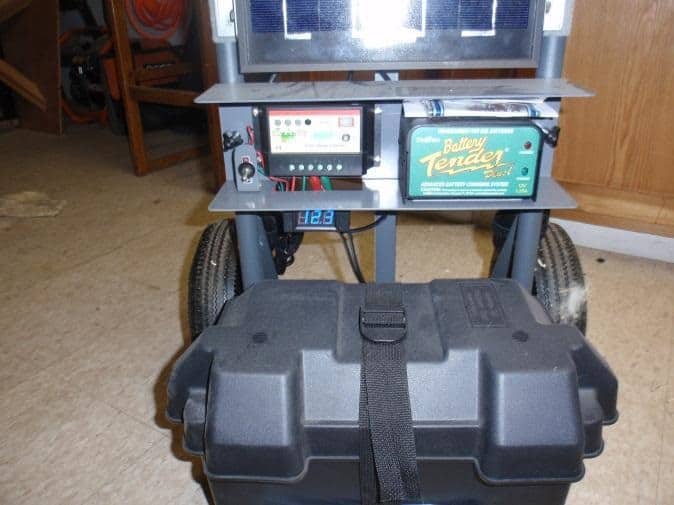
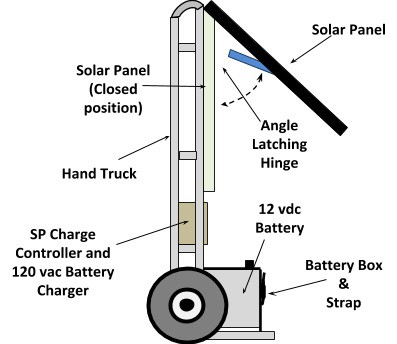
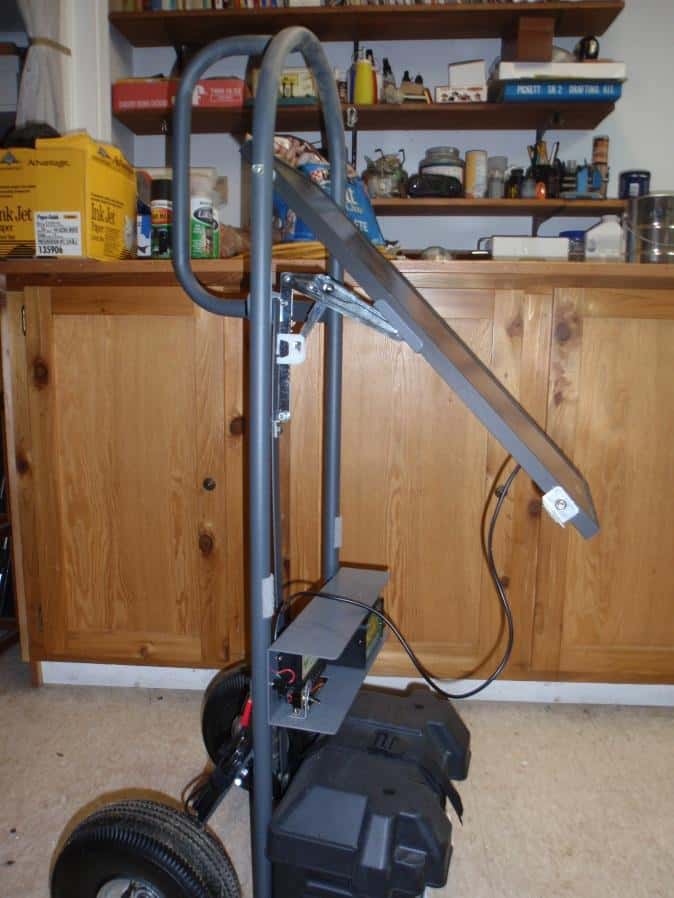
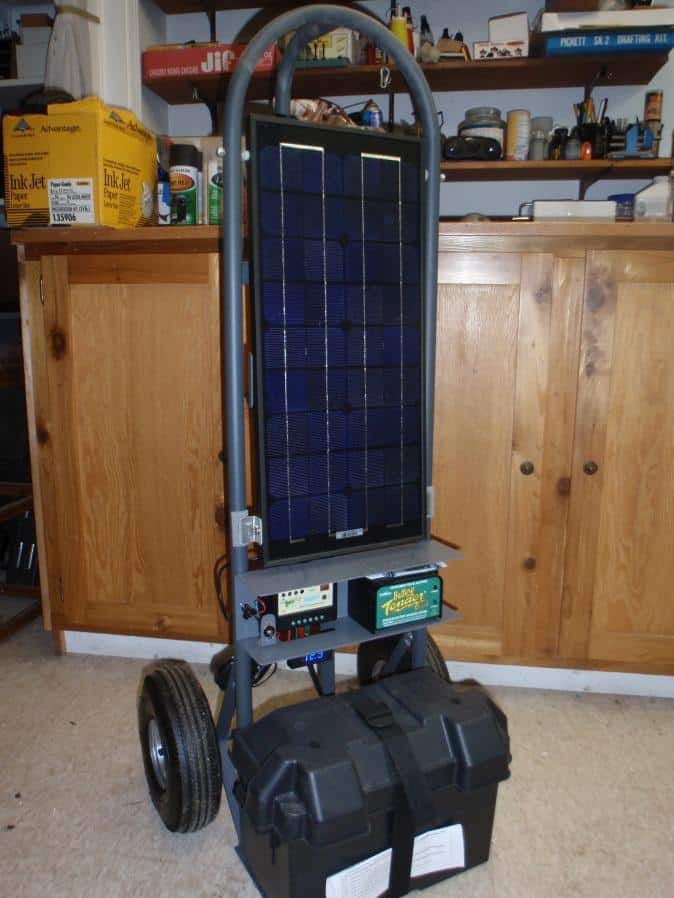
The Solar Power Charging Station is essentially a 20-watt solar panel connected to an SP Charge Controller. The solar panel is mounted on the hand truck so it can be pivoted at the top on a vertical plane. This allows it to be angled so as to best capture the rays of the sun, yet present a slim profile when not in use.

I added a special locking hinge that allows the angle to be easily set. The Solar Panel Battery Charge Controller moderates the output of the panel and keeps the battery from sulfating over time. A very small meter was added so I could monitor the voltage of the battery as an indicator of its charge level. T

o give added flexibility to the unit I added a small 120vac charging unit. A heavy plastic battery box is mounted on the foot of the dolly. Each of the electronic devices was mounted to the hand truck so as to be able to easily remove them. This was done so the individual components could be stored in my grounded Faraday Shield cabinet ………… just in case!

Power Panel Design

The Power Panel is simply a fixed panel that has a variety of quick connect terminals and cables that can be selected and connected with ease. It has two inputs: 12vdc (using battery clips) from the batteries currently in use) and 120vac (using a standard extension cord type connector plugged into a wall outlet). The 120vac is used when our generator is running and supplies 12vdc by powering a standard charger.

The 12vdc to 120 vac inverter is also mounted to the panel. I added a switch so I can choose between Generator/Grid 120vac or Inverter 120vac). The inverter I chose is a Power Bright PW1100. It will provide 1100 watts and draw roughly 9+ amps when used at its max capacity.

It is not a true sine wave inverter but then again I don’t need one. I do not foresee having to use the inverter all that much, but it’s nice to have it wired in and available if needed.

There are no indicator lamps as they just add to the load on the supply. The output connections are all switched and labeled to reduce confusion. I did add a 12vdc switched light (low current LED) to illuminate the panel and immediate surrounding area.

The best radios in the world are worthless unless connected to a good antenna. To complete my communications system I bought a Solarcon I-MAX 2000 24’ CB/HAM Base Station vertical antenna. I constructed a 40’ long-wire receive only antenna.

Both are mounted on the roof peak of my home and feed into my office. The roof peak is approximately 40’ high so the antennas are nicely elevated. These antennas extend the operating range of the CB and significantly improve the reception of any receiver.

to be on the safe side I also added a lightning arrestor. There are other antennas available but I believe that the ones I have chosen are a good compromise.

Details

Major components of my Solar Charger, Power Panel, and the Communication Devices:

•CB Radio, Galaxy DX-2547 AM/SSB CB Base Station
•Eaton (Grundig) 750 Satellite AM/FM Stereo/Shortwave/Aircraft band Radio
•Sony CFDS05 CD/Cassette/AM/FM Radio
•Uniden 800 MHZ 300 Channel Base or Mobile Scanner (BC355N)
•Cobra HHRoadTrip Hand Held CB Radio (x4)
•Maybe: Baofeng UV5RA Ham Two Way Radio 136-174/400-480 MHz Dual-Band Transceiver
•Instapark 20W High-Efficiency Mono-crystalline Solar Panel
•HQRP Solar Panel Controller 10 AMP @ 150 Watt
•Power Bright P-1100 12vdc-120vac Inverter
•Solarcon I-MAX 2000 24’ CB/HAM Base Station Antenna
•Battery Tender 021-0156 Battery Tender Plus 12V Battery Charger True Gel Cell Model (x2)
•Mini Blue Digital Panel Voltmeter 4.5 – 30v for 9, 12, and 24 vdc (x2)
•Adjustable Drafting Table Hardware, lift up ratchet support, sold By Rockler
•Wineguard DS-3000 “J” Pipe support for antennas (x2)
•Coaxial Lightning Antenna Surge Protector LP350
•Hand Truck with air-filled tires, $60 @ Home Depot
•Misc. screws, bolts, wire, coaxial cables, etc.
•Custom mounting plate for Charge Controller, etc.

As of this writing, the Portable Solar Charger has been completed and works as designed. A “maintenance level” charger is kept on both batteries to ensure they are always fully charged. Assembly of the Power Panel is in progress and I expect it to be completed in the near future.

Below you’ll find several photos on the Portable Solar Charger and a very basic schematic for the electrical connections. They should give you an idea of how I put it together. It’s not necessary to be an electrical engineer to assemble a system like this.

All of it is basically a “plug and go” type arrangement with common components readily available off the shelf. You too can put one together and tailor it to your own needs.

Define what you want to do, what type of devices it’ll take to do it, then make a parts & components list. Be sure all of the components you’re going to put together are compatible and will give you the power you need.

Almost everything I used is available online or at your local hardware store. I did have a local metal shop fabricate an aluminum square “C” shaped plate for mounting the SP Controller and small battery charger. The purpose of the “C” shape, beyond providing a mounting plate, is to shield those two components from the weather.

Filed Under: Power Generation

  • « Go to Previous Page
  • Page 1
  • Interim pages omitted …
  • Page 60
  • Page 61
  • Page 62
  • Page 63
  • Page 64
  • Interim pages omitted …
  • Page 79
  • Go to Next Page »

Primary Sidebar

Subscribe to Blog via Email

Enter your email address to subscribe to this blog and receive notifications of new posts by email.

Join 7,202 other subscribers
  • Amazon
  • Facebook
  • Substack
  • Twitter
  • YouTube

“Do more with less.”

– Minimalist proverb

Recent Posts

  • Just so you know
  • Weather Update for My Corner of Appalachia
  • Why I’m Ordering Ivermectin + Mebendazole Every Year
  • The Website’s Shutting Down (But Here’s the Plan)
  • You Are Hated! Start Training Like It!

Footer

Recent Posts

  • Just so you know
  • Weather Update for My Corner of Appalachia
  • Why I’m Ordering Ivermectin + Mebendazole Every Year
  • The Website’s Shutting Down (But Here’s the Plan)
  • You Are Hated! Start Training Like It!

More about me

Books I’ve written

Books I’ve read

Follow Me on YouTube

Follow Me on Facebook

Gear I Use and Recommend

Newsletter

Search this site

Follow me elsewhere

  • Amazon
  • Facebook
  • Substack
  • Twitter
  • YouTube

© 2008–2025 M.D. Creekmore · As an Amazon Associate, I earn from qualifying purchases.