• Skip to main content
  • Skip to secondary navigation
  • Skip to primary sidebar
  • Skip to footer

M.D. CREEKMORE

  • Blog
  • Books
  • Newsletter
  • Gear I Use
  • About
  • Contact
  • Facebook
  • YouTube
  • Blog
  • Books
  • Newsletter
  • Gear I Use
  • About
  • Contact
  • Privacy Policy
You are here: Home / Archives for M.D. Creekmore

M.D. Creekmore

Hello, I’m M.D. Creekmore. I’ve been interested in self-reliance topics for over 25 years. I’m the author of four books that you can find at Amazon.com as well as Barnes and Noble. Over the years, I’ve learned a lot about prepping, homesteading, and self-reliance topics through first-hand experience and now I want to share what I’ve learned with you.

Homesteading and Preps For The Week: May 19, 2018

May 19, 2018 M.D. Creekmore

bulletproof survivor CD ad

Well, folks, I’m happy to let you all know that this site is growing at what I consider a spectacular rate with a DAILY average of over 100 people signing up for our newsletter/site updates!

Yes, you read that right! Over 100 per day… every day… this is great! The goal of any site owner is to get more readers, because well if no one is reading then there really isn’t any use in writing.

Writing without readers… well that’s like talking to yourself just to hear your own voice with no one else in the room.

Thankfully, that’s not the case here on MDCreekmore.com because our readership is growing and our subscriber numbers are too…

I’m also happy to say that sales of my Bulletproof Survivor CD have been phenomenal with a large number ordered in the past seven days!

I’ve been working 12 to 15 hours a day trying to get all of the orders packaged and shipped out!

If the orders keep coming in at the current volume I’m going to have to make it unavailable for new orders until I can catch up with the demand. Thank you all for your support and patience it’s greatly appreciated.

As for preps and homesteading progress this week I didn’t get a lot done (but I did mail over 500 copies of The Bulletproof Survivor), other than planting more tomatoes and peppers.

I also ordered a copy of Prepper’s Natural Medicine: Life-Saving Herbs, Essential Oils and Natural Remedies for When There is No Doctor.

By the way, if you’ve not signed up for my FREE courses then please do that at the links below:

  • Free Prepper Course
  • Free Homesteading Course
  • Free Start Your Own Blog Course

And, just in case you missed it… I published parts one and two of my alternative power sources articles this week:

  • Alternative Energy Sources For The Homestead Part One – Solar Power
  • Alternative Energy Sources For The Homestead Part Two – Wind Power

Parts three and four will be published next week… I hope you enjoy and find those useful.

And, as always, if you have any questions feel free to email those to me. I do my best to answer every email but please be patient because sometimes I get behind and it can take awhile to catch up. Thank you.

Okay, now over to you…
Filed Under: Uncategorized

Alternative Energy Sources For The Homestead Part Two – Wind Power

May 18, 2018 M.D. Creekmore

wind power off grid

This is part two of a four-part series on alternative energy sources for the homestead – you can read part one Solar Power here.

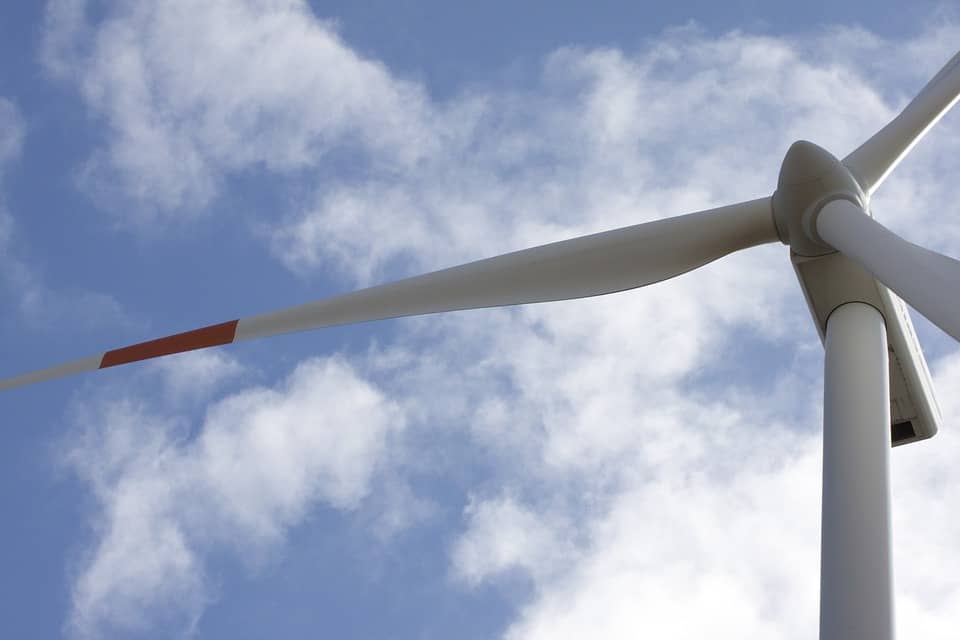
Wind can provide a great source of energy for you and your family when you are living off-grid or for a backup power source.

By choosing a life off-grid, you are choosing a life of independence, a life of self-sufficiency. It is a life where you use the resources the Earth provides and only take what you need. The grocery store doesn’t provide your food, your backyard does.

But it’s not the easiest life. It’s much simpler to just flip a light switch and not even think about where that electricity came from. Because for most people, that electricity just came from some power company that you are vaguely familiar with.

But when you live off-grid, you harvest the energy.

One of your options for energy when you live off-grid is wind power. This invisible mass of air that we often complain about can provide energy to your home. And you can get started yourself. But what does that entail?

What is the off-grid wind system?

There are four different types of wind power systems. One is the off-grid wind power system that uses batteries to store power that is produced by the wind generator for later use.

Another common system is wind-electric water pumping. This couples a wind generator to an electric pump.

Do you have a good location?

As you would imagine, wind power systems take space. Particularly if you want a tall tower that is more efficient. If you need, or just want, something smaller the GOWE small wind generator is an excellent option and good place to start. This turbine might be small but has a high-efficiency motor and can produce up to 600 watts and is available in either a 12 or 24 volt. So I highly recommend this if you are conscious of the size and or on a budget.

Unfortunately, you may also face legal hurdles in some locations, especially if you are close to a city. The most common restrictions are height limitations and mandated distance between a tower and a building or property line. In some instances, you might even need to get consent from your neighbors.

If nothing else, these laws provide a great reason to move out on to a homestead a little further from the city lights. But as a word of caution, I would suggest anyone check with local ordinances before putting in a system.

Does your location make sense?

So you have the space and the green light from local authorities to move forward, but do you have the necessary wind resources on your property. If you don’t, obviously it doesn’t make sense.

To begin, you should find the strength and quality of your wind. That will be an early test in how well your wind power system will work. So how do you do this? You need to determine the average wind speed of your site. To do this, you can reach out to a professional for help. But wind mapping data is available to give you the insight you need.

Your wind speed will likely vary greatly depending on where you live. As this map shows, different parts of the country are better suited for wind power. Areas with a wind average above six miles per hour is usually considered at least doable for off-grid systems.

How much energy do you consume?

A good idea for anyone who is moving off-grid is to have an idea of your energy needs. This means you need to assess the amount of power you use in a day. You can do this by going through your house and looking at the labels detailing wattage for each item. If you can’t locate that information, here is a good chart to help you get started. Make sure your numbers are right because you don’t want to waste any energy.

When you have that information, you will be able to purchase the right turbine and tower for your system.

You will need to perform maintenance

A wind power system requires maintenance on your end. Usually once a year. If you do this, good equipment can last more than two decades. Most of the maintenance is centered around inspections to the turbine and the tower.

So just follow the basic maintenance suggestions and you’ll be fine.

Can I combine wind power with solar?

The wind and solar power combination are relatively common in off-grid living for a few simple, but good reasons. The first is the ability for one type of energy to serve as a backup. When one source isn’t providing energy, you have the opportunity to receive energy from another source.

And think about. When it is a clear, sunny day, you traditionally have less wind. On cloudy or overcast days, or days when the weather is just ugly, you are more likely to have wind. It’s just nice how they cancel each other out.

The two working together will also charge the batteries even faster.

Wind power can be a great option for off-grid living. You will find wind power is able to power most loads depending on the size of the wind turbine and your resources available. If you are wanting to live a life of independence, and you are doing it on a budget, a DIY wind power system will be a great start for you.

Filed Under: Power Generation

Alternative Energy Sources For The Homestead Part One – Solar Power

May 16, 2018 M.D. Creekmore

Moving off the grid doesn’t mean that you have to give up every modern convenience you enjoy today. If you don’t want to. And you don’t need to rely on having gas for your generator.

Solar power has become a popular option for many people in cities and suburbs hoping to save money. But it can also be a great option for those who don’t want to be connected to a traditional source of power.

Those who truly want a life of self-sufficiency away from the power grid can enjoy it with solar power in many locations.

This is off-grid living

And while solar power can be a great option and prices have generally been going down, it is still pretty expensive for most families. Depending on the size of the system, it will cost between $15,000 and $20,000 before any state or federal tax credits or rebates.

If you want to live off-grid and save money, you can get started with do it yourself solar power. Is that really possible? You might be thinking solar power sounds pretty complicated. But with the right planning in place, you can create a DIY off-grid solar system that will give you the self-sufficient off-the-grid lifestyle you want.

However, if you want a smaller system for backup and emergency power or if your power needs are relatively small then you can set up a system for under $5,000, which is what I did.

You can even buy a portable system like the Genex Nature’s Generator or a Humless for portable power which is what I have. These portable solar systems are great for extended fishing, hunting, and camping trips and are also an option if you have a remote bug out location but can’t set up a larger system at the site because of the possibility of theft or vandalism.

Ready to begin? Here are seven steps to getting started with do it yourself solar power for your home, homestead, or survival retreat…

Your needs are unique

The first step is more of a warning. When it comes to the solar power that your house will need, there is no one size fits all solution that will work for every house. You can’t just go to Amazon and buy a solar power kit and expect that it will work for you before doing any other research.

The system that you will need will vary depending on your location, the size of your house and how much energy you will be using. So as you begin this process, make sure you know that you will need to customize your projeMDCreekmore.comct to your individual needs.

Power

The first part of that process is the calculation of how much power you will use. What does that mean? Think of every item that will be powered by solar power in your house. And know that any little change or anything you forgot can make a big difference.

You can utilize a load evaluation calculator to help you get started. There you will enter your appliance, quantity, watts and hours on per day. To make sure you have the right data an electricity usage monitor will be a valuable tool. You can find more general data on individual appliances here.

If you’ve had electricity in the past, you can refer to past bills to find the kilowatt-hours (kWh) used. I suggest going with the highest usage seasons depending on the climate in your area. That will be easier, but it’s not going to be an option for everyone.

Either way, just remember it is very important that your numbers are right.

Batteries

Once you know how much power you need, you can then figure out how many batteries are needed to store it. You don’t want to run out of battery capacity and be forced to use a backup generator. But you don’t need to waste your money on batteries you aren’t using that will just require maintenance.

To make this determination, there are a couple questions to ask. How many days worth of energy do you want to store in your battery bank?  Is it a day or two or more like four or five? Are you storing the batteries in a cold location? Generally, the colder the room the bigger battery bank you will need. Do you have a power source for days you go without sunshine? This will certainly be impacted by where you live. What voltage battery bank do you need? Your battery will be 12V, 24V or 48V and a large system usually requires a higher voltage.

You can use this battery bank calculator to get started.

One other consideration is cost and maintenance. The two batteries most commonly used for off-grid solar power are Lead Acid and Lithium. Lithium will be the most efficient, have the longest lifespan and will not require maintenance or venting. However, it will come at a cost. Lead Acid batteries, on the other hand, will cost less. But they may also require maintenance and have a shorter lifespan.

Sunshine

By knowing how many hours of sunshine you receive each day, you will be able to determine the number of solar panels you need.

Your sun hours will tell you how much sunshine you will be able to harvest. Now, all sun is not created equal. Sun will hit your panels at different angles and will be brighter at certain times of the day. Since you don’t want to be overly optimistic on this calculation, use the season that will give you the least amount of sunshine so you don’t run out of solar energy.

This calculator will help you find the average hours of sun in the city closest to you.

Once you’ve determined the number of sun hours your panels will receive, you will be able to calculate how many panels you need to purchase using this calculator.

Solar charge controller

Your solar charge controller will properly charge your batteries so they will enjoy a long life. Therefore, you will need to make sure you have chosen the right controller. You can do this by taking the wattage of your solar panels and dividing it by the battery bank’s voltage. This will give you a calculation of your needs.

One other important point to note is that controllers come in two types of technologies: PVM and MPPT. If the voltage of the solar panel matches the voltage of the battery bank, you can use PVM. If they are different, you need to go with MPPT.

Inverter

An inverter is basically the “brains” of your solar panel system. It will direct current from the batteries into alternating current for your appliances.

To select the right inverter, you need to start by knowing what type of AC power you have. Once you do that, you need to know how many watts you will be powering (which you’ve already done). And then pay attention to your voltage battery bank as the inverter is designed for a specific voltage.

Tax Credits

Now that you’ve invested in your solar power system, there is some good news. A federal tax credit is available for solar power.

You can talk with your tax pro or find more details here, but this is a quick rundown. You can qualify for a credit equal to 30 percent of your total cost. This credit is currently available through the end of 2019. Then, the percentage will decrease each year and stop after 2021.

Because this is a credit, and not a deduction, you take the amount directly off your tax payment.

And yes, this credit is available for a DIY system.

By following these steps, you will be able to build the off-grid solar power system that is right for your specific needs. And you will finally be able to enjoy life where you would like without a reliance on the power grid.

It’s a great feeling.

Filed Under: Power Generation

Homesteading and Preps For The Week: May 12, 2018

May 12, 2018 M.D. Creekmore

Well, folks, here we are again. I hope that you are as excited to be here as I am… I’m loving this new site and it’s growing much quicker than my old Survivalist Blog site which took years to gain any traction. I learned from my mistakes with the other site, and also what works and what doesn’t and I’m using that knowledge to build this one much quicker.

If you want to learn what I’ve learned about blogging because you want to start a blog of your own then I have a 100% free 7-day blogging course that you can take to do that.  I’ve also published several articles that you should read if you’re interested in doing this yourself including – How to Start a Profitable Blog in 2018, Step-by-Step Guide, and How To Start A WordPress Blog On Bluehost.

I’ve been actively publishing this site for around two months and the daily page view numbers are already near what they were on my old survivalist blog and the subscribers to MDCreekmore.com are getting ready to pass the 5,000 mark with my goal being 25,000 subscribers by the end of the year.

And I can do that, however, right now I’ve not even been focusing a lot on getting new subscribers or readers, no, what I’ve been focusing nearly all of my time and attention on is my new project that I call “The Bulletproof Survivor” check it out!

One more thing, I know that most of you have already bought my book “The Preppers Guide to Surviving The End of The World As We Know” however, new folks coming to the site haven’t so I put together a new page for the book that I will send those new readers to.

Please take a look at the page and let me know what you think and post any comments and ideas on improving it the comments below. Thank you!

Okay, now what… Oh yeah, I have a huge 5,000+ word article on alternative power systems including solar, wind, and water power that I’ll be publishing here next week. You’ll love it!

Now, let’s get to homesteading and preps for the week…

This week I planted tomatoes, peppers, squash, and potatoes in the garden… and then just like that the rain stopped! After raining what seemed like every day for months as soon as I plant boom, sunshine and dry as a powder house with no rain in sight.

Preps for the week include adding a Fire B.O.S.S.- Bug Out Bag Survival Fire Starting Kit and a Fishing and Hunting B.O.S.S.- Bug Out Bag Survival Kit to my emergency cache “Mono Vault” that’s hidden in the forest (buried but easily accessible and that’s all I’m saying).

Here is a photo of my Mono Vault…

boss kits
B.O.S.S. Kits

Well, folks, that’s it for me this week… what about you?

Filed Under: Uncategorized

Concealment Strategies Against Social Unrest, Theft, or Confiscation

May 11, 2018 M.D. Creekmore

secret rooms and security

By Joel Skousen

It does little good to spend a lot of time and money in preparing for difficult times if you don’t also plan on securing those supplies against the very threats you are preparing for.   Severe social dislocations caused by war, economic problems, or widespread natural disasters are almost always accompanied by looting, theft, and increased criminal behavior—sometimes in large mobs that even police cannot control.  We need to plan ahead on how to deal with those threats without resorting to violent confrontations, which should be a last resort.

We also have to consider government’s propensity to confiscate stored supplies when in short supply.  There is still a 1950’s law on the books that gives the government the power to declare anything in short supply as “hoarding.”   In the March 3, 2012 edition of my World Affairs Brief,  I covered the relevant sections with the Defense Production Act of 1950 that affect personal storage:

“Sec. 102. HOARDING OF DESIGNATED SCARCE MATERIALS [50 U.S.C. App. § 2072]

In order to prevent hoarding , no person shall accumulate (1) in excess of the reasonable demands of business, personal, or home consumption, or (2) for the purpose of resale at prices in excess of prevailing market prices, materials which have been designated by the President as scarce materials or materials the supply of which would be threatened by such accumulation.”

The wording implies that the government is taking action against those that start to hoard for profit once something gets scarce in a crisis, but notice that there is no provision for acknowledging or exempting stockpiles that were accumulated before something was declared scare.  That’s what is dangerous about this wording. And there are severe penalties for getting caught “hoarding,” regardless of when your supplies were purchased:

“Sec. 103. PENALTIES [50 U.S.C. App. § 2073] Any person who willfully performs any act prohibited, or willfully fails to perform any act required, by the provisions of this title or any rule, regulation, or order thereunder, shall, upon conviction, be fined not more than $10,000 or imprisoned for not more than one year, or both.”  

As you can see, it is wise to prepare to conceal your supplies from the government as well as from desperate people who may turn to looting and theft in order to survive.

In this article, I’m going to talk about strategies for concealment rather than specific designs—which have to be customized to each specific situation, and shouldn’t be published anyway, lest they become compromised.

Remember too that you must be prepared to secure people as well as your supplies.  Social unrest and even government may be a threat to your person as well, and your supplies won’t do you any good if you are dead.   A well designed safe room can provide for both protection of people and your essential supplies if they have temporary living facilities included for an emergency where you may need to get out of harm’s way.

Principle 1: Select the space for a secret room where that space isn’t obvious without detailed measurements.   I’m not talking about concealing the entrance here but rather picking a space within a cluster of rooms where one can’t tell easily that there is unaccounted space somewhere in the middle.  Large homes are more amenable to hiding a room in a complex of other rooms, wherein the presence of several twists and turns of hallways, it’s impossible to keep track of where you are, let alone the size of rooms around you.

For smaller homes, let’s suppose you have two rooms of equal size along a common wall, and the doorway to each room opens from a common hallway.  You want to create a secret narrow room within one or both rooms.  If you shorten the back wall of one room and not the other, someone opening the door of each room and looking in at the back wall can easily tell that the wall of one room is closer than the other.  But if you put the secret narrow room between the two rooms (shortening both rooms equally), no one can tell that there is extra space between the adjoining walls of both rooms without measuring.

It’s even easier to conceal a secret room in a basement if you carve out space under the garage or an outside deck since no one expects there to be basement space under these two structures.   This is easier and less labor intensive if done during initial construction of the home, but the downside is that the space shows up on the building plans on file with the county or city.  If you do it as a remodeling, shoring up and excavating by hand, the better your chances are of doing this in total privacy.

Principle 2: Make sure you can get to your secret room quickly and privately.   It does little good to have a secret room (for either storage or personal safety), if you can’t get to it easily and in private, both for loading in supplies and to access in a crisis when others may be watching.  This is one of my main objections to backyard buried shelters, with a hatch type door in the ground in the backyard that is your only entrance. People can observe not only the burial of the shelter during construction but your many trips back and forth loading it with supplies.  When you need to get inside during a crisis, don’t be surprised if the entrance is surrounded by people wanting inside too.

Even if designed inside of a house (which I prefer), I like to design the home in such a way as to get to the safe room or concealed storage room without transiting open rooms, front hallways or main staircases. In an intrusion, your access to those public areas may be compromised, so you need to provide alternate access.  If you have a home without a basement, try to carve out space near your master bedroom so you can gain access easily without venturing outside the safety of your room.

In two-story homes, I also like to design ladder wells where kids can get down to the parent’s master bedroom without using the stairs, and from there to the shelter.  Building codes don’t like penetrations through floors, so sometimes you have to do this after the home is finished, as a minor remodel.

If your secure room is in the basement, try to devise a trap door entrance from your bedroom closet that gets you directly down to the basement without using the stairs.  That requires some sort of ladder, but my preferred way is to design a trap door from a master bedroom closet that comes down over a set of basement shelves where I can use the beefed-up shelf edges as a ladder.  I simply design the front reinforced edge of the shelf as a 1” x 2” board that protrudes above the shelf rather than below, giving me a handhold as I climb up or down.

Principle 3:  Use double concealed entrances where possible:  Whenever possible in my design of high-security homes, I like to have a concealed storage room or closet in front of any safe room.  Both rooms have concealed entrances.  The would-be intruder has to find not just one secret entrance, but two, and the latter is unlikely because once the first room is found the person thinks, “I’ve found it.”

This is especially effective if you do keep some “throwaway” valuables in the first room to give some sense of satisfaction.  Naturally, you shouldn’t use the same type of concealed entrance scheme for the first room as with the second one.

Principle 4:  Think outside the normal:  The previous idea is an example of designing concealed entrances that fool people.  So is placing a basement below a garage where people don’t usually expect to find one.  But you can get even more sneaky by providing the entrance to a concealed room on the floor above or below.  Now, that’s hard for people to conceive of, let alone discover.

Principle 5:  Keep the number of persons involved small:   Constructing secure rooms is difficult to accomplish with any privacy if you have to hire it done.  The more you can do yourself, the better in terms of keeping them from being known to others.  It’s even worth learning new skills than taking the easy way out and hiring it done.  Now, I realize that is not possible with many people, so if you need to hire something down, use an older handyman rather than a big contractor who is going to bring in hired labor—which are mostly young guys who talk about any new they are doing.

If you are doing something with new construction that involves building permits and a contractor, design the basic structure of the rooms, but label them as storage.  Finish out the rooms and build the concealed entrances after the occupancy permit is issued when you can remodel or finish in privacy.  During the building process, you may observe one or more workers that are a cut above the others, who you may be able to hire on the side to do addition work later.

You also have to be careful about talking to your own children about secret rooms.  Kids love the idea of secrecy and will run around telling all their friends about the secret room in their home.  It’s better to not tell them or show them these things until they get older and you can trust them to not tell others.

Building Concealed entrances:   While I don’t have the space to get into specific designs, here are a few hints:

  1. Hinges are the most difficult things to conceal in swinging cabinets.  I prefer pivoting pin-type hinges embedded into the top and bottom of a cabinet, which are completely invisible. I show these types of designs in my books (see Bio)
  2. Avoid putting castors or rollers on the swinging side of concealed cabinets to support the weight. They will make marks on the floor that can reveal that the cabinet or shelf swings out.
  3. Pins or latches to open the secret door or cabinet can often be concealed behind the edge of an adjustable shelf. Just lift up one side of the shelf to withdraw a locking pin for opening.
  4. Make sure you provide a second locking mechanism on the inside of the concealed entrance so that once inside, you lock yourself in and disallow anyone else from opening the concealed door even if they find it.
  5. Use a steel door in a steel jamb (14 gauge steel ) for the actual door into the safe room. This way, if someone finds the concealed entrance, they still can’t easily breach the room itself.   Usually, the concealed cabinet must swing out, and the second steel door swings inward to avoid conflict.

Be wary of using published designs on concealment such as books like “How to Hide Anything.”  Once published, others will know about them.  It’s ok to read about what others have done but try and design your own variation. If you study the idea behind the concealment technique, it is easy to think of ways to modify or change them to suit your needs.

You might also like:

  • The Prepper’s Bedside Home Defense Kit
  • Urban Survival Basics: How to Survive in the City When Disaster Strikes

Bio: Joel Skousen is the publisher of the World Affairs Brief, and weekly news analysis service, and a designer of high-security homes and retreats.  He has published three books on the subject:  The Secure Home, and The High-Security Shelter.  He is also the author of Strategic Relocation—North American Guide to Safe Places.

Filed Under: Prepping, Security

DIY Solar Projects Made Simple – Even Forrest Gump Could Do This

May 9, 2018 M.D. Creekmore

by Michael C

DIY Solar ProjectsMost folks have the “idea” that solar costs lots of big bucks. But the truth of the matter is – solar energy is an investment. Like big power company’s that buy a nuclear power plant. There is a big (one time) upfront investment for the company that will usually pay off later.

You would do the same thing – invest in a pile of components that will become your personal utility. The cost of taking care of your utility is minimal – after the initial purchase. You don’t have any monthly bills – it is YOUR utility. Why is solar worth having? Because it gives you power. The power comes from the sun and goes into your pocket – if you got it. Solar power is nice and quiet – use a night-light to go to the bathroom.

A few people can tell you how to build a solar energy system. But, going into wire sizes, battery sizes, panel sizes and everything else is sure to confuse you to the point of “puttin’ it off”. So, I am going to just describe systems that I made. I am going to describe 3 different sized systems – that you can copy – for your own use. You should copy – but, keep in mind that you can adapt your system to the materials you have. If you have a 100 Watt panel lying around – use it – instead of the 80W panel I used in my medium system.

Small system

A small system for me is just some thin-film panels, taped to a piece of stretch proof plastic sheet (from the post office plastic mailer) with wires soldered on. Most productive for recharging batteries or powering a small device. A common connector is style “M” which can be found at Radio Shack.

solar projects diy

I added diodes (…N1001) to each solar panel (since they are all in parallel) to block all reverse current – I did not want any panel to “leak” power backward. At this size of alternate energy system – most of your connections would be soldered. The cost for each thin-film sheet was about $17 (USD) and the wire was cheap speaker wire (24 gage).

The solar panels can be soldered together in parallel, series or both for the voltage/amperage needed. (The thin-film panels can be bought in various sizes too.) At about 12 volts you might consider a 12V solar panel to avoid all the soldering. Thin film panels work great in this case because they are very lightweight and portable. You could have these in your BOB, GHB or with your GPS.

Medium System

This alternate energy system is larger, uses regular components like a framed solar panel. This system is still portable – if you have an electric chainsaw, you can roll into the woods and use it. I use a $30 (USD) hand truck from Harbor Freight to “mount” the parts.

The parts consist of an 80W solar panel, Xantrex C30 charge controller, 2 – 6 Volt 225 Amp hour batteries, 2 – inverters (400 & 1200 Watt), desulphator and a 12V car outlet. The batteries are inside the wood box, the inverters, desulphator, and outlet are on top.

solar projects diy

The components of this system can be separated – the battery box is strapped to the hand truck and the solar panel is mounted on the handle with 2 U-clamps. Mounting the panel this way allows me to “swing” the panel up into the sun, I use a stick to keep it there. I used a short extension cord (cut in two) to connect the panel to the battery so I can “unplug” the panel.

Connections from the battery to charge controller (and from the solar panel to charge controller) are fused using common automotive blade style fuses. The inverters and power outlet have their own (blade style) fusing. The battery and solar panel are the biggest cost in this system. The cost for the panel was $400 (at the time) and the batteries were $150 each.

This system does have 120V AC output but, if you’ll notice – you’re not going to touch it, at all. All components that you handle are only 12 volts, the inverter will be connected to the battery with the cables that they give you.

This system has an 80 Watt solar panel so the output is 80 Watts per hour or 80 Whrs. In a 10 hour sunny day, you would get 800 Whrs – enough for 5 – 24W CFL’s for over 6 hours. (This system is bigger then MD’ Creekmore’s system that’s in his book Dirt Cheap Survival Retreat.)

Large System

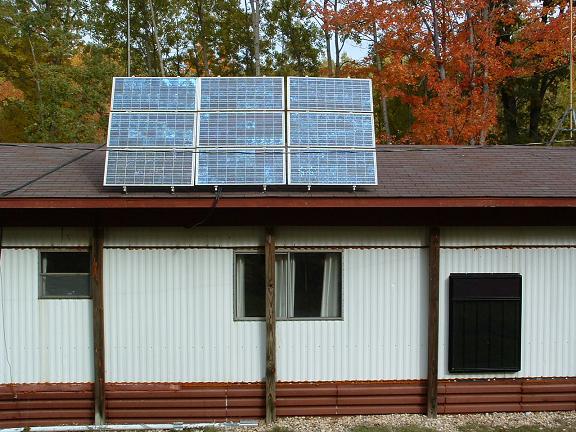
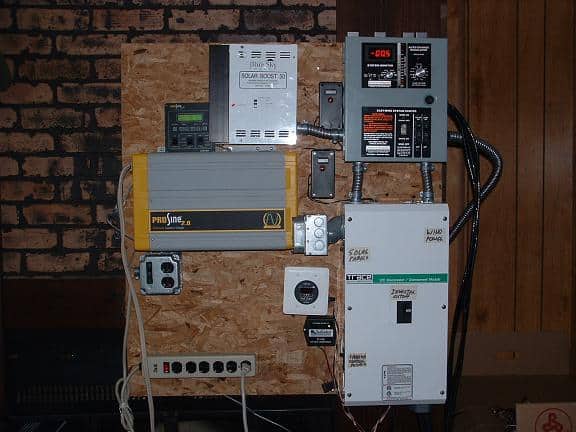
The large solar power setup is just like you see in magazines with solar panels on the roof, a wall full of components and kids playing in the yard. I have 3 – 90W and 6 – 80W (total 750W) solar panels on top and a Solar Boost 50 (charge control), Prosine 2 (2 kW inverter), Xantrex breaker box, Link 10 battery meter (fuel gauge), 8 – Trojan L16 batteries (20 kW storage). All components except batteries and panels are mounted on 3/4″ plywood. This means that I have 3 major connections: solar panels, batteries and AC output from the board.

solar projects diy

This type of system is best bought as a kit – I bought the first 3 panels with an inverter and added the other solar panels and charge controller later. You get almost all the pieces – including roof mounting hardware for the solar panels and the right size wires.

The trick with building this system is to put most of the stuff on a plywood board. I set the parts on plywood and arranged it to my liking. The breaker box should be located close to all the other stuff to minimize wire length. I had my panels mounted on the ground for good snow removal but, after thinking about theft (nice shiny blue panels) I mounted them on the roof. I use a snow rake and angle the panels steep (70 degrees).

The best feature of this kit was the inverter. The inverter has an automatic transfer switch (the thing that goes click in a UPS when the power goes out) and 3 stage battery charger built-in. It is true sine wave (yes, had it hooked up to my scope meter). I added the breaker box because you just can’t get 300 amp DC rated fuses from the electric store.

solar projects diy

I normally use cheap grid power for running everything but, when the power goes out – its solar time. If you have heard neighbors say something like “I have 100 amp service” then this inverter gives you 15 amp service. You can run up to 15 amps at 100% duty, it will surge to 30 amps (4 kW). This inverter is not grid tie but, UPS (Uninterruptable Power Supply) tied. I have my fridge on this inverter in case of power outage.

Here is my little lead in on efficiency. My fridge (19 cf. Kenmore side by side) uses 1.12 kW a day, in 2 hours of sun – my panels will generate 1.5 kW – enough to cover my fridge power (and inverter overhead) use for a day. This fridge is 20% more efficient than every other fridge in its class (19-21 cubic foot). It cost $700 (USD) when I bought it. In the years that I have had it (about 8) it paid for itself in lower electric costs. It will always “pay you” to buy a new fridge.

Final Notes

Try to place the panels where they get sunlight, I should say “where they get the most sunlight”. If you have a tree that shades your panels at 2 pm – move the panels so that the tree shades them at 6 pm. I know that my roof space is limited but, I plan on getting the “best” light (10 am-3 pm) that I can. Losing energy in the winter because the tree shades at 2 pm is very costly (especially after all the money you paid for solar!)

SAFETY for the small system consists of not burning yourself with the soldering iron. The medium system has batteries that could weld your tools to the posts, wrap electrical tape around “good” tools used near the battery, have a tap for the post threads.

The batteries in my medium and large systems are flooded lead acid which means that I have to fill them with pure (distilled) water, I wear rubber gloves for this task and goggles. I also keep the family sized baking soda bucket nearby in case a mouse chews the corner (for water) – a lot of solution (more than a gallon) in a 120-pound battery. Lead acid batteries generate hydrogen gas which is explosive, a vented battery box is recommended.

The medium system uses a (cheaper, easier to find) flooded lead-acid battery, not the best type (AGM Absorbed Glass Mat or Gel Cell) for this application. Since it could tilt past 40 degrees (max fluid to cap angle) the solution can leak. I installed plastic inside the box to contain any fluid and am aware of this limitation in my system. The box is strapped to the hand truck for quick release to move into a truck bed.

The lead acid batteries that I used were bought before I found out about Edison batteries. Admittedly, the lead-acid battery has more power per pound than the Edison (Alkaline based Nickel-Iron) battery but, have become the “throw away” part of every solar power system. Edison batteries will (have) last for a hundred years, don’t sulfate, don’t break down (lead plate flaking) and if they run dry – simply refill. In fact, replacing the alkaline solution would only take Berky water and wood ash (lye is alkaline) solution. Last but not least – no chance for an explosion, does not generate hydrogen.

If you have read “31 Days to Survival” then you know that there is a chapter on alternate energy. I think that any of these systems will count for that day. Please share your comments and thoughts in the comments below.

You might also like:

K-Tor hand crank generator (pocket socket 1 amp usb) : Weekly Product Review

Filed Under: Power Generation

  • « Go to Previous Page
  • Page 1
  • Interim pages omitted …
  • Page 74
  • Page 75
  • Page 76
  • Page 77
  • Page 78
  • Page 79
  • Go to Next Page »

Primary Sidebar

Subscribe to Blog via Email

Enter your email address to subscribe to this blog and receive notifications of new posts by email.

Join 7,202 other subscribers
  • Amazon
  • Facebook
  • Substack
  • Twitter
  • YouTube

“Do more with less.”

– Minimalist proverb

Recent Posts

  • Just so you know
  • Weather Update for My Corner of Appalachia
  • Why I’m Ordering Ivermectin + Mebendazole Every Year
  • The Website’s Shutting Down (But Here’s the Plan)
  • You Are Hated! Start Training Like It!

Footer

Recent Posts

  • Just so you know
  • Weather Update for My Corner of Appalachia
  • Why I’m Ordering Ivermectin + Mebendazole Every Year
  • The Website’s Shutting Down (But Here’s the Plan)
  • You Are Hated! Start Training Like It!

More about me

Books I’ve written

Books I’ve read

Follow Me on YouTube

Follow Me on Facebook

Gear I Use and Recommend

Newsletter

Search this site

Follow me elsewhere

  • Amazon
  • Facebook
  • Substack
  • Twitter
  • YouTube

© 2008–2025 M.D. Creekmore · As an Amazon Associate, I earn from qualifying purchases.