• Skip to main content
  • Skip to secondary navigation
  • Skip to primary sidebar
  • Skip to footer

M.D. CREEKMORE

  • Blog
  • Books
  • Newsletter
  • Gear I Use
  • About
  • Contact
  • Facebook
  • YouTube
  • Blog
  • Books
  • Newsletter
  • Gear I Use
  • About
  • Contact
  • Privacy Policy

Blog

Long-Term Food Storage Tips for New Preppers

January 7, 2019 M.D. Creekmore

FOOD IN BUCKETSby Grayfox114

In today’s economic climate, finances are a major concern for everyone, but doubly so for the prepper or survivalist. Not only are we trying to maintain a semblance of normalcy in our everyday lives, but we are also attempting to put together a “kit” for another lifestyle altogether, a kit that will keep us alive when everything falls apart.

Generally, the first items purchased by a prepper are foodstuffs, and these preps can be made slowly and relatively inexpensively, over a long period of time, or one can bite the bullet and spend a fortune to “prep” quickly, and in today’s socio-economic climate, quickly is the byword.

This usually involves purchasing ready made and assembled food packs from some company offering a 5-gallon survival pail sufficient to feed you for anywhere from three weeks to six months (check this one out on Amazon.com), or by buying surplus MRE’s. Both of these are good options, but you are paying for convenience and there is a better and much less expensive option.

Having been a long time prepper, 25+ years, I was into long-term food storage at a time when options were few: Foods packaged for campers, very expensive, and MRE’s, always surplus and also fairly expensive.

I took it upon myself to put together my own food pails, stocked with items I and my family would eat, and to this day, many of the stored items appear to be store fresh! Before I go on, I want to assure you that there will be many negative comments on the methods I have been using and which I am proposing.

There will be flak about the nutrients being gone and spoilage, among other things. I cannot speak to the nutritive value of the items stored, but I can say they look and taste good, show no signs of spoilage. And this after 20 years in some cases!

I started my food storage program with three and five-gallon food grade buckets which I obtained from a bakery at a local market. These came with lids with a heavy rubber gasket. The buckets were taken home and washed thoroughly with soap and hot water. They were then dried, and the interior surfaces of the bucket, the lid, and the sealing gasket were all wiped down with bleach.

I then placed an unscented trash bag into the bucket, and I used one of two methods to purge the air/oxygen from the pail: Method #1, I dropped a piece of dry ice into the bag and then placed the items I was storing into the bucket. Most were left in their store packages, some items were repacked, such as bulk beans, rice, and flour.

These were placed into separate plastic bags and given their own small piece of dry ice. I added items until the pail was full, and then I lightly twisted the outer plastic bag closed. In a few minutes, the bag would swell, indicating that the CO2 being produced by the dry ice was filling the bag.

The air/oxygen had been displaced. At this point, I twisted the bag shut tightly, wired it closed and placed the lid on the bucket and locked it down. I did not use any oxygen absorbers or desiccants.  Method #2 was to set the pail up as indicated, and instead of dry ice, I used nitrogen from a commercial tank to purge the air/oxygen from the bags.

In addition to bulk items, the pails might also contain pasta, commercials mac/cheese, or any number of items packed in cardboard and plastic. A hose ran from the tank to the bottom of the bag, and when the bag swelled the hose was removed and the bag sealed.

Once sealed, these pails were labeled and dated and kept, at various times, in my workshop, garage, storage shed, and ultimately, in a cargo container that was “roofed over” for shade. All these environments were fairly stable temp and moisture wise.

To test the efficiency of this system, I opened some of these buckets that had been sealed many years ago. In none of the contents did I find spoilage or weevils, not in the flour, cornmeal or other grains. I did have weevils in ALL of the grain products that were stored in sealed buckets that had not been purged.

Canned items appeared to be ok, no swelling or rusting, but due to the ages of these items, I am leery of using them and will replace them. I should have been rotating them, but the items were in sealed pails that I was reluctant to open, so it’s my loss.

As they say about the pudding: My grandkids were visiting and wanted mac/cheese and we were out, stores closed. I opened a storage pail and removed two boxes of commercial mac/cheese, it cooked up great and there were no ill effects, none, other than “Any left?”  My wife and I have regularly used various cereals from storage, such as wheat & oatmeal and they are good also.

The sugars and honey I store will last forever, and I don’t think they lose their nutritional value. It appears that my storage system works well, but to address the nutrition issue, I also store multivitamins, and while I don’t really see a need for them, it can’t hurt.

A quick note on dry beans: I have heard that after a few years of storage they become non-palatable, even after cooking. They stay hard and impossible to chew. The remedy for this is to place the cooked beans in a pressure cooker for a few minutes after cooking to soften them up, and they will be as good as fresh.

As for water, more valuable and necessary than food, I have filters and tablets, but I use a homegrown system for storage. As my wife uses bleach, she gives me the empty plastic bottles. They are filled with water without being washed out and are stored as is. I have drunk water as old as 20 years….no odor or algae, and while flat, shaking to aerate took care of the problem.

This water was from a home well and was not treated in any way before being stored, and I suppose city water, treated, could be stored the same way. The bleach bottles are stored alongside the food pails, and I have had no issues with the plastic bottles degrading or becoming brittle.

On a final note, I use food grade pails for storing my matches and lighters, lantern mantles, and other items which might be moisture sensitive. A desiccant is added, but the pails are not purged. And for soaps, shampoos, scented candles or other items which “smell,” a food grade bucket is ideal for avoiding contamination via “osmosis.”  I store these pails in the same area as my foods and have found no contamination present.

This article deals with preps that I have made over the years, and most were done “on the cheap,” but they have served me and mine well. And while I realize there are commercial alternatives available for long-term storage of food and other items, I find “rolling my own” and saving forty to sixty-dollars to be much more fun.

Also, read M.D. Creekmore’s detailed article on long-term prepper food storage… and his article on How To – Plastic Buckets, Oxygen Absorbers, Mylar Bags…

Filed Under: Prepping

How to Make a Fire in The Wilderness

January 7, 2019 M.D. Creekmore

How to Make a Fire in The Wilderness

by Richard Grimes

No discover since the beginning of time has been more important to the development of mankind, then the discovery of Fire.  The simple presence of fire added to the routinely “normal” day in the outdoors instantly adds the feeling of safety to any situation.  In any severe or extreme condition, the presence of fire literally means life.

There are many ways to start a fire.  They all have the same effect.  The Boy Scout Handbook states, “A fire can warm you, cook your meals, and dry your clothes.  Bright flames lift your spirits on rainy mornings.  On a starry night, glowing embers stir your imagination.”  (Birkby)  The base items needed to build all fires are, Tinder, Kindling, and Fuel.  Each of these must be collected and be prepared before any attempt to build the fire.

These three items are common to all fires.  Tinder is material that catches fire easily and burns fast.  Wood shavings, pine needles, dry grasses, shredded bark and the fluff from seed pods all make good tinder.  You should gather enough to fill a hat.

Kindling is dry, dead twigs no thicker than a pencil.  Gather enough to fill a hat twice.  Fuel, fuelwood can be as thin as your finger or as thick as your arm.  Gather dry dead sticks and limbs.  When gathering fuelwood remember these three rules.

One, you must always have at least 3 sticks in the fire at a time or it will go out.  Two, if you want to burn one, 3” stick, you need to have three 1” sticks burning first.  Three, gather twice as much fuelwood then you think you’ll need.  Once you have all of these items collected you are ready to begin building your fire.

In every case covered below, you will use your “source” to ignite the tinder, which will ignite the kindling, which will ignite the fuelwood.  The effect is always the same regardless of the cause of the initial item(s) used to generate the initial ember, spark or flame that actually starts the fire as these take many forms.

Most Common Ignitors

The most common and easiest items used to start fires are matches and cigarette lighters.  Matches work by striking them against a special surface in order to get them to ignite. The match heads contain sulfur (sometimes antimony III sulfide) and oxidizing agents (usually potassium chlorate), with powdered glass, colorants, fillers, and a binder made of glue and starch.

The striking surface consists of powdered glass or silica (sand), red phosphorus, binder, and filler. When you strike a safety match, the glass-on-glass friction generates heat, converting a small amount of red phosphorus to white phosphorus vapor. White phosphorus spontaneously ignites, decomposing potassium chlorate and liberating oxygen.

At this point, the sulfur starts to burn, which ignites the wood of the match. (about.com/chemistry).

Cigarette lighters work by rotating a steel wheel that is in contact with a flint.  When the wheel is turned the flint produces a spark which ignites the stored fuel in the lighter creating a flame.

Either of these when applied to the Tinder will result in a fire being started.

Metal Fire Starters

Magnesium and flint fire starters are also very common.  A piece of flint approximately 1/8” x 3” will be attached to a piece of magnesium that is approximately 5/8” x 1” x 3”.  It works by scraping a small amount of the magnesium from the block onto your tinder.  (Magnesium burns at 5000 degrees Fahrenheit.)

You then want to strike the flint in a manner to create a spark that will be thrown into the magnesium and tinder.  This is done by holding the bottom of your knife blade directly over the tinder and magnesium.

You then place the top rear portion of the starter against your knife blade.  Then holding the fire starter firmly with under your knife blade you draw the started backward quickly.  This produces a spark that flies forward from you knife blade into the tinder and magnesium.

If you attempt the hold the starter still and create the spark by moving your knife forward across the starter you will most likely know the tinder all over the place.

Wet Weather Starters

Wet weather creates a particular challenge when trying to start a fire.  I have found that taking cotton balls and coating them with Vaseline works wonderfully in wet weather.  You can fit about 10 coated cotton balls in a 35mm film can.  They work by removing one cotton ball from the can and stretching it out until the cotton ball is very thin.  Using any of the above methods to light the cotton ball will result in a small steady flame that will burn upwards to 8 minutes.

Lightning was probably the cause of the first fire that man ever got to enjoy.  If you have got the time, lightning may start your next fire for you too.  Otherwise, it would be smart to be prepared with a few of the items listed here to help you build your next fire.  It could well mean the difference between life and death for you.

Filed Under: Bushcraft

Simple Homemade Cleaning Products That Work

January 4, 2019 M.D. Creekmore

homemade cleaning products

by Lynn T

My first prepping goal was to stock a year’s worth of everything we normally use that has a year plus shelf life. This took a few months but we were able to accomplish the goal.  (We did allow for freezer storage for this interim goal, so we’re really more prepared to not have to buy groceries for a year than being REALLY prepared a major long-term disaster.

One thing I noticed is that the storage takes up A LOT OF ROOM!  We have a bedroom, a walk-in closet, an upstairs ‘landing area’ plus several other small areas for all of the storage.  We want to downsize when we buy land soon, so I’ve been trying to figure out how to streamline as much as possible.

Over the past several months I have also started getting more concerned about many of the chemicals we bring into our house and decided to try some of the homemade green cleaners I’ve read about.  After using a few of them I realized how much less storage space they take up.

Most of the homemade cleaners utilize common ingredients, so you could theoretically make all of the cleaners you need from a pretty short list of storage items.  I also realized that most of the ingredients are a lot cheaper than buying pre-made cleaners.

There are a few items that require an upfront investment (like essential oils) but the amount used in these is very small so they will last a very long time.  They are also better for your family and the environment.

I’ve spent a lot of computer time looking for recipes.  I read reviews,  cross-searched ingredients to find other sources that use the same ingredients for cleaning, and looked for multiple blogs/forums/sites that ‘touted’ identical or very similar recipes.  I compiled a group of recipes for my Home Notebook and would like to share these with you.   I’ve also included an ingredient list explanation at the bottom.

Disclaimer:   Although we have made and currently use several of these, I have not tried all of them.  We are still in transition because we have so many products in storage.  I wanted to give credit for the recipes, but since I didn’t save the sources when I copied them, and since I visited many sites with the same recipes, I wasn’t able to find many of the real sources, so my apologies!

Homemade Cleaners

Lavender Anti-Bacterial Spray

– 1 Cup water

– 20 drops lavender essential oil

It smells great and lavender is naturally antibacterial.

All-Purpose Cleaner

– 3 Tablespoons vinegar

– 1/2 Teaspoon washing soda

– 1/2 Teaspoon castile soap

– 2 Cups hot water

It’s a great daily cleaner on everything from counters to floors.  Be careful when mixing this.  It will bubble a lot . . . . so don’t double up to fill up your containers!  And mix over the sink just in case.

Scouring Powder

1 – Make a paste of baking soda and warm water

2 – Make a paste of baking soda with a few drops of castile soap and warm water

Grease Cleaner

– 2 Cups water

– 1/4 Cup castile soap

– 10 drops lavender oil

Bath & Sink Cleaner

This makes a thick paste-like cleaner.  So use a squirt bottle (like a plastic ketchup/mustard bottle from the dollar store)

– 2/3 Cup baking soda

– 1/2 Cup castile soap

– 2 Tablespoons vinegar

– 1/2 Cup water

– A few drops of Tea Tree oil

Dishwasher Rinse Aid

Use plain white vinegar in the rinse aid compartment.

Dishwasher Soap Recipe

– 1 cup borax

– 1 cup washing soda

– 1/4 cup kosher sea salt

– Two packets of Unsweetened Lemonade-Flavored Kool-Aid

****Only lemon, other flavors will dye your dishwasher!****

Put all of it in the container and shake it up.  (It tends to get clumpy after sitting but a good shake will loosen it up).  Per load, you only need a tablespoon or so into each cup of your dishwasher.  I read that is can leave a film on dishes if you don’t use rinse aid.  So use the vinegar in your rinse aid compartment OR in the bottom of the dishwasher.  It was also recommended to wash on the hot cycle. Source:  decorganizecrafts.blogspot.com

Homemade Fabric Softener

– 6 cups HOT water

– 3 cups white vinegar

– 2 cups Suave Refreshing Waterfall Conditioner {or another favorite scent}

Mix conditioner & hot water well, until conditioner is dissolved completely.  Add the vinegar, and mix well.  Store in a large container {empty fabric softener container, empty large vinegar bottle, etc}  Pour into a downy ball… or use approx. 2 tbsp. in the fabric softener spot in your laundry machine… then wash!  Source:  thefrugalgirls.com

Homemade Laundry Detergent

– 1 5.5 ounce bar Fels Naptha soap

– 1/2 cups washing soda

– 1/2 cups borax

– Water

Using a cheese grater or food processor, grate the entire 5.5-ounce bar of Fels Naptha, finely.

Powdered laundry detergent: In a container that has a tight-fitting lid, combine the grated Fels Naptha, washing soda and borax. Stir to mix well. Store in a sealed container that is properly labeled. Use 1 to 2 tablespoons in a front-loading machine, and up to 1/4 cup in a top loader. Note: The amount required depends greatly on the hardness of your water. Experiment by using the lesser amount, and then increase as necessary. Cost: About 15 cents per load when using 2 tablespoons.

Liquid laundry detergent: Place grated Fels Naptha into a cooking pot. Add enough hot water to cover and heat over low heat, stirring, until soap is melted, not boiling. Remove from stove and pour into a large bucket that has a lid. Add washing soda, borax and 3 gallons of hot water. Stir until well incorporated. Cover and allow to sit overnight. In the morning stir again. Use 1/2 cup to 1 cup per load, experimenting with the lesser amount to start, and then increasing as necessary. Note: The liquid version will be “gel-like.” Some call it gloppy and gelatinous. This is normal. Simply give it a quick stir before each use. Cost: About 3 cents per load using 1/2 cup.

What, no suds?! This detergent does not produce suds. Suds should never be considered visual evidence that a detergent is working. Dirty water is the sign that the detergent is doing its job. Because it does not create suds, this is the perfect product to be used in HE front-loading washing machines. 

Source:  debtproofliving.com

Foaming Dish or Hand Soap

Re-use your foaming soap pump container!  Mix your choice of liquid dish or hand soap with warm water at a ratio of 5:1 (water to soap), mix gently.

Homemade 409 Recipe

– 2 Tbsp. Distilled White Vinegar

– 1 Tsp. Borax

– 1/8 cup Dawn Dishsoap

– 1 cup Hot Water

Pour vinegar, borax and hot water into a spray bottle.  Then continue filling the spray bottle with cool water.  Add Dawn last. {no need to shake}  Source:  thefrugalgirls.com

Homemade Glass Cleaner

– 1/4 c. rubbing alcohol

– 1/4 c. white vinegar

– 1 Tbsp cornstarch

– 2 c. warm water

Combine everything in a spray bottle, and shake well. Shake well before using, too, as the cornstarch might settle at the bottom (and subsequently plug the spray mechanism if it’s not mixed in well).  Source:  crunchybetty.com

NOTE:  when beginning to use vinegar (plain or 50/50) to clean windows and mirrors after having used commercial glass cleaners, it may be necessary to add several drops of dish washing liquid to your solution for the first few cleanings to remove the buildup from the surface.  I’m not sure if the cornstarch has the same effect or if the dish soap still needs to be added the first few times.

Homemade Furniture Polish

– Olive oil, walnut oil, or jojoba (my preference as it doesn’t go rancid)

– Water

– Lemon juice

Blend 1 teaspoon oil, 1 teaspoon water, and a squeeze or two of lemon juice in a small bowl. Place a small amount of the mixture on a soft cloth.  Wipe the polish onto a piece of furniture and give it a good buff.

The oil leaves furniture with a glossy shine, while the lemon juice cuts the oil so it doesn’t go rancid (as well as giving a fresh scent that lingers in the air). NOTE: a small amount on the cloth goes a long way!

Make the mixture as you go, so as to create less waste. You don’t want to leave this mixture sitting around because it will probably go bad before you use it again.  If you want a more shelf stable version, use jojoba and replace the lemon juice with white vinegar.  Use Olive or walnut oil to polish food surfaces (cutting boards, serving platters, wood bowls, etc).

Ingredients

  • Lavender Essential Oil – Essential oils can be found online or at health food stores.  I bought a collection at Sprouts Market on one of my trips to town.  They are pricey but the small bottles last a LONG time.
  • Tree Tea Oil – can be found at a health food store and at most drug stores.  Tree Tea oil has a lot of other uses around the home.  But it has a very strong odor!
  • Castile Soap – an all natural soap that is also very strong so a little goes a long way.  I use Dr. Bronners and found it at CVS.  It is also sold at health food stores and I believe Target.
  • Washing Soda – Sodium Carbonate is a strong base that works great as a laundry detergent and has a ton of uses around the house. I use Arm & Hammer Super Washing Soda, found in the laundry section of my grocery store.  NOT TO BE CONFUSED with baking soda!
  • Borax (Sodium Tetraborate)– is a natural mineral compound.  According to a chemistry.about.com article, it has many uses in the home as a natural laundry booster, multipurpose cleaner, fungicide, preservative, insecticide, herbicide, disinfectant, dessicant, and ingredient in making ‘slime’. Borax crystals are odorless, whitish (can have various color impurities), and alkaline. Borax is not flammable and is not reactive. It can be mixed with most other cleaning agents, including chlorine bleach.  I found 20 Mule Team Borax in the laundry section of my grocery store as an ‘all natural laundry booster and multi-purpose household cleaner’.
  • Jojoba oil – is actually a wax ester.  It is all natural, shelf stable, and is non-comedogenic.  It has many health uses, including eye make-up remover, lip balm, massage oil, moisturizer.  I found organic Jojoba at a health food store.
  • Fels Naptha soap – this is a laundry soap found in a soap bar.  Many people experience difficulties in finding it, but I found it in the laundry section at my local (rural) grocery store.  It is also supposed to be good for poison oak and ivy.  HOWEVER, this is not an all natural/pure solution.  Many people have said they substitute Kirk’s Castile Bar soap, ZOTE!, or even ivory if the ingredients in Fels Naptha bother them.

Filed Under: Uncategorized

How To Build A Solar Powered Off-The-Grid Refrigerator

January 4, 2019 M.D. Creekmore

off grid refrigeratorBy Michael C

I noticed that many people on this blog want to store milk, vegetables, seeds, and medication in a refrigerated atmosphere but have yet to buy 2 refrigerators.  Remember the “two is one and one is none” motto; you need 2 ways (or more) to cool your food.

You could make a Zeer pot like I did but there is too much humidity and the pots aren’t big enough for 2 gallons of milk.  I can’t buy another (let alone storing a 19 cubic footer) $700 fridge as a spare.  The other problem is – I might not have AC to use in the future, regardless of all the solar panels I have.

So, I needed a small DC powered fridge that will hold at least 2 gallons of milk and some other stuff.

I thought of what MD Creekmore would do – a “Do It Yourself” project.  (Mr. Creekmore has a propane fridge (read his book on living in a travel trailer) but, even though he is a great inspiration, I want to limit my power needs to solar since that is the only long-term solution and also because I have solar)  Just like the “MDC made” water filter or electric generator – a person can make a refrigerator.

Of course, there will be some technical discussion of the actual properties of said fridge.  It will be a bit more involved than the water filter project and, for good reason – you want something a bit more complex.

My most important consideration is that it can be serviceable by me, so, the fridge is not going to use Freon.  I am going to use a “Peltier junction” cooling unit – already built for the purpose.  These units are less efficient heat pumps than an evaporator/condenser cooler but are solid state, small, low power and can be ganged together for more cooling power.  Did I mention cheap? At only $35 per unit – you could buy 2 and have one for a spare.

I added fans to the Peltier heat sinks (see photo) and they are the only moving parts.  They are blowing air “into” the heat sink – an important point here; there is more exposure to cooling air than trying to suck air “out” of the fins.

You can have lots of spare fans and they are easily replaced.  I wedged some round head screws between the tapered fins to mount the fans on each heat sink.  The power cord goes to a car cigar plug (negative ground) with a 10A inline fuse.

For anyone who is not familiar with the Peltier device – it is a heat pump that is made like a silicon chip.  A DC electric current will get the chip to “pump” heat to one side of the chip leaving the other side cold.  Heat sinks (and fans) help to distribute the hot and cold.

The second part is the “containment box” that would consist of the good ol’ beer casket – where they get an icy bath until they meet their drinker.  Yes, a cooler, the cooler I selected is 18″ x 10″ x 10″ (1.07 cu. ft. approx.) about 20 quart.

A cooler has all the “fridge” properties like waterproof food grade inner walls, foam wall insulation (except the lid), rugged dent resistant outer walls.  The other benefits of the cooler are: lightweight, portable and you probably have them lying around in a corner from all the camping trips.  This cooler will actually fit 3 gallons of milk but the 2 side containers will touch the walls.

Now, a cooler can be expected to work as good as a cooler was designed to work – it melts 2 bags of ice keeping 12 beers cold for a couple of hours.  I figured that I would improve the efficiency a little bit.  I also figured that this could make for a great article so I wanted to gauge any progress I made.

I decided to use a 7 dollar temperature monitor with remote sensor, which eliminates the “open fridge door” variable in checking the temperature inside.  The sensor was taped to a plastic box (see photo) to keep it off the “floor” of the fridge so that air temperature only would be measured.

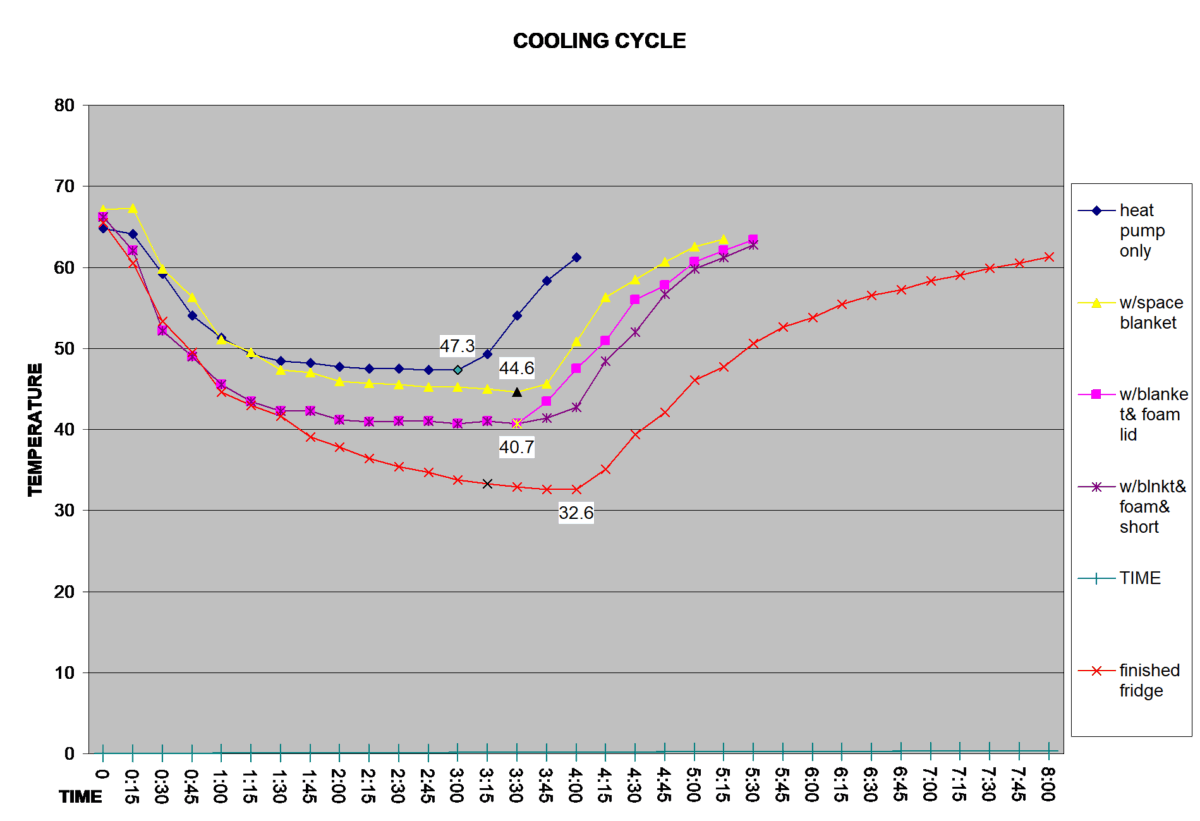
Now, what to check, since I am designing a fridge; the “cooling cycle” is the metric to gage.  This just records the temperature as the fridge runs – how fast it cools. The other metrics are – lowest temperature and the “warming cycle” which is keeping track of the temperature after the cooler is shut off.

As I add insulation I will keep track of how the numbers stack up.  The lowest temperature is the temperature when loses (heat gain) are equal to cooling effort.  The cooling effort is (approximately) 60 Watts – that is what the heat pump and both fans consume.  (A person could mount 2 cooling units which would double the total cooling power)

The first task involved adding the Peltier unit to the cooler.  The smaller top heat sink has 2 “fins” that slide out from the grooves on the side.  I cut the hole (to the size of the smaller, top heat sink) into the plastic (see photo) with a metal Stanley cutter; the cover is really thick in some areas.

I tested the “bare fridge” (see graph) and found that I could only get a 17F degree drop in temperature.  The graph shows a fast rise after the heat pump is turned off and the lowest temp (47F) does not really work for keeping milk cold.

The second test involved adding a cheap space blanket (see photo) to the outside of the cooler.  I used cellophane tape to attach an old (12 year) Mylar space blanket to the top and bottom of the cooler.  The improvement was noticeable; the test ran longer as the heat pump was shaving 0.3F and 0.2F bits for a while.  As long as the temperature kept falling – I would run the cooler.

off grid refrigerator

Next I foamed the cover (see photo) and then tested (see graph) a third (and fourth time), the low temp was now down to 40F deg. – good enough for milk.  The fourth test was exactly like the third except for shorting the Peltier leads together at shutoff, this extended the cool time about 35 minutes at the low end.

Doing this made the Peltier junction “fight” the temperature change with its own electric generation thru “temperature difference”.  (This efficiency improvement would be – adding a switch to shut off/short leads)  Adding expanding foam to the cover was the biggest improvement made, so far, and the cost was small – just 4 bucks.

The poly-urethane foam did not stick to the poly-ethylene cover so clean up was easy.  The cover is easy to foam after you have cut the hole in for the heat pump.  All the later trials do not vary in the first hour of testing – proving that the foam insulation was a big factor for the fridge.

The next step was to replace the old space blanket with a much better insulation solution.  The blanket was interesting but, contains no insulation, just pure heat reflection and with only an 80% rate.  I first added aluminum foil (used for grilling) to the top and bottom of the cooler.

I wrapped a heavier space blanket around the cooler then doubled the blanket over a fiberglass batt wrapped around the cooler.  The space blanket will “seal” the fiberglass in a sandwich and also serve as a double reflective layer.

I used duct tape to hold the foil against the sides and for the blanket seal.  The foil gives 100% heat reflection but tears too easily, the blanket and insulation “press” the foil against the cooler wall and protect it.

The testing (see graph) shows that the “NASA cooler” can now drop down to 32 F.  It also took almost 4 hours to warm up to 60F.  A side benefit of the added insulation is that sound levels are down by half, can’t hear the fan inside.

Things to ponder

This fridge is meant to be run on solar power (click here to read an article about making a portable solar power station) – just one sixty Watt panel (direct connected) will provide all its power during the day.  At night – one can use a battery or plastic “ice blocks” to help keep the cold temperature.  A 100 Watt solar panel (this 100-watt solar kit is great – check it out at Amazon.com) would provide enough power for the fridge and a battery.

I do not have temperature regulation – Peltier cooler does not stop at a pre-set temperature.  Right now the cooler cannot go below the freezing mark (32F/ 0 C) no matter how much it runs since it does not have enough power but regulation could be added if saving power became paramount.  Remember this fridge was homemade and can always be upgraded.

I only measured the air temperature (see chart) inside the fridge; milk (and all other things) will take longer to cool down, maybe 6 hours (per gallon of milk) with this unit.  It will also take longer to warm up – a cold gallon of milk will help chill the next gallon of warm milk.

I could reverse the cooling into heating by adding a small “bridge diode” to the fan leads and putting in a reverse-able coupling.  The Peltier unit comes with a connector – you would need to find the cord to fit the connector.  Of course; I already have a solar cooker.

You could go out and buy a cooler with the Peltier unit inside although I think that it would cost a little more than my unit.  It might be a quite a bit less efficient (no space blanket heat reflection) and the parts replacement will be a question.

Parts list

Free          cooler (18″x10″x10″ size I used, yours can be different)

$35           PJT-10 – Large thermoelectric device (allelectronics.com)

$6            2X CF-390 – 80mm cooling fan ($3 -allelectronics.com)

$4            can expanding foam (hardware store)

$1            about 8.5 ft. of thin aluminum cooking foil (free)

$13           CW B250 Space (brand) blanket ( EE beprepared.com )

$3            about 8.5 ft. (4 X 16”) fiberglass Insulation (hardware store,

———-        I had this laying around too)

$62

I know that this fridge does not look “commercial” and I would not blame you if you bought a nice $1400 “Sun Cooler” DC fridge but if your Sun Cooler gives out – you now have the skill to convert a cooler to a fridge.

Well, what do you think?

Filed Under: Power Generation

How to Keep an Old House Warm in Winter?

January 4, 2019 M.D. Creekmore

keep an old house warm in cold weatherby Repair Mama

I just wanted to do a post on trying to save money by making your home cost you a little less.  Why give your money to the utility when you can use it to prep.  They get enough of our hard earned dollars as it is. I have used these methods for years, (my older home is a nightmare)

Doors and heat loss…

Your home has 2 ways to lose heat in the winter.  Air infiltration, and heat loss.  Doors and windows are usually the biggest loss factors in heat loss. Air can leak in causing cold spots and the heating system to run longer to make up for the cold coming into the home.

First, we will deal with the doors leading to the outside or unconditioned spaces of your home.  Weather stripping is a must!  To do a cheap test of the doors, use a lighter or if you smoke, a cigarette and place it close to the cracks where the door meets the door jam.  If the flame flickers, or the smoke moves, you have air infiltration.

This is a place that needs weather stripping.  The package of stripping purchased at the hardware store is not expensive (I have even used thin strips of cardboard or other materials staple-gunned into place when I could not afford the stripping).  The package will have installation instructions so you can figure out how to use the product.

After you install the stripping, retest the door.  Did you find a major leak at the bottom?

I do every year.  This is usually the big problem spot.  Even with a storm door, this area is a big problem.  Here you can install a thing called a door skirt.  It is a metal strip with a rubber strip at the bottom.  You will have to measure the door and see what length of skirt you need.

Most commercially purchased exterior doors come in 32”, 34”, and 36” (wide).  Cut the door skirt with a pair of metal snips, position the door skirt along the bottom of the door remembering to push down to make the rubber contact the door eliminating the air leak and screw that puppy into place.

You can seal the top of the door skirt to the door with silicone caulk but is not totally necessary.  Now that should take care of the major leaks in the exterior doors.

Sometimes, I find it necessary to lay a large towel between the storm door and the exterior door to further cut down on air leaks, but this is annoying if done to a door that you frequently use.  I do this on the doors that I don’t use much. (I have 3 doors leading to the outside, but we usually only use one of them).

Do you have an air leak at the door jam trim where it meets the wall?  If the gaps at the trim are small, caulk is the answer here.  They make a paintable latex caulk that comes in white that can be used here.  I purchase mine at the Dollar General Store for about $2.00 per tube. The caulk will fill in the crack making it less likely to leak cold air.

If the cracks are large, you can fill them in with fiberglass insulation by pushing in small pieces with a butter knife and then filling with a spray foam product that will expand and dry, or caulk.  Do you have a large window in this door?  Is the glass single pane or multiple panes?

When you touch the glass, is it very cold?  Can you feel cold radiating from the glass when you stand close to it?  If so, the only thing I can suggest here is a very thick window covering or curtain.  I have small windows on my doors and have them covered with quilted curtains.  My little windows don’t radiate much cold, but I cover them anyway.  The thick quilted curtain acts like a layer of insulation that holds the cold at bay just a little.  Every little bit helps.

Now that the doors are airtight and the glass is taken care of, look at the storm door from the outside.  Is there anything you see that can let air into the exterior door?  Any air leakage stopped here will not make it to the main door or into your house especially on a windy day.  Cracks can be caulked and stripping can be done to stop air leaks.  Adjustments to the door latch can make the door close good and tight here is desirable.

If you have a screen door that is not metal and glass, the whole area of screen is like an open window.  I have in the past covered the screen with thick clear plastic to stop the majority of air flow.  It is not really attractive but will help with the cold blowing air.

Next, let’s look at the windows…

What kind do you have?  Windows come in a variety of ways depending on the age of your home or if they were updated ever.  My home used to have the wood frame, single pane windows that were very common in older homes.  The panes of glass were placed in and “Glazed” or puttied into place.  These are some of the most inefficient types of windows you may have next to say jalousie windows.

One pane of glass between you and the cold outside is a major source of heat loss in an older home.  I hope that if you have this type of window that an external storm frame and window is in place on the outside of your home.  They do help some.

Some of the storm windows had additional screens that could be put in to keep bugs and such out in the summer, and the glass pane that could be put in for winter or bad weather to keep air and heavy rain away from the outside of these wooden window frames.  If this is the type you have, here is what we need to do.

Look at the individual panes of glass, are any broken or missing?  If so, we need to replace the pane or at least tape over the cracks.  Is the caulk, putty, or glazing missing where the glass meets the wood of the window frame?  If so, re-caulk the cracks and make the seal airtight.

Keeping the air from coming into the house is what we need to do in this step.  Is the storm window in place, or is the screen still there? If the screen is still there, place the glass pane to the bottom, or if the glass is missing, cover the screen with plastic to block the wind from blowing into the window.

Are there cracks or gaps around the outside frame of the storm window?  If so, stuff the cracks with something, or caulk them into place.  I use silicone caulk here, water doesn’t affect it much.  Silicone cannot be painted but does come in clear or white.  This will seal up another source of air leakage.

Can you open the wooden window?  If so, you can place a small, thin piece of the same foam weather stripping that you bought for the doors along the bottom where the pane meets the window sill.  Then close the window tightly down onto the stripping to seal up that air leak.  Use the lighter or the cigarette and check the window and window trim for additional leaks.  If air is leaking around the window trim, use the latex caulk and stop that air from coming in.

Now, let’s look at the blinds and curtains…

Winter is a good time to take down the light and airy ones that you may use in warmer weather.  Vinyl backed drapes are good for the winter months, but you may want to go a step farther.  Windows are not insulated like the walls of your home and are a large part of heating loss.

Think of the window as a thin place in the wall that the cold can come in.  What do you have in the house or garage that can make the windowless cold.  Insulation comes in many non-traditional forms.

You want to find material that does not conduct heat or cold well.  Fiberglass insulation, Styrofoam panels or pieces, thick quilts, foam rubber like in couch cushions, or the like.  These things can be measured or assembled to cover the entire inside of the window frame to keep the cold out.  It will make for a darker house, but the savings on the heating bill might make it worth dealing with.

Here’s what I have done as an example…

I have used fiberglass insulation measured to fit the window and placed down inside of a large black contractor grade trash bag (to keep the fiberglass fibers from getting all over everything and making me itch) and place over the window.  I fit it to the inside of the window trim so it does not stick out past the wall and use the spring-loaded café curtain rods to hold it into place.  This cuts the air infiltration to almost nothing.  The window does not exist.

This is also good for blackout situations.  You can pull up a corner of the bag if you need to see out but will block out all light from being seen from the outside of the house.  If the area is under a power outage, the people around you will not know that your lights are on.  Cool HU?

Now you can top off with a layer of plastic to cover the entire window if you want to or just put the curtains back up.  The room will be dark, but look normal. Normal is good.

This week I was dealing with my windows before the cold blast came in that was forecast for us.  I did not have any fiberglass insulation handy, so I went to the garage to see what I had to use.  I found Styrofoam panels stored there for just this type of thing.  They were 15”x20” and my windows were larger than that.  I laid the panels on the table in the kitchen and measured out what I needed to cover each window.

The panels were cut to fit, and taped together with clear packing tape.  I looked around the house again for more materials to finish my project and found cases of disposable bed pads that were ordered for mother’s bed.

She is gone now, so I don’t need them for the purpose intended.  I opened a pack of these (the backs are white) and placed them over the foam panels that I had made and stapled them into place onto the foam.  Tape could also have been used, but I am deadly with a staple gun!  Once the panels were completed, I placed them over the glass in my awful windows and pulled the mini blinds down over them to hold them into place.

White shows through the glass to the outside of the house like drapes, so it does not look strange and the rooms are warmer now.  I finished off the inside of the window with heavy winter drapes, and that project is done except for the large window in the living room.

This window is too large for the amount of foam boards that I had left.  So I went hunting and found some old ugly drapes sister in law gave me some years ago.  I cut the pleated tops off and turned them over.  I took down the drapes already over this window and matched the vinyl backs to touch each other and stitched them together along the top just below the pleated tops of the newer ones.  If one set of drapes are good, 2 layers are better.  They move together when opened and will hang on one rod with one set of hooks.

They look normal but are warmer.  Under the drapes, I have another rod firmly mounted to the wall and have added a set of “S” hooks like you would find on the end of rubber bungee cords.  I save the hooks after the bungee has broken.  I have here a large, old bedspread that covers the entire window.

I make some holes in the bedspread and slipped the S hook through the holes to hand this under the drapes.  Another layer of insulation to keep the cold out.  Close the drapes and the living room looks normal from the inside and outside.  Project complete!

I know there are many other things that will need to be addressed to keep from having to give the utility money, but this kinda takes care of windows and doors.  I will follow with more posts to cover plumbing, water heater, attic, crawl spaces, and basements.

Insulation and air leaks are the majority of all of these posts.  Every dime you spend on insulation will pay for itself over and over.  Just remember it is all about comfort and saving money.

Plumbing and Pipes…

There is nothing worse than having the pipes freeze and bust in the extreme cold weather.

This could lead to a very expensive repair bill, or a wasted weekend having to re-plumb your home due to busted water lines.

There are many types of pipes that you may find in your home.  Galvanized steel, copper, cpvc, pex, and such.   I know more about the cpvc than the other types of pipes.  Cpvc will freeze and bust at 19 degrees if not insulated and protected.

The first thing to address is pipe insulation.  The most common type found here is a black foam style that comes in 6ft sections that are split down the middle lengthwise.  Some types will have an adhesive along the split to stick it back together after it is placed on the pipe.

It comes in many different sizes line ½”, ¾”, and 1”.  You will need to know what size your pipes are and purchase what sizes you need.  You need to know about how many feet to purchase.  You can return pieces that you don’t use if you purchase too much. The most common tools and materials that you will need for the insulation is a razor knife or carpet knife.  A serrated butcher knife or scissors can also be used to cut the insulation pieces.

A cheap roll of black electrical tape, and tape measure.  Most pipes in this area are in the crawl space, or in the basement.  Look and find where the main water line comes into the house and start there.  This is where the 200PSI black plastic pipe will come in from the meter in the yard.  Find where the pipe enters the foundation.

Place the pipe into the slit and close the insulation around the pipe.  Use the electrical tape around the insulation to hold it together.  Wrap around 2-3 times and move on to the next piece. You do not have to tape up the entire piece of insulation.

Tape at ends and maybe in middle but that is all that is needed.  If the pipe is shorter than the insulation and comes to a tee or elbow, cut the insulation in 45-degree elbow or whatever is needed to cover the fittings or terminations and seal up with the tape.

You will use quite a bit of tape, but it is cheap and goes a long way. Work your way and cover all of the pipes. Tape the insulation at the ends and around the fittings to keep the pipe from being exposed.  This will protect you a little better from the pipes freezing and bursting due to the cold.

Another thing you can look into is a product called heat tape.  Lowe’s or Home Depot will carry this product and can give you some instruction on how to install and use.

It will need electricity to work, so read the package to get an idea on how to install and the power requirements.

The insulation on the pipes will help protect from freezing, but another benefit of the insulation is not losing as much heat from the hot water line when you run the water to do dishes or take a shower.  Any pipes ran in an unconditioned space is susceptible to heat loss.  The cold pipe will take the heat from the water, causing you to use more on the hot water tap to get the desired temp at the faucet.

Insulation blankets for water heater tanks can be purchased at the hardware store.  It is a fitted blanket to fit the outside of the water tank to keep the water from losing heat as fast.  This will keep the elements from having to work as hard and keep the electric usage down a little bit more.

Another usage saving idea for the water heater is to adjust the tank temperature down a bit.  I have had customers in the past that want to crank the temp up as high as it will go.  Water heaters are now preset at 120 degrees to prevent scalds but can be adjusted up or down by the homeowner.  The cooler the setting on the tank, the less fuel or power it will need to use to maintain the temperature.  Thus saving money.

Water savings can be upgraded by using less water if you are on a meter and have to pay for what you use.  Water saving aerators can be added to the bath and kitchen sinks to cut the gallon per minute rate back. Water saving shower heads can also be purchased inexpensively and installed as well.

As a water-saving measure in my home, I added a ½” ball valve to my shower arm before the shower head was put into place.  This way, during a shower, I can leave the faucet settings where I like them and turn the flow of water down or off at the shower head when the water is not needed.

I don’t need the shower head running the water down the drain while I am shaving legs or shampooing my hair before rinsing.  This cuts down the amount of wasted water and I still get clean.

A ½” brass ball valve costs around $5.00 and screws right onto the chrome shower arm with just a bit of Teflon tape.  Use a short ½”xclose brass nipple on the other end and then reinstall the shower head with another bit of Teflon tape to prevent the thing from leaking.  After your shower is over, just turn the water off at the faucet handles.  This will keep the line to the shower head from being pressurized when not in use between showers.

Now, let’s look at the toilet.  Is this toilet an older style with a large tank? Or a newer model? The newer models already have a smaller tank as a water saving feature.  They will use less water per flush as compared to the older models.  An older tank used more water per flush, so you can do 1 or 2 things here to make the toilet use less water per flush.

You can place a brick in the tank.  The brick will take up some space where the water used to be and raise the level of water in the tank causing the fill valve to shut off sooner.  Or you can adjust the fill valve to a lower position causing it to shut off the water flow at a lower tank level.  This will make a little less water available to the toilet for flushing purposes.

Another thing to look for in a toilet is the flapper.  This is the round rubber thing in the bottom of the toilet tank that raises up when you push the flush handle down.  This device should have a good seal and not leak water into the bowl when the toilet is not flushing.

If the flapper is leaking water by when it should not, you need to replace it.  They are usually less than $5.00 and will save you at least that much or more over the life of the item.  They are easy to install and the instructions can be found on the back of the package or on a paper insert inside the package.

That takes care of the fixtures inside the house.  I hope this did not bore the socks off of all of you.  Home maintenance is something that has to be done all of the time and it will get away from you if you let just one little thing slip.  Like not doing the dishes after every meal, the list of things that need to be done just pile up and get bigger the longer you wait, costing you money every second.

Heating and Air Maintenance…

Traditional home heating systems come in many different types and configurations.

Natural gas, propane gas, electric, and fuel oil.  Some of these topics will work for all forced air systems and some for just gas and electric.  We quit servicing fuel oil many years ago and my knowledge of them is extremely limited!

The first thing I will cover on a forced air heating system is the filter.  Many types of filters are on the market for these systems and you will have to measure the return air grille to see what size of disposable filter to purchase.  Types of disposable filters are the cheap economical fiber and cardboard ones are the ones I will tell you to purchase.

There is a reason for this that I will explain to you in a minute and then tell you why not to use them.  The other types of disposable filters that you can find are the thicker materials that will be pleated and will be labeled as allergen type to catch smaller particles that are in the air like pet dander or pollen.  Stay away from these!!!!  They are system killers!

These types of filters restrict air flow into the heating system, reducing the air volume too much less than the forced air system is designed for.  Unless the unit was installed by a licensed contractor and was specifically designed and installed to use these filters.

Restriction of airflow will cause several issues in a system in heating mode as well as issues in air conditioning mode.  In heating mode of a natural gas or propane furnace or gaspak, these types of systems have a part inside called a “heat exchanger” These function much like a firebox to keep the flue gasses separate from the air you are heating and breathing.

Restriction of air flow will cause the heat exchanger to overheat because not enough air is passing through it to heat the home and will cause the heat exchanger to fail prematurely.  Failure of the heat exchanger is a burn through, or crack causing the flue gasses to enter your home and your family will breathe these gasses.

Carbon monoxide poisoning and death will result from using a heating system with a cracked heat exchanger.  If you have a heating system that uses combustion to make the heat, PLEASE purchased a carbon monoxide detector and install it in accordance with the instructions found with it.  It could save your live and the lives of the family that you love!

Air restriction in air conditioning mode will cause the evaporator coil to freeze up, causing a reduction in cooling and makes the compressor work harder.  The compressor can fail prematurely and cost you a bunch of money to have replaced.  Even a dirty air filter will cause these things to happen, so be sure to check it often and vacuum off the filter or change it regularly.

Another thing that can be done to cause air restriction in a system is covering up or closing off vents.  Even keep doors closed to bedrooms can starve the system for air. This can make all the things that I described above happen as well.  Your system can not pull air in if it can’t push the air out.

Each system is designed to move a certain amount of air called CFM or cubic feet per minute.  Mess with this and lots of things can happen from the unit costing you more to operate to failure of the system.  Airflow is the biggest thing that you can control to protect yourself.  Have the system serviced by a licensed technician with a good reputation once a year.  Have the airflow checked, gas pressure measured, air temps done at each floor register, and have the furnace cleaned and serviced.

Also, have them do readings with a carbon monoxide meter.  Purchase a carbon monoxide detector if you don’t have one.  Have someone like yourself or the technician check to see if the ductwork is insulated.  If it is not, you can be losing heating BTU’s (British Thermal Units) just by your hot air being transported through cold metal also costing you money and comfort.

If you live in a climate that is humid, the uninsulated ductwork will sweat in the summer time setting you up for wet ceilings if ductwork is in the attic or growing mold where there is an increase of moisture for it to thrive in.  It will cost to insulate the ducts, but well worth taking care of.

Another thing that you can do to save a little bit is by installing a programmable thermostat on the wall.  When purchasing this thermostat, you will need to know the type of system to purchase for.  If you have a heat pump, you will need to purchase one that is for a heat pump.  2 stage heating and 1 stage cooling unless you have a high dollar system that calls for 3 stage heating and 2 stage cooling.  If you have a gas furnace and air conditioner, you will need a 1 stage heating and 1 stage cooling.

These are usually a little cheaper than the thermostats for heat pumps.  If you have an electric furnace and air conditioner (not a heat pump) you will also need  1 stage heating and 1 stage cooling. If you have heat only, you can use the same thermostat as a gas or electric furnace, but you will not have wires to hook up for the cooling stage and that is no big deal.

Now that you have the thermostat, you will need to read the instructions and make sure that you can install the thermostat.  If you think this is a bit much, call the HVAC tech and they will install it for you, but I have no idea what they will charge you.

If you want to tackle this yourself, be sure to TURN OFF THE ENTIRE SYSTEM! Turn off the breakers that power the system.  If you don’t and you touch some of the wires together with the power on, it will give a small spark and you will burn out either the transformer in the unit or the electronic control board.  This could be a bit costly to have repaired.

Once the thermostat is installed and set up according to the instructions included with the thermostat, it is time to program it.  You will be able to set it to operate at a colder temp when you are not home and raise the temp to warmer just before you arrive home.

This is accomplished nicely if you have the same schedule every day.  Some thermostats will allow for different settings on the weekend and on the weekdays.  Some others will allow you to program a separate time schedule for each day of the week.

Next thing I will tell you if you have gas heat. Natural gas does contain a bit of moisture in it, and if you are on a natural gas well, the moisture content is even more.  This moisture will freeze small pieces of ice and restrict the flow of gas through either the meter or the gas pressure regulator.

It is a good idea to insulate the regulator or the meter to prevent a loss of gas pressure that may cause you to lose heat when it is bitter cold outside.

I have seen it cold enough here to cause the gas meter and regulator that sets outside to freeze enough to cut the heat off.  I went out and wrapped insulation around the entire meter and covered it with a trash bag.  After a little bit, the meter thawed out and I was able to turn the heat back on.

I hope this article will help some of you look over the system and maybe help save some money.  Extending the life of the unit will save the money of untimely replacement as well as a lower operating cost.  I am available to answer any questions that I can to help with the HVAC things you need.

I hate spending money that I don’t have to and hate to see other contractors rip people off just to make a buck.  These type of people just give all contractors a bad name!

Also, read:

  • How To Stay Warm During a Power Outage

Filed Under: Power Generation

Can I Raise Meat Rabbits In My Backyard?

January 3, 2019 M.D. Creekmore

raising rabbits

by The Mid-west Mrs.

Can I Raise Meat Rabbits In My Backyard? Yes, You Can!

I had rabbits when I was young but only as pets. Our children had rabbits growing up, again only as pets. We now have rabbits but they are for food. You have most likely a basic understanding of rabbits so this article focuses on how we manage our rabbit husbandry. We maintain 3 does and two bucks.

Getting your rabbits

It is not so much where to look but what to look for. Uncrowded caging, clean fur, no drainage from eyes or noses. No smeared loose looking poo in the cage bottoms and clean food/water bowls.

Check the fur for parasites, look in the ears to make sure they are clean. And no rabbits sneezing allowed!

Check for the sex. It is not too hard once you know how. Here is a link

http://www.pet-informed-veterinary-advice-online.com/sexing-rabbits.html

We found our rabbits on Craig list. The young boy wanted $6.00 for each and since everything looked good I was happy to hand him the money. We brought home one white buck and one brown brindle doe at about 10 weeks of age.

Transport them in a cardboard box or small dog kennel. Place hay in the container if possible because they will pee and poo even on the shortest drive. Do not use newspaper. They may eat it and cause a blockage. Take note of the weather and road conditions too, you don’t want to transport them in the back of your pick up if it is freezing outside or you have a 4×4 road to drive on.

Plan on quarantining any new rabbits you bring in from your current stock of bunnies for at least 10-14 days. Keep them as far away as possible during this time.

Here is some info on breeds http://www.arba.net/breeds.htm Maybe you will want Angoras for spinning their wool? Be careful, they require lots of grooming too!

Housing your rabbits

Colony or protected caging? I have never utilized colony style housing of rabbits so I will only discuss protected caging.

Your rabbits need to stay dry, cool and safe from predators. A portion of their cage needs to be covered or needs to be under a lean-to, in a building or such. It needs to be high enough to stay out of reach of raccoons and coyotes. Could you imagine every night being visited by a beast that is trying to get you?

We think we have a pretty good solution. Our rabbits are housed in a “dog trot” shed. This is a long rectangular outbuilding with solid doors on each end. On the entry door end, DH also put a screen door on the inside made of poultry wire and wood frame. On the other end, it can open up into a fully enclosed chain link fence area. (Think dog kennel). Since the fencing butts up against the shed the 4th wall of fencing was put to use as the top. A prop pole sits in the middle underneath for support for when it snow or rains as we have it covered. We have strong white tarps on the top, north and east sides. It is open on the south while the building is on the west. We can close the door between the shed and the “yard” when we want but rarely do.

This yard serves several purposes. The bunnies do get to run in it but mostly it is so we can pick grass and food for them in bad weather without getting wet and to have a cooler spot for them in a hot weather spell.

While we do employ frozen bottles for them when necessary in a grid downtime we plan to just turn the cages over on the door side with the door open and the rabbits will be able to dig down in the ground to get cool. I have seen some amazing excavation work done by them. You do need to be careful in not letting them dig too close to the edge of the fencing.

The cages are one per bunny and are set up on rail shelves attached to the walls of the shed. On these rails are triangle shaped sticks with the cages sitting on top of them. This gives the cages support and yet leaves almost no area for urine or droppings to collect. Round rails would be best also for the same reason. We have regular board rails and I do have to clear them from time to time. Some folks prefer to hang their cages instead. I don’t because I do not like the idea of them swinging as I work around them.

Do plan on scrubbing cages at least quarterly because rabbit urine has a lot of calcium in it that builds up on the wire and when mixed with shedding fur can make for some crud accumulating on the wire.

Make sure your cages allow for your bunnies to stretch out, take a hop or two and to stand up on their hind feet. The floor must allow the droppings to pass through and it should be at least ½” grid. ¼”grid is too small for most meat rabbits. Doors should be big enough to allow nest boxes through.

You can buy your cages or make your cages. We have done both and have lots of different sizes and configurations.

We find we clean out from under the cages about every 2 weeks and since the floor of this building is wood (wish it was dirt) we use straw or dried grass to help soak up moisture from the urine. In never gets too smelly and generally does not have any fly problems.

By the way, we keep our bucks caged across the shed from the does. When we had them side by side it seemed we had less breeding success and smaller litters. Now that there is some distance between them we have better results. Maybe this has something to do with the does being induced ovulators.

Feeding your rabbits

In order for rabbits to help sustain you in a SHTF situation you would want to feed them as cheap and as easily as possible. We have chosen to go as natural as possible. We feed a lot of grass, weeds, garden leavings, brambles, herbs, tree twigs and sometimes a little fruit or dried bread (treats!) and grains. We still feed some pellet food regularly but very little.

Grains are chicken scratch (unmedicated), grass seed heads, corn, sunflowers and other kinds of seed. These are fed sparingly, only about a tablespoon a day in the winter to all and only to lactating does and growing kits otherwise… Check out this link. http://www.homesteadingtoday.com/showthread.php?t=211220. Grain will put fat on your rabbits. You will see it when you butcher. Too much fat can make it hard on your breeding program though

I think this year we will use the gutter gardening technique we learned from the Wolf Pack. We will install the gutters on the chain link and therefore have even more available food growing space for the bunnies close at hand. You gotta just love being able to pick fresh food in the rain and not get wet!

If you use green food introduce it slowly over a two week period to your bunnies. You need to give their gut time to develop the correct bacteria for digesting new foods. In doing so I have never ended up having any trouble with diarrhea. If you do then back off the forage for a day and give a saltine cracker or a small piece of dry bread. Keeping them on both bagged food and green food can help out in case one or the other food source gives out. You need to make sure you feed both types at least every other day to keep them used to it.

I look for food and water bowls at thrift shops and garage sales. This saves a lot of money because you will want at least 3 times the number of bowls you think you need. I will not pay $5.00 per bowl at a pet store or farm outlet! The soup bowls that look like a coffee cup are great. They are squat, heavy and don’t tip easy. We prefer crocks or bowls because rabbits spray urine and it is a pain to disassemble the hook on feed bins to clean them.

In the winter fill the water bowls only halfway full. This saves room in the crock for another filling later and less switching out of the frozen bowls. Do the watering first and while the bunnies are tanking up go about your other hutch chores. Re-check the water levels just before leaving. This has worked out so well in the winter for us. Bring full frozen bowls back to the warmth of the house to thaw out in a bucket.

Breeding your rabbits

We breed only in the spring and fall. Some of this is in consideration of food availability, rest for the does, and heat tolerance in the summer.

I sometimes breed does back to back litters depending on how many kits they had. Every doe we have had has been a great first-time mother. I do believe that tendency can be genetic and also on making sure your does are between 8 and 11 months old for the first breeding (meat rabbits). Any earlier or later the physiological and mental states of the rabbit may inhibit success. This is my own findings, not scientific in basis. It seems to work for me so I go with it.

I also breed the does about one week apart from each other so I am not overwhelmed at birthing time or butchering time.

I let the buck have 2 successful attempts in the morning of the day of breeding and then again about 4 hours later. This can take as little as a couple of minutes. I have found that the doe seems “entranced” immediately after the act and that this is an easy time to get the doe picked up and back to her cage. Wait too long and she will be up and running again. Here is another link for detailed information

http://www.debmark.com/rabbits/breeding.htm.

For replacement stock, I choose from our spring litters. This gives good grow out feeding on natural foods readily available at that time. We also have “baby savers” this is a miniature fence wall we put around the opening of the nest box to catch baby bunnies if they catch a ride out of the nest box on Mom before they are old enough to come out. This keeps them from crawling to the side of the cage and out between the wires to fall on the floor.

THE FOREGOING MAY BE DEEMED UNSETTLING FOR THE SQUEAMISH OR JUST PLAIN GRAFFIC!

Butchering your rabbits

Ok, so you know the whole purpose of this is to be able to raise rabbits for food. This does mean you have to end their life by killing them.

I do not handle our rabbits a lot unless I am picking replacements for breeding stock. I do not give them names. Everyone in the family knows they are raised for food.

On the chosen morning I offer prayers for the rabbits. I ask that I be swift, deliberate and gentle all at the same time. I do not take this action lightly. They have not eaten since last night and I do not remove them from their mother.

I choose to break their neck/skull by stepping on the head and pulling (a good swift yank) upwards with the back legs. This is similar to the broomstick method but only requires one person. They will twitch and quiver for a few moments but they are already gone. I take them back to the kitchen sink and cut the throat for blood drainage and proceed to skin, gut, and process the meat.

More links http://www.rudolphsrabbitranch.com/rrrpt1.htm this is all words, scroll down towards the bottom of the page.

This is a video http://www.youtube.com/watch?v=iali_mkReYA yes, graphic content.

One last note…it is a little unnerving to sometimes see a heart on the kitchen counter still with a heartbeat but that just proves that the saying “it’s just nerves” is true.

Cooking your rabbits

rabbit-meatRabbits have been a Godsend to me. I am allergic to chicken but with rabbit and rabbit broth I can still have a lot of Chicken type dishes. Rabbit can even masquerade as burger and sausage. Hoppy Joes anyone? The DH makes a great Hoppy Joe. A little Worcestershire sauce and beef bouillon cubes mixed with browned ground rabbit in the basic tomato paste sauce with some spices and there you go!

He also makes a chili dog sauce and we make Italian sausage for pizza too. One of the best rabbit dishes though is an adapted recipe for General Tsao’s Chicken. Just substitute rabbit and enjoy! Here’s the link http://www.chinesefood-recipes.com/chinese_poultry_recipes/general_tsao_chicken_recipe.php

I can rabbit both with the bones and without, I make broth too. We make and freeze sausage. We save the ribcages for making soups/broth. The rest can easily be used for almost any dish.

Now, most of our rabbit we pre-cook in the pressure cooker, even for fried rabbit. The exceptions would be for ground rabbit recipes and sausage. The DH doesn’t get to eat much chicken anymore because of me and pressure cooking it seems to bring the texture closer to what he thinks store-bought chicken is like. It’s the least I can do for him.

So here it all is. I’m sure I have left a thing or two out but if anybody has questions just ask. Hopefully, this will give those who want to try to raise rabbits some needed information and please remember to take these ideas and adapt them to your own situations, whether it is backyard suburbia, farm or apartment…

Filed Under: Homesteading

  • « Go to Previous Page
  • Page 1
  • Interim pages omitted …
  • Page 51
  • Page 52
  • Page 53
  • Page 54
  • Page 55
  • Interim pages omitted …
  • Page 87
  • Go to Next Page »

Primary Sidebar

Subscribe to Blog via Email

Enter your email address to subscribe to this blog and receive notifications of new posts by email.

Join 7,202 other subscribers
  • Amazon
  • Facebook
  • Substack
  • Twitter
  • YouTube

“Do more with less.”

– Minimalist proverb

Recent Posts

  • Just so you know
  • Weather Update for My Corner of Appalachia
  • Why I’m Ordering Ivermectin + Mebendazole Every Year
  • The Website’s Shutting Down (But Here’s the Plan)
  • You Are Hated! Start Training Like It!

Footer

Recent Posts

  • Just so you know
  • Weather Update for My Corner of Appalachia
  • Why I’m Ordering Ivermectin + Mebendazole Every Year
  • The Website’s Shutting Down (But Here’s the Plan)
  • You Are Hated! Start Training Like It!

More about me

Books I’ve written

Books I’ve read

Follow Me on YouTube

Follow Me on Facebook

Gear I Use and Recommend

Newsletter

Search this site

Follow me elsewhere

  • Amazon
  • Facebook
  • Substack
  • Twitter
  • YouTube

© 2008–2025 M.D. Creekmore · As an Amazon Associate, I earn from qualifying purchases.