• Skip to main content
  • Skip to primary sidebar
  • Skip to footer
  • Blog
  • Books
  • Newsletter
  • Gear I Use
  • About
  • Contact
  • Privacy Policy

M.D. CREEKMORE

  • Blog
  • Books
  • Newsletter
  • Gear I Use
  • About
  • Contact
You are here: Home / Archives for Security

Security

May 11 2018

Concealment Strategies Against Social Unrest, Theft, or Confiscation

secret rooms and security

By Joel Skousen

It does little good to spend a lot of time and money in preparing for difficult times if you don’t also plan on securing those supplies against the very threats you are preparing for.   Severe social dislocations caused by war, economic problems, or widespread natural disasters are almost always accompanied by looting, theft, and increased criminal behavior—sometimes in large mobs that even police cannot control.  We need to plan ahead on how to deal with those threats without resorting to violent confrontations, which should be a last resort.

We also have to consider government’s propensity to confiscate stored supplies when in short supply.  There is still a 1950’s law on the books that gives the government the power to declare anything in short supply as “hoarding.”   In the March 3, 2012 edition of my World Affairs Brief,  I covered the relevant sections with the Defense Production Act of 1950 that affect personal storage:

“Sec. 102. HOARDING OF DESIGNATED SCARCE MATERIALS [50 U.S.C. App. § 2072]

In order to prevent hoarding , no person shall accumulate (1) in excess of the reasonable demands of business, personal, or home consumption, or (2) for the purpose of resale at prices in excess of prevailing market prices, materials which have been designated by the President as scarce materials or materials the supply of which would be threatened by such accumulation.”

The wording implies that the government is taking action against those that start to hoard for profit once something gets scarce in a crisis, but notice that there is no provision for acknowledging or exempting stockpiles that were accumulated before something was declared scare.  That’s what is dangerous about this wording. And there are severe penalties for getting caught “hoarding,” regardless of when your supplies were purchased:

“Sec. 103. PENALTIES [50 U.S.C. App. § 2073] Any person who willfully performs any act prohibited, or willfully fails to perform any act required, by the provisions of this title or any rule, regulation, or order thereunder, shall, upon conviction, be fined not more than $10,000 or imprisoned for not more than one year, or both.”  

As you can see, it is wise to prepare to conceal your supplies from the government as well as from desperate people who may turn to looting and theft in order to survive.

In this article, I’m going to talk about strategies for concealment rather than specific designs—which have to be customized to each specific situation, and shouldn’t be published anyway, lest they become compromised.

Remember too that you must be prepared to secure people as well as your supplies.  Social unrest and even government may be a threat to your person as well, and your supplies won’t do you any good if you are dead.   A well designed safe room can provide for both protection of people and your essential supplies if they have temporary living facilities included for an emergency where you may need to get out of harm’s way.

Principle 1: Select the space for a secret room where that space isn’t obvious without detailed measurements.   I’m not talking about concealing the entrance here but rather picking a space within a cluster of rooms where one can’t tell easily that there is unaccounted space somewhere in the middle.  Large homes are more amenable to hiding a room in a complex of other rooms, wherein the presence of several twists and turns of hallways, it’s impossible to keep track of where you are, let alone the size of rooms around you.

For smaller homes, let’s suppose you have two rooms of equal size along a common wall, and the doorway to each room opens from a common hallway.  You want to create a secret narrow room within one or both rooms.  If you shorten the back wall of one room and not the other, someone opening the door of each room and looking in at the back wall can easily tell that the wall of one room is closer than the other.  But if you put the secret narrow room between the two rooms (shortening both rooms equally), no one can tell that there is extra space between the adjoining walls of both rooms without measuring.

It’s even easier to conceal a secret room in a basement if you carve out space under the garage or an outside deck since no one expects there to be basement space under these two structures.   This is easier and less labor intensive if done during initial construction of the home, but the downside is that the space shows up on the building plans on file with the county or city.  If you do it as a remodeling, shoring up and excavating by hand, the better your chances are of doing this in total privacy.

Principle 2: Make sure you can get to your secret room quickly and privately.   It does little good to have a secret room (for either storage or personal safety), if you can’t get to it easily and in private, both for loading in supplies and to access in a crisis when others may be watching.  This is one of my main objections to backyard buried shelters, with a hatch type door in the ground in the backyard that is your only entrance. People can observe not only the burial of the shelter during construction but your many trips back and forth loading it with supplies.  When you need to get inside during a crisis, don’t be surprised if the entrance is surrounded by people wanting inside too.

Even if designed inside of a house (which I prefer), I like to design the home in such a way as to get to the safe room or concealed storage room without transiting open rooms, front hallways or main staircases. In an intrusion, your access to those public areas may be compromised, so you need to provide alternate access.  If you have a home without a basement, try to carve out space near your master bedroom so you can gain access easily without venturing outside the safety of your room.

In two-story homes, I also like to design ladder wells where kids can get down to the parent’s master bedroom without using the stairs, and from there to the shelter.  Building codes don’t like penetrations through floors, so sometimes you have to do this after the home is finished, as a minor remodel.

If your secure room is in the basement, try to devise a trap door entrance from your bedroom closet that gets you directly down to the basement without using the stairs.  That requires some sort of ladder, but my preferred way is to design a trap door from a master bedroom closet that comes down over a set of basement shelves where I can use the beefed-up shelf edges as a ladder.  I simply design the front reinforced edge of the shelf as a 1” x 2” board that protrudes above the shelf rather than below, giving me a handhold as I climb up or down.

Principle 3:  Use double concealed entrances where possible:  Whenever possible in my design of high-security homes, I like to have a concealed storage room or closet in front of any safe room.  Both rooms have concealed entrances.  The would-be intruder has to find not just one secret entrance, but two, and the latter is unlikely because once the first room is found the person thinks, “I’ve found it.”

This is especially effective if you do keep some “throwaway” valuables in the first room to give some sense of satisfaction.  Naturally, you shouldn’t use the same type of concealed entrance scheme for the first room as with the second one.

Principle 4:  Think outside the normal:  The previous idea is an example of designing concealed entrances that fool people.  So is placing a basement below a garage where people don’t usually expect to find one.  But you can get even more sneaky by providing the entrance to a concealed room on the floor above or below.  Now, that’s hard for people to conceive of, let alone discover.

Principle 5:  Keep the number of persons involved small:   Constructing secure rooms is difficult to accomplish with any privacy if you have to hire it done.  The more you can do yourself, the better in terms of keeping them from being known to others.  It’s even worth learning new skills than taking the easy way out and hiring it done.  Now, I realize that is not possible with many people, so if you need to hire something down, use an older handyman rather than a big contractor who is going to bring in hired labor—which are mostly young guys who talk about any new they are doing.

If you are doing something with new construction that involves building permits and a contractor, design the basic structure of the rooms, but label them as storage.  Finish out the rooms and build the concealed entrances after the occupancy permit is issued when you can remodel or finish in privacy.  During the building process, you may observe one or more workers that are a cut above the others, who you may be able to hire on the side to do addition work later.

You also have to be careful about talking to your own children about secret rooms.  Kids love the idea of secrecy and will run around telling all their friends about the secret room in their home.  It’s better to not tell them or show them these things until they get older and you can trust them to not tell others.

Building Concealed entrances:   While I don’t have the space to get into specific designs, here are a few hints:

  1. Hinges are the most difficult things to conceal in swinging cabinets.  I prefer pivoting pin-type hinges embedded into the top and bottom of a cabinet, which are completely invisible. I show these types of designs in my books (see Bio)
  2. Avoid putting castors or rollers on the swinging side of concealed cabinets to support the weight. They will make marks on the floor that can reveal that the cabinet or shelf swings out.
  3. Pins or latches to open the secret door or cabinet can often be concealed behind the edge of an adjustable shelf. Just lift up one side of the shelf to withdraw a locking pin for opening.
  4. Make sure you provide a second locking mechanism on the inside of the concealed entrance so that once inside, you lock yourself in and disallow anyone else from opening the concealed door even if they find it.
  5. Use a steel door in a steel jamb (14 gauge steel ) for the actual door into the safe room. This way, if someone finds the concealed entrance, they still can’t easily breach the room itself.   Usually, the concealed cabinet must swing out, and the second steel door swings inward to avoid conflict.

Be wary of using published designs on concealment such as books like “How to Hide Anything.”  Once published, others will know about them.  It’s ok to read about what others have done but try and design your own variation. If you study the idea behind the concealment technique, it is easy to think of ways to modify or change them to suit your needs.

You might also like:

  • The Prepper’s Bedside Home Defense Kit
  • Urban Survival Basics: How to Survive in the City When Disaster Strikes

Bio: Joel Skousen is the publisher of the World Affairs Brief, and weekly news analysis service, and a designer of high-security homes and retreats.  He has published three books on the subject:  The Secure Home, and The High-Security Shelter.  He is also the author of Strategic Relocation—North American Guide to Safe Places.

Written by M.D. Creekmore · Categorized: Prepping, Security · Tagged: Security, Self-defense

May 09 2018

DIY Solar Projects Made Simple – Even Forrest Gump Could Do This

by Michael C

DIY Solar ProjectsMost folks have the “idea” that solar costs lots of big bucks. But the truth of the matter is – solar energy is an investment. Like big power company’s that buy a nuclear power plant. There is a big (one time) upfront investment for the company that will usually pay off later.

You would do the same thing – invest in a pile of components that will become your personal utility. The cost of taking care of your utility is minimal – after the initial purchase. You don’t have any monthly bills – it is YOUR utility. Why is solar worth having? Because it gives you power. The power comes from the sun and goes into your pocket – if you got it. Solar power is nice and quiet – use a night-light to go to the bathroom.

A few people can tell you how to build a solar energy system. But, going into wire sizes, battery sizes, panel sizes and everything else is sure to confuse you to the point of “puttin’ it off”. So, I am going to just describe systems that I made. I am going to describe 3 different sized systems – that you can copy – for your own use. You should copy – but, keep in mind that you can adapt your system to the materials you have. If you have a 100 Watt panel lying around – use it – instead of the 80W panel I used in my medium system.

Small system

A small system for me is just some thin-film panels, taped to a piece of stretch proof plastic sheet (from the post office plastic mailer) with wires soldered on. Most productive for recharging batteries or powering a small device. A common connector is style “M” which can be found at Radio Shack.

solar projects diy

I added diodes (…N1001) to each solar panel (since they are all in parallel) to block all reverse current – I did not want any panel to “leak” power backward. At this size of alternate energy system – most of your connections would be soldered. The cost for each thin-film sheet was about $17 (USD) and the wire was cheap speaker wire (24 gage).

The solar panels can be soldered together in parallel, series or both for the voltage/amperage needed. (The thin-film panels can be bought in various sizes too.) At about 12 volts you might consider a 12V solar panel to avoid all the soldering. Thin film panels work great in this case because they are very lightweight and portable. You could have these in your BOB, GHB or with your GPS.

Medium System

This alternate energy system is larger, uses regular components like a framed solar panel. This system is still portable – if you have an electric chainsaw, you can roll into the woods and use it. I use a $30 (USD) hand truck from Harbor Freight to “mount” the parts.

The parts consist of an 80W solar panel, Xantrex C30 charge controller, 2 – 6 Volt 225 Amp hour batteries, 2 – inverters (400 & 1200 Watt), desulphator and a 12V car outlet. The batteries are inside the wood box, the inverters, desulphator, and outlet are on top.

solar projects diy

The components of this system can be separated – the battery box is strapped to the hand truck and the solar panel is mounted on the handle with 2 U-clamps. Mounting the panel this way allows me to “swing” the panel up into the sun, I use a stick to keep it there. I used a short extension cord (cut in two) to connect the panel to the battery so I can “unplug” the panel.

Connections from the battery to charge controller (and from the solar panel to charge controller) are fused using common automotive blade style fuses. The inverters and power outlet have their own (blade style) fusing. The battery and solar panel are the biggest cost in this system. The cost for the panel was $400 (at the time) and the batteries were $150 each.

This system does have 120V AC output but, if you’ll notice – you’re not going to touch it, at all. All components that you handle are only 12 volts, the inverter will be connected to the battery with the cables that they give you.

This system has an 80 Watt solar panel so the output is 80 Watts per hour or 80 Whrs. In a 10 hour sunny day, you would get 800 Whrs – enough for 5 – 24W CFL’s for over 6 hours. (This system is bigger then MD’ Creekmore’s system that’s in his book Dirt Cheap Survival Retreat.)

Large System

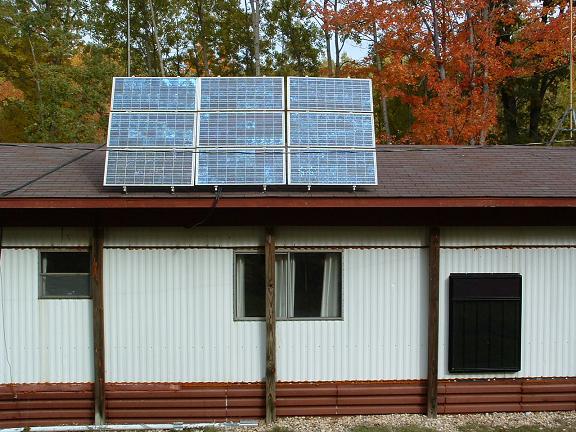
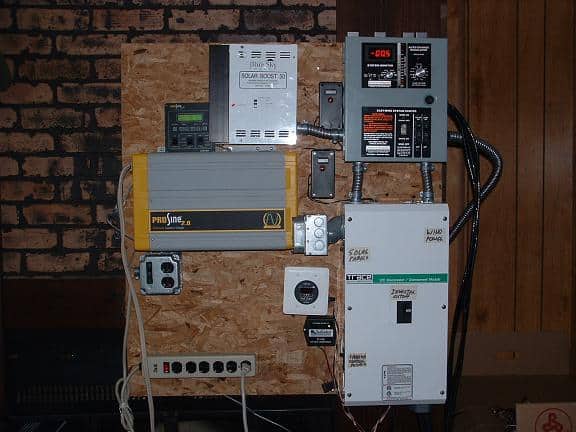
The large solar power setup is just like you see in magazines with solar panels on the roof, a wall full of components and kids playing in the yard. I have 3 – 90W and 6 – 80W (total 750W) solar panels on top and a Solar Boost 50 (charge control), Prosine 2 (2 kW inverter), Xantrex breaker box, Link 10 battery meter (fuel gauge), 8 – Trojan L16 batteries (20 kW storage). All components except batteries and panels are mounted on 3/4″ plywood. This means that I have 3 major connections: solar panels, batteries and AC output from the board.

solar projects diy

This type of system is best bought as a kit – I bought the first 3 panels with an inverter and added the other solar panels and charge controller later. You get almost all the pieces – including roof mounting hardware for the solar panels and the right size wires.

The trick with building this system is to put most of the stuff on a plywood board. I set the parts on plywood and arranged it to my liking. The breaker box should be located close to all the other stuff to minimize wire length. I had my panels mounted on the ground for good snow removal but, after thinking about theft (nice shiny blue panels) I mounted them on the roof. I use a snow rake and angle the panels steep (70 degrees).

The best feature of this kit was the inverter. The inverter has an automatic transfer switch (the thing that goes click in a UPS when the power goes out) and 3 stage battery charger built-in. It is true sine wave (yes, had it hooked up to my scope meter). I added the breaker box because you just can’t get 300 amp DC rated fuses from the electric store.

solar projects diy

I normally use cheap grid power for running everything but, when the power goes out – its solar time. If you have heard neighbors say something like “I have 100 amp service” then this inverter gives you 15 amp service. You can run up to 15 amps at 100% duty, it will surge to 30 amps (4 kW). This inverter is not grid tie but, UPS (Uninterruptable Power Supply) tied. I have my fridge on this inverter in case of power outage.

Here is my little lead in on efficiency. My fridge (19 cf. Kenmore side by side) uses 1.12 kW a day, in 2 hours of sun – my panels will generate 1.5 kW – enough to cover my fridge power (and inverter overhead) use for a day. This fridge is 20% more efficient than every other fridge in its class (19-21 cubic foot). It cost $700 (USD) when I bought it. In the years that I have had it (about 8) it paid for itself in lower electric costs. It will always “pay you” to buy a new fridge.

Final Notes

Try to place the panels where they get sunlight, I should say “where they get the most sunlight”. If you have a tree that shades your panels at 2 pm – move the panels so that the tree shades them at 6 pm. I know that my roof space is limited but, I plan on getting the “best” light (10 am-3 pm) that I can. Losing energy in the winter because the tree shades at 2 pm is very costly (especially after all the money you paid for solar!)

SAFETY for the small system consists of not burning yourself with the soldering iron. The medium system has batteries that could weld your tools to the posts, wrap electrical tape around “good” tools used near the battery, have a tap for the post threads.

The batteries in my medium and large systems are flooded lead acid which means that I have to fill them with pure (distilled) water, I wear rubber gloves for this task and goggles. I also keep the family sized baking soda bucket nearby in case a mouse chews the corner (for water) – a lot of solution (more than a gallon) in a 120-pound battery. Lead acid batteries generate hydrogen gas which is explosive, a vented battery box is recommended.

The medium system uses a (cheaper, easier to find) flooded lead-acid battery, not the best type (AGM Absorbed Glass Mat or Gel Cell) for this application. Since it could tilt past 40 degrees (max fluid to cap angle) the solution can leak. I installed plastic inside the box to contain any fluid and am aware of this limitation in my system. The box is strapped to the hand truck for quick release to move into a truck bed.

The lead acid batteries that I used were bought before I found out about Edison batteries. Admittedly, the lead-acid battery has more power per pound than the Edison (Alkaline based Nickel-Iron) battery but, have become the “throw away” part of every solar power system. Edison batteries will (have) last for a hundred years, don’t sulfate, don’t break down (lead plate flaking) and if they run dry – simply refill. In fact, replacing the alkaline solution would only take Berky water and wood ash (lye is alkaline) solution. Last but not least – no chance for an explosion, does not generate hydrogen.

If you have read “31 Days to Survival” then you know that there is a chapter on alternate energy. I think that any of these systems will count for that day. Please share your comments and thoughts in the comments below.

You might also like:

K-Tor hand crank generator (pocket socket 1 amp usb) : Weekly Product Review

Written by M.D. Creekmore · Categorized: Power Generation · Tagged: Communications, Minimalism, Security

May 04 2018

Training your Situational Awareness or dying: which do you prefer?

Training your Situational AwarenessLife is a series of choices made by individuals with the information they have gathered while living through choices made by others around them. We can thank pilots for the term “situational awareness”. However, for the past few decades many professional crime fighters, military, and civilian individuals have used this term and trained to understand and be more aware of their situations. This is an article about a term many of us think we know well, it’s my intent to help understand it completely and maybe learn a few things as well. (I know I always learn from the comments and feedback received!)

Situational Awareness is understanding, observing and being involved in your immediate environment. The technical definition is, “the perception of the elements in the environment within a volume of time and space, comprehension of their meaning and the projection of their status in the near future.”¹ As individuals who desire to be prepared for what life may throw at us, having a well tuned situational awareness is easily the most important thing we can do.

How do we train ourselves to be prepared all while maintaining a safe immediate environment?

For myself there is one approach that I learned very early in life, I call it “UN-focusing”. Using the horizon, I look out and consciously make myself see the objects on the horizon without focusing on any of them in particular. When you do this you will find that the smallest movement or change in your eye line will cause you to instantly shift and focus on it. It is this approach that has honestly done the most over the years to help me stay safe and by default my family and those around me. Situational awareness is understanding your environment and how you interact within it. The key is being aware of your surroundings!

Several years ago I learned Colonel Cooper’s color code approach to maintaining awareness. White = relaxed and unaware. Yellow = relaxed but aware of what is around you, Orange = something of interest has entered your awareness, Red = what you are aware of is a threat. After several courses and more time spent I learned Massad Ayoob’s fifth color code, Black = acting with intent to stop a threat. It only took a little while before I realized that simple is better than complicated when it comes to self-defense. This is why I came up with the abbreviated approach that has worked well for me.

Using just three colors you can navigate life and stay safe. Understanding that everything is a threat until proven otherwise; I simply tossed White and maintain a life in Yellow = relaxed but aware of what is around you including items of interest. This way I can easily move directly to Red = aware of and focusing on the threat or threats and fluidly into Black = acting with the intent to stop a threat as needed based on knowledge of human action and surroundings where I may find myself at the time. Again there are really only three colors in the life of someone who understands a threat is NOT always someone that needs to be shot, a threat can be an out of control vehicle, a falling building, rock or even an animal of any type at any time.

By utilizing additional props that are all around us in our daily life we can easily expand our 180 degrees visual awareness to take in the 270 auditory awareness and even extend it into a full 360 degree awareness bubble, NOT circle, as what is above and below us is just as potentially dangerous as what is in front, on our sides or behind us. To do this learn to use mirrors that exist in anything reflective. When I taught surveillance and counter surveillance we used buildings, other people and the age-old primate ideal, deception. When walking down a street with or around other people do you notice their expressions or shifts in concentration? Humans have barely imperceptible shifts that occur in our faces, posture and more when we become aware of anything else in our vicinity.

We often perk up, our lips may purse or our eyebrows may furrow just for a split second, these are tells that regardless how good someone is, WILL occur in many situations. Specifically when we view what is deemed to be a potential threat through social programming or simple genetic coding. These are the tells you can be aware of allowing you to easily extend your bubble past your solitary 360 bubble and into the realm of the supernatural.

Consider for a minute the various individuals who over the many years we have come to see as somehow more advanced or superhuman in their various abilities. Good, experienced marine snipers or seasoned special forces and or seasoned field agents with any number of agencies can sometimes seem to be capable of things far beyond the normal range. Let me reassure you, their capabilities may have some natural ability attached OR they are simply well trained.

Be aware of your surroundings and learn to use it to your benefit. Remember, that glass-walled building is a mirror, the concrete planter is cover and sometimes those people who will surely freeze also offer momentary cover for you to react. After all, ACTION always beats REACTION. I personally have absolutely no compunction whatsoever with placing someone I do not know in between myself/family and a potential threat.

After all, the sooner I can freely engage said threat the faster the threat is ended. This leads to the next step regarding situational awareness, understanding that everything you do is based on your internal measure of the individual value of yours and others lives. I am not asking you to physically place a value on others, rather, I need those interested in truly understanding what is necessary to resolving a threat to understand that subconsciously we ALL already do value others based on any number of reasons. This is pure human nature, nothing more, it is not a negative it simply is. Understand this and your life will become both more difficult and yet also much simpler.

Next, in the lineup of things to work on that relate directly to situational awareness from a daily living standpoint is the very simple idea that a moving target is always harder to hit. Daily you should be in Yellow = relaxed but aware of your surroundings by simply un-focusing this is possible to maintain at all times regardless external or internal factors. Next, it is a simple matter of daily repetition in movement and the utilization of scientific method to ensure further safety utilizing situational awareness.

I am talking about being able to move instantly off the X. I am talking about the X, Y, that is your 360-degree environment. What you should always be noticing are potential areas where a threat may occur. All predators enjoy a hunt, however, they enjoy an easy capture/kill far more than the hunt itself. Know where ambushes may be more likely, or where people may crowd into a single place making them easy pickings.

Recent events have shown me yet again that understanding situational awareness is necessary regardless your belief in self-determination eg., self-defense. Consider that recent school shootings have NOT been accomplished by well trained or even intelligent individuals. Rather, they have been accomplished by predators who acted on their base instincts. They pursued easy to gain prey and did so in locations where the prey could be even more easily dispatched.

When the prey no longer presented an easy target in almost all instances the predators left or terminated themselves. I am not discounting the heinous nature of the events, I am simply stating that if these children had parents that cared more about them than their careers, political goals or otherwise they may see the simple reality that is prevention by education; utilizing situational awareness.

Lastly, it is absolutely necessary to address our actions when we are tired or believe we are in a safe place and why even in our castles., eg. homes, we CANNOT live outside of Yellow. The greatest number of traffic accidents happen within 2 miles of one’s own home. Violent crime statistics show us that the vast majority occur in commercial areas (restaurants, bars etc.,) where we are relaxed from drinking or are spending time with loved ones and our attention is not on our surroundings.² There is NEVER a reason to drop our Yellow level in any circumstances.

I firmly believe in always being in Yellow and have even been able to adapt sleep habits to match, with some minor adjustments and the obvious need for sleep there are things that can be done that allow for a good life all while being safe. This is why I firmly believe in the idea that is situational awareness and the approaches I have lined out above. This is what I taught and now you know the why in most cases.

As always if you have questions or comments please let me know! I am positive I have missed some things and likely could use more refinement as time does, in fact, reveal errors quite well. So let me know and we can help each other!

Free the mind and the body will follow…


¹ ENDSLEY R Mica (1987). The application of human factors to the development of expert systems for advanced cockpits. Proceedings of the Human Factors Society 31st Annual Meeting, pp. 1388-1392. Human Factor Society (Santa Monica, CA), 1987

² National Crime Victimization Survey (NCVS). (2018). Retrieved April 03, 2018, from https://www.bjs.gov/index.cfm?ty=tp&tid=44

Written by Jesse Mathewson · Categorized: Security · Tagged: Security, Self-defense

Apr 16 2018

LifeCard® by TrailBlazer Firearms: Weekly Product Review

Legally I have to tell you if I have received the product or any compensation for writing this review. I did receive this product in exchange for a review! There may be affiliate links in the material that utilize Amazon as a platform. The LifeCard® has been designed to be discreet, hidden and functional, this article will explore all of these and look at benefits and drawbacks. It is also entirely built in the United States!

ifeCard® by TrailBlazer Firearms

When this firearm first came out I was both intrigued and dismayed, I saw another gimmick versus a workable tool for defense, hunting or competition. Over the past couple of years and with research and quite a bit of going back and forth I decided to accept the offer and test LifeCard® using several approaches. Being someone who carries backups for my primaries and even just in case firearms on top of that, this appeals to that niche. However, seeing as how it is a single shot in .22lr and not easily reloaded, the drawbacks are apparent instantly.

ifeCard® by TrailBlazer Firearms

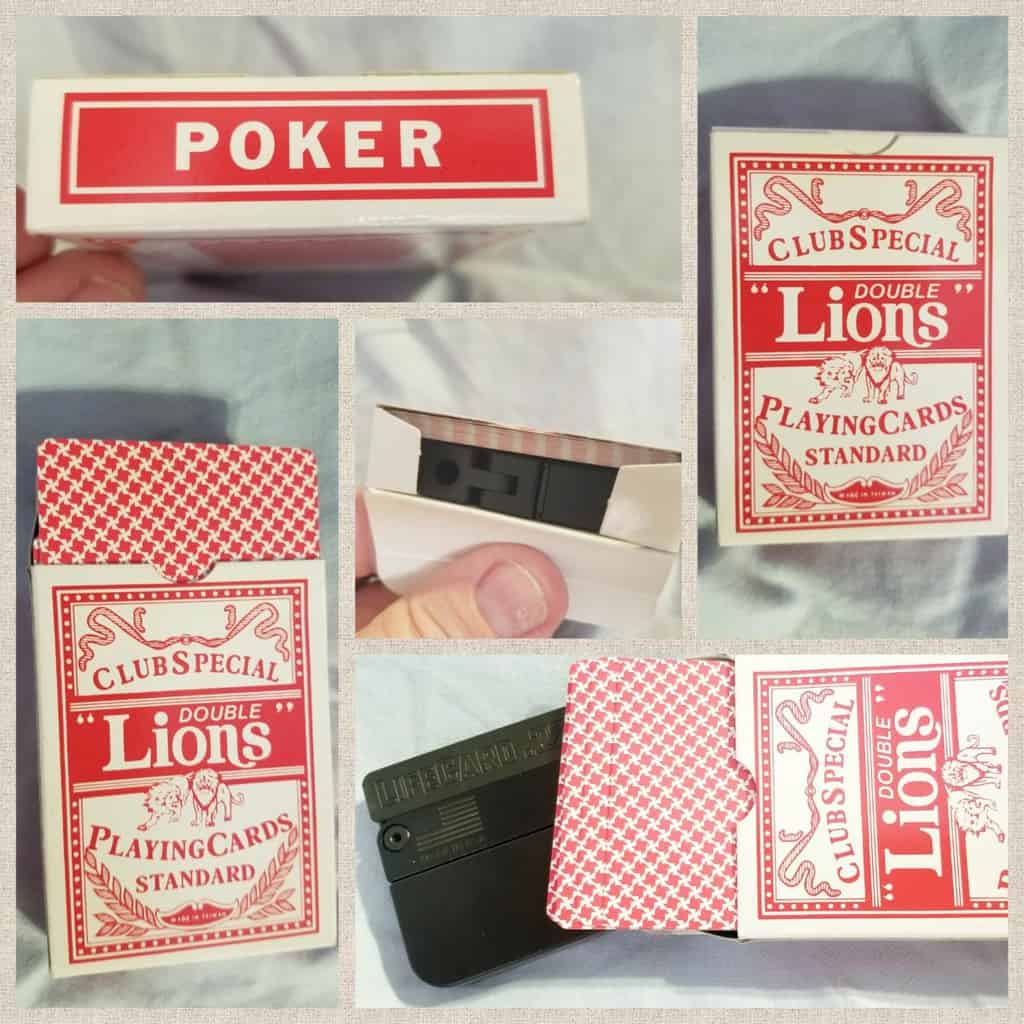
Upon receiving the firearm the location I do my transfers at had several people that like myself had never actually seen one of these, and of course, it made the rounds quickly. Everyone checking it out and admiring the solid construction. Let me say this up front, it is VERY solidly made especially considering what role it fits and where you will be carrying it! At 7 ounces and the size of a deck of cards, it is absolutely concealable. How does it shoot and is it worth spending money on?

ifeCard® by TrailBlazer Firearms

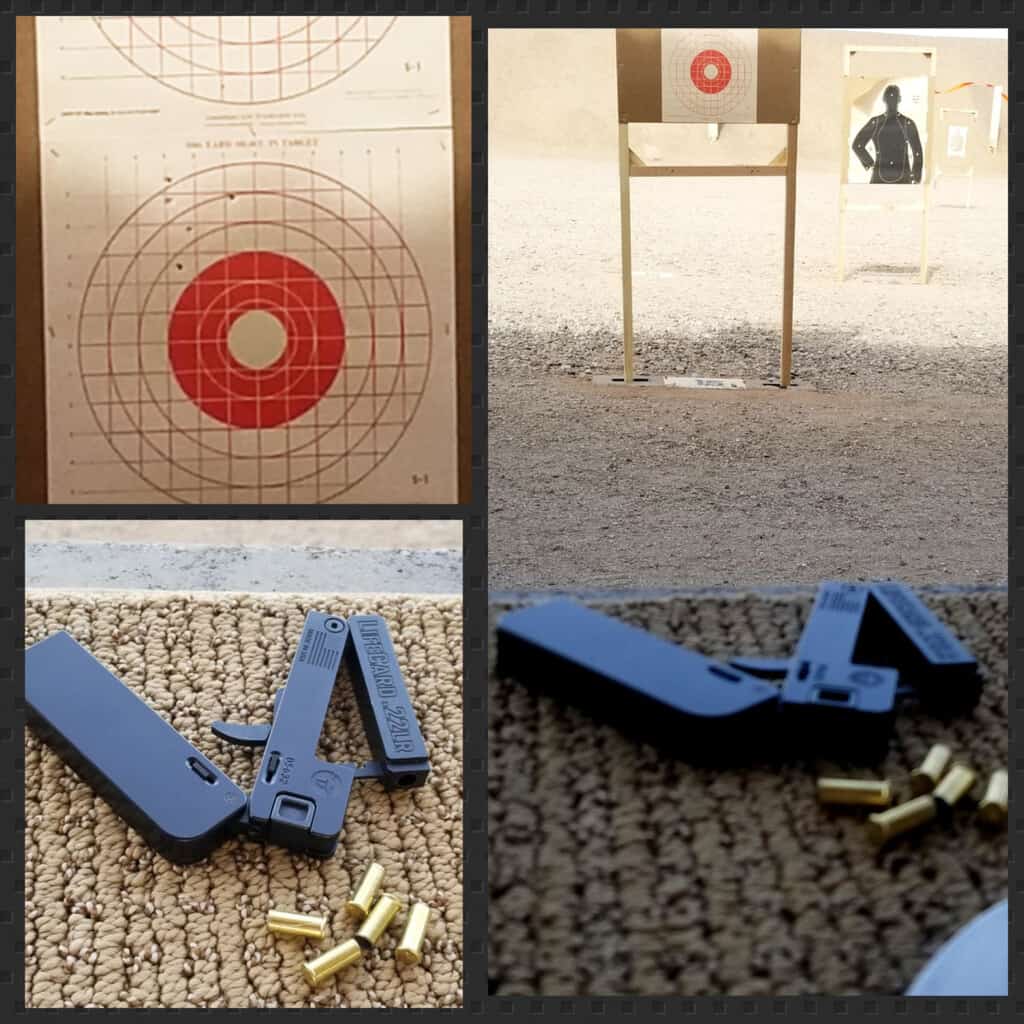
It does not have sights, it does have a simple channel machined into the top of the barrel. This allows for rudimentary sighting or what amounts to point shooting it. As you can see in the picture it groups well, though it shoots a bit high and left. The group shown was at 10 yards and was not shot to get center of the target but rather to get a group size to show you!

group shot

To shoot it you have to unfold and lock it into place, grip the bolt firmly and the firearm with your finger off the trigger and pull the bolt out until it locks into place. Aim and squeeze until it fires. After firing, keep the muzzle pointed away from people and using your fingernails or a key or a small knife pop the empty out! Reload and fire as needed. The instruction PDF can be downloaded here, LifeCard instructions for use. It is an extremely safe firearm, it cannot fire unless fully cocked, you cannot keep it cocked while folded, and the trigger is fully covered while folded. You have to consciously cock it and then shoot, making it extremely safe. Obviously, as with all firearms follow the rules of safety.

  1. Loaded or not, keep the finger OFF the trigger!
  2. Loaded or not, ALWAYS ensure the muzzle is pointed in a safe direction!

If you follow these rules you can never hurt anyone without meaning too. I know that the NRA instructors have their 3 big rules and an entire list of others. I have seen some lists of rules go pages in length. However, as with everything K.I.S.S. is essential! Keep it Simple Silly!

Like all small handguns I wanted to test it using good ammunition, I need to know it will function every time and that the round will do its job. I tested this handgun with the following ammunition,

  • CCI Stinger
  • CCI Velocitor (1400 fps)
  • CCI Segmented
  • Aguila Hypervelocity (1700 fps)
  • Aguila Interceptor (1400 fps)
  • Aguila Super Extra
  • Aguila Pistol Match
  • Remington standard
  • Winchester (333 round white box)
  • Federal Premium

All of the listed ammunitions worked, however, I chose Aguila Interceptor as my carry round in this handgun because it clocks in at 1030 fps average over 8 rounds from the short barrel; it is also a 40-grain bullet giving me more punch from a small package. Additionally, the group shown in the picture above was from the Aguila Hypervelocity round, showing that at up too 10 yards it is plenty accurate. I was easily able to put rounds inside of a 2” circle at 3-5 yards. The energy from this small round is around 94 ftlbs, which is more than adequate for a small handgun.

ifeCard® by TrailBlazer FirearmsSo why should you own this pistol? From the perspective of someone on a fixed income and with limited resources I can answer this easily. This is a pistol that easily fills multiple roles. You can use it as a last ditch or very covert defensive tool. It is NOT fast into action, it is, however, VERY easily concealed which makes it something you can get into action without notice. In addition to this, it makes a really solid hunting and trapping backup. I like having a 22lr handgun when I am hunting or trapping or harvesting meat on the farm. This really is perfect for these things. This video shows how easy it is to fire and reload the handgun.

ifeCard® by TrailBlazer Firearms

Now, this is not an inexpensive firearm, it averages $350. For quality, this is not a bad price, and of course, it is the last firearm anyone will want to ban so there is that benefit as well! I am a firm believer in having what I need all the time. This being said, something like this is perfect for your tackle box, pants pocket, purse or console of the car. It is the last ditch tool you never want to use but will have if you need it. If you need something that can be concealed and is well made and works well, this really is the pistol to get.

Here is a quick list of places you can order this amazing little handgun from, obviously you will need to transfer it in legally and fill out the appropriate paperwork for it.

  • Buds Gunshop (one of my favorite places to get firearms)
  • LifeCard (directly from the company)
  • Gun Deals (another solid place to go for good pricing)

Check with your local firearm dealer and see if they have it in stock as well. They may be able to order it for you directly or worse case you can transfer it in through them. If you have any questions please ask, and of course, also put some feedback in the comments if you have one!

Free the mind and the body will follow

Written by Jesse Mathewson · Categorized: Gear Reviews, Security · Tagged: Firearms, Security, Self-defense

Primary Sidebar

About Me

Subscribe to Blog via Email

Enter your email address to subscribe to this blog and receive notifications of new posts by email.

Join 7,184 other subscribers
  • Amazon
  • Facebook
  • Substack
  • Twitter
  • YouTube

A prudent man foresees danger and takes precautions. The simpleton goes blindly on and suffers the consequences.
Proverbs 27:12

Footer

DISCLAIMER

This website is for informational and educational purposes only.
I’m not a financial advisor, medical professional, or legal expert.

Everything shared here is based on personal experience, research, and opinion.
Use your own judgment and do your own research before making decisions.

  • Blog
  • Books
  • Newsletter
  • Gear I Use
  • About
  • Contact
  • Privacy Policy

© 2008–2025 M.D. Creekmore · As an Amazon Associate, I earn from qualifying purchases.