• Skip to main content
  • Skip to secondary navigation
  • Skip to primary sidebar
  • Skip to footer

M.D. CREEKMORE

  • Blog
  • Books
  • Newsletter
  • Gear I Use
  • About
  • Contact
  • Facebook
  • YouTube
  • Blog
  • Books
  • Newsletter
  • Gear I Use
  • About
  • Contact
  • Privacy Policy
You are here: Home / 2018 / Archives for June 2018

Archives for June 2018

Kentucky Knife Laws: A Guide for Knife Carriers!

June 29, 2018 M.D. Creekmore

kentucky-flag - KENTUCKY KNIFE LAWS
Kentucky Knife Laws

Kentucky, which is known for its scenic hills and handcrafted bourbons, is also known for being one of the more friendlier knife owning states located in America.

As a 19th-century pioneer who fought at the Alamo, Jim Bowie played an integral role in pushing for Texas independence. Bowie received a custom-made knife designed and constructed by a Kentucky native. The knife later became known as the Bowie Knife.

Because of the rich heritage of individual freedoms found in The Bluegrass State, Kentucky has historically featured favorable knife ownership laws that included ambiguously worded statutes in reference to concealed carry restrictions.

Overview of Kentucky Knife Laws

In 2013, the Kentucky legislature enacted a preemption knife law that unified state knife laws by eliminating conflicting municipal ordinances, such as the knife restrictions implemented by cities such as Louisville. The different local ordinances made knife ownership difficult, as anyone who moved around the state had to comply with different knife statutes. Five years after knife law reform, Kentucky is a pro knife ownership state that clearly promotes open and concealed carry ownership rights.

Kentucky Constitution and State Knife Laws

The Kentucky Constitution sets the legal framework for laws addressing knife ownership issues. With clear intent to preserve the right to bear arms and the right to defend family and property, Section 1 of the Kentucky Constitution has been cited numerous times in cases involving the legality of knife ownership.

Section 1 reads “All men are, by nature, free and equal, and have certain inherent and inalienable rights, among which may be reckoned.” Kentucky citizens enjoy “the right of enjoying and defending their lives and liberties,” as well as “the right of seeking and pursuing their safety and happiness.” The 7th clause of Section 1 grants the right to bear arms, which most court decisions have ruled pertains to knives.

Knife Ownership in Kentucky

Knife ownership in Kentucky can be boiled down to one sentence. Residents are allowed to buy, sell, carry, and display any type of knife on private property. Kentucky law first defines the “regular” types of knives covered under the law to include clasp, pocket, hunting, and Bowie knives. Once banned for private ownership, knife enthusiasts in Kentucky are allowed to own daggers, stilettos, bayonets, and KA-BAR blades

Here are some of the “exotic” knives that are legal to own in The Bluegrass State:

  • Comb Dirks
  • Dagger Necklaces
  • Disguised Knives
  • Swords
  • Machetes
  • Throwing Knives
  • Balisong Knives
  • Martial Arts Throwing Stars

Knives made illegal by other American states are not considered unlawful to own when brought to Kentucky. The Bluegrass State does not prohibit knives based on the methods of opening, the technique used, or any other standard.

Open Carry in Kentucky

Open carry in Kentucky is much more lenient than concealed carry for knife owners. Knife owners are permitted to open virtually any type of knife, with the exception being Civil War relic knives that belong in museums and at historical landmarks. Kentucky law does not restrict the length of knives for open carry.

Concealed Carry in Kentucky

The Kentucky legislature has passed more restrictive statutes for regulating concealed carry knives. You must apply for a license to conceal carry a knife in The Bluegrass State. Section 527.020 of the Kentucky Revised Statutes (KRS) prohibits the carrying of concealed weapons of any type, without presenting a license granting concealed carry for a weapon. KRS 500.080 exempts only a few types of knives from concealed carry law, including common hunting and pocket knives. Concealed carry implies a maximum knife length, but no law specifically defines the maximum length. Vague legal wording has led to several lawsuits filed by Kentucky residents fighting for the right to conceal carry long-bladed knives outside of the hunting and pocket knife categories.

Kentucky Miscellaneous Knife Laws

Kentucky law forbids knives on the grounds and within the buildings of schools, prisons, and courthouses. The prison ban includes makeshift knives inmates use for committing violent acts. However, some cities have added more restrictions. For example, Queensboro prohibits any type of knife carrying in municipal parks. State open carry laws remain the same for every municipality operating in The Bluegrass State.

KRS 237.110 spells out the procedure required to apply for a concealed carry license. Kentucky approves concealed carry license applications on a “shall issue” basis, which means applicants 21 years of age or older that have clean criminal records should receive automatic approval of applications. You also have to be a citizen of the United States to receive a concealed carry knife license.

Kentucky Knife Laws Moving Forward

Nothing on the Kentucky legislative docket in 2018 suggests current knife laws will change for at least one year. However, there is momentum in the state to loosen the restrictions on concealed carry knife laws.

None of the material in this article should be interpreted as legal advice.  I am not a lawyer.  Never take any action with legal consequences without first consulting with a lawyer licensed in your jurisdiction.  This article should not be relied upon for making legal decisions.  This information is provided for scholarship and general information only.

[ Note: Out of all of the pocket knives available on Amazon.com this one is my favorite everyday carry knife – click here to see what it is on Amazon.com. I love this knife! It’s built like a tank and holds an edge better than any other knife that I’ve owned…]

Check out these related articles:

  • What’s The Best Multi-Tool to Buy For EDC
  • Best Survival Knife of for Under $100
  • Best Folding Knives For Self-Defense
  • Work Sharp Pocket Knife Sharpener Review
  • SOG Tactical Tomahawk Review

Filed Under: Knife Laws by State

Review: Darkest Days – How to Survive an EMP Attack to the Grid

June 25, 2018 Jesse Mathewson

lantern for emp

Personally, I tend to avoid conspiracies and doomsday predictions, because typically they are, fear-based attempts to drive an individual or groups agenda. At no point in history has any species lived longer than it should nor has any state or collection of states lasted forever. This said I was sent a copy of the book Darkest Days: how to survive an EMP attack to the grid (Link goes to Amazon.com) recently, my review of this book follows. What follows is my review.

Thirty-five pages of explanations regarding what EMPs are and why they pose a risk using solid scientific and mathematical validation were how the book began. As I read through each page I had flashbacks to the e-book Alive after the Fall by an individual who was so ashamed of their work that they did not even use their real name. Certainly, there is a modicum of truth to the idea that in today’s highly industrialized world there is a risk of both natural and manmade EMP related disasters.

However, as I pointed out in the review of Alive after the Fall, these risks are not nearly as disastrous as many would have you believe. In fact, modern electronics are made from less and less metal than ever before lending to their increased survivability during magnetic or EMP interference.

For instance, modern Solid-State Drives are virtually indestructible and have the potential for extremely long-term data storage as compared to the older magnetic drives in use with many lower-end computers. ¹

Next is the inevitable discussion regarding vehicles and the overall electric grid. The simple reality is that if a pulse occurs that is large enough to knock it all offline, your vehicle running is the least of your concerns. Rather, the infrastructure itself providing you with extra fuel is the more important issue at hand.

This means that regardless vehicle type and in fact in spite of in some case, for instance, older fuel-guzzling non-electronically guided vehicles will need more fuel than most of us will be able to store with any real hope of longevity. This leads to the review of the rest of the book, and the preparations the author suggests implementing overall.

Page 39 of the book begins with this interesting line, “Unfortunately, it has been proven that those with less income tend to not fare as well as those who took a little bit of time and money each month to prepare. It is understandable but ANY small thing you can do today will help get you prepared and improve your chances of survival.”

When you look only at statistics coming from densely populated, heavily industrialized, city-states in the last 100 years this is in fact correct. However, what the author conveniently fails to make mention of is the simple reality that through excessive use of force by the states involved those who had less and in every case, no ability to defend themselves were indeed less likely to fare well and rarely have.

You see the author like the author of the other similar tome recently reviewed tends to believe that government is infallible and necessary to the continued happy coexistence of society as a whole.

I would posit that government is at its best unnecessary while society or people as a whole are in fact at their worst still better than government at its very best. I am agreed with by many of the brightest non-socialist minds across history, from Thomas More in the 1500’s through Thomas Paine and onward the reality of collapse is first that it is inevitable and second that humanity can indeed function quite well without babysitters made up of selfish individuals interested in personal gain of power or money.

The benefits of this book lie in the prepping advice,

  • put away a little at a time and over time your supplies will build nicely
  • food, water, toiletries, medication and the like are areas that are specifically looked at first in the book
  • involving the family and having A meeting place is also beneficial goals, though as with everything I suggest more than one.
  • A rather quick blurb regarding protection is mentioned without specifics

After these basic beneficial mentions, the author goes right back into in-depth preparations for what they describe as an inevitable EMP event. I personally do have spare electronic devices such as pre-programmed hand-held radios and backed up data storage in EMP resistant protective approaches, the reality is I could afford the extra radios at the time and I always backup data!

Over the rest of the book, there is some relatively decent information with regards to setting up a variety of energy generating pieces of equipment. Unfortunately, I do not believe that this brief and rather incomplete information is worth paying money for the book. Where the book itself may have some redeeming qualities is in the add-ons that are given to the original purchaser of this book.

First is Unscathed Survival: how to come out untouched from 10 different scenarios, 73 pages of reading with a few areas that are simply not applicable and several others that are.

Among the applicable information is the preparations for and survival after of floods, earthquakes, and other natural disaster preparation is essential. Though it should be mentioned that these same preparations can be easily found on the Red Cross site for free.

Next is Off-grid Home Protection System, this one is interesting with several solid approaches mentioned that are sometimes overlooked. Again, I would say that the author failed to adequately follow through. I have known several persons who purchased and installed many security measures as mentioned here including livestock guarding dogs or LGDs as the author states.

However, like the author they failed to implement any real training around these items and to this day the dogs are little better than house dogs regardless their use of German phrasing for commands as none of the dogs was trained and as many have proven untrained dogs regardless breed are little more than a distraction to home invaders.

My personal recommendation is either well-trained protection dogs OR small dogs like terriers (link goes to Amazon.com and terrier training manual) and the like who will be quite noisy and give an alarm. Some having proven to actually be more willing to attack intruders when compared to larger dog breeds (when both are untrained). I do love the use of vegetation with stickers on it as deterrents.

Personally, as a high desert dweller, I love prickly pear and ocatillo cacti along the inside of my back and front walls. These are almost impenetrable and can be placed for a visual benefit, not to mention the food and medicinal benefit of both of these plants!

Lastly, we have the final addition, how to make your own pharmacy. Sadly, this particular booklet has no value outside of pointing out the potential benefits of herbal medicine. There is no real guidance into what and how to make up various medications from the herbs mentioned.

And NO, making a tea or tonic is not simple nor is it the only way. There are dozens of approaches to the application of herbal medicines and only a few right ways. This booklet does not explain those well.

Only two or three of the mentioned herb-based recipes actually go into detail and offer a somewhat solid approach. For anyone with no or little real experience with these things, this book could easily do more harm than good.

My overall impression is that the authors or author of this book series simply wishes to cash in on the hysteria embracing so many uninformed individuals today. I would definitely suggest avoiding the purchase of these books and any that use words like “guarantee” in the ads for them.

Rather spend your money on solid well put together books (link goes to Amazon.com) that are written by individuals who use their own names and have the credentials and experience to support their work. I will be reviewing a few more books over the next few weeks, and many of them will be positive reviews.

Free the mind and the body will follow…

¹     Introducing the SSD Endurance Experiment. (2018). Retrieved from https://techreport.com/review/24841/introducing-the-ssd-endurance-experiment

The SSD Endurance Experiment: They’re all dead. (2018). Retrieved from https://techreport.com/review/27909/the-ssd-endurance-experiment-theyre-all-dead

Also Read:

  • The Lost Ways – “A Guide to Real Life Homesteading and Survival Skills From Our Past That Work!”
  • How to Make Your Own Faraday Cage at Home (Quick, Easy, Effective!)
  • Herbal Medicine: Trends and Traditions, Et Al: weekly product review
  • Kephart by Condor Knife and Tool: weekly product review

Filed Under: Gear Reviews

This Week on The Homestead: Homesteading Progress and Preps For The Week / June 23, 2018

June 23, 2018 M.D. Creekmore

Good morning everyone… remember…

Morning is wonderful. Its only drawback is that it comes at such an inconvenient time of a day.

Anyways, we are all up and awake and that’s great, however, I do have some bad news to report…

After days of my brain not registering the fact that my email load had dropped from an average of 100 emails a day down to 15 or 20 at that those emails that were being sent were sent directly with my email address and not with the contact form of my contact page.

Well, once it finally did register I started looking into it and to my dismay, I discovered that my email contact form was broken and NOT sending me any email. So if you have sent an email using my contact form and I’ve not answered, then, please don’t think that I’ve been ignoring you… I’ve simply not gotten your email because the form was broken…

But the good news is that it’s fixed now, so if your email was really important then please resend it and I will get back with you as soon as possible… thank you for your understanding.

Okay, if you look closely you’ll notice a few changes to my blog design… look closely… there have been five changes to the design over the past few days… the first person to describe all five changes in the comments below will get a new Lifestraw Personal Water Filter!

I also made a few changes to my recommended must have prepper gear page but we won’t include those in the five design changes mentioned above. Now let’s see who has been paying attention… Good luck.

Okay, now let’s get on with our homesteading progress and preps for the week…

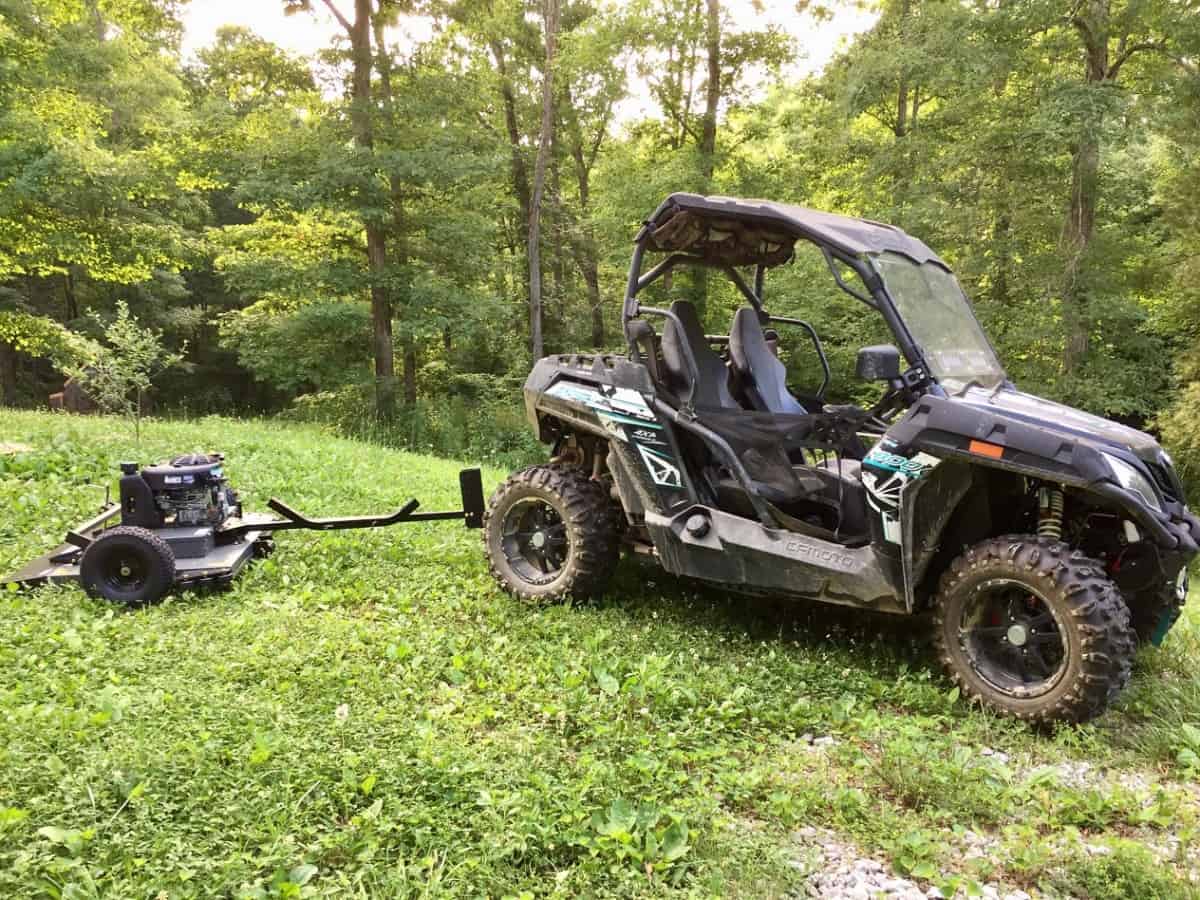
My main homestead expensive/progress for this week was that I received my Swisher 10.5 HP 44-Inch Finish Cut Trail Mower. I had to order the mower through Amazon.com because, unfortunately, no one in my area is a dealer for that type of mower.

I have some hillside on my property and mowing it with a typical riding mower was dangerous and exhausting. Once that I finally got the Swisher 10.5 HP 44-Inch Finish Cut Trail Mower unloaded and uncrated, I checked to make sure it had been filled with engine oil (it had) and then I filled with 100% gasoline as I prefer to not use gasoline that has had ethanol added.

I gave it three cranks and it started up and after letting it run idle for about ten minutes I hooked it up behind my side-by-side UTV and proceeded to mow my hillside in record time.

This mower is great for mowing on hillside land if you have a UTV or ATV and it can also be pulled behind a regular riding mower while off-set to the side to mow two times the normal area in one pass which cuts mowing time in half. However, if you’re pulling it behind a regular riding mower then you’ll need to stay on level ground.

Well, folks, that’s my main homesteading for the week… of course, I did other stuff like gardening and removed the suckers for my tomato plants and fed the chickens several times but I know that you probably don’t want to hear all of the details about that…

Now over to you…

Filed Under: Uncategorized

What to Do When You Get Pulled Over by the Police

June 20, 2018 M.D. Creekmore

by Scott G

dealing with law enforcement

DISCLAIMER: I am not an attorney (I’m not a liar), so what I’m telling you is based on my best understanding of the law and experience. For legal advice, you must see an attorney (although they don’t always know what they’re talking about – you may need a second opinion).

Speaking as a former law enforcement officer, the one thing we are always on guard against is for anyone armed with anything that can be used as a weapon, be it a knife, blunt instrument or a firearm. That said, without question, no person, let alone a law enforcement officer has anything to fear from an armed, responsible, person.

The mindset of a law enforcement officer is that anyone, not a law enforcement officer or his/her spouse or personal friend is a potential threat. The reason for this is that a law enforcement officer has a target on his body. Anyone, no matter how seemingly innocent, can snap and turn on you. A couple weeks ago, in Portland, CT, two boys ages 7 and 11 tried to carjack and rob a woman at gunpoint. In September, in D.C., a group of boys ages 7-14 were panhandling and when a man said go away, one boy pulled a gun and fired it at the victim. During August, in Abilene, TX, a 91-year-old man was convicted of armed robbery.

I could go on and on, but the point is that in the eyes of a law enforcement officer anyone not in a uniform is a potential aggressor. A cop looks at everyone the same way, looking for any signs that fit certain profiles. Cops are big on body language and the better ones also listen to their gut. A potential suspect does subtle and not so subtle things that send up alarm signals. Things like constantly looking around in a certain manner or their way of dressing.

So many people (whining liberals specifically) scream that LEO’s only profile certain races. This is largely a pile of male bovine fecal matter (I don’t swear, so figure it out). Most cops are not racists, they simply hate criminals. I once had a member of a minority race (not black) accuse me of being prejudiced. I told him, “That’s not true. I hate everybody.” The fact of the matter is that LEO’s target people who have a propensity to commit crime. It doesn’t matter the race of the person, it only matters if the suspect fits a certain profile that in the experience of the LEO, falls within a certain criminal profile.

LEO’s know that a legally armed citizen (LAC) doesn’t wear his pants with the crotch dragging on the ground. His hat isn’t on sideways and his underwear doesn’t show. The LAC doesn’t keep his weapon stuffed behind his waistband but in a good holster. The vast majority of felons simply do not use a holster. Studies have shown that LAC’s use the same types of holsters as a LEO. Also, LAC’s usually wear the same style clothes and accessories as cops. Also, LEO’s know that the vast majority of LAC’s are pro-law enforcement and would come to their aid in a heartbeat.

A person illegally carrying a weapon will always give off obvious and subtle clues in the presence of a cop. Things that a law enforcement officer are looking for are gang-style clothing, aggression, challenging and belligerent behavior, looking away or avoiding the LEO altogether. The suspect will be evasive in his answers, fidgeting and nervous, has his hands on hips, arms folded, scowling, etc. The LAC usually does not put off these clues. Yeah, they will be anxious, but the majority of people are anxious when stopped by a cop. This is expected. Good behavior or demeanor is an intuitive characteristic. It is highly difficult to fake. You either have it or you don’t.

However, because everyone not in a uniform is a potential threat, even an off-duty LEO, they are often suspected to be an aggressor and proned out until identification can be made. This is also the case even when a LAC has a suspect at gunpoint, has informed the police and is waiting for a law enforcement officer to arrive.

There are a number of things you can do to alleviate the stress on both you and the LEO:

1. Be polite and respectful. Politeness and respect will get you a long way. In fact, sometimes it will get you out of a ticket (at least with me it did). Many criminals get nabbed during a traffic stop because they were an ignoramus toward the LEO.

2. Do not be aggressive or challenging. This will immediately send up red flags in the mind of a law enforcement officer. Ninety-nine times out of a hundred, a law enforcement officer believes you did something to warrant being stopped. If you did something wrong, you don’t have to admit to it, but don’t carry on as if you are innocent. If you don’t think you did something wrong, try to politely explain why you didn’t do what you are accused of. If that doesn’t work, take it to court.

3. Answer his questions honestly. If he wants to know what you were doing driving at 2 AM, tell him. Don’t lie because most people are lousy liars and a law enforcement officer will spot this. Do not sit there and argue. The LEO will dig deeper to understand your aggression. Most likely, he will ask you to get out of your car and then search you. This is legal. He also will probably ask to search your car. You don’t have to consent to this search, but then he might call in a K-9 unit to sniff your car. Personally, I would not consent to any search of my vehicle no matter the circumstances. It’s usually a fishing expedition.

Most people who are stopped by LEO’s comply with orders and answer questions willingly.

4. Don’t refuse to sign a ticket or identify yourself. SCOTUS has opined that while you are not required to carry identification, you are required to ID yourself. If you lie about it, that’s a crime and at the least, you will be detained until your true identity is verified. More often than not, you will be arrested and jailed.

5. Don’t act like a lawyer. LEO’s have a very low opinion of lawyers. One of my favorite jokes is:

What’s the difference between a lawyer and a catfish?

One’s a scum sucking, bottom feeding scavenger and the other one’s a fish.

Don’t start spouting the law even if you are a lawyer. It will not get you anywhere. It will irritate the LEO and guarantee you at least a ticket and probably a deeper check into your background. Not all LEO’s are fully in tune with the law, but most are. If you come up against one like I was, he will know the law forwards and backward.

Quite often, even if he’s wrong and it’s something minor, simply agree with him then take it up with his supervisor and chain of command at a later time.

Matt. 5:25 Agree with thine adversary quickly, whiles thou art in the way with him; lest at any time the adversary deliver thee to the judge, and the judge deliver thee to the officer, and thou be cast into prison.

6. No sudden moves. Don’t get out of your car. Stay put. Don’t reach under your seat and don’t open your glove box. If you are armed, tell the LEO immediately. Some states require you to immediately notify a law enforcement officer if you are packing. Know the laws of your state. Personally, I’d do it no matter what. A criminal will not do this. If you are stopped while driving, keep your hands on the steering wheel.

When reaching for your wallet, if your weapon is on your hip, let him know where it is and that you are getting out your wallet. He may stop you, he may not. It depends on the LEO. Some of them will ask to see your weapon and verify that it’s not stolen. Usually, only a rookie who doesn’t know any better will do this.

7. Follow all commands. Simply put, do what you’re told. A law enforcement officer doesn’t want to hurt you or for you to get hurt. If you argue or hesitate, you are begging for trouble.

Doing the above things will demonstrate to the LEO that you are cooperative and are not a threat. Remember, a law enforcement officers main goal is to go home in the same condition in which he went to work.

For more information, refer here: http://www.policeone.com/police-products/firearms/articles/2144601-Dealing-with-citizens-legally-carrying-a-concealed-weapon/ and http://www.legallyarmed.com/.

Now, on to if the worst happens.

If you are unfortunate enough to be involved in an incident involving the use of deadly force, be prepared to be treated with suspicion unless it is obvious that you had no other choice but to defend yourself. This brings up the issue of whether or not you should talk to the police or invoke your rights. Simply put, it depends on the circumstances surrounding the incident.

If you are forced into shooting someone, I’m assuming that you are justified in your use of force (UOF). In our society, UOF must be reasonable based on the totality of the circumstances. I’m a pretty big dude. At 6’1” and well over 200 pounds, I would not be justified in shooting an unarmed assailant who was 5’8” and 160 pounds. However, a 5’6”, 130-pound woman would be justified in shooting me. Also, it depends on the law of your particular state.

Some bleeding heart states require you to retreat if possible from an aggressor, even in your own home. Some laws allow you to use deadly force in your own home only if the person is armed or otherwise able to harm you. My favorite states are those with the “Castle Doctrine.” In these states, you have no duty to retreat if you are in a place you are legally permitted to be.

So, if you do shoot someone and you decide to talk to the police, remember this one thing: tell the police that you shot to stop the suspect. You never, ever tell them that you shot to kill. In the eyes of most pshrinkologists, this makes you a dangerous, unstable person. You tell the police that you stopped shooting when your attacker was no longer a threat. This is nothing more than legal mumbo jumbo, but it is very important mumbo jumbo. It will keep you out of court.

Tell the officers that because of the threat, you were in fear of your life or the life of another person. Explain why you were in fear of your life, i.e., “It was dark; I didn’t know the person; my family was in the other room; he kept advancing on me,” etc. Let them know if you warned the suspect or if you attempted to retreat. Tell them everything. Do not lie. A law enforcement officer can smell a lie a mile away.

Be able to articulate the threat that made you feel that you had no other recourse but to use deadly force. If the suspect had something in his hand that made you believe it was capable of being used as a weapon, be able to describe it and why you thought it was a weapon. I.E., it was a shiny object that appeared to be a knife or a pipe, or a gun, etc.

Whatever you do, do not disturb the crime scene. Don’t move the body or remove anything from the room. The detectives are very, very good at reading a crime scene. A homicide detective is usually very experienced and if something is out of place, he will eventually discover it. If your story doesn’t match the scene, it will eventually be discovered. Maybe not right away, but sooner or later and you will be put to the Inquisition.

As to whether or not you should invoke your rights that depends on the circumstances. By law, if a law enforcement officer believes that you have committed a criminal act, he must advise you of your Constitutional rights. When you are being questioned after a shooting, the LEO will be asking questions to determine what happened. At this point, he is not required to advise you of your rights, but if you say something obviously incriminating, then he should read you your rights. There are some exceptions to this and I don’t know all of the most recent rulings.

Remember, cops are devious when it comes to finding out the truth. After a shooting, you will probably be interviewed two or three times even if you aren’t suspected of doing anything wrong. If a law enforcement officer does suspect you of lying, his questioning will become sharper and certain questions will be rephrased and repeated to see if your story changes. This is a tactic used in court and interrogations. If this happens, you’re in for a long night.

My personal advice is if you think you may have done something wrong, invoke your rights and talk to an attorney. If it’s obvious that your shooting was righteous, then talk away, but with great feelings of remorse. While sadly shaking your head, make sure to express regret and that you were forced into defending yourself. Possibly ask for referrals for counseling and most importantly, do not show the satisfaction of knowing that you defended you and yours from the devil. You can do that later with your close friends.

I’m sure I haven’t covered everything, but you get the gist.

Remember, generally, local law enforcement is on your side. Most LEO’s are on the conservative side and believe in the 2nd Amendment. Most of them know that LAC’s are the good guys. However, there are bad apples in every barrel and there are exceptions to every rule. But as a general rule, the vast majority of LEO’s are honest and won’t screw you over. As for the feds…well, enough said.

Recommended Books:

  • Arrest-Proof Yourself
  • You Have the Right to Remain Innocent
  • You & the Police!
  • Battlefield America: The War On The American People
  • After You Shoot: Your Gun’s Hot. The Perp’s Not. Now What?

And to add in some controversy to this article below are two of the most controversial videos that you’ll ever watch…

  • When Should You Shoot a Cop?
  • Cops Are Cowards

Filed Under: Uncategorized

This Week on The Homestead: Homesteading Progress and Preps For The Week / June 16, 2018

June 16, 2018 M.D. Creekmore

Hello everyone. Over the past couple of weeks, I’ve received a number of emails from readers letting me know how broke that they are and how that they could not afford to buy any preps, or homestead, however, the strange thing was that when I emailed back asking what they were doing to try and earn some extra money the conversations went silent.

Folks, complaining about being broke isn’t going to help you. As far as I know, complaining isn’t a marketable skill and no one is hiring for it. So stop complaining and get off your butts and do something to earn more money if you need it.

I’ve been broke and I’ve even been homeless, however, I did not just give up, nor did I expect anyone to give me anything. Instead, I got up and hustled. I planned, I worked and I failed a lot, but I kept at it and I finally started earning a living as a handyman.

And you know what… the more jobs I got, the more satisfied customers that I had, which led to repeat business with those customers and also to those customers letting their family and friends know about me and my work which led to even more customers…

And then about 12-years ago I decided to start a blog.

At that time I didn’t know anything about blogging or doing anything online other than a google search. But I had always wanted to publish a print newsletter and a blog is a modern version of that so I moved forward. And after doing a lot of studying, and planning I started my first blog.

I spent hours every day working to add content and to get everything just right. Somedays I’d work 16 hours a day just on my blog and you know what… nothing happened. No one was reading, no one was commenting… nothing.

But I didn’t give up because I have knowledge that I wanted to share with others. I wanted to teach and help others so I kept at it and after a few months and hundreds of hours of work, I started to see my pageviews trickle upwards.

So I kept working, and the page views started to grow along with my subscriber numbers by which 10 or more every day, and it just kept going. It was slow, very slow but as long as those numbers kept going up, even slightly, I knew that I was doing something right, so I kept doing it.

And then after several years and thousands of hours working on my blog for free, I started earning a few dollars a month from it. If I remember correctly my first month as an Amazon.com affiliate I earned just over $1.50.

Keep in mind that this $1.50 was after several years of blogging and having several hundred subscribers at that time. But I kept at it and each month my page views and subscriber numbers increased as did my earnings to the point where I was able to stop working as a handyman and start blogging full-time.

Anyways, the point is that instead of complaining while doing nothing isn’t going to work. You need to figure out how to earn more while spending less on stuff that you don’t really need.

I’ve written several articles recently on doing both… but just reading those articles isn’t going to help you… you have to actually do something.

I’ll link to a few of those articles below:

  • 31 Ways To Make Extra Money on The Homestead
  • How To Start A WordPress Blog On Bluehost
  • How to Start a Profitable Blog in 2018, Step-by-Step Guide

I even have a free blogging course – yes, it’s truly free, with no strings attached – just click on this link to get started.

Okay, now what about my homesteading and preps for the week.

This week, I put in another raised garden bed, set up a 55-gallon barrel to catch rainwater runoff, that I’ll use to water my garden. Planted more peppers and tomatoes.

And ordered one of these that I’ll pull behind my UTV.

Oh yeah, I only have a limited supply of the super awesome Bulletproof Survivor CD left so order now if you want a copy.

And don’t forget to check out my T-shirts and book.

Please, let me know which of my T-shirt designs that you like the best as well as the one that you dislike the most.

Well, folks, that’s it for me… what about you?

Filed Under: Uncategorized

Budgeting for Fixed or Low-Income Families: My Personal Journey and Advice

June 15, 2018 Jesse Mathewson

For the past 11 years I have been on a fixed income, with a family this not easy nor is it recommended. If you can avoid a fixed or low income, by all means, do so, after all a greater quality of life is essential to spiritual, physical and emotional self. However, the reality is that due to substantially raised costs of living around the United States if you make under 30,000 dollars a year and have a family you are struggling to meet your obligations in rent, utilities and more than likely shop at Walmart regularly because you believe that lower cost is saving you money. The real test is going from comfortable to strict in budget, which is difficult when single, even more so when you have a family!

My goal is to show you how to prepare in a way that allows for eating better, building supplies, gaining more knowledge and still meeting your obligations. I believe firmly that you can, in fact, raise your individual or families quality of life by simply doing what I am going to show you. It is important to note that my approach is not a quick and easy save, rather it is a journey like all good things in life. Everything takes time to be well done and of course if you take the time necessary it will mean that much more as well. We are going to look first at budgeting based on an income of $15,500 dollars. This is the current fixed income I live on and support myself, two children and still prep regularly including but not limited to actively seeking new training in medical, firearms and even food preparation.

Form local groups or get to know your neighbors. Lower-income families need to have support to do better for themselves. It is essential to understand that I firmly believe that to gain support one must also be willing to lend it! This means that I am not suggesting you seek out charity for the sake of charity, but rather look at generating acquaintances and friend groups that benefit you as much as you benefit them. As an example, my knowledge and active abilities which allow me to trade that for items or abilities I cannot and do not know or need to know have allowed me to have work done on my vehicles for the cost of parts. I than gift a bottle or two of spirits that they cannot make themselves. With that, it is time to look at eating as a part of prepping.

Eating better, this is essential to a healthy life and a greatly improved quality of life. How do you eat better, when you have an annual income that is less than most people will make over the course of 3 months in the United States today?

  • Buy local and look for programs that have large amounts of greens, vegetables, and fruits for little or no cost. We have two locally in Arizona called the 3000 club and Produce On Wheels. By attending one or both every week or even every other week I have been able to not only keep ourselves well fed with vegetables and fruits but also the chickens and canning which simply benefits us even more as a result! And this is all for $20 and a few minutes of time on a Saturday.
  • Reduce your carbohydrate intake, a large amount of food manufactured these days is carbohydrates. While pasta, rice and grain-based products can seem to be inexpensive; the reality is the overall health costs will in fact cost you more than simply reducing your intake of them. Regardless your income you can easily gain excess weight if you have limited mobility and bad diet!
  • Even if you live in the city, you can have a garden, once you begin growing your own greens you will find that your taste and desire for them increases. I am most definitely a lover of meat-based products, I enjoy steaks, hamburger, ham, bacon, venison, chicken and fish. However, whittling down the amount of animal products we eat and replacing with greens can, in fact, have a large impact on our health and weight.
  • Buy or barter local, grass/pasture fed for your meat, you will pay more on average for small cuts of meat if you buy local. However, if you have other individuals you trust around you, you can look at group buying a full beef, pigs and more and by doing so actually save money in the long term.
  • Alcohol and cigarettes; in moderation, good alcohol can be beneficial and is definitely fun to drink, however, if you are unable to control yourself I would suggest staying away from this. Cigarettes are a habit that has no long-term benefits, nicotine has anti depressant properties but for anyone who hunts and is active we know that long-term heavy use of these reduces our chances to capture prey or continue being active.
  • Avoid all fast food and cut your eating out down to once a month or less! This alone has been a significant factor in my reducing weight and feeling healthier in the last few months. Additionally, it has reduce expenditures and allowed for a greater amount of healthier food options in shopping.
  • Coupons, use them, learn to use them and do not be afraid of the people who get mad while you are using them (though for manner reasons alone I suggest waiting till after 7 pm to use them in a major store simply to avoid the rushes and prevent issues.) My wife has been a coupon using lady for years and is struggling to teach me her craft! With coupons and knowledge of how to use them appropriately, you can easily save hundreds of dollars every month! (just do not get caught in the trap of addiction with coupon use). M.D. published a good article on using coupons a few months ago that you’ll want to read.

Next, we need to look at ways to build supplies while staying within our budget, this part has become increasingly easier for myself and my wife as we have been more willing to look for the deals while still maintaining quality especially in life-saving items.

  • Personally, I budget 15% of my monthly income specifically to this. With a monthly income of $1300, it stands to reason that to simply survive it is essential to have an extremely regulated budget. I will admit that saving money overall is quite difficult. However, it is possible to still maintain prepping and do so well. With $145 or less every month for the following extras, it takes planning and preparation to properly ensure solid approaches using quality items. (this is why I write the reviews I do).
  • Buying gas when the prices are down and you have spare funds, using the stored gasoline when funds are tight! I buy 15 extra gallons every few months and always have a half or more full tank! Store it in a well-ventilated area that is relatively temperature controlled. I use gas extension products that allow me to use this gas as long as a year to 18 months after purchase. Gasoline costs rise around elections, and weekends and are lowest after elections and from Monday through Wednesday.
  • Firearms, it takes 4 to 6 months for me to have the funds available for a firearms purchase. I refuse to do so if it means shorting our family for any reason. This is also why I am a budget shopper with firearms. As I have noted in several articles less expensive is not a bad thing much of the time. I have tested 3 different AR15 brands over the last decade to the tune of 10,000 to 15,000 rounds each, what I found was that Palmetto State Armory Freedom AR15s (their budget line), worked exceedingly well and were 90% reliable. However, I will be writing and article with my overall findings soon. It must be noted that the 90% reliability was not all firearms, this means that one of the tested firearms had issues occasionally and was replaced for one that functions, FREE OF CHARGE BY PALMETTO STATE ARMORY, all of the ones we currently have run 99% of the time which is the most you can expect. Additionally, I have saved and purchased used Glock 19 gen 3, Mossberg 702 .22lr rifles and other firearms all which function almost perfectly and which allow for easy repair should they have any issues.
  • Ammunition, some people suggest buying a box or two here and here and there as you get the money. I actually suggest a different approach for several reasons. I suggest saving for a month and buying a minimum of a case at a time from a dealer online. Firstly, you will actually save money by doing this and you will get exactly what you want and what works best for your firearms! I enjoy using The Lucky Gunner and *SGammo* for my needs, though I do sometimes shop pricing using AmmoSeek which allows me to input exactly what I need and then find the best overall prices including shipping. I can suggest defensive and hunting ammunition for your use as long as it is in the following calibers, 7.62×39/5.45×39/ .22lr/ 5.56×45-.223/.308-7.62×51/7.55x55swiss/.243/9x19luger/9x18mak/.40sw/17hmr . For practice purposes, any Walmart special will work, unless you are me.
  • Dry goods, like sleeping bags, tarps, blankets and tents or even ropes can be had for reasonable prices with a quick Amazon search. Again quality is essential, however, you can get that quality without always buying a certain name brand! Especially because most if not all of those name brands are sourcing their materials from the same factories making the off brands these days. While some people believe a cotton duck tarp is best, I have used poly-plastic tarps for years with no real negative effect. Additionally, I peruse local second-hand stores and pawn shops regularly. It is amazing what you can find for little or no money especially if you also haggle for it before buying. One of my favorite websites to use for prior used military gear is KeepShooting.com they also manufacture aftermarket magazines for one of my favorite 22lr handguns and many others!
  • Medicines, these take a whole other approach. I know people that swear only home remedies and others that do not use any home remedies, I prefer a balanced approach and while I have access to doctors and testing equipment will continue to avail myself of their services. This being said I also tend to use our local flora for many really solid home remedies that do in fact work quite well. For instance, I use apple cider vinegar, blackstrap molasses and local dark honey for a daily “pill regimen”. I also am versed in and use many other local wild plants that are amazing for their many uses. I also keep stocked several full “runs” of modern antibiotics, even though we rarely use them in our house!
  • Car and animal repairs and adjustments fall under this category as well. You may need to invest in a prepaid credit/debit card that is not attached to your bank account for saving purposes. These do not generate interest, however, they will allow you to place the cards out of sight out of mind and ready for emergencies. Additionally, you can have direct deposit of small amounts sent directly to the cards in most cases and there are several that have no charge or a small opening fee.

Gaining more knowledge, this takes an active mindset and desire to better yourself and your family overall. Knowledge these days can be had with nothing more than a mobile device or library membership. As a child, I spent many hours reading, practicing what I read and testing hypothesis based on presumptions taught me and or learned by reading and studying. I was a voracious reader, who at this point in my life have read over 12,000* books and have no plans to stop. Even with my active ability to learn and apply knowledge acquired through reading, I have found it necessary to find others who have greater knowledge in areas I wish to acquire and solicit their help or pay for it.

budgeting for low incomeAmong those who read this, I am aware of two engineers, a doctor, several nurses, a professional highly skilled dog trainer, several law enforcement (current or prior) and a plethora of mechanics and much more. I doubt that any of these trained professionals simply learned their craft by reading books at a library, though many of them have augmented their knowledge by doing so! (and this is highly recommended) Rather, it is the active engagement with qualified instructors and solid material that allowed most to learn their trade. This means that for many areas it is essential to learn the basics from others who know and then build on that knowledge gained.

What I have found to be the best approaches for this with a small fixed income is this,

  • Barter your skills and knowledge for theirs, I would not associate myself with anyone who believes what they know is so valuable that they would not be willing to exchange that knowledge or teach it for a reasonable sum.
  • If you must pay for some knowledge, seek out avenues that allow you to make payments over a few months. (lay away for education exists especially in the firearms training and legalities training world)
  • Local shooting ranges often need volunteer assistance with range master duties, they will often offer to pay for your NRA range master class in exchange for your volunteering a few hours every other month or so. (I received my RSO certifications this way)
  • Shooting instructors will often need RSO assistance on the range, and this can be exchanged for a free class or two! This assists you in making connections and finding others who are accomplished shooters, as well as opening the door to the groups that exist on every public or semi-public range I have ever been on across the United States and in Canada, the groups of advanced shooters who train regularly. (training with individuals like these will help you polish your skills and because many of these groups are people who work in various fields that require regular training it will also allow you to increase your knowledge further in those areas as well. )
  • For medical and other skilled professions I have found that if you are willing to exchange your skills they are often willing to divulge information for little or no fee. For instance due to my continued visitation of various medical professionals over the last many years I have learned how to gather information and supplies by simply asking! (I am not suggesting you beg or steal, rather I would suggest you ask the doctors and nurses caring for you or your loved ones what care is required, write it down and be specific, than ask what supplies may be needed- in many cases hospitals cannot reuse supplies that have been in a patients room, asking about these can mean you end up with added stock)
  • Seek out training groups, I have found a few over the years made up of individuals who recognize that more civilians need medical and firearms based knowledge. Some are defunct and others are non-starters, however, all have further increased my direct network allowing for the added benefit of knowledge of local and national (even international) training centers and individuals whom I can recommend without hesitation.
  • Learn to read a diagram, schematic, map and the like. Do not hesitate to use one or gather any that may be of assistance to you on your homestead or while prepping. For instance, I have a collection of maps spanning the American Southwest and much of Mexico. Additionally, I have manuals for my vehicles and several in-depth slightly outdated but still viable medical tomes as well. Buying these written works from 3 or 4 years ago will allow you to have access to amazing amounts of knowledge while avoiding the high fees associated with brand new volumes from this year. For instance, the Physicians Desk Reference from 2012-2014 is around a half or quarter of the cost of the same from this year or even two years ago! It is an extremely valuable guide to have available in print.

Meeting your obligations, the unfortunate reality of life in the United States is that our government promotes rapid inflation which quickly outpaces the value of our dollars which depending on the type of fixed income we may be on will not rise fast enough to make a large difference. For instance the real inflation over the past 10 years now has meant that while I used to be able to pay rent, utilities and buy food with some money left over for special extras that are essential for quality of life with children, I am instead forced to resort to gray market and back door dealing to continue simply paying rent.

Our house that cost $500 to rent 10 years ago now costs $1100 and utilities have increased over 200% since 2008. My income has increased by 15% overall which means that paying for the mandatory “free” insurance, taxes (yes, poor people pay taxes too), utilities and rent I am left with a deficit every month of around $250. This is before I put aside for extras and saving for just in case emergencies. The government has mandated that I am not to work given the extent of injuries, this means that I am forced to find alternative means of meeting my obligations every month while still raising two amazing children and maintaining my personal strict code of ethics.

There are many ways to generate additional income that are legal yet for fixed and low-income families will need to be gray marketed simply because of the regulations governing additional incomes. Some of those approaches have been bartering, buying – fixing – reselling items using local craigslist and other sources and there are many other avenues that may be available to you depending on your individual abilities and ethical considerations. For myself it is simple, I believe that whatever is agreed with open knowledge and consent between two individuals is always right, if something is done that has not had the consent of all involved it is always wrong. I have neighbors in a similar situation that have a yard sale every couple of weeks for a couple weeks running then take a break to stay within the law. I barter our chicken eggs and the product of my hands for items that I then resell at times.

Case in point my computer failed on me several weeks ago, I had several other partial computers I had been cannibalizing for a few years and unfortunately this one needed parts I could not afford nor did I have access too. I was partially assisted by one person (thank you) and looked around at locally available rebuilt computers and was able to purchase a computer that I am now using to write this article on. The computer is not brand new, it is, however, extremely solid and with the addition of two parts will easily run for at least two more years allowing me time to save for a new or newer one.

Simply put to save money and really be independent you have to be willing to forgo designer clothing, and addictive habits like coffee, smoking and soda. We drink water at our house, and I make teas from local and traded tea gathered. We have our chickens and I trade my knowledge and abilities to local farmers, ranchers and take advantage of every single available program that exists at this time. While I detest the idea of state-based welfare, I endorse the idea of private aid and earning your way. I worked for decades and still pay taxes today (though grudgingly so) as a result I do not see my main income as a problem. After all, I earned it, unlike so many others who abuse it. However, this is not a political article, it is a guide meant to help those who may need that!

Free the mind and the body will follow…

* It should be noted that this number of books is based on my average reading speed, time that I have been reading and may be off plus or minus a few hundred. Additionally, the number will increase as long as I am able to read, for instance at the writing of this article I had just completed a 9 book series I began 3 days ago. (I love good well thought out science fiction/ alt history/alt future)

Filed Under: Self-Employment

  • Page 1
  • Page 2
  • Page 3
  • Go to Next Page »

Primary Sidebar

Subscribe to Blog via Email

Enter your email address to subscribe to this blog and receive notifications of new posts by email.

Join 7,202 other subscribers
  • Amazon
  • Facebook
  • Substack
  • Twitter
  • YouTube

“Do more with less.”

– Minimalist proverb

Recent Posts

  • Just so you know
  • Weather Update for My Corner of Appalachia
  • Why I’m Ordering Ivermectin + Mebendazole Every Year
  • The Website’s Shutting Down (But Here’s the Plan)
  • You Are Hated! Start Training Like It!

Footer

Recent Posts

  • Just so you know
  • Weather Update for My Corner of Appalachia
  • Why I’m Ordering Ivermectin + Mebendazole Every Year
  • The Website’s Shutting Down (But Here’s the Plan)
  • You Are Hated! Start Training Like It!

More about me

Books I’ve written

Books I’ve read

Follow Me on YouTube

Follow Me on Facebook

Gear I Use and Recommend

Newsletter

Search this site

Follow me elsewhere

  • Amazon
  • Facebook
  • Substack
  • Twitter
  • YouTube

© 2008–2025 M.D. Creekmore · As an Amazon Associate, I earn from qualifying purchases.