• Skip to main content
  • Skip to primary sidebar
  • Skip to footer
  • Blog
  • Books
  • Newsletter
  • Gear I Use
  • About
  • Contact
  • Privacy Policy

M.D. CREEKMORE

  • Blog
  • Books
  • Newsletter
  • Gear I Use
  • About
  • Contact
You are here: Home / Archives for Jesse Mathewson

Jesse Mathewson

Arizona since 86', lifetime prepper, camper - criminal justice advanced degrees, numerous certifications, 1+ million rounds (shooting for decades), prior contractor, instructor, current volunteer, disabled, honest, father of two husband of one - all budget and prepared. Jesse Mathewson reviews because regular people need someone in their corner as well!

About Jesse Mathewson

Arizona since 86', lifetime prepper, camper - criminal justice advanced degrees, numerous certifications, 1+ million rounds (shooting for decades), prior contractor, instructor, current volunteer, disabled, honest, father of two husband of one - all budget and prepared. Jesse Mathewson reviews because regular people need someone in their corner as well!

Dec 03 2022

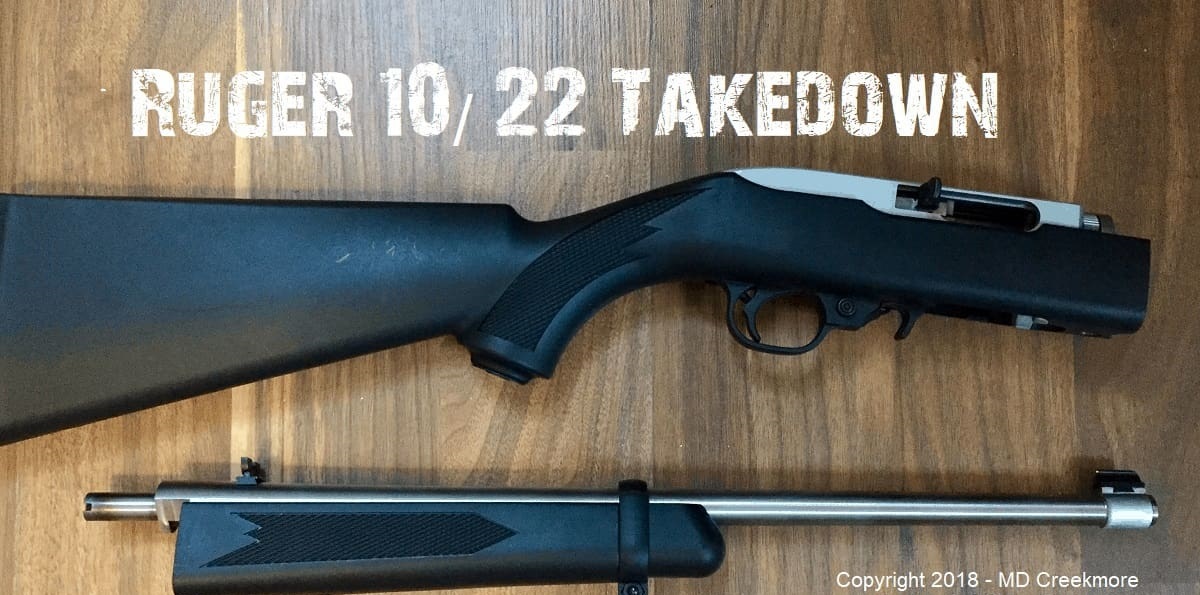
Ruger 10/22 – Is it Still American’s Best .22 Rifle?

by Jesse Mathewson

As I get older I am less likely to follow trends and popularity contests than ever before. This is definitely the case with firearms. Having learned that quality in firearms can be had from many manufacturers and with many designs, owning a firearm just because Tom, Dick or Mary down the street do, lost its appeal years back.

The Ruger 10/22 is a solid firearm and while my experiences may be abnormal, they should not detract from its value.

Ruger as a company has a difficult recent history, while they have been innovators in firearms since 1949. Bill Ruger designed the first 22lr handgun based on the Japanese Nambu, German Luger, and the Colt Woodsman. This design became known as the Ruger standard, its progeny becoming the MkII and MkIII. The 10/22 was put into production in 1964 and has remained in production since that time.

The first rifle I shot was a 10/22 built-in 1965 or 1966. My first memories of shooting were having my father assisting me in holding his venerable 10/22 as we shot at a truck tire with a piece of cardboard in it that had been rolled across the barnyard, I was 3 or maybe 4 years old at the time. This 10/22 had a fully wooden stock, stock sights, and action.

There was no internet at the time and mail order gun parts simply did not exist. If a firearm did not work well, you fixed it yourself or if you were fortunate enough to have a gunsmith that knew how to work on these new fangled guns, you took it too them.

My first 10/22 was purchased when I turned 22, the internet had started to become a real thing to use and extra bits and pieces were becoming more available. Like my fathers 10/22, the magazines and rifle were extremely picky with ammunition types.

Unlike my fathers using CCI stingers did not fix my issues. In fact, after 2 or 3 years with this particular rifle, I decided to sell it and move on. It was a decade later that I ended up purchasing another version.

Ruger 10/22 Top 5 jams and stovepipe causes and fixes

While this particular rifle was much better, on the whole, the magazines it came with were dismal failures. After spending almost $60 replacing two magazines at the time, I finally had a decently running 22lr. When I say decent I mean decent, accounting for ammunition failures with inexpensive 22lr the rifle itself had several springs replaced and a new firing pin installed before it became reliable enough to use in a local rimfire match.

Ruger 10/22 comes stock in several configurations these days, however, for many years it came with the following only.

  • Gold bead front sight (not easy to use except in paper punching)
  • Adjustable rear leaf sight
  • Solid wood full-length single piece stock
  • 10 round rotary box magazine
  • Blowback action
  • 18” barrel with a 1:16 RH twist (non-threaded)
  • Weight 5lbs, overall length 37”

Accuracy is something that I value, and a rifle should be more accurate than a pistol, my MkII handgun was very accurate from 0-50 yards and the 10/22 (all 3 I have used or owned) were also very accurate with even sub-par ammunition. 50 yard 10 round groups saw 1.5” groupings as a normal day.

This aspect is one I have never been able to complain about. When it worked, the 10/22 my versions, were more than accurate enough for squirrels, rabbits, and feral dogs. I personally took hundreds of these small game animals over the years and after moving to the Southwest border, a few dozen feral dogs, cats, and even javelina, all with the 10/22 and CCI stingers.

These days there are several dozen brands of 22lr, at the time I began using it you were limited to whichever brands were available from the local hardware store or farm and supply store. In small town, Illinois pre-1986 this meant CCI, Remington and Winchester ammunition in 50 count boxes. These were the days before big box stores reduced the quality along with the price.

Admittedly 22lr as a rimfire loading will never be quite as reliable as good centerfire ammunition. I can say that Eley, CCI, and Aguila have always been as reliable as low to mid ranged center fire loadings for myself. As of 2008, I had been using Aguila and Eley almost exclusively for my 22lr firearms. When you match the ammunition to the firearm, choosing reliability and accuracy as benchmarks, you will quickly find your firearm to be your favorite regardless brand name.

Reliability in my experience has been a mixed bag with the Ruger 10/22. Until the mid to late 90s magazines were factory 10 round magazines. Butler Creek made some less expensive versions, my first experience with these was around 1994 or so. They did not work well, in comparison today’s KCI Glock magazines have a better success rate than the early Butler Creek 10/22 magazines. Currently, the most reliable “extra-capacity” magazines for the Ruger 10/22 are the Ruger BX Series Magazine.

Other issues that have been seen in numerous 10/22 rifles, feeding was and remains ammunition dependent. Standard velocity rounds in the older models had a relatively high rate of failure, double feeds, cycling issues and more. With today’s offerings, you have enough non-Ruger components on the market to make an entire “10/22” without even using Ruger parts on the gun. This has led to even more failures, unfortunately.

Ruger 10/22 Disassembly Assembly Including Barrel

Most of the issues I saw personally were magazine related, secondary only too ammunition related failures. Again, if you match good quality 22lr ammunition to the rifle and you will be pleasantly surprised.

Swapping out stocks, barrels and more will begin causing issues and should be avoided unless you have a specific goal you are headed for and the gunsmithing abilities to do the swaps properly. Like working on a car, virtually anyone can change the oil, some of us can change brakes, very few of us can do these things quickly and right.

I have never seen a 10/22 in any configuration (minus the very expensive Volquartsen configuration professionally installed and tuned) that could keep pace with a CZ 455 22lr or similar. This being noted, I have personally cut playing cards at 25 feet or so with a stock 10/22 with stock sights. There is a definable point at which accuracy requirements become more expensive than you will ever use.

Most of us shoot paper behind our house, for this purpose and for hunting all manner of small game the stock 10/22 is very well suited. Certainly, I have found and own or use far more reliable, more accurate firearms. This specific firearm is, however, well made and when matched to good ammunition with solid magazines can be more than reliable enough for trap lines, prepping and more.

If you read many of the firearms reviews I have written you will quickly see that I am not a fan of most aftermarket add-ons applied today. For this rifle, there are just 3 items you can and should replace to make it a solid training, plinking, and small game hunting rifle.

Ruger 10/22 Accessories

  • Solid two point sling
  • Tech-Sights are a must (follow this link to Amazom.com, I use these on several rifles currently owned.)
  • Spare magazines

For 22lr firearms I have not seen a need for expensive scopes and bi-pods, even though you can take game past 100 yards with a 22lr, the reality is, the round is best for game under 50 yards. Unless you have a firm rest for your firearm or know how to use a sling wrap appropriate for sitting, standing or laying down; a scope can be detrimental.

If you decide to add a red dot at some point, this option has become more viable in recent years’ thanks to vastly improved metallurgy, construction practices optics and battery life. It is not necessary for the 10/22 in most cases.

If you decide to purchase one of these rifles make sure you clean it well and lubricate properly before taking it to the range. To do this you need to safety check the firearm, ensuring it is completely unloaded and safe to work on. For added safety remove all ammunition from the room. Visually and digitally check the action.

Rotate the rifle so that the bottom is facing upwards. Using solid gunsmithing tools/screwdriver remove the screws from in front of the trigger guard. Loosen the screw holding the band on front of the stock, your model may not have this band. Remove the band carefully and the stock will come off rather easily. Once you do this you can access the important parts for a solid cleaning session.

Ruger 10/22 Rifle Cleaning

Breaking it down further than this is at best difficult without 4 hands or a true gunsmithing set up. Once you clean this firearm you will want to lubricate it. Again I suggest using Ballistol or Hoppes oil for this firearm. Wipe the pieces down with a clean cotton cloth that has a small amount of lubricant on it. Put the rifle back together.

Cycle the action back and anchor it open. Rotate the gun until the ejection port is facing upwards. Drop 3 drops of oil into the receiver. Using the cloth from earlier you can wipe the interior down again. Let the bolt fall closed and work the bolt several times to help the lubricant get into all the areas necessary for proper function. This is a very basic approach that will allow solid function of the firearm.

As with all the articles, please comment and let me know if or what I missed while putting this together. Being a human I regularly make mistakes and if you find one rest assured, it will not be the last.

Written by Jesse Mathewson · Categorized: Uncategorized

Sep 03 2022

Colt M4 Carbine Review (LE6920)

by Jesse Mathewson

It is no secret that I enjoy firearms as well as knives. Having spent much of my life using tools in the projectile and bladed category this enjoyment is well founded. My first memories of shooting were having my father assisting me in holding his venerable 10/22 as we shot at a truck tire with a piece of cardboard in it that had been rolled across the barnyard, I was 3 or maybe 4 years old at the time.

My review of the Colt LE6920  M4 carbine (and others) is a result of the love and respect instilled in me by my father.

Colt LE6920  M4 carbine History

Colt began as a company in 1855, Samuel Colt, arguably one of the most influential firearms manufacturers and designers at the time already had several firearms designs under his belt. He is best known for the Dragoon, Ring Lever Rifle and the most famous old west handgun, the Colt Walker 6 gun. Obviously I am leaving out many valuable additions, however, this is a review of the more modern AR15 variant the Colt LE6920 M4 carbine.

It should be noted that one of the chief benefits of the firearms he originally manufactured were the parts interchangeability and the production line approach to manufacturing. Henry Ford was not really the first, though he was the most famous in this regards.

For anti-gun naysayers, there is a truly amazing history to be found, and many advances that were made in manufacturing, parts interchangeability, and metallurgy that directly impact all life in a positive way that came from firearms manufacturing.

When I first got the Colt LE6920 M4 carbine I was underwhelmed, after all, I had just plunked down almost $1000 for a non-precision, non-hunting, defensive firearm. This is not small change for someone making under $25,000 annually. My opinion of the firearm was quickly changed by the reality/facts of the firearm itself. This is a very well-built firearm.

While not as accurate as an LWRC or Daniel Defense premium model, it is very much capable, with good ammunition, of seeing 1-2 inch groups at 100 yards while benched and using only a sling rest I have easily put 30 rounds into a 3” circle with it.

Specifications of The Colt 6920

  • gas operated
  • 223 rem/ 556 NATO
  • 16.1” chrome lined 4150 (industry standard steel) barrel
  • A2 flash hider (still my favorite non-suppressor muzzle device)
  • flat top, Magpul rear sight
  • 1:7 twist (I have and use twists from 1:7 through 1:12 and prefer 1: 7 for most applications)
  • 32 to 35 inches in length
  • M-16 or full auto BCG (fully staked etc.,)

Lower and upper are made of 7075 aluminum and forged by Cerro (mine was, some may not be!) it is a low shelf lower.

As we can see it is really just an AR-15 with the capability of being a bit more. It was designed for Law Enforcement and military use and the version we can buy as civilians is literally identical to what is sold to LE (minus the potential for burst/full auto which many LE agencies avoid for standard patrol people anyhow.)

It allows mounting of optics easily with the standard 1913 rail on the top of the receiver. Though the handguard is a standard patrol/ milspec approach, it can be swapped easily for a Magpul MOE for-end for added versatility.

Colt LE 6920 M4 Carbine Accuracy

Accuracy was a mixed bag, this is the reality for most firearms. Even with modern machining and computerized approaches accuracy is flexible at best and depends on ammunition type, bullet weight, and even the sun, wind and whether the moon was full or not.

Seriously, I have two very expensive firearms that shoot best on new moon months, (I am obviously joking folks). I found my LE6920 did best with MEN 56 grain NATO spec and Fiocchi 69 grain 223 rem. Both groups of 5 rounds with these loads were under 2 inches off of a sandbag at 100 yards, it was a clear day with a small breeze and it was hot. Standard Arizona shooting weather includes breezes, heat and a clear sky.

My worst groupings with this firearm were with Federal big box 55grn and Wolf standard 55grn, both were over 4” with the Wolf loadings coming in slightly under the Federal. I should mention that I do not use bi-metal bullets in my firearms anymore. It is not because they are not reliable or accurate, which with some is an issue.

It is simply because when you calculate the heat of the round and steel on steel wear, the life of a barrel does, in fact, go down enough to make it difficult for me to justify even at 2-4 cents difference per round. I have worn out several barrels over the years, and simply do not enjoy replacing barrels before what I believe the lifespan should be.

Colt LE 6920 M4 Carbine Reliability

Reliability was very good, again this is sometimes an ammunition based metric. Of the AR-15s I use, this is among the most reliable one I have owned. Every single new gun I buy gets stripped down and cleaned before shooting. No factory lubrication on AR15s can make up for sitting on a shelf collecting dust while waiting to be sold.

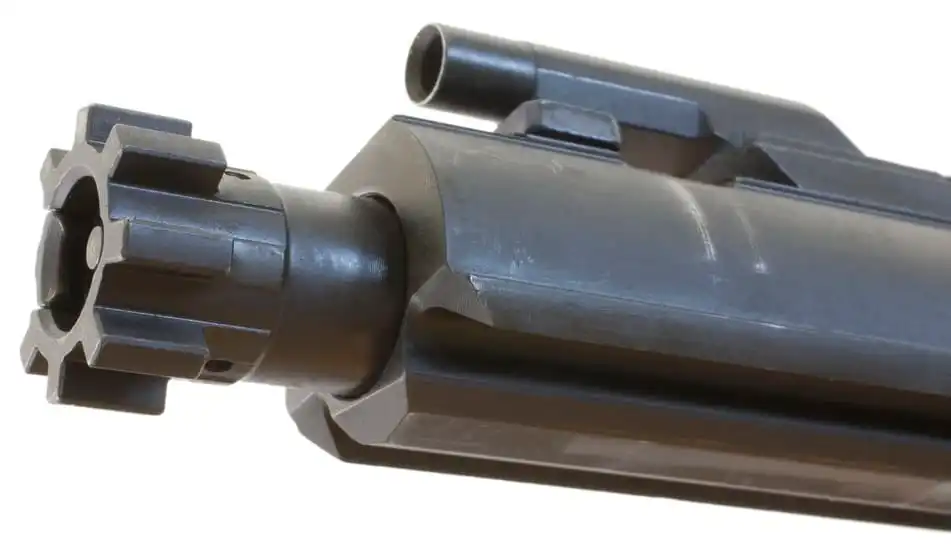
Take your gun apart and clean it well, then lubricate it per the accepted approach. I use 2-4 drops of Ballistol inside the channel where the bolt carrier group will ride, cycle the bolt several times to get the oil spread about well and add a couple drops to the side of the BCG you see through the ejection port. Cycle the bolt a few times again and go shooting.

After around 50 rounds of initial use, remove the BCG and wipe it down, replace the BCG and put 2 drops or so on it. Then run it through the next 450 or so rounds. My standard initial testing is 500 rounds for reliability. This includes 3-4 magazines or 120 rounds as fast as you can pull the trigger, without a cool down in between.

This stage is essential as fast, high rates of fire will raise the temperature substantially and will quickly show problems if they exist. While I have never found a perfect firearm as far as reliability is concerned, this one is very close to that. In fact, I did not have any issues until I was over 1000 rounds in with it.

It had begun cycling sluggishly and failed to eject a round, and I quickly remedied this and have not had any non-ammunition related issues since.

Shooting The Colt LE 6920 M4 Carbine

Shooting this firearm is not difficult, though the trigger leaves a bit to be desired. It is a milspec trigger, nothing special and allows function well. The premium trigger from Palmetto State Armory is a much better feeling, though, the Colt trigger works very well. It is very easy to polish the trigger, or just shoot it a few hundred times and it will polish itself.

As with most well made defensive firearms, I do not suggest adding things to it, this approach leads to more failures than any other. If you want a sporter AR-15 with a 2lb or less trigger and sub moa groups, build one from scratch. This particular gun is designed for use as a defensive tool and excels at the role!

Negatives are quite a few in actuality. From the factory, there is no ability to mount a light, something I really need on my defensive tools. Additionally, it is very expensive for what amounts to being a standard, well made, but a still standard milspec firearm. If you have the money, or if you are not looking to collect multiples of this type firearm and just need one good performer, this is the tool for you.

However, if you are outfitting more than yourself and like myself make substantially less than Bill Gates, there are other choices that will function perfectly well and do the job for substantially less.

My only other real complaint is that for the money you spend there is no reason that Colt does not manufacture all parts in-house, they do outsource many of the major parts for this and other firearms they sell. None of the “issues” are really a problem, except for people who nitpick, like myself.

Overall this is a firearm that with a little care from you, can be passed down to your children. It is well made, durable and on the higher end of cost, but not exorbitantly so. I can recommend the Colt LE6920 M4 carbine with two thumbs up and would not feel under armed using one for personal defense or for patrol as a combat person. There are other versions of the 6920 available and right now is really a buyers market for firearms of all types.

Be sure to comment below if you have had any experiences with a Colt LE6920 and let us know. As I have only used this one carbine, I cannot speak to the overall ability of the 6920 series. Again, comment below and let me know how yours run.

Free the mind and the body will follow…

Written by Jesse Mathewson · Categorized: Uncategorized

Jun 05 2020

Don’t Tread on Me – The Gadsden Flag and it’s Meaning

BY JESSE MATHEWSON

What Does Don’t Tread on Me and the Gadsen Flag Mean Today? Of the many slogans that have been socially adopted by some as a banner, and others as the new evil to kill, the line, “Don’t tread on me” is easily among the top ten over the past few years. To find out what the Don’t Tread on Me Flags Meaning today we need first take a look at where it came from, and why.

The idea promoted with the Gadsen Flag and the Don’t Tread on Me phrase is simple, “leave me alone to live in peace, to do what I do best, and as long as my actions do not cause physical harm to others there is no need for your intervention. It is about free will, personal choice, and freedom without rulers or government overloads. It has nothing to do with race or religion and everything to to with maximum freedom and limited government. 

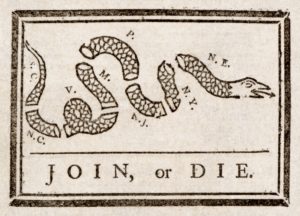
Rattlesnakes, in this case, the eastern diamondback and the timber rattlesnake, were both abundant in North America, and something not found in Great Britain. Benjamin Franklin made many references to rattlesnakes in his commentaries, published from 1751 onward.

In 1754 he published the woodcut of a snake cut into 8 sections with the message, “JOIN or DIE”. Fast forward 21 years and we were on the cusp of a civil war with England.

Contrary to what has been taught for decades in the United States, our war with England was, in fact, a rebellion. Christopher Gadsden designed the Gadsden flag in 1775, this is what we think of today when we hear the phrase, “Don’t tread on me”.

This was the year before the declaration of independence was signed. As a firm believer in the natural rights of man*, I choose to see the benefit of separating from the state of England.

Department of Army EmblemIn 1778 the United States Congress began using the War Office Seal, which was replaced in 1947 for the official document used by the Department of Army Emblem, pictured here. As you can see, the rattlesnake, like the bald eagle and the lone pine tree, features heavily in our history and documentation.
Current day versions of the Gadsden flag can be traced to the Tea Party movement, another maligned movement based in a misrepresented historical ideal.

One article from 2016 says, “The snake, it turns out, was something of a Colonial-era meme, evidently originated by Benjamin Franklin. In 1751, Franklin made the satirical suggestion that the colonies might repay the Crown for shipping convicts to America by distributing rattlesnakes around England, “particularly in the Gardens of the Prime Ministers, the Lords of Trade and Members of Parliament; for to them we are most particularly obliged.” (Walker, 2016) Modern “educated” writers who cannot be bothered to search further than Wikipedia are in fact the reason why, in our current day and age, any use of the Gadsden flag is seen as hateful by the left – or worse, as supportive of yet more government by the right.

These people use just enough verifiable information that no one questions the veracity of their stories, tweets, and posts.

England and more specifically the East India Trading Company-owned or controlled the original 13 colonies, as well as lands spanning what is currently Canada. The colonists had, for many years, dealing with everything from forced conscription in the English naval forces, to forced eviction from homes built and land farmed for years. In addition to these things, there were many instances of the quartering of English troops in colonial residences without any real recompense.

✔️CHECK OUT THIS HUGE SELECTION OF DON’T TREAD ON ME PATCHES AT AMAZON.COM

All of this was done under the color of law and for the colonists’ “own good”. The reasoning was the same as what we are given today when taxes are raised, levies are sought, and new wars and conflicts entered into. “Your safety, the safety of (English) interests abroad and the furthering of (English) influence around the globe!”

For 258 years the East India Trading company literally ruled the world, and it was all done under English laws and rules. (Rittman, n.d.)

The use of symbols was especially important at a time when many people were not able to read and write effectively. By using figures such as rattlesnakes and bald eagles, these uniquely American animals, the colonial civilians could cling to something that was theirs, and that did not stem from the King or company controlling the leaders of the “civilized” world.

What Does The Don't Tread on Me Snake Mean
What Does The Don’t Tread on Me Snake Mean?

It should be noted that the idea of slavery as an institution and means of profit was originated by Spain, England, and the East India Trading Company. (Please note that while the East India Trading Company is also known as the British East India Trading Company, and the Dutch East India Trading Company, it was originated and founded in London in 1600) The symbol of the rattlesnake was specifically meant to offer a warning to England. A rattlesnake that is stepped on bites in every case.

This is obviously dangerous to the person doing the stepping, hence the term, “Don’t tread on me,” it was meant to convey this warning in terms that even the farmers and working man could understand.

So What Does Don’t Tread on Me Mean?

Over the past few years, we have seen extremes, more so than ever before. These extremes are a result of people being classified, labeled, and marginalized by mainstream media and politicians alike.

In our modern society, thanks to endless loops of 15-second sound-bytes and directed social media outbursts, we see even more people becoming disillusioned with the status quo.

On a personal note, the past few years have been difficult beyond any other years before in my life. The hatred is being stoked to further divide the population, much like what happened in France prior to their revolution, and here in the United States prior to ours.

This has led to people using old slogans and catchphrases to promote alternatives to the status quo. “Don’t tread on me” is just such a slogan. I embrace this slogan though I do not embrace all who use it. This is extremely important to understand.

Americans, and humans in general love to use others to validate their beliefs. There are those of us who realize that only the facts matter in the end. This means that in some respects we have to understand that the data is simply that, data.

There is a current phrase being used, “Big Data”. I see this phrase for what it is, the philosophical ramblings of Political Science majors who have no concept of facts outside of how they may prop up their positions.

1778 20 dollar bill from Georgia

Consider this, in recent decades, this country has been in a state of upheaval. Financial destruction, millions of hard-working Americans jobless, increasing inflation, and hundreds of new laws and protest organizations. Certainly, there is blame to go around, and it should be directed at each of us. We are to blame for our own life decisions and approaches.

This being said, when you have a government that cannot listen to the people, or people who are more interested in emotional outbursts than facts, these slogans and their history become that much more important! I will not blame a single man or woman, but rather a mindset that infects and affects all of us.

This malaise and division are embraced and promoted by those in control as well as many who prop them up with financial and “moral” support.

The modern usage of this term was meant to generate a sense of patriotic furor and has been associated with the Tea Party movement, a more recent movement originally designed to protest extremely high taxes and government overreach, but which was co-opted and devolved into mainstream political infighting.

Between the mainstream media (all sides), and political finagling (on all sides), what could have been a positive thing was subverted, perverted, and eventually demonized by many Americans – simply due to ignorance being given platform over facts.

Commodore Hopkins
Commodore Hopkins

In looking at the history of the Gadsen flag in use we find that the first to use it was Commander Esek Hopkins, the first “admiral” of the newly formed naval forces. He was widely known to have not been enamored with Washington and other “leaders” of that time.

He was, however, an active privateer prior to, and during, the Revolutionary War. In his words, “the two new ships are Launched & will be soon ready if men could be had.” (Hopkins, 1776) He was speaking about the fact that Washington and Gates were requisitioning all the men and not leaving any to man the newly formed fleet.

Washington later sacked him, many believe this was a result of Hopkins inability to hold his tongue when someone was doing something he saw as stupid.

When using historical symbols, my personal approach is to learn as much as I can about them and to absorb the real history surrounding them. This is a reason I have not adopted the rather common “Molon Labe” phrase. In the case of the “Don’t tread on me” flag, it was brightly colored and easy to read.

Also, over the ocean in a sailing craft where it could take an entire day or longer for one ship to overtake another, this allowed for a sense of dread to build and to be felt by the crew of ships being overtaken.

Modern times have seen a resurgence in the use of this flag and phrase, and while many who fly it are a part of the failed Tea Party movement, many others, like myself, have and fly this flag as a symbol against tyranny.

Tyranny is quite simply, “oppressive power”, which can be applied to the approaches used by modern media, activists, and politicians alike. Thomas Jefferson once said, “for I have sworn upon the altar of God eternal hostility against every form of tyranny over the mind of man.” (Jefferson, 1800) In my personal study of the founders** I embraced the writings of Jefferson, Paine, Henry, Mason, Lee, Yates, Singletary, Warren, Clinton, Smith, Fenner, Martin, Samuel Adams, and Monroe as well as others seen to be Anti-Federalists or from who the Anti-Federalists drew their inspiration.

How does this apply to the phrase, “Don’t tread on me”?

The idea promoted with this flag and phrase is simple, “leave me alone to live in peace, to do what I do best, and as long as my actions do not cause physical harm to others there is no need for your intervention.

Christopher Gadsden, the author of the phrase, made clear his intent to represent an idea to the British overlords at the time when he penned this phrase, attached as it was to a coiled rattlesnake.

It seems quite obvious that he believed very strongly in the real separation between England and the colonies, and that his loyalty was also very much in the colonies with his family, friends, and those who wished to see us free of the grip of the corporate overlords of the East India Trading Company and England.

Interestingly, there is not much known about this individual, and I have searched everywhere I have access to. Feel free to write a comment below with any links or books that may have additional information on him.

So there you have it, the modern use of “Don’t tread on me”, as well as its history – and my somewhat anemic commentary. If you have any added information or knowledge in this arena, comment below. I learn from what others share with me, and from what I study and research. While I feel confident that my knowledge in this arena is extensive, there is always more to learn.

Thank you for reading, and of course, commenting and sharing.

*When I use the term “man” I am referring to humankind as a whole, using the classic sense of the word.

**There were 3 sets of founders, first you have the Declaration authors than the drafters of the Articles of Confederation and lastly the Constitution drafters. These individuals are not the same though there is some minor crossover between them, many of the original Declaration signatories rebelled against the passage of the Constitution, and some of them were very vocal in their belief that this “document” would be a problem in the future.

  • Hopkins, E. (1776). Founders Online: To George Washington from Commodore Esek Hopkins, 22 May 1776. Retrieved from https://founders.archives.gov/documents/Washington/03-04-02-0300
  • Jefferson, T. (1800). Founders Online: From Thomas Jefferson to Benjamin Rush, 23 September 1800. Retrieved from https://founders.archives.gov/documents/Jefferson/01-32-02-0102
  • Rittman, P. Rise and Fall of the British East India Company. Retrieved from http://paulrittman.com/EastIndiaCompany.pdf
  • Walker, R. (2016). The Shifting Symbolism of the Gadsden Flag. Retrieved from https://www.newyorker.com/news/news-desk/the-shifting-symbolism-of-the-gadsden-flag

Written by Jesse Mathewson · Categorized: Uncategorized

Oct 24 2019

Is Medical Training Needed For Concealed Carry?

Concealed carry and medical training

Medical knowledge and medical supplies are used far more frequently than defensive tools in the United States. When I was much younger I had several things occur that helped me understand the benefits of understanding trauma care and remaining current with my training.

After watching an individual bleed out in front of me and being able to do nothing, and intervening and saving the life of two people trapped in a bad car wreck, I made the decision to learn as much medical knowledge as I could. This led me to search for solid instruction from real medical professionals.

At first, I was limited to learning from my friends in local Emergency Rooms, between them and EMT friends I was able to learn quite a bit. Of course, with time that knowledge became outdated and as a result I have over the years taken training regularly.

It is important to note that I am not a medical professional, I simply have enough experience and training to stop some major bleeds, assess the bleed, perform CPR, assess- insert and use any one of the top three utilized tourniquets, use a Halo Chest Seal, nasopharyngeal airway, and even suture or staple depending on need.

Obviously, it is my intent to never have to use any of this again. However, I also understand that medical knowledge is much more necessary in daily life than most people understand. Additionally, I have taught and continue to work with others from very young through the elderly in this and other areas.

In 2015 27.6 million people were treated in an emergency department for injuries. 2.8 million were hospitalized due to injuries and 214,000 people died from injuries in the United States. (Injury prevention and control, 2017) These numbers are fact, they are compiled from raw data and regardless your feelings on the CDC they keep very detailed records.

Now, firearms are used between 200,000 and 3 million times every year in self-defense, with most legitimate studies showing that a firearm is used closer to 3 million times. (Leshner, 2013) (For the naysayers understand that this is based on several agencies who did not want to release this data because it showed that the benefits outweighed the negatives.) The book referenced costs $38 and is worth reading if you have the chance.

Here is an excerpt, “studies…have found consistently lower injury rates among gun-using crime victims compared with victims who used other self-protective strategies.” Another quote is as follows, “The estimate of 3 million defensive uses per year is based on an extrapolation from a small number of responses taken from more than 19 national surveys.

The former estimate of 108,000 is difficult to interpret because respondents were not asked specifically about defensive gun use.” It should be noted that the book/study does its best to discount any use of firearms in defense, however, at no point does data support their assertions. Rather, the data clearly support the use of firearms in defense.

There is a simple reason for including the data that is available, it is not meant to build sides in an endlessly pointless political battle. The reason is that without data and facts one cannot know for certain what works and what does not.

In this case training in medical knowledge, specifically EMT or Trauma Care basics at a minimum is necessary to be well rounded as a solid individual practicing their natural rights. To this end, there are several solid schools in the United States.

When it comes to self-defense and the surrounding needs that accompany this, it is essential to have as much solid education and hands-on experience as possible. I would suggest the following for their training and reputable approach. All of the listed have embedded links directing you to them.

  • Gunsite Academy (founded by Jeff Cooper)
  • The Firearms Academy of Seattle (Marty Hays)
  • Active Response Training
  • Your local community college likely offers EMT/Trauma medicine classes which can be applied!

There are other schools around the United States today, however, not all of them offer classes at the same level that you will get in the above-mentioned locations. Certainly, there is a surplus of experienced Army (and marine/navy and even air force) Medics as a result of the 17-year war we have been involved in.

What I suggest when it comes to medical and firearms training is getting training from individuals who can prove their abilities and have a legitimate background in the area. There are several large schools that offer basic/intermediate instruction for firearms using the timeshare approach to teaching.

This means that while you get some benefit, the reality is you are cycled in and out as quickly as feasible and then sent endless emails and phone calls to beg you to upgrade your membership or sell it to your friends. A solid school and approach does not need to be sold.

So far we have established that having modern, basic medical training is an essential life-saving component of being prepared and carrying a concealed firearm for self-defense. What is important now is understanding that trauma based medical care has advanced greatly in the last 20 years alone and what worked even a decade ago or what you learned in medical school or a first aid class 5 years ago may no longer apply.

For instance, just in the past few years using tourniquets and what and how they are made has changed drastically. Make sure you get up to date training from individuals who understand and use these approaches.

Once you receive solid training you will need to put together a simple easily carried trauma kit for your personal use. This kit should be small, and, should include the following items these are the most important.

  • Tourniquet, there are several types the SOFTT-W, SWAT-T and the CAT style tourniquets. While I personally use and practice with a CAT tourniquet the others have their place based on need and intent. Stopping the bleed is a term you will hear a lot in modern classes. This tool is used for extremities.
  • Israeli Bandage or similar product, again the intent is to stop the bleed. This is used for non-extremities, bleeds that are on the trunk of your body or head is where this one will be used most.
  • Bandages, both gauze 4×4 and 2×2 and standard Band-Aid bandages for smaller issues. Infection is a serious possibility and to avoid this you want to wash the wound with clean water and bandage it.
  • Sheers, medical-grade sheers are absolutely necessary.
  • Sterile individually wrapped nitrile gloves. Make sure you get the non-allergenic ones.
  • A small bottle of sterile water for wound washing.
  • Hypo-Allergenic medical adhesive tape
  • CPR mask, you can get small disposable versions that work very well for an EDC kit. It is essential to have CPR supplies and KNOW how to apply CPR properly. Again, what was taught even 10 years ago is NOT what is being taught now.

The above are the very basics that are necessary for a trauma kit. All of this can be easily stored in a small package that can be worn on the belt, tucked in a pocket or purse easily. Some individuals I know often carry just the tourniquet and Israeli bandage based on space available.

This works when needed. For myself personally, I have a full trauma kit with everything from antibiotics through surgical needs. In addition to the large kit I have vehicle kits and then personal kits for each member of our family.

When it comes to my family their safety is something I take very seriously. I know that we are the only ones who can prevent problems or solve them as they occur, and that responders are quite often too late which is why deaths from injuries are quite high.

For myself and my family, prevention is worth far more than a “cure”. I teach them what I know and we all test our knowledge regularly so as to prevent stagnation. Active involvement with our environment is the easiest way to prevent issues from happening.

As with the other articles, please let me know if you see something that is missed and if so comment below. I learn daily and cannot learn if I do not know where I am making mistakes. Additionally, it should be noted again I am not a medical professional, I am simply a dad who trains and trained and practices to prevent issues in my and my families lives!

Thank you for reading and make sure to check out the links in the article for some great products, by purchasing through the links you support this site and allow the owner and individuals writing like myself to continue to put out solid material for your educational benefit.

Free the mind and the body will follow

Injury prevention and control (2017). Key Data and Statistics|WISQARS|Injury Center|CDC. [online] Cdc.gov. Available at: https://www.cdc.gov/injury/wisqars/overview/key_data.html [Accessed 9 Aug. 2018].

Leshner, A. (2013). Priorities for research to reduce the threat of firearm-related violence. 1st ed. Washington DC: The National Academies Press.

Further Study on DVD

  • Gunshot Wound First Aid
  • Basic First Aid Training
  • Knife Wound First Aid

Written by Jesse Mathewson · Categorized: Health and Fitness

Oct 24 2019

What Medical Training Should I Get For Concealed Carry?

first aid training for concealed carry

This article is meant to show you what training you should get for concealed carry. What is included in the article are references, links for additional training and resources and lastly definitions and descriptions. Always remember, make sure you and your family are safe before attempting to offer assistance to anyone. Never do so if it means sacrificing your own safety.

To answer what medical training you should get, you have to know why medical training is essential. It is important to note that I am not a medical professional, I simply have enough experience and training to stop some major bleeds, assess the bleed, perform CPR, assess- insert and use any one of the top three utilized tourniquets, use a Halo Chest Seal, nasopharyngeal airway and even suture or staple depending on need. I firmly recommend getting any training you can, when it comes to caring for your self and family, make sure you find the best that you can afford.

In 2015 27.6 million people were treated in an emergency department for injuries. Over 2.8 million were hospitalized due to injuries and 214,000 people died from injuries in the United States. (Injury prevention and control, 2017) These numbers are fact, they are compiled from raw data and regardless of your feelings on the CDC they keep very detailed records.

Now, firearms are used between 200,000 and 3 million times every year in self-defense, with most legitimate studies showing that a firearm is used closer to 3 million times. (Leshner, 2013) The book referenced costs $38 and is worth reading if you have the chance.

Here is an excerpt, “studies…have found consistently lower injury rates among gun-using crime victims compared with victims who used other self-protective strategies.” Another quote is as follows, “ The estimate of 3 million defensive uses per year is based on an extrapolation from a small number of responses taken from more than 19 national surveys.

Concealed carry medical training needsThe former estimate of 108,000 is difficult to interpret because respondents were not asked specifically about defensive gun use.” It should be noted that the book/study does its best to discount any use of firearms in defense, however, at no point does data support their assertions. Rather, the data clearly supports the use of firearms in defense.

Now that we understand why medical training is so essential to concealed carry, what medical training do we need to have? There is a phrase that has been popularized over the past few years, “stop the bleed.” What this phrase means is quite simple, train to stop bleeding. Medically there are other important items to consider, airway blockages, CPR and a few other important medical considerations.

For a concealed carrier, the plan should always be centered around what they may encounter most. In this case another individual with a knife, firearm or other deadly weapons. The damage that will occur from a wide variety of deadly weapons carried today regardless of location can range from penetrating or slash wounds causing rapid exsanguination (blood loss) and crushing injuries causing broken limbs coupled with exsanguination of the rapid or slow type both of which can result in death. Lastly, shock and or extreme trauma induced heart attacks and stress-related breathing issues can also result.

Interestingly the government has released a few little known publications in the public sphere regarding trauma care and the need for immediate action. For instance per the Department of Homeland Security, FEMA, these are the five “simple” steps that may save a life. Call 9-1-1, Stay Safe, Stop the Bleeding, Position the Injured, Provide Comfort. (FEMA, 2014) Follow the links and take the on-line training, while it is not the same as hands-on training, this will help you better understand what is needed.

Additional bleeding control training is made available by the American College of Surgeons through the website, bleedingcontrol.org, lastly, FirstCareProvider offers instructor courses and has been endorsed by a few organizations that offer it legitimacy.

Care is a term coined and used by DHS and FEMA that stands for the following. Control bleeding with direct pressure or tourniquet. Airway improvement with recovery position. Respirations improve by covering open chest wounds. Exposure to the elements causes loss of heat. This can help understand the added training needs everyone who carries concealed should have as a precaution.

Find a course that offers you training in CARE as well as carries specific trauma care. Call 9-1-1 first, do not panic, panic prevents care from occurring. Control bleeding, find the source of bleeding. Open or remove the clothing over the wounded area so that you can see the wound. Head wounds will always bleed profusely, they will always seem very bad.

direct pressure on woundPressure should be used on the head and trunk (body, not arm or leg) injuries. Using a clean cloth if possible, fold it and press firmly on the wound, hold a firm pressure and maintain that pressure until the paramedics arrive. Stopping the bleed is far more important at this stage than preventing infection.

Both should be attempted when possible, which is why I suggest wound cleaners and sterile gauze, homeostatic bandages and Israeli style bandages. However, this is not always the case, so stop the bleed first! If the wound is on the groin, trunk or close to the body and is deep and bleeding steadily, pack the wound using a clean cloth and if you have a trauma kit use your Israeli style bandage or a homeostatic bandage. I keep two of each in my vehicle-based trauma kits.

On extremities, legs and arms, unless close to the body, use a tourniquet. If you do not have a specialized modern tourniquet use a belt, long cloth rolled diagonally, 550 cord doubled or another similar device to stop the bleed. All pictures have been borrowed from the booklet stop the bleed (Pons & Jacobs, 2017)

Next is Airway improvement with recovery position. This is extremely important of the person is having difficulty breathing or has lost consciousness. Establish that the airway is not obstructed, the tongue is the most common obstruction. If you see a foreign object and it can be removed easily, remove it. Tilt the head back and lift the chin, this will straighten out the airway and make it easier for breathing to occur.

Using your CPR mask if you have one, place it over the victim’s mouth and nose, ensuring the head is tilted as can be seen in the attached picture, blow air into the mouth, two one-second breaths forcing the chest to rise and fall with each.

packing wound

If the breaths do not cause the chest to rise and fall, engage in chest compressions. These are given differently for adults and children so make sure you take a course that teaches this! Chest compressions should be administered at a 30:2 ratio, meaning 30 chest compressions with two solid breaths in between.

Continue compressions until EMS arrives or the person begins to breathe on their own. If they begin to breathe on their own roll them into the recovery position, pictured here.

Respirations improve by covering open chest wounds. This part of care is more tricky and requires chest seals or again clean clothes applied directly to the wound area. Finding training in CARE will help you better understand what to do in this regard.

Not all wounds are the same, and all should be assessed and treated per the guidelines given in prior linked articles and through the application of learned materials from classes linked.

tourniquet wrap

Lastly is Exposure to the elements causes loss of heat. This has a more simple solution, use a blanket or space blanket which should be carried in your trauma kit or vehicle. I keep two 90% or greater wool blankets inside of 9’ square tarps in my vehicles along with 2-4 small mylar space blankets in each trauma kit and in the vehicle.

Preventing exposure can increase the possibility of a beneficial outcome with someone who has been in a vehicle accident or other form of traumatic incident. If the person is unconscious, check for obstructions in the airway, check for bleeding and than place them in the recovery position inside of the blanket or space blanket.

For concealed carry the medical training you should get is the same as the medical training you should have for driving a vehicle, camping, hiking, bicycling and swimming activities. It is worth the time invested to ensure your training stays up to date as well.

New approaches are innovated quite often in the medical community and this means training does not end with your medical license 30 years ago or a course you took in the 80s for CPR. What is known and taught now is far different than what was taught in the 80s, 90s, and even in the early 2000s. Stay abreast of the new knowledge and utilize common sense.

first-aid-training-recovery
The recovery position If the victim starts to breath normallyFree the mind and the body will follow…

FEMA (2014). You Are the Help Until Help Arrives. Retrieved October 26, 2018, from https://community.fema.gov/until-help-arrives

Injury prevention and control (2017). Key Data and Statistics|WISQARS|Injury Center|CDC. Cdc.gov. Available at: https://www.cdc.gov/injury/wisqars/overview/key_data.html

Leshner, A. (2013). Priorities for research to reduce the threat of firearm-related violence. 1st ed. Washington DC: The National Academies Press.

Pons, P., & Jacobs, L. (2017). How to Stop the Bleed. Retrieved from https://www.bleedingcontrol.org/~/media/bleedingcontrol/files/stop%20the%20bleed%20booklet.ashx

Written by Jesse Mathewson · Categorized: Health and Fitness

Oct 24 2019

Is There a National Concealed Carry License?

What is the national concealed carry qualification? 

Graphic By Jeff Dege

In 2004 the Law Enforcement Officers Safety Act (LEOSA) was enacted in the United States. This law allows to classes of persons, the qualified Law Enforcement officer” and the “qualified retired or separated Law Enforcement officer” to carry a concealed firearm in any jurisdiction in the United States or United States Territories, regardless of state or local laws with minor exceptions.

At this time this is the only national carry or national concealed carry law on the books. It should be noted that this article is not meant to offer legal advice merely to allow others to better understand LEOSA and national carry restrictions or allowances.

This article is meant to clarify what is legally allowed and not allowed for the qualified, or qualified separated or retired Law Enforcement that may be reading this article. Additionally, the article is meant to explain what it takes to maintain and keep as well as use the LEOSA permit.

Here is the law paraphrased, “Notwithstanding any other provision of the law of any State or any political subdivision thereof, an individual who is a qualified law enforcement officer and who is carrying the identification required by subsection (d) may carry a concealed firearm that has been shipped or transported in interstate or foreign commerce…” (LII / Legal Information Institute, 2004)

So what is a qualified law enforcement person? In most states, commonwealths and territories have codified Law Enforcement training centers. These are known as P.O.S.T. or Peace Officer Standards and Training. While some locations within the United States have differing qualifications for firearms training, these differences are relatively minor.

A qualified Law Enforcement person is one that is active duty with no behavioral or legal restrictions or who has served 10 years or more as a federal, state or local POST certified or federally certified law enforcement officer.

If you search this term in your browser replacing your state with your states name, “(your state) LE POST” it will pull up information on your state’s qualifications. For non LE concealed carriers if you can train and pass a verified course of fire for your states LE POST qualifications this can be beneficial if you have to use deadly force in defense of self.

I suggest getting the target you passed on signed by a range master on duty who can verify you passed it and whichever instructor or other person attended, a minimum of two witnesses for legal reasons, sign, and date!

Legally this law has seemed some blowback, specifically in New York state, the District of Columbia and California. Thankfully, each case saw the defendants who were, in fact, Law Enforcement officers or agents cleared and has set precedents supporting the initial LEOSA law.

In 2006 Arthur Rodriguez a Pennsylvania Court Constable was found in a New York court ruling to qualify for protection under LEOSA. In 2012 Barbusin a special police officer of the District of Columbia Protective Services Police Department was found to have satisfied the LEOSA’s broad definition for qualified law enforcement.

In 2008 a Coast Guard reservist named Booth was found to be a law enforcement officer and his rights were upheld in a ruling in, surprise, surprise, New York again. The ruling stated that his job was to “prevent, detect and enforce federal law” as a coast guard serviceman. California arrested Jose Diaz in 2007 for having a loaded firearm in his vehicle in San Fernando.

The charges were dismissed and the subsequent lawsuit filed for violation of civil rights was settled outside of court by the city, the city redrafted the police training standards on LEOSA. (Baranowski, 2014)

Directly quoting the article – Does the LEOSA carry law apply to you, “On Jan. 2, 2013, LEOSA was amended to specifically allow for active and “retired” (as defined by LEOSA) military and DOD police and law enforcement officers with UCMJ (Uniform Code of Military Justice) apprehension authority to qualify for the statute; however, also hidden within the amendment was language mandating that all QLEOs now carry a photographic ID that “identifies the employee as a police or law enforcement officer of the agency,” and that QRLEOs carry a photographic ID “that identifies the person as having been employed as a police or law enforcement officer.” (Baranowski, 2014) If you go to the LEOSA website they offer the ability to easily sign up for a national carry identification card allowing ease of use and carry. Click here, LEOSA, and make sure to read it and ask them questions as needed.

Another solid resource is found on PoliceOne under LEOSA. As a civilian who has trained and taught Law Enforcement and various military over the course of two decades I can say that PoliceOne authors are almost all slanted away from law-abiding civilian carry.

Given that law-abiding civilian carriers outnumber every other demographic that carries it may be a beneficial idea to work with us rather than join the loud cries against our carrying.

Obviously, not all civilians are trained well enough to carry in a trustworthy manner, however, during my training of law enforcement and military over the years it is no small wonder that friendly fire is a rather high statistic there as well.

Training is essential whenever deadly force is prepared for in any way. I would suggest that training be increased if you plan in carrying regularly. Never relax completely, never let your guard down to your own potential missteps and more importantly live in yellow, relaxed but aware.

It is not a negative and given statistical evidence that the largest percentage of incidents occur close to your home, this is a reason to be more aware of your actions when at home.

This leads into the current desire for law-abiding civilians who are wanting a national carry law to be enacted. Given the current political climate, a national carry law would be at best a two-edged sword with the handle of the sword also being a blade.

National carry would allow a much easier time collecting data on law-abiding carriers, currently, data is collated at a national level using the background checks performed at the time of purchase as well as the various state-issued permits.

Regardless of what is said, all of this data is collected. What is not done at this time is keeping it all in one database. Between social media, digital communication, and the various state and federal steps needed for law-abiding firearms ownership most of the firearms bought and sold over the past three or four decades can be quickly and easily traced through purchasers and even past that level if the firearm was sold to others.

National carry could be easily used to come down on law-abiding citizens who carry for self-defense if the political winds changed more than they already have. Currently, there are many very vocal people who disparage law-abiding carry, even though not a single law-abiding person has ever committed a crime using a firearm. After all, the very nature of the term precludes the commission of crimes.

In addition to the political issues, there are the media and social media pushed emotional views based on spurious lackadaisical “truths” which have been promoted as “facts.” Some of these are, gun owners are more likely to commit crimes, etc. et, al., promoted by any town and the Brady camp. The real facts are simple, criminals do not care if you are black, white, red, female, male, trans, gay, straight or a horse. If you have what they believe they should have, they will commit crimes against you.

Certainly depending on areas and demographics, some demographics are more likely to commit crimes. However, when you look at the facts you will quickly find that the myths behind mass murder and or mass shootings are just that.

Myths and the reality is every single one of the individuals who committed one of these crimes was bat shit crazy insane. And yes, mass murder occurs and has occurred more frequently with much higher body counts in many nations in Europe, Asia, and even Africa than in the United States.

What you will not find as often outside of the United States is the use of firearms to prevent mass violence, or to stop it. In fact, outside the United States and in fact in many states in the United States people have become the equivalent of sheep, they bleat and complain making an awful racket and have lost almost all ability to care for themselves in any real manner.

If you can carry legally, do so, regardless of your status as a privileged badge carrier or not. If you cannot carry legally, move. I have not found a single instance of voting or political action that does not negatively affect far more people than it helps. This is why I say move. I understand that many readers regardless of side they support will rabidly state their objections.

However, none can rationally argue that I am incorrect. As I am not insane, I choose to personally not repeat the same actions endlessly in a futile hope that it will somehow make life better. Rather, I have dedicated my life to raising my children, training and being prepared as best I can.

I hope you also consider investing as much time in your children as you may invest in your social media accounts. (It should be noted I do not have social media accounts, I do have social interactions in person with others as well as gardens, children, animals and the regular constant acquisition of more knowledge which I than put into practice, something so many walking dictionaries fail to do.)

If you enjoyed this article or have any questions, please leave them in the comment section below!

Free the mind and the body will follow…

  • Baranowski, J. (2014). Does the LEOSA Carry Law Apply to You?. [online] NRA-ILA. Available at: https://www.nraila.org/articles/20140117/does-the-leosa-carry-law-apply-to-you [Accessed 25 Oct. 2018].
  • LII / Legal Information Institute. (2004). 18 U.S. Code § 926B – Carrying of concealed firearms by qualified law enforcement officers. [online] Available at: https://www.law.cornell.edu/uscode/text/18/926B [Accessed 25 Oct. 2018].

Jesse Mathewson BSCJA et, al.,

520 249 8495

Written by Jesse Mathewson · Categorized: Uncategorized

Jun 26 2019

What Are The Best Survival Knives For The Money [2019 Hands-On]

what is the best survival knife for the moneyWritten by – Jesse Mathewson

One of the most underrated and over marketed essential components of a bug out, survival, bushcrafters kit are the knife, or in my case knives. Since the rollover in 2000 and failure to collapse of anything at that time, the prepper, survival world has blossomed as an entirely new industry.

This has led to knife builders getting into designing knives for large production companies versus the plethora of smaller individual builders that used to exist. There are now machine shops producing show-stopping advanced design knives, however, are any of these modern art pieces really worth the money you pay for them?

And do they have a purpose outside of looking pretty when you post an Instagram of your never used daily carry?

As a lifetime prepper/bush crafter who has lived for over two decades in the High Deserts of North America having a useful knife on hand is not only essential, it is a life or death decision. There have been numerous times in my life where a simple Opinel #8 kept me from going hungry, allowed me to start a fire and set up camp.

Knives are tools, essential tools. If you live where you are not allowed to carry a knife, move; honestly it is the height of political arrogance, that people not be allowed to carry even a simple folding or sheath knife.

This being said, time for the basic reviews of three manufacturers I recommend to people wanting to start their kits on the cheap, or even for experienced individuals looking at expanding their tool chest.

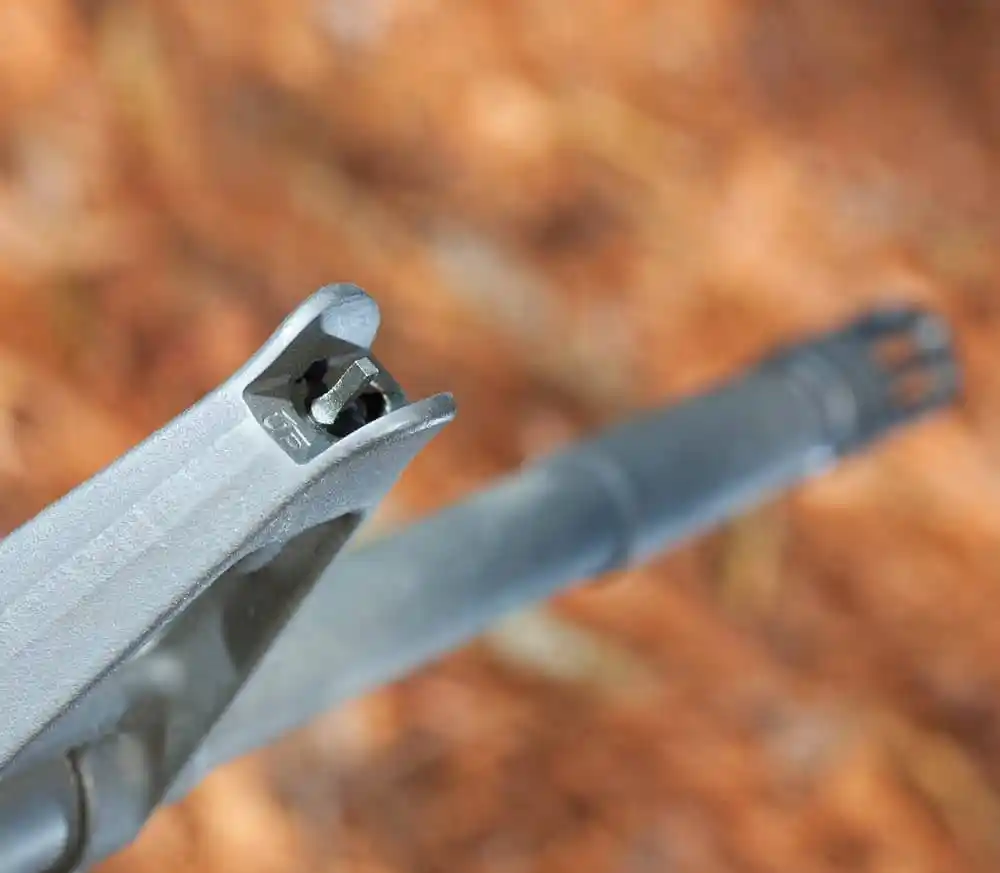
Mora of Sweden – manufactures the famous Morakniv line of knives. There are dozens of models available though I have found that for most tasks the simple Companion in either stainless or high carbon works just fine and at an average of $13 apiece on Amazon, they are worth buying in bulk.

1.  These are fixed blade, sheath knives and come with a standard working plastic sheath. Modern polymers have proven time and again to be as strong as many steels so don’t let that deter you. The stainless version most commonly seen is made of Sandvik 12C27 a Swedish steel that is almost naturally occurring and well known for its longevity.

The HC or high carbon version is made of laminated high carbon and softer external steel.

2.  The edge bevel or grind is called the Mora grind, and is a very shallow, thin grind that allows easy cutting and shaving of kindling. It is NOT a good knife to use for chopping, though you can do so, as the bevel of the blade itself lends itself to edge rolling and it will need a quick strop before continuing on.

3. Stainless steel models do not hold an edge as well as compared to the high carbon models; however, they are far more rust resistant than the latter. So it is a toss-up as both easily work for the same tasks when called upon. One simply needs more touch up than the other.

4. The grip is a rubberized plastic and they are a ¾ tang, which is quite strong. Initially, upon testing I hammered two into a tree about 5 feet off the ground, I then hung from the handles and put my full weight on them for as long as I could hold it several times. I have also pried with them, putting them in a vice and bending the blades almost double without any harm occurring in the handles themselves.

5. Speaking of the blades, they are relatively thin running .078” to .098” of an inch wide, however, this is a good thing as it means they will work very well for cooking, camping, picnicking, cleaning game, filleting fish and much more. And yes I have done this with them.

6. Over time they will get a patina from use, this is a benefit, of course, if you want to prevent rust upfront and add a little personal touch, there are hundreds of videos about using mustard through vinegar. My preferred method is heating apple cider vinegar up to boiling and placing the blade in this for 5-10 minutes, rinsing with cold water, repeating until quite dark. Than using mineral oil or really any gun or knife lubricant/ cleaner you wipe the blades down well and store them away. It works and they look very tactical after you are finished.

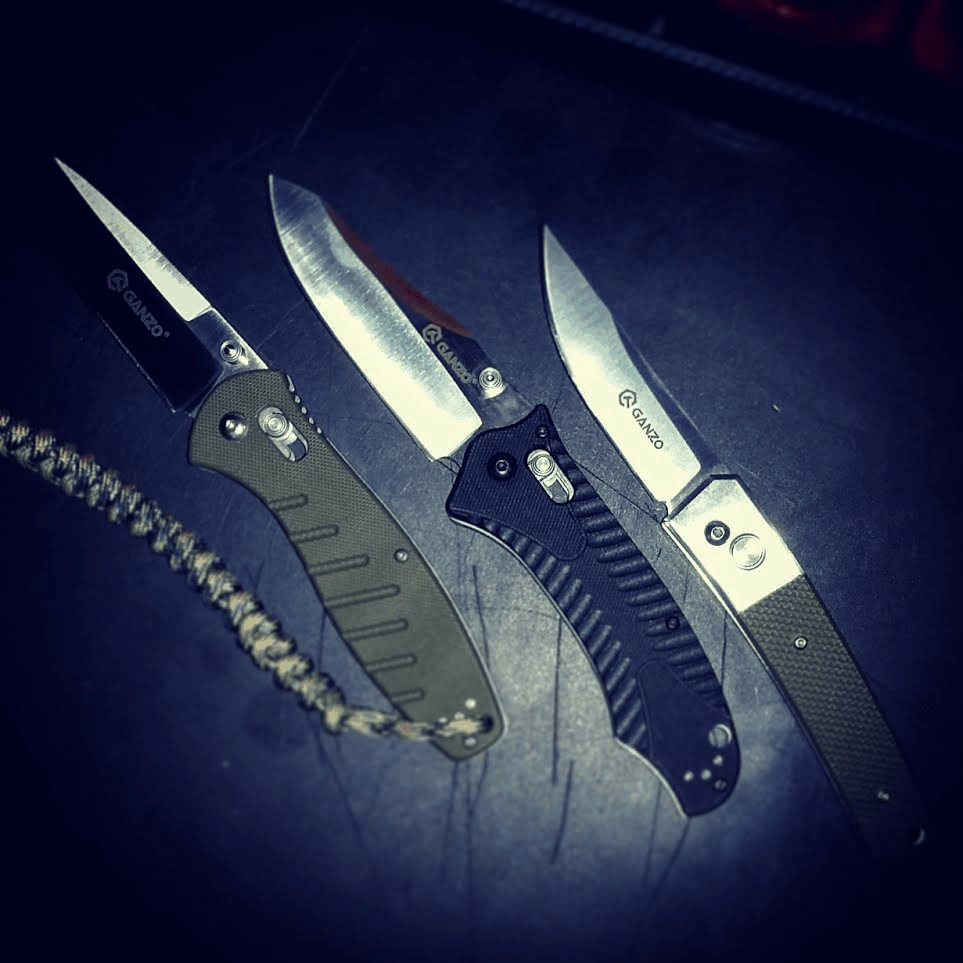
knives-budget-Ganzo

7. Lastly the spine, these blades do not have a 90-degree spine, however, with a hand file you can quickly put one on and even the stainless model with throw sparks from a Ferro rod!
Ganzo Folding Knives – A Chinese manufacturer of folding knives that has grown in popularity and is very well made using solid steel and well fit parts for a low price.

1.  Again there are several models; they have automatic folders, flippers, frame locks and the much talked about the Chinese version of Benchmade’s famous Axis Lock. For the purists, I have several Benchmade knives and love them all.

The axis lock that is being used on the Ganzo is nothing like the lock Benchmade originated. The design is similar, however, it is not as smooth or easy to use.

2. The blade material is 440C stainless steel, with the plethora of modern super steels and machinist designed blades in existence this steel has lost ground. However, for those of us who understand the purpose of a folding knife and tend to use it for that, buying one or more of these for $13-$31 apiece versus a Spyderco, Benchmade or high-end Kershaw at $100-$1200 apiece is the intelligent approach.

3. I tested several models including one auto version, my favorites are the G738 and G724 and lastly the G7212 (auto) model. They come quite sharp, hold an edge as well as most of the other high-end comparable size, styles available and easily take an edge or retouching if needed.

4. I have destruction tested these as well, nearly cutting my thumb off with one test (it was the Spyderco that failed) where I was testing lock strength. I carry one of the above three as my daily user in my left pocket; my right pocket has a defensive styled folder (Fox Karambit, Benchmade Emerson CQC7, Spyderco Paramilitary) and carry this way every day.

5. They are worth the money and easily among my favorite carry knives these days.
Lastly the large bush crafting blade – my first choice (non-khukri style or blade) is Ontario Knives of the USA. You can get a well-made machete, large butcher knife or the Ka-Bar made by Ontario and all of the above will fit well in the large blade category.

1. I highly recommend any of their machete styles though I am personally a fan of the Parang style for its cutting ability.

2.  The butcher knife is a 7” blade length, inexpensive handle, and no sheath though the ka-bar styled sheath will fit it easily and can be found for under $10 on Amazon. The knife itself runs $10-$12 on Amazon and is worth every penny. You can chop with it and do all sorts of things with it, it is inexpensive enough that even if it breaks (the handle is not attached well) you lose nothing and can try your skills at re-handling.

3.  The Ka-Bar well, it has proven itself as a fighter and for many, myself included as a large bush crafting blade as well.

4.  The steel most commonly used by Ontario Knives is 1095 high carbon which is treated properly, takes and holds an edge well, though I do have my blades chip regularly. (Easily fixed, but still something to consider)

So there is three of my favorite low budget bush crafting knives for your consumption. What say you? Which do you like and why? And remember, this is low budget, not bad knives simply under $100 bucks for the three types of knives every bush crafter should have (to begin with).

Written by Jesse Mathewson · Categorized: Knives and Blades

Jun 11 2019

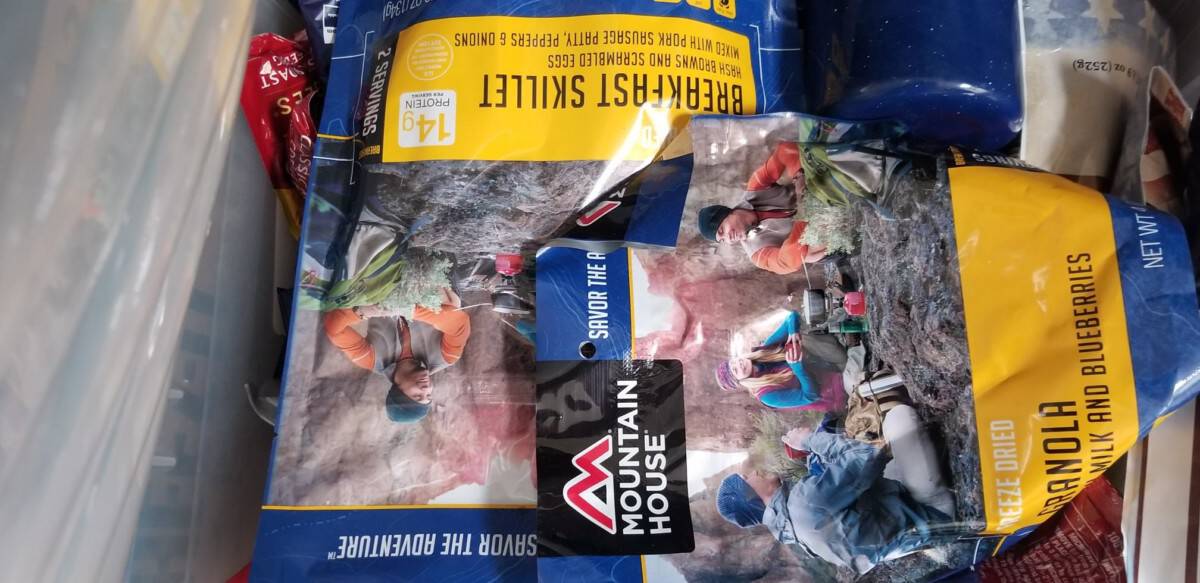
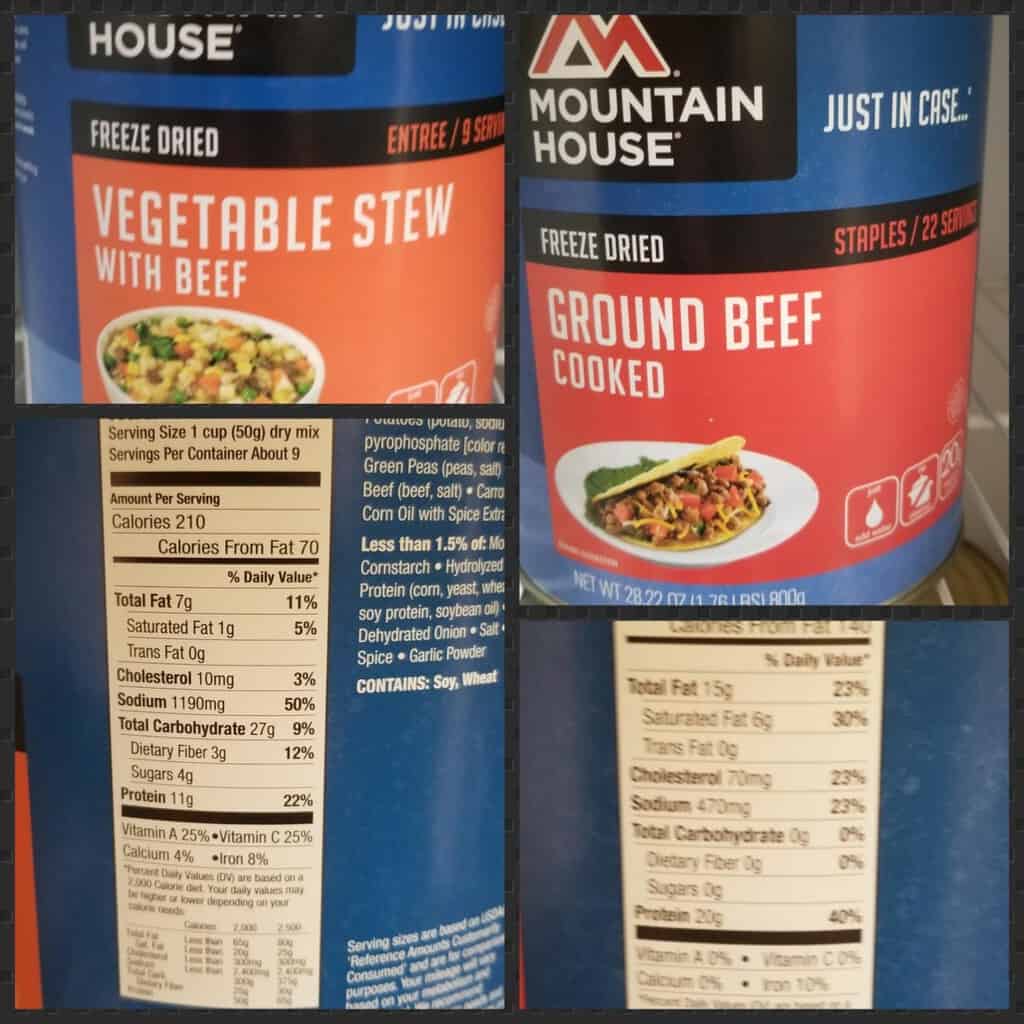
Mountain House Classic Assortment Bucket Review

Mountain House Bucket From Amazon.com

Over the last few decades, I have been more invested in long-term supplies for survival and prepping. After all the evidence shows that it is not a matter of if an event will occur but rather when. By event I mean; flooding, wildfire, home fire, windstorms, hurricanes, earthquakes, mudslides and even the dreaded fabled collapse of our current society. ¹ Now it should be noted that I have invested many thousands of dollars over the years in long-term storage foods, specifically Mountain House. I was contacted to review Mountain House brand foods and sent two packages of food recently. So this review is a mixture of paid and not, the latter being far greater in quantity.

Facts and data, regardless of what we want to believe facts and raw data is always what it is. It is only when we interpret these things that they become “evil or good”. My goal with the reviews I have done is simply to interpret the data and facts I have regarding products I use and either like or dislike.

Mountain House brand foods are hands down the best I have personally tested.

It should be noted that I have tasted and tested several other brands as well, from Wise through Augason Farms and have always come back to Mountain House foods for my personal and family use.

So why do I choose Mountain House foods for my family and self,

  • Ease of preparation (each container is effectively its own serving or dinner dish just add hot or cold water and mix)
  • All of their products are peanut free in fact, entirely nut free (except for coconut which is an ingredient in some meals)
  • Mountain house offers a vegetarian menu as well!
  • Each meal is set up to provide a maximum amount of beneficial calories for the ACTIVE individual, if you are eating these while hiking, camping, and “surviving” they will be quite healthy for you!
  • Cost per meal is actually very good considering what it is you are buying and getting as a benefit!

What are the drawbacks of Mountain House foods and other similar freeze dried meals and long-term food options?

  • High in carbohydrates, unless you are active I would not suggest eating these as a regular meal!
  • Cost per meal is around 50% to 100% higher than meals you could prepare yourself depending on where you shop.

Why do I prefer Mountain House foods over the others, it is simple for me personally. Some of the others do not offer REAL MEAT in their meals, Mountain House does. Taste is also an extremely large concern as well as serving size and amount per sealed container.

I have a family of four with between 2 and 4 other people always joining us. Other manufacturers make much smaller size portions, Mountain House packages full meals for 2 – 4 people per package and the overall package size is still similar to the sizes offered by their competition. Taste of these is considerably better in my opinion than Wise foods for instance. While I carry spices and at a minimum salt and pepper, I prefer to not season my pre-packaged survival/ camping foods.

As with Augason Farms, the large cans of food from Mountain House must be used within a week to 2 weeks after opening. For myself this is never an issue as again, we have 4 – 8 people at all times in and around our house and or campsite! If you are an individual or person preparing for yourself and one other the smaller meal packages will be your best approach to long-term storage and use.

They are easy to use and work well for one or two people! I find that when camping (and yes I have tested and tasted many brands while camping and while at home) Mountain House individual meal packages work great for me and my daughter. We rarely need more in a single sitting meal. As we are relatively active, for instance, we have learned gold panning, trapping, shelter building and much more on our expeditions, higher carbohydrates do not pose a great issue. Again, I would not suggest eating these if you are sedentary (not extremely mobile or active).

Would I recommend these to my friends and family?

Absolutely and without reservations, I highly recommend purchasing one of their Classic Buckets for one person which will work great for two people for 36 to 48 hours if you stretch it. The bucket runs $77 on Amazon and I personally purchase one every 3 or 4 months to continue adding to my selection and replenish used materials. Use my personal approach as someone on a fixed income for prepping your homestead!

Also, be sure to take a close look at the “Recommendations Page” for M.D. Creekmore’s most recommended items and gear…

Free the mind and the body will follow!

¹ Letzter, R. (2016, August 29). This is what it looks like when society collapses. Retrieved from http://www.businessinsider.com/what-happens-society-collapses-2016-8

BJ Campbell. (2018, June 08). The Surprisingly Solid Mathematical Case of the Tin Foil Hat Gun Prepper. Retrieved from https://medium.com/s/story/the-surprisingly-solid-mathematical-case-of-the-tin-foil-hat-gun-prepper-15fce7d10437

Written by Jesse Mathewson · Categorized: Gear Reviews

Nov 11 2018

What Is The Best Home Defense Weapon That Isn’t A Gun?


Open-ended questions like these are often answered using personal experience or second-hand chatter. What is often ignored are the actual studies and verified results coming from these studies. For instance in the United States did you know that while Bear Spray (somewhat more elevated approach to pepper spray) works very well on animal encounters while similar products are less likely to have an immediate stopping effect on humans? (Smith, et al. 2006) (Vesaluoma, et al. 2000) Facts matter when it comes to self-defense of any type.

What I hope to give you with this article is a compilation of data that shows enough for you to make appropriate decisions regarding your defense of self and family. The best defense is avoidance of potential harm through better life decisions and practices.

An indisputable reality is that those who seek war will find it, and those who seek peace will also find it. Lastly, training is inherently necessary with any form of defense and or tool used in said defense. Without training, any tool used in defense is as useful as a brick sitting on the ground. With the preaching out of the way, its time to look at what is the best non-firearm home defense weapon!

Non-firearm defensive implements take many forms. Some of the more popular are as follows, in no particular order.

  • Blades (knives, swords, and farm or working implements with blades)
  • Chemical repellents (oleoresin capsicum otherwise known as OC spray or pepper spray through hairspray and even ammonia in bottles as suggested by some misguided individuals.)
  • Taser-type devices (tasers, stun guns, cattle prods, and spring or air powered electric prong launchers)
  • Bludgeoning tools (bats both cricket and American ball bats, rocks, bricks, anything that can be held in your hand and used to bludgeon an animal or individual who may be attacking you)
  • Walking aids and support material (canes, walking sticks, umbrellas and or walkers etc.,)

When you are in the home what is your plan of defense and approach to safety? Do you have plans in place with alternative meeting locations for all individuals in your house and immediate family group? Do you know what you will do in case of a fire? Have you made plans and practiced them with regards to potential home invasion by armed assailants?

best-self-defense-weapons-that-not-a-gun

It has been established that armed home invasions while relatively small in number compared to other crimes are still a large enough risk that if you practice fire drills than you should also be practicing home invasion drills. It is essential to understand that there is no glory in battling from room to room with individuals regardless of situation when your family is also involved.

In fact, while it may seem a bit cowardly it is the more intelligent thing to avoid this and barricade yourselves into rooms resorting to using of armed defense only when directly threatened.

Obviously, if you live in a rural area and have no backup from emergency responders or neighbors within a reasonable distance and time frame, in this case, it would be important to have studied how to repel individuals intent on harming you and yours. It is still the best approach to barricade yourself and loved ones and defend from a secure position.

Hunting the intruders is pure Hollywood and will only get you or those you love harmed physically or otherwise. I for one would rather my children never have to take a human life or witness its occurrence. Use of less than lethal tools for defense allows for a solution that while not always immediately effective reduces these issues. It should be noted that firearms are not immediately effective either.

Use of bladed tools for defense is hotly contested by many countries and in many states within the United States. Regulations on length and type of bladed tool are important to know for your individual location.

Where I happen to reside blades are relatively unregulated and I am able to own virtually any type of bladed weapon and even use them in defensive situations. However, the same legal implications apply with the use of a bladed tool and a firearm as both are seen as deadly weapons in the eyes of the law regardless of where you live.

Be very careful about the laws and take the time to review recent cases where blades may have been used defensively in your residential area (country, state or social area).

Using a blade takes a substantial amount of training to be effective with, however, due to the alternative uses for blades as utility tools they can be easily carried, procured and kept around. With this one, I definitely suggest training from someone who has a proven background in use of these tools (i.e. Ghurka) or in the Filipino art of Arnis/Escrima/Kali or similar Filipino bladed martial art as these are widely considered the best for self-defense and modern combat approaches. (Wagner, 2014)(Alonso, 2010) There are several extremely solid schools where you can train over the course of a 2 or 4-day seminar and learn enough to practice and have a good footing for future use. As with all things related to personal safety continued training is an essential component.

Chemical repellents have been shown to be somewhat more effective when employed properly. Meaning directly to the eyes and face of the assailant or assailants. It should be noted that in many tests with products and individuals over the years these sprays have had less than stellar results, some uses ending in harm coming to the person using the spray due to it simply not working at the time.

There have also been deaths related to use of OC and other similar sprays. (U.S. Dept of Justice, 2003) There is a relatively high failure rate of the spray canisters themselves to function. These devices are not legal and are outright banned in many locations around the globe. I disagree with the reasoning behind these decisions made by governments, however, they exist so make sure you understand the local laws!


As for overall effectiveness, OC spray ends up being about 85% effective per several studies, when used properly. (Kaminski, Robert et al. 1999) I would suggest training with one and even being sprayed if possible so that you understand exactly how this spray works and can better use it or avoid the use of it when needed.

Lastly, make sure you get a solid version and do not settle for inexpensive knockoffs as this will simply lower the effectiveness with these tools.

These are tools that absolutely require a higher level of quality control from the factory and result in a higher price as well. One last consideration with these devices, OC spray regardless concentration can cause or significantly contribute to difficulty breathing which with already impaired individuals (asthmatics, obese individuals and similar) can and has lead to death as shown above.

SABRE Red is one of the most effective and is used by many police departments across the United States – check current price and availability at Amazon.com…

Taser devices work well in some scenarios also and do take somewhat less training to operate, though as with everything I do suggest practicing with your chosen tool. When it comes to taser type devices there are only a few types I can recommend as I have had numerous types used on myself and personally can attest that the vast majority of the low-cost noise makers hawked by unscrupulous individuals at local gun shows and even gun shops rarely function well.

The only versions I have used that functioned well every time contact was made are the Vipertek brand and Taser-brand stun guns. Vipertek is quite a bit less expensive than Taser with the trade-off being that Vipertek products require you to directly contact the assailant with the device while Taser offers this ability, as well as use as a standoff weapon through gas, propelled electrical leads. Both devices work quite well with human assailants when employed properly!

There are other brands out there, Sabre and Ruger both made forays into the stun gun market, my experiences with these are no different than my experience with off-brand versions. They are more gimmick than function in my strict opinion.

Stun guns may also result in unintentional death though the risk is relatively low compared to the overall use of said products. Again as with all other defensive tools, make sure you know the local rules and regulations attached. Good stun guns work well, again make sure you practice use of these and if possible test them on yourself so that you are able to better understand the effect. Practice, train and practice more!

Bludgeoning implements are the last segment we will look at for non-firearm based defensive tools. I will be including canes, walking sticks and umbrellas into this area simply because legally in some locations they are seen in the same light when used as a ‘weapon”.

Again with these make sure you know local laws, for instance in most areas around the world use of police batons and nun-chucks are banned for use as a defensive tool. However, some areas allow the use of expandable batons and other similar tools for defensive purposes. Again, you will want to have some training.

I highly recommend Filipino martial arts in this arena as they are unparalleled in the implementation of beneficial combative approaches utilizing batons and knives.

What is the best self-defense weapon that isn't a gun

There are several approaches to using a cane, walking stick and even your umbrella as a defensive tool as well. It is relatively easy with training to use the extra leverage a cane or stick can offer to gain the upper hand in a situation requiring self-defense.

There have been several news stories over the years of elderly women and men using canes and or purses to bludgeon their attackers forcing a retreat and defending themselves safely. As one of the individuals I worked with over the years stated, everything can be a weapon if you know where to use it best!

There are canes that are specifically made for the dual purpose of being used as a cane plus as a self-defense tool when needed like this BadAss Cane.

So to answer the original question, What is the best home defense weapon that isn’t a gun? There is no definitive best home defense weapon. Any self-defense instructor with personal integrity and ability will tell you something similar to what I will.

Use your head, avoid potentially dangerous situations and get training in solid, functional approach that allows you to best defend yourself. More importantly, remain aware of your surroundings and continually train yourself to recognize threats that may present themselves! If you have anything to add or comment on be sure to do so below in the comments!

Free the mind and the body will follow

Alonso, R. (2010). In the Stick of Things – INQUIRER.net, Philippine News for Filipinos. [online] Web.archive.org. Available at: https://web.archive.org/web/20100615170421/http://showbizandstyle.inquirer.net/sim/sim/view/20100612-275230/In-the-Stick-of-Things [Accessed 29 Jul. 2018].

Kaminski, Robert et al. (1999). Assessing the incapacitative effects of pepper spray during resistive encounters with the police. Policing: An International Journal of Police Strategies & Management. 22. 7-30. 10.1108/13639519910257801.

Smith, T. et al. (2006). Efficacy of Bear Deterrent Spray in Alaska. [online] Wdfw.wa.gov. Available at: https://wdfw.wa.gov/hunting/bear_cougar/bear/files/JWM_BearSprayAlaska.pdf [Accessed 29 Jul. 2018].

U.S. Dept of Justice (2003). The Effectiveness and Safety of Pepper Spray. [online] Ncjrs.gov. Available at: https://www.ncjrs.gov/pdffiles1/nij/195739.pdf [Accessed 29 Jul. 2018].

Vesaluoma, M. et al. (2000). Effects of Oleoresin Capsicum Pepper Spray on Human Corneal Morphology and Sensitivity. [online] Iovs.arvojournals.org. Available at: https://iovs.arvojournals.org/article.aspx?articleid=2123766 [Accessed 29 Jul. 2018].

Wagner, J. (2014). Filipino Kali is Alive and Well in Today’s Police and Military Training – USAdojo.com. [online] USAdojo.com. Available at: https://www.usadojo.com/filipino-kali-is-alive-and-well-in-todays-police-and-military-training/ [Accessed 29 Jul. 2018].

Written by Jesse Mathewson · Categorized: Security

Oct 12 2018

Best Solar Powered / Hand Crank Flashlights

Best flashlights

January 2016, a purchase was made of over 20 solar powered, crank powered and alternative powered handheld lights. These flashlights all underwent extensive testing. This testing included the following steps for my personal use.

1. Drop testing (from 4 feet and 6 feet using different angles and surfaces) – I live in the high desert, if they can’t handle being banged around a bit I cannot use them, regardless what it is.

2. Water survivability – just because I live in the high desert, does not mean things cannot or will not get wet! I use from several inches through 4 feet of water and leave the products submerged for several minutes through overnight depending on their rated survivability.

3. Overall durability/ quality– I always test multiple versions of the same product, like testing accuracy using a full magazine or expansion using 5 rounds minimum, etc., a test is only as good as the number of items used to ensure overall quality.

4. Battery life in use and stored – (this was originally going to be a year-long test, however, as of this writing only one flashlight has survived all testing and still retains a charge!)

The following lights were tested in full, using a minimum of two identical lights per test for each brand, maximum of four. (Donations always accepted, of course, this gets expensive!)

· MECO emergency hand-cranked/solar powered light. (Four lights were tested, I had two fail using cranks, and one crank snapped off after just two cranks, however, they were relatively bright.)

· Thorfire LED solar and hand cranked light. (Being an avid fan of Thorlight battery powered LED lights, I expected great things. Sadly, after testing just 2, I was quickly put in my place. Where they as a company have excelled at building strong, bright small pocket lights, their foray into alternative energy approaches and unfortunately leaves much to be desired. I didn’t have a light last longer than an hour with a full charge and had one crank break, maybe a pattern in cranking lights?)

· Bear Motion – motion powered light with solar backup/ radio and ports to charge other devices (I have never used a Bear Motion product, however, have owned several motion activated watches and really enjoy the idea. Sadly, the charge barely lasted out a week in both lights tested, and when on they gave me between 45 minutes and an hour of light. Also, drop testing shattered one into a thousand pieces, so a definite NO for this light, except as a possible addition for your vehicle?)

· ECEEN solar torch, with port for charging using usb – (My son took one to England, used it well and had it work quite nicely. Sadly, when charged fully it retains battery power for only around 3 days. This means without direct continuous sunlight you will eventually lose charge. I do not use this model in my packs and would not recommend it, my son, however, loves the light and since we live in a VERY sunny area, it will work for him for now. It is both water-resistant and relatively shockproof having been through multiple baggage handlers and the like and lasted fine!)

· Hybrid Solar – Solar powered flashlight with emergency battery backup(This light is the clear winner, and the rest of the review will go into detail as to why with pictures and video attached.)

The rest of this review will focus solely on the Hybrid Solar, solar powered flashlight with emergency battery backup. First I want to review the factory specifications with you.

  • a. Recharges with any light source
  • b. 8 hours of light from one full charge
  • c. Holds a charge for up to 3 years
  • d. Water resistant to 3 meters
  • e. 40 lumens
  • f. 72 meter light beam
  • g. Floats

h. 3 click operation, one click is solar battery/charge light source, two clicks puts it in charge mode, three clicks puts it in backup battery mode

Now it’s my turn based on testing 4 identical lights from this manufacturer.

· It will charge if there is any ambient light in the room, however, full sunlight will charge it in under 3 hrs.

· My max life of light on solar powered side, without battery backup was 6.5 hours approximately, (plus or minus a minute or two) the minimum life was 5.5 hours (plus or minus a minute or two) I was never able to get a full 8 hours, however, I have never had a flashlight that met fully this particular claim regardless.

· As of right now I have one that I charged put through testing and charged again that has been sitting since the 20th of January of this year in a closet with no light, every week I test it just to see if it still lights up, so far it continues, NONE of the other lights tested lasted over a month.

· Because it DOES float, I had to hold it under water, which I did before and after drop testing. Without ANY ill effects and this was on all four being tested. One light I used in a pools deep end of 10 feet and had no problems, I have seen reviews from others that this is a light they used for snorkeling and took it to 40+ feet without any ill effects.

· The 40 lumens are closer to 100 for the first hour or so- however, again this averages out to 40 over the entire length of life lit. It is quite bright and while it cannot come close to my sun like de.Power 1000 lumen lights or an expensive 4000 lumen LED spotlight I have, it functions extremely well for the purposes it is designed. As a survival/ lightweight/ backpacking light!

· Measured beam averaged 70 meters, so this claim from the manufacturer is correct.

· I have used the clicker on one light specifically every day several times a day since purchasing and have had no failures, this was a weak point in a few other lights.

· There were no specific claims to drop testing, though they stated it was durable, my testing dropped it sideways and end over end onto concrete, gravel, dirt and tile. I had no major breakages and only one minor scuff mark on one flashlight as a result. While I would not use it as a baton, it is after all made entirely of polymers, I would not hesitate to rely on it while mountain climbing at this time.

· There is very little information about the power sources for this light, I am not even sure if you can replace the backup battery. However, from what I gather and can tell after breaking one down completely, the solar cells charge a capacitor style bank which stores the initial charge. The backup battery has the average shelf life of most batteries of 7 years and once it’s used up can be changed, using two CR2032 3v button cell. However, I did not test this feature, simply because I did not need too as the solar side/capacitors continue to work very well!

· The factory does not state the weight of this flashlight, so I weighed it myself, as weight is of course always an issue! It came out to right at 6 ounces.

· My children and wife both LOVED this light, and as a result, we are replacing all of our go bag/ vehicle lights with this light.

· Temperatures that it safely operates at, I left one of mine in the sunlight on the dashboard of my 4 Runner Sport in Tucson, Arizona since January. Quite literally it took temperatures from freezing through close to 150 degrees (inside the car) and didn’t waver for second, the polymer build means it will not necessarily burn your hands if you pick it up from being in the sun charging, versus other models which use aluminum casings meaning they get quite a bit hotter.

Best flashlights

In conclusion, it is my educated opinion based on extreme testing that the Hybrid Solar flashlight (40-lumen model) is the overall best solar/ alternative energy powered light available at this time. Amazon carries these at a great price of under $20 apiece. Given the lack of need to change batteries, or bulbs due to the LED setup, this is an absolutely amazing price and because it weighs about half as much as most battery powered lights of the same size, carrying two would not be a bad thing and would essentially double your ability for the same weight requirements.

This light also comes in 120-lumen model as well, which is quite a bit brighter, however, again, for the weight savings and pricing, the 40-lumen model is sufficient in every way.

If you have any questions or would like to add your experiences, please feel free to do so. And as always, free the mind and the body will follow.

Jesse Mathewson bio:

  • BSCJA / Alpha Phi Sigma
  • Massad Ayoob graduate
  • Multiple advanced firearms schools
  • NRA range safety instructor

Currently volunteers time writing reviews and educational articles based on his experience and background, as well as being a disabled father at home.

He taught LE/Mil/Fed programs ranging from firearms safety through active use as well as surveillance/counter-surveillance as paid contractor and volunteer instructor

He has lived in and immersed himself in the Arizona high desert for over 25 years, experienced bushcrafter with extensive knowledge both taught and learned in the state/le/mil approach to the same.

Is an active non-voting, freedom loving, non-religious (in normal sense) human being with a desire to share freedom through knowledge with others

Written by Jesse Mathewson · Categorized: Gear Reviews

Oct 10 2018

Inexpensive Bows for Hunting, Bushcraft, and Survival

Recurve BOW for hunting“Immerse yourself in the outdoor experience. It will cleanse your soul and make you a better person.” Fred Bear
“Nothing clears a troubled mind better than shooting a bow.” Fred Bear

For thousands of years, archery has been utilized as a tool for hunting, defense and waging war. It is the one tool that has seen the littlest real advancements and yet remains solidly on the forefront for sports-related sales and use around the world.

Sure, we now have mechanically driven bows, special wheels and different styles of shooting, however, the basics remain the same. A “stick” a “string” and another “stick” combined to create one of the most historically terrifying and relevant tools of all time.

Obviously, I am simplifying things to say the above, however, using pure reasoning, one can see this being a true statement in a general way.

I grew up shooting rifles, handguns, using knives and bows and arrows. It was part of the tradition of the rural American to have this knowledge when I was a child, these days people will call you negligent to teach your children these arts…and yet, I firmly believe the opposite is true.

For safeties sake alone, knowledge of these tools is essential. So let’s get on with the review of the Sammick Sage takedown bow as well as the Sososhoot Buffalo style horsebow.

Takedown bows are superbly beneficial for individuals with space restricted, my Sammick Sage bow in its taken down configuration with two dozen arrows can fit inside of a 30” by 18” package and is less than “4 inches thick. I can easily fit string wax, spare strings, spare fletches and materials for building or repairing arrows and bow as well inside this package and it will be under 10 lbs.

shooting a recurve bow more accurately

While I do not use a bow stringer, some recommend this and it is beneficial for most. In fact, I should get one, if simply to extend the life of my bows. The horsebows are under 48” unstrung and strung and are about 2lbs lighter than the Sammick Sage package, with other measurements remaining the same.

The horsebows cost between $120 and $165 dollars depending on draw weight, on Amazon, this is something you should make sure you get correct. (Buffalo Hunting Bow and Arrow Handmade Recurve Horsebow Longbow for Adults By Sososhoot) A bow with 30-65lb draw weight will work to take medium game (deer etc.,) 40-120lbs will easily take much larger game.

I have read stories of people with 45lb draw weights taking elephants so, don’t feel the need to be overly manly when choosing the bow you will use. You should be able to shoot 4-8 flights of arrows and not be sore afterward. These bows are shipped from China, I own two currently and have purchased several as gifts, the shipping time is within 2 weeks generally.

The Sammick Sage recurve take down bow runs between $126 and $200 on Amazon, these you can get within two days if you have Amazon Prime or a week without. They are absolutely worth every single penny and I have yet to have one fail or be a problem. Both companies are quite good about communicating and will work with you, yes, even and especially the Chinese company, Sososhoot.

The arrows I use range from Easton Aluminum through my cedar shafted wooden, turkey fletched favorites. (Huntingdoor Black Feather wooden arrows 30” length, tri tip bodkin style iron tip) Again, I have found the best pricing to be on Amazon and shipped from China by the same manufacturer. I use the 3 sided 150-grain bodkin style tips and truly love them, they puncture well, cause rapid exsanguination, (internal bleeding leading to death) and are reusable.

For practice, I use the 150-grain field points or have made my own stumping arrows, “stumping is shooting small grass clumps/ wood stumps with flat tipped, or cloth wrapped arrows for practice as you are walking about the woods.” I have had two pass through shots at 35 feet and one at approximately 70 feet on Javelina. Upon inspection after death, one of the arrows had pierced a shoulder bone and gone through it.

Understand that unless you have a serious set up with a dozen straw bales and styrofoam backstops, you will lose arrows during practice. Its the cost of archery, arrows are not cheap, HOWEVER, they are reusable and for myself at least I find that having 4 – 6 flights per bow is satisfactory and keeps the package weight under what I can carry with physical problems.

This being said, as the old saying goes, one can NEVER have too much ammunition…so remember that. Unlike firearms, high capacity magazines and the like archery should be available and or can be made from materials close at hand.

Now for the meat and potatoes of the review of these bows. It is essential to understand these are low cost, but NOT low-quality bows and arrows. They are worth every penny and then some. I have owned PSE bows, Bear bows and collectibles from several renowned boyers.

I prefer these bows simply because I am not afraid to bang them about a bit as they didn’t cost me $500+ as almost every major manufactures bow for adults will end up costing.

The pros of these bows.

Cost, they are quite simply the most cost-effective approach outside of making your own, which is a skill you would be better for learning.

Longevity, I have been using one of the horsebows and a Sammick Sage takedown for over three years and shoot 3-4 times a week in my backyard, 4 straw bales, a sheet of half inch plywood and a $60 Field Logic Classic Block black and white target has worked well for 4 years now, and this is in Arizona sun, rain and more.

You can easily purchase an inexpensive $15 or $20 foam and plastic block target from Walmart as well. Or, stuff a medium size box (24” by 24” cubed at a minimum) with crumpled up newspaper and this will also work.

Quality, again, after owning many different bows, I have not realized any real major loss in quality purchasing and using these versus the name brand ones that cost two or three times as much on average.

They work, are easy to take down and or are extremely lightweight, being made of wood laminated with fiberglass for the horsebows and coated with faux snakeskin for a fun look!
The cons, very few but there are cons!

They are inexpensive bows, you may have one that misses quality controls and need to return/ both companies allow for this and have solid customer service via email.
You will want to purchase spare strings, the strings that come with the bows are not the best.

girl-with-bow

They work fine for quite a while, but they are definitely a lower quality, thankfully you can purchase strings from Trad Gear on Amazon, B-50 Dacron 16 strand strings run around $7 apiece. Wait till you get the horsebows before purchasing new strings, this way you can measure the string that comes with it. These bows sometimes vary as much as an inch either way as they are handmade.

The Sammick Sage has proper measurements available when you purchase them.

The horsebows do NOT have arrow rests on the bow or a place for one, the entire purpose of these bows is to shoot them from all angles, different sides and positions, literally shooting a horsebow is VERY different than shooting a standard recurve or longbow.

But, they are designed for strength and the ability to be shot from horseback without getting in the way of riding the horse, the Mongols, plains Indians and more used similar bows and did so with great, deadly efficiency.

That’s it, all I can say is, practice daily, it really is a great workout and has helped me strengthen my core which is essential with a bad back. Besides, it is also quiet, deadly and something discounted by governments around the world as a threat.

Understanding this places you ahead of them in the eternal battle for our individual freedom. While they may kick your doors in for your guns…they won’t look twice at the bows.

Comment, ask questions and please add knowledge. It is essential to our growth as a pack. Free the mind and the body will follow.

Written by Jesse Mathewson · Categorized: Archery

  • Page 1
  • Page 2
  • Page 3
  • Page 4
  • Go to Next Page »

Primary Sidebar

About Me

Subscribe to Blog via Email

Enter your email address to subscribe to this blog and receive notifications of new posts by email.

Join 7,184 other subscribers
  • Amazon
  • Facebook
  • Substack
  • Twitter
  • YouTube

A prudent man foresees danger and takes precautions. The simpleton goes blindly on and suffers the consequences.
Proverbs 27:12

Footer

DISCLAIMER

This website is for informational and educational purposes only.
I’m not a financial advisor, medical professional, or legal expert.

Everything shared here is based on personal experience, research, and opinion.
Use your own judgment and do your own research before making decisions.

  • Blog
  • Books
  • Newsletter
  • Gear I Use
  • About
  • Contact
  • Privacy Policy

© 2008–2025 M.D. Creekmore · As an Amazon Associate, I earn from qualifying purchases.