• Skip to main content
  • Skip to secondary navigation
  • Skip to primary sidebar
  • Skip to footer

M.D. CREEKMORE

  • Blog
  • Books
  • Newsletter
  • Gear I Use
  • About
  • Contact
  • Facebook
  • YouTube
  • Blog
  • Books
  • Newsletter
  • Gear I Use
  • About
  • Contact
  • Privacy Policy
You are here: Home / Archives for Gear Reviews

Gear Reviews

Here is where you will find product reviews of gear and tools for the homestead.

Review: Slime Self-Sealing Tube for Bicycles

July 9, 2018 Jesse Mathewson


Here in Arizona, we enjoy bicycling, we also enjoy one of the densest populations of spiny flora on the planet. This combination is absolutely terrible for bicycle tubes. This is a review of one product I have found for my bicycle that works quite well and allows us to maintain pressure even when we encounter the inevitable patch of cacti or mesquite laying across a pathway. As with most of my reviews this product was purchased by myself and has been tested for several years with my children and self.

First, let’s get the downside out of the way, these tubes cost on average $15 for two depending on size, we as a family have 26” x 1.75-2.25 tires on our bicycles. We chose mountain and beach style cruisers over road bikes for several reasons, the largest being the lack of maintained roads in many places where we regularly travel. Using M.D. Creekmore Amazon link you can find them here! Now, if you are a regular bicyclist you will know that these tubes are actually not that expensive when you look at what you are getting in return.

Extended use alone makes these a valuable investment. They are not great for road bikes or competitive bicyclists simply because they are heavier and can seem unwieldy after installation. Personally, I have never noticed balance changes. While they are somewhat heavier again, the benefits outweigh these perceived negatives. The company warranties them for up to 2 years after installation. Honestly, I can say that prior to using these I was spending $5-9 every other month on new tires, even with patch kits, which can still be used on these if necessary. Given the sheer amount of unseen thorny threats, these have paid for themselves several times over.

We keep a full set available at all times just in case, and I have a full sized 200psi hand pump that will work in a pinch for vehicle tires as well. I also have a small hand pump and toolkit with patches that sits next to the small trauma kit under my bicycle seat. I should mention I got all of our bicycles for little or no money, two were purchased from local pawn stores for under $30 after a little elbow grease both work great and two others were either gifts or were added on by others in trade. So if you ever see our family riding “designer” bicycles, remember, “designer” can be had for far under new pricing if you are willing to look!

I can highly recommend Slime Self-Sealing Tubes for your bicycles! We enjoy them as a family and yes, I do ride a bicycle, after all, you have to stay in some type of physical shape and this is a lower impact approach.

Free the mind and the body will follow…

Related: 

  • Work Sharp Pocket Knife Sharpener: Weekly Product Review
  • Ten Amazing Book Related Life Hacks for the Modern Homesteader

Filed Under: Gear Reviews

Review: Darkest Days – How to Survive an EMP Attack to the Grid

June 25, 2018 Jesse Mathewson

lantern for emp

Personally, I tend to avoid conspiracies and doomsday predictions, because typically they are, fear-based attempts to drive an individual or groups agenda. At no point in history has any species lived longer than it should nor has any state or collection of states lasted forever. This said I was sent a copy of the book Darkest Days: how to survive an EMP attack to the grid (Link goes to Amazon.com) recently, my review of this book follows. What follows is my review.

Thirty-five pages of explanations regarding what EMPs are and why they pose a risk using solid scientific and mathematical validation were how the book began. As I read through each page I had flashbacks to the e-book Alive after the Fall by an individual who was so ashamed of their work that they did not even use their real name. Certainly, there is a modicum of truth to the idea that in today’s highly industrialized world there is a risk of both natural and manmade EMP related disasters.

However, as I pointed out in the review of Alive after the Fall, these risks are not nearly as disastrous as many would have you believe. In fact, modern electronics are made from less and less metal than ever before lending to their increased survivability during magnetic or EMP interference.

For instance, modern Solid-State Drives are virtually indestructible and have the potential for extremely long-term data storage as compared to the older magnetic drives in use with many lower-end computers. ¹

Next is the inevitable discussion regarding vehicles and the overall electric grid. The simple reality is that if a pulse occurs that is large enough to knock it all offline, your vehicle running is the least of your concerns. Rather, the infrastructure itself providing you with extra fuel is the more important issue at hand.

This means that regardless vehicle type and in fact in spite of in some case, for instance, older fuel-guzzling non-electronically guided vehicles will need more fuel than most of us will be able to store with any real hope of longevity. This leads to the review of the rest of the book, and the preparations the author suggests implementing overall.

Page 39 of the book begins with this interesting line, “Unfortunately, it has been proven that those with less income tend to not fare as well as those who took a little bit of time and money each month to prepare. It is understandable but ANY small thing you can do today will help get you prepared and improve your chances of survival.”

When you look only at statistics coming from densely populated, heavily industrialized, city-states in the last 100 years this is in fact correct. However, what the author conveniently fails to make mention of is the simple reality that through excessive use of force by the states involved those who had less and in every case, no ability to defend themselves were indeed less likely to fare well and rarely have.

You see the author like the author of the other similar tome recently reviewed tends to believe that government is infallible and necessary to the continued happy coexistence of society as a whole.

I would posit that government is at its best unnecessary while society or people as a whole are in fact at their worst still better than government at its very best. I am agreed with by many of the brightest non-socialist minds across history, from Thomas More in the 1500’s through Thomas Paine and onward the reality of collapse is first that it is inevitable and second that humanity can indeed function quite well without babysitters made up of selfish individuals interested in personal gain of power or money.

The benefits of this book lie in the prepping advice,

  • put away a little at a time and over time your supplies will build nicely
  • food, water, toiletries, medication and the like are areas that are specifically looked at first in the book
  • involving the family and having A meeting place is also beneficial goals, though as with everything I suggest more than one.
  • A rather quick blurb regarding protection is mentioned without specifics

After these basic beneficial mentions, the author goes right back into in-depth preparations for what they describe as an inevitable EMP event. I personally do have spare electronic devices such as pre-programmed hand-held radios and backed up data storage in EMP resistant protective approaches, the reality is I could afford the extra radios at the time and I always backup data!

Over the rest of the book, there is some relatively decent information with regards to setting up a variety of energy generating pieces of equipment. Unfortunately, I do not believe that this brief and rather incomplete information is worth paying money for the book. Where the book itself may have some redeeming qualities is in the add-ons that are given to the original purchaser of this book.

First is Unscathed Survival: how to come out untouched from 10 different scenarios, 73 pages of reading with a few areas that are simply not applicable and several others that are.

Among the applicable information is the preparations for and survival after of floods, earthquakes, and other natural disaster preparation is essential. Though it should be mentioned that these same preparations can be easily found on the Red Cross site for free.

Next is Off-grid Home Protection System, this one is interesting with several solid approaches mentioned that are sometimes overlooked. Again, I would say that the author failed to adequately follow through. I have known several persons who purchased and installed many security measures as mentioned here including livestock guarding dogs or LGDs as the author states.

However, like the author they failed to implement any real training around these items and to this day the dogs are little better than house dogs regardless their use of German phrasing for commands as none of the dogs was trained and as many have proven untrained dogs regardless breed are little more than a distraction to home invaders.

My personal recommendation is either well-trained protection dogs OR small dogs like terriers (link goes to Amazon.com and terrier training manual) and the like who will be quite noisy and give an alarm. Some having proven to actually be more willing to attack intruders when compared to larger dog breeds (when both are untrained). I do love the use of vegetation with stickers on it as deterrents.

Personally, as a high desert dweller, I love prickly pear and ocatillo cacti along the inside of my back and front walls. These are almost impenetrable and can be placed for a visual benefit, not to mention the food and medicinal benefit of both of these plants!

Lastly, we have the final addition, how to make your own pharmacy. Sadly, this particular booklet has no value outside of pointing out the potential benefits of herbal medicine. There is no real guidance into what and how to make up various medications from the herbs mentioned.

And NO, making a tea or tonic is not simple nor is it the only way. There are dozens of approaches to the application of herbal medicines and only a few right ways. This booklet does not explain those well.

Only two or three of the mentioned herb-based recipes actually go into detail and offer a somewhat solid approach. For anyone with no or little real experience with these things, this book could easily do more harm than good.

My overall impression is that the authors or author of this book series simply wishes to cash in on the hysteria embracing so many uninformed individuals today. I would definitely suggest avoiding the purchase of these books and any that use words like “guarantee” in the ads for them.

Rather spend your money on solid well put together books (link goes to Amazon.com) that are written by individuals who use their own names and have the credentials and experience to support their work. I will be reviewing a few more books over the next few weeks, and many of them will be positive reviews.

Free the mind and the body will follow…

¹     Introducing the SSD Endurance Experiment. (2018). Retrieved from https://techreport.com/review/24841/introducing-the-ssd-endurance-experiment

The SSD Endurance Experiment: They’re all dead. (2018). Retrieved from https://techreport.com/review/27909/the-ssd-endurance-experiment-theyre-all-dead

Also Read:

  • The Lost Ways – “A Guide to Real Life Homesteading and Survival Skills From Our Past That Work!”
  • How to Make Your Own Faraday Cage at Home (Quick, Easy, Effective!)
  • Herbal Medicine: Trends and Traditions, Et Al: weekly product review
  • Kephart by Condor Knife and Tool: weekly product review

Filed Under: Gear Reviews

Where There is No Doctor a Village Health Care Book: Weekly product review

June 11, 2018 Jesse Mathewson

where there is no doctor
Some reviews are simple to write, some are difficult. This is one of the simple ones, firstly I need to tell you that I purchased this book with the intention of adding to my library of medical knowledge. I did not receive it for free or in exchange for anything.

Some purchases can be seen through hindsight with eyes tinged with regret. This is one of those purchases. I purchased this book on Amazon for $27 including shipping. On the cover of the book and in the description it is promoted for the “villager/ pharmacist/ storekeeper/ teacher/ health worker/ mothers and midwives who live far from medical centers.”

Unfortunately, there are maybe only half the pages of the 445-page book that have applicable medical knowledge.

In fairness, there are several subjects broached that are extremely necessary for sub-third world nations or areas filled with people who believe using lollipops that have been dipped in open sores is a good approach for reducing potential chicken pox/ smallpox and other viral infections.

My real issues with this tome are how it was written and the language used most frequently which shows a disproportionate level of reliance on socialist life approaches. It should be noted that I do not see any government outside of self-governance or at most tribal approaches as a beneficial approach.

If the book had shown a disproportionate amount of “democratic/republican” leaning it would have received the same response from myself. I find that many items of interest in the book I agree with. Such as the statement, “if you can use what is best in modern medicine with what is best in traditional healing you are often better than using either alone” (quoting from memory so it may be a bit off).

Additionally, the insistence that we share knowledge eg., medical in nature adds to the potential that the book begins with. Where I believe it falls apart is its insistence on poor health being a direct result of an unfair distribution of land and wealth. While I am someone who lives daily in a system where my poverty is ignored by most others due to my being born “privileged” as a white male, even though I was also born with debilitating spinal conditions and even though I worked for decades with spinal conditions.

I still firmly believe that to better ourselves and our world we should instead focus on solutions which I promote individually through my writing reviews without charge and other one on one actions I take regularly without charge or profit personally. I share my extensive knowledge with people regularly and do so basically free of charge. This does not mean I am a socialist, communist nor does my rejection of these institutions and definitions mean I am a capitalist or otherwise. Rather it means I am a self-determining individual and this is my choice.

Additional direct critiques of the book are the use of imagery to associate firearms with deadly medicinal uses. (page w18) or (page 49). Additionally, they do not address the use of beneficial approaches such as the assessment of and stoppage of serious bleeds on extremities. (eg., use of tourniquet and or use of alternatives for a tourniquet when needed.) Instead, they chose to apply antiquated medical science to these issues. (page 90-91) and while it is not terrible, it is not in the best interests of anyone to follow outdated medical science when better-proven alternatives exist.

On page 116 the authors recommend avoiding meats and instead of growing a mixture of vegetables and groundnuts because animal-based food is ‘more expensive and less nutritious” than these grains, vegetables and nuts. In the very next paragraph, the author states the importance of raising chickens for food. There is an extreme cognitive dissonance with the authors given their supposed hands-on experience with villages in Mexico in the 90s’, I find their experience to be lacking especially in this area.

Unlike first world nations where the editor originated food is not often purchased from Walmart or Publix and is in fact raised, hunted, or otherwise gathered for the poorer individuals. While some nations have become completely dependent on foreign aid, eg., welfare states like Haiti, Nigeria et., al, there are many many others that still have a sense of self-ownership and desire to do for themselves. There are several dozen other minor and major issues I recognized and I am not a doctor or even nurse.

It should be noted further that there are many very good ideas and approaches noted within the book. Some of the wonderful ideas are regarding clean living, specifically avoiding mixing ones pets or food animals with ones home life, (something we Americans are sadly repeating with our current legislation supporting animals in eating establishments). I should note that it is the overall approach promoted sometimes subtly and other times overtly that drives me to say this is not, in fact, a beneficial book for the homesteader.

I do not, however, believe these outweigh the issues within the book and if the authors or editors happen to read this article would gladly assist with editing future editions at little or no cost simply to help others in the future.

My final recommendation for this is simple. Save your money and purchase one of the other fine medical books available. Several which I have reviewed in the past and some which I will be reviewing soon here. If you have questions or suggestions please make them below. I cannot learn without knowledge from others and through self-reflection.

Note: You can download this book and others for free here.


Free the mind and the body will follow…

Filed Under: Gear Reviews, Health and Fitness, Uncategorized

Work Sharp Pocket Knife Sharpener Review

May 28, 2018 Jesse Mathewson

work sharp

I am a fan of Work Sharp products, owning several and having purchased a few for gifts and various applications over time. In this case the Pocket Knife Sharpener is a brand new product that WorkSharp decided to allow me to test! So in this case, I did receive a product (that I will be buying more of) in exchange for a review. Please follow the links above for their website, this product is slated to be on the shelf by Fathers Day!

Work Sharp is an amazing brand name, well known in the knife building and sharpening industry. An American tool company founded in 1973 under the name Darex it is a business that has remained in the family for four generations. Matthew Bernard is the fourth generation family owner of the corporation. The brands under this name are Darex industrial bit sharpeners, Drill Doctor professional and DIY drill bit sharpeners and my personal favorite the Work Sharp line of knife and tool sharpeners.

Not only does Work Sharp (Darex) design and engineer their equipment in-house, they also manufacture it entirely under the same roof. Located in Jackson County, Oregon; it is based in a town of approximately 21,000 people called Ashland. Having been through that area I can say it is an absolutely beautiful place with hard-working individuals who remember the American work ethic. Makes sense as to why they chose this as their location after founding the company in Illinois, guess you could say the founders were truly forward thinkers in 1978 when they made the move out west!

worksharpWhen I first received the Work Sharp Pocket Knife Sharpener I was hesitant, honestly, it would be difficult for them to beat the Guided Field Sharpener I own and love. After grabbing some of my knives and the new sharpener I set to work and was quickly blown away by the ease of use and performance in such a small package. I sharpened inexpensive blades and some of my more expensive ones as well. It easily allowed for quick honing and full sharpening for everything from my Morakniv blades, Schrade multi-blade pocket knife to my skinning blades and the Husqvarna camp ax that has seen me through a few cold camping trips.

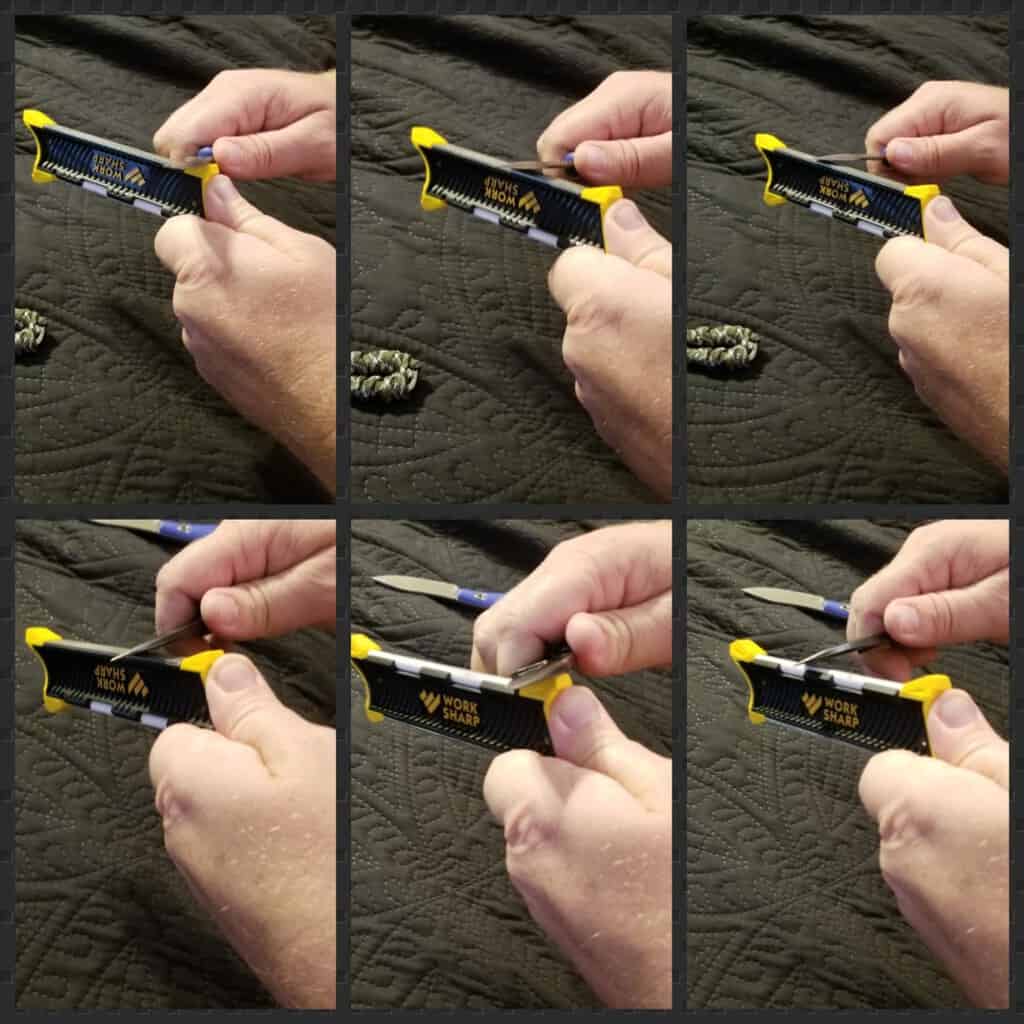
worksharp photoThere are a few ways to hold the Pocket Knife Sharpener as you can see in the pictures the design allows for ease of use regardless choice in holding it. I would suggest ensuring your fingers are clear of the blade when you begin sharpening. Additionally, remember that you do not want to use excessive force when sharpening. In most cases allow the weight of the knife and a small added pressure do the work for you. The instructions say to use 10 strokes on each side of the edge and each side of the sharpener. With a few of my blades I needed to do 20 or 30 strokes and it should be noted that if you do not have to do NOT use the rough grit diamond plate side relying on a quick touch up with the ceramic rod only.

Overall this is a great product and would shine in the field as a tool for hunters, fishermen and the like who need something smaller and lighter. It weighs maybe a third of the Guided Field Sharpener and will cost less than half! Here is a quick rundown of what is included with this sharpener.

  • 20-degree angle guide on a securely fastened 320 grit diamond plate (allowing for fixing of rough edges)
  • 25-degree angle guide on a fine ceramic rod (giving you a hair-splitting edge)
  • It has grippy soft rubber ends that make it easy to hold onto it regardless weather

This is a definite addition if you need something that is compact and works!

WorkSharp has this marked at $15 retail with a hold for sale at or around Fathers Day this year. Make sure to note the Work Sharp page on Amazon and check out their other amazing well-made tools! This tool gets two thumbs up with no hesitation and a definite nod towards those wanting to lighten their go bags or hunting kit! As always thanks for reading and if you have questions please do so!

worksharp photo final

Free the mind and the body will follow…

Filed Under: Gear Reviews

Kephart by Condor Knife and Tool Review

May 21, 2018 Jesse Mathewson

Legally I have to write a disclosure here, I purchased the Condor Kephart and did not receive anything in exchange for the following review.

It should be common knowledge by now, I have a serious steel addiction. My dad has built knives for most of my life, I also built a few and own several dozen at any given moment. When it comes to useful tools I am a firm believer in having a good knife around always! The Kephart by Condor Knife & Tool is one of my personal favorites when it comes to daily use. Originally it was designed by Horace Kephart author of Camping and Woodcraft one of the amazing books I own in print (and will be reviewing for you all soon).

It was during his time spent in the Great Smoky Mountains of North Carolina that he wrote Camping and Woodcraft and designed the Kephart blade. Around 3 years ago I read an article on this particular blade type and being an avid collector and user of good steel, decided to do some searching for one. Now it should be noted that I firmly believe in the value of a good blade, specifically the Morakniv line of knives. However, I am always looking for other blades that may fit different or similar roles and the Kephart is a blade that can do that!

Horace Kephart wrote. “A camper has use for a common-sense sheath-knife, sometimes for dressing big game, but oftener for such homely work as cutting sticks, slicing bacon, and frying “spuds.” On this I agree, it is rare that we will do more than the basic tasks with a knife and in fact, we are far more likely to engage in basic camp tasks for which this blade type is exquisitely designed. Horace goes on to say, “For such purposes, a rather thin, broad pointed blade is required, and it need not be over four or five inches long. Nothing is gained by a longer blade, and it would be in one’s way every time he sat down.”¹ I agree firmly with this as well, for general daily tasks a knife is better when it is thinner and not more than 5” in length. As with all blades, this is a purpose built knife. It is not built to be a military blade or fighting knife. The Condor Knife & Tool did an amazing job with their version!

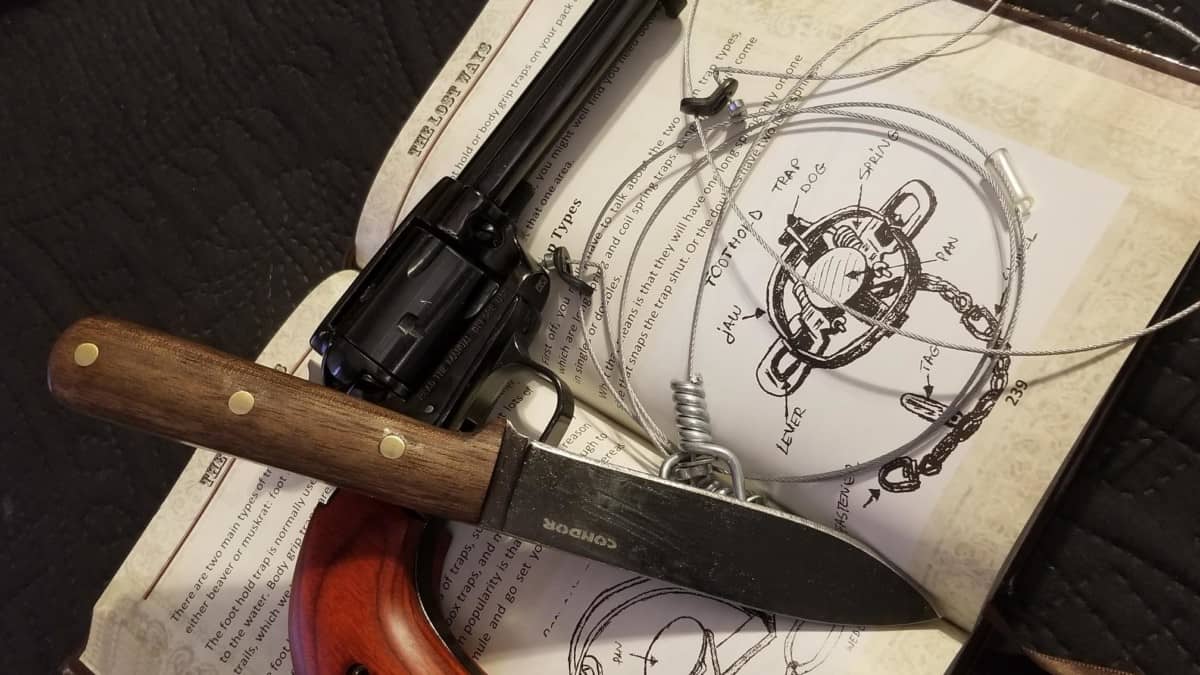
Here are the specifications for the Condor Kephart blade,

  • 1075 flat ground spear point carbon steel blade
  • a total length of 9 inches with a blade sitting at 4.5 inches this allows for a large handle
  • full tang and 1/8th inch wide it is 1 inch deep allowing for solid skinning ability
  • mine came with a hardwood grip and the typical well made leather sheath that Condor Knife & Tool supplies with their camp knives!
  • As with most Condor knives, it has a blued blade which helps prevent rust (though you should clean and oil it after use)

As with all Condor Knife & Tool blades I own it needs a little sharpening but is sharp (just not my preferred shaving sharp) from the factory. It has a good temper and retains an edge with general use. I enjoy the leather sheaths because I can use them to strop the blade lengthening the time between sharpening.

Testing included basic kitchen tasks and camp tasks as well as some more advanced approaches such as batoning for those who believe a knife should fill the role of camp ax. While I prefer to have a true camp ax or hatchet available, I appreciate the desire to consolidate tools and can easily do this with logs up through 3” in diameter. It easily split cured Mesquite which as the 4th or 5th hardest wood in the United States and will quickly show the weakness of a blade or tool. It excelled at slicing and dicing as well as skinning tasks while maintaining a working edge through much of the work. I will say that for some tasks I definitely prefer my Morakniv and the mora grind, it is finer and easier to use for in close fillet work and kitchen tasks. This being said, I was still able to use the Condor Kephart quite well for all of the above. I would put its strength and durability as on par with the Morakniv Craftline HD or Companion HD or Morakniv Kansbol or the Morakniv Bushcraft knives (all of which I own and LOVE).

This knife is a definite addition as a style and from Condor Knife and Tool as well! Highly recommended two thumbs up and definitely 4 stars! As I said in my Amazon review the only reason I gave it 4 stars over 5 is that it needed a better edge from the factory. This is a simple easily fixed item and per laws, in many countries and states, they cannot ship sharp blades anyhow! What we get in Arizona may be completely different than what you can get in New York or New Jersey. If you are looking for a solid camping blade this one does the trick!

Free the mind and the body will follow

¹ Kephart, H. (1988). Camping and Woodcraft: A handbook for vacation campers and for travelers in the wilderness. Knoxville: University of Tennessee Press.

If you liked this review then you might also like:

  • LifeCard® by TrailBlazer Firearms: Weekly Product Review
  • How To Put Together an Effective Patrol / Guard Duty Kit

Filed Under: Gear Reviews, Knives and Blades

Heritage Rough Rider .22 Revolver Review – Is It Any Good?

May 14, 2018 Jesse Mathewson

Heritage Rough Rider .22 LR Revolver Review

Everyone needs a .22lr firearm. Specifically, one that is accurate and reliable, the Heritage Rough Rider is an accurate, reliable handgun! Now before we get any further, the Heritage Rough Rider is a single action handgun that comes in several varieties and barrel lengths.

It will chamber the .22lr, .22 short and with a cylinder change .22wmr.

As with all single action handguns, accuracy is a matter of perspective and ability as well as understanding your individual firearm and ammunition combination. I originally purchased this handgun to have something that my son would enjoy.

[Note: If you’re looking for a nice Thumb Break type holster for the Heritage Rough Rider .22 LR Revolver then take a look at this one on Amazon.com! It’s a nice holster for the price.]

It is inexpensive running $136 after taxes from my local firearms dealer and easily $120-$145 depending on your location. This allowed for someone with limited funds to purchase a firearm without a large investment in the event it was not seen as a valuable addition to the family.

Heritage Manufacturing is held by parent company Taurus as of 2012. However the Heritage company has been building firearms since 1992, I first heard about them in 2004 when I was searching for a decent single action .22lr revolver.

They continued to pop up on the radar as an extremely affordable, reliable, accurate single action revolver for the hobbyist, trapper or individual who needs a solid 22lr handgun.

Now, this is not a Ruger Single Six or even an H&R trapper or similar, it is, however, quite a bit of gun for the money spent.

It comes in several variations, my personal favorite is the 6 shot 4.75” barrel. The other variations are the 6 shot 3.5” and 6.5” birds head grip, the 6 shot 4.75” and 6.5” standard colt peacemaker grip type in several colors and the 9 shot peacemaker styled setup.

All of these options have the added benefit of cylinder swaps too .22 magnum for those who need it. As an avid shooter and tester of firearms and ammunition I would say it is an unnecessary addition in a handgun, however, not everyone will agree regardless the data supporting my assertions regarding barrel length and .22 LR versus 22 magnum.

The handguns are built on aluminum alloy frames with solid steel barrels and springs. The ejector paddle is made of polymer. I would suggest after the first 100 or so rounds do a quick once over with some Winchester Gunsmith Tools or my favorite regularly used Wheeler Gunsmith Tools and some BLUE not red LocTite!

My handgun had no issues, however, the largest issue or complaint seen among other testers has been the loosening of the screws. (follow the directions sent with it and DO NOT remove the trigger/ hammer or main grip screws as it can get sticky putting things back!)

For those who care to know, the data shows that 22 LR and 22 magnum up too around 4 inches tend to run close in FPS for similar bullet weights. This being said, the benefit of having the added ability to swap cylinders is available and makes for a solid platform depending on personal taste and need.

For myself, the diminutive 22lr has proven itself numerous times with snakes, coyotes, javelina, feral Russian hogs and other small and medium critters that needed put down. This, of course, leads into accuracy as experienced by myself.

Heritage Rough Rider .22lr pistol review

Unfortunately, I only had a sample of one for this test. Regardless, taking my results and comparing them with a few dozen other reviews available I can say that you should be quite happy with the results overall.

If you know handguns and especially know single action revolvers with blade sights and no drift adjustable features you will understand that accuracy is a general thing. For instance, my kids and self-had no problem nailing spent shotgun shells at 10-25 feet while the wife had some adjustment issues and was able to quickly master the use of this fine handgun.

It does NOT aim like a modern handgun, there is some fair amount of Kentucky “windage” involved, however, that does not detract from the overall success of the test. There was a small need to adjust vertical hold, the windage, however, was spot on!

It grouped offhand into a 2” circle at 10 yards for test groups and it really does prefer 40 grn lead versus jacketed/ coated or larger or smaller rounds. The best groups were with Aguila Super Extra (blue box from LuckyGunner Ammo) and CCI 40 grn standard loads also found at LuckyGunner Ammo. Make sure to use the links if you need bulk ammunition!

We ran 500 rounds of CCI, Aguila, Federal Premium and Eley 22lr through the revolver had us all smiling by the time we called it a day. The net benefit of a single action revolver with a trap door feeding approach versus the swing arm seen in many modern revolvers tends to slow you down in shooting and 500 rounds take a substantially longer time than it would with a modern autoloader or even modern swing arm revolver.

I should mention again, it is a SINGLE ACTION ONLY revolver, it would not be my first selection for self-defense regardless of the caliber. It is plenty accurate enough for plinking, trap line running, small game disposal and hunting and range work or butcher work as needed. Now for the negatives!

Heritage Rough Rider .22lr pistol reviewed

It is NOT a trick shooting revolver, the cylinder will not spin freely it clicks solidly into each position and if you try to spin it you will end up breaking the gun. (honestly most firearms are not designed to replicate Hollywood stupid so please be careful!) Additionally, it is NOT designed to FAN the hammer for trick shooting. (see a trend here?)

It comes from the factory timed and tested by a master gunsmith who has been testing and adjusting single action revolvers for over a decade with Heritage Arms and has been in the business for many many years above that.

That is something I really liked about this handgun, it has truly impeccable timing and did not flutter even once, additionally, the mouth/throat of the barrel facing the cylinder has been designed to allow for small variances when they will inevitably occur. (I’ve never had a revolver that didn’t eventually have small timing issues and need the mainspring, trigger spring etc, replaced and tuned – of course in all cases except my Ruger GP101 this occurred post 15,000 rounds of hard use)

Overall I can recommend this revolver for the survival enthusiast, trapper, hunter, farmer, rancher, woodsman, bushcrafter, homesteader or avid backcountry living person. 500 rounds of your favorite 22lr and this handgun (and some minor cleaning supplies) and you will be set for a couple years maybe more if you stretch it.

The overall investment for my family day (test day) out with this revolver was $176 including the revolver BRAND NEW. I am investing in at least one more, and will likely get the Birdshead grip this time (it just looks cool!) This handgun is easy to maintain, easy to own and the best part is, it costs $450 less than the Ruger Single Six.

Heritage Rough Rider 22LR / 22 Magnum Review

Related:

  • LifeCard® by TrailBlazer Firearms: Weekly Product Review
  • The Prepper’s Bedside Home Defense Kit

If you have any questions or comments please let me know. Free the mind and the body will follow.

Filed Under: Gear Reviews

  • « Go to Previous Page
  • Page 1
  • Page 2
  • Page 3
  • Page 4
  • Page 5
  • Go to Next Page »

Primary Sidebar

Subscribe to Blog via Email

Enter your email address to subscribe to this blog and receive notifications of new posts by email.

Join 7,197 other subscribers
  • Amazon
  • Facebook
  • Substack
  • Twitter
  • YouTube

“Do more with less.”

– Minimalist proverb

Recent Posts

  • Just so you know
  • Weather Update for My Corner of Appalachia
  • Why I’m Ordering Ivermectin + Mebendazole Every Year
  • The Website’s Shutting Down (But Here’s the Plan)
  • You Are Hated! Start Training Like It!

Footer

Recent Posts

  • Just so you know
  • Weather Update for My Corner of Appalachia
  • Why I’m Ordering Ivermectin + Mebendazole Every Year
  • The Website’s Shutting Down (But Here’s the Plan)
  • You Are Hated! Start Training Like It!

More about me

Books I’ve written

Books I’ve read

Follow Me on YouTube

Follow Me on Facebook

Gear I Use and Recommend

Newsletter

Search this site

Follow me elsewhere

  • Amazon
  • Facebook
  • Substack
  • Twitter
  • YouTube

© 2008–2025 M.D. Creekmore · As an Amazon Associate, I earn from qualifying purchases.